Quick answer: A 12V block that reads a normal float voltage can still be failing. Voltage tells you the block is being held on charge; it does not tell you the block can deliver its rated power. Internal resistance trended against that same block over time is the reading that finds the weak unit, and the trend matters more than any single number. Published internal resistance for a healthy new Stryten Energy E-Series AGM block is 4.5 milliohms on the S12V325FL, 4.0 on the S12V370FL and 3.1 on the S12V539FL, but those are a sanity reference rather than a threshold: the block to look at is the one whose resistance has risen more than 50 percent above its own baseline, and a string is replaced as a set.
Key points
- Published internal resistance for a healthy new block is 4.5 milliohms on the S12V325FL, 4.0 on the S12V370FL and 3.1 on the S12V539FL. Short circuit current is 1640, 1900 and 3100 amps.
- Those are published values for a new block. They are a sanity reference, not a pass or fail threshold. The working method is each block trended against its own baseline, taken with the same instrument, established at about six months in service.
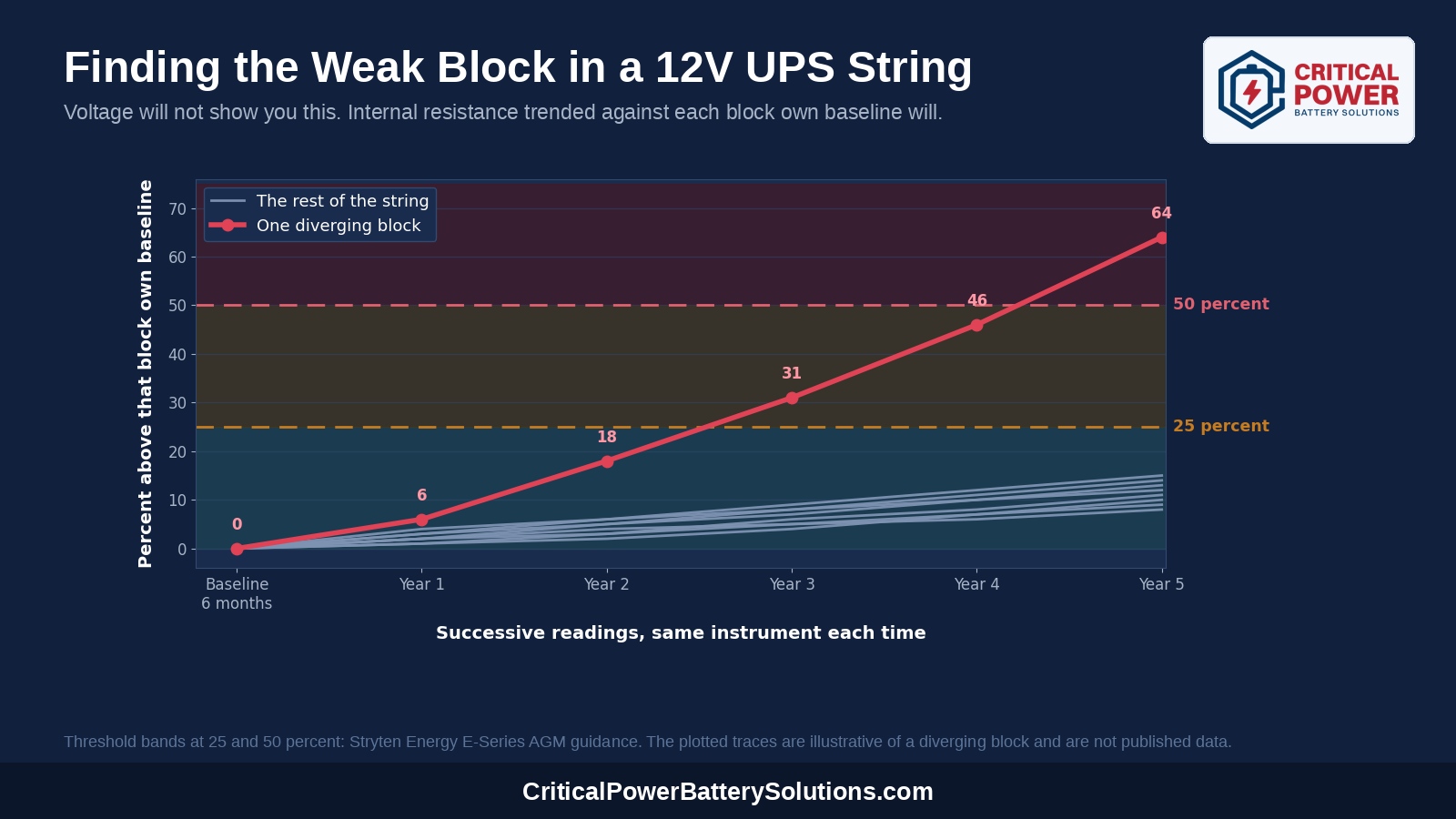
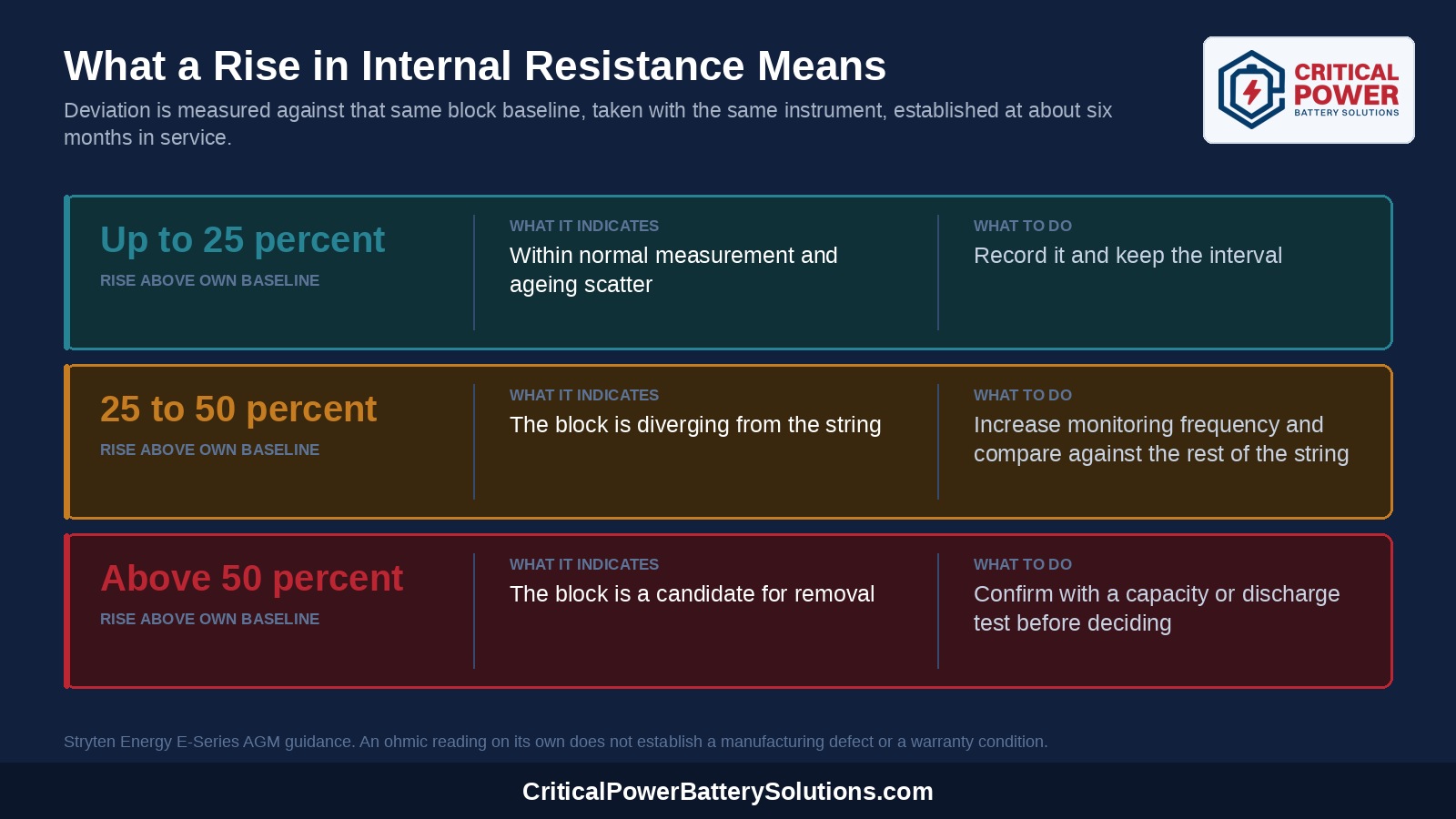
- A rise of up to 25 percent above that baseline sits inside normal measurement and ageing scatter. A rise of 25 to 50 percent means the block is diverging from the string. Above 50 percent the block is a candidate for removal, confirmed with a capacity or discharge test before deciding.
- The float charging window is 2.25 to 2.30 volts per cell on the AGM325 and the AGM370 and 2.25 to 2.35 volts per cell on the AGM539, with a temperature corrected minimum of 2.21 and a maximum of 2.40. Compensation is 5.5 mV per degree C per cell, which is 3 mV per degree F per cell.
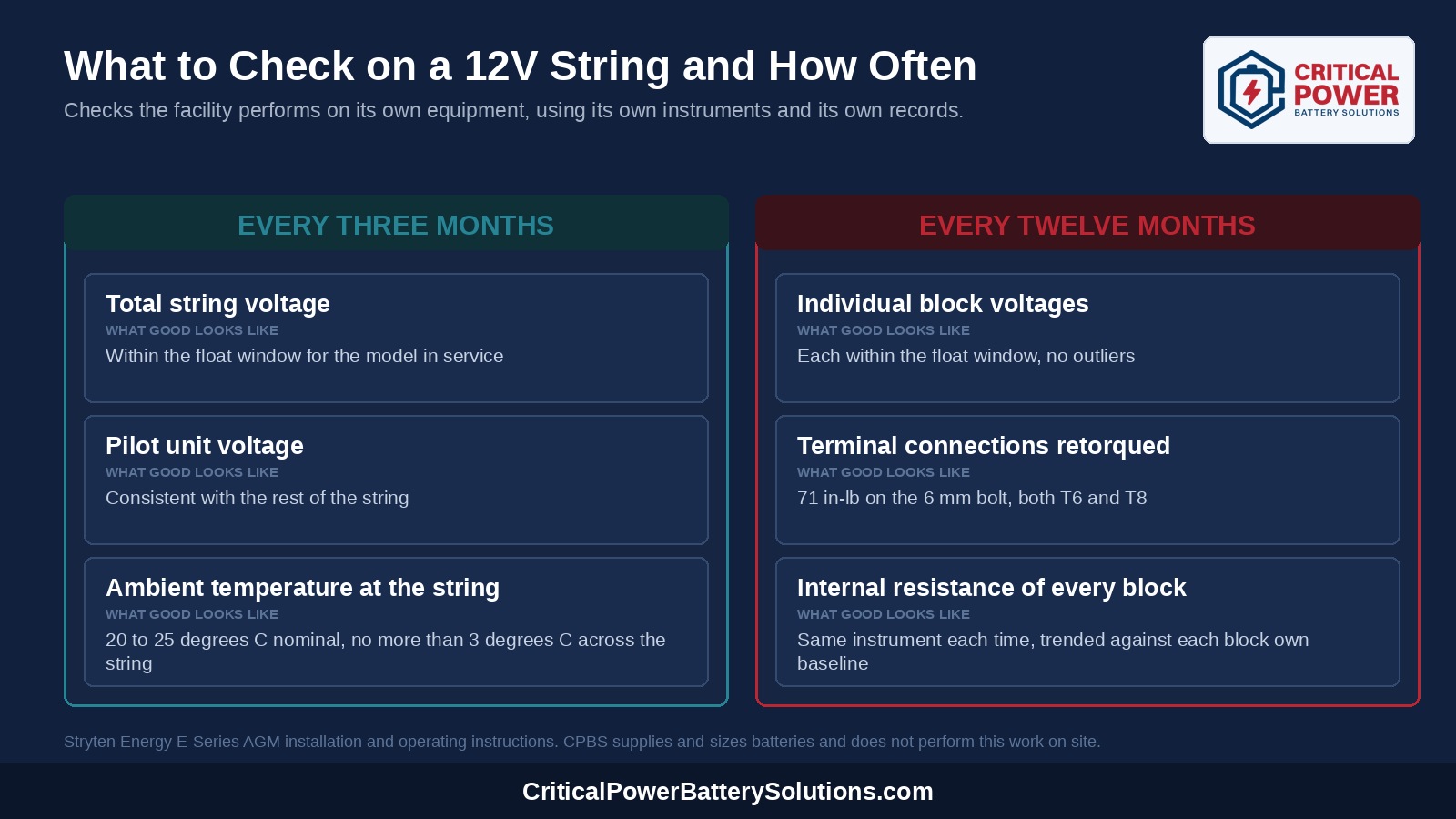
- String voltage, the pilot unit and ambient temperature are read every three months. Individual block voltages, a retorque to 71 in-lb on the 6 mm bolt and an internal resistance reading on every block are done every twelve months, with the same instrument each time.
- No published ohmic figure exists for the legacy blocks still in the field, and none may be worked backwards from the current model that succeeds them. The baseline method does not need one.
- The decision is made at string level. Mixing new blocks into an aged string pulls the new blocks down to the condition of the old ones.
Current 12V blocks: specifications and quote
Published reference values, drawings and manuals for each current model.
Legacy blocks S12V300F, S12V370F, S12V370NGF and S12V550NGF are succeeded by these models. Case dimensions, terminal design and weight differ, so fit is confirmed before ordering.
A routine round produces a page of numbers. Every block sits inside the float window, nothing looks obviously wrong, and the reading most people take first is the reading that hides the problem.
This guide covers block level triage on 12V monoblocs: which readings matter, what the published reference values are, what a deviation from a baseline means, and how a page of numbers turns into a decision to buy. Published 12V UPS block internal resistance values exist for the three current models and are set out below.
Whether a string is old enough to be a candidate at all is a different question, and it is answered on age against actual operating conditions in the four to five year replacement decision. This guide starts after that point. The string is already suspect, and the job is to work out which blocks in it are weak and what to do about them.
Critical Power Battery Solutions (CPBS) is the battery division of Advanced Technical Services Inc., founded in 1981 and ISO 9001 certified, and is an authorized Stryten Energy reseller. Tom Kierna, who has more than 40 years in industrial batteries including 15 across GNB and Stryten, sizes every order personally.
Who this block level triage guide is for
This guide is for anyone holding a set of readings from a 12V monobloc string and deciding whether that string needs replacing. It assumes the UPS and the enclosure are staying, and that the open question is which blocks are weak and what the readings justify doing.
- Facility and critical power managers who have to defend a replacement decision.
- UPS service technicians recording float voltages and ohmic readings and deciding what to escalate.
- Telecom and utility power engineers checking a string against the duty cycle it was commissioned for.
- Oil and gas technicians maintaining backup power at unmanned sites.
- Procurement staff who need the string condition documented before a purchase order is raised.
CPBS is consulting based: it supplies and sizes batteries and does not perform on site installation, commissioning, testing, or maintenance. Supplying or specifying UPS systems, cabinets, racks, or breakers is out of scope for CPBS. Every check described below is one the facility performs on its own equipment, using its own instruments and its own records.


Why does voltage alone miss a failing 12V block?
On float, the charger holds every block near the same voltage regardless of how much capacity remains in it, so a block can read correctly on a handheld meter and still fail under load. This is the single most useful thing to understand before looking at any set of readings, because it explains why a string can be inside specification on paper and short of its rated duration in practice.
A float charger is a voltage source. Its job is to hold the string at a set potential and supply whatever small current the blocks draw to stay there. A block that has lost a large part of its useful capacity still draws that small current and still sits at the potential the charger is holding. The meter across its terminals reports the charger as much as it reports the battery.
The failure mode is a loss of the ability to deliver current, not a loss of terminal voltage. Inside a valve regulated lead acid monobloc, capacity is lost through mechanisms that raise internal resistance rather than pull open circuit voltage down. Corrosion of the positive grid narrows the conductive path out of the plate. Drying of the absorbent glass mat separator reduces the electrolyte in contact with the plate surface. Neither announces itself as a sag on float.
Load is what exposes it. When the utility drops and the UPS calls on the string, the current demanded is orders of magnitude above the float current. At that current, internal resistance becomes a voltage loss within the block itself, and the block with the highest resistance falls toward the inverter cutoff first. On a series string the weakest block sets the point at which the whole string stops being useful, which is how one unit shortens the backup duration of an entire cabinet.
That is why resistance trending exists. An ohmic reading is an indirect measure of condition, and its value is that it can be taken on a live string in a few minutes without discharging anything. A discharge test remains the only direct measure of capacity, which makes it the confirmation step rather than the screening step.
The two readings answer different questions. Voltage confirms the charger is doing its job. Resistance, trended, says whether a block can still do work. A round that records only the first cannot detect the failure it is being carried out to catch.
What internal resistance should a healthy 12V block read?
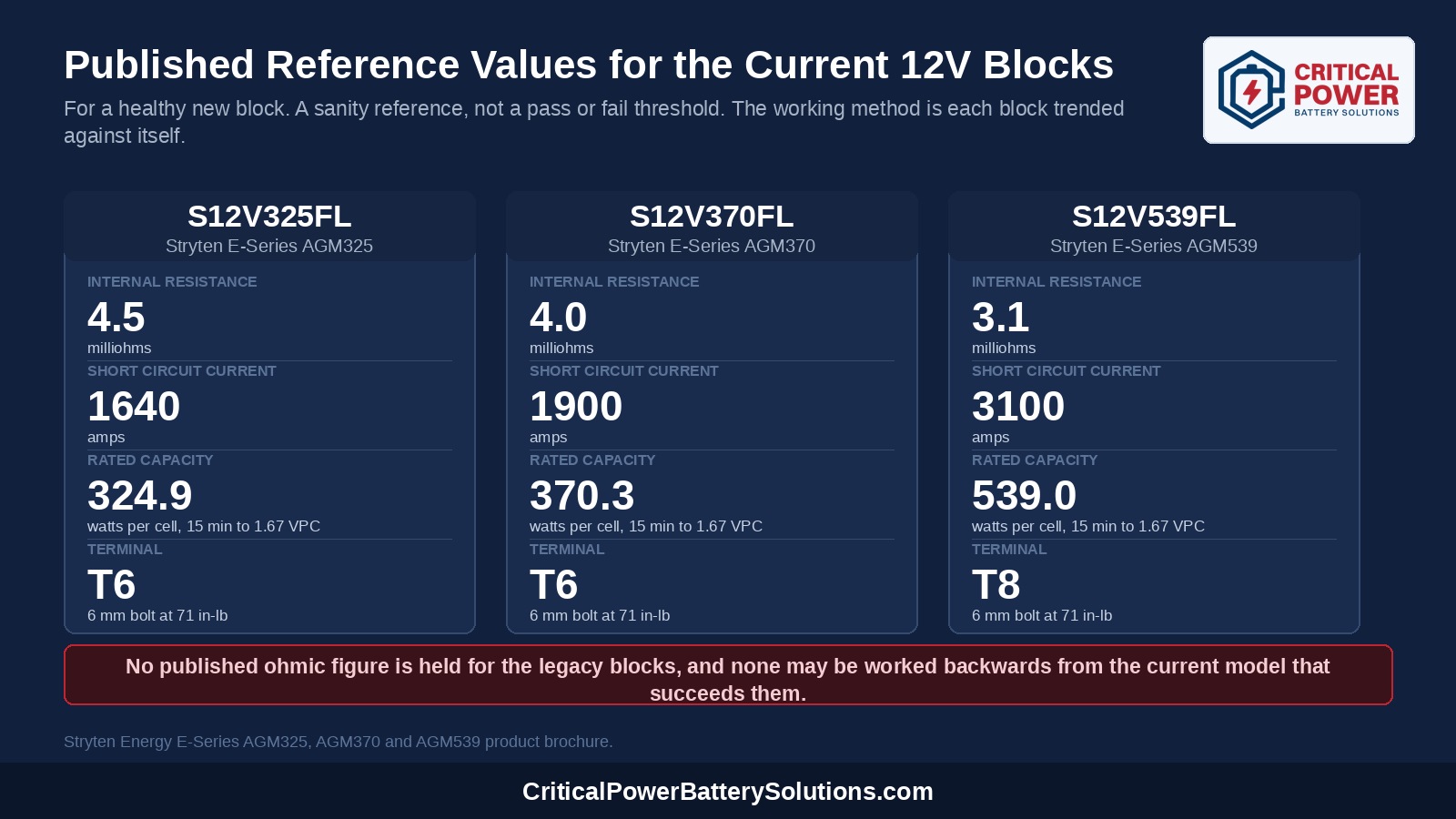
Published internal resistance for a healthy new block is 4.5 milliohms on the S12V325FL, 4.0 on the S12V370FL and 3.1 on the S12V539FL. These figures come from the Stryten Energy E-Series AGM325, AGM370 and AGM539 product brochure, and they describe a new block in good condition.
| Part number | Model name | Internal resistance milliohms | Short circuit current amps | 15 min WPC | Terminal |
|---|---|---|---|---|---|
| S12V325FL | Stryten E-Series AGM325 | 4.5 | 1640 | 324.9 | T6 |
| S12V370FL | Stryten E-Series AGM370 | 4.0 | 1900 | 370.3 | T6 |
| S12V539FL | Stryten E-Series AGM539 | 3.1 | 3100 | 539.0 | T8 |
Read the table as a sanity reference rather than a threshold. A new block measuring near its published figure confirms nothing went wrong in transit or on the shelf. It does not follow that a block above that figure years later is faulty, or that one below it is healthy. Absolute ohmic numbers vary with the instrument, the temperature and the state of the connection at the moment of the reading.
The other two columns are worth knowing for what they are. Short circuit current sizes the protective devices around the string; it is not a condition measurement. The watts per cell column is rated capacity at the 15 minute rate to 1.67 volts per cell, which is the basis any runtime claim is checked against. Both appear in full, with dimensions, weight and the constant power tables, in the E-Series AGM325, AGM370 and AGM539 specification reference.
Published internal resistance values are held for the three current blocks only, and no value for a legacy block may be inferred from them. No internal resistance figure, short circuit current figure or rated capacity figure is published in the sources CPBS holds for the S12V300F, the S12V370F, the S12V370NGF or the S12V550NGF, and CPBS will not produce one by working backwards from the current block that succeeds each of them. Grid design, plate count and active material volume all moved across those generations, so a number carried across would be a guess wearing the appearance of a specification.
That gap costs the method nothing, because the method never needed a published number. Every block is compared against its own history, so a string of legacy blocks is triaged exactly like a string of current ones: baseline each block, read them on the same instrument at the same interval, and watch which leaves the group.
What float voltage should a 12V block hold, and what does drifting cost?
The float charging window is 2.25 to 2.30 volts per cell for the AGM325 and the AGM370, and 2.25 to 2.35 volts per cell for the AGM539. The minimum acceptable temperature corrected value is 2.21 volts per cell and the maximum is 2.40.
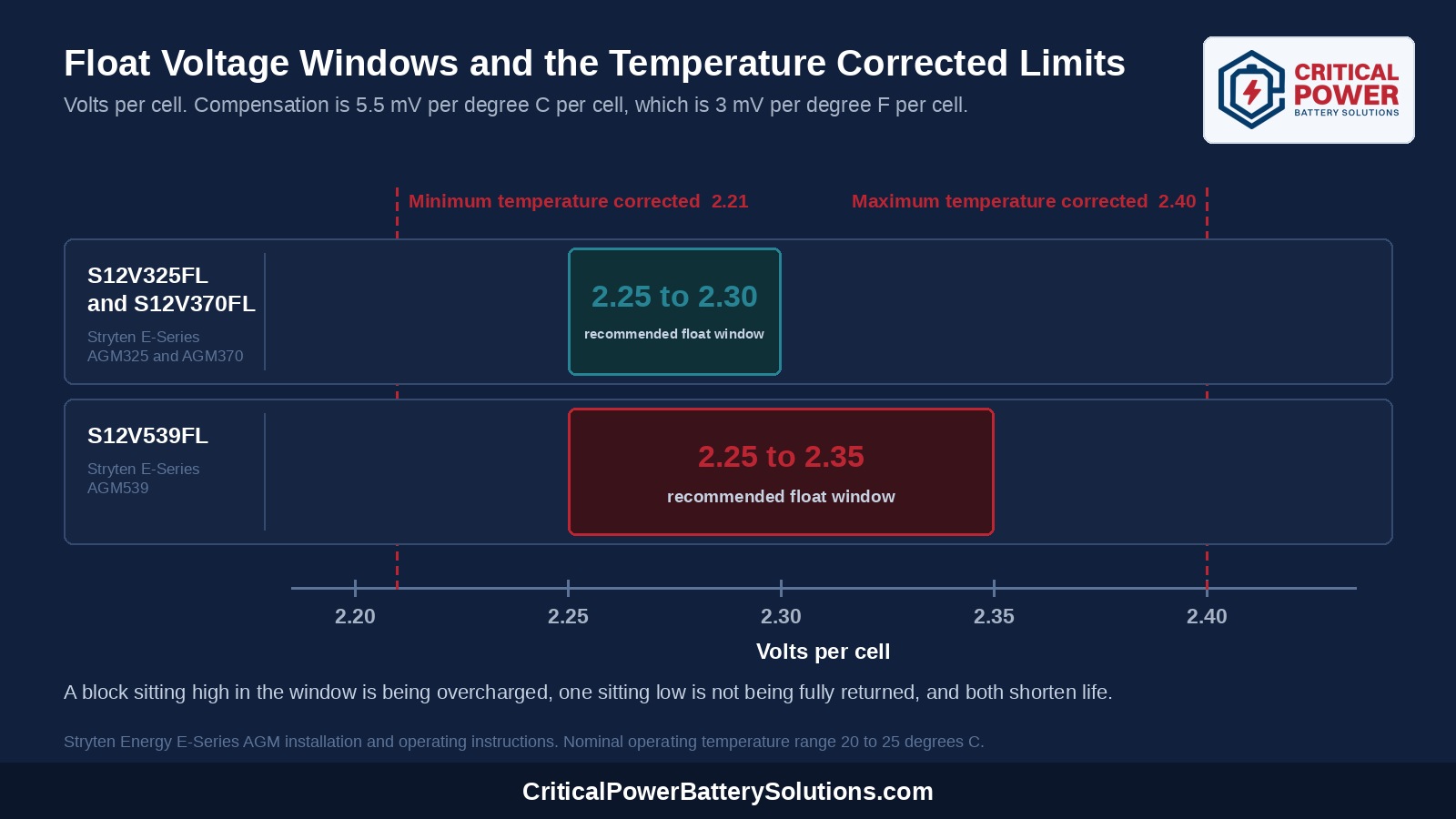
Temperature compensation is 5.5 mV per degree C per cell, the same relationship expressed as 3 mV per degree F per cell. A compensating charger moves its target by that amount for every degree the string sits away from the reference temperature, which is why an ambient reading is taken alongside the voltages rather than treated as background.
A block sitting high in the window is being overcharged, one sitting low is not being fully returned, and both shorten life. Overcharging drives grid corrosion faster and pushes the block toward venting, which takes with it water the sealed design cannot replace. Undercharging leaves lead sulfate on the plates long enough to harden, and hardened sulfate raises internal resistance permanently rather than temporarily.
Both directions produce the same symptom on the instrument: a resistance figure that has climbed away from where it started. That is why the trend is read alongside the float voltages. A block drifting up in resistance while sitting at the top of its window implicates the charger rather than the block.
How float voltage and temperature translate into years of service life is not reproduced here. That relationship belongs to the replacement timing article linked above.
How much resistance rise above baseline actually matters?
Deviation is measured against that same block baseline, taken with the same instrument, established at about six months in service. The ladder below is how a percentage rise turns into an action.
| Rise above the block own baseline | What it indicates | What to do |
|---|---|---|
| Up to 25 percent | Within normal measurement and ageing scatter | Record it and keep the interval |
| 25 to 50 percent | The block is diverging from the string | Increase monitoring frequency and compare against the rest of the string |
| Above 50 percent | The block is a candidate for removal | Confirm with a capacity or discharge test before deciding |
The baseline is taken at about six months rather than at commissioning, because a new block settles over its first months in float service and a reading taken before it settles gives a number every later reading appears to rise against.
Using the same instrument every time matters more than which instrument is chosen. Ohmic testers do not all measure the same quantity the same way, and two meters reading one healthy block will not agree on the absolute figure. Each will reliably show that block moving relative to its own earlier readings. Change the meter and the record restarts.
Technique inside a single instrument matters too. Probe placement, the condition of the terminal surface and the torque on the connection all move the number, and a reading on a loose or corroded connection reports the connection rather than the block. That is one reason the retorque and resistance intervals are scheduled together. Method against the sizing framework is set out in the guide to internal resistance measurement and IEEE 485 sizing.
Read the shape of the trend, not only its size. A steady climb across several intervals is ageing, and ageing is expected. A step change between two consecutive readings on one block, while the rest of the string holds, points at something internal to that block or its connection. Two blocks climbing together in the same part of the cabinet is more likely a temperature gradient than a coincidence.
An ohmic reading on its own does not establish a manufacturing defect or a warranty condition; that determination is made by the manufacturer against its own criteria. The reading is strong evidence for an operational decision about a string, not an adjudication.
Above 50 percent, the confirmation step is a capacity or discharge test, the only measurement that answers the question directly. How such a test is planned and carried out is covered in the UPS battery testing guide.
What do you check on a 12V string, and how often?
Three readings are taken every three months and three more every twelve months. These are checks the facility performs on its own equipment, and the intervals come from the Stryten Energy E-Series AGM installation and operating instructions.
| Check | Interval | What good looks like |
|---|---|---|
| Total string voltage | Every three months | Within the float window for the model in service |
| Pilot unit voltage | Every three months | Consistent with the rest of the string |
| Ambient temperature at the string | Every three months | Nominal operating range 20 to 25 degrees C, and no more than 3 degrees C variation across the string |
| Individual block voltages | Every twelve months | Each within the float window, no outliers |
| Terminal connections retorqued | Every twelve months | 71 in-lb on the 6 mm bolt, both T6 and T8 |
| Internal resistance of every block | Every twelve months, same instrument each time | Trended against each block own baseline |
The split is practical. The quarterly items are read at the string, take minutes and need nothing disconnected. The annual items require working block by block, which is why they sit on a longer interval and are scheduled together: the visit that retorques a connection to 71 in-lb on the 6 mm bolt is best placed to read resistance through a connection known to be tight. A relaxed connection shows up as heat under load, and corrupts the resistance record while it does so.
The ambient check earns its place because temperature does two things at once: it shifts the correct float target, and it drives the ageing rate of every block in the cabinet. A variation of more than 3 degrees C across the string means some blocks are ageing faster than others in the same enclosure, which shows up later as a spread in the resistance record.
None of this is worth much without the record. A resistance reading with no history behind it is a number. The same reading with three years of the same block behind it is a decision. What makes triage possible is keeping the sheet.
How do you work out which 12V blocks in a string are bad?
Nine steps take a set of readings to a replacement decision, and the decision is made at string level rather than block by block. Work through them in order; each narrows what the next has to consider.
- Record the model and the string layout. Take the part number from the block label, then count the blocks per string and the number of strings. If the label has faded, the model number guide explains where else on the block the number appears. Everything downstream, from the float window to the terminal torque, depends on knowing which model is in the rack.
- Read total string voltage and the pilot unit, and record ambient temperature. These three quarterly readings set the context for everything else. A string voltage outside the window points at the charger before it points at any block, and an ambient reading well away from nominal changes what the correct float target should have been.
- Read every block voltage and note any outside the float window for that model. Work along the string in physical order and record the readings in that order, because position matters when the results are reviewed. Outliers are noted rather than acted on here: a block sitting low on float is a flag, not a verdict.
- Measure internal resistance on every block with the same instrument. Record each reading against that block previous readings rather than against any published figure. Every block gets measured, including the ones that looked fine on voltage, because the point of the exercise is that voltage did not tell you.
- Calculate each block rise against its own baseline and place it on the ladder. Express the result as a percentage above that block baseline and put it in one of the three tiers in the deviation table above. This is the step that turns a page of raw numbers into a short list.
- Confirm anything above 50 percent with a capacity or discharge test. A block in the top tier is a candidate for removal rather than a proven failure, and the confirmation test closes that gap. Plan it as a scheduled event, since the string is out of service for the test and the recharge afterwards.
- Look for physical signs. Case distortion, a block running hot relative to its neighbours, or evidence of venting are conditions to act on immediately rather than schedule, whatever the numbers say. Any of the three points at thermal risk, handled as a safety matter first.
- Decide at string level. Mixing new blocks into an aged string pulls the new blocks down to the condition of the old ones, so a string with several blocks in the upper tiers is replaced as a set rather than patched. Where the string sits in an extended run time battery cabinet, the fit checks run alongside the decision, not after it.
- Send CPBS the part number, quantity, cabinet make, runtime requirement and ship to location. Those five items are what turn a triage result into a quote that can be checked, and gathering them takes one pass along the string rather than a second visit.
A current block that succeeds a legacy block differs in case dimensions, terminal design and weight, so fit is confirmed before ordering. Which current model succeeds which legacy number is set out in the succession guide for legacy Sprinter blocks, and a block carrying a different manufacturer name is mapped through the cross reference and replacement guide.
What does CPBS need to quote a replacement string?
Send the part number on the label, the quantity, the cabinet make, the runtime requirement and the ship to location. Those five items let a replacement set be sized and checked for fit in one pass rather than across a chain of clarifying emails.
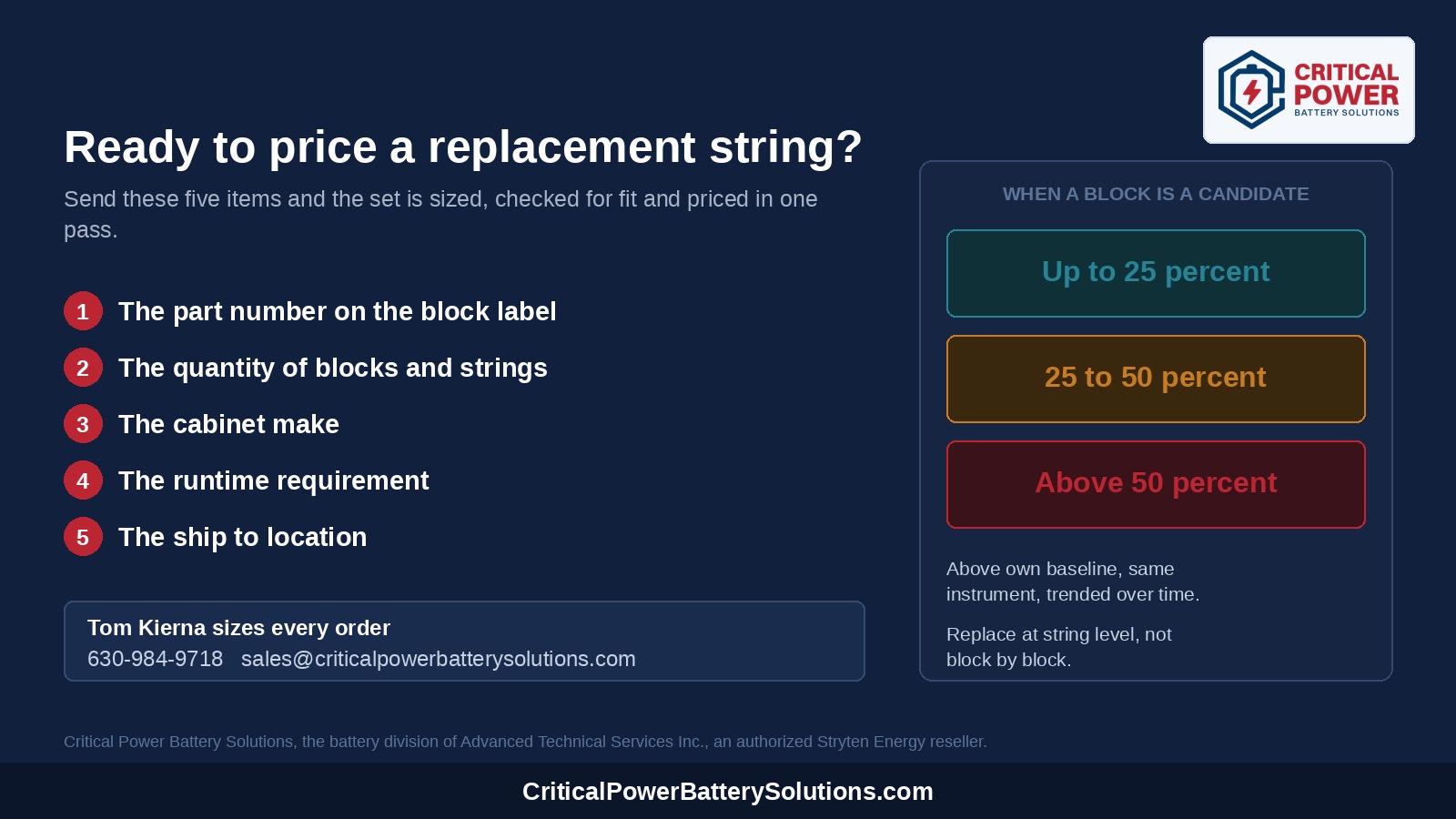
Each one is doing a job. The part number identifies the block and the current model that succeeds it. The quantity establishes whether this is one string or several. The cabinet make is what case dimensions and terminal height are checked against. The runtime requirement is checked against rated capacity at a stated end voltage rather than against the previous part number. The ship to location settles freight.
What a complete request looks like, including the detail that most often goes missing, is set out in the guide to getting an accurate quote on Stryten E-Series AGM batteries. Tom Kierna sizes every order. Contact 630-984-9718 or sales@criticalpowerbatterysolutions.com, and most requests are identified the same day.
Frequently asked questions
How do I tell if a 12V UPS battery block is bad?
A 12V block is treated as bad when its internal resistance has risen well above its own established baseline and a capacity or discharge test confirms it can no longer deliver its rated power. Voltage alone will not tell you, because a failing block held on float still reads inside its window. Read resistance on every block with the same instrument, compare each against its own earlier readings, and confirm anything above 50 percent with a discharge test.
What is a normal internal resistance for a Stryten E-Series AGM block?
The published value for a healthy new block is 4.5 milliohms on the S12V325FL, 4.0 milliohms on the S12V370FL and 3.1 milliohms on the S12V539FL. Those come from the manufacturer product brochure and describe a new block. Treat them as a sanity reference rather than a threshold: absolute readings vary with the instrument, the temperature and the connection, so field judgement is made against the block own baseline.
How much resistance rise means a block should be replaced?
A rise above 50 percent from that block own baseline makes it a candidate for removal. Up to 25 percent sits inside normal measurement and ageing scatter. Between 25 and 50 percent the block is diverging from the string and the monitoring interval is shortened. Above 50 percent, the finding is confirmed with a capacity or discharge test before a replacement decision is made.
Why does a failing block still read a normal voltage?
Because the charger holds every block near the same voltage regardless of how much capacity is left inside it. The failure mode is a loss of the ability to deliver current, not a loss of terminal voltage. Grid corrosion and separator drying both raise internal resistance, and neither shows on a handheld meter across a block sitting on float.
What float voltage should a 12V block sit at?
Between 2.25 and 2.30 volts per cell on the AGM325 and the AGM370, and between 2.25 and 2.35 volts per cell on the AGM539. The minimum acceptable temperature corrected value is 2.21 volts per cell and the maximum is 2.40. Temperature compensation is 5.5 mV per degree C per cell, which is 3 mV per degree F per cell, so the ambient reading is taken alongside the voltages.
How often should I check the blocks in a UPS string?
Total string voltage, pilot unit voltage and ambient temperature every three months; individual block voltages, terminal retorque and internal resistance on every block every twelve months. The annual resistance reading is taken with the same instrument each time, because a change of meter restarts the trend the method depends on.
Do I replace one bad block or the whole string?
A 12V block string is replaced as a set, not one block at a time. Mixing new blocks into an aged string pulls the new blocks down to the condition of the old ones, so the new units do not deliver the service life they are rated for. Where one block has failed early and the rest of the string is young, that is a different conversation.
What torque do the terminal bolts take?
The terminal bolts on a Stryten E-Series AGM block take 71 in-lb on the 6 mm bolt. The figure applies to both terminal types, the T6 used on the AGM325 and the AGM370 and the T8 used on the AGM539, and it comes from the manufacturer product brochure. Retorque is scheduled every twelve months alongside the annual resistance reading, because a relaxed connection corrupts that reading.
Does a high resistance reading prove the block is defective?
No, a high internal resistance reading on its own does not establish a manufacturing defect or a warranty condition; that determination is made by the manufacturer against its own criteria. What the reading supports is an operational decision about the string. Treat it as strong evidence for planning a replacement, not as a finding against the manufacturer.
What internal resistance should my older S12V block read?
Published internal resistance values are not held for the legacy blocks, and no figure for them may be inferred from the current block that succeeds each one. That is not an obstacle. The working method never used a published number: every block is baselined against itself at about six months in service and trended from there, whether or not a reference figure was ever printed.
What physical signs mean I should act immediately?
Case distortion, a block running hot relative to its neighbours, or any evidence of venting. Each is a condition to act on straight away rather than add to the next scheduled round, whatever the electrical readings say, and each points at thermal risk that is handled as a safety matter first.
What do I send CPBS to get a replacement quoted?
The part number on the label, the total quantity of blocks, the cabinet make, the runtime requirement and the ship to location. Those five items identify the current model, check that it fits where the old one came out, confirm the string still meets its duty cycle and price the freight. A photograph of the label and one of a full shelf answer the rest.
About the author: Tom Kierna is a Battery Systems Specialist at Critical Power Battery Solutions with more than 40 years in industrial battery systems, including 15 years across GNB and Stryten. He specializes in Sprinter and E-Series AGM block battery selection, UPS application sizing, and fitment confirmation for cabinet and rack installations. Last updated August 20, 2026.
References
- Stryten Energy. E-Series AGM325, AGM370 and AGM539 product brochure: published internal resistance in milliohms, short circuit current in amps, rated capacity in watts per cell at 15 minutes to 1.67 volts per cell, terminal type, and the 6 mm bolt torque figure of 71 in-lb stated for both the T6 and T8 terminals.
- Stryten Energy. E-Series AGM installation and operating instructions: recommended float voltage windows per model, the minimum and maximum temperature corrected float values, the temperature compensation coefficient, the maintenance check intervals, retorque practice and the permitted temperature variation across a string.
- Sprinter UPS Block Battery Selection Guide, UPS top terminal valve regulated lead acid block batteries. Exide branded, manufacturer published, historical guide only: consulted to confirm that no internal resistance or short circuit current figure is published for the legacy blocks named in this guide.
- IEEE Standards Association. IEEE 485 Recommended Practice for Sizing Lead-Acid Batteries for Stationary Applications, referenced at the method level for duty cycle sizing, aging margin and design margin.
- IEEE Standards Association. IEEE 1188 Recommended Practice for Maintenance, Testing, and Replacement of Valve-Regulated Lead-Acid Batteries for Stationary Applications, referenced at the method level for ohmic baselines and capacity testing.