Quick answer: An Absolyte GP part number such as 6-90G15 tells you two things at a glance: the leading digit is the cell configuration (1 is a 2V cell, 3 is a 6V module, 6 is a 12V module) and the 50G, 90G, or 100G series is the cell and plate family that sets the capacity range. The same 50G, 90G, and 100G scheme continues in the current Stryten Absolyte AGP line, so a legacy GP number points straight to its current-series equivalent, which Critical Power Battery Solutions (CPBS) confirms exactly before you order.
Key points
- The leading digit is cells per module: 1 is one 2V cell, 3 is a three-cell 6V module, 6 is a six-cell 12V module.
- The 50G, 90G, and 100G series names are cell and plate families of rising size, not random codes.
- The trailing number is the capacity step within that series; capacity is always quoted at a stated discharge rate and end voltage.
- A V suffix (for example 3-100G33V) marks the UL94 V-0 flame-retardant case option.
- Stryten Absolyte AGP continues the same G-series numbering, so the legacy number maps to a current-series equivalent that the specialist confirms for exact part number, tray and terminal fitment, seismic build, and rating.
If you are holding an Absolyte module label or an old submittal and need to know what the number means before you requisition a replacement, this reference decodes the scheme at the concept level and gives the per-series capacity ranges. It is written for procurement managers, plant and facility engineers, maintenance leads, and asset managers who want an accurate read, not a guess from a scraped lookup site.
The line comes from Stryten Energy (formerly GNB Industrial Power, a division of Exide Technologies). The Absolyte GP product line continues today as Stryten Absolyte AGP, built on the same design lineage at the same North American plant, with the same 50G, 90G, and 100G model-number scheme; only the brand name changed, per the Stryten Energy Manufacturer Declaration of August 17, 2023. For the full brand story, see the Absolyte history from GNB to Stryten.
| Legacy (GNB) | Current (Stryten) |
|---|---|
| GNB Industrial Power | Stryten Energy |
| GNB Absolyte GP | Stryten Absolyte AGP |
| Absolyte GP 50G / 90G / 100G series | Stryten Absolyte AGP, same 50G / 90G / 100G series scheme |
How to read an Absolyte GP part number
An Absolyte GP part number breaks into three readable parts plus an optional case-option letter. Read left to right: the leading digit is the number of 2V cells in the module, the 50G, 90G, or 100G group is the cell and plate family, and the trailing number is the capacity step inside that family. There is no public one-to-one decode key that converts every number to an exact capacity and build, so the values below are the published series ratings, and the exact current match is confirmed by the specialist.

| Part of the number | What it tells you | Example in 6-90G15 |
|---|---|---|
| Leading digit | Cells per module: 1 is one 2V cell, 3 is a three-cell 6V module, 6 is a six-cell 12V module | The 6 marks a 12V module |
| Series (50G, 90G, 100G) | The cell and plate family, which sets the physical size class and capacity range | 90G is the mid-range family |
| Trailing number | The capacity step within that series (a higher number is a larger rating) | 15 is the capacity step |
| V suffix (optional) | Marks the UL94 V-0 flame-retardant case option | Shown as a trailing V, for example 3-100G33V |
To submit a number and get the confirmed current match, follow the step-by-step GNB Absolyte part-number cross-reference workflow. This guide stays on what the number means and what capacity the series carries.


The 50G series (compact ratings)
The 50G family is the compact end of the Absolyte GP line, used for smaller strings and cabinets. Published 8-hour capacities run from 104 Ah to 312 Ah at the 8-hour rate to 1.75 volts per cell (VPC) at 77 degrees F (25 degrees C). The examples below are 12V six-cell modules.
| Part number | Configuration | Capacity (8-hour rate to 1.75 VPC, 77 F) |
|---|---|---|
| 6-50G05 | 12V, six 2V cells | 104 Ah |
| 6-50G07 | 12V, six 2V cells | 152 Ah |
| 6-50G09 | 12V, six 2V cells | 208 Ah |
| 6-50G13 | 12V, six 2V cells | 312 Ah |

The 90G series (mid-range strings)
The 90G family is the mid-range Absolyte GP group, common in telecom and central-office strings. Published 8-hour capacities run from 256 Ah to 608 Ah at the 8-hour rate to 1.75 VPC at 77 degrees F. All five examples below are 12V six-cell modules, which is why the strings are built from stackable trays.
| Part number | Configuration | Capacity (8-hour rate to 1.75 VPC, 77 F) |
|---|---|---|
| 6-90G07 | 12V, six 2V cells | 256 Ah |
| 6-90G09 | 12V, six 2V cells | 344 Ah |
| 6-90G11 | 12V, six 2V cells | 432 Ah |
| 6-90G13 | 12V, six 2V cells | 520 Ah |
| 6-90G15 | 12V, six 2V cells | 608 Ah |

The 100G series (the large-capacity workhorse)
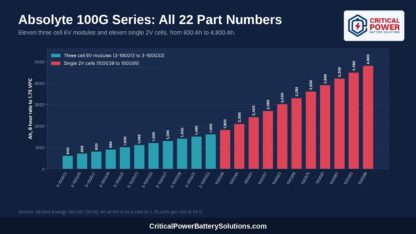
The 100G family is the large-capacity Absolyte GP workhorse for UPS, switchgear, and telecom plant. It comes as 6V three-cell modules and as 1-cell 2V units, with published 8-hour capacities from 600 Ah to 4,800 Ah at the 8-hour rate to 1.75 VPC at 77 degrees F. The 2V single cells are how the very large strings are built.
| Part number | Configuration | Capacity (8-hour rate to 1.75 VPC, 77 F) |
|---|---|---|
| 3-100G13 | 6V, three 2V cells | 600 Ah |
| 3-100G25 | 6V, three 2V cells | 1,200 Ah |
| 3-100G33 | 6V, three 2V cells | 1,600 Ah |
| 100G39 | 2V, single cell | 1,800 Ah |
| 100G57 | 2V, single cell | 2,688 Ah |
| 100G99 | 2V, single cell | 4,800 Ah |

Capacity, ratings, and options
Every Absolyte GP capacity is tied to a discharge rate and an end voltage, so a single amp-hour number is never the whole rating. The figures in the tables above are the published 8-hour ratings to 1.75 VPC at 77 degrees F. Pull more current and the delivered capacity drops; allow a lower end voltage and it changes again. Match the rating to your actual duty cycle before you compare numbers.
Two more items live in the part number and the datasheet. The optional V suffix marks the UL94 V-0 flame-retardant case, specified where the local fire code or listing calls for a self-extinguishing container. The Absolyte platform is also qualified to recognized seismic standards at the family level, including the 1997 UBC, the 2005 IEEE-693, and the 2012 IBC, when built in the qualified configuration.
Temperature matters too. Float voltage for these 2V cells is 2.25 VPC, and the standard temperature compensation is 3 mV per degree F per cell (5.5 mV per degree C per cell) referenced to the 77 degree F (25 degree C) base. For the full current-generation specification set by application, see the Stryten Absolyte AGP specifications by application, and the downloadable datasheets in the CPBS spec sheet library.
GP versus IIP numbering
Absolyte GP uses the G-series, and the older Absolyte IIP uses the A-series; they are separate legacy families and are never mixed in one string. A GP number reads like 6-90G15 or 100G99. An IIP number reads like 1-100A93, with an A where the GP number carries a G. The leading-digit rule for cells per module is the same, but the families are not interchangeable, and the capacity steps do not translate one to one across the letter.
If your string mixes families, or you are cross-referencing an IIP number to a current unit, do not force a GP reading onto it. Use the cross-reference workflow to submit the exact string and get the confirmed match. For a broader look at the current Stryten families, including the flooded lines, the Stryten E-Series selection guide maps the options.
Finding your current Stryten Absolyte AGP equivalent
Stryten Absolyte AGP continues the same 50G, 90G, and 100G numbering, so your legacy GP number points to a current-series equivalent. Authorized-channel listings show current AGP units under the same G-series numbers, for example 6-50G07, 3-100G23, 3-100G25, 100G51, 100G57, and 100G87. That continuity is factual, but the exact current part number, tray and terminal fitment, seismic configuration, and rating are confirmed by the specialist rather than assumed from the number alone.

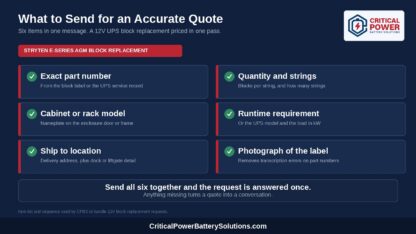
A canonical one-to-one lookup table that pairs every legacy GP number with its exact current part number is being prepared for a dedicated GNB reference page; treat this guide as its companion, and use the worksheet below in the meantime. To identify your unit, send the specialist four things: a clear photo of the module label, the full part number, the module count and string voltage, and the application. You can also confirm supply and lead time in the GNB availability and Stryten replacement supply guide, and review the manufacturer line on the Stryten Energy E-Series Absolyte AGP page.
How to get your Absolyte GP number identified
Send your Absolyte GP number to Tom Kierna and get the series identified, usually the same day. Tom Kierna brings 40 plus years in industrial batteries, including 15 years across GNB and Stryten, and confirms the exact current equivalent from authorized-channel stock with documentation. CPBS is the battery division of Advanced Technical Services (ATS), an ISO 9001 company founded in 1981, and works as a consulting and supply partner rather than an on-site installer.
Reach Tom directly at 630-984-9718 or sales@criticalpowerbatterysolutions.com, or start from the contact page. Most requests get same-day series identification, and domestic lead time runs 8 to 10 weeks. A companion guide on Absolyte GP for solar and off-grid systems is in preparation and will be linked here once it is live.
Frequently asked questions
What do Absolyte GP part numbers mean?
An Absolyte GP part number has three parts. The leading digit is the cells per module (1 is a 2V cell, 3 is 6V, 6 is 12V). The 50G, 90G, or 100G series is the cell and plate family. The trailing number is the capacity step within that series. CPBS confirms the exact current match.
What is the difference between 50G, 90G, and 100G Absolyte batteries?
The 50G, 90G, and 100G labels are three cell and plate families of rising size. The 50G family covers the smaller ratings (about 104 to 312 Ah at the 8-hour rate to 1.75 VPC), 90G the mid range (256 to 608 Ah), and 100G the large workhorse ratings (600 to 4,800 Ah).
What does the first digit in an Absolyte GP part number mean?
The first digit is the number of 2V cells in the module, which sets the module voltage. A 1 is a single 2V cell, a 3 is a three-cell 6V module, and a 6 is a six-cell 12V module. For example, the 6 in 6-90G15 marks a 12V module.
What is the capacity of an Absolyte 6-90G15?
The Absolyte GP 6-90G15 is a 12V module rated 608 Ah at the 8-hour rate to 1.75 volts per cell at 77 degrees F. Capacity varies with the discharge rate and the final volts per cell, so match the rating to your duty cycle. CPBS confirms the current equivalent.
Is there an Absolyte GP to Stryten AGP conversion chart?
This guide gives a series-level chart, so you can see how the 50G, 90G, and 100G ratings line up. A full one-to-one public SKU chart is not published, because the exact current part number, tray fitment, and seismic build are confirmed by the specialist for your specific string.
What is the Stryten equivalent of Absolyte GP 100G99?
The Absolyte GP 100G99 is a 2V cell rated 4,800 Ah at the 8-hour rate to 1.75 VPC. Stryten Absolyte AGP continues the same 100G series, so the equivalent carries the matching G-series rating. Tom Kierna confirms the exact current part number, fitment, and seismic configuration.
What is the difference between Absolyte GP and Absolyte IIP part numbers?
Absolyte GP uses the G-series (for example 6-90G15). The older Absolyte IIP uses the A-series (for example 1-100A93). They are separate legacy families and are never mixed in one string. To cross a mixed or IIP string, use the cross-reference workflow and confirm with the specialist.
What does the V suffix mean on an Absolyte part number?
A V at the end of an Absolyte part number marks the UL94 V-0 flame-retardant case option, for example 3-100G33V. Facilities specify the V-0 case where the local fire code or listing calls for a self-extinguishing container. Confirm the case option with the specialist when you quote.
Are Absolyte GP and Stryten Absolyte AGP part numbers the same?
The G-series scheme continues into Stryten Absolyte AGP, and current units carry the same 50G, 90G, and 100G numbers. Confirm the exact current part number and the tray, terminal, and seismic fitment with the specialist before you order, rather than assuming an automatic match.
How do I find my Absolyte GP battery capacity?
Read the part number and the rating printed on the module label. The 8-hour capacity to 1.75 VPC is set by the series and the trailing capacity step, for example 6-90G15 is 608 Ah. Because capacity changes with the discharge rate and final volts, match the rating to your duty cycle.
Where is the part number on an Absolyte GP module?
The part number is on the manufacturer label on the steel module tray, usually on the front face next to the voltage and amp-hour rating. If the label is worn, the number is also on the original submittal or the system drawing. Send a photo of the label to the specialist to confirm it.
Where can I buy a Stryten Absolyte AGP replacement for my Absolyte GP number?
CPBS, the battery division of Advanced Technical Services, is an authorized Stryten reseller. Send your Absolyte GP number to Tom Kierna at 630-984-9718 or sales@criticalpowerbatterysolutions.com. Most requests get same-day series identification, with 8 to 10 week domestic lead time.
About the author: Tom Kierna is a Battery Systems Specialist at Critical Power Battery Solutions with more than 40 years in industrial battery systems, including 15 years across GNB and Stryten. He specializes in Absolyte GP and Stryten Absolyte AGP identification, application sizing, and GNB to Stryten transition guidance. Last updated July 15, 2026.
References
- Stryten Energy. Stryten Energy Manufacturer Declaration of August 17, 2023 (brand continuity from GNB Industrial Power to Stryten Energy).
- Stryten Energy. E-Series Absolyte AGP product page. Nominal capacity range 105 to 4,800 Ah at 77 degrees F, VRLA AGM, 2V cells.
- GNB Industrial Power. Absolyte GP Section 26.10 published 8-hour capacity ratings to 1.75 volts per cell at 77 degrees F.
- IEEE Standards Association. IEEE 693 Recommended Practice for Seismic Design of Substations (seismic qualification referenced at the family level).