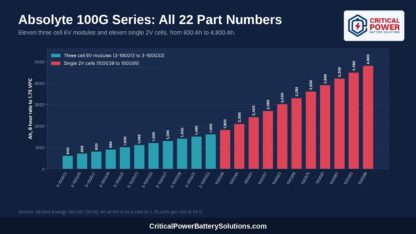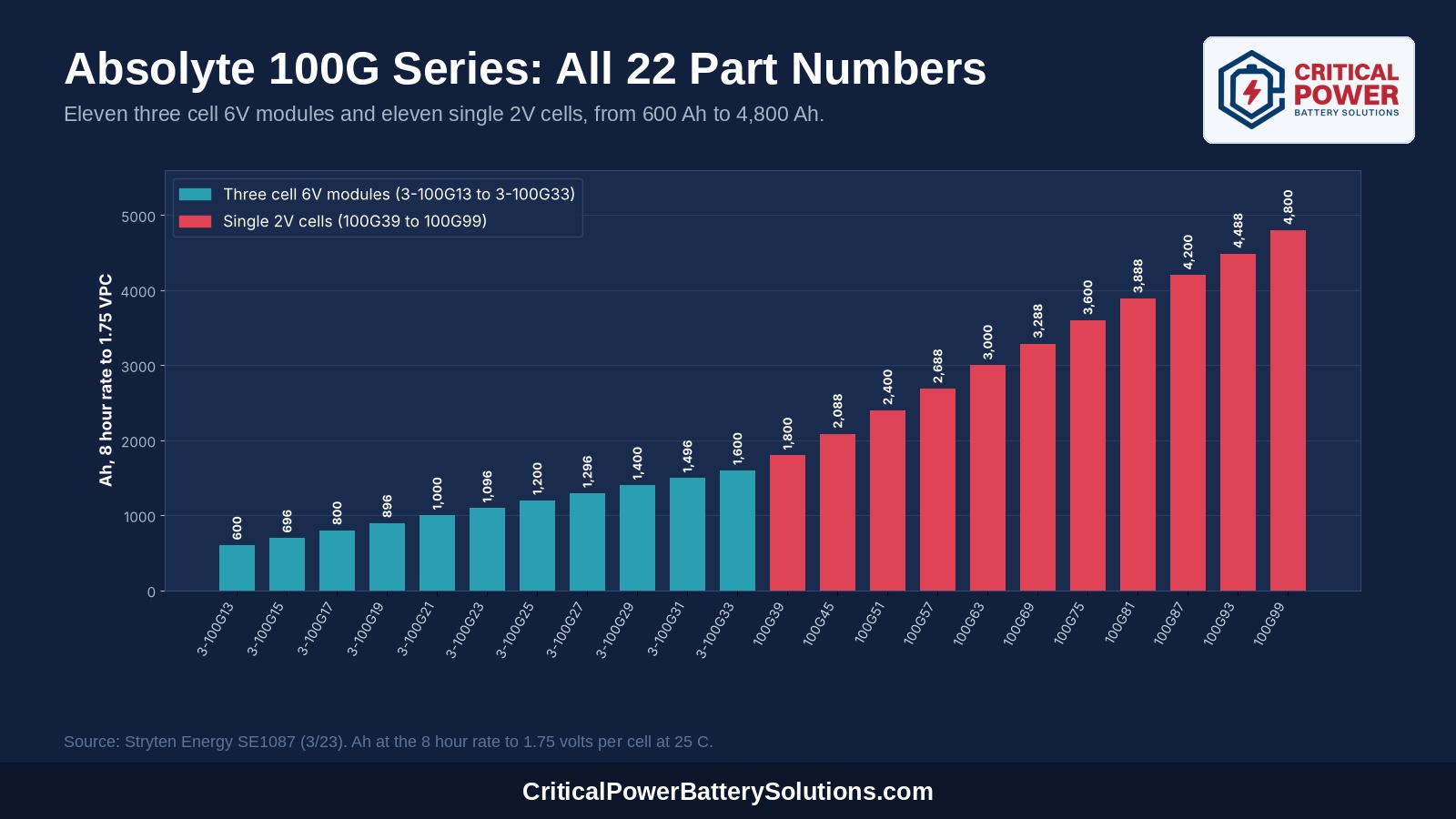
Quick answer: The Stryten Absolyte AGP 100G series, formerly GNB Absolyte GP, has 22 part numbers in two groups. Cell types 100G13 to 100G33 are built as three cell 6V modules, 3-100G13 (600 Ah) to 3-100G33 (1,600 Ah). Cell types 100G39 to 100G99 are larger single 2V cells, 100G39 (1,800 Ah) to 100G99 (4,800 Ah). All ratings are 8 hour to 1.75 volts per cell at 25 C, from the Stryten Energy SE1087 spec sheet. 100G15 is one 2V cell; 3-100G15 is a module of three 100G15 cells.
Key points
- Stryten Energy publishes 22 Absolyte AGP 100G modules: eleven three cell 6V modules and eleven larger single 2V cells.
- The leading digit is the number of cells in the module. 3-100G21 is three 100G21 cells in one tray at 6V nominal. 100G57 is one large 2V cell.
- The 100G21 cell is rated 1,000 Ah and the 100G15 cell 696 Ah at the 8 hour rate to 1.75 volts per cell.
- Each large single cell shares its published size and weight with a three cell module: the 100G99 cell and the 3-100G33 module both measure 42.50 inches long and weigh 795 lbs unpacked.
- RFQs often give only the cell type (100G21). Count the cells first, then convert cells to modules.
- Stryten Absolyte AGP continues the 100G numbering. Confirm the exact current module and its fit with the specialist before ordering.
Stryten Absolyte AGP 100G: product page, resources and quote
A request for quote lands that says “100G21, quantity 24.” A label on a twenty year old rack reads 3-100G25. An old submittal lists a 125 VDC bank of 100G15 cells. All three are Absolyte 100G numbers, and all three need translating into a module count, a size and a weight before anyone can order.
The Absolyte 100G series comes from Stryten Energy (formerly GNB Industrial Power, a division of Exide Technologies). It is the large capacity family in the Absolyte line, used for UPS, switchgear, utility substation and telecom plant batteries. The Absolyte GP line continues today as Stryten Absolyte AGP, and the current Stryten literature carries the same 100G numbering.
This reference sets out every 100G module Stryten publishes, the capacity, dimensions and weight of each, the runtime figures at 1.75 volts per cell, and how to read a 100G number off an RFQ without mixing up cells and modules. The general numbering scheme across the 50G, 90G and 100G families is explained in the Absolyte GP model number guide; this page goes deep on the 100G family only.
Critical Power Battery Solutions (CPBS) is the battery division of Advanced Technical Services Inc., founded in 1981 and ISO 9001 certified, and an authorized Stryten Energy reseller. Tom Kierna, who has more than 40 years in industrial batteries including 15 across GNB and Stryten, confirms every order.
Who is this Absolyte 100G reference for?
This reference is for anyone holding a 100G number and needing to know exactly what it describes before buying. It assumes the battery string exists or is specified, and the open question is what the number means in cells, modules, capacity, size and weight.
- Procurement staff turning an RFQ or a requisition into a correct order.
- Facility and plant engineers checking a submittal against the published ratings.
- Maintenance leads reading a module label on an existing rack.
- Utility, telecom and data center power engineers sizing a replacement string against the original duty.
If the question is whether the existing string is failing, start with the guide on telling whether an Absolyte battery is really bad. If the question is how old the string is, the guide to dating GNB Absolyte batteries covers it. This page starts once the decision to buy is made and the number needs reading.
CPBS is consulting based: it supplies and sizes batteries and does not perform on site installation, commissioning, testing or maintenance. Installation practice for the current line is covered in how Stryten Absolyte AGP is installed, for the contractor doing the work.


How is the Absolyte 100G series organized?
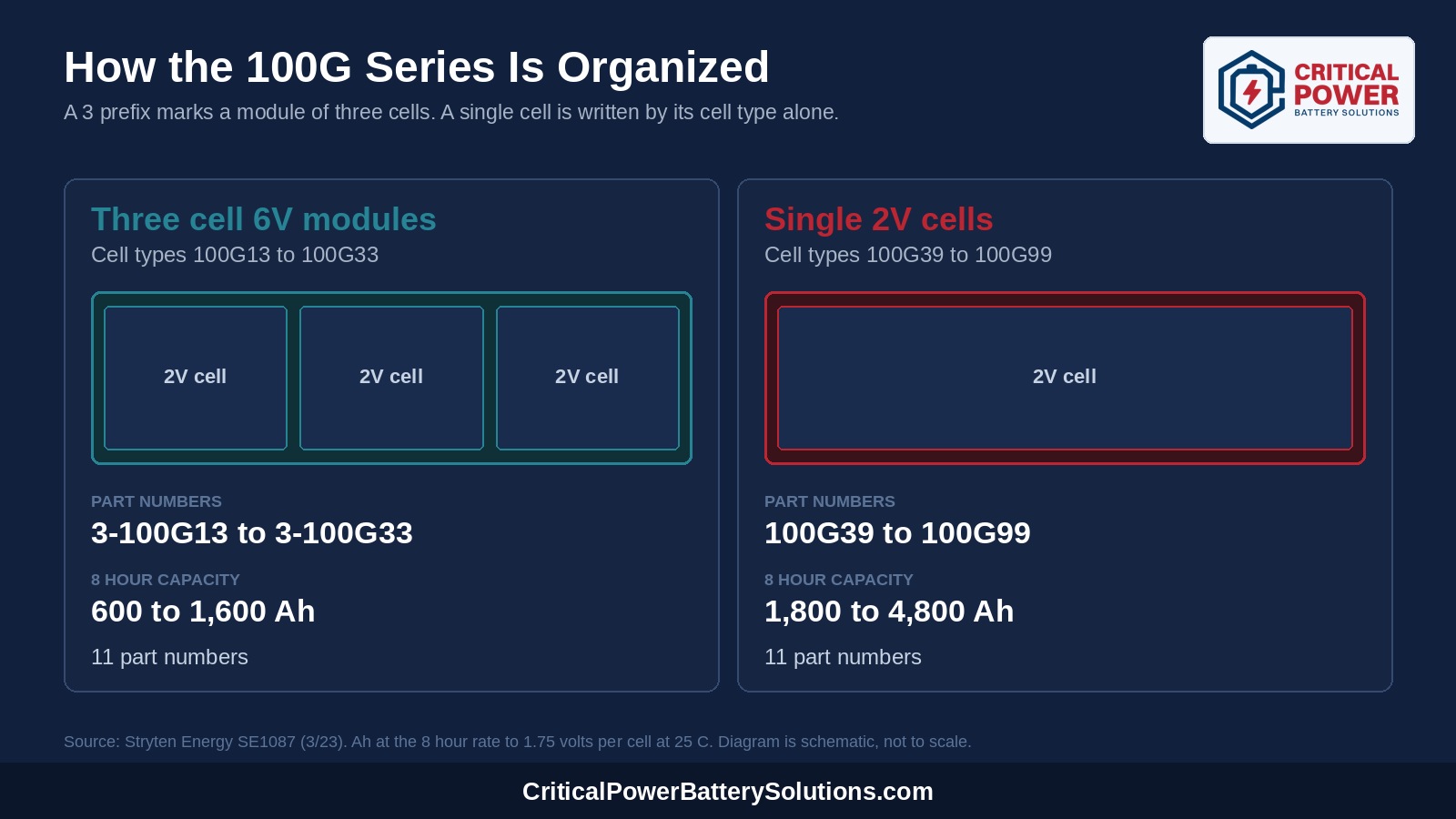
The 100G series splits into two groups by the number of cells in each module. Cell types 100G13 to 100G33 are published as three cell 6V modules. Cell types 100G39 to 100G99 are larger single 2V cells, each in its own steel tray. There are eleven part numbers in each group, 22 in total.
Two terms carry the whole page:
- Cell type: the 100G number on its own, such as 100G21. It names the 2V cell and its capacity step.
- Module number: the cell type with a leading digit, such as 3-100G21. The leading digit is the number of cells in the steel tray, which sets the module voltage.
In the three cell group, capacity runs from 600 Ah on the 3-100G13 to 1,600 Ah on the 3-100G33. In the single cell group it runs from 1,800 Ah on the 100G39 to 4,800 Ah on the 100G99. The large single cells are how the largest strings are built: one large cell per tray instead of three smaller ones.
What is the capacity, size and weight of every 100G part number?
Stryten Energy SE1087 publishes all 22 Absolyte AGP 100G part numbers with their 8 hour capacity, stacking dimensions and weight. The table reproduces that data. Ah is the 8 hour rate to 1.75 volts per cell at 25 C. Dimensions are in inches; depth includes the 3 inch module cover. Weight is unpacked, in pounds.
| Part number | Cells | Volts | Ah (8 hr) | Length in | Height in | Depth in | Weight lbs |
|---|---|---|---|---|---|---|---|
| 3-100G13 | 3 | 6 | 600 | 19.93 | 8.53 | 26.38 | 328 |
| 3-100G15 | 3 | 6 | 696 | 22.18 | 8.59 | 26.38 | 374 |
| 3-100G17 | 3 | 6 | 800 | 24.50 | 8.59 | 26.38 | 424 |
| 3-100G19 | 3 | 6 | 896 | 26.75 | 8.59 | 26.38 | 470 |
| 3-100G21 | 3 | 6 | 1,000 | 29.00 | 8.59 | 26.38 | 515 |
| 3-100G23 | 3 | 6 | 1,096 | 31.25 | 8.59 | 26.38 | 561 |
| 3-100G25 | 3 | 6 | 1,200 | 33.50 | 8.59 | 26.38 | 608 |
| 3-100G27 | 3 | 6 | 1,296 | 35.75 | 8.59 | 26.38 | 653 |
| 3-100G29 | 3 | 6 | 1,400 | 38.00 | 8.59 | 26.38 | 704 |
| 3-100G31 | 3 | 6 | 1,496 | 40.25 | 8.59 | 26.38 | 750 |
| 3-100G33 | 3 | 6 | 1,600 | 42.50 | 8.59 | 26.38 | 795 |
| 100G39 | 1 | 2 | 1,800 | 19.93 | 8.53 | 26.38 | 328 |
| 100G45 | 1 | 2 | 2,088 | 22.18 | 8.59 | 26.38 | 374 |
| 100G51 | 1 | 2 | 2,400 | 24.50 | 8.59 | 26.38 | 424 |
| 100G57 | 1 | 2 | 2,688 | 26.75 | 8.59 | 26.38 | 470 |
| 100G63 | 1 | 2 | 3,000 | 29.00 | 8.59 | 26.38 | 515 |
| 100G69 | 1 | 2 | 3,288 | 31.25 | 8.59 | 26.38 | 561 |
| 100G75 | 1 | 2 | 3,600 | 33.50 | 8.59 | 26.38 | 608 |
| 100G81 | 1 | 2 | 3,888 | 35.75 | 8.59 | 26.38 | 653 |
| 100G87 | 1 | 2 | 4,200 | 38.00 | 8.59 | 26.38 | 704 |
| 100G93 | 1 | 2 | 4,488 | 40.25 | 8.59 | 26.38 | 750 |
| 100G99 | 1 | 2 | 4,800 | 42.50 | 8.59 | 26.38 | 795 |
Read across a row to see one part number; read down the table to see the pattern. The 3 prefix marks a module of three cells. Each single 2V cell shares its published size and weight with a three cell 6V module, from the 100G39 cell with the 3-100G13 module through to the 100G99 cell with the 3-100G33 module. It is the same tray, holding one large cell instead of three.
That pairing matters on site. A 100G99 cell and a 3-100G33 module both weigh 795 lbs unpacked and both take the same footprint in a stack, so floor loading, handling and tier clearance are planned the same way whichever group the string uses. Which cell type a site needs depends on the load and the runtime, covered in the guide to Absolyte AGP specifications by application.
What runtime does each 100G cell give at 1.75 volts per cell?
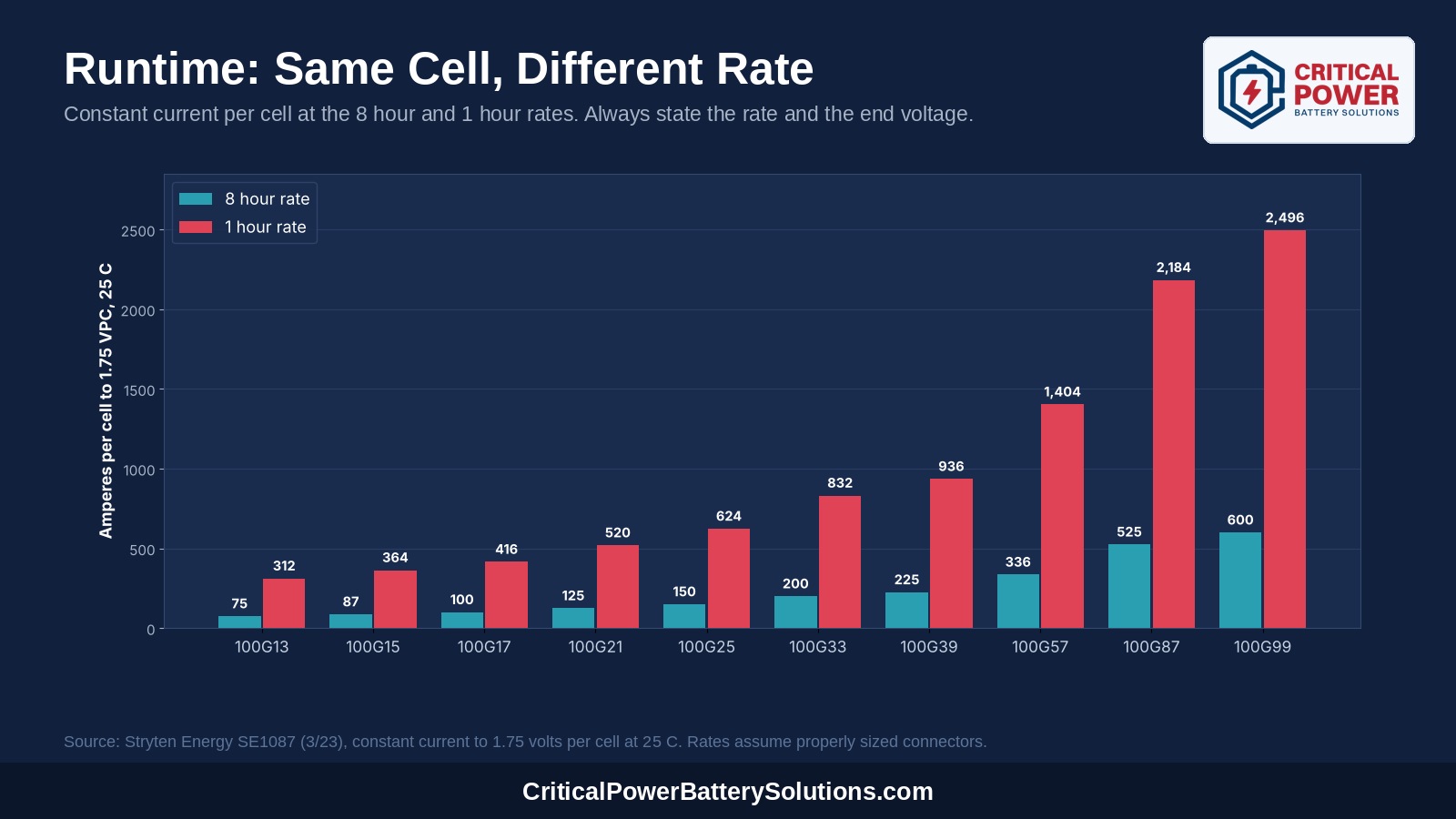
SE1087 publishes constant current in amperes per cell for each 100G cell type, to a stated end voltage at 25 C. The table shows selected cell types at three rates to 1.75 volts per cell. The published rates assume properly sized connectors.
| Cell type | 8 hr amps | 1 hr amps | 15 min amps |
|---|---|---|---|
| 100G13 | 75 | 312 | 559 |
| 100G15 | 87 | 364 | 652 |
| 100G17 | 100 | 416 | 745 |
| 100G21 | 125 | 520 | 932 |
| 100G25 | 150 | 624 | 1,118 |
| 100G33 | 200 | 832 | 1,491 |
| 100G39 | 225 | 936 | not published |
| 100G57 | 336 | 1,404 | not published |
| 100G87 | 525 | 2,184 | not published |
| 100G99 | 600 | 2,496 | not published |
The same cell delivers very different current depending on how fast it is discharged. A 100G15 cell delivers 87 amps for 8 hours to 1.75 volts per cell, and 364 amps for 1 hour to the same end voltage. That is why a capacity figure means nothing without its rate and end voltage, and why every rating on this page states both.
SE1087 does not publish 30 minute, 15 minute or 1 minute figures for 100G39 and above, and none may be inferred from the smaller cells. Stryten also publishes the same tables to other end voltages; sizing a string to a specific load profile is done against the full manufacturer tables, not this extract.
Is 100G15 a cell or a module?
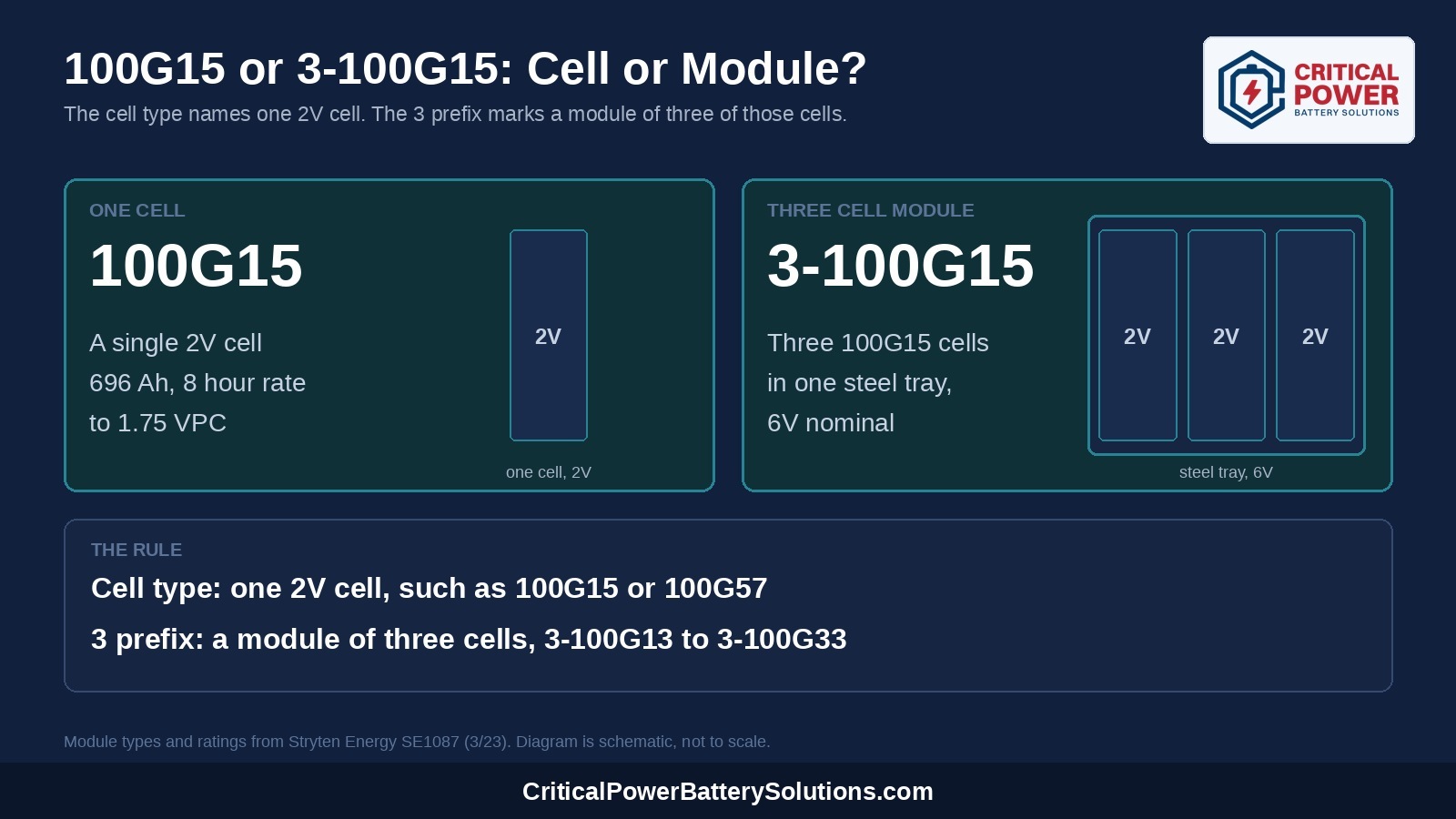
100G15 is one 2V cell. 3-100G15 is a module of three 100G15 cells in one steel tray, 6V nominal. The cell type names the cell. The 3 in front of it says how many of those cells sit in the module. The same reading holds across the three cell group, from 3-100G13 to 3-100G33.
RFQs often blur the two. A request for 24 of a 100G15 can mean 24 cells or 24 modules, and that is a factor of three in the order. CPBS confirms the order in cells and in modules before it is quoted, so the count is right the first time.
How do you read a 100G number on an RFQ?
Work out whether the document gives a cell type or a module number, count the cells, then convert cells to modules. These eight steps cover every 100G request CPBS sees.
- Find whether you have a cell type or a module number. 100G21 is a cell type; 3-100G21 is a module number. Buyers and old submittals often give only the cell type.
- Place the cell type in its group. 100G13 to 100G33 comes in three cell 6V modules, written with a 3 prefix. 100G39 to 100G99 are large single 2V cells.
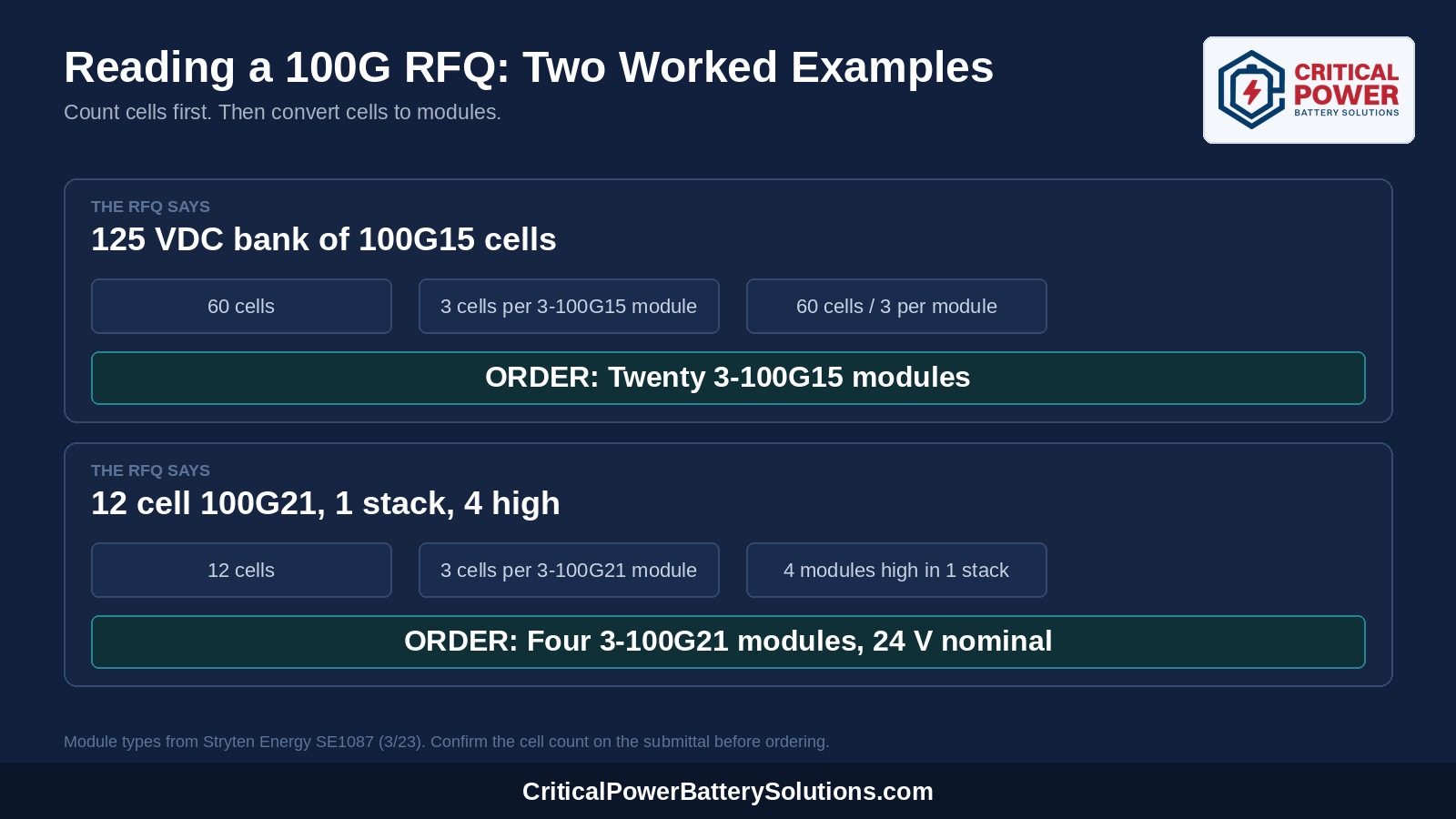
- Count cells, not modules. Worked example: a 125 VDC bank of 100G15 cells is 60 cells, which is twenty 3-100G15 modules.
- Read stack descriptions literally. Worked example: “12 cell 100G21, 1 stack, 4 high” is four 3-100G21 modules in one stack, 24 V nominal.
- Check the rating. Compare the 8 hour Ah in the module table with the label or submittal rating to confirm the cell type.
- Note suffixes and requirements. Send any letter after the number, such as a V on an older GNB label, exactly as written. On current Absolyte AGP, SE1087 lists a UL94 V-0 flame retardant polypropylene container as standard. Note any seismic requirement for the site.
- Leave system ordering numbers as written. A longer Stryten system ordering number on a quote identifies the assembled stack. Send it to CPBS as written. Do not decode it.
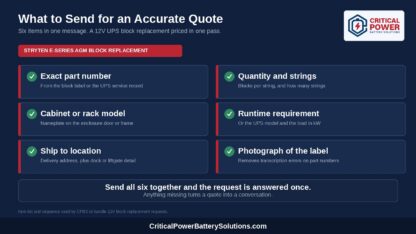
- Send the details. Send CPBS the cell type or module number, the cell count, the stack arrangement, the application and the ship to location.
For the wider buying process, including documentation and approvals, see the Absolyte battery procurement guide. Where the number on the paperwork is a legacy GNB number from a different Absolyte family, the GNB Absolyte part number cross reference explains how the confirmed match is worked out.
How high can 100G modules stack, and are they seismic rated?
Absolyte AGP is seismic qualified to 1997 UBC, 2005 IEEE 693 and 2018 IBC / 2016 CBC in certain configurations. Modules stack horizontally, up to 10 high depending on cell type and seismic zone. Stryten publishes a maximum stack height table by zone, and the allowed height for a given 100G cell type is confirmed by the specialist for the site.
Seismic rating is one reason 100G strings are common in utility substation battery systems, where the installed configuration has to match the qualification. SE1087 also lists a 20 year design life in float applications when operated per the installation and operating manual, UL Recognized Component status, and ISO 9001:2015 manufacture.
Does Stryten still make the Absolyte 100G series?
Yes. Stryten Energy publishes the 100G series in its current Absolyte AGP literature, SE1087 dated March 2023, under the same 100G numbering. The brand changed from GNB to Stryten; the background is in the history of Absolyte from GNB to Stryten, and supply questions are answered in the guide to whether GNB batteries are still available.
Stryten Absolyte AGP continues the 100G numbering. Confirm the exact current module and its fit with the specialist before ordering. Exact module number, stack and rack arrangement, terminal plates, seismic configuration and rating are confirmed with the specialist before ordering. Domestic lead time is typically 8 to 10 weeks.
What do you send CPBS to quote Absolyte 100G modules?
Five items: the cell type or module number, the cell count, the stack arrangement, the application and the ship to location. Those identify the module, confirm the stack and price the freight in one pass. A photo of a module label and one of the full stack answer most follow up questions before they are asked.
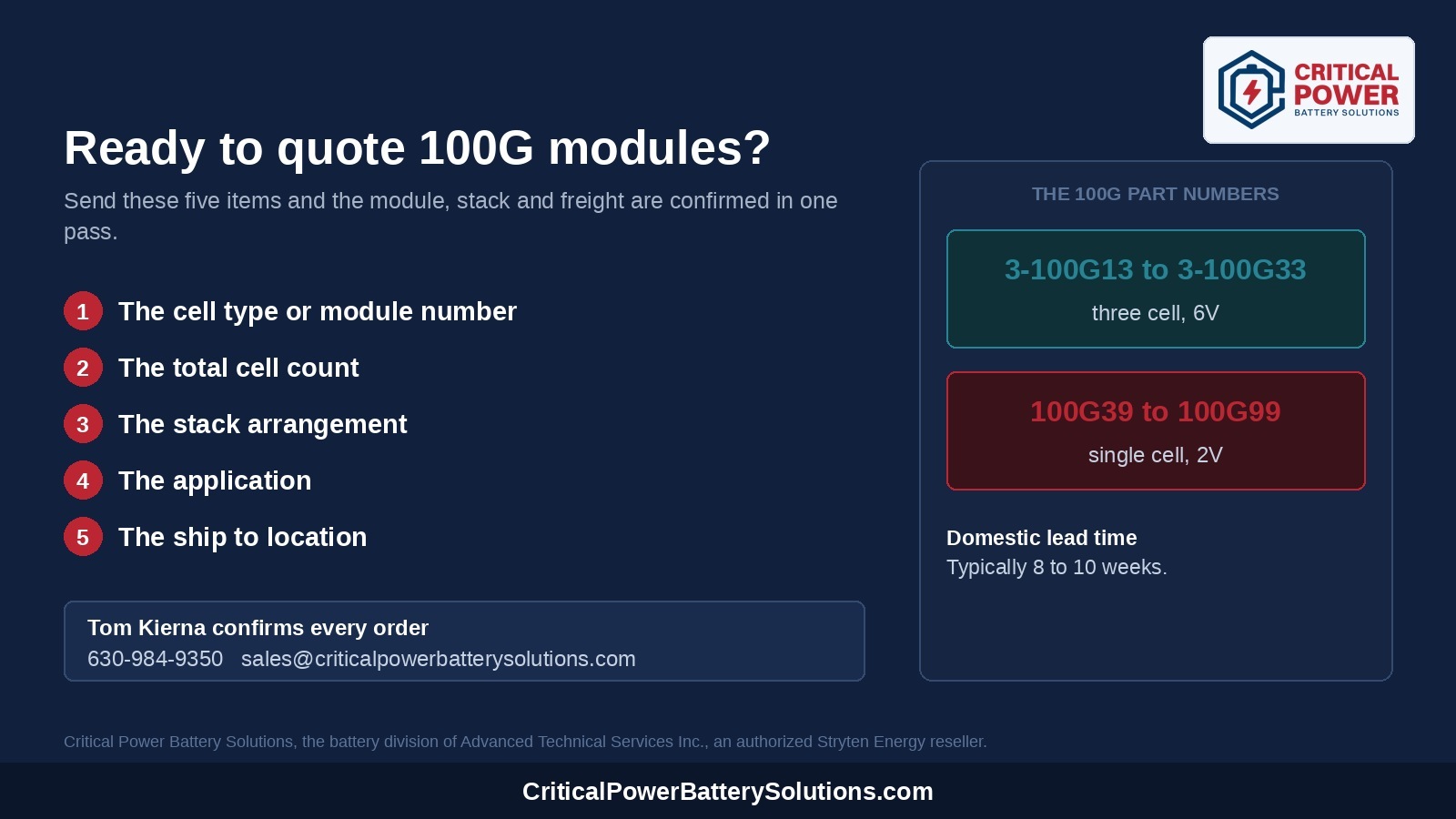
Send the 100G number, cell count and stack arrangement to Tom Kierna: 630-984-9350, sales@criticalpowerbatterysolutions.com, or through the CPBS contact page.
Frequently asked questions
What is an Absolyte 100G battery?
An Absolyte 100G battery is a module from the large capacity family of the Stryten Absolyte AGP valve regulated lead acid line. Stryten Energy publishes 22 100G part numbers, three cell 6V modules and large single 2V cells, used for UPS, switchgear, utility substation and telecom plant batteries.
What does 3-100G mean on an Absolyte module?
The 3 is the number of cells in the module. A 3-100G module holds three 2V cells for 6V nominal. Cell types 100G13 to 100G33 are published as three cell modules, so 3-100G21 is three 100G21 cells in one steel tray.
Is an Absolyte 100G15 a single cell or a module?
100G15 is a single 2V cell. Three 100G15 cells in one steel tray make the 3-100G15 module, 6V nominal. On an RFQ, CPBS confirms whether the quantity is in cells or in modules before quoting.
What is the capacity of an Absolyte 100G15?
The 100G15 cell is rated 696 Ah at the 8 hour rate to 1.75 volts per cell at 25 C. At the 1 hour rate to the same end voltage it delivers 364 amps. Three 100G15 cells make up the 3-100G15 module, per Stryten Energy SE1087.
What is the capacity of an Absolyte 100G21?
The 100G21 cell is rated 1,000 Ah at the 8 hour rate to 1.75 volts per cell at 25 C. At the 1 hour rate to the same end voltage it delivers 520 amps. Three 100G21 cells make up the 3-100G21 module, 6V nominal.
What is the capacity of an Absolyte 3-100G25?
The 3-100G25 module is rated 1,200 Ah at the 8 hour rate to 1.75 volts per cell at 25 C. It holds three 100G25 cells for 6V nominal, measures 33.50 inches long and weighs 608 lbs unpacked.
How much does a 3-100G33 module weigh?
A 3-100G33 module weighs 795 lbs unpacked. It measures 42.50 inches long, 8.59 inches high and 26.38 inches deep including the module cover, the largest of the three cell 100G modules in SE1087.
What is the largest Absolyte 100G cell?
The 100G99 is the largest, rated 4,800 Ah at the 8 hour rate to 1.75 volts per cell at 25 C. It is one large 2V cell, and shares its size and 795 lbs unpacked weight with the 3-100G33.
What is the difference between a 100G cell and a 3-100G module?
The 3 prefix means three cells in one tray. A 3-100G module holds three cells for 6V nominal and covers cell types 100G13 to 100G33. Cell types 100G39 to 100G99 are large single 2V cells, one cell per tray.
Does Stryten still make the Absolyte 100G series?
Yes. Stryten Energy publishes the 100G series in its current Absolyte AGP literature, SE1087 dated March 2023. The numbering continues from GNB Absolyte GP. Confirm the exact current module and its fit with the specialist before ordering.
How many 100G modules are in a 125 VDC battery?
Count cells first. A 125 VDC bank of 100G15 cells is 60 cells, which is twenty 3-100G15 modules. For cell types 100G39 and above, each part number is one cell, so the module count equals the cell count. Confirm the cell count on the submittal.
How do I get a quote on Absolyte 100G modules?
Send CPBS the cell type or module number, the cell count, the stack arrangement, the application and the ship to location. Tom Kierna confirms the module and stack. Call 630-984-9350 or email sales@criticalpowerbatterysolutions.com.
About the author: Tom Kierna is a Battery Systems Specialist at Critical Power Battery Solutions with more than 40 years in industrial battery systems, including 15 years across GNB and Stryten. He specializes in Absolyte GP and Stryten Absolyte AGP identification, application sizing, and GNB to Stryten transition guidance. Last updated October 8, 2026.
References
- Stryten Energy. E-Series Absolyte AGP Constant Current Specs, SE1087, March 2023: module types, volts, 8 hour capacity, stacking dimensions, weights, constant current tables, seismic qualifications, design life and certifications.
- Stryten Energy. Manufacturer Declaration, August 17, 2023: continuity of the Absolyte product line under the Stryten Energy name.
- IEEE Standards Association. IEEE 693 Recommended Practice for Seismic Design of Substations, referenced as the seismic qualification framework.
- IEEE Standards Association. IEEE 485 Recommended Practice for Sizing Lead-Acid Batteries for Stationary Applications, referenced at the method level for sizing.