How To Replace Exide Technologies and GNB Industrial Power Batteries With Stryten E‑Series
If you are planning how to replace Exide Technologies or legacy GNB Industrial Power batteries with Stryten, you are not alone, since Stryten Energy now manufactures the former GNB Industrial Power lines as direct drop‑in successors, thousands of facilities are standardizing on Stryten Energy e-series batteries for their next battery replacement cycle.
At Critical Power Battery Solutions, a specialized division of Advanced Technical Services (ATS), we bring over 40 years of electrical engineering experience and ISO 9001 backed processes to help you plan, size, install, and maintain these replacements correctly.
Key Takeaways
| Question | Answer |
|---|---|
| How do I replace Exide / GNB Absolyte GP with a modern equivalent? | Use Stryten E‑Series Absolyte AGP 2 V cells, a direct successor with 20‑year design life and NEBS Level 3 performance. See the product overview at Stryten Absolyte AGP. |
| How do I choose which Stryten E‑Series model fits my legacy GNB system? | Match your existing series (MCT, MCX, PDQ, NXT, H1T, Absolyte) to the corresponding Stryten E‑Series replacement, then confirm voltage, Ah rating, and rack layout using our Stryten Energy brand guide. |
| How do I plan battery replacement without risking downtime? | Define runtime requirements, calculate load, and schedule a staged cutover, especially for data centers and telecom systems. Our guidance for these environments starts at data center battery replacement systems. |
| What should I consider when replacing GNB batteries in telecom or network sites? | Focus on NEBS compliance, front‑terminal access, and footprint when moving to Stryten H1T or PDQ series. Learn more about telecom‑focused solutions at telecommunications battery backup systems. |
| How do I size and commission new Stryten strings correctly? | Apply IEEE sizing practices, validate voltage and Ah capacity, and perform acceptance and capacity tests during commissioning. For utilities and substations, start with the guidance at utility substation battery systems. |
| Where can I learn more about the GNB to Stryten evolution? | Review the manufacturing and product lineage history at GNB Industrial Power history to understand compatibility and migration paths. |
👤 Article by: Tom Kierna
Reviewed by: CPBS Engineering Team
Last updated: 22 January 2026
Credentials: Authorized Stryten battery Reseller, ISO 9001 Certified, IEEE Standards Member


Understanding The GNB / Exide To Stryten Transition
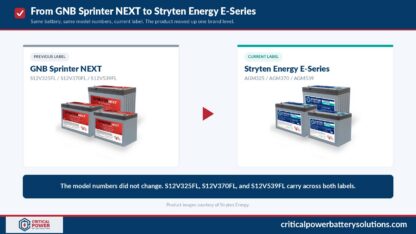
Before you plan how to replace Exide Technologies batteries with Stryten, you need a clear picture of product lineage and compatibility. Stryten now manufactures many of the legacy GNB Industrial Power designs, which simplifies migration for existing systems.
In our experience, this direct lineage is what makes it practical to replace GNB batteries with Stryten E‑Series without redesigning your UPS racks, DC systems, or substation layouts. This is especially important when you are managing large fleets across data centers, telecom networks, or utility yards.
Why Stryten Is The Natural Successor To Exide / GNB
Legacy GNB series such as Absolyte GP, Marathon, Sprinter, MCT, MCX, PDQ, and H1T now have Stryten successors with equal or improved specifications. This continuity saves you from re‑engineering string configuration, cabling, and protection schemes during replacement.
As an authorized Stryten Energy reseller, we see many customers standardize on Stryten because it protects past engineering investments while upgrading to tighter quality control and modern manufacturing capacity.

Specifying Stryten as an Exide replacement: documentation you’ll need
Replacing Exide Technologies industrial batteries with Stryten Energy product requires two documentation pieces in the procurement file.
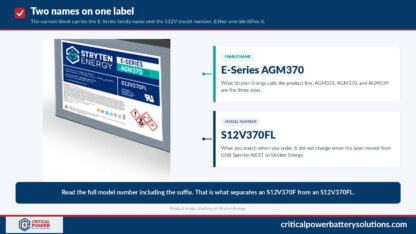
- Stryten Energy product branding clarification. Explains the modern Stryten naming convention. Useful when buyers see legacy GNB Industrial Power references in their existing equipment manuals or service records. Stryten formally introduced E-Series naming in March 2023.
- Stryten Energy factory authorization for CPBS. Confirms CPBS is authorized to specify, supply, install, and service the complete Stryten Essential Power line including Absolyte, Flooded Classic, AGM, and chargers. Protects warranty entitlement and procurement audit compliance.
Mapping Your Legacy Exide / GNB Models To Stryten E‑Series
The first tactical step is to identify what you currently have and map it to the correct Stryten replacement. Accurate model matching reduces risk and prevents undersized or incompatible installations.
We recommend you start by pulling nameplate data and layout drawings for each existing string, then use a mapping table like the one below as a working reference.
Common GNB To Stryten Replacement Pairs
| Legacy Exide / GNB Series | Typical Application | Recommended Stryten E‑Series Replacement |
|---|---|---|
| Absolyte GP | Data center, telecom, utility UPS | Stryten E‑Series Absolyte AGP (2 V VRLA AGM) |
| MCT flooded | Utility switchgear, industrial control | Stryten E‑Series MCT flooded |
| MCX flooded | Complex duty cycle industrial UPS | Stryten E‑Series MCX flooded |
| PDQ | High rate UPS, data center | Stryten E‑Series PDQ |
| H1T front‑terminal | Telecom, network UPS | Stryten E‑Series H1T |
For each site, document the exact GNB model, plate rating, and configuration, then confirm the matching Stryten part numbers with our engineering team before placing orders. This same mapping process works for how to replace GNB batteries across mixed fleets.

Legacy Exide/GNB models mapped to modern Stryten E-Series replacements (Absolyte GP → AGP, MCX, MCT, PDQ, H1T).
How To Plan Battery Replacement Without Downtime
Once you know the correct Stryten replacements, you need a detailed plan for how to plan battery replacement that fits your maintenance window and risk tolerance. Poor planning is the leading cause of unplanned outages during battery projects.
We recommend treating each site as a small project with documented scope, schedule, resources, and rollback options, especially for data centers with strict uptime SLAs and telecom hubs with 24/7 traffic.
Key Planning Steps For Critical Facilities
- Define critical loads and required runtime for each string.
- Decide whether you can de‑energize one string at a time or need temporary parallel capacity.
- Sequence replacement so that redundant paths remain online.
- Align with IT or grid operations for acceptable maintenance windows.
For facilities managers asking how to calculate battery runtime, we size to worst realistic outage duration, not just minimum code requirements, and then validate against manufacturer discharge tables for each Stryten model.

A proven sequence for replacing critical battery strings without risking downtime.
How To Size Battery Systems When Moving From Exide To Stryten
Many teams ask whether they can simply replicate existing Ah ratings or if they should revisit how to size battery systems during a technology refresh. Our recommendation is to treat replacement as an opportunity to verify that capacity still meets current loads.
Loads often grow over time, so sizing to the original design might leave you short during extended utility events or generator failures.
Practical Sizing Workflow
- Measure or estimate actual DC load in amps at nominal voltage.
- Decide target backup duration in minutes or hours per application.
- Use Stryten discharge curves to select Ah ratings that deliver required voltage at end of discharge.
- Apply design margins for temperature, aging, and future capacity loss.
For data center teams learning how to select data center batteries, we typically recommend premium VRLA like Stryten Absolyte AGP or PDQ that provide 20‑year design life and NEBS Level 3 compliance where required.

Sizing correctly prevents under-runtime and early failures especially during Exide/GNB replacements.
How To Install Stryten Batteries Safely And Correctly
Whether you are learning how to install Stryten batteries for the first time or updating existing procedures, correct installation is critical for safety, performance, and warranty compliance. Always follow NEC, local code, and Stryten installation manuals for each series.
Use full PPE, apply lockout/tagout, and de‑energize circuits where possible before any mechanical or electrical work on battery racks.
Core Installation Steps For Most Stryten E‑Series
- Inspect racks, cable lugs, and protective devices for corrosion or damage and replace as needed.
- Place cells or blocks per the layout drawing, keeping clearances for ventilation and maintenance.
- Torque intercell and terminal connections to manufacturer specifications using a calibrated torque wrench.
- Verify polarity and string voltage before connecting to the DC bus or UPS input.
For engineers asking how to install Absolyte AGP, follow Stryten’s VRLA AGM specific guidelines regarding restraint, seismic bracing, and ventilation, since Absolyte AGP offers 2 V cells from roughly 104 to 4,800 Ah with a 20‑year design life.

Safety + torque verification are the two most common “misses” that cause post-replacement issues.
Commissioning New Stryten Battery Systems After Exide Removal
After installation, you need to know how to commission battery systems so that you start their life under controlled, documented conditions. Commissioning also verifies that sizing and installation are correct.
We align our commissioning steps with IEEE 1188 for VRLA and IEEE 450 for flooded batteries, along with Stryten’s own procedures for each model.
Recommended Commissioning Tests
- Visual inspection of each jar or block for damage or electrolyte anomalies.
- Float voltage checks at each unit and across the full string.
- Initial equalize or boost charge where required by Stryten guidance.
- Baseline internal ohmic measurements to support future trending.
For teams documenting how to test UPS batteries during commissioning, we also recommend a controlled discharge test to a defined end voltage, then a review of results relative to rated capacity to confirm no early‑life defects.

Commissioning establishes a baseline so you can prove performance and track degradation over time.
How To Maintain Stryten VRLA And Flooded Batteries After Replacement
Knowing how to maintain Stryten batteries after you remove Exide units is essential if you want to achieve the typical 20‑year design life of products like Absolyte AGP or long service life for E‑Series flooded lines. Maintenance practices differ between VRLA and flooded technologies.
We structure maintenance programs according to IEEE 1188 for VRLA and IEEE 450 for flooded, then adjust for site conditions such as temperature and cycling frequency.
How To Maintain VRLA Batteries (Absolyte AGP, PDQ, H1T, NXT)
- Keep float voltage within Stryten’s specified window, adjusted for temperature.
- Perform periodic internal resistance or conductance tests to detect early deterioration.
- Inspect for bulging, leaks, or terminal corrosion every quarter or per your risk profile.
How To Maintain Flooded Batteries (MCT, MCX)
- Check electrolyte levels and specific gravity as specified by Stryten.
- Record cell voltages and temperature routinely for trending.
- Ensure adequate ventilation and spill containment per safety codes.
When facility teams ask how to maintain VRLA batteries versus how to maintain flooded batteries, our answer is to follow the standard plus the Stryten datasheet closely, then capture results in a maintenance log for lifecycle planning.
How To Extend Battery Lifespan And Avoid Premature Failures
Once you have completed the replacement, the focus should shift to how to extend battery lifespan so that you maximize return on investment. In our field experience, most premature failures trace back to temperature control, charging, or maintenance gaps.
Good practices are similar regardless of whether you replaced Exide batteries with Absolyte AGP, MCT, MCX, PDQ, NXT, or H1T.
Practical Ways To Extend Lifespan
- Maintain ambient temperature near 77 °F whenever feasible, or adjust float voltage for higher temperatures.
- Use Stryten’s recommended float and equalize settings, avoiding chronic overcharge or undercharge.
- Perform regular inspections and testing, then act early on abnormal trends.
For managers evaluating how to extend battery lifespan at multiple sites, we suggest standardizing procedures and training so that every technician performs the same checks regardless of location.
How To Troubleshoot Battery Issues After Switching To Stryten
Even with correct planning and installation, you need a clear process for how to troubleshoot battery issues in your new Stryten strings. Early detection avoids unexpected runtime loss when the system is called on during an outage.
Our troubleshooting approach starts with symptoms at the system level, then works down to individual jars or blocks using both electrical measurements and visual inspection.
Common Symptoms And Checks
| Symptom | Likely Causes | Initial Actions |
|---|---|---|
| Reduced runtime | Capacity loss, improper float, increased load | Confirm float settings, perform discharge or conductance test, verify load. |
| Hot spots or elevated jar temperature | Loose connections, internal fault | Check torque, inspect for corrosion, isolate suspect units. |
| Uneven float voltages | Aging spread, connection issues | Retorque, clean terminals, schedule equalize charge if appropriate. |
Document each issue and resolution so that trends across sites can be identified, especially if you manage fleets of similar Stryten installations replacing Exide or GNB designs.
Common Mistakes To Avoid When Replacing Exide With Stryten
From hundreds of replacement projects, we see the same avoidable mistakes when teams switch from Exide Technologies to Stryten without a structured process. Avoiding these pitfalls will protect uptime and the service life of your new batteries.
Most of these issues relate to incomplete planning, skipping tests, or assuming that any VRLA or flooded unit is a functional equivalent to the original GNB design.
Frequent Errors And How To Avoid Them
- Undersizing new strings. Always recalculate load and runtime rather than copying old Ah values.
- Mixing old and new units. Replace complete strings instead of inserting Stryten units into aged Exide strings.
- Ignoring commissioning tests. Perform acceptance testing so problems are caught before being put into service.
- Neglecting temperature. Plan for HVAC and ventilation, especially for sealed VRLA rooms or high density telecom racks.
When in doubt, engage our engineering team early, since correcting design mistakes after installation is almost always more disruptive than doing the upfront analysis.
When To Consult A Professional For Your Replacement Project
Certain projects are straightforward, such as one or two small UPS strings in a non‑critical office environment. However, when you work in data centers, telecom networks, utilities, or industrial plants, engaging professional support is often the safest and most cost effective path.
We advise involving experts whenever you are uncertain about how to choose industrial batteries, how to size battery systems for new loads, or how to commission battery systems in complex facilities.
Situations That Merit Expert Assistance
- High voltage DC systems or large multi‑string UPS plants.
- Seismic zone installations that must meet IEEE 693 or NEBS criteria.
- Substations and switchgear where NERC or utility standards apply.
- Facilities that cannot tolerate unplanned outages during cutover.
As a specialized division of ATS, we combine product supply with engineering support, so you can treat us as a technical partner rather than just a catalog supplier.
Conclusion
Replacing Exide Technologies and legacy GNB batteries with Stryten E‑Series is straightforward when you follow a structured process, map models correctly, and apply sound engineering practices for sizing, installation, commissioning, and maintenance. The GNB to Stryten product evolution gives you direct replacements that preserve your existing infrastructure while improving long term reliability.
If you would like help planning or executing your next replacement cycle, we are ready to support you with both product and technical guidance.
Next Steps
- Review Stryten product options that align with your legacy GNB fleet at our industrial battery products catalog.
- Evaluate whether Stryten Absolyte AGP is the right choice for your critical systems by reading our detailed guide at why Stryten Absolyte AGP is the go‑to for critical applications.
- Learn more about our company, engineering heritage, and quality processes at the About Us page.
- Request technical support or a sizing consultation for your Exide to Stryten project through our contact form.
Exide-to-Stryten Migration for Indian Industrial Sites
Exide Industries Ltd has a deep installed base across Indian industrial and standby applications, and many fleets are reaching end-of-life as Stryten emerges as the global Absolyte successor.
Where CPBS engages on Indian Exide migration:
- Sectors: Industrial standby, telecom, railway signaling, power utility substations
- Geography: Pan-India industrial corridors: Pune, Chennai, Hyderabad, Kolkata, Delhi NCR
- Scope: Exide-to-Stryten cross-reference, lifecycle migration planning, Absolyte AGP specification
- Engagement: Engineering consultation on installed-base review and replacement strategy
Project-scale only, discuss your Exide migration plan with our team.
India FAQ
Q: Can CPBS help replace Exide batteries with Stryten in India?
A: Yes, for project-scale industrial replacement programs. We provide Exide-to-Stryten cross-reference, lifecycle migration planning, and Absolyte AGP specification for industrial standby, telecom, railway signaling, and substation applications across Pune, Chennai, Hyderabad, Kolkata, and Delhi NCR.
Companion guide: replacing batteries bought under the Exide name? The Exide Absolyte end of life replacement guide owns the brand story: the buyer timeline, how to identify an Exide era string, the like for like Stryten Absolyte AGP successor, warranty continuity, and where to buy.