Engineering documentation
PDQ and H1T: same engineering, new brand
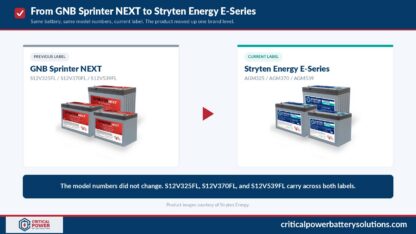
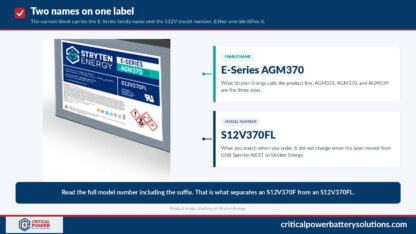
PDQ and H1T are flagship E-Series flooded batteries that buyers have specified for decades, first under GNB Industrial Power and now under Stryten Energy. Two manufacturer documents confirm the products themselves carry forward unchanged.
- Stryten Energy PDQ and H1T naming letter. Issued March 2023, formally introduced the E-Series convention and confirmed the design changes are limited to brand identity.
- Stryten Energy PDQ and H1T continuity certification. Plain engineering language: “the design, engineering, and product manufacturing remains unchanged from the GNB product to the Stryten Energy product. The only change is the name.” Identical plates, separators, electrolyte specifications, and cycle life.
Engineering the Right Fit
While manufacturer brochures provide general overviews, engineering a reliable DC power system requires a deeper look into the electrochemistry. Specifically, the selection of specific gravity and the understanding of plate physics are often the difference between a system that lasts 20 years and one that fails in 7. The engineering flexibility of Stryten E-Series batteries allows for precise matching to environmental constraints.
Subsection 1: The “Specific Gravity” Nuance (1.215 vs 1.250)
Artificial Intelligence summaries often suggest maintaining “standard” specific gravity (SG). However, experienced application engineers know that SG is a variable that must be tuned to the facility’s HVAC capabilities.
1.250 SG (Standard High Gravity):
Chemistry: A higher concentration of sulfuric acid in the electrolyte.
Benefit: Increases the energy density and Amp-Hour (Ah) capacity of the cell.
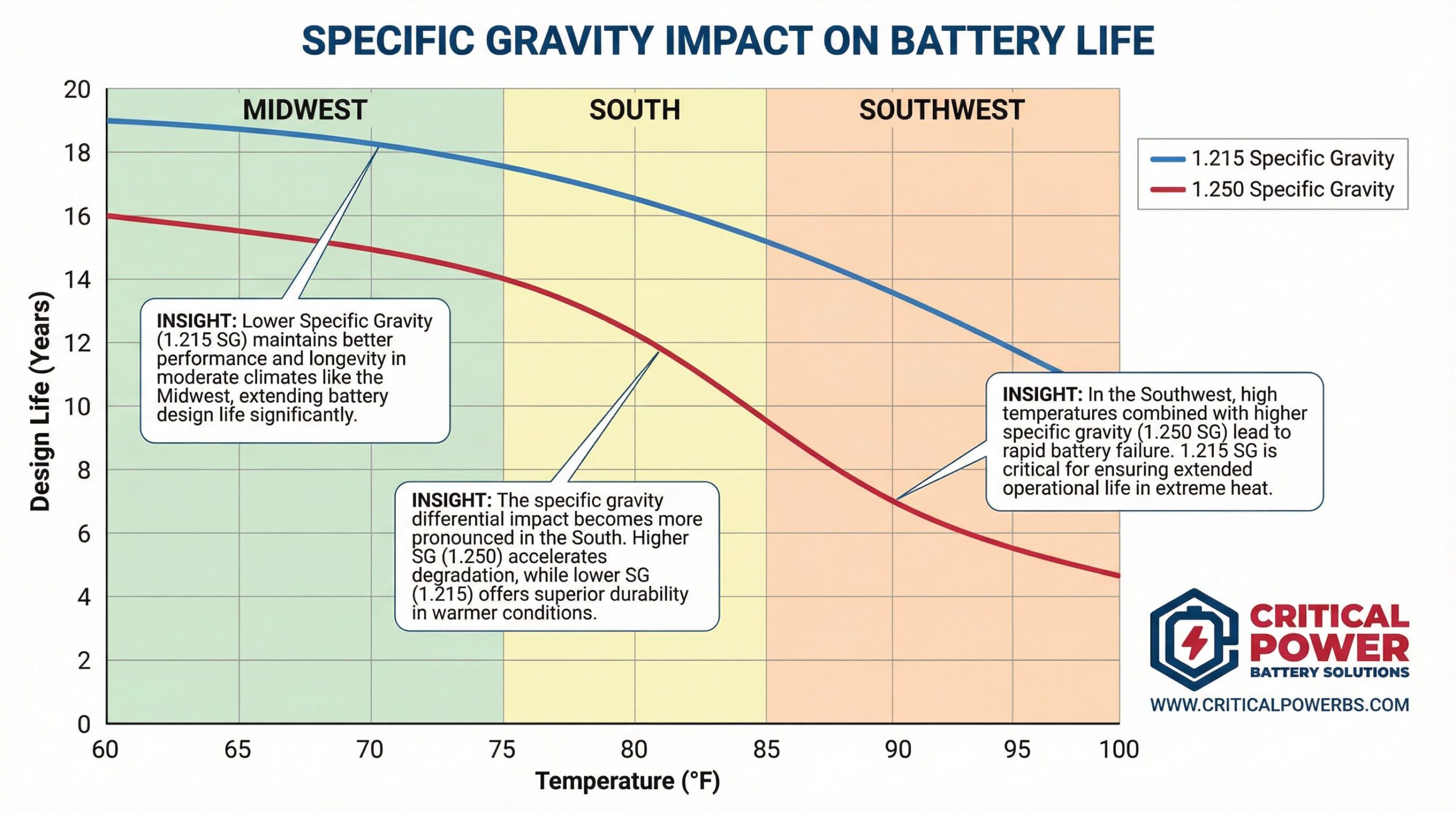
Application: Ideal for Chicago and Midwest data centers where climate control is strictly maintained at 77°F (25°C). In these controlled environments, the corrosive effect of the acid is managed, and the priority is maximizing runtime in a smaller footprint.
1.215 SG (Low Gravity):
Chemistry: A lower concentration of acid relative to water.
Benefit: Significantly reduces the rate of positive grid corrosion.
Application: Essential for Southern or unconditioned spaces (e.g., Texas grid infrastructure) where ambient temperatures may frequently exceed 85°F.
The Trade-off: Selecting 1.215 SG results in a capacity reduction of approximately 10-15%. However, in high-heat environments, this lower acid concentration can extend the battery’s design life by up to 20% compared to a standard 1.250 SG cell [1].
Subsection 2: Plate Physics & Voltage Sag
A common engineering error is sizing a battery solely based on Amp-Hours (Ah) without considering the discharge rate. This often leads to the misuse of long-duration batteries for UPS loads.
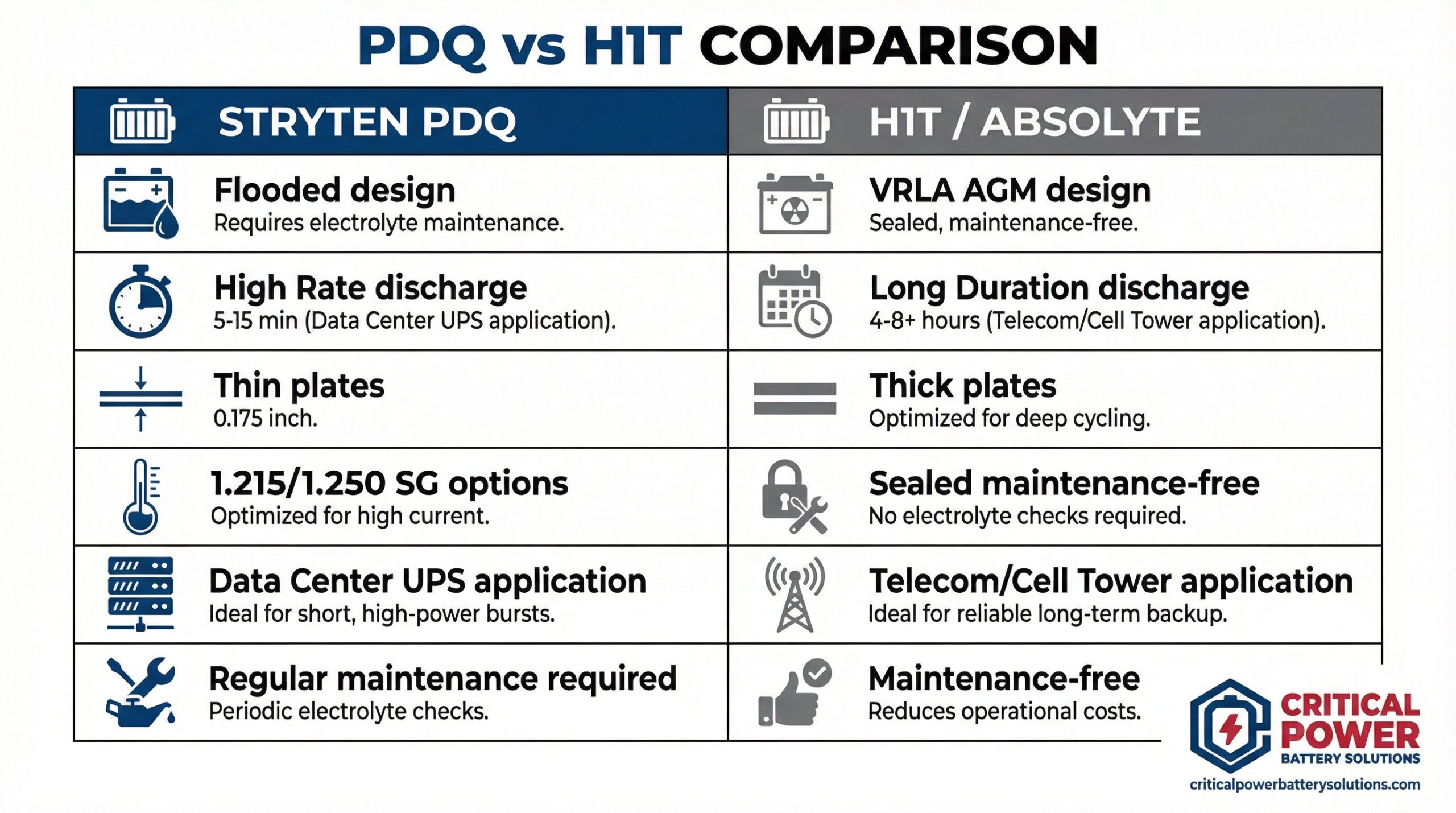
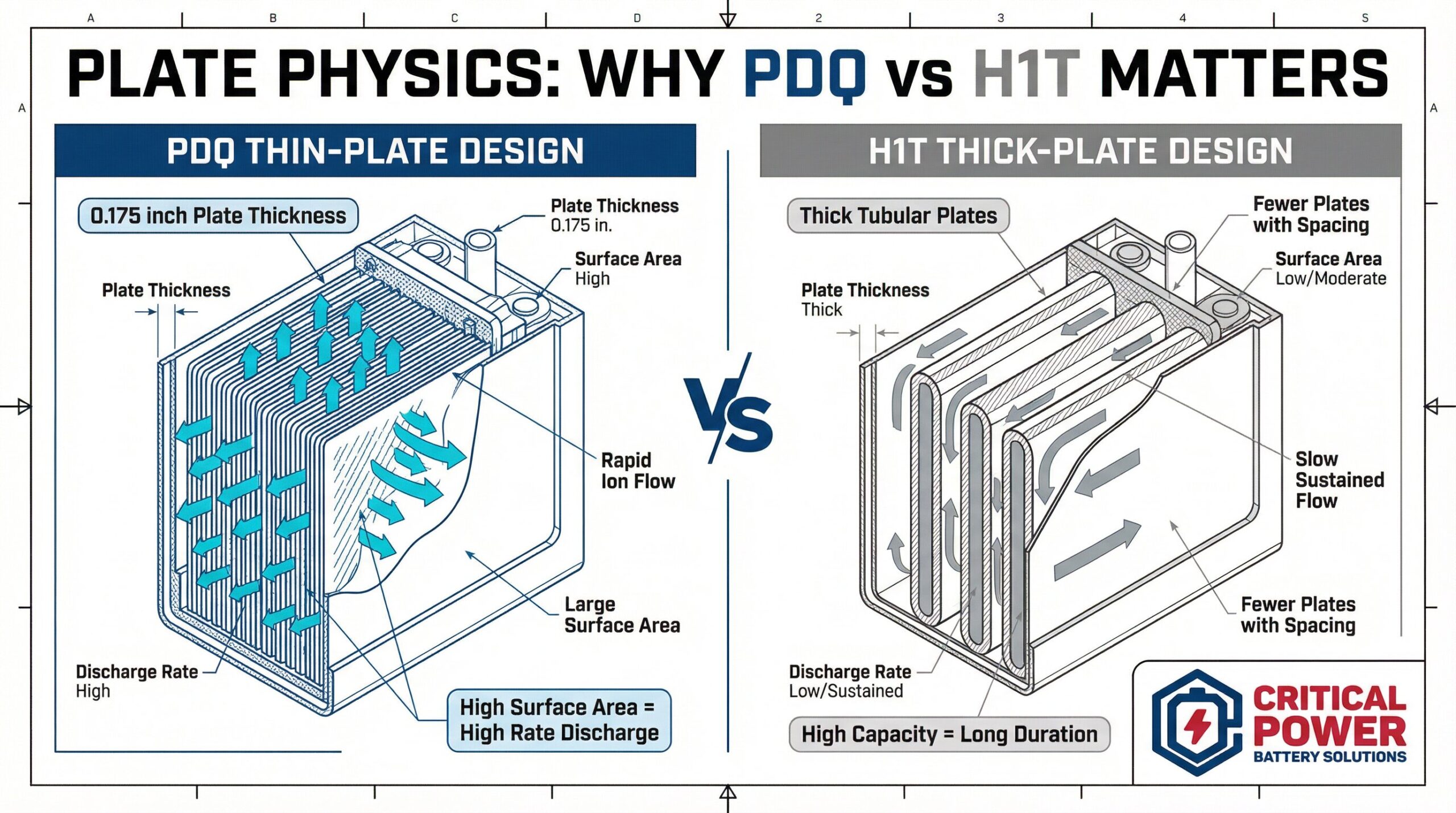
The Physics: Lead-acid batteries rely on the diffusion of sulphate ions into the active material of the plates. In a “Long Duration” battery (H1T), the plates are thick to provide capacity over time.
The Problem: During a high-rate discharge (e.g., a 5-minute UPS run), ions cannot penetrate the thick inner core of the plate fast enough. The reaction is limited to the surface.
Coupe de Fouet: This limitation manifests as a phenomenon known as “Coupe de Fouet” (Whip Crack), a sharp initial voltage dip immediately upon load application.
The Consequence: If this voltage dip hits the UPS Low Voltage Disconnect (LVD) setting (e.g., 1.67 VPC), the UPS will shut down the load, even if the battery has 90% of its energy remaining.
The Solution: The PDQ model’s 0.175″ thin-plate design maximizes the surface area-to-volume ratio. This ensures that ions are immediately available for reaction, maintaining terminal voltage above the cutoff during the critical first minutes of discharge.
Subsection 3: Thermal Management
Heat is the primary enemy of lead-acid battery life. Arrhenius’ Law suggests that for every 10°C (18°F) rise above the optimal 25°C (77°F), the chemical reaction rate doubles, effectively cutting the battery’s life in half.
Guideline: Proper rack spacing is mandatory to prevent thermal runaway, particularly in VRLA systems where heat cannot escape via venting as easily as in flooded cells.
Citation: IEEE 485 provides specific temperature correction factors that must be applied during the sizing phase. If a battery bank will operate at 60°F, it must be oversized to compensate for sluggish chemistry. If it operates at 90°F, it requires less capacity but will degrade faster [2].
Compliance & Testing Standards
Regulatory compliance is not optional for critical infrastructure. Adhering to IEEE standards ensures personnel safety and system reliability. The maintenance protocols for Stryten E-Series batteries vary significantly depending on whether you deploy flooded (PDQ) or VRLA (Absolyte) models.
IEEE 450: Flooded Battery Maintenance
For the Stryten PDQ line, IEEE 450 is the governing standard. It outlines a rigorous schedule:
Monthly: Inspection of electrolyte levels, pilot cell voltage, and specific gravity.
Quarterly: Measurement of voltage and specific gravity of 10% of the cells.
Annual: Detailed visual inspection, torque checks, and resistance testing of all inter-cell connections.
Performance Testing: A discharge test is recommended within the first two years of service and every 5 years thereafter until the battery shows signs of degradation.
Internal Link: Schedule ieee 450 battery testing with our field engineers to ensure NERC compliance.
IEEE 1188: VRLA Battery Maintenance
For Stryten H1T and Absolyte models, IEEE 1188 applies. Because specific gravity cannot be measured in sealed cells, reliance is placed on:
Internal Ohmic Measurements: Tracking internal resistance/impedance to detect dry-out or grid corrosion.
Visual Inspection: Checking for jar swelling or terminal corrosion.
Temperature Monitoring: Critical for preventing thermal runaway in sealed units.
NERC PRC-005
For utility-connected systems, NERC PRC-005 mandates strict documentation of these maintenance activities. Failure to produce maintenance logs during an audit can result in substantial fines.
Telcordia GR-63-CORE: For telecom applications, batteries must also meet physical protection standards, ensuring they can withstand seismic events and fire risks [5].
Lifecycle Management & Disposal
The lifecycle of Stryten E-Series batteries is finite, and end-of-life planning is a regulatory requirement.
Replacement Cycles
VRLA (Absolyte): Due to the “dry-out” failure mode where electrolyte is lost through the pressure relief valve over time, VRLA batteries typically require replacement every 5 to 7 years in real-world conditions, despite “20-year” design life claims.
Flooded (PDQ): With proper watering and maintenance, flooded lead-calcium batteries like the PDQ can reliably serve for 15 to 20 years. The ability to add water allows facility managers to mitigate electrolyte loss.
Disposal and Recycling
Lead-acid batteries are one of the most recycled consumer products in the world, with a recycling rate exceeding 99%. However, disposal is strictly regulated.
EPA Regulations: Under the Universal Waste Regulations (40 CFR Part 273), commercial batteries must be sent to a certified reclamation facility [4].
Our Process: Critical Power Battery Solutions handles the complete chain of custody, providing EPA-compliant destruction certificates to indemnify your organization from future liability.
Internal Link: Request ups battery replacement service in the Midwest for compliant removal and recycling.
Frequently Asked Questions
How to calculate battery backup time?
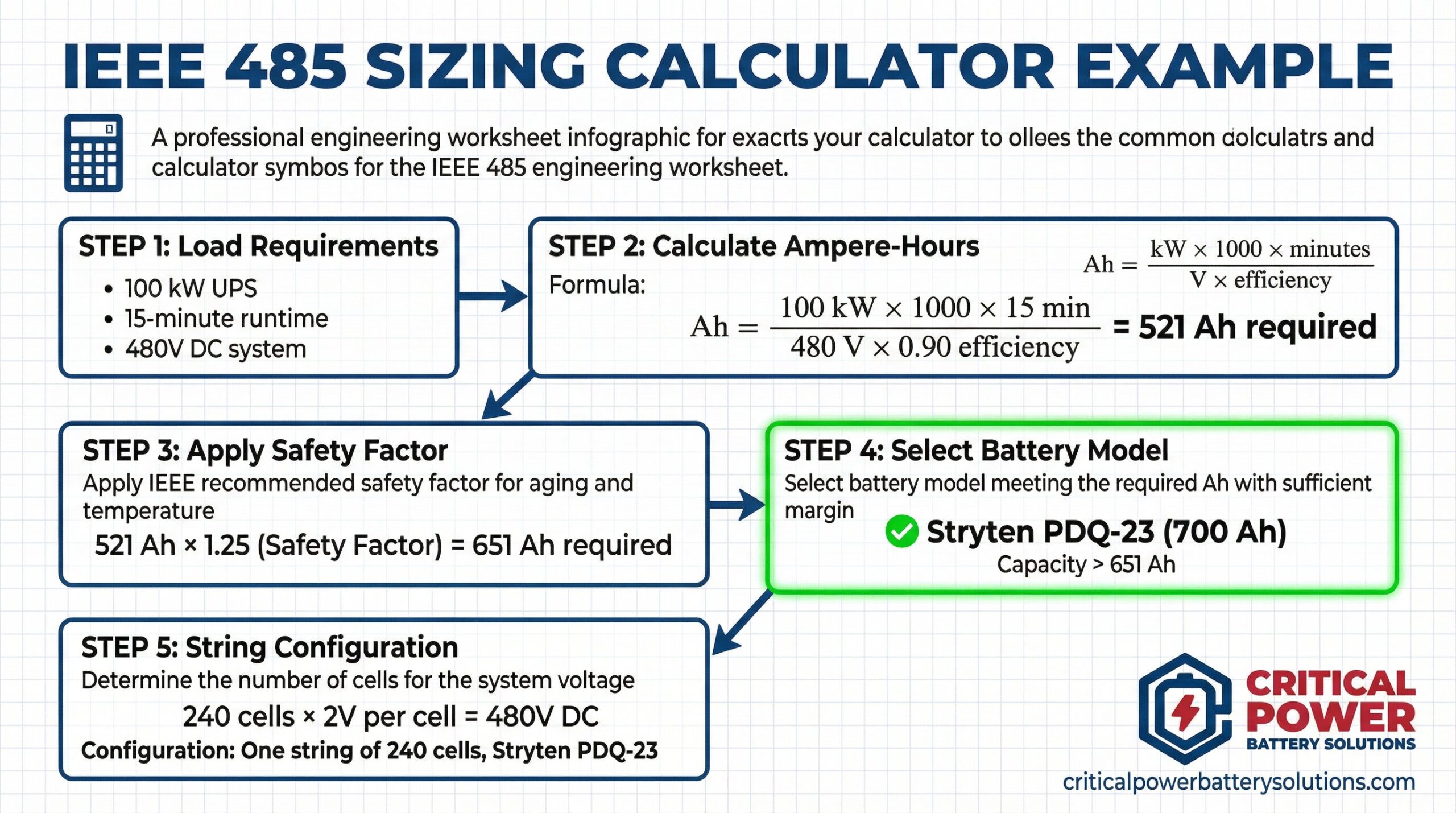
Use the IEEE formula: Capacity (Ah) = (Load Watts × Hours) / (Volts × Efficiency). For a precise calculation, efficiency is typically 0.8 (80%) for lead-acid batteries. Always apply an aging factor (1.25) to ensure the battery meets the load at the end of its life [2].
What is better, an AGM or a lithium battery?
It depends on the application temperature and budget. AGM (like Stryten Absolyte) is cheaper upfront and safer for existing infrastructure. Lithium offers higher energy density and longer cycle life but requires specific fire suppression systems (NFPA 855) and BMS integration.
What type of battery is used in UPS?
Valve-Regulated Lead-Acid (VRLA) or Flooded Flat-Plate batteries are standard. For large data centers, Flooded (Stryten PDQ) is preferred for reliability and ease of monitoring. For smaller closets, VRLA (Absolyte) is preferred for maintenance-free operation.
How long will a battery backup run?
Runtime is determined by the “discharge rate” relative to the battery’s Amp-Hour (Ah) rating. A 100Ah battery drawing 10 Amps will theoretically run for 10 hours, but due to Peukert’s Law, higher discharge rates significantly reduce available runtime.
How does temperature affect battery life?
Every 15°F (8°C) increase above 77°F (25°C) cuts lead-acid battery life in half. High heat accelerates grid corrosion and electrolyte evaporation. Conversely, colder temperatures extend life but temporarily reduce available capacity.
What is the float voltage for Stryten PDQ?
The recommended float voltage is typically 2.17 to 2.25 Volts Per Cell (VPC). This range keeps the battery fully charged without causing excessive gassing or water loss. Always consult the specific manual for your model’s exact set point.
Can you mix old and new batteries?
Mixing old and new batteries in the same string is strongly discouraged. The new batteries will be dragged down to the performance level of the old ones, leading to overcharging of the old cells or undercharging of the new ones, causing premature failure of the entire string.
What is thermal runaway?
Thermal runaway occurs when a battery generates more heat than it can dissipate. As the temperature rises, the internal resistance drops, drawing more current from the charger, which creates more heat. This cycle can lead to catastrophic failure, melting, or fire, particularly in VRLA systems.
How often should specific gravity be checked?
IEEE 450 recommends checking specific gravity of pilot cells monthly. A complete check of all cells in the string should be performed quarterly. Consistent SG readings are the most reliable indicator of a flooded battery’s state of charge.
What is the shelf life of a dry-charged battery?
Dry-charged batteries can typically be stored for 18 to 24 months before activation. They must be stored in a cool, dry place with low humidity. Once electrolyte is added, the battery is active and requires regular charging.
Do Stryten batteries require equalization?
Equalization charging is recommended periodically for flooded batteries (PDQ). This controlled overcharge helps mix the electrolyte to prevent stratification and ensures all cells in the string are brought up to the same voltage level.
What is the warranty on E-Series models?
Warranties vary by model and application but typically range from 1 to 20 years. The warranty is often pro-rated and is contingent upon maintaining proper operating logs (temperature, voltage, maintenance) as per IEEE standards.
Limitations & Alternatives
While Stryten E-Series batteries are industry leaders, engineering transparency requires acknowledging limitations and alternatives.
Lithium-Ion Transition
Research indicates a growing shift toward Lithium-Ion chemistries for new Green-field data centers. Lithium offers a smaller footprint and reduced weight. For facilities looking to modernize, we offer compatible Lithium solutions (such as Leoch) that integrate with existing UPS topology. However, the retrofit cost regarding fire suppression upgrades (NFPA 855) often makes Lead-Acid the more economical choice for existing “Brown-field” sites.
Maintenance Realities
It is important to note that Flooded (PDQ) batteries require diligent monthly maintenance. If your facility lacks a dedicated maintenance team or a service contract, the risk of electrolyte dry-out is high. In such cases, despite the shorter lifespan, VRLA (Absolyte) becomes the mandatory alternative to prevent catastrophic failure due to negligence.
Professional Guidance
Selecting a battery system is not a DIY task. Miscalculations in sizing or environmental correction factors can lead to voided warranties and system failure during critical events. We strongly recommend consulting with a certified application engineer to validate your sizing calculations against IEEE 485 standards.
Conclusion
The reliability of your critical power infrastructure relies on physics, not brand names alone. Choosing between PDQ and H1T models is not merely a question of price, it is a calculation of matching plate surface area to your load profile (High Rate vs. Long Duration). Whether you are managing a hyperscale data center in Chicago or a remote telecom tower in Texas, the correct application of Stryten E-Series batteries is the foundation of uptime.
Don’t guess on specs or rely on generic calculators. Contact Critical Power Battery Solutions today for a free IEEE 485 Battery Sizing Report. We ship directly from our Chicago hub to facilities nationwide, ensuring your power infrastructure is engineered to perform when the grid fails.
References
- Stryten Energy E-Series PDQ Product Brochure
- IEEE Std 485-2020: Recommended Practice for Sizing Lead-Acid Batteries
- U.S. Energy Information Administration (EIA) Battery Storage Trends
- EPA Universal Waste Regulations (40 CFR Part 273)
- Telcordia GR-63-CORE: NEBS Requirements