VRLA Battery Sizing Guide: How To Right-Size Backup Power For Mission‑Critical Facilities
Many critical facilities oversize or undersize their VRLA banks because they do not fully account for real-world conditions, even though industry data shows elevated temperatures can cut lead‑acid battery life by about 50% for every 8°C above 25°C, which has a direct impact on how you should size and specify your backup systems.
Key Takeaways
| Question | Answer |
|---|---|
| How do I start a VRLA battery sizing exercise? | Begin by defining your critical loads, required runtime, and acceptable depth of discharge, then translate kW to DC amps and apply a 10–15% design margin as commonly recommended for ups battery systems and standby power systems. You can see how we frame this process across multiple applications in our battery selection guides. |
| What role does application type play in VRLA sizing? | Data centers, telecom, utilities, and industrial facilities all use VRLA differently, from short high‑rate UPS support to multi‑hour telecom battery backup strings, so sizing must reflect discharge profile, ambient temperature, and availability targets. We outline these differences in our data center battery articles. |
| How deep can I discharge VRLA in critical power battery applications? | AGM VRLA can typically be safely discharged up to around 80% DoD for cycle life comparable to flooded lead‑acid at 50% DoD, but many stationary battery systems are sized for 20–50% DoD to extend life. We discuss DoD strategy in our battery sizing guide resources. |
| Where can I browse VRLA options for different industrial power solutions? | We maintain a curated catalog of VRLA products suitable for industrial battery solutions, data center battery replacements, and emergency backup power applications. Explore current options in our VRLA battery category. |
| How do I justify VRLA upgrades to finance and management? | Frame decisions in terms of total cost of ownership, cost per year of service, and risk mitigation for mission critical power events, referencing industry standards and lifecycle expectations. For context on technology evolution and reliability, see our overview of battery technology developments. |
| Can I get help choosing between VRLA brands and chemistries? | Yes, our team has 40+ years in industrial power solutions and supports both Leoch VRLA and Stryten Energy flooded and VRLA lines, helping you align products with your uninterruptible power supply and compliance needs. You can see our broader capability by visiting our Critical Power Battery Solutions home page. |
| How does VRLA sizing differ for telecom versus other standby power systems? | Telecom networks often use front‑terminal strings in tight cabinets with NEBS considerations and long runtimes, so volumetric energy density and temperature performance are more critical than in some UPS rooms. We outline telecom‑specific considerations in our telecom battery systems content. |
👤 Article by: Tom Kierna
Reviewed by: CPBS Engineering Team
Last updated: 28 January 2026
Credentials: Authorized Stryten Energy battery Reseller, ISO 9001 Certified, IEEE Standards Member


Why A Structured VRLA Battery Sizing Guide Matters For Critical Facilities
For facilities that depend on critical power battery systems, VRLA sizing is not a one‑line calculation, it is a risk management decision that affects uptime, safety, and budget over 10 to 20 years.
At Critical Power Battery Solutions, backed by more than 40 years in industrial battery solutions through our parent company Advanced Technical Solutions (ATS), we have seen well‑sized VRLA banks quietly support 99.99% uptime and poorly sized banks drive repeated emergency replacements and unplanned outages.
VRLA technology, especially AGM and pure‑lead variants, remains a mainstay in battery backup systems for data centers, telecommunications, utilities, and industrial plants.
A structured VRLA battery sizing guide helps you justify decisions to engineering peers and finance teams, anchor your design in standards, and select products that align with your mission critical power requirements.
Core Concepts In VRLA Battery Technology For Sizing Decisions
Before you size a bank, it is important to align on what vrla battery technology brings to the table compared to flooded lead‑acid or lithium systems.
VRLA AGM and pure‑lead batteries offer sealed construction, low maintenance, relatively low self‑discharge, and predictable performance across a wide temperature band, which is why they dominate ups battery systems and standby power systems today.
Industry data shows that AGM VRLA can typically be discharged up to about 80% depth of discharge while still achieving comparable cycle life to flooded batteries that are limited to around 50% DoD, which directly impacts how many amp‑hours you need to install.
At the same time, many enterprise designs intentionally target 20–50% DoD for key events to lengthen service life and keep capacity in reserve for multi‑event scenarios, especially in data center battery and utility substation applications.

Depth of Discharge vs Cycle Life: Based on ODYSSEY AGM² Performance Data
Step‑By‑Step VRLA Battery Sizing Methodology
In our experience across hundreds of projects, a defensible VRLA sizing process follows a set of consistent steps, regardless of whether you are supporting a 10 kW UPS or a 2 MW uninterruptible power supply array.
The high‑level workflow is to define load and runtime, convert to DC amps, select appropriate DC voltage and string architecture, pick an amp‑hour range, apply aging, temperature, and design margins, and then map to specific models in your chosen vendor family.
Practical sizing steps for stationary battery systems
- List all critical loads in kW or kVA, then determine which are supported by the VRLA bank during different outage scenarios.
- Convert AC kW to DC amps at your battery bus voltage, adjusting for UPS or DC system efficiency.
- Select a target runtime for your scenario (for example 5, 15, or 30 minutes for UPS, or 2–8 hours for telecom and substation battery energy storage functions).
- Choose a target end‑of‑discharge voltage and acceptable DoD based on lifecycle expectations.
- Apply adjustment factors for temperature, aging, and a design margin, which many engineering guides suggest at about 10–15% for UPS and emergency backup power systems.

VRLA Sizing Methodology: 6-Step Process Following IEEE 485 Standard
Only after those steps do we recommend moving into product‑level discussions, such as whether a 150 Ah, 210 Ah, or 300 Ah nominal rating is appropriate for a given string using real manufacturer discharge curves instead of nameplate values.
For global deployments, we also factor in logistics and supply chain availability so that the selected VRLA families can be supported through their entire lifecycle at your remote and international sites.
Depth Of Discharge, Cycle Life, And Design Margin In VRLA Sizing
Depth of discharge is one of the most leveraged variables in VRLA sizing, because it affects both how much capacity you must install and how often you will need to replace your bank.
For example, published ODYSSEY AGM² data, which is typical of premium AGM VRLA, shows that around 20% DoD can yield approximately 2,000 cycles, while 80% DoD may yield roughly 400 cycles, so your DoD target effectively trades runtime headroom for replacement frequency.
Applying design margin and DoD strategy
Most engineering teams we work with choose a conservative DoD target for routine events, then maintain the ability to go deeper during rare extended outages, which keeps stationary battery systems within their planned lifecycle.
On top of that, design margin of 10–15% is typically added to account for installation variances, battery aging, and minor load growth, especially in critical power battery use cases where unplanned degradation can have disproportionate business impact.
Those parameters form the basis of a technical and financial argument you can present to management, such as comparing cost per year of service or cost per delivered kWh over the planned life between a shallow‑DoD, higher‑Ah system and a deeper‑DoD, lower‑Ah installation.
We often share these tradeoffs early in a project so that uptime stakeholders and finance teams align on an acceptable DoD and replacement schedule before hardware is specified.
Temperature, Environment, And Their Impact On VRLA Sizing
Temperature is one of the most misunderstood inputs in VRLA sizing for industrial power solutions, even in controlled data center and telecom spaces.
Industry guidance indicates that for lead‑acid batteries, every 8°C increase above 25°C can roughly halve expected life, so a bank designed for 10 years at 25°C may provide only about 5 years at 33°C unless you compensate in your sizing and replacement planning.

Temperature Derating Factors: Impact on VRLA Battery Capacity and Lifecycle
Adjusting capacity and expectations for real conditions
For indoor UPS rooms held near 22–25°C, temperature derating may be minor, but for rooftop telecom cabinets, substation control houses, and industrial MCC rooms, we regularly apply temperature adjustment factors to ensure adequate capacity at end of life.
We also pay close attention to ventilation and rack layout for front‑terminal VRLA, because hot spots within a string can accelerate imbalance and reduce effective usable capacity, particularly in high‑density telecom battery backup installations.
Application‑Specific Sizing: Data Center, Telecom, Utility, And Industrial
While the physics of VRLA are consistent, the way we apply sizing principles differs across data center battery, telecom, utility, and industrial customers.
Each environment presents unique constraints on runtime, footprint, standards compliance, and integration with upstream and downstream systems.

Application-Specific VRLA Sizing: Runtime, DoD, and Voltage Requirements by Industry
Data center and UPS battery systems
In Tier III and IV facilities, UPS VRLA banks are often sized for relatively short runtimes, such as 5–15 minutes at full load, and designed to support high discharge rates while maintaining bus voltage and ensuring proper match with UPS charging profiles.
For these ups battery systems, decisions focus on high‑rate performance curves, cabinet form factor, and ease of maintenance to support zero‑downtime replacement strategies that align with IEEE 1188 testing and maintenance programs.
Telecom battery backup and remote sites
Telecom networks typically require hours of runtime in constrained enclosures, so we often recommend high‑density front‑terminal VRLA such as Leoch PLH series products as part of broader telecom battery backup solutions.
Runtime must be validated at realistic temperatures for outdoor cabinets, and NEBS or equivalent requirements help shape selection and sizing for central offices and 5G edge sites.
Utility substations and industrial process facilities
Utility substation DC systems support protection relays, breakers, and communication gear through a mix of steady and momentary duty cycles, so sizing must meet both long‑duration control loads and brief high‑current events.
Industrial plants use VRLA to support process control, safety systems, and emergency backup power for critical equipment, where IEEE maintenance guidance and site‑specific safety rules drive how much redundancy and design margin is appropriate.

Using Leoch XP12 VRLA Batteries As Practical Sizing Examples
To make the sizing process more concrete, it helps to anchor calculations to actual VRLA families such as the Leoch XP12 series, which ranges from 100 Ah to 490 Ah in 12 V blocks for battery backup systems.
These products are engineered for UPS, data center, telecom, and other mission critical power installations, and their discharge tables provide reliable guidance for high‑rate and long‑duration sizing.
Mapping load and runtime to Leoch XP12 models
Suppose a 48 V DC system needs to support 4 kW for 10 minutes through a string of 12 V VRLA blocks, after accounting for converter and UPS efficiency, we can translate that requirement into a per‑block current and then use Leoch XP12‑150 or XP12‑210 datasheets to find the amp‑hour class that meets the duty at the target end‑of‑discharge voltage.
For larger enterprise loads, XP12‑300 and XP12‑490 give more runtime per string, which can reduce the number of parallel strings, simplify cabling, and improve maintenance in large industrial power solutions rooms.
| Model | Nominal Voltage | Nominal Capacity (Ah) | Typical Use Case |
|---|---|---|---|
| Leoch XP12‑100 | 12 V | 100 Ah | Small UPS, network closets, branch office battery backup systems |
| Leoch XP12‑150 | 12 V | 150 Ah | Mid‑range UPS, small data center battery rooms, industrial control |
| Leoch XP12‑210 | 12 V | 210 Ah | Enterprise UPS racks, telecom shelters, larger standby systems |
| Leoch XP12‑300 | 12 V | 300 Ah | High‑demand critical power battery applications, extended runtime |
| Leoch XP12‑490 | 12 V | 490 Ah | Maximum capacity enterprise and utility installations |
With a consistent family like XP12, many of our clients standardize across multiple sites, simplifying spares, training, and testing procedures while maintaining flexibility to mix capacities in different strings based on local runtime requirements.
From a total cost of ownership standpoint, choosing a higher‑Ah block that reduces string count can also reduce long‑term labor and inspection time, which is a material component for large VRLA fleets.
Front‑Terminal VRLA For Telecom And High‑Density Racks
Front‑terminal VRLA products, such as the Leoch PLH series, are particularly relevant in this VRLA battery sizing guide because they change how many amp‑hours you can physically install per rack and how efficiently your technicians can maintain strings.
These pure‑lead front‑terminal designs are engineered for high‑rate discharge and extended life in telecom, data center, and network equipment rooms, where footprint and serviceability are constrained.
Sizing with front‑terminal constraints
When sizing PLH strings, we often begin with the same electrical calculations as for XP12, then overlay mechanical constraints such as maximum cabinet height, allowable floor loading, and minimum clearance for terminations and IR scanning.
In practice, that can mean choosing between PLH100, PLH150, PLH170, PLH190, or PLH210 depending on your target runtime and rack layout, rather than simply selecting the highest amp‑hour available.
| Model | Capacity (Ah) | Form Factor | Primary Applications |
|---|---|---|---|
| Leoch PLH100FT(A) | 100 Ah | Front‑terminal 12 V | Standard telecom racks, small network POPs |
| Leoch PLH150FT(A) | 150 Ah | Front‑terminal 12 V | Mid‑range telecom and data center strings |
| Leoch PLH170FT(A) | 170 Ah | Front‑terminal 12 V | High‑performance telecom requiring longer runtime |
| Leoch PLH190FT(A) | 190 Ah | Front‑terminal 12 V | NEBS‑sensitive, high‑density telecom applications |
| Leoch PLH210FT(A) | 210 Ah | Front‑terminal 12 V | High‑capacity telecom and data center racks |
With front‑terminal systems, our clients often see a reduction in maintenance time and safety risk, which is an important, though indirect, factor in total cost of ownership for VRLA‑based telecom battery backup and data center battery installations.
We also evaluate how front‑terminal strings align with monitoring hardware and IEEE 1188 testing practices to preserve predictable lifecycle performance.

VRLA Product Selection Matrix: Leoch XP12 Series and Stryten Absolyte AGP Comparison
Total Cost Of Ownership, Testing, And Replacement Planning
In our role as a long‑term partner rather than a transactional vendor, we encourage teams to view VRLA sizing as a lifecycle decision that spans design, commissioning, maintenance, and replacement.
For critical power battery fleets, the largest cost driver is often not the initial purchase, but the combination of labor, testing, planned replacements, and disruptions associated with outages or emergency work.
Aligning sizing with standards and testing programs
Standards such as IEEE 450 and IEEE 1188, while focused on maintenance and testing, implicitly influence sizing and technology choice because they define how the batteries will be evaluated over time.
When we size VRLA systems, we account for the type of capacity testing you plan to perform, anticipated re‑rating over life, and how replacement intervals will align with your budgeting process, so that your installed capacity and testing cadence support your compliance and uptime commitments.
Practically, many organizations evaluate VRLA options based on cost per year of service or cost per guaranteed kW‑minutes of runtime at end‑of‑life capacity, which allows meaningful comparison between mid‑range and premium technologies.
This is where technologies like pure‑lead VRLA and high‑reliability brands such as Stryten Energy and Leoch can demonstrate value beyond initial cost, especially for high‑stakes mission critical power environments.
How Critical Power Battery Solutions Supports VRLA Sizing And Lifecycle Management
As an authorized distributor and technical partner, our team at Critical Power Battery Solutions combines product expertise with application engineering to support VRLA sizing and deployment across data center, telecom, utility, and industrial portfolios.
We work alongside facilities managers, engineering directors, and procurement professionals to align technology choices with internal standards, uptime SLAs, and financial planning horizons.
Our role as a trusted advisor for industrial power solutions
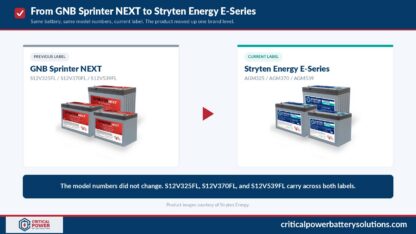
With over four decades of experience in industrial power solutions through ATS, we bring context from previous generations of GNB, Exide, and modern VRLA platforms, which is particularly useful when replacing legacy banks or standardizing across multiple sites.
Our support covers front‑end sizing, product selection, logistics planning, and ongoing technical assistance, so your VRLA sizing decisions remain defensible and adaptable as your load profile and compliance environment evolve.
Integrating VRLA Sizing With Broader Critical Infrastructure Planning
A robust VRLA battery sizing guide should never be used in isolation, it is one part of a broader critical infrastructure strategy that spans upstream generation or utility feeds and downstream distribution and load segmentation.
As your facilities incorporate more battery energy storage, renewables, and intelligent power management, the role and sizing of VRLA banks may shift from simple standby to more dynamic support under diverse operating modes.
Coordinating VRLA with long‑term infrastructure strategy
We encourage teams to revisit VRLA sizing assumptions whenever there are significant changes to IT load, building systems, protective relay schemes, or telecom architecture, rather than simply replacing banks on a like‑for‑like basis.
Doing so can avoid over‑investment in capacity that no longer aligns with your resilience strategy or under‑investment that fails to account for load growth and rising uptime expectations in modern digital operations.
Conclusion
VRLA battery sizing is ultimately about aligning electrical requirements, environmental realities, and business objectives into a configuration that reliably supports your uninterruptible power supply and standby power systems through their entire lifecycle.
By methodically defining loads and runtimes, choosing appropriate DoD and design margins, accounting for temperature and mechanical constraints, and mapping requirements to proven VRLA families like Leoch XP12 and PLH, you can support uptime targets while maintaining a strong total cost of ownership story for stakeholders.
Our team at Critical Power Battery Solutions, together with ATS, is available to act as a technical partner for your next VRLA sizing or replacement project, whether it involves a single telecom shelter or a multi‑site industrial power solutions program.
To move forward in a low‑risk and informed way, we recommend the following next steps:
- Request a structured load and runtime assessment for your existing VRLA or planned battery backup systems, so we can validate current sizing against your uptime and lifecycle objectives.
- Schedule a consultation with our battery engineers to review options in our VRLA and stationary battery product portfolio and align them with your application, standards, and budget.
- For organizations evaluating multiple vendors, use our background on GNB and Stryten evolution at GNB Industrial Power history to inform your technology roadmap.
- If you are consolidating suppliers across data center, telecom, and industrial sites, review our company background at About Critical Power Battery Solutions and ATS at ATS to see how a single long‑term partner can support your VRLA sizing, deployment, and lifecycle management strategy.
Application example: For a worked application of standby battery selection in transit and commuter rail signaling and traction power substation DC control, see the regional transit rail battery solutions guide.