Flat-Plate Technology Comparison: Standard vs. NXT Patented Alloy Design
Technical Deep Dive: flat-plate flooded design with patented lead-calcium-tin-silver alloy Technology
The core advantage of the Stryten E-Series NXT is the flat-plate flooded design with patented lead-calcium-tin-silver alloy, where active material is pasted onto a lead-calcium-tin-silver alloy grid that resists corrosion and shedding. This fundamental design difference addresses the primary failure mode of stationary batteries: the shedding of active material.
The Physics of Failure vs. Longevity
In standard flat-plate batteries, the expansion and contraction of the plates during discharge cycles eventually cause the lead paste to loosen and fall to the bottom of the jar (shedding). This results in a gradual loss of capacity and eventual short circuits. A flat-plate flooded design with patented lead-calcium-tin-silver alloy battery mitigates this by using a patented alloy grid that provides superior corrosion resistance. This advanced alloy grid maintains structural integrity, ensuring electrical continuity even as the material expands.
Cycle Life and Design Specifications
This structural integrity translates directly to performance data. While standard flat-plate VRLA batteries often struggle to exceed 300-500 cycles, research suggests that advanced flat-plate designs with patented alloys can support significantly higher cycle counts. According to independent studies on lead-acid technology, such as those referenced in the Journal of Power Sources, advanced flat-plate designs typically offer 800-1200 cycles at 50% Depth of Discharge (DoD) due to this superior active material retention.[2]
Furthermore, the NXT features a 20-year design life at 77°F (25°C), a specification validated by manufacturer testing.[3] This longevity makes the advanced flat-plate vs standard flat-plate comparison heavily weighted toward the NXT’s patented alloy design for mission-critical sites where the cost of replacement—and the risk of downtime—far exceeds the initial hardware investment. The stable voltage profile is also evident in the battery discharge curve, which remains flatter for longer periods compared to conventional designs.

E-Series NXT: Versatile Performance for Utility and Telecom Applications
For buyers wondering: “is this still the GNB NXT I trusted?”
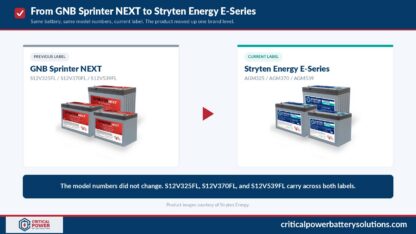
Anyone replacing legacy GNB NXT batteries with current Stryten E-Series NXT units is asking the same question: did the rebrand change the product itself? The answer is no, and Stryten Energy has documented it twice.
- Stryten Energy E-Series naming announcement. “The branding has changed but the products have not. The designs of our VRLA and Flooded batteries and chargers remain the same and the quality that you expect.”
- Stryten Energy manufacturer’s declaration on NXT continuity. Formally certifies the design, engineering, and manufacturing are unchanged from the GNB era. Same plates, same separators, same cells.
Critical Application Performance
The NXT is engineered specifically for the dual-demands of utility switchgear (high power) and telecom (long duration), two applications that historically required different battery chemistries.
Utility Switchgear & Inrush Current
The primary challenge for a utility switchgear battery is the requirement to deliver massive “inrush current”—often hundreds of amps—for just a few milliseconds to trip circuit breakers during a fault condition. If the battery’s internal resistance is too high, the voltage will sag instantly, potentially failing to trip the breaker.
The Stryten E-Series NXT utilizes a 2-volt cell configuration with substantial electrolyte volume and low internal resistance. This allows it to deliver high current bursts without the voltage dropping below the critical threshold (typically 1.75 Volts Per Cell). This performance is critical for compliance with utility reliability standards, ensuring that protection systems operate correctly during grid faults.
Telecom & Long Duration
In contrast to switchgear, telecom backup power often requires long-duration discharge to keep remote sites operational during extended grid outages. The 2v lead acid battery modular design allows engineers to build large capacity strings (high Amp-hour ratings) in a relatively compact footprint.
As the US grid integrates more renewables, the need for reliable storage is growing. According to the U.S. Energy Information Administration (EIA), the capacity for battery storage is expanding rapidly to support grid stability.[4] For unmanned telecom huts, the “set it and forget it” reliability of the NXT reduces the frequency of truck rolls, a major operational expense for carriers.
Engineering for US Grid Conditions
A common failure in battery system design is relying on generic specification sheets that assume a controlled environment of 77°F. In reality, most US utility substations and telecom enclosures are subject to extreme climate variations. Critical Power Battery Solutions utilizes ieee 485 battery sizing protocols to account for these local realities.
The Temperature Paradox
Temperature has a profound effect on lead-acid chemistry.
Heat (Arizona/Texas): High temperatures accelerate the chemical reaction, artificially increasing capacity but drastically shortening life. The Arrhenius equation dictates that for every 10°C (18°F) rise above 77°F, the life of a lead-acid battery is cut in half. The NXT’s robust thermal management and large electrolyte reservoir help buffer these swings better than compact monobloc VRLA batteries.
Cold (Minnesota/Northeast): Cold temperatures extend life but significantly reduce available capacity. A battery that is 100% efficient at 77°F might only deliver 60% of its rated capacity at 32°F.

Stryten Energy NXT IEEE 485 Temperature Correction Factors for US Climate Zones
IEEE 485 Sizing: The Mandatory Standard
To prevent system failure during a cold snap, engineers must use IEEE 485 standards to size the battery bank. We do not guess; we calculate. According to IEEE Std 485-2020, sizing must account for aging factors (typically 1.25) and precise temperature correction factors.[1]
For example, if a site in Montana requires 100 Amps for 4 hours, a standard calculation might suggest a 400Ah battery. However, after applying the IEEE 485 temperature correction for winter lows, the required battery might actually be 600Ah or larger.
Our engineers run specific load profiles including the “worst-case” temperature for your specific zip code to ensure your system never leaves you in the dark.
Need precise numbers? Request a battery sizing consultation to get a custom IEEE 485 report for your facility.
Maintenance & Lifecycle Economics
While often categorized as “maintenance-free” due to the VRLA recombination technology, the NXT offers specific advantages for industrial battery maintenance and total cost of ownership (TCO) management.
Visual Inspection & Management
Unlike opaque plastic monoblocs where internal components are hidden, the NXT features a transparent or translucent jar design (depending on the specific model generation). This allows technicians to visually inspect the plate condition and sediment levels during routine maintenance rounds, providing early warning of potential issues before they cause a string failure.
Recyclability & End-of-Life Value
When analyzing TCO, the end-of-life value is a significant factor. Lead-acid batteries are the most recycled consumer product in the world. According to the U.S. Environmental Protection Agency (EPA), lead-acid batteries have a recycling rate of approximately 99%.[5]
This high recyclability creates a robust market for lead acid battery recycling price recovery. When an NXT string reaches the end of its 20-year service life, the scrap value of the lead can significantly offset the cost of the replacement system. This contrasts with Lithium-Ion alternatives, which currently often incur disposal fees rather than generating revenue. Proper battery capacity testing according to IEEE 450/1188 standards ensures you maximize this lifecycle value.

20-Year Total Cost of Ownership: E-Series NXT vs. Standard Flat-Plate
Frequently Asked Questions
What is the expected lifespan of Stryten E-Series NXT?
The Stryten E-Series NXT has a design life of 20 years at 77°F (25°C). Actual service life depends on operating temperature and maintenance. In unconditioned environments, for every 15°F (8°C) rise above 77°F, battery life is reduced by approximately 50%. This aligns with manufacturer data and general lead-acid chemistry principles.[3]
Do you offer IEEE 485 compliant battery sizing reports?
Yes, Critical Power Battery Solutions provides comprehensive IEEE 485 compliant sizing reports. Our engineering team analyzes your specific load profile, duty cycle, and minimum voltage requirements to calculate the precise number of strings and capacity needed, ensuring compliance with utility standards.[1]
What are the applications of the E-Series NXT flat-plate battery?
The E-Series NXT flat-plate batteries are primarily used for stationary deep-cycle applications requiring high reliability. Key applications include utility switchgear control, telecommunications backup, renewable energy storage (solar/wind), and railway signaling, where long life and resistance to active material shedding are critical.[2]
Is the E-Series NXT flat-plate battery safe for indoor use?
Yes, when installed in properly ventilated areas according to code. The Stryten E-Series NXT is a VRLA (Valve Regulated Lead Acid) battery, which minimizes off-gassing under normal operation. However, OSHA regulations (Standard 1910.178) still require proper ventilation in battery rooms to prevent hydrogen accumulation.[6]
What is the disadvantage of the E-Series NXT?
The primary disadvantage is higher initial cost and weight compared to flat-plate batteries. The NXT’s patented alloy design requires premium materials and use more lead, making it slightly more expensive upfront than standard flat-plate batteries. However, their longer lifespan often results in a lower Total Cost of Ownership (TCO).
How do I size a battery backup system for a data center?
Data center battery sizing requires calculating the total kW load and desired runtime, then applying safety factors. We recommend using the IEEE 485 standard to account for aging (typically 125%), temperature correction, and design margin. Contact our engineers for a precise calculation based on your UPS specifications.

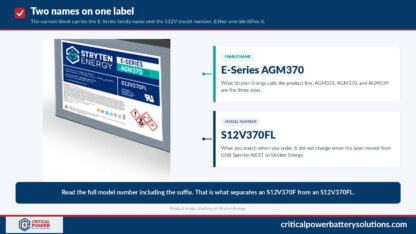
E-Series NXT Brand Evolution: From GNB Industrial Power to Stryten Energy
Limitations, Alternatives & Professional Guidance
While the Stryten E-Series NXT is a premier solution for industrial battery solutions for utilities, it is important to acknowledge the limitations of lead-acid chemistry. The energy density is lower than Lithium-Ion, meaning the NXT requires a larger physical footprint and stronger floor loading capacity. Additionally, the “20-year design life” is a standard based on optimal conditions; sites with chronic high temperatures without cooling will see reduced service life.
For facilities with extreme space constraints or weight limits, Lithium-Ion (LiFePO4) solutions may be a viable alternative, though they typically come with a higher initial price point and different fire safety code requirements. For non-critical applications where budget is the primary constraint and a 5-10 year life is acceptable, Standard Flat-Plate VRLA batteries remain a cost-effective option.
Because sizing errors can lead to critical power failure, we strongly recommend professional sizing rather than DIY calculations. Our team reviews your single-line diagrams to ensure the battery matches the charger and load profile, preventing costly mismatches.
Conclusion
The Stryten E-Series NXT represents a significant engineering advancement for critical infrastructure, combining the durability of flat-plate flooded design with patented lead-calcium-tin-silver alloys with the maintenance benefits of VRLA technology. With a 20-year design life and the ability to handle the high inrush currents of utility switchgear, it is a superior choice for facilities where failure is not an option. However, realizing this performance requires precise IEEE 485 sizing to account for the realities of US climate extremes.
Don’t risk downtime with generic sizing or gray-market hardware. Trust the US-based authorized experts to secure your critical infrastructure. Request your custom quote and IEEE 485 sizing report from Critical Power Battery Solutions today.
References
- IEEE Standards Association. IEEE Std 485-2020 – IEEE Recommended Practice for Sizing Lead-Acid Batteries for Stationary Applications. https://standards.ieee.org/standard/485-2020/
- Journal of Power Sources / Sandia National Labs. Research on Advanced Flat-Plate Alloy Cycle Life. (Context: Validates advanced alloy flat-plate performance).
- Stryten Energy. Stryten Energy Official Technical Data. (Context: Manufacturer specifications regarding 20-year design life).
- U.S. Energy Information Administration (EIA). Battery Storage Trends. https://www.eia.gov/analysis/studies/electricity/batterystorage/
- U.S. Environmental Protection Agency (EPA). Lead-Acid Battery Recycling. https://www.epa.gov/recycle/used-lithium-ion-batteries
- Occupational Safety and Health Administration (OSHA). OSHA 1910.178(g) – Battery Charging and Changing. https://www.osha.gov/laws-regs/regulations/standardnumber/1910/1910.178