Data Center Battery Replacement: How To Plan, Specify, And Execute With Zero Downtime Risk
Data center battery replacement used to be a routine 3–5 year event, but with AI workloads driving denser racks and stricter SLAs, 55% of operators now cite higher efficiency requirements as a primary driver for rethinking their energy storage strategy.
Key Takeaways
| Question | Answer |
|---|---|
| How often should data center UPS batteries be replaced? | VRLA data center battery strings are typically replaced every 3–7 years depending on design life and maintenance. Premium systems like Stryten E‑Series Absolyte AGP are engineered for up to 20 years of service in properly managed environments, which can reduce replacement frequency and lifecycle cost. |
| What is the main risk in data center battery replacement projects? | The primary risk is losing critical power battery redundancy during changeout. We mitigate this through staged replacement, load planning, and proven data center battery replacement systems tailored to Tier III and Tier IV uptime requirements. |
| Which battery technologies are best for modern UPS systems? | For many facilities, advanced VRLA battery technology and flooded stationary battery systems remain the most defensible choice due to proven reliability, safety, and predictable end‑of‑life behavior. Stryten Energy VRLA and flooded E‑Series products are designed specifically for mission critical power applications. |
| How do I justify battery replacement to finance teams? | We recommend framing projects around total cost of ownership, including cost per year of service, impact on uptime risk, efficiency gains, and alignment with sustainability targets. Our team at Critical Power Battery Solutions can help document these factors in a defensible business case. |
| Can one supplier support both data center and telecom battery backup? | Yes. As an authorized distributor with 40+ years of experience, we support data centers, telecom battery backup systems, utilities, and industrial facilities with integrated industrial power solutions from design through end‑of‑life. |
| Who manufactures Stryten Energy batteries for critical power? | Stryten Energy, the successor to GNB Industrial Power and Exide stationary lines, manufactures many of its critical power products in Reading, Pennsylvania and Oelwein, Iowa. Our overview of GNB industrial power history explains the brand evolution and continuity. |
| Where can I review compatible products for my next replacement cycle? | Our curated catalog of battery backup systems and products is organized by application, technology, and manufacturer, so you can quickly narrow options for UPS battery systems, telecom, and utility substation standby power systems. |
👤 Article by: Tom Kierna
Reviewed by: CPBS Engineering Team
Last updated: 28 January 2026
Credentials: Authorized Stryten Energy battery Reseller, ISO 9001 Certified, IEEE Standards Member


Why Data Center Battery Replacement Requires A Strategy, Not Just A Purchase
For facilities teams, data center battery replacement is no longer a simple like‑for‑like swap of VRLA strings. It is a strategic decision that affects uptime, energy efficiency, compliance, and long term total cost of ownership.
Our experience across hundreds of data center projects shows that the most successful operators treat their UPS battery systems as a core asset within a broader portfolio of industrial battery solutions. They plan refresh cycles around risk, capacity, AI growth, and sustainability targets instead of waiting for failures.
- Tier III and Tier IV uptime targets mean you cannot accept unplanned runtime loss during replacement.
- AI and high‑density compute increase short‑duration but very high power demands on each data center battery string.
- Changes in codes, standards, and corporate sustainability goals often require re‑evaluating technology choices at each refresh.
Critical Power Battery Solutions, backed by our parent company Advanced Technical Solutions (ATS), works as a long term partner in these decisions, not just a vendor shipping pallets.
Understanding UPS Battery Lifecycles And Replacement Windows
Typical VRLA data center battery strings operate 3 to 5 years in high‑stress environments, and up to 7 to 10 years in controlled rooms with conservative float voltages and regular maintenance per IEEE 1188 and IEEE 450 practices. Flooded stationary battery systems and advanced VRLA designs can extend that further when sizing and thermal conditions are optimized.
When you align design life, operating temperature, and discharge profile correctly, you reduce unexpected failures and can plan replacements as capital projects rather than emergency repairs. For example, premium Stryten Energy E‑Series batteries are designed for 20 or more years of service under standard conditions, which fundamentally changes how often you must allocate capex for critical power battery refresh.
| Battery Type | Typical Design Life | Typical Replacement Window | Common Use |
|---|---|---|---|
| Standard VRLA AGM (data center UPS) | 10 years | 3–7 years | UPS battery systems, smaller rooms |
| Premium VRLA (e.g. Stryten Absolyte AGP) | 20 years | 10–15 years in optimized rooms | Large data centers, telecom battery backup, utilities |
| Flooded lead‑acid (E‑Series MCT / MCX) | 20+ years | 12–18 years with proper maintenance | Utility substations, industrial process power |
Our role is to help you decide whether you want shorter, lower‑capex refresh cycles or longer design life that improves cost per year of service. We look at your UPS topology, ambient conditions, load growth, and runtime requirements before recommending a replacement interval.

Stryten Energy: Continuity From GNB / Exide For Mission Critical Power
Many operators still reference GNB or Exide part numbers in their documentation. The core stationary product lines behind those labels now live under the Stryten Energy brand, with the same engineering DNA and in many cases the same U.S. manufacturing footprint.
As an authorized Stryten Energy distributor, we have deep familiarity with legacy part numbers, form factors, and rack layouts, which is essential for clean data center battery replacement without re‑engineering your UPS rooms. We match existing strings with equivalent or improved Stryten models and confirm physical, electrical, and seismic compatibility.
Stryten Absolyte AGP For High Reliability VRLA Battery Technology
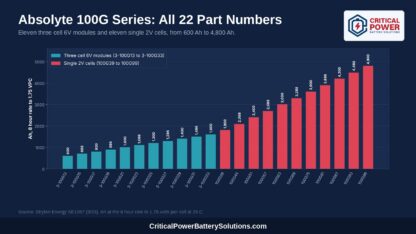
The Stryten E‑Series Absolyte AGP is a 2‑volt VRLA system with a 20 year design life, NEBS suitability, and a track record in data centers, telecom, and utility substations. It is a direct replacement for legacy GNB / Exide Absolyte IIP and GX installations, which simplifies replacement projects.
Absolyte AGP uses a lead‑calcium‑tin‑silver alloy for improved cycle life and float stability, and its modular design works well for centralized UPS plants and large battery energy storage rooms. It is particularly strong where you need long autonomy times or mixed duty cycles that sometimes act as battery energy storage for peak shaving.
Stryten E‑Series MCX And MCT For Flooded Stationary Battery Systems
For sites that prefer flooded designs, the Stryten E‑Series MCX offers a 20+ year design life with transparent containers for visual inspection, and robust grid designs for demanding duty cycles. MCX is often used in utility switchgear rooms and industrial process facilities where long discharge events and high inrush currents are common.
Combined with E‑Series MCT, these flooded options form a comprehensive platform across data centers, utility substations, and other standby power systems where safety, seismic compliance, and maintainability are top priorities.
VRLA Vs Flooded Batteries In Data Center Applications
Most data centers still rely on VRLA battery technology because it simplifies installation, ventilation, and routine service. Flooded batteries remain relevant in central plants and mixed‑use critical facilities, especially when very long runtimes or complex duty cycles are involved.
We help teams choose between these stationary battery systems by focusing on safety processes, available floor space, maintenance staffing, and local regulations. There is no one universal answer, but there are clear patterns that make one technology more defensible in a given facility.
| Factor | VRLA Battery Systems | Flooded Stationary Systems |
|---|---|---|
| Maintenance | Low, sealed design, no watering | Requires watering, more inspections |
| Footprint | Compact, high energy density | Larger footprint per kWh |
| Service Life | 3–15 years depending on design | 15–20+ years typical |
| Common Use | UPS battery systems, telecom, IT rooms | Utility switchgear, process plants, some central UPS plants |
In many modern data centers, a high design life VRLA system like Absolyte AGP provides the right balance of safety, footprint, and longevity. Where utilities and industrial facilities share backup rooms with data center loads, E‑Series MCX flooded banks often handle the most demanding mission critical power circuits.

Sizing And Specifying Replacement Batteries For Modern UPS Systems
When we design a data center battery replacement project, we rarely recommend a one‑for‑one amp‑hour swap. Load profiles have changed, AI clusters are more bursty, and many operators are comfortable with shorter runtimes if generator reliability and fuel contracts are strong.
Good engineering practice is to start from the required runtime at present and future loads, then select the correct technology and capacity. We size for both steady load and short‑term high kW pulls, especially in modular UPS configurations that support blade clusters and storage nodes with high inrush currents.
- Review UPS OEM discharge tables and confirm compatibility with proposed industrial battery solutions.
- Account for temperature, end of life capacity, and redundancy (N+1, 2N) when calculating required amp‑hours.
- Verify that replacement units meet or exceed short circuit and fault duty requirements for protective devices.
This process yields a defensible specification that aligns with both operational risk tolerance and finance team expectations around cost per year of service.

Leoch XP12 And HPX12 Batteries For High Density UPS Battery Systems
Many facilities look for high‑density VRLA replacements that fit existing racks while increasing available runtime or reducing the number of parallel strings. The Leoch XP12 and HPX12 series are strong options in this space, especially for retrofit projects where you want to keep the existing UPS and rack footprint.
Leoch VRLA batteries in the XP12 family cover a wide range of capacities, from 100 Ah to 490 Ah at 12 V, while HPX12 models push capacity higher for mission critical power densities. All are maintenance‑free AGM designs with low self discharge and strong deep discharge recovery.
- XP12‑100 (12 V, 100 Ah) for standard UPS blocks and smaller racks.
- XP12‑150 and XP12‑210 for mid‑range capacity data center battery replacement.
- XP12‑300, XP12‑350, XP12‑400, and XP12‑490 for large UPS battery systems in enterprise rooms.
- HPX12‑540 (12 V, 540 Ah) for maximum capacity and extended runtime deployments.
We deploy these units in both single UPS rooms and large colocation facilities, often mixing frame configurations to optimize aisle space and cable routing while keeping maintenance access safe and practical.


Front Terminal And Telecom Battery Backup In Edge And Colocation Sites
Many data center operators also manage edge facilities, network rooms, or shared spaces with telecom providers. In these scenarios, front terminal telecom battery backup designs can simplify service, especially in 19‑inch and 23‑inch rack bays with limited depth and rear access.
The Leoch PLH110FT(A) front terminal VRLA battery, for example, is a 12 V, 110 Ah pure lead unit designed for rack installation in network and data rooms. Front terminals allow safe service in tight aisles while maintaining compliance with telecom and IT space constraints.
Key advantages of front terminal designs include:
- Improved service access, which reduces time and risk for technicians.
- Better cable management, especially in dense telecom battery backup and edge compute cabinets.
- Alignment with NEBS and similar telecom standards when cabinets are configured correctly.
We often standardize on a small set of front terminal and standard VRLA units across data centers and network rooms to simplify spares, training, and test procedures.

Managing Risk During Data Center Battery Replacement Projects
From a risk standpoint, the most important part of a data center battery replacement is how you sequence work to maintain redundancy. We work with operators to build method of procedure documents that coordinate UPS bypass plans, temporary battery backup systems if required, and clear go / no‑go criteria at each step.
Typical risk controls include:
- Staggered replacement of parallel strings so N+1 or 2N redundancy is preserved.
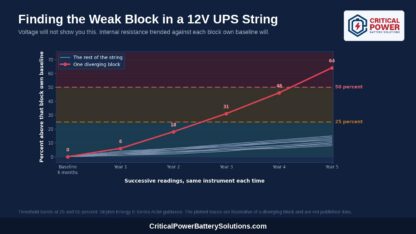
- Functional testing after each string is commissioned, including impedance or conductance measurements.
- Clear roles for facilities, IT, and vendor teams during each shift of work.
We also pay attention to logistics, from proper packaging and transport of new units to regulatory compliant removal and recycling of spent batteries. This approach reduces the chance of schedule slips that can impact maintenance windows and customer commitments.

Total Cost Of Ownership, Sustainability, And Recycling
Finance and sustainability teams increasingly evaluate critical power battery projects on total cost of ownership and environmental impact, not just initial capex. We structure our recommendations so you can compare options on cost per year of service and cost per delivered kWh over the lifespan of the system.
Premium VRLA or flooded systems may cost more initially yet often deliver 40 to 60 percent lower effective cost over 15 to 20 years due to fewer replacement cycles and lower emergency service incidents. When combined with robust recycling programs, this also reduces environmental footprint.
Typical pattern: A higher design life system has 15–25% higher upfront cost but can avoid one or two full replacement cycles, plus labor and disposal, over a 20 year facility horizon.
We also support documentation for ESG reporting, including recycling certificates and summary reports of reduced waste from extended life industrial battery solutions compared to shorter cycle systems.
Integrating Data Center Battery Replacement With Broader Industrial Power Solutions
Data center operators are increasingly responsible for a full portfolio of critical power assets, including generator controls, utility substation battery systems, and industrial controls in adjacent plants. Coordinating data center battery replacement with these other assets can reduce vendor complexity and harmonize maintenance schedules.
We take a holistic view that includes:
- UPS battery systems for data halls and network rooms.
- Telecom battery backup installations within or adjacent to the facility.
- Utility and process control standby power systems that protect switchgear, relays, and safety PLCs.
By standardizing on families of Stryten Energy batteries and high performance VRLA lines from partners like Leoch, you gain consistent testing methods, spare management, and training across sites. Our affiliation with ATS means we can also coordinate with broader electrical and automation projects to avoid overlapping outages and duplicated costs.
How Critical Power Battery Solutions Supports The Full Lifecycle
With more than 40 years in critical power, we structure our support around the full lifecycle of your data center battery assets. That includes design, specification, supply, commissioning, ongoing testing guidance, and eventual end‑of‑life planning.
Our team is familiar with legacy GNB, Exide, and early Absolyte systems as well as current Stryten E‑Series, Leoch, and other industrial battery solutions. This continuity is important when your facility documentation still reflects older brands but you want to keep future options open.
- Application engineering for mission critical power, UPS, and telecom battery backup.
- Product selection across VRLA battery technology and flooded stationary battery systems.
- Global logistics and coordination with local installation partners.
We focus on being a long term advisor, so that each data center battery replacement project builds on the last one rather than being a one‑off procurement event.
Conclusion
Data center battery replacement is a technical, financial, and operational decision that touches every part of your critical power strategy. The right combination of VRLA or flooded stationary battery systems, careful sizing, and disciplined replacement planning can support 99.99 percent uptime, improve energy performance, and deliver a lower total cost of ownership over the life of your facility.
As an authorized Stryten Energy distributor with deep experience in GNB / Exide product lines and complementary partners like Leoch, we help facilities managers, engineering directors, and procurement teams make defensible, standards aligned decisions. Our goal is to act as your trusted advisor across data center, telecom, utility, and industrial power portfolios.
Next Steps
- Request a battery lifecycle review so we can benchmark your current UPS and data center battery replacement schedule against design life and risk tolerance.
- Schedule a technical consultation with our engineers to evaluate whether Stryten E‑Series Absolyte AGP, MCX, or high capacity Leoch VRLA products fit your next project.
- Develop a standardized product set across your data centers, telecom rooms, and utility substations to simplify testing, training, and spares.
- Ask for a TCO comparison that models different replacement intervals and technologies so you can present a clear, data backed business case to finance and leadership.
We are ready to support your next data center battery replacement cycle with the industrial battery solutions, critical power battery expertise, and lifecycle planning that modern facilities demand.
Data Center Battery Projects in India: Hyperscale & Colocation
India is Asia’s fastest-growing data center market, with hyperscale and colo programs concentrated in Mumbai, Chennai, and Hyderabad.
Where CPBS engages on Indian DC projects:
- Operators: CtrlS, Yotta, NTT, STT, AdaniConneX hyperscale and colocation builds
- Geography: Mumbai, Chennai, Hyderabad, Pune, Navi Mumbai
- Scope: Absolyte AGP modular stacks, flooded E-Series, IEEE-485 sizing, 20-year design-life specification
- Engagement: Project-scale specification, sourcing, and lifecycle consultation
Project deployments only, reach our project team to scope your battery room.
India FAQ
Q: Can Critical Power Battery Solutions supply batteries for data center projects in India?
A: For large project deployments, yes. We support hyperscale, colocation, and enterprise data center projects in Mumbai, Chennai, Hyderabad, Pune, and Navi Mumbai with Stryten Absolyte AGP, flooded E-Series, and Leoch system specification, sizing, and project-scale sourcing. Engagement is engineering-led project work, not stocked retail orders.