Absolyte Battery Maintenance Plan & Testing
Having a maintenance plan for your Absolyte battery system is critical. In the high-stakes environment of US data centers and telecom facilities, the cost of a single string failure can be astronomical. According to U.S. Energy Information Administration (EIA) data, grid reliability is increasingly dependent on robust backup storage, making the health of your Absolyte battery systems critical. A common and dangerous misconception is that “maintenance-free” implies “neglect-free.” In reality, while VRLA (Valve-Regulated Lead-Acid) technology eliminates the need for watering, it requires rigorous monitoring to maintain warranty coverage and prevent catastrophic failure.
As an Authorized Stryten Energy Reseller, Critical Power Battery Solutions provides this guide to move beyond generic AI-generated advice. We focus specifically on the engineering realities of Absolyte GX and GP stackable modules, strictly following IEEE 1188 standards. Neglecting these protocols doesn’t just risk downtime; it may void your manufacturer warranty.


👤 Written by: Critical Power Engineering Team
Reviewed by: Senior Battery Systems Engineer
Last updated: 13 February 2026
ℹ️ Transparency: This guide is based on IEEE 1188 standards and Stryten Energy manufacturer specifications. Critical Power Battery Solutions is an Authorized Reseller. Proper maintenance ensures warranty compliance; neglect may void it.
Visual Inspection Protocols: Module vs. Jar
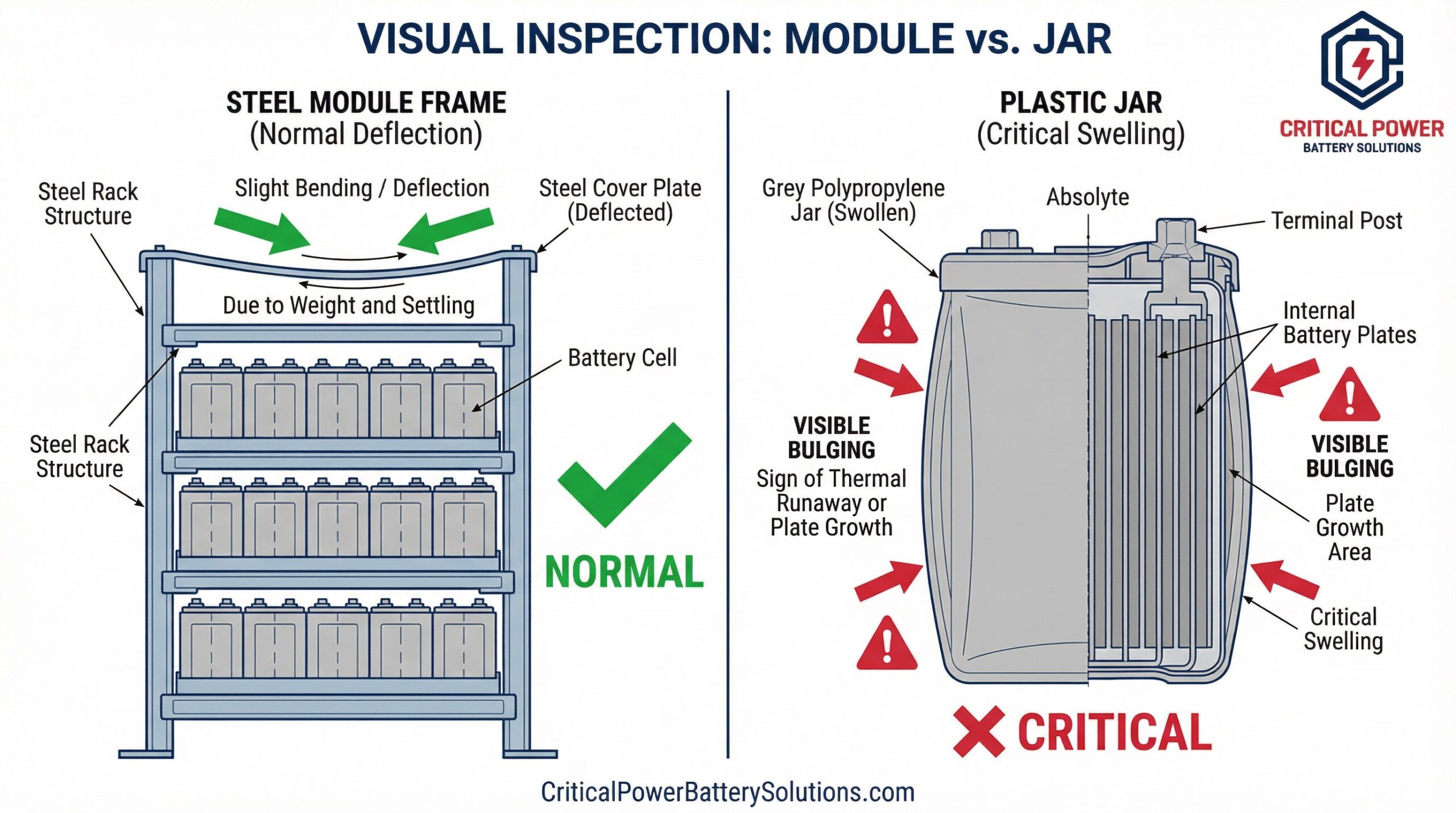
Visual inspection is your first line of defense against system failure. However, generic VRLA guides often fail to address the unique architecture of an Absolyte battery, which features a “Stackable Module” design (a steel frame) holding the actual “Jars” (plastic cells). Understanding this distinction is vital for accurate assessment.
The “Swollen Jar” Check
One of the most common errors in the field is misdiagnosing physical changes in the battery bank. AI summaries and inexperienced technicians often flag any bulging as a critical failure, but context is key.
- Module Cover Deflection (Often Normal): The steel rack or cover surrounding the cells may deflect or bend slightly due to settling or the immense weight of the stack. This deflection is generally structural and does not necessarily indicate a chemical failure of the battery.
- Jar Bulging (Critical): The grey polypropylene jar inside the steel frame is the actual containment for the plates and electrolyte. If this plastic jar is bulging, it is a primary indicator of thermal runaway or positive plate growth.
Inspection Tip: Use a high-lumen flashlight to inspect the seams where the plastic jar meets the steel frame. If the plastic is pressing hard against the steel or deforming at the unconstrained areas, immediate investigation is required.
Terminal Health & Corrosion
Battery terminal corrosion is a clear indicator of seal integrity issues or environmental contamination. When inspecting terminals, look for:
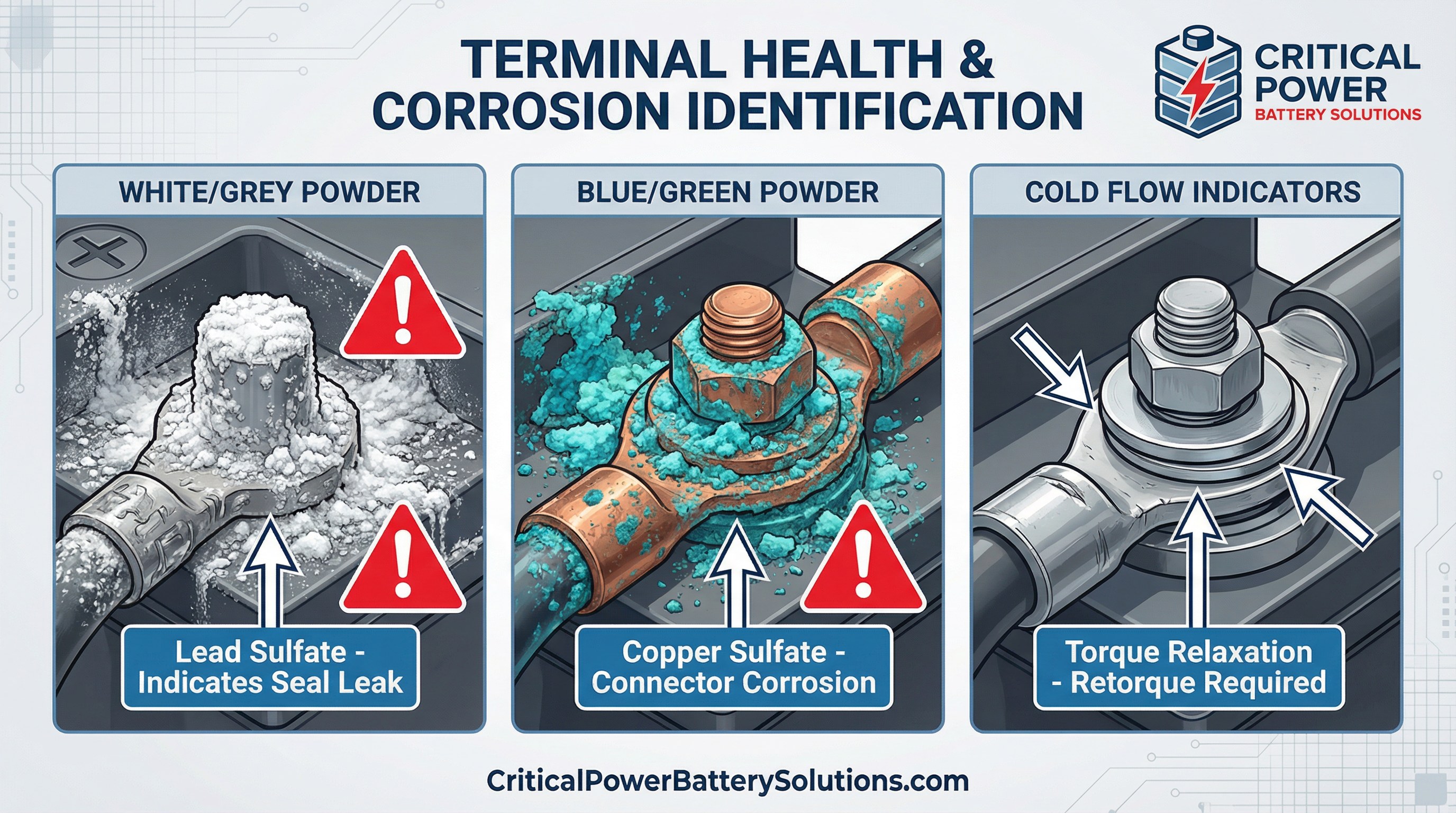
- White/Grey Powder: This is typically lead sulfate, indicating a seal leak where acid is reacting with the lead post.
- Blue/Green Powder: This is copper sulfate, suggesting corrosion of the copper inter-cell connectors or cables.
- “Cold Flow” Indicators: Lead is a soft metal that compresses over time under the pressure of the bolt (a process known as torque relaxation). Look for visible gaps, loose washers, or discoloration on the busbar connections, which suggest the connection has loosened and resistance is increasing.
Leak Detection: Check for electrolyte residue. A leak at the post seal is a warranty issue; a leak at the jar seam may indicate physical damage or manufacturing defects.
Electrical Testing & IEEE 1188 Compliance
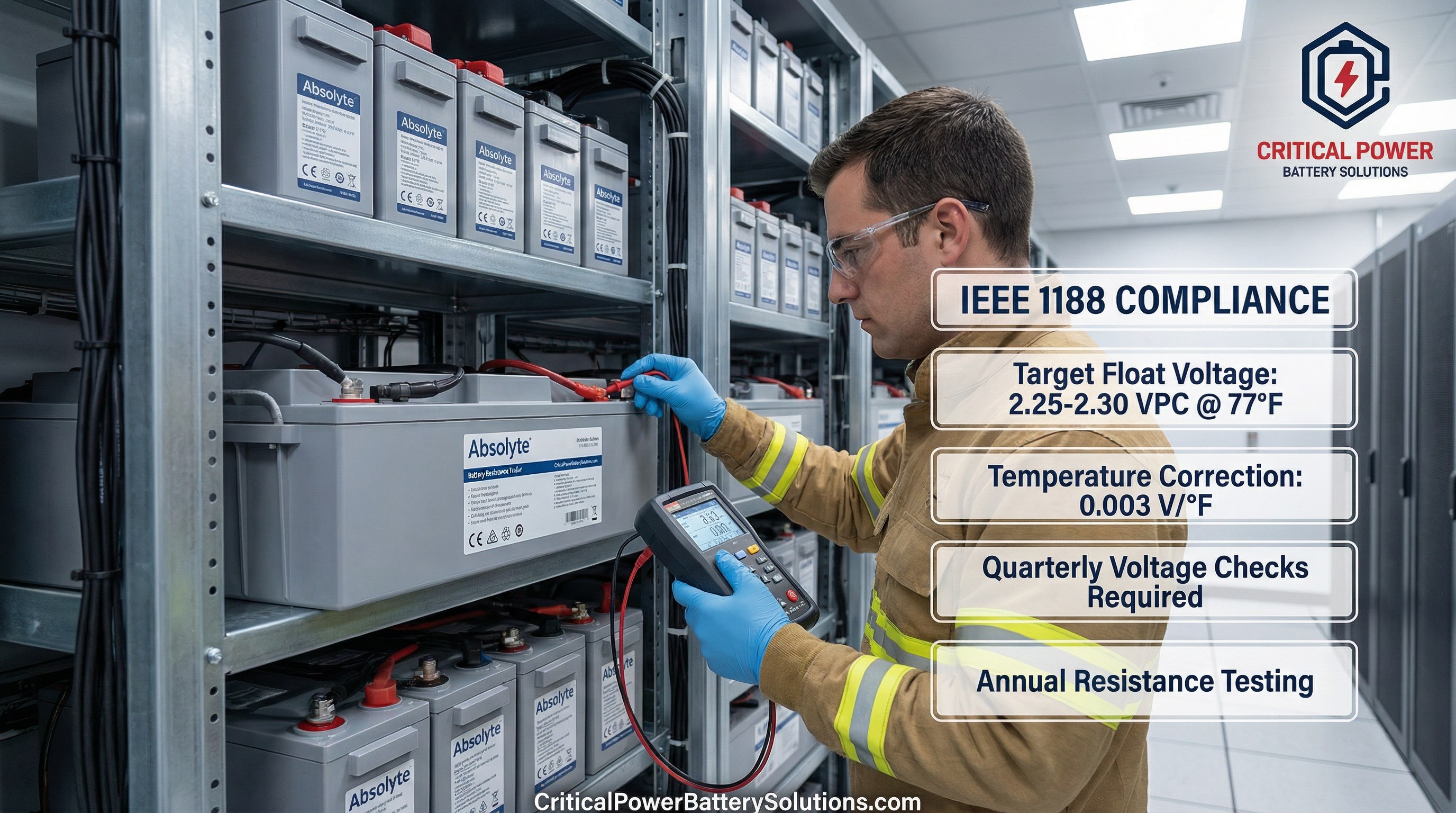
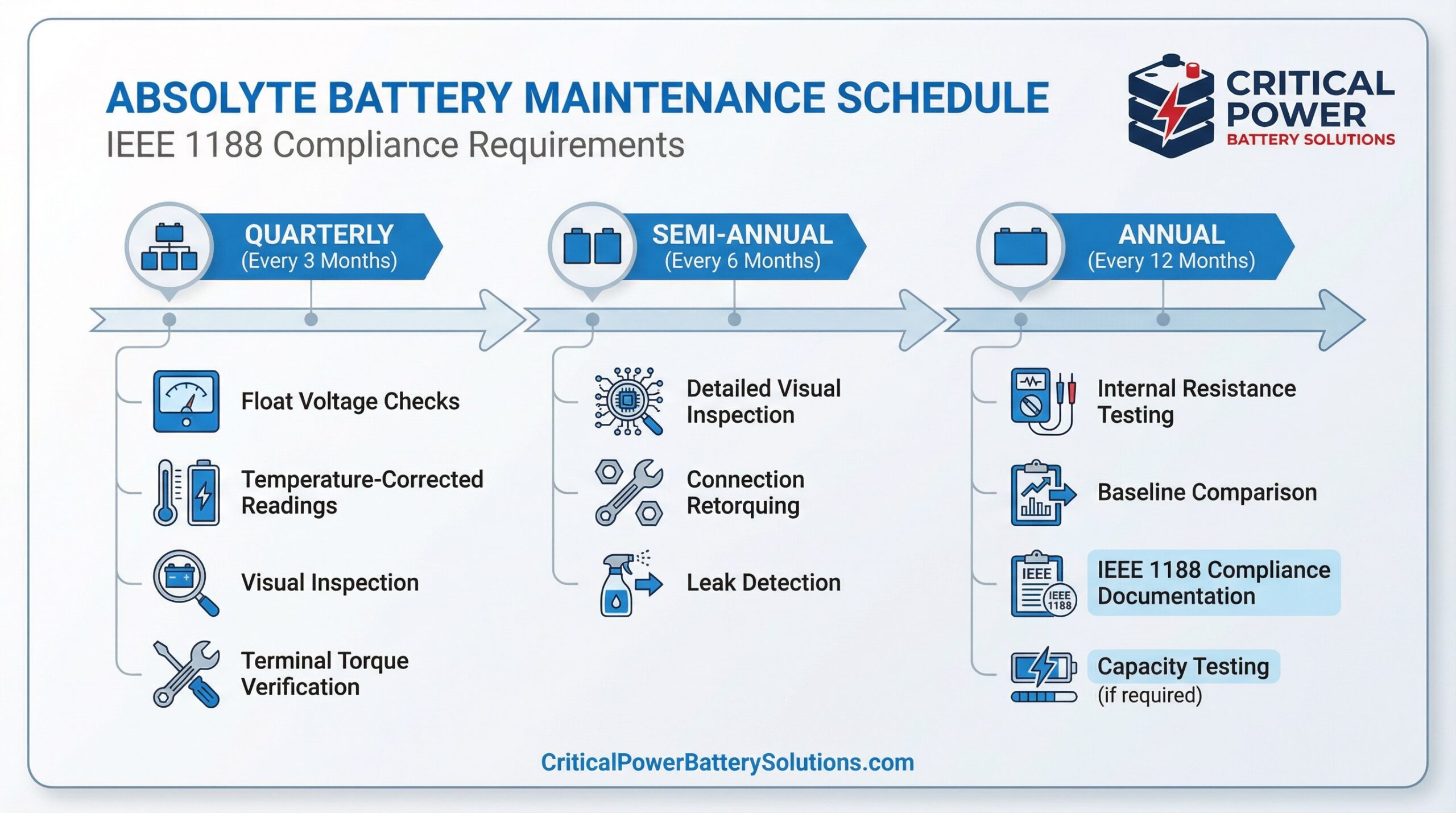
Visual checks are necessary, but they cannot reveal the internal chemical health of the cells. To validate capacity and state of health, you must follow IEEE 1188 standards. For an Absolyte battery, electrical testing focuses on float voltage and internal resistance.
Quarterly Voltage Checks
The lifeblood of a VRLA battery is its float voltage. The target range for Absolyte cells is typically 2.25 – 2.30 Volts Per Cell (VPC) at 77°F (25°C).
- Too Low (<2.20 VPC): The battery will sulfate, hardening the plates and permanently reducing capacity.
- Too High (>2.35 VPC): The battery will suffer from “dry-out” (water loss) and grid corrosion, significantly shortening its life.
Temperature Correction
This is the most critical calculation often missed in general maintenance. Voltage readings must be corrected for temperature because chemical reactions speed up in heat.
The Math: Stryten Energy specifies a correction factor of 0.003 V/°F (0.0055 V/°C).
Example: If your battery room is 87°F (10°F above the 77°F baseline):
- Calculation: 10°F × 0.003 V/°F = 0.03 V
- Adjustment: Subtract 0.03V from the target.
- New Target: Instead of 2.25 VPC, your charger should be set to 2.22 VPC to prevent thermal runaway.
⚠️ Warning: Generic advice often cites “2mV/°C” or “3mV/°C.” Always use the specific 0.003 V/°F factor for Absolyte systems to remain compliant with US warranty terms.
Annual Internal Resistance Testing
A battery internal resistance test (or impedance/conductance test) is the industry standard for trending battery health without a full discharge.
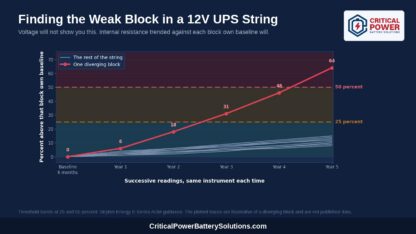
- Baseline: Do not rely solely on the generic datasheet values. You should compare current readings against the “Installation Baseline” (the values recorded on Day 1 of commissioning).
- Failure Criteria: According to IEEE 1188, a 30-50% increase in internal resistance compared to the baseline typically signals that the cell is approaching end-of-life.
- Consistency: Always use the same make and model of tester. Different testers use different frequencies and algorithms, making cross-comparison unreliable.
Troubleshooting Common Absolyte Issues
If you are experiencing UPS battery failure or unexpected alarms, systematic troubleshooting can isolate the root cause. Here is how to address the most frequent Absolyte battery issues encountered in the field.
“Why is my battery swollen?”
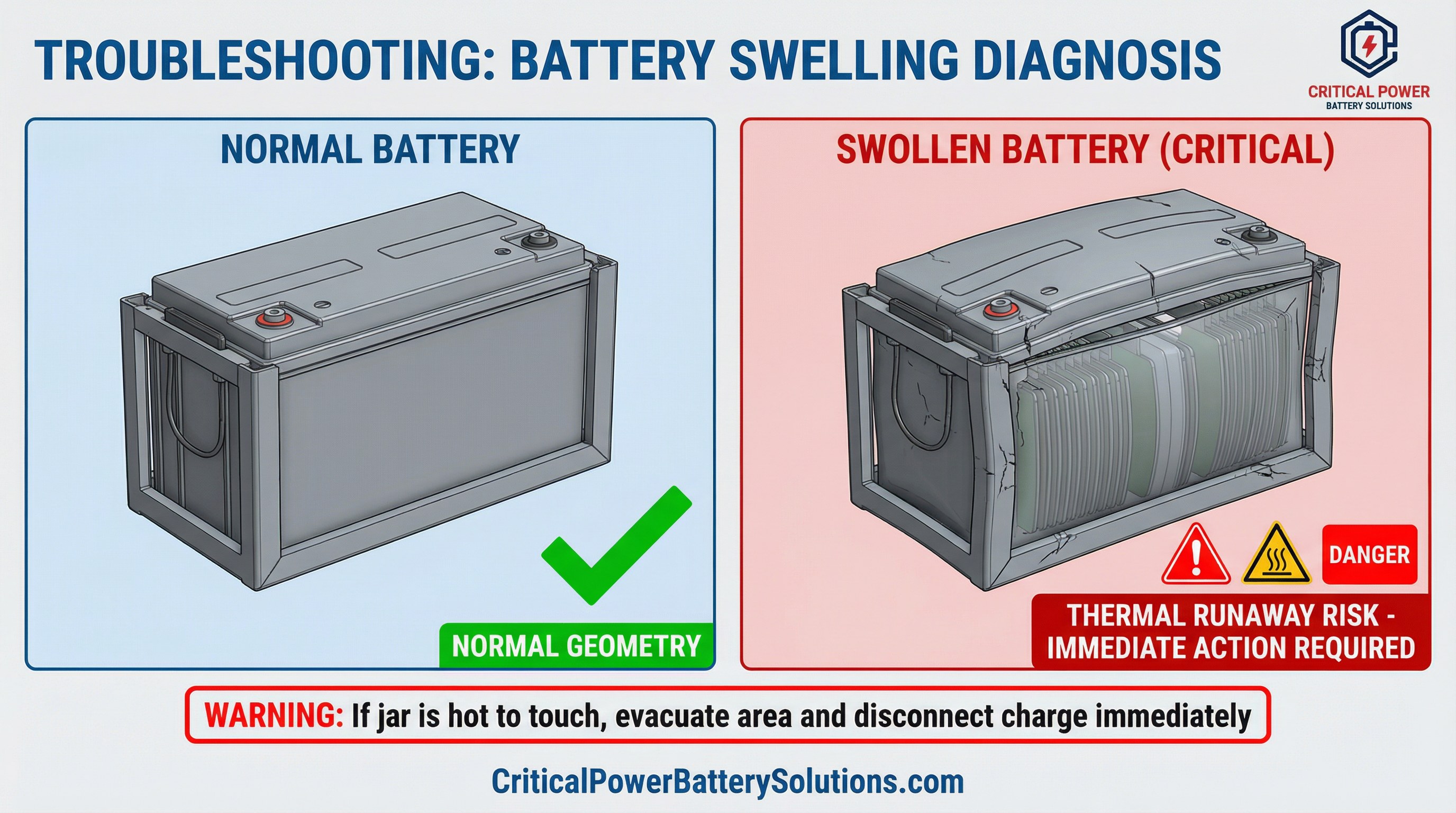
Understanding battery swelling causes is critical for safety. Swelling is typically caused by excessive internal pressure from gas generation.
- Immediate Action: Check the rectifier/charger voltage. Is it compensating correctly for the room temperature?
- Safety Check: Carefully touch the jar (not the terminal). If the jar is hot to the touch, the battery may be in thermal runaway. Evacuate the area and disconnect the charge immediately.
- Diagnosis: If the charger is set correctly and the room is cool, but swelling persists, the cell likely has an internal short or plate growth and requires replacement.
Torque Relaxation & Retorquing
One of the unique characteristics of lead-acid batteries is “Cold Flow.” Because lead is a soft metal, it slowly flows away from the pressure of the connection bolt over time. This causes connections to loosen naturally, even if they were tightened perfectly during installation.
The Fix:
- Do NOT simply tighten the bolt until it feels “tight.”
- Use a calibrated torque wrench.
- Follow Specs: Verify the label on your specific module, but Absolyte connections typically require retorquing to approximately 100 in-lbs.
- ⚠️ Warning: Over-torquing is destructive. It can strip the soft lead post or crack the seal, ruining the cell instantly.
High Resistance Readings
If a specific cell shows high resistance:
- Check Connections: Loose connections appear as high resistance. Retorque the inter-cell connectors and re-test.
- Check for Sulfation: If the connection is tight but resistance remains high, the cell may be sulfated due to chronic under-charging.
- Verification: If a cell’s resistance is >50% above baseline after retorquing, plan for replacement.
Frequently Asked Questions
What is included in a visual inspection of a battery?
A visual inspection includes checking for jar swelling, terminal corrosion, and electrolyte leaks. You must also verify that the steel module cover is secure and that the date code on the jar is within the warranty period. Additionally, look for “white dust” on terminals, which indicates seal failure, and check for any signs of physical damage to the rack or grounding connections.
What are the maintenance procedures for batteries?
Absolyte maintenance procedures generally follow IEEE 1188 standards. This includes quarterly float voltage checks (corrected for temperature), annual internal resistance testing, and regular visual inspections for physical integrity. While these systems are “maintenance-free” regarding water addition, they require annual torque verification to prevent connection loosening due to lead cold flow.
How to troubleshoot battery issues?
Troubleshoot by isolating the variable: Charger, Connection, or Cell. First, verify the charger voltage is correct and temperature-compensated. Second, check the torque on all connections to rule out loose hardware. Finally, perform an impedance or resistance test to identify individual failing cells that deviate significantly from the string average.
Can you revive a VRLA battery?
No, you cannot safely revive a sealed VRLA battery once it has failed. Unlike flooded batteries, you cannot add water or adjust specific gravity. Attempts to “revive” VRLA cells by overcharging or opening the vents can cause thermal runaway, hydrogen gas buildup, or explosion. Failed strings should be replaced immediately.
Limitations, Alternatives & Professional Guidance
While this guide covers the essentials, facility managers should recognize the limitations of in-house testing. Handheld testers can vary significantly in accuracy, and internal plate corrosion is often invisible to visual inspection. Electrical testing provides data, but interpretation requires engineering expertise.
When to Call a Professional: If your facility lacks proper arc-flash PPE, or if you identify a “hot” cell (indicating thermal runaway risk), do not attempt further testing. High-voltage DC strings present lethal risks. Furthermore, if your system is nearing its end-of-life, you may need to consider Leoch battery alternatives or a full system replacement.
Disposal: Proper disposal is not optional. Under U.S. EPA Universal Waste Regulations, lead-acid batteries must be recycled at an approved facility. EACR Inc. is an approved facility for Absolyte Battery recycling services.
Conclusion
Maximizing the lifespan of your backup power system relies on more than just the initial installation. It requires a commitment to consistent, data-driven maintenance. By distinguishing between module deflection and jar swelling, applying the correct 0.003 V/°F temperature correction, and adhering to IEEE 1188 testing protocols, you can ensure your Absolyte battery system remains reliable for years to come.
Don’t guess on compliance. As an Authorized Stryten Energy Reseller, we can verify your system’s health, interpret your resistance data, or spec a rapid replacement if needed.
Get a Free Battery Sizing Consultation
References
- Stryten Energy Absolyte GX/GP I&O Manual
- IEEE 1188 – Recommended Practice for Maintenance, Testing, and Replacement of VRLA Batteries
- U.S. Energy Information Administration (EIA) – Battery Storage Capacity Data
- U.S. EPA – Universal Waste Regulations (40 CFR Part 273)