Quick answer: For a Class I Division 2 oil and gas site, the common choice is a sealed recombinant VRLA AGM battery, such as the Stryten Absolyte AGP, sized to the site DC load and installed in an area-appropriate enclosure provided by the system integrator. The battery is selected for the application. Class I Division 2 suitability is determined by the area classification study and the Authority Having Jurisdiction (AHJ) under NEC Article 500 and 501, not by a battery “rating.” Critical Power Battery Solutions (CPBS) supplies the battery, the sizing, and the qualification documentation. The integrator supplies the classified enclosure.
Key points
- For a Class I Division 2 oil and gas site, the common backup choice is a sealed recombinant VRLA AGM battery such as the Stryten Absolyte AGP.
- No battery is rated for a Class I Division 2 area on its own. Suitability is the AHJ determination under NEC Article 500 and 501, and the battery is installed in an area-appropriate enclosure built by the integrator.
- CPBS supplies the battery, the sizing, and the qualification documentation. The integrator supplies the classified enclosure and panel.
- Sealed VRLA AGM fits confined, unmanned enclosures: low hydrogen evolution, nonspillable UN 2800, maintenance-light, and made in USA.
- Size the battery to the DC bus voltage, continuous and peak load, autonomy, ambient temperature, and recharge source for SCADA, RTU, and cathodic protection loads.
Building or upgrading a remote oil and gas site means specifying a backup battery that has to ride through utility loss, generator gaps, and solar deficits while sitting unattended in a hazardous-location enclosure. This is a sourcing and specification problem, not a replacement job. If you are replacing aging GNB strings, that path is covered separately in our oil and gas battery replacement guide and the GNB to Stryten cross-reference. This guide is for the engineer or buyer choosing and specifying a battery on a new project, anchored to the made in USA Stryten Absolyte AGP and the broader oil and gas battery systems for hazardous locations program at CPBS.
Who this guide is for
This guide is for the people who own the DC plant on a remote oil and gas site:
- Operators and automation teams standing up or upgrading a remote site.
- EPC, SCADA, and instrumentation integrators sourcing the DC power system.
- Instrumentation and electrical (I&E) engineers and architect and engineer (A/E) specifiers writing the backup-power section of the spec.
- Corrosion and cathodic protection (CP) engineers sizing rectifier backup.
- Procurement leads qualifying a battery vendor to an operator approved-vendor list (AVL).
Many readers are evaluating Stryten Absolyte AGP for the first time against integrator-supplied options, and they need a defensible answer to four questions: which battery, what chemistry, what runtime, and what documentation. A battery supplier should own the battery selection, the load-to-capacity sizing, and the paperwork that gets the cells approved on your project. The system integrator owns the classified enclosure, the area classification, and the panel build. Keeping that boundary clear is what separates a specification you can defend in a design review from a marketing claim.


Class I Division 1 versus Division 2 in plain English
Class I means flammable gases or vapors may be present, which is the oil and gas case. The Division tells you how often: Division 1 means the flammable atmosphere is present during normal operation, and Division 2 means it is present only under abnormal conditions, such as a leak or an equipment failure. Most outdoor oilfield surface equipment, including the area around wellheads, separators, gathering equipment, and compressor skids, falls under Division 2, but that is a site-specific determination. The area classification study sets the boundary and the AHJ confirms it under NEC Article 500 and 501 (NFPA 70). Always confirm your classification with your AHJ before you finalize equipment.
| Aspect | Class I Division 1 | Class I Division 2 |
|---|---|---|
| When flammable gas is present | During normal operation | Only under abnormal conditions (a leak or failure) |
| Typical oilfield context | Inside vapor spaces and enclosed process areas | General wellpad, gathering, compressor, and pipeline areas around sealed equipment (the common surface case) |
| What it means for power gear | Most stringent; equipment must suit a continuously present hazard | Equipment suitable for abnormal-only exposure, housed in an area-appropriate enclosure |
| Who determines it | Area classification study, confirmed by the AHJ per NEC Article 500 and 501 | Area classification study, confirmed by the AHJ per NEC Article 500 and 501 |
| Battery implication | Cells and electronics in a listed, area-appropriate enclosure built by the integrator | Same; a sealed recombinant VRLA AGM is preferred for confined enclosures |
Notice what is not in that table: any notion of a battery that is on its own approved for the classified area. Equipment suitability for a Class I Division 2 area is a property of the installed system and the AHJ determination, not a label on a cell. The right way to specify is to select the battery for the application, then install it in a listed, area-appropriate enclosure that the integrator provides.
Two hazards, one design: the battery versus enclosure boundary
Remote oil and gas power design has to separate two different hazards that often get blurred together:
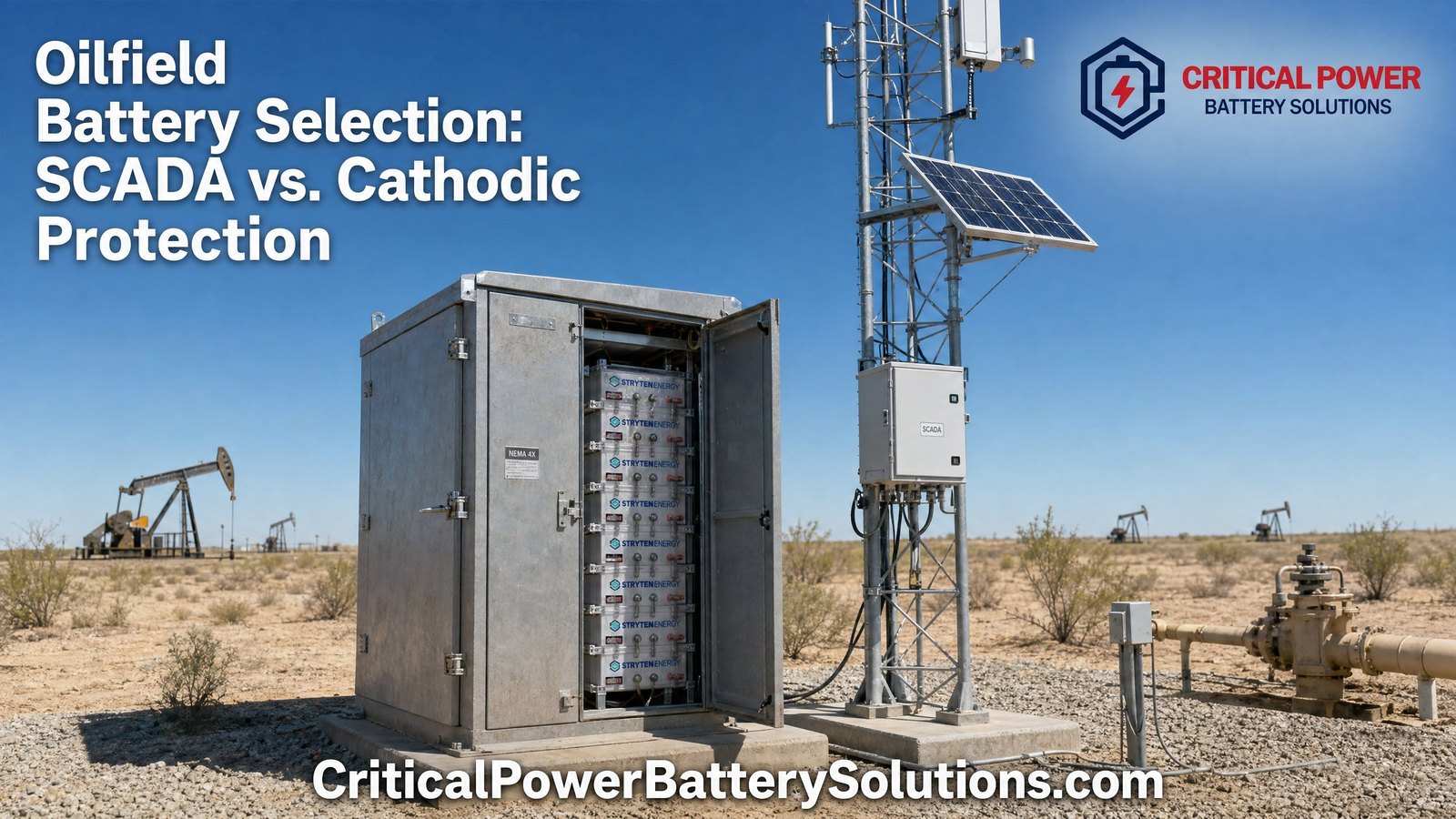
- The ambient classified area (integrator scope). Flammable process gas can be present around the equipment, so batteries and electronics go in an area-appropriate, often sealed or purged NEMA 4X enclosure that the integrator engineers and lists for the site classification the AHJ confirms, along with any UL 508A or UL 698A panel inside it.
- The battery hydrogen on charge (chemistry choice). Every lead-acid battery evolves some hydrogen on charge. A flooded cell vents it freely; a sealed recombinant VRLA AGM such as the Absolyte AGP recombines more than 99 percent of that gas internally, so it releases far less hydrogen in a confined enclosure. You still vent the enclosure per IEEE 1635, with the ventilation math in our battery room ventilation calculation guide.
That makes the scope boundary simple. Write your specification this way and every party owns what it is actually responsible for:
| Scope | Owner |
|---|---|
| Battery selection, sizing, and qualification documentation | CPBS |
| Classified enclosure, purge or seal system, and UL 508A/698A panel | System integrator |
| Area classification and equipment suitability | AHJ (per NEC Article 500 and 501) |

Why a sealed VRLA AGM battery fits remote oil and gas sites
For confined, unmanned enclosures at hazardous-location sites, a sealed recombinant VRLA AGM battery is usually the right chemistry, and the Stryten Absolyte AGP is the anchor product CPBS specifies. Several properties line up with the remote oil and gas use case:
- Sealed recombinant oxygen cycle. More than 99 percent internal gas recombination under normal float means low hydrogen evolution compared with flooded cells, which matters in a small sealed cabinet.
- Nonspillable, classified UN 2800. The immobilized electrolyte makes the battery nonspillable and shippable as UN 2800, which simplifies transport and handling to a remote location with no maintenance crew on site.
- Flame-retardant case. The Absolyte AGP uses a flame-retardant polycarbonate (UL94 V-0) container.
- Field-proven qualification. NEBS Level 3, UL recognized, and IEEE 535 qualified, with IEEE 693 Zone 4 seismic qualification available, and maintained to IEEE 1188 for VRLA.
- Maintenance-light for unmanned sites. No water addition and a self-discharge rate under 2 percent per month at 25°C suit sites that get visited rarely.
- Made in USA. The Absolyte AGP is built in the USA by Stryten Energy, which matters when an operator has a domestic-content preference. The government and domestic-sourcing angle is covered in our companion Stryten Absolyte AGP government and oil and gas contract sourcing guide.
Temperature is part of the selection conversation, but only at the concept level here. Lead-acid capacity and life both move with temperature, so the site low and high temperatures become sizing inputs rather than afterthoughts. The Absolyte AGP carries a 20 year design life at 25°C (77°F) and a wide operating window, and when a charger uses temperature compensation the value to apply is 3 mV per °F per cell (5.5 mV per °C per cell). The full temperature-derating treatment, including how heat shortens life and cold reduces available capacity at an oilfield site, lives in our extreme-temperature oilfield battery guide. If your project ever specifies a flooded battery instead, the made in USA Stryten E-Series flooded line is the alternative, though for sealed remote enclosures the AGP is usually the better fit. You can review the product details on the Stryten E-Series Absolyte AGP product page and in our Stryten Absolyte AGP review.

Application fit: SCADA, RTU, telemetry, ESD, and cathodic protection
Remote oil and gas backup usually covers two load families, and they size differently. The same sealed VRLA AGM chemistry suits both; the capacity is what changes.
| SCADA, RTU, and telemetry | Cathodic protection (CP) backup | |
|---|---|---|
| Load profile | Low and steady, with short transmit and ESD bursts | Steadier, heavier continuous DC draw |
| Typical DC bus | 12, 24, or 48 VDC | Set by the rectifier |
| Design driver | Total amp-hour capacity for multi-day autonomy | Rectifier output and required hold time |
| Sized on | Continuous load, transmit and ESD peaks, autonomy | CP current and required hold time |
| Typical sites | Wellpad, gathering, compressor, pipeline RTU | Pipeline and wellhead casing CP rectifiers |
SCADA, RTU, telemetry, valve and emergency shutdown (ESD) control all sit in the first column: a flat, low current with short bursts, where the design driver is amp-hour capacity to ride through a multi-day loss of charging, not peak current. An impressed current cathodic protection (ICCP) rectifier sits in the second: where the operator wants CP to hold through a power loss, the battery supports a heavier continuous draw sized on the rectifier output and the required hold time. Absolyte AGP strings back up both where the design calls for it, and each load gets sized on its own numbers.

Sizing inputs you provide
You do not need to run the battery sizing math to get a usable specification started. You provide the inputs and a battery specialist turns them into a capacity and a string configuration. The calculation methodology itself, including IEEE 485 capacity correction and aging margins, is covered in our VRLA battery sizing guide and the battery capacity calculation guide. Here is the input list to gather for a remote oil and gas site.
| Input | What to provide | Why it matters |
|---|---|---|
| DC bus voltage | 12, 24, or 48 VDC nominal | Sets cell count and string configuration |
| Continuous load | Steady draw in amps or watts (RTU, transmitters, radio, CP rectifier) | Drives the base amp-hour capacity |
| Peak and pulse load | Transmit bursts, valve or ESD actuation, motor starts | Confirms the battery supports momentary highs |
| Autonomy | Required backup hours or days with no charging | Multiplies the required capacity |
| Ambient temperature | Site low and high, and whether the enclosure is conditioned | Capacity and life adjustment (depth in the temperature and sizing guides) |
| Recharge source | Solar, line, generator, or thermoelectric, and available recharge current | Sets recharge time and array or charger sizing |
If you want to write a clean battery section into the project specification or RFQ, the mechanics of doing that, the clauses and the structure, are in our battery specifications and procurement guide, and the application-by-application spec data lives in the Absolyte AGP specifications by application library. Provide the six inputs above and CPBS returns a sized recommendation you can drop into the design.

Documentation operators need to qualify a battery supplier
On an operator project, a battery is not approved until the paperwork is. Procurement and the AVL process want proof, not promises. For a Stryten Absolyte AGP specification, the documentation set CPBS provides covers what an operator typically asks for:
| Document | What it proves |
|---|---|
| Product spec and data sheet | The electrical and mechanical specifications for the proposed cells |
| Country of origin | Made in USA content for operator domestic-content preference |
| Authorized reseller proof | That the cells are authentic Stryten stock with valid warranty, verifiable through our authorized Stryten distributor verification guide |
| Warranty terms | Coverage and the design-life expectation |
| UN 2800 transport data | Nonspillable classification for remote shipping and handling |
When the project is a government or domestic-content contract, the sourcing and compliance documentation goes deeper. That is handled in the companion Stryten Absolyte AGP government and oil and gas contract sourcing guide, which focuses on domestic-content and contract qualification rather than the technical battery selection covered here.
How to get a specification and quote
To get a sized Absolyte AGP recommendation for a Class I Division 2 oil and gas site, send us five things:
- DC bus voltage (12, 24, or 48 VDC)
- Continuous and peak load (SCADA, RTU, radio, or CP rectifier)
- Required autonomy (hours or days with no charging)
- Site ambient temperature (low and high)
- Area classification (Division and group) confirmed by your AHJ
Send it to Tom Kierna, who has more than 40 years in industrial batteries including 15 at GNB and Stryten, at 630-984-9718 or sales@criticalpowerbatterysolutions.com, or start with our before your battery sizing consultation checklist and the contact page. CPBS returns the battery selection, the sizing, and the documentation your project and AHJ review will ask for, and leaves the classified enclosure and panel to your integrator.

Frequently asked questions
What batteries are used at Class I Division 2 oil and gas sites?
Most Class I Division 2 oil and gas sites use a sealed recombinant VRLA AGM battery, such as the Stryten Absolyte AGP, sized to the DC load and installed in an area-appropriate enclosure built by the integrator. The sealed chemistry keeps hydrogen evolution low in confined remote cabinets. Suitability for the classified area is the AHJ determination under NEC Article 500.
Is the Stryten Absolyte AGP battery rated for Class I Division 2 areas?
No battery carries a “Class I Division 2 rating.” The Absolyte AGP is selected for the application and installed in a listed, area-appropriate enclosure provided by the system integrator. Whether the installation suits a Division 2 area is determined by the area classification study and the Authority Having Jurisdiction under NEC Article 500 and 501, not by a label on the battery.
What is the difference between Class I Division 1 and Division 2 for battery systems?
Class I Division 1 means a flammable atmosphere is present during normal operation. Division 2 means it is present only under abnormal conditions, such as a leak, which is the common oilfield surface case. In both, the battery sits in an area-appropriate enclosure built by the integrator and confirmed by the AHJ; the Division affects the enclosure scope, not a battery rating.
What battery is best for oilfield SCADA and RTU backup power?
A sealed VRLA AGM battery like the Stryten Absolyte AGP suits oilfield SCADA and RTU backup. These loads are low and steady on a 12, 24, or 48 VDC bus, so the design driver is total amp-hour capacity to ride through a multi-day loss of charging. Size it to the continuous load, the transmit and ESD peaks, and the required autonomy.
Why are sealed VRLA AGM batteries preferred for remote oil and gas enclosures?
Sealed VRLA AGM batteries run an internal oxygen recombination cycle that recombines more than 99 percent of charge gas, so hydrogen evolution is far lower than flooded cells in a confined cabinet. They are nonspillable, classified UN 2800, and maintenance-light with no water addition, which suits unmanned remote sites. You still vent the enclosure per IEEE 1635.
Do batteries need a special enclosure at a hazardous oil and gas site?
Yes. At a classified oil and gas site the battery and electronics are housed in a listed, area-appropriate enclosure, often a sealed or purged NEMA 4X cabinet, built by the system integrator for the site classification. CPBS supplies and sizes the battery; the integrator supplies the enclosure and panel; the AHJ confirms suitability. Enclosure ventilation follows IEEE 1635.
Can Absolyte AGP batteries back up a cathodic protection power system?
Yes. Absolyte AGP strings back up impressed current cathodic protection (ICCP) rectifiers where the design calls for the CP system to hold during a power loss. CP backup is a steadier, heavier DC draw than a telemetry node, so it is sized on the rectifier output and the required hold time rather than on a light SCADA profile.
How do I size a battery for a remote wellhead or pipeline SCADA load?
Start with the inputs: DC bus voltage, continuous load, peak and pulse load, required autonomy, site temperature range, and recharge source. A specialist converts those into a capacity and string configuration using IEEE 485 methodology. The calculation detail is in our VRLA battery sizing and battery capacity calculation guides; send CPBS the inputs for a sized recommendation.
Can Absolyte AGP handle oilfield temperature extremes?
Absolyte AGP carries a 20 year design life at 25°C and a wide operating window, and site temperature becomes a sizing input because lead-acid capacity and life move with temperature. Chargers apply temperature compensation of 3 mV per °F per cell (5.5 mV per °C per cell). The full temperature-derating treatment for oilfield extremes is in our extreme-temperature oilfield battery guide.
Are Absolyte AGP batteries nonspillable for remote shipping and handling?
Yes. The Absolyte AGP immobilizes its electrolyte in absorbed glass mat separators, which makes it nonspillable and classified for transport as UN 2800. That simplifies shipping and handling to remote oil and gas sites and is part of the documentation set operators request when qualifying a battery supplier.
What documentation do oil and gas operators need to qualify a battery supplier?
Operators typically ask for the product spec and data sheet, country-of-origin (made in USA) documentation, authorized reseller proof for authentic stock and warranty, warranty terms, and UN 2800 transport data. CPBS provides this set for an Absolyte AGP specification. Government and domestic-content contracts add deeper sourcing documentation, covered in the companion contract sourcing guide.
Who do I contact to spec batteries for an oil and gas project?
Contact Tom Kierna at CPBS, 630-984-9718 or sales@criticalpowerbatterysolutions.com, with more than 40 years in industrial batteries including 15 at GNB and Stryten. Send the site DC bus voltage,
👤 Article by: Tom Kierna
Reviewed by: CPBS Engineering Team
Last updated: June 16, 2026
Credentials: Authorized Stryten battery Reseller, ISO 9001 Certified, IEEE Standards Member