Quick answer: For regional public transportation rail systems, the standby battery of choice across wayside signaling, grade crossings, interlockings, traction power substation DC control, station and tunnel emergency systems, and train control communications is the sealed Stryten Absolyte AGP VRLA AGM. It is maintenance free for unstaffed wayside and substation locations, it tolerates unconditioned wide temperature and vibration enclosures, it carries a 20 year design life, and it sizes to the DC control bus, commonly 12V or 24V signaling and 24V, 48V, or 125VDC substation and switchgear, by the IEEE 485 duty cycle method. Critical Power Battery Solutions (CPBS) supplies the battery, matches it to the duty and the DC bus, and provides the country of origin and conformance documentation that transit procurement asks for.
Key points
- A transit rail system is not one DC convention. Heavy rail rapid transit, light rail, and commuter rail run different signaling, train control, and traction power arrangements, so the standby battery is specified per subsystem rather than once for the whole property.
- Agency spend concentrates in traction power substation DC control, station and platform emergency lighting and communications, train control and SCADA backup, and tunnel ventilation control power, alongside the classic wayside signaling and grade crossing loads.
- Absolyte AGP is a sealed recombinant VRLA AGM battery. It fits unstaffed wayside cases, substations, and below grade equipment rooms because it needs no watering, it tolerates wide temperature swings and vibration, and it carries a 20 year design life at 25C.
- Positive Train Control is a commuter rail and shared corridor requirement, not a universal transit requirement. Scope it to the lines it actually governs before writing it into a specification.
- FTA Buy America at 49 U.S.C. 5323(j) is a different statute from the Buy American Act that governs direct federal purchasing. Absolyte AGP is manufactured in the USA by Stryten Energy and CPBS supplies the documentation, while the compliance determination for any given solicitation belongs to the contracting officer at the agency.
Every vital function on a transit railroad depends on a DC control source that is still there when the utility supply fails. When a signal must show a stop, when a crossing gate must drop ahead of a train, when a traction power breaker must trip to clear a fault, and when platform emergency lighting and the public address system must stay up while passengers leave a station, the standby battery alone does the work once the charger has lost power. That makes the battery a reliability decision and a procurement decision at the same time. This guide is anchored to the made in USA Stryten Absolyte AGP, a sealed recombinant VRLA AGM battery from Stryten Energy (formerly GNB Industrial Power, a division of Exide Technologies), and it is the internal reference hub for the transit and commuter rail DC power lane at CPBS. Absolyte is the historic native battery of rail signaling and substation control, so a legacy GNB or Exide string on an agency property has a like for like, US made path forward.
Who this guide is for
This guide is for the engineers and procurement staff at regional and commuter transit agencies who have to guarantee that a signal, a crossing, a breaker, or a station emergency system operates when the power is out, and who have to defend the battery choice in both a design review and a public solicitation. It speaks to four groups:
- Transit signal and communications engineers responsible for wayside signal power, interlockings, grade crossings, train control, and radio sites.
- Traction power and substation engineers who specify the station battery for substation DC control, protective relays, and SCADA.
- Facilities and systems engineers responsible for station and platform emergency lighting, communications, and tunnel ventilation control power.
- Procurement and contract officers who have to satisfy domestic preference, documentation, and specification requirements on a publicly funded purchase.
Agencies such as the Chicago Transit Authority (CTA), Metra, and Bay Area Rapid Transit (BART) operate this mix of subsystems, as do MBTA, SEPTA, WMATA, NJ Transit, MARTA, Sound Transit, Caltrain, LA Metro, DART, TriMet, and RTD. The property types differ, but the promise is the same: the signal shows, the gate drops, the breaker operates, and the station stays lit and reachable when utility power is gone. Many readers are evaluating Stryten Absolyte AGP for the first time against an incumbent GNB or Exide string that is 10 to 20 years old, and they need a defensible answer to four questions: which battery, what chemistry, what capacity, and what documentation. A battery supplier should own the battery selection, the load to capacity match, and the paperwork. The charger, the rectifier, and the signal, relay, or traction power design stay with the agency engineer. Keeping that boundary clear is what separates a specification you can defend from a marketing claim.


What transit rail DC control demands of a battery
These applications demand a battery that holds a stable float for years, rides through utility loss without interruption, tolerates an unconditioned and vibrating enclosure, and still delivers a heavy momentary current to drop a gate or trip a breaker at the end of the outage. The duty profile is not one thing. It combines a low, steady standby draw with brief, high current events, and it lives in wayside cases, substations, below grade equipment rooms, and tunnel plant rooms that see wide temperature, moisture, and vibration.
| Demand | What it means for the battery |
|---|---|
| Stable float for years | Held ready on a rectifier or charger, with a long design life that cuts maintenance visits across a dispersed property |
| Ride through utility loss | Carries the standby load with no interruption when the charger loses power |
| Momentary high current | Drops a crossing gate or trips and closes a traction power breaker without the voltage sagging below the operating threshold |
| Unconditioned enclosure | Tolerates wide temperature and vibration in a wayside case, an outdoor substation, or a below grade equipment room |
| Unstaffed site | Sealed and maintenance free, with no watering, for a location visited only a few times a year |
| Documented for public procurement | Country of origin, conformance, and authorized reseller documentation available at quote and at delivery |
A sealed recombinant VRLA AGM battery such as the Absolyte AGP lines up with every one of these. The sections below take each subsystem in turn, then bring them together in an application by subsystem matrix.
Wayside signaling, interlockings, and grade crossings
Wayside signaling on a transit property runs on a 12V or 24V nominal battery string floated off a signal rectifier or a solar charger, and a grade crossing puts a higher cycling duty on that string because the crossing activates on every train. Color light signals, vital relay and microprocessor interlockings, and coded track circuits all depend on the standby string. The duty is mostly float, and the battery has to be ready for an outage that can come at any time. Because the instrument house or wayside case is usually unstaffed and often unconditioned, the sealed and maintenance free design of the Absolyte AGP is the reason it fits: no watering, a stable float, and a long design life that reduces site visits across a dispersed right of way.

Grade crossings appear on commuter rail and light rail alignments wherever the track crosses a roadway at grade. Flashers, bells, and gate mechanisms draw current every time a train approaches, so the standby string bridges utility loss and also buffers the activation surge. That means the battery sees more cycling than a pure float signal string. Absolyte AGP suits this because it tolerates the frequent activation cycling and the wide temperature enclosure that an outdoor crossing case sees. Size the string for the crossing load and the activation profile, and keep it in an enclosure that manages the temperature extremes the location will see. The signal engineer sets the rectifier, the charger, and the relay scheme. CPBS matches the battery to the string voltage, the standby load, and the enclosure conditions, and the temperature derating depth is handled in the extreme temperature guide.
Traction power substation DC control
The traction power substation station battery powers breaker trip and close coils, spring charging motors, protective relays, SCADA and remote terminal units, and indication, commonly on a 48V or 125VDC control bus, with the duty mostly float plus a defined trip and close duty cycle. This is distinct from the traction power itself. The rectifier and the DC switchgear deliver propulsion power to the third rail or the overhead contact system, while the station battery backs the control and protection layer that operates that equipment. A 125VDC control bus is 60 cells of 2V in series on a continuously charged float bus.
The battery holds ready while the charger carries the normal control load, and it takes over with no interruption when the AC supply fails. The worst case is the continuous relay and SCADA load plus a final breaker trip at the end of the autonomy period, so the battery has to hold its voltage above the operating threshold for that momentary event rather than simply carry amp hours. IEEE 485 sizes the string by that duty cycle and IEEE 946 frames the DC auxiliary power system design. Traction power substations on a transit property are frequently unstaffed, sometimes outdoors, and sometimes in a vault under a viaduct or alongside a station, which is precisely the case a sealed battery is built for.

Where a transit substation sits inside or alongside a utility substation, the substation seismic case and the IEEE 693 shake table story are covered in the dedicated utility substation battery guide. This post owns the transit and commuter rail application, and it hands the utility substation seismic depth there.
Train control, SCADA, and communications backup
Train control processors, SCADA and remote terminal units, radio and fiber communications, and the wayside interface equipment that ties them together all sit on standby DC, commonly 24V or 48V nominal, and they must ride through utility loss at locations that are usually unstaffed. On a transit property this equipment lives in wayside cases, station equipment rooms, tunnel niches, and control center backrooms. A sealed Absolyte AGP string removes the watering task, holds a stable float, and carries a 20 year design life at 25C, so the site rides through an outage and the maintenance burden stays low. Where the train control or communications equipment shares a telecom enclosure specified to a carrier grade standard, the Absolyte AGP NEBS Level 3 qualification carries over, which matters when the site is written to that envelope.
Positive Train Control needs to be scoped rather than assumed. PTC is required under 49 U.S.C. 20157 on main line track that carries intercity or commuter passenger service or specified hazardous materials, which is why commuter railroads such as Metra and Caltrain operate PTC. It does not apply the same way to a heavy rail rapid transit subway such as CTA rail, which is overseen under the FTA state safety oversight framework and uses its own train control and signaling arrangements. Write PTC into a specification only for the lines it actually governs. The battery duty at a PTC wayside interface unit or radio site is the same standby, ride through, unstaffed case described above, so the product recommendation does not change; only the regulatory language does.
Stations, platforms, and tunnel systems
Station and platform emergency lighting, public address and passenger information, fire alarm and communications, and tunnel ventilation control power all draw on standby DC or on a UPS battery, and on a transit property these loads are often the ones with the clearest life safety case. When a station loses utility power, the emergency lighting and the communication path that let passengers leave safely have to stay up for a defined period. Tunnel ventilation fans and their control power have a defined operating duty during an incident. These are specified loads with stated durations, which makes them an IEEE 485 duty cycle problem in the same way the substation control bus is.
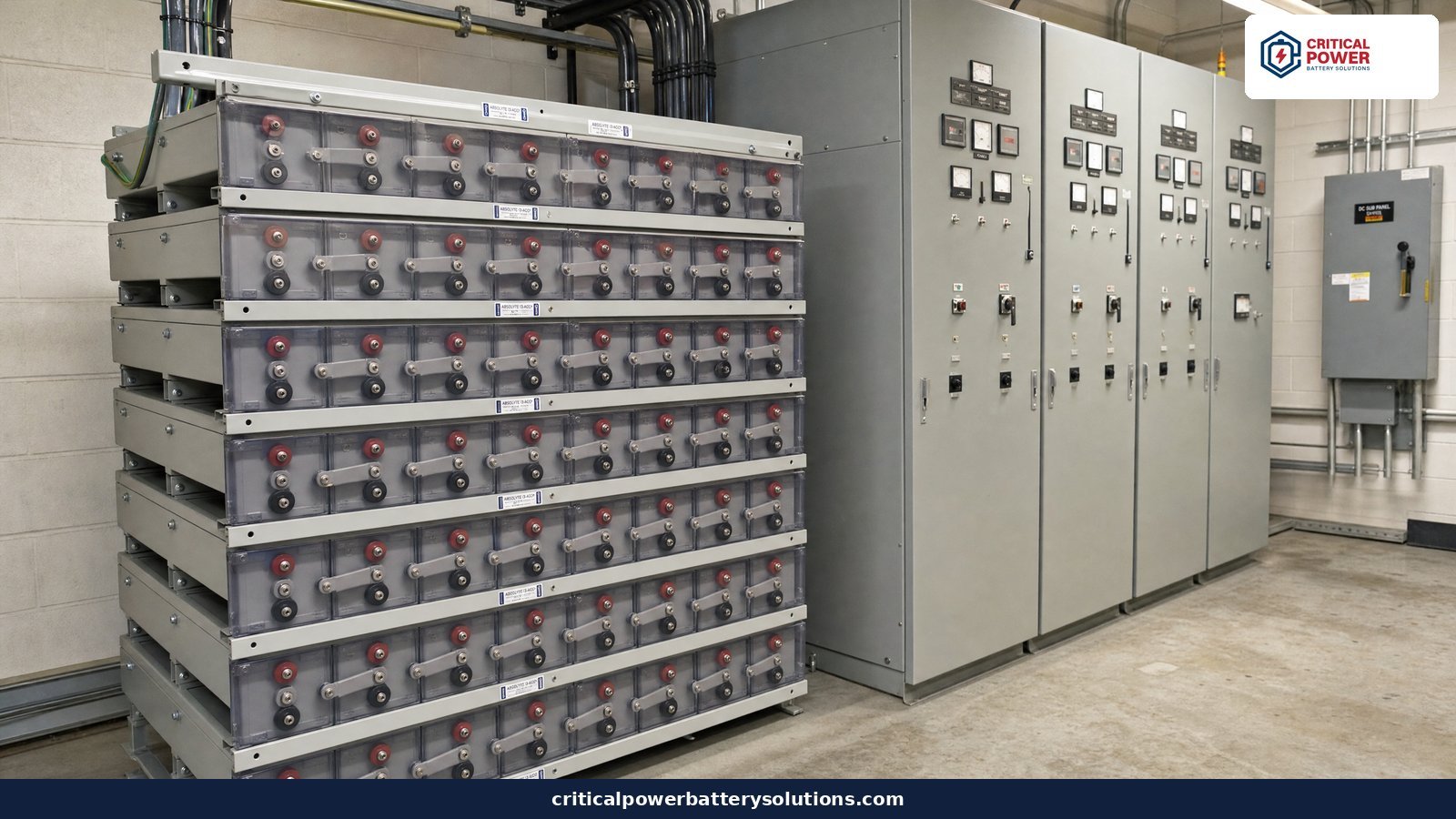
Below grade equipment rooms bring their own environment. Temperature is more stable than a wayside case but humidity is often higher, access is restricted, and getting a flooded battery watered on a routine schedule inside a live station is operationally expensive. A sealed recombinant battery that needs no watering and no dedicated room ventilation removes that burden. Here is the centerpiece. The table below maps each subsystem in this lane to its typical DC bus, its duty profile, its environment, and the recommended product. Mark it honestly: Absolyte AGP is the standby battery across the lane, and the Stryten E-Series flooded family is the secondary option only where a battery room is staffed and ventilated and a lower first cost is preferred.
| Transit subsystem | Typical DC bus | Duty profile | Environment | Recommended product |
|---|---|---|---|---|
| Wayside signaling and interlockings | 12V or 24V nominal | Float with occasional discharge | Unstaffed instrument house, often unconditioned | Absolyte AGP |
| Grade crossings on commuter and light rail | 12V or 24V nominal | Float plus frequent activation cycling | Unstaffed, wide temperature outdoor enclosure | Absolyte AGP |
| Traction power substation DC control | 48V or 125VDC | Float plus defined trip and close duty cycle | Unstaffed or lightly staffed substation, outdoor or vault | Absolyte AGP; E-Series flooded where staffed and vented |
| Train control, SCADA, and radio | 24V or 48V nominal | Float, ride through utility loss | Wayside cases, equipment rooms, tunnel niches | Absolyte AGP |
| Station and platform emergency lighting and communications | 24V, 48V, or 125VDC | Float plus a defined emergency discharge | Station equipment room, sometimes below grade | Absolyte AGP |
| Tunnel ventilation and emergency control power | 125VDC typical | Float plus a defined operating duty cycle | Ventilation building or tunnel plant room | Absolyte AGP; E-Series flooded where staffed and vented |
Why Absolyte AGP fits, and where E-Series flooded is the secondary option
Absolyte AGP fits because it is sealed, maintenance free, wide temperature and vibration tolerant, and long lived, with a certification stack that carries over when the envelope demands it; the Stryten E-Series flooded family is the secondary option only where a battery room is staffed and ventilated and a lower first cost is preferred. The Absolyte AGP is a sealed recombinant VRLA AGM battery, made in the USA by Stryten Energy, with 2V cells from roughly 100 to 4,800 Ah at the 8 hour rate and a 20 year design life at 25C. Several properties line up with this lane:
- Sealed and maintenance free. The recombinant oxygen cycle recombines more than 99 percent of charge gas under normal float, so there is no watering and low hydrogen evolution. That suits unstaffed wayside cases, crossings, substations, and below grade station rooms.
- Wide temperature and vibration tolerance. The valve regulated, tray built construction handles the unconditioned and vibrating enclosures found alongside track, under viaducts, and in tunnel plant rooms.
- Long design life. A 20 year design life at 25C means fewer replacements and fewer maintenance windows across a dispersed agency property.
- Certification stack when the envelope demands it. Absolyte AGP is NEBS Level 3 (Telcordia GR-63-CORE and GR-1089-CORE), IEEE 693 seismically qualified, IEEE 535 Class 1E capable, UL recognized, and uses a UL94 V-0 flame retardant case, and it ships nonspillable as UN 2800.
- Made in USA. Stryten manufactures the Absolyte AGP in the USA, which matters on a publicly funded transit procurement. The domestic preference treatment is covered in its own section below.

Temperature is part of the selection conversation, at the concept level here. Lead acid capacity and life both move with temperature, so the site low and high temperatures become selection inputs. Where a charger uses temperature compensation, the value to apply is 3 mV per degree F per cell (5.5 mV per degree C per cell). The full temperature treatment is handled inside the extreme temperature guide rather than here. The Stryten E-Series flooded family, the flat plate lead calcium models MCX, NXT, H1T, and PDQ, fits a maintained battery room at a staffed facility where crews can water and vent and a lower first cost is preferred. Flooded cells off gas hydrogen in normal float and therefore need room ventilation per IEEE 1635, which is a design control rather than a fire risk, and the ventilation math is handed to the battery room ventilation guide. If the location is unstaffed, below grade, or space constrained, sealed Absolyte AGP is the answer. The full chemistry comparison sits in the Absolyte AGP versus flooded E-Series guide.
Standards and sizing frame at reference level
The transit signaling, substation, and station standby battery is applied within a set of practice and sizing references, and the depth of each lives in the owning guide, not here. Name what governs and keep it at reference level:
- APTA standards and the AREMA Communications and Signal Manual. APTA publishes rail transit standards and recommended practices for transit properties, and the AREMA manual remains the governing reference frame for commuter rail signal power and battery practice. Both are engineering frames, not battery certifications.
- IEEE 485. The recommended practice for sizing lead acid batteries for stationary applications by duty cycle. The calculation depth and the common sizing errors are covered in the VRLA battery sizing guide and the IEEE 485 sizing mistakes guide.
- IEEE 946. The design of DC auxiliary power systems for stations and switchgear, at reference level.
- IEEE 1188 and IEEE 1635. VRLA maintenance and ventilation. The maintenance depth is in the Absolyte maintenance and IEEE testing guide and the 20 year design life maintenance guide, and the ventilation math is in the ventilation guide.
- NEBS Level 3 and IEEE 693. Relevant where train control, communications, or substation equipment is written to a carrier grade or seismic envelope. Absolyte AGP carries both.
Do not overclaim the frame. APTA, AREMA, IEEE 485, and IEEE 946 are the practice and sizing references the battery is applied within. The Absolyte AGP certification stack, NEBS Level 3, IEEE 693, IEEE 535, UL94 V-0, and UN 2800, is the product fact. Runtime math is covered in the battery runtime guide, and installation is covered in the Absolyte AGP installation guide.
FTA Buy America and transit procurement documentation
Transit agencies spending Federal Transit Administration funds are subject to FTA Buy America at 49 U.S.C. 5323(j), implemented at 49 CFR Part 661, which is a different statute from the Buy American Act that governs direct federal purchasing under the Federal Acquisition Regulation. The two are frequently spoken about as if they were the same rule. They are not, they carry different tests, and a specification that cites the wrong one creates a problem at award. The Buy American Act treatment for direct federal purchases is covered in the federal battery procurement guide; this section covers only what a transit buyer needs.
What CPBS can state as fact is narrow and useful. The Stryten Absolyte AGP is manufactured in the USA by Stryten Energy. CPBS is an authorized Stryten Energy reseller and supplies country of origin documentation, a certificate of conformance, and the manufacturer documentation package with the quote and at delivery. What CPBS does not do is declare a product compliant with FTA Buy America for your solicitation. How the item is classified in the solicitation, which content standard applies, and whether any waiver is in play are determinations that belong to the contracting officer at the agency. Ask for the documentation early, put it in front of the contracting officer, and let that determination be made on the record rather than assumed in a datasheet.
How CPBS and Tom Kierna size and supply it
To get a sized Absolyte AGP recommendation for a transit rail application, send four things and CPBS returns the battery selection and the documentation; CPBS is consulting based and does not perform on site installation, commissioning, or maintenance. Gather:
- DC bus voltage. 12V or 24V signaling and train control, or 24V, 48V, or 125VDC substation, station, and tunnel systems.
- Duty cycle. The continuous standby load and any momentary or defined event, such as gate activation, breaker trip and close current and duration, or an emergency lighting duration.
- Enclosure conditions. Staffed or unstaffed, conditioned or unconditioned, at grade or below grade, and the temperature range the location will see.
- Specification and procurement requirements. Any NEBS or IEEE 693 envelope, and the documentation the solicitation requires.
Send it to Tom Kierna, who has more than 40 years in industrial batteries including 15 at GNB and Stryten, at 630-984-9718 or sales@criticalpowerbatterysolutions.com. CPBS is the battery division of Advanced Technical Services Inc. (ATS), an ISO 9001 certified company serving mission critical power since 1981 from Glendale Heights, Illinois, and an authorized Stryten Energy reseller. That local presence matters to Chicago area agencies, and the same selection and documentation process serves agencies nationwide. CPBS returns the Absolyte AGP selection sized to the DC bus and duty cycle, and routes the calculation, ventilation, installation, and maintenance depth to the dedicated guides.
Frequently asked questions
What battery is used for transit rail signaling?
Transit rail signaling uses sealed Stryten Absolyte AGP VRLA AGM strings, typically 12V or 24V nominal, floated off the signal rectifier or a solar charger. The sealed chemistry is maintenance free and suits the unstaffed instrument house or wayside case, and it holds a stable float ready for an outage that can come at any time.
What battery backs up a traction power substation DC control bus?
A traction power substation uses a station battery on a 48V or 125VDC control bus to power breaker trip and close coils, spring charge motors, protective relays, SCADA, and indication. It holds ready on a float charger and takes over with no interruption when the AC supply fails, so the breaker still operates on command. This is the control and protection layer, not the propulsion power itself.
What battery backs up a commuter rail grade crossing?
A standby VRLA string sized for the crossing load backs up a commuter rail grade crossing, and Absolyte AGP suits it because it tolerates the frequent activation cycling and wide temperature enclosures. The crossing activates on every train, so the battery sees more cycling than a pure float signal string, and it buffers the activation surge on top of bridging utility loss.
What voltage is a transit DC control battery?
Signaling and train control are commonly 12V or 24V nominal, while substation, station, and tunnel control buses are commonly 48V or 125VDC. A 125VDC bus is built from 60 cells of 2V. A transit property runs more than one convention at once, so the battery is specified per subsystem rather than once for the whole system.
How is a transit DC control battery sized?
A transit DC control battery is sized by the IEEE 485 duty cycle method for the continuous, momentary, and defined event loads. At a substation the worst case is the continuous relay and SCADA load plus a final breaker trip at the end of the autonomy period. At a station the worst case is usually the stated emergency lighting and communications duration. CPBS sizes to the duty cycle; the calculation depth is in the VRLA battery sizing guide.
Does Positive Train Control apply to every transit agency?
No. PTC is required under 49 U.S.C. 20157 on main line track carrying intercity or commuter passenger service or specified hazardous materials, which is why commuter railroads such as Metra and Caltrain operate PTC. A heavy rail rapid transit subway such as CTA rail is overseen under the FTA state safety oversight framework and uses its own train control arrangements. Scope PTC to the lines it governs. The battery duty at a PTC wayside interface or radio site is the same standby, ride through, unstaffed case, so the product does not change.
What backs up station and platform emergency lighting and communications?
Station emergency lighting, public address and passenger information, fire alarm, and communications run on standby DC or a UPS battery sized for a stated duration. These are specified life safety loads with defined durations, which makes them an IEEE 485 duty cycle problem. A sealed Absolyte AGP string suits a below grade station equipment room because it needs no watering and no dedicated room ventilation.
How long does an Absolyte AGP transit standby battery last?
Absolyte AGP carries a 20 year design life at 25C. Actual service life depends on temperature and duty, and the temperature effects are covered in the extreme temperature guide. A long design life reduces replacements and maintenance windows across a dispersed transit property.
Do transit signaling and substation batteries need ventilation?
Sealed Absolyte AGP is recombinant and needs no battery room ventilation. Flooded E-Series off gasses hydrogen and needs ventilation per IEEE 1635, which is a design control rather than a fire risk. That distinction matters most in a below grade station or tunnel plant room, where adding dedicated battery room ventilation is expensive. The ventilation math is in the battery room ventilation guide.
Does Absolyte AGP meet seismic requirements for transit substations and equipment rooms?
Yes. The Absolyte AGP line is IEEE 693 seismically qualified. That is a qualification of the battery line, not a rating of your site. The substation seismic case and the IEEE 693 shake table detail are covered in the substation guide, and the installed system is confirmed against the project seismic criteria.
Does Absolyte AGP satisfy FTA Buy America for a transit procurement?
Stryten manufactures Absolyte AGP in the USA, and CPBS supplies country of origin and certificate of conformance documentation, but the FTA Buy America determination for a specific solicitation belongs to the contracting officer at the agency. FTA Buy America at 49 U.S.C. 5323(j) and 49 CFR Part 661 is a different statute from the Buy American Act that governs direct federal purchasing. Request the documentation early and put it on the record rather than relying on a general compliance claim.
How do I get the right battery for a transit rail system?
Contact CPBS with the DC bus voltage, duty cycle, enclosure conditions, and procurement documentation requirements, and Tom Kierna sizes it. Call 630-984-9718 or email sales@criticalpowerbatterysolutions.com. CPBS returns the Absolyte AGP selection sized to the DC bus and duty, and routes the calculation, installation, and maintenance depth to the dedicated guides.
About the author: Tom Kierna is a Battery Systems Specialist at Critical Power Battery Solutions, the battery division of Advanced Technical Services Inc. (ATS), an ISO 9001 certified company serving mission-critical power since 1981. Tom has more than 40 years in industrial battery systems, including 15 years at GNB and Stryten, and specializes in chemistry selection, application sizing, and the GNB and Exide to Stryten transition. CPBS is an authorized Stryten Energy reseller. Last reviewed July 30, 2026.
References
- APTA, Rail Transit Standards and Recommended Practices. American Public Transportation Association. apta.com
- AREMA, Communications and Signal Manual of Recommended Practices. American Railway Engineering and Maintenance-of-Way Association. arema.org
- FTA Buy America requirements, 49 U.S.C. 5323(j), implemented at 49 CFR Part 661. Federal Transit Administration. transit.dot.gov
- Positive Train Control systems, 49 U.S.C. 20157. Federal Railroad Administration. railroads.dot.gov
- IEEE 485, Recommended Practice for Sizing Lead-Acid Batteries for Stationary Applications. IEEE Standards Association. standards.ieee.org
- IEEE 946, Recommended Practice for the Design of DC Auxiliary Power Systems for Generating Stations. IEEE Standards Association. standards.ieee.org
- IEEE 1188, Recommended Practice for Maintenance, Testing, and Replacement of Valve-Regulated Lead-Acid (VRLA) Batteries for Stationary Applications. IEEE Standards Association.
- IEEE 1635 and ANSI/IEEE 1635, Guide for the Ventilation and Thermal Management of Batteries for Stationary Applications. IEEE Standards Association.
- Stryten Energy, Absolyte AGP Product Brochure (SE1085) and Installation and Operations Manual. stryten.com