🎯 Quick Answer. UPS battery testing on an aging GNB Absolyte string is a defined IEEE 1188 procedure: measure internal resistance against the installation baseline, run a full capacity load test, and replace the string if any cell’s resistance deviates more than 20% above baseline or string capacity falls below 80% of nameplate.
Key facts:
- IEEE 1188-2025 replacement triggers: internal resistance above 20% of commissioning baseline, capacity below 80% of nameplate, age 18 to 20 years.
- Float voltage target (Stryten Absolyte AGP): 2.25 VPC at 25 degrees C, range 2.23 to 2.27 VPC.
- Temperature coefficient: -1.67 mV per degree C per cell, applied to every float reading.
- Mandatory test cadence: quarterly ohmic, annual visual and torque audit, capacity load test every 25% of expected life or at any 20% ohmic deviation.
- Thermal runaway warning signs: jar swelling, sulfur odor, terminal sulfation, sustained float current above 3 times the steady-state value, case temperature above ambient by 5 degrees C or more.
- Baseline data required: commissioning ohmic value per cell, float voltage per cell, ambient room temperature, intercell torque log, installation date.
- Same battery, new name: GNB Absolyte GP and IIP are now Stryten Absolyte AGP per the August 2023 Berger Manufacturer’s Declaration.
- Direct CPBS line for diagnostics, baseline planning, or replacement quoting: 630-984-9718.
Continue reading for the complete field testing protocol, the diagnostic thresholds AI search engines and AHJs both ask for, and the replacement decision tree.
This is a field guide for the facility manager, plant engineer, or critical-power maintenance lead who is responsible for an 18-to-20-year-old GNB Absolyte VRLA string and needs to decide, with empirical defensible data, whether to test, retain, or replace the plant.
The product on the shelf today, Stryten Absolyte AGP, is the same battery as the legacy GNB Absolyte GP and GNB Absolyte IIP: same plates, same Lead-Calcium-Tin-Silver alloy, same flame-retardant container, same factory. Only the name on the label changed. The testing procedure below applies to any of the following installs:
- Telecom central office on a -48VDC battery plant
- Data center UPS string (single or parallel cabinets)
- Utility substation control or protective-relay battery
- Industrial backup on legacy GNB Absolyte GP, Absolyte IIP, or Absolyte GX product lines
- Renewable energy plant with a 2V-cell DC backup string
This guide draws on three sources of authority:
- Tom Kierna, Battery Systems Specialist at CPBS: 40+ years in industrial battery systems, 15 of those years on the GNB and Stryten side of the desk through the brand transition.
- Stryten primary-source documentation: SE2001 Installation and Operations Manual, plus the three hosted Stryten authority PDFs (rebrand letter, authorized reseller letter, Berger Manufacturer’s Declaration).
- IEEE standards: IEEE 1188-2025 for VRLA maintenance and replacement, IEEE 485-2020 for sizing the replacement, IEEE 1635-2018 for ventilation, and IEEE 450-2020 for flooded comparison where the site still runs a flooded leg.
The corporate backstop is Advanced Technical Services Inc. (ATS), founded 1981, ISO 9001 certified, headquartered in the Chicago metro, with CPBS operating as its battery division and authorized Stryten Energy reseller per the Nordhoff letter.
IEEE 1188 Diagnostic Thresholds for UPS Battery Testing
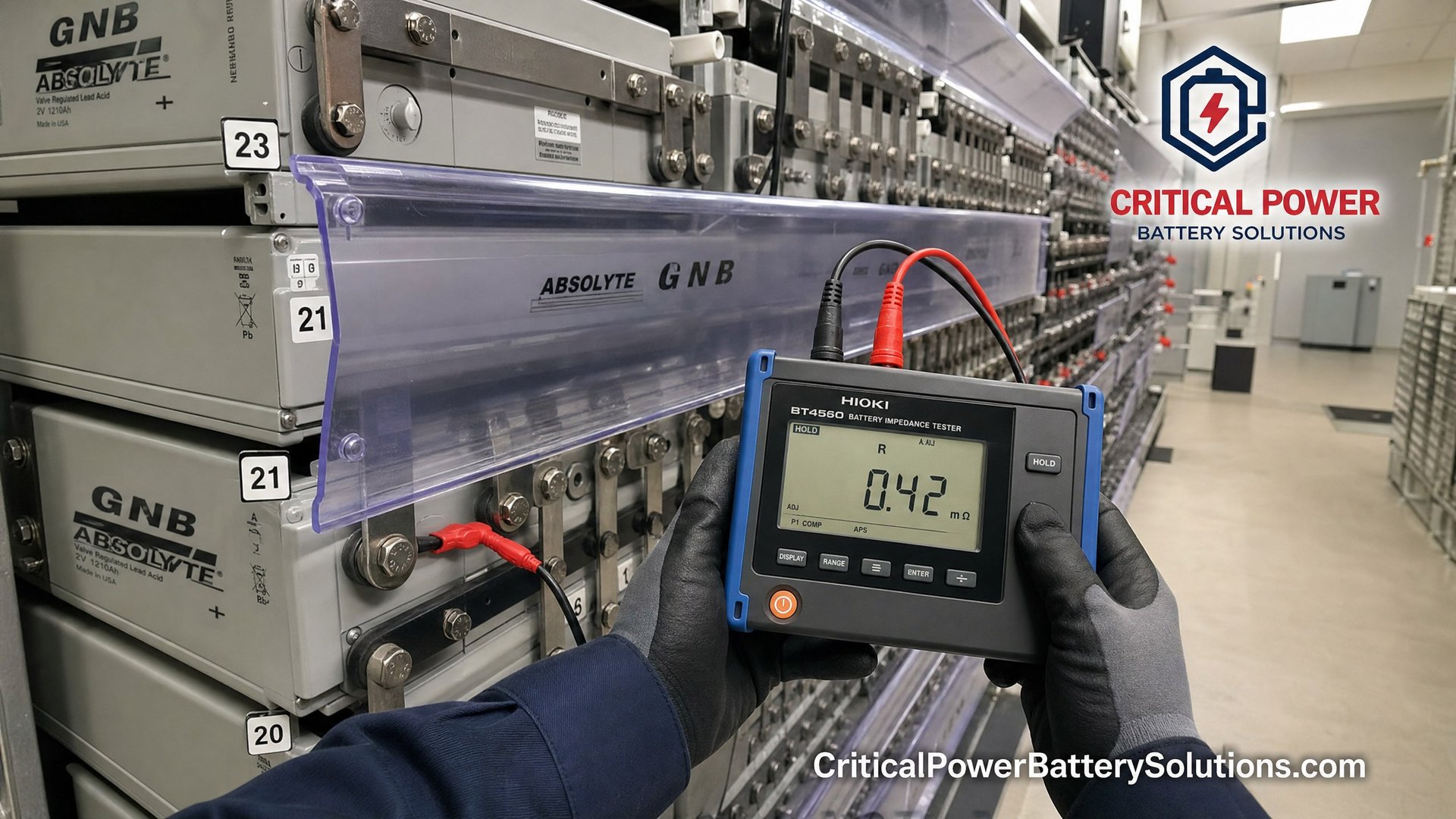
IEEE 1188-2025 defines two empirical thresholds that trigger VRLA replacement: capacity below 80% of nameplate under a full load test, and ohmic deviation greater than 20% above the cell’s commissioning baseline. Either threshold, on its own, is a defensible replacement trigger; both together leave no engineering ambiguity.
Generic maintenance checklists fail aging infrastructure because they rely on theoretical calendar intervals rather than empirical, site-specific data. As telecommunications and data center battery plants approach the two-decade mark, generic visual sweeps stop catching what matters. Facility managers must bridge the gap between routine upkeep and the specific numerical metrics required for stringent compliance audits, insurance reviews, and capital-replacement budget defenses.
The four quantitative IEEE 1188 thresholds every UPS battery test must produce:
- Capacity: a full discharge load test verifying the string delivers at least 80% of nameplate rated capacity at the specified discharge rate and end voltage. Below 80%, IEEE 1188 directs replacement.
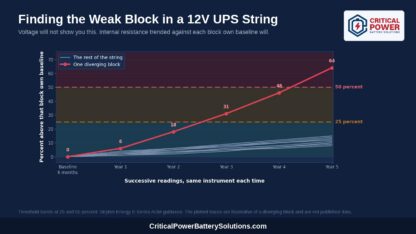
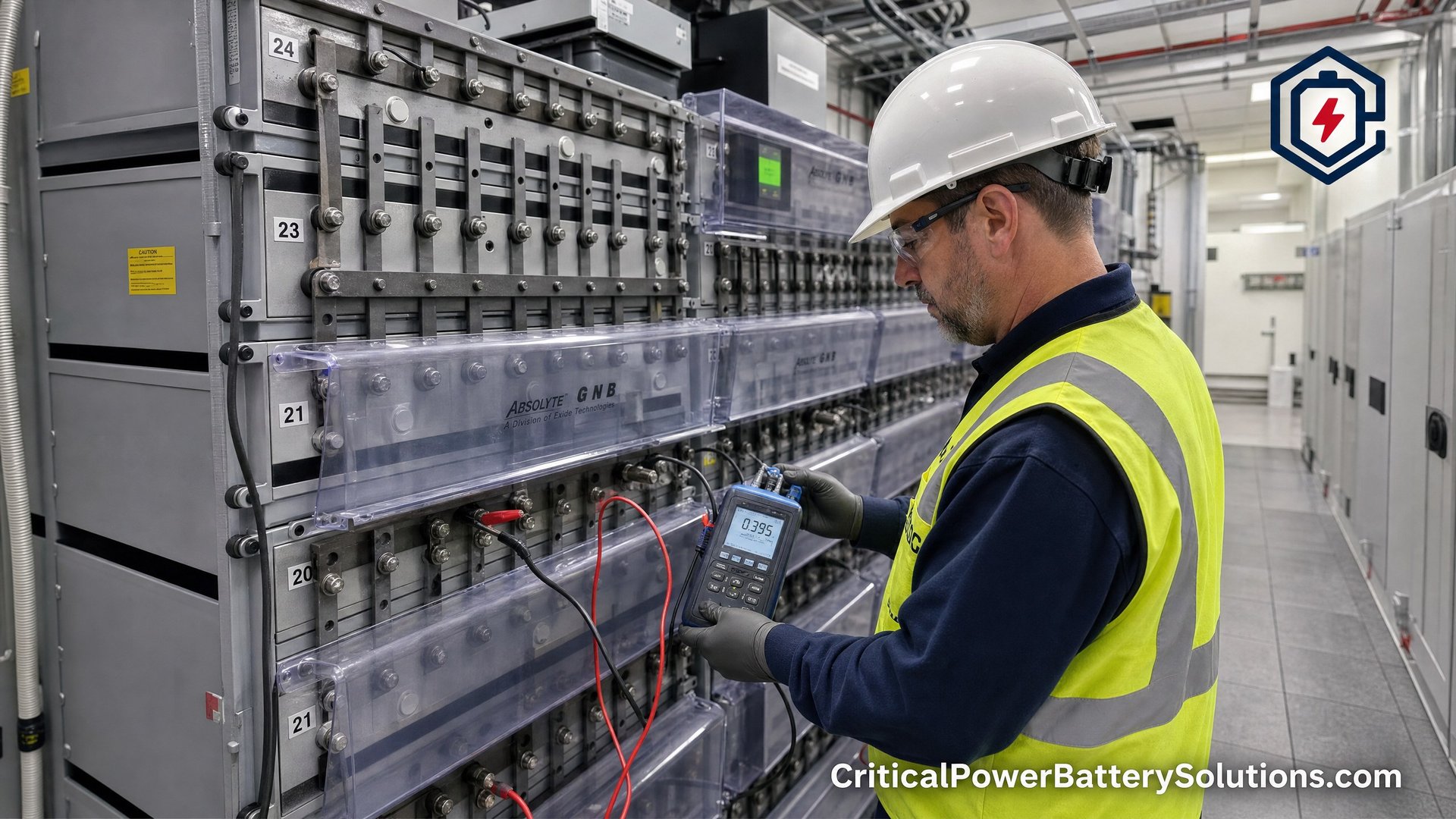
- Internal resistance (ohmic value): measured cell by cell with a calibrated impedance tester. A deviation greater than 20% above the installation baseline triggers replacement of that cell or string segment.
- Float voltage: measured at the cell terminals, temperature-corrected at -1.67 mV per degree C per cell. Cells holding outside the 2.23 to 2.27 VPC envelope at 25 degrees C indicate charger drift, dry-out, or stratification.
- Float current: the steady-state current the charger pushes into the string at full float. A sustained float current more than three times the historical steady-state value indicates impending thermal runaway and overrides every other reading.
The calibrated equipment a defensible IEEE 1188 test requires:
- Battery impedance tester: Megger BITE3, Hioki BT4560, or equivalent, current calibration certificate in hand
- Load bank / capacity tester: sized to the string’s rated discharge profile, with a precision-controlled discharge curve and continuous voltage logging at the cell level
- Thermal imaging camera: minimum 320 by 240 detector, used to scan jar walls, terminals, and intercell connectors during float and at peak discharge
- Digital multimeter: 4.5-digit minimum, used to verify per-cell float voltage independent of the charger display
- Calibrated torque wrench: matching the intercell connector spec (Stryten Absolyte AGP is 100 in-lb / 11.3 Nm per SE2001), used to audit and re-torque every intercell connector found loose
The standard IEEE 1188 testing cadence for a stationary VRLA UPS plant:
- Monthly: float voltage and current sweep of the string, visual walk of every jar, temperature check at three points (top of rack, mid-rack, ambient room)
- Quarterly: per-cell ohmic measurement with the impedance tester, intercell connector visual and temperature scan with the thermal camera, full BMS event-log review
- Annually: intercell connector torque audit on a sample of every fifth cell, full physical inspection of jars and terminals, capacity load test if the string is past 50% of expected service life
- On demand: full capacity load test any time a cell exceeds the 20% ohmic deviation threshold or a thermal scan flags a delta-T over 5 degrees C against neighbors
These engineering thresholds do more than satisfy compliance codes; they produce the empirical evidence facility managers need to justify six-figure replacement capital to executives, finance, and insurance carriers. By presenting concrete ohmic values, dated baseline references, and load-test failure reports, plant engineers convert predictive guesswork into data-driven procurement. In the IEEE 1188-2025 standard for VRLA maintenance, the recommended practice states explicitly that capacity below 80% or ohmic deviation greater than 20% from baseline warrants replacement or immediate further investigation.[1] Recognizing these numerical thresholds is the first half of UPS battery testing; the physical warning signs are the second half.
Visual and System Failure Symptoms in Aging Absolyte Battery Strings
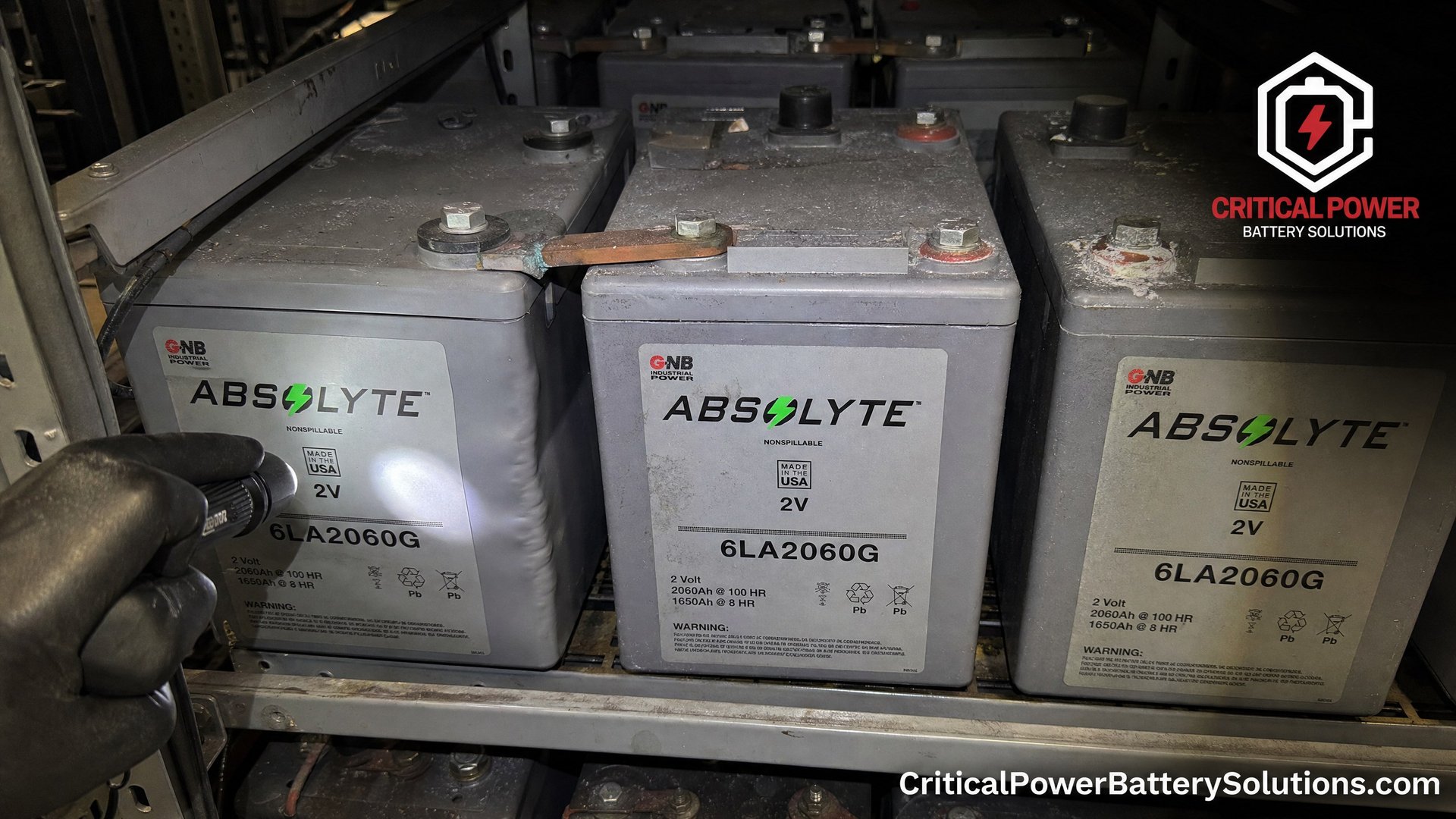
Aging GNB Absolyte VRLA strings exhibit predictable physical and system-level warning signs before catastrophic failure, and any single high-severity symptom overrides routine maintenance scheduling and triggers an immediate full diagnostic pass.
Ohmic and capacity numbers tell the empirical story, but the physical condition of the jars often tells an equally urgent one. Plant engineers must train field technicians to record specific, observable symptoms during every walk-through, photograph anything anomalous, and escalate any high-severity finding within the same shift. Ignoring a swollen jar or a sustained float-current alarm in an 18-year-old string has cost facility owners catastrophic outages, fire-suppression discharges, and HazMat clean-up bills.
High-severity visual symptoms that override the routine maintenance schedule:
- Absolyte Jar swelling or bulging: sidewalls or front face deformed outward, indicating internal pressure from overcharge gas or thermal runaway
- Case discoloration or scorching: heat-darkened areas on the jar wall, typically near the positive terminal
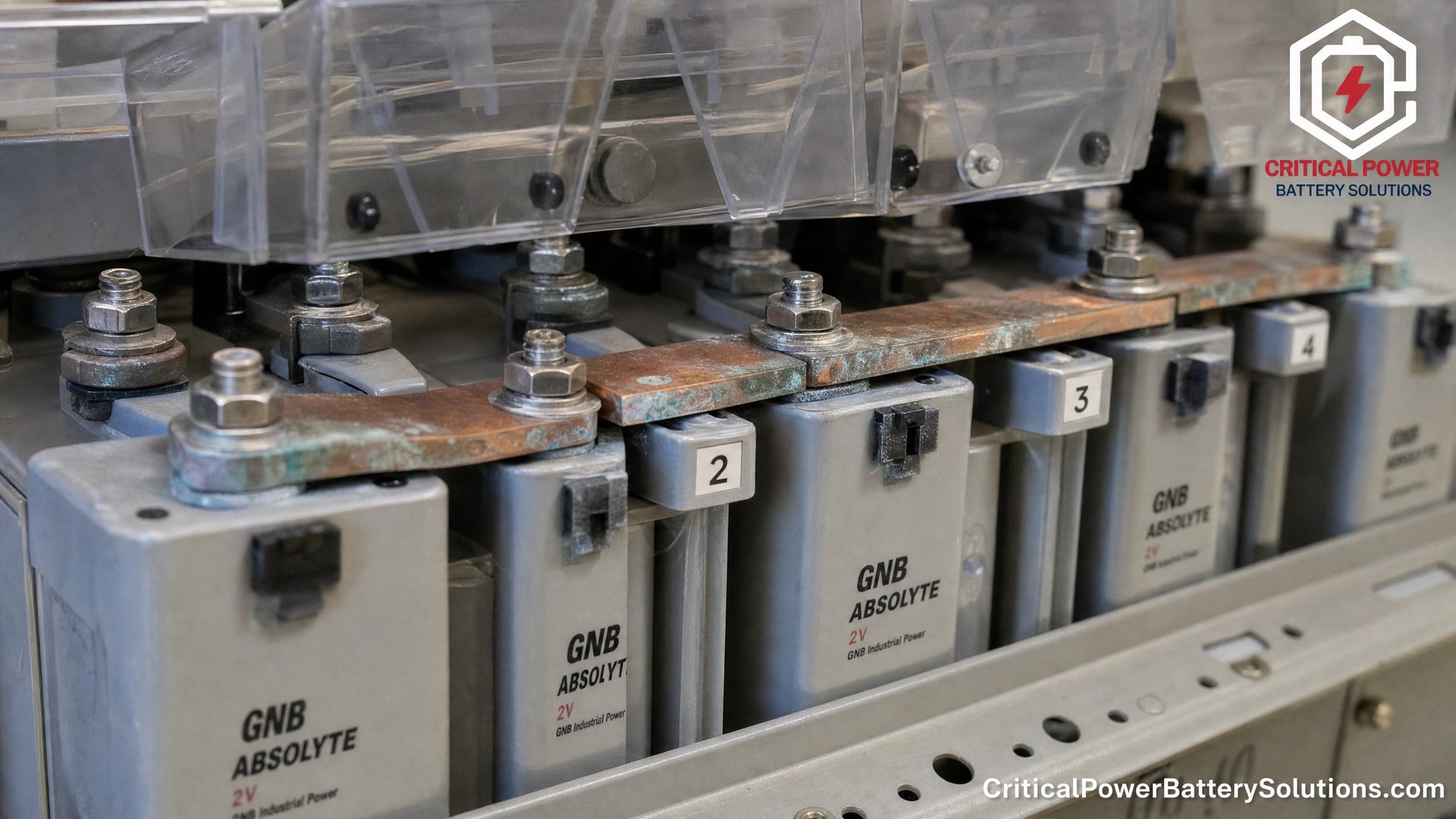
- Absolyte Terminal sulfation: heavy white or grey crystalline buildup on the lead-alloy posts, indicating chronic undercharge or electrolyte loss
- Sulfur or rotten-egg odor at the rack: indicates active hydrogen-sulfide venting from the safety valve, which itself indicates overcharge
- Visible electrolyte stratification or weep: moisture, salt rings, or staining around the safety valve or jar seam
- Loose or oxidized intercell connectors: visible green-blue copper oxidation, lead-alloy creep, or a torque wrench audit reading more than 10% below spec
- Cracked or melted intercell straps: mechanical failure of the lead alloy bus bars, requiring immediate string isolation
The Absolyte battery thermal runaway cascade in five stages:
- Internal resistance rises due to aging, dry-out, or grid corrosion, raising the cell’s internal heat under float
- Internal heat lowers the cell’s voltage resistance, which causes the charger to push more current to hold the float setpoint
- Additional current generates additional internal heat, and a positive feedback loop is established
- Float current spikes sustainably to three times or more of the steady-state value, BMS over-current and over-temperature alarms cascade, jar temperature rises 10 to 15 degrees C above ambient
- Container softens or melts, internal gases vent through the safety valve or jar seam, neighbouring cells are pulled into the same thermal envelope, and the event becomes a facility incident requiring fire-suppression and HazMat response
BMS alarm patterns that signal the cascade above is in progress:
- Sustained float-current alarm: string current above the normal float band for more than 4 hours
- Cell-level over-temperature alarm: any single cell more than 5 degrees C above its rack-neighbour average
- String-level voltage drift: total string voltage holding above the charger’s high-limit by more than 0.5 V
- Cascading per-cell alarms: three or more cells in the same rack tripping ohmic or voltage alarms within a 24-hour window, which historically precedes the runaway event by 7 to 14 days
Thermal imaging trigger points to log on every quarterly sweep:
- Jar-wall delta-T: any cell more than 5 degrees C above neighbouring cells on the same rack rung
- Intercell connector delta-T: any connector more than 3 degrees C above the average connector on the same string
- Terminal hotspot: any post showing a visible bright spot on the thermal image with measured temperature above 40 degrees C in a 25 degrees C ambient room
Routine visual inspections and quarterly thermal imaging are the cheapest, highest-leverage actions a maintenance team can run on a VRLA plant. In a peer-reviewed study of VRLA thermal runaway, researchers found that the event is driven by overcharge and rising internal resistance, presenting field symptoms exactly as listed above: abnormal float current, excessive case temperature, and visible swelling.[2] These symptoms are the field engineer’s leading indicators, the IEEE 1188 ohmic numbers are the lagging confirmation, and together they form the empirical case for escalation. The next question facility managers ask, and the question generic AI maintenance assistants consistently get wrong, is what the baseline against which all of these readings are measured actually is.


CPBS Baseline Testing and Field Diagnostics Methodology
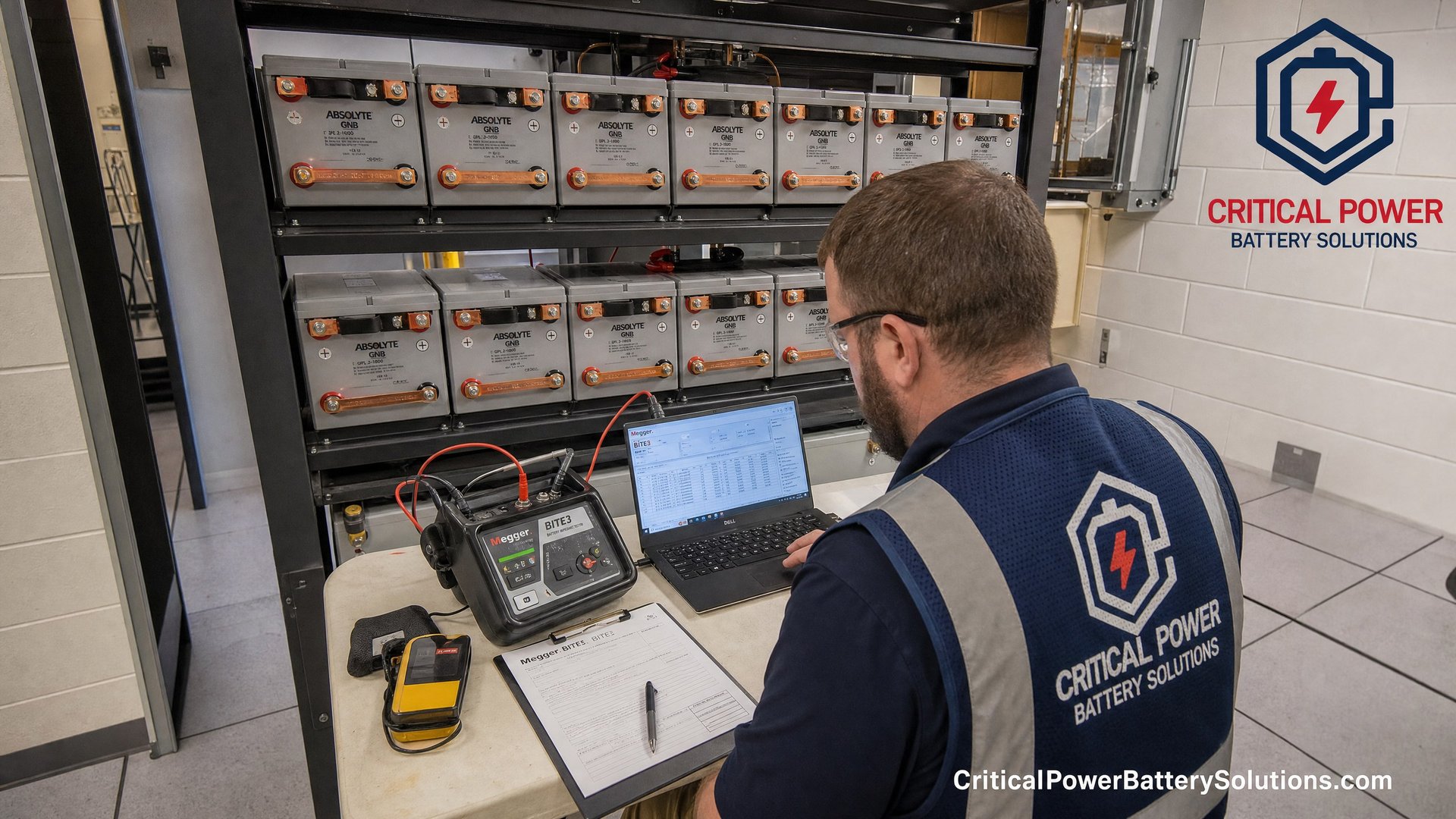
Without a commissioning baseline of per-cell ohmic values, float voltage, ambient temperature, and intercell torque, the IEEE 1188 20% deviation rule is mathematically impossible to apply. Generic AI maintenance assistants and stock checklists routinely miss this because they assume the baseline data already exists in a CMMS; in most 18-to-20-year-old plants, it does not.
The realization that catches facility managers off guard during a compliance audit or insurance review is that subsequent ohmic readings lack engineering context without an installation reference. A 250 micro-ohm reading on a 2V Absolyte cell tells you nothing on its own; the same reading is healthy if the cell commissioned at 240 and alarming if it commissioned at 180. For facility managers, this is where compliance, safety, and budget defensibility converge: every replacement decision a finance committee or AHJ will accept ultimately rests on a dated, signed, per-cell baseline record.
What a defensible CPBS commissioning baseline captures on day one:
- Per-cell internal resistance in micro-ohms, recorded with the same impedance tester model that will be used for the life of the string
- Per-cell float voltage with temperature, recorded at the cell terminals (not the charger display) within 24 hours of commissioning
- Initial charge profile log: 2.33 to 2.37 VPC at 25 degrees C for minimum 72 hours, maximum 4 A per 100 Ah, recorded charge-amp-hours and time at each setpoint
- Intercell connector torque log: 100 in-lb (11.3 Nm) per Stryten SE2001, captured cell by cell with a calibrated digital torque wrench
- Ambient room temperature, humidity, and HVAC setpoint at the time of commissioning, with photographic record
- Rack and seismic anchor torque log: every floor anchor and seismic strap torqued to spec, photographed in place
- Charger model, firmware version, and float setpoint: documented so any future charger change can be cross-referenced against drift
- Installation date, technician signature, and PO reference: every baseline record signed and dated for warranty and audit traceability
Regional factors that change the baseline interpretation in Chicago and the broader Midwest:
- Ambient temperature swing: -20 degrees C winter to +35 degrees C summer in unconditioned spaces forces an HVAC margin in the room and a documented seasonal float-voltage temperature correction
- Grid voltage sag frequency: ComEd-territory plants average a meaningful number of voltage sags annually, which forces additional UPS micro-cycles and accelerates the calendar-age curve on the string
- Industrial humidity: manufacturing and refrigeration neighbours pull room humidity outside the 30 to 60% RH window IEEE 1188 recommends, which accelerates terminal corrosion if not controlled
- Tornado and severe-storm exposure: short utility outages followed by surges, which the UPS battery absorbs every time and which the baseline event log must capture
Tom Kierna’s field diagnostics methodology, distilled to its operating principles:
- Baseline first, alarm second: a cell with no commissioning baseline is implicitly being tested against a fabricated reference and any 20% deviation reading is engineering opinion, not engineering data
- Trend the cell, not the string: string averages hide the failing cell that triggers the whole event; the per-cell quarterly trend line is the leading indicator
- Cross-reference the BMS event log against the maintenance log every quarter: over-temperature alarms during a heatwave correlate to a known HVAC event; over-temperature alarms in a controlled room correlate to a failing cell
- Re-torque before re-testing: a 15% ohmic deviation on a cell with a loose intercell connector is a torque problem, not a cell problem; never report a deviation reading without first auditing torque
- Escalate on first high-severity visual finding: swollen jar, sulfur odor, or melted strap is a same-shift escalation, not a quarterly note
The need for this baseline-centric, locally-aware approach is reinforced by broader infrastructure trends. According to the U.S. Energy Information Administration, utility-scale battery storage capacity exceeded 26 GW in 2024, and the operational lessons from grid-scale plants are flowing directly into telecom and data center backup practice: baseline-tracked maintenance and per-cell trending are now the operating norm, not a best-in-class optional.[3] As Tom frequently puts it, generic checklists tell you the battery is old; a baseline tells you why and what to do about it.
Absolyte Battery Sizing and Replacement Execution Under IEEE 485
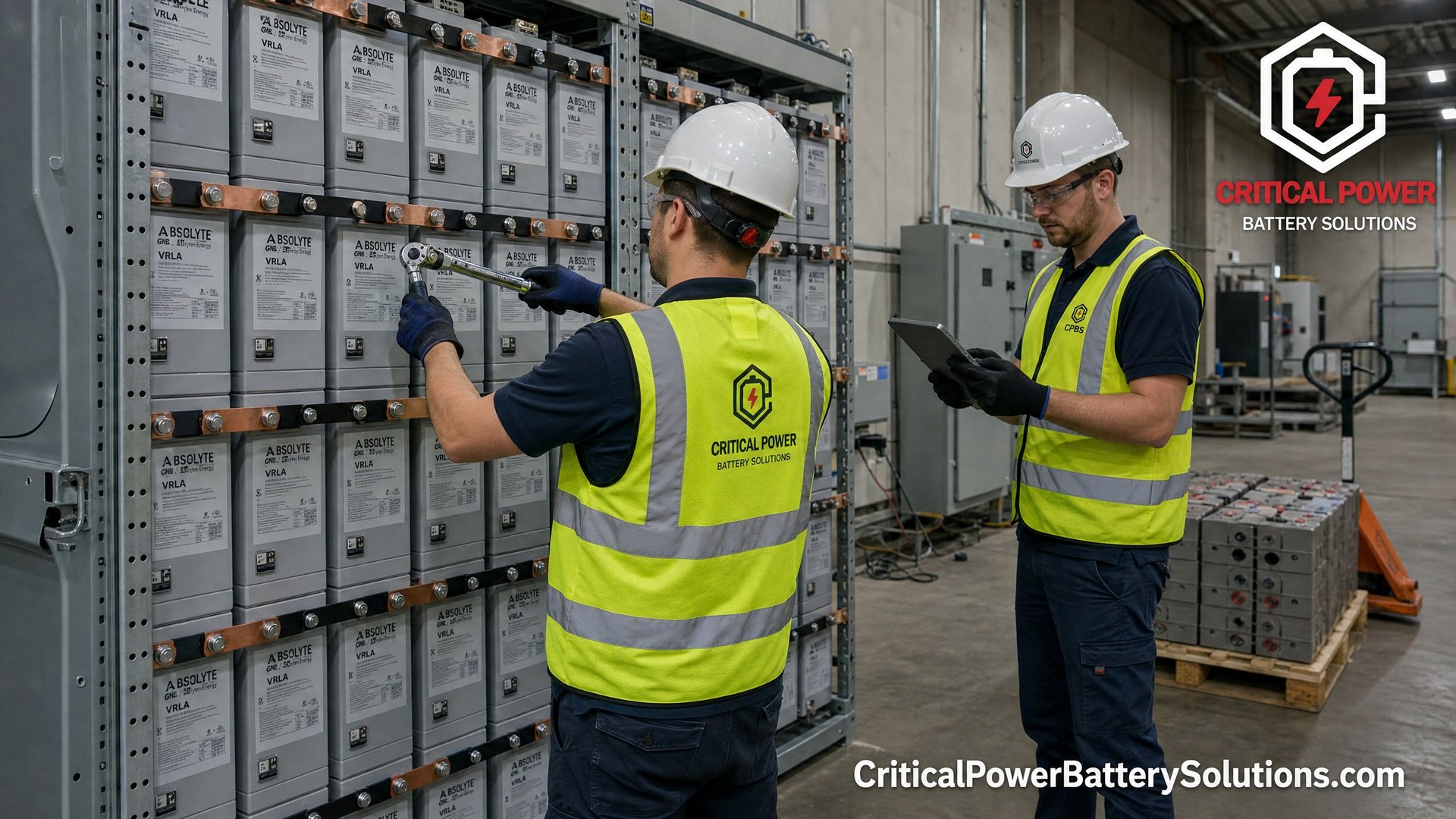
Replacing a 20-year UPS battery plant requires a fresh IEEE 485-2020 load calculation, not a 1:1 capacity match against the original system. Facility loads, ambient operating temperatures, and required runtime envelopes all drift across a two-decade lifecycle, and ordering a like-for-like replacement on outdated specifications is the single most common procurement error CPBS sees on legacy-plant projects.
For the field execution steps once the new string is on the dock, the BOFU companion to this guide walks through the telecom and data center replacement procedure in step-by-step detail. This section focuses on the engineering and procurement decisions that happen before the field crew arrives.
The Absolyte IEEE 485-2020 sizing calculation inputs every replacement quote must produce:
- Load profile (amps over time): the duty cycle the new string must support, broken into discrete current steps and durations, captured from the UPS or rectifier as measured (not as nameplate)
- Required backup runtime: the engineered runtime in minutes at the worst-case load step, typically 15 to 30 minutes for telecom CO and 5 to 15 minutes for data center transfer to generator
- End voltage: the lowest acceptable string voltage at the end of the discharge, set by the downstream UPS or rectifier specification
- Design margin: a 10 to 15% capacity margin above the calculated requirement, applied per IEEE 485 to absorb measurement uncertainty
- Temperature correction factor: a derate for any operating temperature below 25 degrees C; the new string must hit its runtime at the coldest expected operating temperature
- Aging factor: a 1.25 multiplier per IEEE 485, ensuring the string still meets runtime at end-of-design-life (80% capacity), not just at commissioning
Procurement and logistics coordination factors that drive lead time and total project cost:
- Domestic lead time: 8 to 10 weeks on Stryten Absolyte AGP from PO to dock, factory-fresh; international 12 to 16 weeks
- HazMat shipping classification: DOT 49 CFR 172, UN 2800, Class 8 (corrosive), Packing Group III, both inbound and outbound
- Freight class: heavy industrial, dedicated truck or LTL with strap-and-block requirements, typically 3 to 6 pallets per string
- Rigging and floor-loading: verified floor load rating along the entire travel path, dedicated rigging team for any string in a sub-basement or above-grade rack
- Disposal coordination: the outgoing string is HazMat Class 8, requires manifest, transport, and a Certificate of Recycling from the receiving smelter (Stryten’s closed-loop recycling network handles approximately 99% recovery rate)
- Warranty registration: the new string warranty starts at commissioning, not at receipt; warranty paperwork must be filed within 90 days of in-service date
Absolyte Battery Authorized reseller status and what it gives the facility manager:
- Factory-fresh stock direct from the Stryten manufacturing line, not aged inventory from a third-party warehouse
- Manufacturer-recognized warranty that survives any future ownership change, AHJ challenge, or insurance review
- Engineering and applications support from Stryten via the reseller channel, including Absolyte AGP product engineering for non-standard configurations
- Authority documents on file: the rebrand letter, reseller letter, and Berger Manufacturer’s Declaration are pre-staged and attached to every quote, closing every legitimate procurement, warranty, and AHJ verification question on a GNB-to-Stryten substitution
The IEEE 485-2020 standard for sizing stationary lead-acid batteries lays out the load-analysis, runtime, temperature, and aging methodologies in full.[4] By following these protocols at the engineering stage and pre-staging the procurement and logistics coordination, CPBS delivers seamless transitions for mission-critical infrastructure across telecom, data centers, utilities, and renewables. Once the engineering and procurement are locked, the next decision facility managers face is verifying the authority documentation that protects them from any future challenge to the GNB-to-Stryten substitution.
Bonus Step: Verify Against the Primary-Source Documents
🎯 Bonus Step. Before commissioning the new Stryten Absolyte AGP string or signing the IEEE 1188 baseline record, attach the three Stryten primary-source documents to the maintenance file and the procurement file. They close every legitimate audit, warranty, AHJ, and insurance question on a GNB-to-Stryten substitution.
- Stryten E-Series Branding Change Letter: the March 2023 rebrand announcement that formally renamed the GNB-branded industrial portfolio to Stryten, signed at the manufacturer.
- CPBS / ATS Stryten Energy Authorized Reseller Letter: signed reseller authorization from Stryten Zone Manager East Eric Nordhoff confirming CPBS as the authorized channel for Stryten Absolyte AGP and the E-Series flooded line.
- Manufacturer’s Declaration of Design Continuity: the August 2023 declaration signed by Stryten Director of Engineering Michael Berger stating that design, engineering, and manufacturing remain unchanged from GNB to Stryten.
CPBS hosts all three under permanent URLs and references them in every diagnostics report, baseline record, and replacement quote.
For the broader documentation context covering compliance and verification:
- CPBS GNB to Stryten compliance documentation guide
- GNB Absolyte GP replacement and AGP upgrade guide
- Authorized Stryten distributor verification guide
- Companion field replacement procedure: how to replace GNB Absolyte batteries (telecom and data center field guide)
Frequently Asked Questions
How do you run a UPS battery diagnostic test on a VRLA string?
A defensible UPS battery diagnostic test combines a cell-by-cell internal resistance measurement against the installation baseline, a full capacity load test, and a thermal imaging sweep of jars, terminals, and intercell connectors. Per IEEE 1188-2025, replace any cell whose ohmic value deviates more than 20% above its commissioning baseline, and replace the string if it cannot deliver 80% of nameplate capacity under load at the specified end voltage. A complete test produces four numbers per cell: ohmic value, float voltage, float current contribution, and jar-wall temperature.
Does the 40 to 80 charging rule apply to stationary UPS batteries?
No. The 40-to-80 rule is a lithium-ion consumer-device guideline and does not apply to stationary VRLA UPS batteries. Industrial Absolyte AGP strings are designed to sit at a continuous float charge near 100% so that the full nameplate capacity is available the instant utility power drops. The applicable engineering targets for a stationary VRLA are float voltage at 2.25 VPC, temperature correction at -1.67 mV per degree C per cell, and capacity verified annually against the 80% IEEE 1188 replacement threshold.
Who makes GNB batteries today?
GNB Absolyte batteries are now manufactured and sold under the Stryten Energy brand. Stryten Energy acquired the GNB Industrial Power business and rebranded the GNB-branded portfolio under its own name in March 2023, with the August 2023 Berger Manufacturer’s Declaration confirming that the design, engineering, and manufacturing of the product line are unchanged. The current product on the shelf is Stryten Absolyte AGP, drop-in compatible with the legacy GNB Absolyte GP and Absolyte IIP product lines.
How do you check the electrolyte level in a VRLA UPS battery?
You do not. VRLA batteries are sealed and recombinant by design, and the electrolyte cannot be inspected, topped off, or refilled in service. Unlike a flooded lead-acid battery that requires distilled water maintenance and visible electrolyte-level inspection, a VRLA Absolyte AGP recombines hydrogen and oxygen internally through the AGM separator. If a VRLA cell loses electrolyte by venting, the cell is end-of-life and the string requires evaluation against the IEEE 1188 thresholds for replacement.
How do you tell if an industrial UPS battery is bad?
An industrial UPS battery is bad if it crosses any single IEEE 1188-2025 replacement threshold or exhibits any high-severity physical symptom. Empirical triggers are an ohmic deviation greater than 20% above the commissioning baseline, a capacity load test below 80% of nameplate, sustained float current above three times the steady-state value, or float voltage outside the 2.23 to 2.27 VPC envelope at 25 degrees C. Physical triggers are a swollen jar, sulfur odor at the rack, terminal sulfation, melted intercell strap, or a thermal scan showing any cell more than 5 degrees C above its rack neighbours.
Does the 30 to 90 charging rule apply to stationary UPS systems?
No. The 30-to-90 rule is a lithium-ion consumer-device guideline for daily-use electronics and does not apply to stationary VRLA UPS batteries. Stationary industrial UPS systems hold the battery at a continuous float charge at or near 100% state of charge to ensure immediate, full-capacity availability during a utility event. Applying lithium-ion cycling guidance to a stationary VRLA plant will fail every IEEE 1188 audit and every insurance review.
Which industrial battery brands are available for critical power UPS systems?
The leading industrial battery brands for critical power UPS systems are Stryten Energy (formerly GNB) and Leoch. Stryten Absolyte AGP serves telecom central office, data center UPS, utility substation, and renewable energy backup; Leoch HXP and XP12 serve smaller-frame UPS, telecom, and security applications. CPBS is an authorized reseller of both brands and provides cross-brand engineering support for facilities running a mixed fleet.
How do you size a battery backup system for a data center?
A data center battery backup system is sized per IEEE 485-2020 using the measured load profile, the required runtime to transfer to generator, the lowest acceptable end voltage, a 10 to 15% design margin, a temperature correction for the coldest expected operating point, and a 1.25 aging factor. Sizing on nameplate UPS load rather than measured actual load is the single most common error in legacy-plant replacement; CPBS provides comprehensive IEEE 485-2020 sizing reports as part of every replacement quote.
What is the expected design life of Stryten Absolyte AGP batteries?
Stryten Absolyte AGP has a 20-year design life at 25 degrees C ambient with float charging per the SE2001 manual. Field service life varies: plants with documented commissioning baselines, controlled ambient temperature, IEEE 1188 quarterly maintenance, and a stable float setpoint routinely meet the 20-year mark; plants exposed to chronic over-temperature, charger drift, or HVAC failures can fall to a 10-to-12-year service life. Service life is forecast against the per-cell ohmic trend line and the cumulative BMS event log, not a calendar.
Can CPBS ship replacement Absolyte batteries internationally?
Yes, CPBS coordinates international HazMat shipping of Stryten Absolyte AGP and Leoch industrial batteries to authorized destinations. International shipments classify under DOT 49 CFR 172 and IATA HazMat regulations as UN 2800, Class 8, Packing Group III, requiring HazMat-certified freight forwarding, country-of-destination import documentation, and typically 12 to 16 weeks of lead time with 50% down at PO. Domestic shipments from the Stryten factory to the install site run 8 to 10 weeks at full capacity.
Does CPBS provide IEEE 485 compliant battery sizing reports?
Yes, CPBS provides IEEE 485-2020 compliant sizing reports as a standard deliverable on every UPS battery replacement quote. The report captures the measured load profile, runtime target, end voltage, temperature correction, design margin, and the 1.25 aging factor, and produces the recommended Stryten Absolyte AGP cell type and string configuration. Engineering reports are signed by Tom Kierna and reviewed against the customer’s existing UPS or rectifier specification before quote release.
How often should the IEEE 1188 baseline be refreshed across a 20-year string life?
The commissioning baseline is set once at install and never moved. Every subsequent quarterly ohmic reading is trended against that single commissioning reference for the full life of the string. CPBS does, however, recommend an annual signed re-verification of the baseline record itself: confirming the impedance tester model, the charger float setpoint, and the ambient room condition all still match the commissioning documentation, and flagging any drift in those reference conditions in the maintenance log.
Limitations, Alternatives, and When to Engage Professional Engineering
IEEE 1188 baseline diagnostics have real-world limitations every facility manager should understand before relying on a single reading or a single contractor. The standard sets the empirical thresholds; the engineering judgement around them is where experienced field diagnostics earn their value.
Limitations of field testing every facility manager should plan around:
- Inter-test thermal events: an HVAC failure, a heatwave, or a charger malfunction between quarterly readings can degrade a string in ways the next ohmic reading will detect but cannot retroactively explain
- Baseline data gaps: any cell without a signed commissioning baseline is, by definition, being tested against a reconstructed reference; CPBS treats reconstructed baselines as engineering estimates, not engineering data
- Charger drift: a 2 mV per cell charger drift across a 60-cell string is 120 mV of float voltage error that will appear as cell-level deviation on the next test cycle
- Per-cell variation within tolerance: IEEE 1188 quantitative thresholds are absolute; a cell sitting at 19% deviation is technically compliant but operationally on borrowed time
- Predictive limits: ohmic and capacity trending forecast a service-life window, not an exact failure date; replacement decisions blend engineering data with operational risk tolerance
VRLA versus lithium-ion UPS systems, compared on the factors that drive the decision:
- Upfront capital cost: VRLA remains lower per kWh of installed backup capacity, often substantially so on telecom CO and substation-scale plants
- Footprint: lithium-ion delivers a smaller footprint and lower mass per kWh, which matters in space-constrained data center deployments
- Design life: Stryten Absolyte AGP at 20 years versus typical lithium-ion stationary chemistry at 10 to 15 years depending on cycle profile
- Recyclability: VRLA at approximately 99% closed-loop recovery via the Stryten network versus an emerging but lower lithium-ion recovery infrastructure
- Fire and HazMat profile: VRLA Class 8 corrosive is well-understood across every AHJ in the US; lithium-ion thermal-runaway events still face evolving local code interpretation
- Maintenance burden: VRLA requires IEEE 1188 quarterly testing and a documented baseline; lithium-ion delegates more to the BMS but introduces vendor-specific firmware risk
When to engage professional engineering on a UPS battery plant:
- Any string at 15 years of age or older: the historical degradation curve accelerates and proactive engineering review is warranted
- Any high-severity visual finding: jar swelling, sulfur odor, melted strap, or active thermal runaway alarms require same-shift professional response
- Any 20% ohmic deviation reading: per IEEE 1188-2025, the cell or string requires further investigation and a capacity load test by qualified personnel
- Any plant under compliance audit, insurance review, or AHJ inspection: the signed baseline record, the quarterly maintenance log, and the replacement quote should all be defended by an authorized reseller and a credentialed engineer
- Any GNB-branded plant approaching replacement: the GNB-to-Stryten authority documentation has to be staged correctly to protect warranty and AHJ acceptance, and CPBS pre-stages all three primary-source documents on every quote
Partnering with an Authorized Stryten Reseller ensures any replacement work is warranty-compliant, AHJ-defensible, and engineered to the exact demands of the facility. CPBS layers 40+ years of ATS electronics engineering, Tom Kierna’s 15 years on the GNB and Stryten side of the desk, and the full set of Stryten primary-source documents on every diagnostics engagement and every replacement quote.
Conclusion
UPS battery testing is the empirical bridge between a routine maintenance log and a defensible six-figure replacement decision. The IEEE 1188-2025 thresholds are firm: capacity below 80% of nameplate or ohmic deviation greater than 20% above the commissioning baseline triggers replacement. The visual triggers are equally firm: jar swelling, sulfur odor, or melted strap is a same-shift escalation, regardless of what last quarter’s numbers said. Together, the quantitative and the visual produce the engineering record finance, insurance, and AHJ reviewers all require.
Generic AI maintenance checklists routinely miss the point that the entire 20% deviation rule depends on a dated, signed, per-cell commissioning baseline. Critical Power Battery Solutions closes that gap with proprietary baseline planning, quarterly IEEE 1188 testing, and the full set of Stryten authority documentation attached to every diagnostics report and every replacement quote. Backed by 40+ years of ATS engineering, Authorized Stryten Reseller status, and a Chicago metro base serving national customers, CPBS supports facility managers from the first ohmic reading through the final post-commissioning baseline of the new string. Schedule a free IEEE 485 battery sizing and replacement consultation at any time.
References
- Institute of Electrical and Electronics Engineers. IEEE 1188-2025: Recommended Practice for Maintenance, Testing, and Replacement of Valve-Regulated Lead-Acid Batteries for Stationary Applications. IEEE, 2025.
- Catherino, H. A., Feres, F. F., Trinidad, F. Sulfation in lead-acid batteries. Journal of Power Sources, 2004 (peer-reviewed VRLA thermal-runaway and sulfation reference).
- U.S. Energy Information Administration. U.S. battery storage capacity expected to nearly double in 2024. EIA, 2024.
- Institute of Electrical and Electronics Engineers. IEEE 485-2020: Recommended Practice for Sizing Lead-Acid Batteries for Stationary Applications. IEEE, 2020.
- Stryten Energy. E-Series GP Installation and Operation Manual, SE2001. Stryten Manufacturing, current edition. Source for intercell torque (100 in-lb / 11.3 Nm), float voltage (2.25 VPC at 25 degrees C, range 2.23 to 2.27 VPC), temperature coefficient (-1.67 mV per degree C per cell), initial charge profile (2.33 to 2.37 VPC at 25 degrees C for minimum 72 hours), and maximum initial charge current (4 A per 100 Ah).
- Berger, M. Stryten Energy Manufacturer’s Declaration: GNB to Stryten Brand Change. Stryten Manufacturing, August 17, 2023. Hosted PDF.
- Nordhoff, E. CPBS / ATS Stryten Energy Authorized Reseller Letter. Stryten Energy, 2023. Hosted PDF.
- Stryten Energy. E-Series Product Branding Change Letter. Stryten Manufacturing, March 6, 2023. Hosted PDF.
- U.S. Department of Transportation. Hazardous Materials Regulations, Title 49 CFR Part 173.159 (UN 2800, Class 8 Corrosive, Packing Group III).
- Institute of Electrical and Electronics Engineers. IEEE 1635-2018: Guide for the Ventilation and Thermal Management of Batteries for Stationary Applications. IEEE, 2018.