Primary source archive
Primary source documents behind the Absolyte brand transition
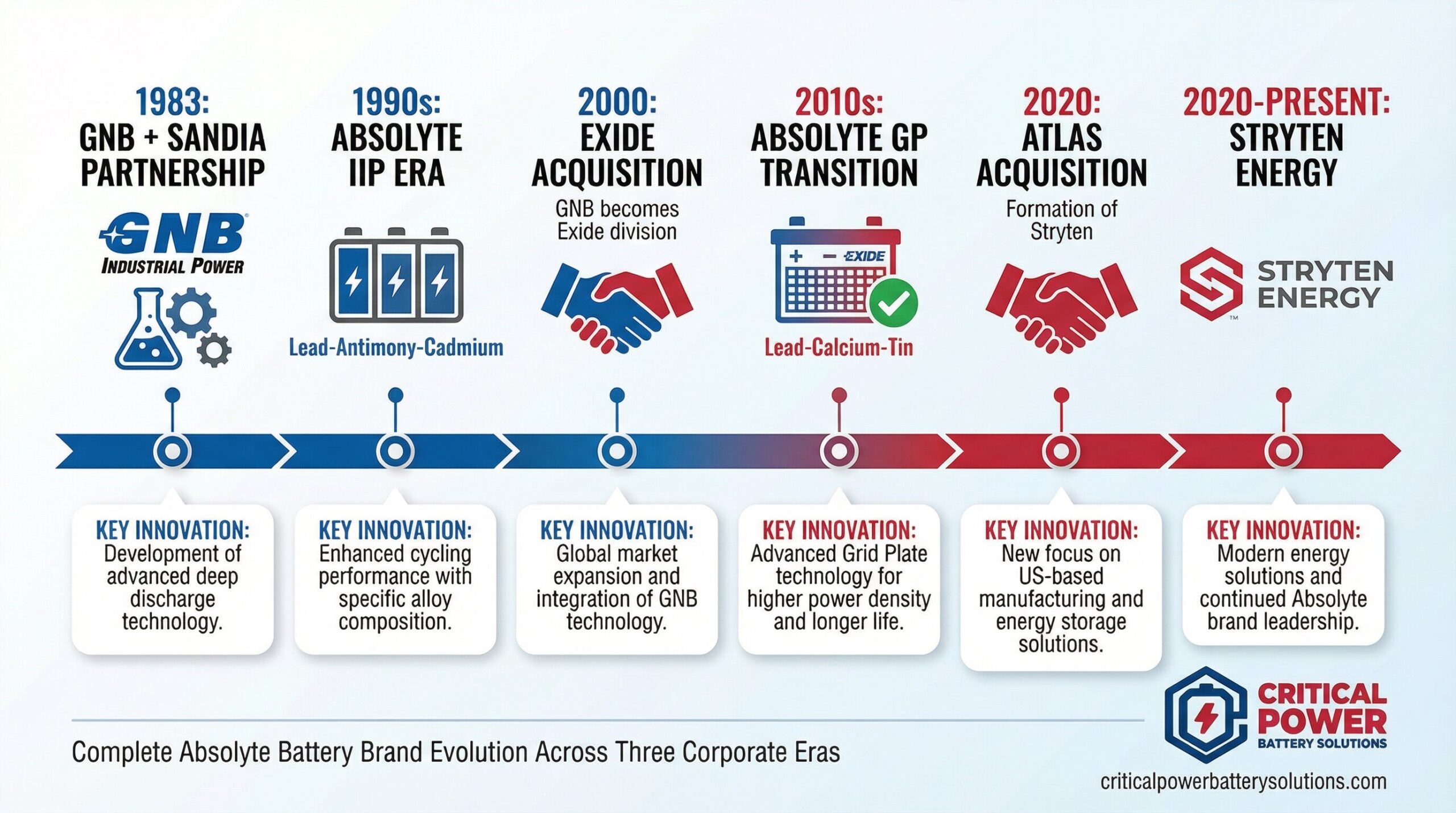
Absolyte’s brand journey from GNB Industrial Power to Stryten Energy is well documented in primary sources. Two manufacturer letters tell the full story.
Critical Engineering: Replacement & Compliance
Replacing an industrial battery string is rarely a “plug-and-play” operation, especially when dealing with legacy infrastructure. There are three critical engineering factors that must be addressed during replacement.
⚠️ Engineering Advisory: Do Not Mix IIP and GP
Do not install Absolyte IIP and Absolyte GP cells in the same series string.
While the jars may look identical physically, the internal resistance and float voltage requirements differ due to the alloy changes (Cadmium vs. Calcium-Tin).
The Risk: Mixing these chemistries typically leads to voltage mismatches. One set of cells may undercharge while the other overcharges.
The Result: This imbalance can lead to thermal runaway, accelerated grid corrosion, and premature failure of the entire string.
- The Solution: If you have failing IIP cells, the entire string must be replaced with Absolyte GP to ensure safety and performance.
Seismic Code Evolution: UBC vs. IBC
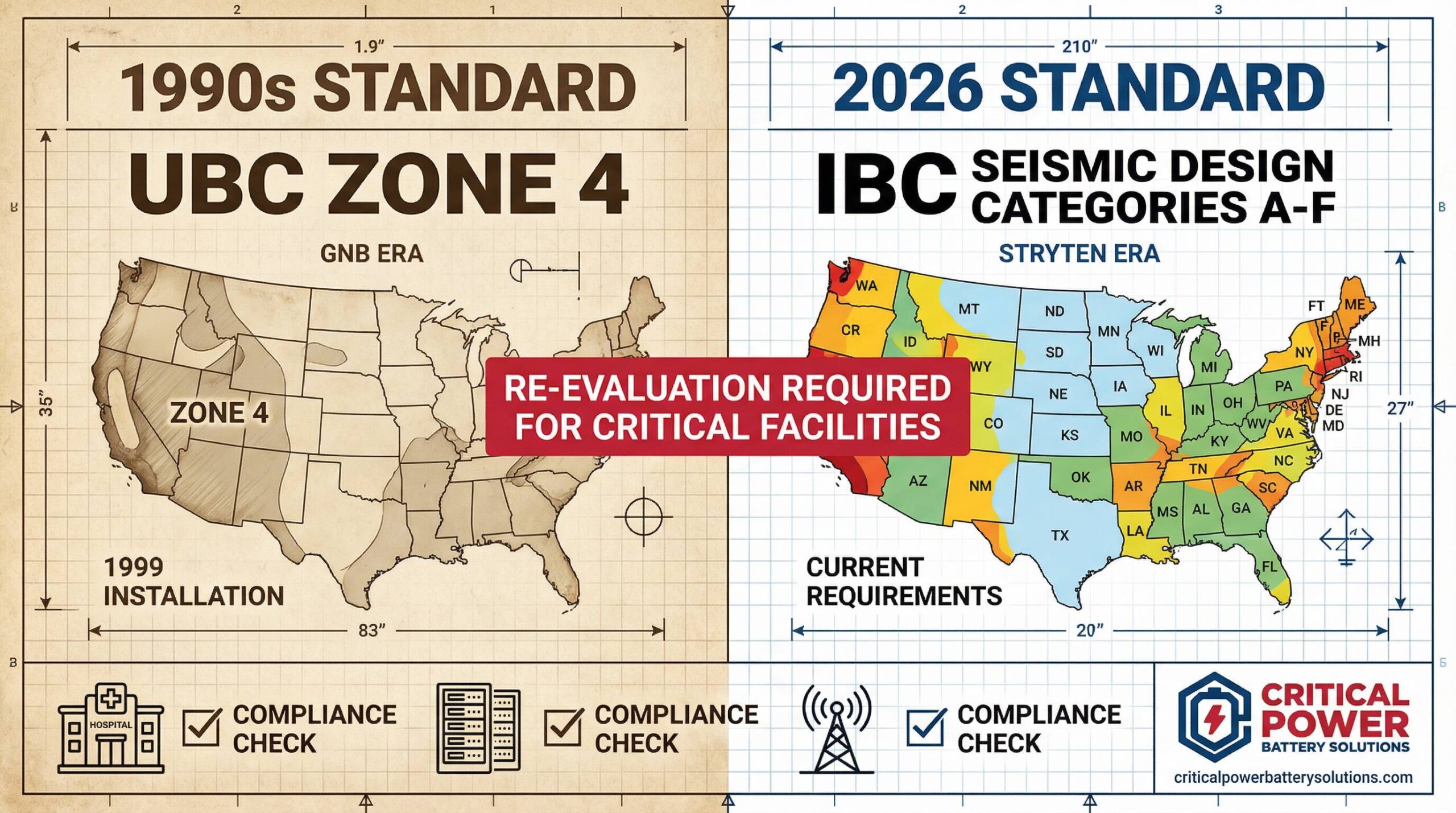
Many legacy Absolyte installations from the 1990s utilize racking systems rated for UBC (Uniform Building Code) Zone 4. However, the UBC has been superseded by the IBC (International Building Code) across the United States.
According to IBC Chapter 16, seismic design is now categorized by Seismic Design Categories (A through F) rather than simple zones. A rack installed in 1999 rated for “Zone 4” does not automatically meet current IBC requirements for critical infrastructure. When replacing batteries, facility managers should re-evaluate the racking system to ensure it complies with modern code, particularly for essential facilities like hospitals or data centers.
IEEE 485 Sizing Standards
Proper sizing is governed by IEEE 485-2020 (“Recommended Practice for Sizing Lead-Acid Batteries”). It is a common misconception that a battery’s nameplate capacity equals its real-world capacity at the end of its life.
IEEE 485 sizing calculations account for:
- Aging Factor: Batteries lose capacity over time; the standard typically adds a 125% margin to ensure the battery can support the load at the end of its service life.
- Temperature Correction: Capacity drops as temperature drops.
- Design Margin: A safety buffer for unforeseen load growth.
Our engineering team uses these standards to ensure that your replacement string is not just a like-for-like swap, but a calculated solution that meets your actual load profile.
Frequently Asked Questions
Who makes GNB batteries now?
Stryten Energy manufactures GNB batteries today. Following the acquisition of GNB Industrial Power assets in 2020, Stryten Energy continues to produce the Absolyte and Marathon lines in the USA using the original specifications and manufacturing facilities.
What is the difference between Absolyte IIP and GP?
The primary difference is the grid alloy chemistry. Absolyte IIP (discontinued) utilized a Lead-Antimony-Cadmium alloy, while the modern Absolyte GP uses a Lead-Calcium-Tin alloy. This change eliminates hazardous Cadmium and improves corrosion resistance, but it also means the two types have different float voltages and cannot be mixed.
Are GNB Absolyte batteries still available?
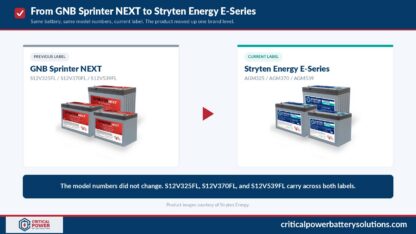
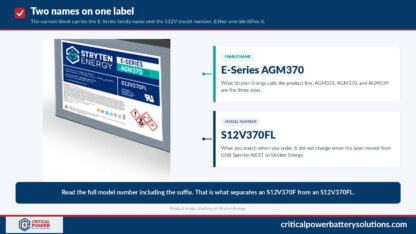
Yes, but they are now branded as Stryten Energy Absolyte AGP. The product specifications, dimensions, and performance characteristics remain identical to the legacy GNB models, ensuring backward compatibility for rack footprints (though not for mixed strings). The Absolyte battery remains a core product in Stryten’s portfolio.
Can you mix Absolyte IIP and Absolyte GP batteries?
No, you should never mix Absolyte IIP and GP batteries in the same string. They require different float voltages and have different internal resistance profiles. Mixing them will cause charge imbalances, leading to reduced capacity and potential safety hazards.
What is the life expectancy of an Absolyte battery?
The design life of an Absolyte AGP battery is 20 years at 25°C (77°F). However, real-world service life typically ranges from 12 to 15 years depending on operating temperature, discharge frequency, and maintenance adherence.
Limitations & Professional Guidance
Research Limitations
While VRLA technology is mature, lifespan claims are often based on controlled laboratory conditions at 25°C. In real-world applications, particularly in unconditioned outdoor cabinets, the Arrhenius equation applies: for every 10°C (18°F) rise in operating temperature above the optimum, the battery life is cut in half.
Alternatives
For sites with extreme cycling needs or severe weight constraints, Front Terminal VRLA alternatives or Lithium Iron Phosphate (LiFePO4) solutions may offer a better Total Cost of Ownership (TCO). However, the Absolyte line remains superior for ease of recycling (99% recyclability) and proven safety records in occupied spaces.
Professional Consultation
Due to the complexity of IEEE 485 sizing and IBC seismic compliance, we recommend a professional sizing consultation before ordering replacements. This ensures that your new system meets all modern code requirements and that the Stryten Energy warranty remains valid.
Conclusion
From the research labs of Sandia to the manufacturing lines of Stryten Energy, the Absolyte battery remains the gold standard for industrial backup power. While the name on the jar has changed from GNB, the engineering rigor, specifically the Lead-Calcium-Tin innovation, continues to power critical US infrastructure.
Don’t risk compliance with outdated sizing or incompatible chemistries. Contact Critical Power Battery Solutions for a Free IEEE 485 Battery Sizing Consultation. Our engineers will verify your load profile, check your seismic zone requirements, and ensure your replacement string meets all modern Stryten Energy warranty standards.
For Exide era owners: if this history answered what happened to the brand on your labels, the Exide Absolyte end of life replacement guide turns it into action: identify your string, confirm end of life status, and source the like for like Stryten Absolyte AGP successor.
References
- Sandia National Laboratories – Utility Battery Storage Systems Program Report for FY93 (SAND93-3899)
- Atlas Holdings Establishes Stryten Manufacturing (August 25, 2020)
- IEEE 485-2020 Recommended Practice for Sizing Lead-Acid Batteries
- International Building Code (IBC) Chapter 16: Structural Design
- U.S. Department of Energy – Energy Storage Systems Program