Quick answer: For a utility substation DC system, the common choice is a sealed recombinant VRLA AGM station battery, such as the Stryten Absolyte AGP, sized per IEEE 485 to the station duty cycle and seismically qualified per IEEE 693 where the site requires it. The battery has to carry the continuous protection and control load and still deliver a final breaker trip at the end of an 8 hour autonomy period, at end of life and at the minimum site temperature. Critical Power Battery Solutions (CPBS) supplies the battery, the IEEE 485 sizing, and the documentation a utility approved vendor list requires.
Key points
- The station battery is the last line of defense for substation protection and control. It powers relays, SCADA and RTU, breaker trip and close coils, and communications when AC and the charger are gone.
- A sealed recombinant VRLA AGM battery such as the Stryten Absolyte AGP fits unmanned substations: low maintenance, nonspillable UN 2800, low hydrogen evolution, and a 20 year design life at 25°C.
- The worst case is the continuous load plus a final 1 minute breaker trip event at the end of the autonomy period. Size for that, not for the average load.
- Absolyte AGP is IEEE 535 Class 1E qualified and IEEE 693 seismically qualified, which suits high reliability and seismic zone substations. State the qualification, not a site rating.
- CPBS owns the battery selection, the IEEE 485 sizing, and the qualification documentation. The sizing math, maintenance procedures, and full spec data live in the dedicated guides linked throughout.
Building a new substation or replacing an aging station battery means specifying the DC source that every protection and control function depends on. When the utility supply and the battery charger are both gone, the station battery alone trips the breaker that clears a fault. That makes battery selection a reliability decision, not a catalog purchase. This guide is anchored to the made in USA Stryten Absolyte AGP, a sealed recombinant VRLA AGM battery from Stryten Energy (formerly GNB Industrial Power, a division of Exide Technologies), and to the broader utility substation battery systems program at CPBS. If you still run the line under the GNB or Exide name, the Absolyte AGP is the like for like successor, so a legacy substation string gets a US made path forward.
Who this guide is for
This guide is for the engineers and buyers who own the substation DC plant and have to defend the battery choice in a design review. It speaks to the people specifying or replacing the station battery:
- Substation and protection and control (P&C) engineers who own relay, SCADA, and breaker control reliability.
- Station DC engineers setting the battery, charger, and DC distribution design.
- Architect and engineer (A/E) and engineer, procure, construct (EPC) specifiers writing the station battery section of the spec.
- Utility procurement and supply chain qualifying a battery to an approved vendor list (AVL).
Many readers are evaluating Stryten Absolyte AGP for the first time against an incumbent GNB or Exide string that is 10 to 20 years old, and they need a defensible answer to four questions: which battery, what chemistry, what capacity, and what certifications. A battery supplier should own the battery selection, the load to capacity sizing, and the paperwork that gets the cells onto your AVL. The charger, the DC distribution, and the relay settings sit with the substation designer. Keeping that boundary clear is what separates a specification you can defend from a marketing claim.


What the substation station battery powers
The station battery powers two different load families: a steady continuous load that runs for the whole outage, and brief momentary loads that draw very high current to operate breakers. The battery has to serve both from the same string, and the momentary event is what sets the worst case. Protection relays, SCADA and remote terminal units (RTU), indicating lights, communications, and emergency lighting draw a low, steady current for the full autonomy period. Breaker trip and close coils and motor operated disconnects draw a brief, heavy current, often at the worst possible moment, the end of the discharge.

| Load family | Examples | Current profile | What it drives in sizing |
|---|---|---|---|
| Continuous loads | Protection relays, SCADA and RTU, indicating lights, communications, emergency lighting | Low and steady for the full autonomy period | The base amp hour capacity over 8 hours |
| Momentary loads | Breaker trip and close coils, motor operated disconnects | Brief, very high current bursts | The final voltage at the end of discharge, so the breaker still operates |
Here is why the split matters. If the battery is sized only on the average continuous load, the voltage can sag below the minimum operating threshold during a momentary breaker trip, and the switchgear will not operate even though amp hours remain. Accurate load profiling, separating continuous from momentary and placing the breaker trip at the end of the cycle, is the technical foundation for sizing the station battery correctly.
The substation DC plant in plain English
A substation DC plant is usually a 125 VDC bus for protection and control, with 48 VDC for communications and some SCADA and 24 VDC for some RTU, backed by a battery sized for roughly 8 hours of autonomy. The 125 VDC system is the heart of it: about 60 lead acid cells in series on a continuously charged float bus that holds the battery ready while the charger carries the normal load. When the AC supply fails, the battery takes over with no interruption.
| DC bus | Typical role | Approximate cell count (lead acid) |
|---|---|---|
| 125 VDC | Protection relays, breaker trip and close, primary control | About 60 cells |
| 48 VDC | Communications and some SCADA | About 24 cells |
| 24 VDC | Some RTU and telemetry | About 12 cells |
Utilities commonly specify about 8 hours of autonomy so a substation can ride through an extended outage unattended and still operate breakers at the end of it. The battery is sized so the most severe duty cycle, the continuous load plus a final breaker trip event, is met at end of life and at the minimum expected temperature, not just when the battery is new and warm. The sizing method for lead acid is IEEE 485, the maintenance and testing method for VRLA is IEEE 1188, and both sit inside the utility North American Electric Reliability Corporation (NERC) PRC-005 protection system maintenance program. We keep those at the concept level here and route the depth to the dedicated guides below.
Why a sealed VRLA AGM battery fits substations
For unmanned substations, a sealed recombinant VRLA AGM battery such as the Stryten Absolyte AGP is usually the right choice: it is low maintenance, nonspillable, qualified for high reliability and seismic duty, and carries a 20 year design life. Several properties line up with the substation use case:
- Sealed recombinant oxygen cycle. More than 99 percent internal gas recombination under normal float means low hydrogen evolution versus flooded cells and no water addition, which suits a site visited only a few times a year.
- IEEE 535 Class 1E qualified. The Absolyte AGP carries the Class 1E nuclear qualification pedigree, evidence of high reliability stationary duty.
- IEEE 693 seismically qualified. Seismic qualification is available for substations in seismic zones, with Zone 4 qualification on the line.
- Nonspillable, classified UN 2800. The immobilized electrolyte makes the battery nonspillable and simplifies transport and handling to a remote substation.
- Flame retardant case. The Absolyte AGP uses a flame retardant polycarbonate container (UL94 V-0), and the line is NEBS Level 3 and UL recognized.
- 20 year design life. A long design life at 25°C means fewer replacements over the life of the substation.
- Made in USA. The Absolyte AGP is built in the USA by Stryten Energy, which matters when a regulated or public power utility has a domestic content preference.

Temperature is part of the selection conversation, but only at the concept level here. Lead acid capacity and life both move with temperature, so the site low and high temperatures become sizing inputs rather than afterthoughts. The Absolyte AGP carries a 20 year design life at 25°C (77°F) and a wide operating window, and where a charger uses temperature compensation the value to apply is 3 mV per °F per cell (5.5 mV per °C per cell). The full temperature treatment is handled inside the sizing guides rather than here.

AGP versus flooded (E-Series) for substations
Choose sealed AGP when the substation is unmanned and low maintenance matters; choose a flooded lead calcium battery when the utility spec specifically calls for flooded, where the Stryten E-Series is the made in USA option. Both are valid substation chemistries, and the right answer depends on the utility standard and the site. This is a concept level comparison, and the flooded model selection depth is handed off.
| Consideration | Sealed VRLA AGM (Absolyte AGP) | Flooded lead calcium (E-Series) |
|---|---|---|
| Maintenance | Low, no water addition, suits unmanned sites | Periodic watering and specific gravity checks |
| Hydrogen evolution | Low under normal float (recombinant) | Higher, vents freely |
| Visibility of state | Sealed, monitored by float and ohmic testing | Visible electrolyte level and specific gravity |
| Best fit | Unmanned substations, seismic zones, sealed enclosures | Utilities whose standard specifies flooded for switchgear and control duty |
If your standard specifies flooded lead calcium, the Stryten E-Series covers the complex switchgear and control duty cycle, with MCX and NXT as the substation relevant models. The model selection logic lives in the Stryten E-Series selection guide, the MCX and NXT details in the E-Series MCX review and the E-Series NXT review, and the full AGM versus flooded chemistry comparison in the Absolyte AGP versus flooded E-Series guide. For the Absolyte AGP product details and ordering information, see the Stryten E-Series Absolyte AGP product page, and for how each chemistry is specced across applications, see the Absolyte AGP specifications by application library, which carries the utility substation IEEE 693 spec data.
Sizing inputs you provide
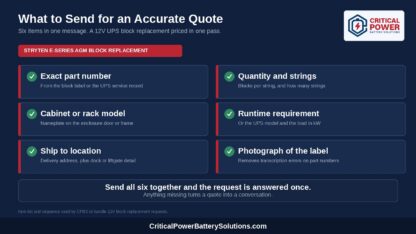
You do not need to run the IEEE 485 math to get a usable specification started. You provide six inputs, and a battery specialist turns them into a capacity and a string configuration. The calculation methodology itself, including the IEEE 485 duty cycle worksheet, capacity correction, aging, and design margins, is covered in the VRLA battery sizing guide and the battery capacity calculation guide. Here is the input list to gather for a substation.
| Input | What to provide | Why it matters |
|---|---|---|
| DC bus voltage | 125, 48, or 24 VDC nominal | Sets the cell count and string configuration |
| Continuous load | Steady draw in amps (relays, SCADA, RTU, communications) | Drives the base amp hour capacity over the autonomy period |
| Momentary load | Breaker trip and close coil current and duration | Confirms the final voltage holds for the breaker operation |
| Autonomy | Required backup time, commonly about 8 hours | Multiplies the required capacity |
| Minimum ambient temperature | Coldest expected site temperature | Capacity correction; cold reduces available capacity |
| End of life margin | Aging factor to the end of design life | Ensures the duty cycle is met when the battery is aged, not just new |

If you want to write a clean station battery section into the project specification or RFQ, the clauses and structure are in the battery specifications and procurement guide. Common IEEE 485 sizing errors, and how internal resistance ties into sizing and testing, are covered in the IEEE 485 sizing mistakes guide and the internal resistance measurement guide. Provide the six inputs above and CPBS returns a sized recommendation you can drop into the design.
Maintenance and compliance context
Substation VRLA batteries are maintained and tested to IEEE 1188, and that program sits inside the utility NERC PRC-005 protection system maintenance plan. NERC PRC-005 is a utility program requirement, not a property of the battery, and it sets the intervals at which station batteries and their protection systems are inspected, tested, and maintained. For a sealed VRLA AGM string, the IEEE 1188 program centers on float voltage checks, intercell connection resistance, and periodic ohmic (internal resistance or conductance) measurement, rather than the specific gravity readings a flooded string needs.

What changes when you move from a flooded string to a sealed AGM string is the data you collect: you trade specific gravity and water addition for trended ohmic readings and float voltage stability. The full IEEE 1188 procedure, the inspection intervals, and the visual inspection checklist are covered in the Absolyte battery maintenance and IEEE testing guide. Choosing a sealed AGM battery up front reduces the hands on maintenance burden at an unmanned substation, which is one reason it is the common pick for new builds.
Documentation for utility vendor qualification
On a utility project, a battery is not approved until the documentation is. Procurement and the AVL want proof, not promises. For a Stryten Absolyte AGP specification, the documentation set CPBS provides covers what a utility typically asks for:
| Document | What it proves |
|---|---|
| Product spec and data sheet | The electrical and mechanical specifications for the proposed cells |
| IEEE 693 and IEEE 535 qualification references | Seismic and Class 1E qualification pedigree for the line |
| Country of origin | Made in USA content for a utility domestic content preference |
| Authorized reseller proof | That the cells are authentic Stryten stock with valid warranty |
| Warranty terms | Coverage and the design life expectation |
| UN 2800 transport data | Nonspillable classification for shipping and handling |
That set is what gets the Absolyte AGP onto an approved vendor list and through a design review. When the project carries a Buy American or domestic content contract requirement, the sourcing and compliance documentation goes deeper, and that is handled in the dedicated federal and government sourcing guides rather than here. A brand by brand comparison against other VRLA manufacturers is covered in the companion Absolyte AGP versus competitors comparison post.
How to get a specification and quote
To get a sized Absolyte AGP recommendation for a substation, send five things and CPBS returns the battery selection, the sizing, and the documentation. Gather:
- DC bus voltage (125, 48, or 24 VDC)
- Continuous load (relays, SCADA, RTU, communications)
- Momentary breaker trip current and duration
- Required autonomy (commonly about 8 hours)
- Minimum site temperature and any seismic requirement (IEEE 693 zone)
Send it to Tom Kierna, who has more than 40 years in industrial batteries including 15 at GNB and Stryten, at 630-984-9718 or sales@criticalpowerbatterysolutions.com, or start with the before your battery sizing consultation checklist and the contact page. CPBS returns the station battery selection, the IEEE 485 sizing, and the documentation your project and AVL review will ask for, and routes the calculation, maintenance, and full spec data to the dedicated guides.
Related application: For transit and commuter rail signaling, grade crossings, and traction power substation DC control on a public transportation property, see the regional transit rail battery solutions guide.
Frequently asked questions
What battery is used in an electric utility substation?
Most electric utility substations use a sealed recombinant VRLA AGM station battery, such as the Stryten Absolyte AGP, on a 125 VDC bus. It powers protection relays, SCADA and RTU, breaker trip and close coils, and communications. The sealed chemistry is low maintenance and suits unmanned sites. Some utilities specify a flooded lead calcium battery instead, where the Stryten E-Series is the made in USA option.
What voltage is a substation station battery?
The primary substation station battery bus is usually 125 VDC, built from about 60 lead acid cells in series. Substations also use 48 VDC for communications and some SCADA and 24 VDC for some RTU and telemetry. The 125 VDC bus carries the protection and control load, including breaker trip and close, so it is the one most station battery specifications are written around.
Why are VRLA AGM batteries used for substation protection and control?
Sealed VRLA AGM batteries are used because they are low maintenance, nonspillable, and reliable for unmanned substations. The recombinant oxygen cycle recombines more than 99 percent of charge gas, so hydrogen evolution is low and no water addition is needed. AGM strings hold a stable float and are tracked by ohmic testing. The Absolyte AGP also carries IEEE 535 Class 1E and IEEE 693 seismic qualification for high reliability duty.
Is the Stryten Absolyte AGP battery seismically qualified for substations?
Yes. The Stryten Absolyte AGP is IEEE 693 seismically qualified and IEEE 535 Class 1E qualified. That is a qualification of the battery line, not a rating of your specific site. The seismic adequacy of an installation depends on the rack, anchorage, and the site seismic requirement, which the substation designer confirms. State the IEEE 693 and IEEE 535 qualification in the spec, and confirm the installed system against your project seismic criteria.
How is a substation station battery sized?
A substation station battery is sized with the IEEE 485 method, which maps the duty cycle, then applies capacity correction, aging, and design margins. The worst case is the continuous load plus a final breaker trip at the end of the autonomy period, met at end of life and minimum temperature. You provide the bus voltage, loads, autonomy, and temperature; a specialist runs the IEEE 485 math. The calculation detail is in the VRLA battery sizing and capacity calculation guides.
How long should a substation battery back up the DC system?
Utilities commonly specify about 8 hours of autonomy for a substation station battery. The exact figure is set by the utility standard and the criticality of the site, and the battery is sized so the full duty cycle, including a final breaker trip, is met at the end of that period. The autonomy requirement is a sizing input; the IEEE 485 method then determines the capacity. The sizing guides cover how autonomy drives capacity.
What is the difference between AGM and flooded batteries for substations?
AGM batteries are sealed and low maintenance with low hydrogen evolution; flooded lead calcium batteries vent freely and need periodic watering and specific gravity checks. AGM suits unmanned substations and sealed enclosures, while some utility standards specify flooded for switchgear and control duty. Both are valid; the choice follows the utility standard and the site. The Absolyte AGP covers the AGM option and the Stryten E-Series covers flooded.
How often should substation batteries be tested?
Substation VRLA batteries are tested and maintained to IEEE 1188, at intervals set by the utility NERC PRC-005 program. A sealed AGM string is tracked with float voltage checks, intercell connection resistance, and periodic ohmic measurement, with capacity testing as the program requires. The specific intervals come from the utility maintenance plan. The full IEEE 1188 procedure and visual inspection checklist are in the Absolyte battery maintenance and IEEE testing guide.
Does NERC require substation battery maintenance?
NERC PRC-005 requires utilities to maintain and test the protection system, which includes the station battery, on a documented program. PRC-005 is a utility program obligation, not a property of the battery, and it sets the maintenance and testing intervals for station DC supply within the protection system. Choosing a sealed AGM battery does not remove the PRC-005 obligation; it changes the maintenance tasks from watering and specific gravity to ohmic and float trending.
Can Stryten Absolyte AGP replace legacy GNB or Exide substation batteries?
Yes. The Stryten Absolyte AGP is the direct successor to the GNB Industrial Power Absolyte GP and IIP line, so it gives legacy substation strings a like for like, made in USA replacement path. Stryten Energy continues the Absolyte line formerly sold under the GNB and Exide names. A specialist confirms the capacity, footprint, and string configuration against the existing installation so the replacement drops into the substation DC plant.
What certifications should a utility substation battery have?
A utility substation battery should carry the qualifications a protection system expects: IEEE 535 Class 1E, IEEE 693 seismic where the site requires it, UL recognition, and a nonspillable UN 2800 transport classification. The Stryten Absolyte AGP carries IEEE 535 Class 1E, IEEE 693 seismic qualification, NEBS Level 3, UL recognition, a UL94 V-0 case, and UN 2800. CPBS supplies the qualification references as part of the vendor documentation set.
Who do I contact to size and spec a substation battery?
Contact Tom Kierna at CPBS, 630-984-9718 or sales@criticalpowerbatterysolutions.com, with more than 40 years in industrial batteries including 15 at GNB and Stryten. Send the DC bus voltage, continuous and momentary load, autonomy, minimum temperature, and any seismic requirement, and CPBS returns the Absolyte AGP selection, the IEEE 485 sizing, and the qualification documentation your project and AVL review require.
About the author: Tom Kierna is a Battery Systems Specialist at Critical Power Battery Solutions, the battery division of Advanced Technical Services Inc. (ATS), an ISO 9001 certified company serving mission-critical power since 1981. Tom has more than 40 years in industrial battery systems, including 15 years at GNB and Stryten, and specializes in chemistry selection, application sizing, and the GNB and Exide to Stryten transition. CPBS is an authorized Stryten Energy reseller. Last reviewed June 25, 2026.
References
- IEEE 485, Recommended Practice for Sizing Lead-Acid Batteries for Stationary Applications. IEEE Standards Association. standards.ieee.org
- IEEE 693, Recommended Practice for Seismic Design of Substations. IEEE Standards Association. standards.ieee.org
- IEEE 535, Standard for Qualification of Class 1E Lead Storage Batteries for Nuclear Power Generating Stations. IEEE Standards Association.
- IEEE 1188, Recommended Practice for Maintenance, Testing, and Replacement of Valve-Regulated Lead-Acid (VRLA) Batteries for Stationary Applications. IEEE Standards Association.
- NERC PRC-005, Protection System, Automatic Reclosing, and Sudden Pressure Relaying Maintenance. North American Electric Reliability Corporation. nerc.com
- Stryten Energy, Absolyte AGP Product Brochure (SE1085) and Installation and Operations Manual. stryten.com