Quick Answer: Proper ieee 485 Absolyte battery sizing requires precise calculations for temperature derating, Peukert’s effect on high-rate discharges, and mandatory aging margins to guarantee telecom uptime. Key points:
- Standard 20-hour (Ah) ratings fail during 15-minute critical telecom step-loads.
- Northern United States deployments require exact IEEE 485 temperature correction (KT) factors to prevent winter outages.
- A mandatory 1.25 aging factor ensures end-of-life capacity compliance.
Continue reading for a complete engineering breakdown of the most common VRLA sizing errors and how to secure your mission-critical infrastructure.
For United States facility managers and telecom operations directors, power failure is not an option. Yet, countless critical infrastructure sites risk catastrophic downtime due to fundamental errors in ieee 485 battery sizing. While generic calculators and AI tools provide surface-level estimates, they consistently fail to account for the complex variables demanded by mission-critical engineering—such as non-linear discharge rates, regional climate extremes, and precise grid corrosion metrics. Securing a national telecom network requires more than just buying premium batteries; it demands rigorous, math-backed compliance.
Backed by over 40 years of ATS electrical engineering heritage and ISO 9001 certified processes, our team frequently audits failing systems engineered with generic specifications. This guide exposes the five most critical sizing mistakes made in telecommunications power systems today. From mitigating cold weather capacity loss in Northern US cell towers to applying the correct Peukert exponent for high-rate step-loads, we will walk you through the precise engineering methodologies required to maintain absolute 100% uptime.
👤 Article by: Tom Kierna
Reviewed by: CPBS Engineering Team
Last updated: March 14, 2026
Credentials: Authorized Stryten battery Reseller, ISO 9001 Certified, IEEE Standards Member


Transparency: This article explores ieee 485 Absolyte battery sizing methodologies based on official IEEE standards and peer-reviewed electrochemical research. Some links may connect to our authorized Stryten Energy and Leoch product lines. All information is verified by our engineering team. Our goal is accurate, mission-critical technical guidance.
Mistake 1 – Ignoring Temperature Correction in Cold Climates
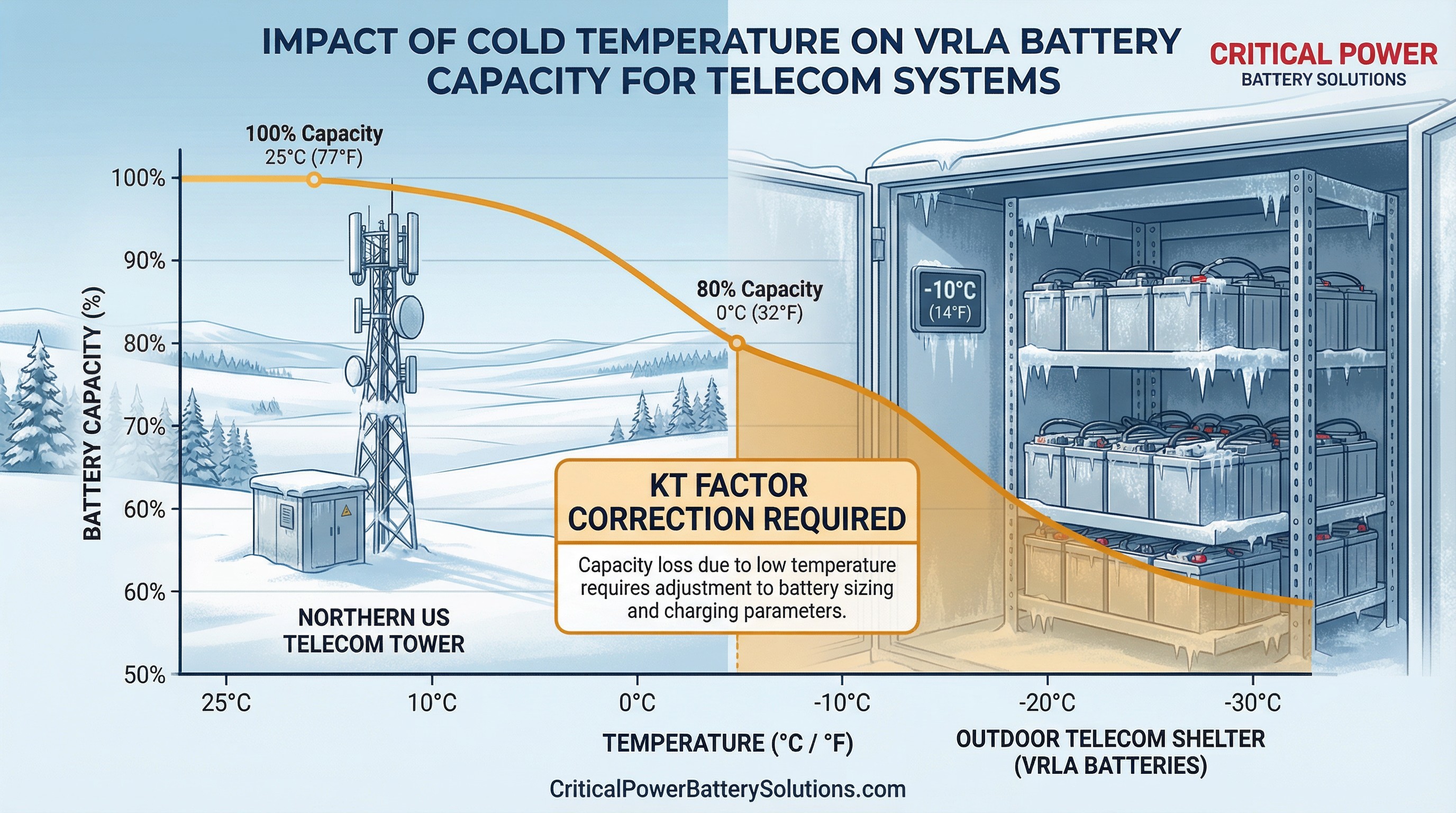
Failing to apply strict temperature correction factors (KT) in sub-freezing environments is a primary cause of premature telecom power failure. Cold climates drastically increase internal resistance in a valve regulated lead acid battery, severely limiting its ability to deliver current during an outage. This presents a unique and persistent challenge for Northern United States deployments, where winter temperatures routinely plummet well below freezing.
Standard capacity calculations assume a baseline operating temperature of 25°C (77°F). However, battery performance in cold weather deviates significantly from this nominal rating. To maintain critical load compliance, engineers must apply the IEEE 485 KT multiplier, which dictates over-provisioning battery capacity for remote cell towers in states like Minnesota, North Dakota, or Maine. When evaluating agm vs vrla gel technologies in extreme cold, premium solutions like Absolyte AGP can help mitigate some capacity loss due to their advanced structural design and suspended electrolyte, but they do not eliminate the need for proper mathematical derating.
In a peer-reviewed electrochemical analysis published in the Journal of Power Sources, researchers found that VRLA batteries exhibit pronounced capacity loss at low temperatures compared to flooded alternatives, necessitating strict KT factor application. Without this specific derating calculation, a temperature drop to 0°C (32°F) can temporarily reduce available capacity to roughly 80% of its nominal rating, leaving the facility mathematically incapable of supporting its intended runtime.
Ultimately, temperature derating is a mandatory mathematical adjustment, not a mere suggestion for facility managers. While cold weather temporarily hides available capacity, improper voltage settings actively destroy it, leading us to the next critical sizing error.
Mistake 2 – Incorrect Float Voltage & Grid Corrosion
Incorrect battery float voltage programming accelerates positive grid corrosion and drastically reduces the expected design life of telecom backup systems. Sizing calculations inherently assume a healthy, fully optimized battery, which is highly difficult to maintain with poor charging parameters.
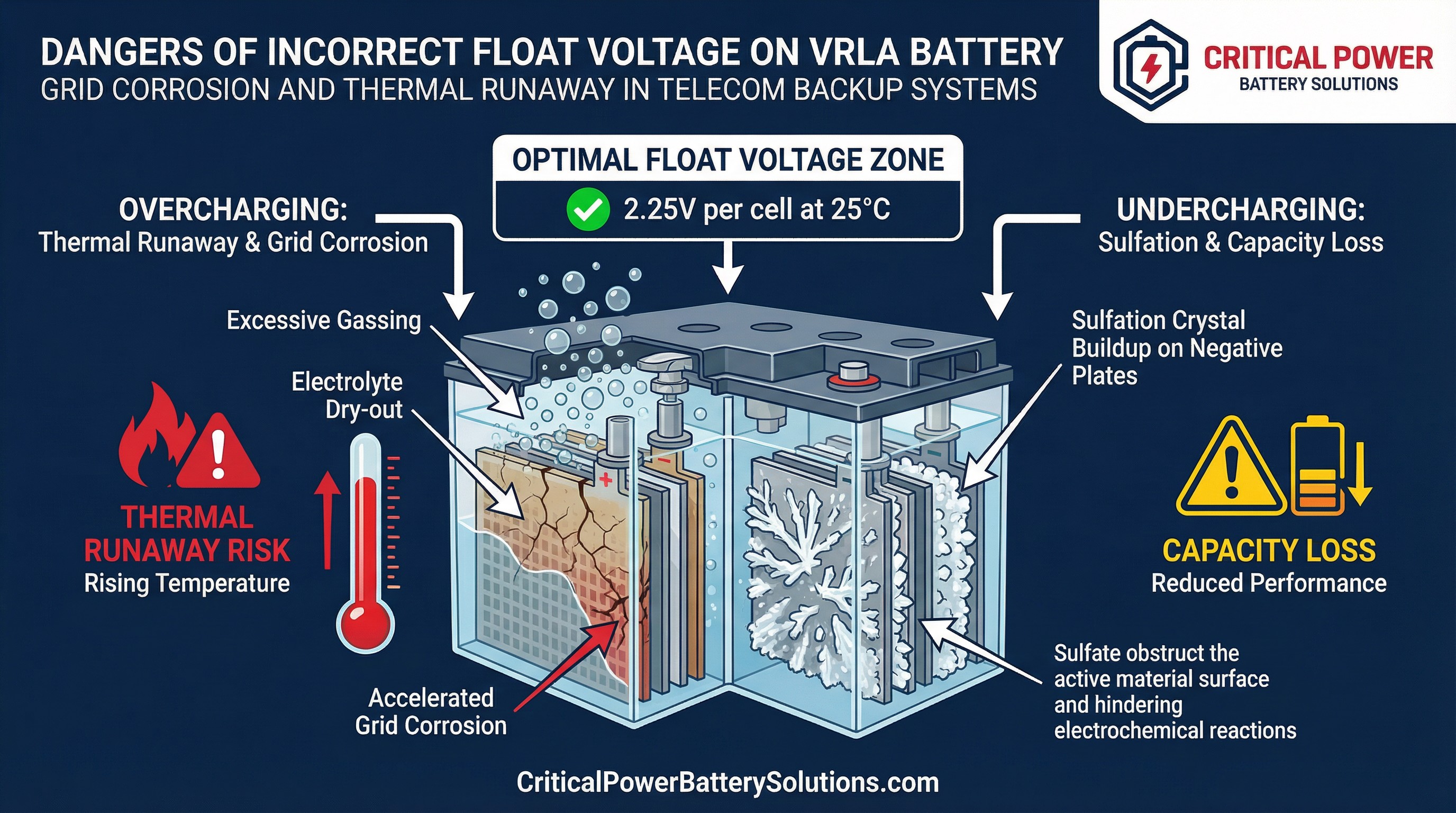
During float charging, a precise chemical balance must be maintained to keep the battery at full capacity without causing internal degradation. Overcharging presents severe operational risks, including excessive gassing, electrolyte dry-out, and the severe workplace hazard of battery thermal runaway. According to OSHA workplace safety guidelines, improper battery management and charging can lead to thermal runaway, requiring specific hazard awareness and safety equipment.
Conversely, undercharging leads to sulfation of the negative plates, permanently reducing the battery’s ability to hold a charge and rendering initial capacity calculations useless. To combat these issues, temperature compensation must be tied directly to the charging system. This ensures the battery float voltage adjusts dynamically across United States seasonal changes—lowering the voltage during hot summer months to prevent dry-out, and raising it during winter freezes to ensure a full charge is achieved. Additionally, proper battery room ventilation calculation is essential to prevent hydrogen gas accumulation during overcharge conditions.
Precise Absolyte battery float voltage management is critical to maintaining the capacity calculated during the initial design phase. Beyond basic float charging, cyclic applications introduce entirely different sizing variables that must be carefully calculated to ensure longevity.
Mistake 3 – Underestimating PSoC & Coulombic Efficiency
Designing systems without accounting for Partial State of Charge (PSoC) and battery coulombic efficiency often leads to rapid capacity degradation in cyclic applications. Coulombic efficiency is defined as the ratio of Ampere-hours (Ah) discharged to the Ah required to restore a full charge.
Remote telecom sites utilizing a solar hybrid battery setup often operate continuously in PSoC, rarely reaching a full 100% recharge due to limited sunlight hours and weather fluctuations. In these demanding environments, deep battery depth of discharge cycles compound efficiency losses over time. If a battery has a 90% battery coulombic efficiency, sizing calculations must account for the 10% energy lost as heat during the recharge cycle. This becomes especially critical in off-grid United States installations where backup generator runtimes are strictly limited and fuel delivery is expensive.
In a controlled study on lead-acid degradation published in the Journal of Power Sources (2011), researchers demonstrated that high-rate partial state-of-charge operation causes accelerated capacity fade, requiring specific sizing compensations to maintain system reliability.
Failing to calculate these efficiency losses leaves hybrid telecom sites mathematically short of required runtime during extended outages. While cyclic efficiency is complex, calculating high-rate discharge for step-loads is where most basic calculators completely fail.

Mistake 4 – Misapplying the Peukert Effect (Why AI Fails at Battery Sizing)
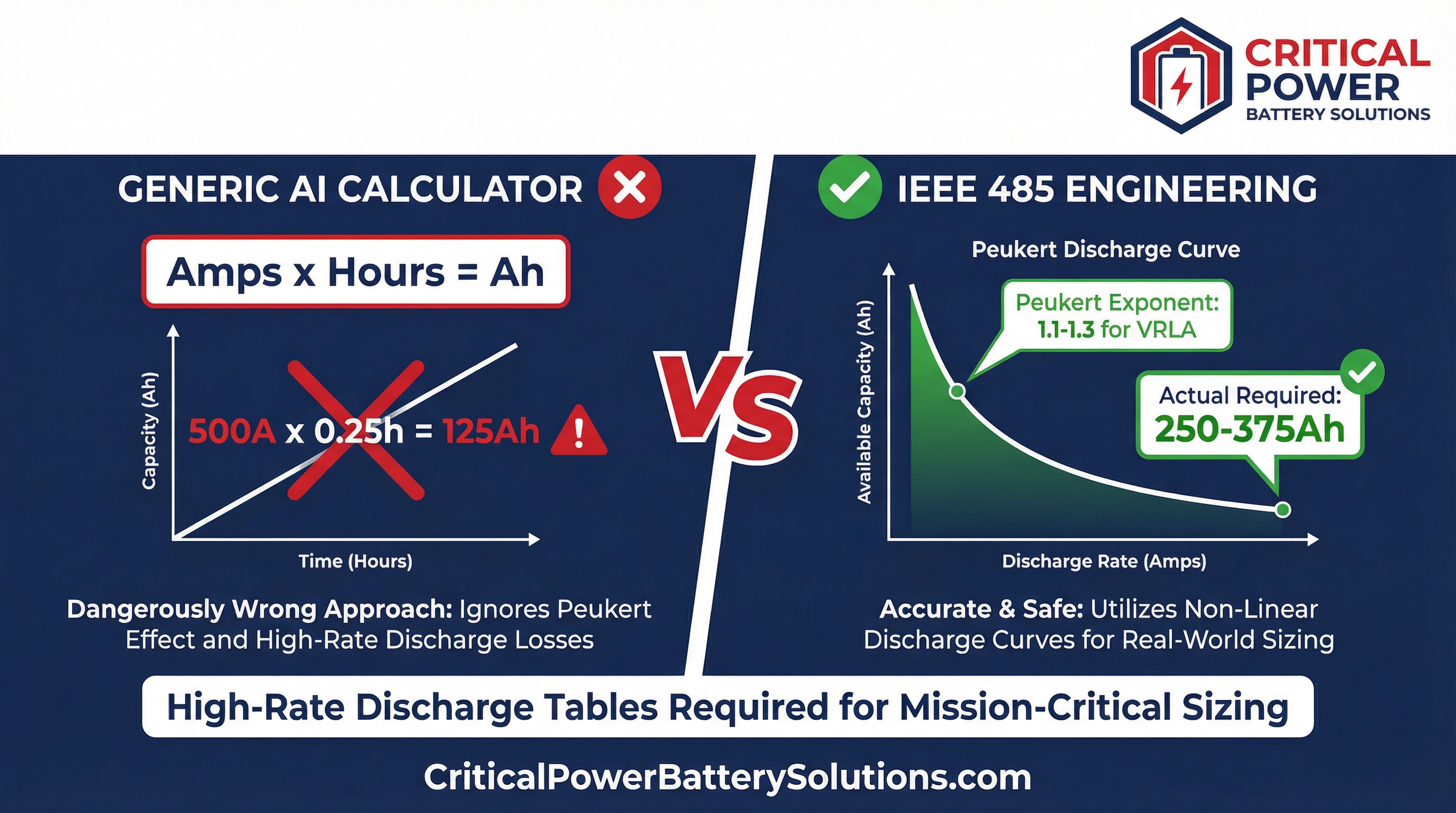
When performing an ieee 485 battery sizing calculation, relying on standard 20-hour Ampere-hour (Ah) ratings for high-rate telecom loads is a highly likely path to system failure. Generic AI chatbots and basic calculators typically generate capacity formulas (Amps × Hours = Ah) that assume a linear discharge rate. This approach is dangerous because telecom step-loads often require massive power over short 15 to 60-minute windows, where battery chemistry does not behave linearly.
The core issue lies in the peukert effect, a phenomenon where available battery capacity decreases exponentially as the rate of discharge increases. Generic AI tools share a critical blindspot: they do not know the specific Peukert exponent (typically ranging from 1.1 to 1.3 for VRLA) of the exact battery model being specified.
Consider a typical battery capacity calculation scenario: a data center needing 500 Amps for 15 minutes cannot simply use a 125Ah battery. Due to Peukert’s law and internal resistance, the required nominal capacity might be double or triple that initial estimate. To solve this, our engineers utilize manufacturer-specific high-rate discharge tables (see our guide on how to calculate battery runtime)—measuring Amps per cell or Watts per cell—rather than generic Ah ratings. This methodology allows us to closely match the telecom power systems step-load profile, ensuring the battery can actually deliver the required current without voltage collapse.
The IEEE 485-2020 standard explicitly requires capacity calculations to account for non-linear discharge characteristics and specific duty cycles, utilizing manufacturer-provided performance curves rather than nominal ratings. Leveraging over 40 years of ATS electrical engineering experience, our ISO 9001 certified process generates these specific, audit-proof sizing reports for United States facility managers. This provides exact, custom load-profile math that automated tools simply cannot replicate.
Mistake 5 – Skipping the Aging Margin
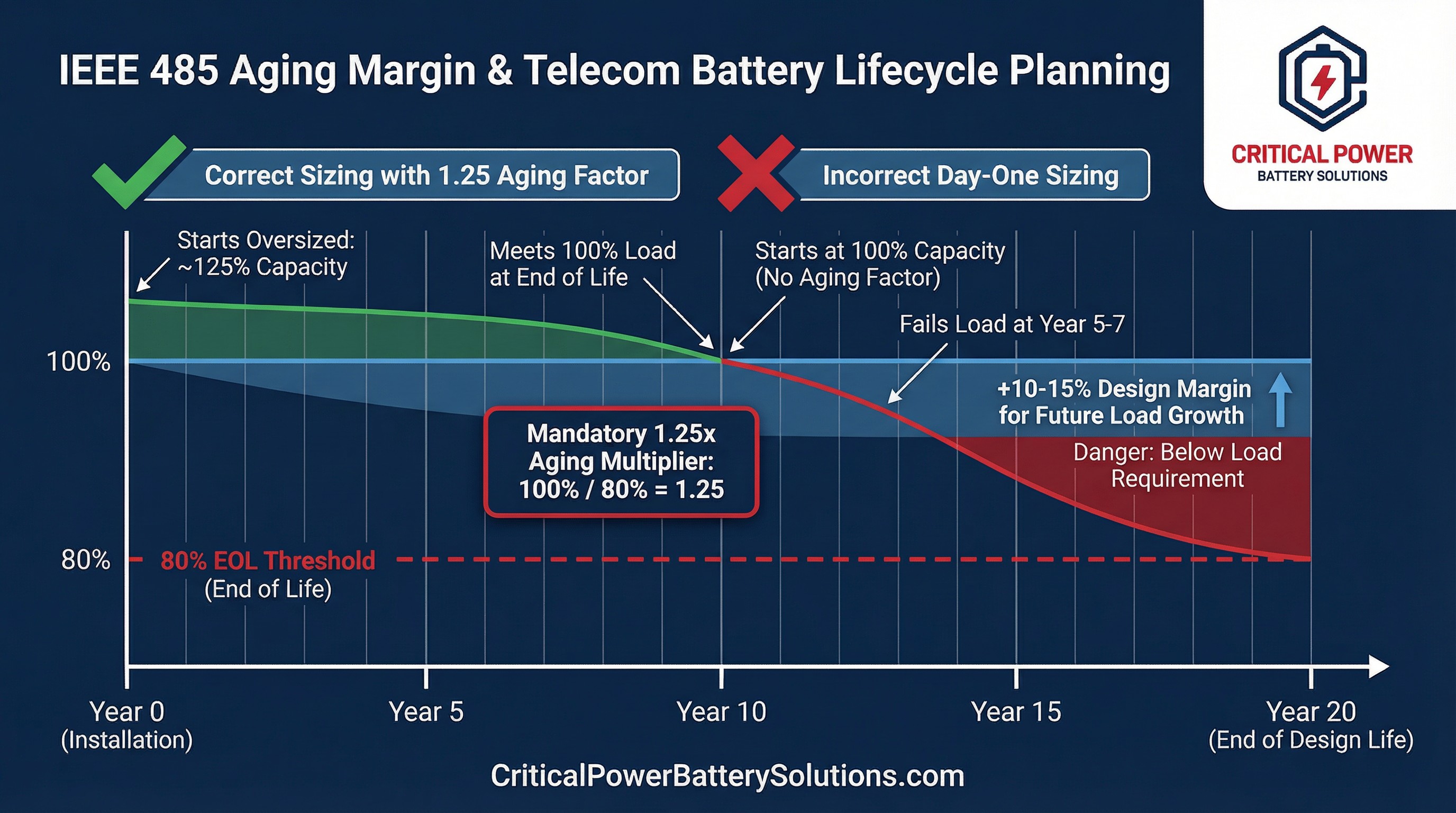
A compliant ieee 485 battery sizing report must include a mandatory aging margin to ensure the system supports the load at the end of its design life. In mission-critical engineering, batteries are typically considered at “end of life” when they degrade to 80% of their rated capacity.
The math behind the battery aging factor is straightforward but frequently ignored during procurement. To ensure 100% load support at the end of life, the initial battery size must be multiplied by 1.25 (which is 100% divided by 80%). Budget-focused contractors often skip this 1.25 multiplier to lower initial bid costs. Consequently, this leaves telecom battery backup systems critically undersized by year five, right when they are needed most.
As the U.S. Energy Information Administration reports record growth in battery storage capacity—adding 10.3 GW in 2024 alone—ensuring long-term lifecycle reliability through proper aging margins is critical for national grid stability. Furthermore, robust designs often include an additional 10-15% design margin for future load growth, ensuring the infrastructure can scale safely without requiring a complete system tear-out.
Sizing strictly for “day one” capacity is an engineering failure; true critical power sizing accounts for year ten. Understanding these variables transitions naturally into answering the most common questions our engineers receive in the field.
Frequently Asked Questions
What temperature can you store VRLA batteries?
You can safely store VRLA batteries between -15°C (5°F) and 40°C (104°F), though the optimal storage temperature is 20°C to 25°C (68°F to 77°F). Storing batteries at higher temperatures significantly accelerates self-discharge rates, requiring more frequent refresh charges. Always store in a dry, well-ventilated environment to maximize shelf life.
What temperature is too cold for a battery?
Temperatures below -20°C (-4°F) are generally too cold for standard lead-acid batteries, as the electrolyte can freeze if the battery is discharged. While fully charged VRLA batteries resist freezing better, extreme cold drastically increases internal resistance, temporarily reducing available capacity by up to 50%.
Can AGM batteries be left outside in winter?
Yes, AGM batteries can be left outside in winter, provided they remain fully charged and are housed in a weather-proof enclosure. Because the electrolyte in AGM (Absorbent Glass Mat) batteries is suspended in fiberglass, they are highly resistant to freezing and cracking compared to flooded lead-acid batteries.
What is the operating temperature of VRLA battery?
The recommended operating temperature for a VRLA battery is 25°C (77°F) to achieve its maximum rated lifespan. While they can technically operate in ranges from -20°C to 50°C, every 8°C (15°F) increase above the optimal 25°C typically cuts the battery’s expected design life in half.
Is it okay to store batteries in a cold garage or remote cabinet?
It is okay to store batteries in a cold garage or remote telecom cabinet as long as they are kept fully charged and protected from direct elemental exposure. Cold storage actually slows the internal self-discharge chemical reaction, extending shelf life, though operational capacity will be temporarily reduced until warmed.
Do VRLA batteries need continuous ventilation?
While VRLA batteries emit significantly less gas than flooded types, they still require adequate ventilation to prevent hydrogen gas accumulation. Under normal operation, they recombine gases internally, but overcharging can cause the pressure relief valves to vent hydrogen, which becomes explosive if concentrated in a sealed room.
How do I size a battery backup system for a data center?
To size a battery backup system for a data center, you must calculate the total UPS kW load, determine the required runtime, and apply IEEE 485 standards. This includes utilizing manufacturer high-rate discharge tables (Watts per cell), factoring in inverter efficiency, and applying mandatory aging (1.25) and design margins.
What is the expected lifespan of Stryten Absolyte batteries?
Stryten Absolyte batteries have an expected design life of 20 years at 25°C (77°F) under proper float charging conditions. Actual operational lifespan depends heavily on environmental temperatures, depth of discharge, and adherence to strict maintenance and capacity testing protocols. Results may vary based on site conditions.
Do you offer IEEE 485 compliant battery sizing reports?
Yes, Critical Power Battery Solutions provides comprehensive IEEE 485 compliant battery sizing reports. Our electrical engineering team calculates specific load profiles, Peukert exponents, temperature derating (KT factors), and aging margins to deliver audit-proof specifications for mission-critical infrastructure.
How does cold weather affect battery capacity calculation?
Cold weather significantly lowers available battery capacity, requiring the application of a temperature correction factor (KT) during capacity calculations. For example, a battery operating at 0°C (32°F) may only deliver 80% of its rated capacity, requiring engineers to oversize the initial battery string to compensate.
Limitations, Alternatives & Professional Guidance
While IEEE 485 provides the gold standard for stationary battery sizing, it is important to acknowledge that real-world degradation can vary. Research indicates that unexpected environmental fluctuations, inconsistent grid power quality, and manufacturing variances can alter battery performance outside of modeled calculations. Furthermore, while Peukert’s law is highly accurate for constant current discharges, highly dynamic or pulsed telecom loads may require even more advanced electrochemical modeling to predict exact end-of-life behavior.
For facilities struggling with the footprint or weight requirements of properly sized VRLA systems, Lithium-Ion (Li-ion) UPS batteries represent a viable alternative. Li-ion systems offer higher energy density, lower weight, and are significantly less susceptible to Peukert’s effect at high discharge rates. However, they require complex Battery Management Systems (BMS), have stricter fire suppression requirements, and carry a higher initial capital expenditure. When considering alternatives like Lithium-ion or disposing of end-of-life VRLA systems, EPA guidelines mandate utilizing certified hazardous waste collection protocols to prevent fire risks and environmental contamination. The choice between advanced AGM/VRLA and Lithium depends heavily on facility constraints and budget cycles.
Because mission-critical power sizing involves complex variables that directly impact life safety and national infrastructure, automated calculators should only be used for preliminary estimates. Facility managers should seek guidance from certified electrical engineers before procuring equipment. A professional consultation will verify load profiles, assess environmental conditions, and ensure that all aging and temperature margins comply with federal and state regulatory standards.
Conclusion
Protecting United States critical infrastructure requires moving beyond basic Ah estimates and embracing rigorous engineering math. By understanding the impact of cold weather KT factors, managing precise float voltages, and applying the correct Peukert exponents for high-rate loads, facility managers can help prevent catastrophic downtime. Most importantly, integrating the mandatory 1.25 aging factor ensures your system remains fully capable at the end of its design life. Accurate ieee 485 battery sizing, supported by a comprehensive VRLA battery sizing guide, is the foundation of a resilient, audit-proof power network.
At Critical Power Battery Solutions, our parent company ATS brings over 40 years of electrical engineering expertise to your facility. As an authorized reseller of premium Stryten Energy and Leoch batteries, we don’t just supply hardware; we aim to provide the mathematical certainty your critical loads demand. If you are planning a facility upgrade or designing a new telecom deployment, consider scheduling a Free Battery Sizing Consultation with our ISO 9001 certified engineering team. We will deliver a custom, compliant sizing report tailored to your exact regional requirements.
References
- IEEE 485-2020 Standard – The globally recognized, definitive engineering standard for sizing lead-acid batteries for stationary applications.
- U.S. Energy Information Administration (EIA) – Official US government source for energy statistics and infrastructure data.
- Occupational Safety and Health Administration (OSHA) – Federal regulatory agency overseeing workplace safety and hazard awareness.
- U.S. Environmental Protection Agency (EPA) – Federal regulatory agency overseeing environmental protection and hazardous waste disposal.
- Journal of Power Sources (Rand et al., 2002) – “Lead-acid battery operation in VRLA applications.” Peer-reviewed electrochemical analysis on temperature impacts.
- Journal of Power Sources (Schiffer & Sauer, 2011) – “Capacity fade in lead-acid batteries caused by high-rate partial state-of-charge operation.” Peer-reviewed study on battery degradation modeling.
IEEE-485 Sizing for Indian Telecom Projects
The same IEEE-485 sizing discipline that protects North American 5G sites maps directly to Indian deployments under IS / BIS standards and 50Hz grid loads.
Where CPBS engages on sizing-led Indian telecom work:
- Standards alignment: IEEE-485 sizing reconciled with Indian IS / BIS conventions and 50Hz operating frequency
- Geography: Tier-2 and Tier-3 expansion: Kolkata, Ahmedabad, Lucknow, Jaipur, Indore
- Sectors: Tower companies (Indus, Summit Digitel), BSO / MSO networks, defense communications
- Scope: Sizing review, runtime modeling, Stryten / Leoch specification
Project-scale only, discuss IEEE-485 sizing for your Indian telecom project.
India FAQ
Q: Does CPBS provide IEEE-485 sizing support for Indian telecom projects?
A: Yes, for project-scale telecom deployments. We provide IEEE-485 sizing review, runtime modeling, and Stryten / Leoch system specification aligned with Indian IS / BIS conventions and 50Hz grid loads. Coverage includes Tier-2 and Tier-3 expansion programs in Kolkata, Ahmedabad, Lucknow, Jaipur, and Indore: engineering consultation only, not retail.