🎯 Quick Answer. To find out how old your GNB Absolyte batteries are, read the manufacture date stamped on the steel module, then compare it against your commissioning records, because the service-life clock starts when the string is energized. A GNB Absolyte string installed 10 to 14 years ago is normal to be questioning now: the published 20-year design life assumes a 25 C (77 F) battery room, and most real rooms run hotter, which is why a battery sold as a 20-year unit can be struggling at 12.
Key facts:
- Same battery, new name: GNB Absolyte GP and IIP are now Stryten Absolyte AGP. The design did not change, only the name, per the August 2023 Manufacturer’s Declaration.
- Two clocks: manufacture date (stamped on the module) versus in-service date (your records). The in-service date drives the life estimate.
- 20-year design life is a 25 C number. VRLA service life roughly halves for every 10 C above 25 C, so a 33 to 35 C room cuts real life to about 10 to 12 years.
- Genuinely due when: measured capacity is below 80% of nameplate, internal resistance is more than 20 to 25% above the commissioning baseline, or the temperature-adjusted age has run out.
- Next step: a date stamp tells you when it was built, not how it performs today. A capacity or internal-resistance test confirms true condition. Email a photo of your label to Tom Kierna at CPBS for an authoritative read: 630-984-9718.
What you are actually looking at: GNB Absolyte is now Stryten Absolyte AGP
If your rack label reads GNB Absolyte GP, IIP, or GX, you are looking at the product line that is sold today as Stryten Absolyte AGP. The brand changed; the battery did not. Stryten Energy (formerly GNB Industrial Power, a division of Exide Technologies) was formed in 2020 from the merged Exide industrial division and GNB Industrial Power, and on March 6, 2023 it formally renamed the GNB-branded industrial portfolio to Stryten.
This matters before you assess age, because it tells you the path forward is a clean like-for-like replacement, not a hunt for a discontinued battery. The continuity is documented. Stryten’s August 2023 Manufacturer’s Declaration states plainly that “the design, engineering, and product manufacturing remains unchanged from the GNB product to the Stryten Energy product. The only change is the name.”
- GNB Absolyte GP is now Stryten Absolyte AGP (the “G” cell-type suffix carries over, for example 100G45).
- GNB Absolyte IIP is the same lineage, using an “a” suffix on otherwise identical part numbers (for example 1-100a93).
- The footprint, seismic rack, terminals, and module geometry are unchanged, so an aging GNB string drops into the same hardware. Do not mix legacy IIP modules and current GP or AGP modules in the same string, though: they are different product generations with different internal-resistance profiles, so always replace the full string rather than individual cells.
For the full lineage, see our GNB to Stryten Absolyte brand history and the GNB Absolyte GP to Stryten AGP upgrade guide. The current product is the Stryten Absolyte AGP, manufactured in the USA by Stryten Energy.
The two dates that matter: manufacture date versus in-service date
Battery age has two clocks, and the one that governs end-of-life is the in-service date, not the stamped manufacture date. A module can sit in a warehouse for months before it is energized, and the warranty and float-life clock effectively starts at commissioning. To estimate age correctly, find both dates and use the later one as your baseline.
- Manufacture date: stamped or labeled on the module itself. Tells you when the unit was built.
- In-service date: from your commissioning report, original purchase order, CMMS record, or the install tag on the rack. Tells you when the life clock actually started.
- Shelf time counts against you: a long gap between manufacture and energization shortens usable service life, because lead-acid plates self-discharge and can sulfate while stored uncharged.
If the two dates are close, use either. If they are far apart, or if you have no install records, the manufacture date is your floor and a capacity test is the only way to confirm true condition.
Where to find the date code on a GNB or Stryten Absolyte module
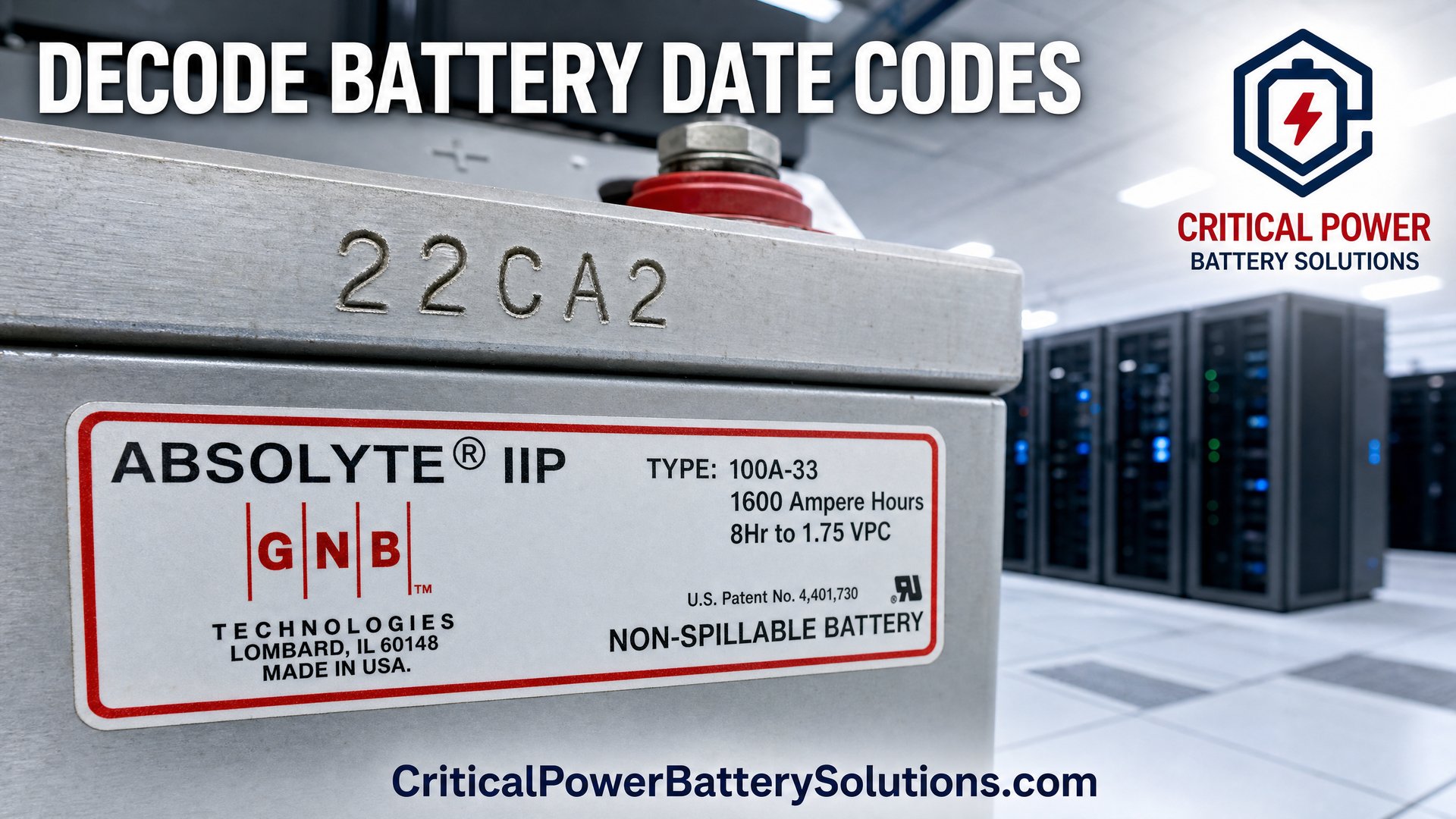
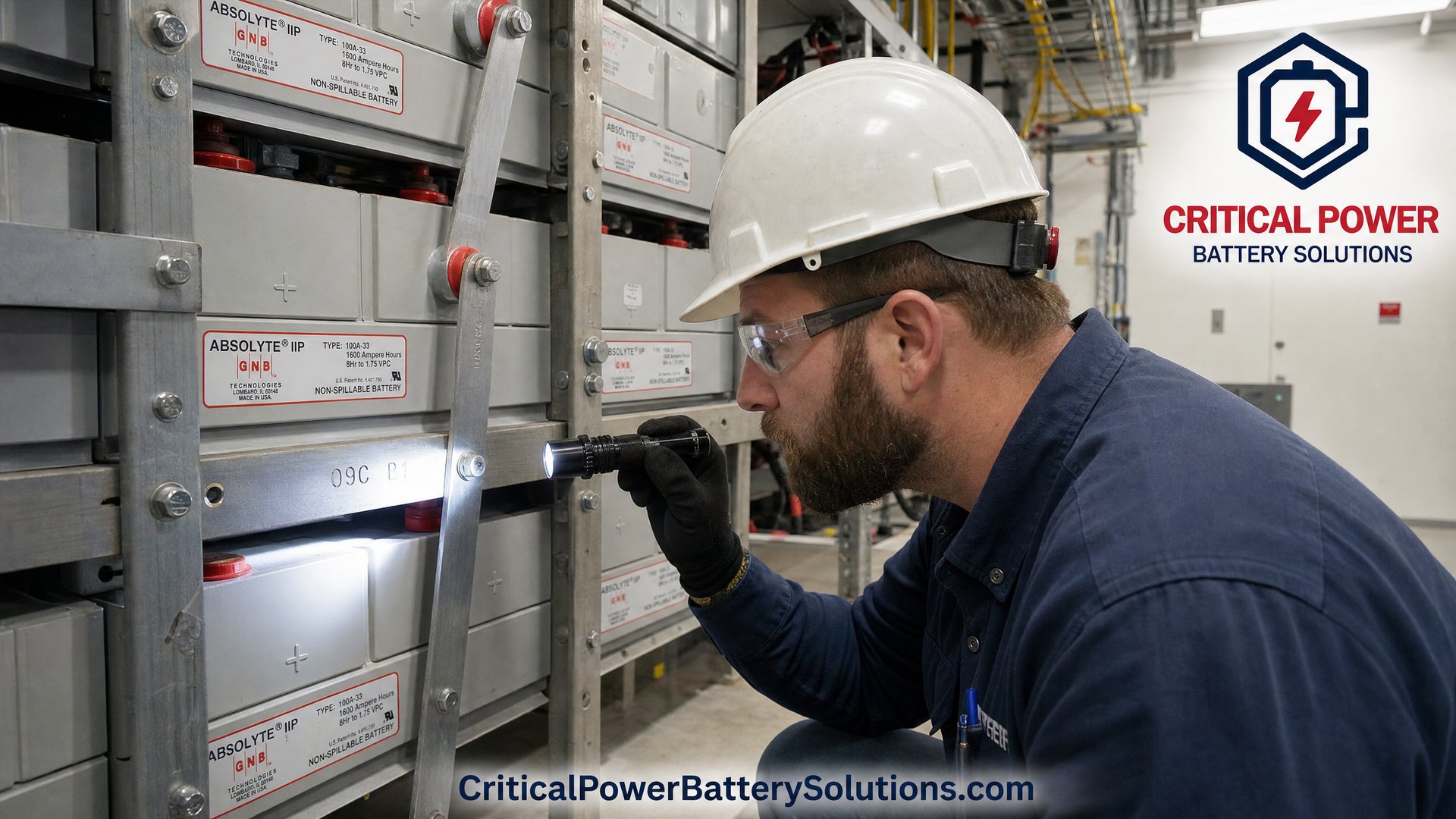
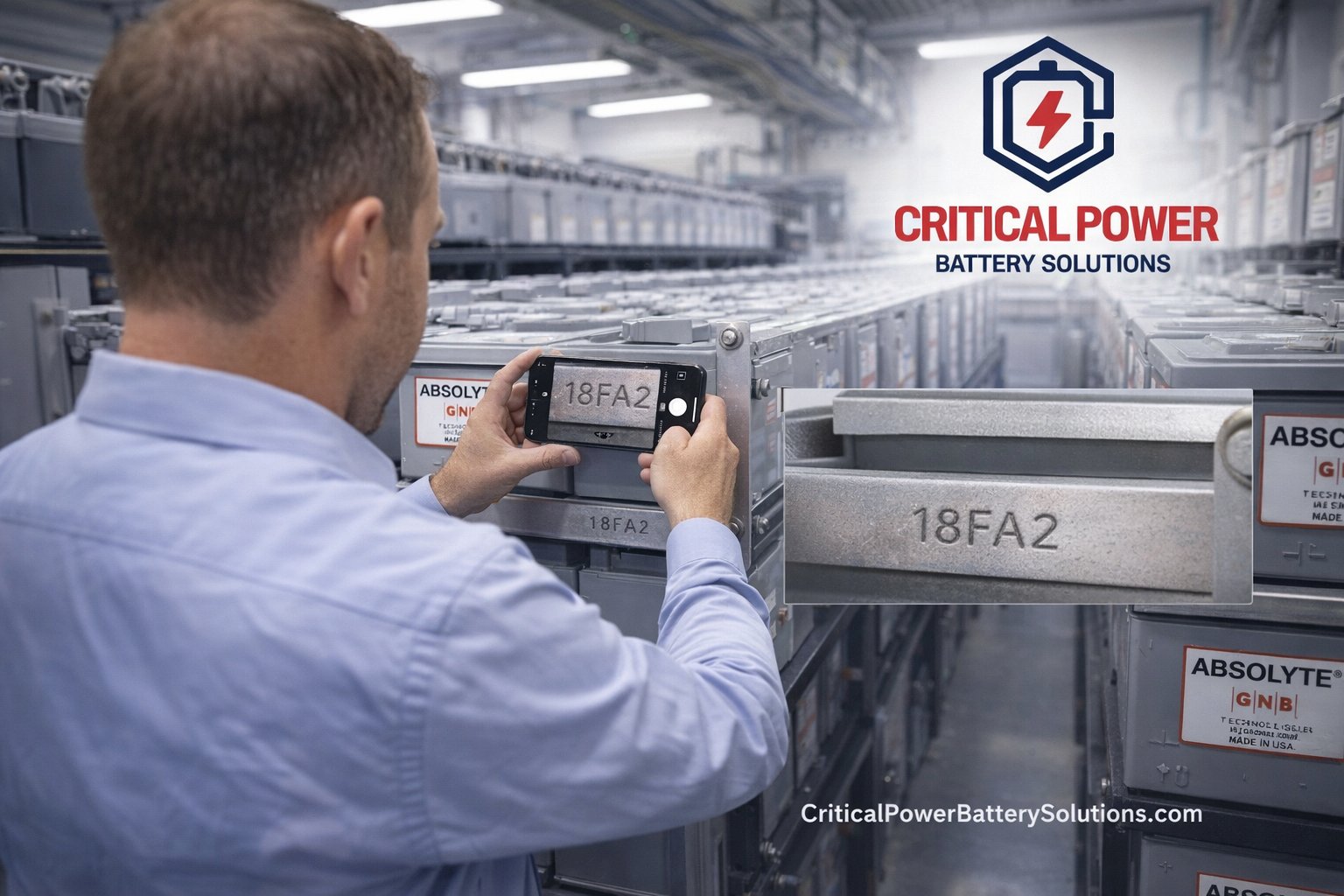
On industrial Absolyte modules, look past the paper label and find the physical date stamp engraved into the steel tray or molded into the terminal cover. Paper labels fade, peel, and get washed off by routine acid-neutralizing maintenance, so on a 10 to 14 year-old string the engraving is usually the most reliable mark left.
- Steel module lip and side casing: the most common location for the engraved manufacture stamp on Absolyte GP and AGP trays.
- Terminal covers and the area around the lead posts: often carry heat-stamped or molded production marks.
- System rating label: the original nameplate on the rack or cabinet, if still legible.
- Packing and commissioning documents: the paper trail that ties the module to an install date.
A flashlight held at an oblique angle across the metal throws shadow into the engraving and makes a faded stamp readable. A gentle wipe with a neutralizing pad clears off-gassing residue that fills the characters. Be careful not to confuse the long, standardized part number (which matches the spec sheet) with the shorter production date code.
Why you cannot reliably decode the stamp yourself, and what to do instead
There is no single public key that decodes every GNB and Stryten Absolyte date stamp, because the format varied by manufacturing plant and production era across the GNB, Exide, and Stryten years. Generic online “battery date code” charts are written for automotive and small UPS batteries and do not map cleanly onto industrial Absolyte modules. Guessing wrong is not harmless: misreading a 12-year-old string as 5 years old leaves a degraded battery carrying a critical load it can no longer support.
The dependable method is not a decoder ring. It is a two-step verification:
- Capture the evidence: photograph the engraved stamp and the nameplate, and pull whatever install date you can from records.
- Confirm it with someone who has handled the formats: CPBS offers a send-a-photo verification. Email a clear photo of the stamp and the module type to our team, and Tom Kierna, who spent 15 years at GNB and Stryten, returns the production date and whether the string is at end-of-life.
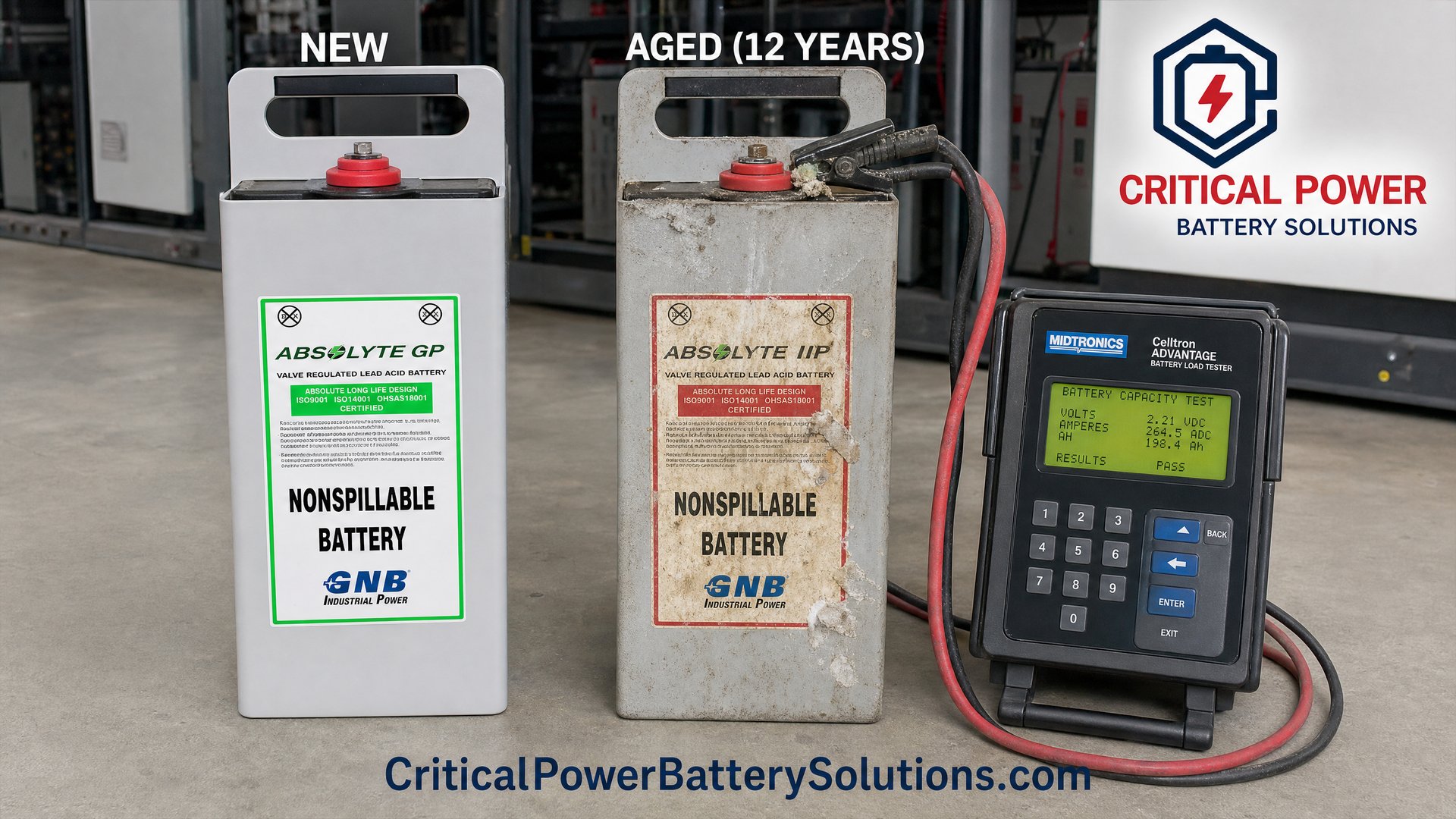
If the stamp is corroded beyond reading, your install paperwork is the next-best source. And regardless of what the stamp says, a capacity or internal-resistance test is what proves the battery’s true electrical age. We cover the procedure in the UPS battery testing guide; our companion guide, Is Your GNB Absolyte Battery Really Bad?, covers whether a low 2.2-volt-per-cell float reading means the string is failing.


Absolyte Design life versus real-world service life: why a 20-year battery struggles at 12
The 20-year design life on a Stryten Absolyte AGP is a specification measured at 25 C (77 F) float on a properly maintained string, not a guarantee of 20 calendar years in your room. Design life and service life are two different numbers. Service life is what you actually get, and in most real installations it is shorter, because three things quietly eat into it.
- Heat: the single largest factor. Every battery room that runs warm is aging the string faster than the spec sheet assumes.
- Float drift: a charger left uncompensated for temperature, or drifting high or low, accelerates grid corrosion or sulfation.
- Cycling and outages: each deep discharge consumes a measurable slice of the 1,200-cycle (at 80% depth of discharge) budget.
So a string sold on its 20-year design life, sitting in a 33 to 35 C room on an uncompensated float, reaching 10 to 14 years and showing weakness, is behaving exactly as physics predicts. That is not a defective battery. It is a battery that lived a harder life than the 25 C lab number assumes.
The temperature effect: how heat shortens VRLA life
As a rule of thumb, valve-regulated lead-acid (VRLA) service life is cut roughly in half for every 10 C rise above the 25 C reference temperature. This is the Arrhenius effect: the chemical reactions that corrode the positive grid and dry out the plates run faster as temperature climbs. The table below applies that rule to the Absolyte AGP’s 20-year design life so you can estimate the real life your room is delivering.
| Battery temperature | Approx. service-life reduction | Effective life of a 20-year design |
|---|---|---|
| 25 C (77 F) | 0% | ~20 years |
| 30 C (86 F) | ~29% | ~14 years |
| 35 C (95 F) | ~50% | ~10 years |
| 40 C (104 F) | ~65% | ~7 years |
| 45 C (113 F) | ~75% | ~5 years |
| 50 C (122 F) | ~83% | ~3.5 years |
Read across the row that matches your room. A remote telecom hut without robust HVAC, or a data center aisle running warm, can easily sit at 33 to 35 C, which lines up with a real service life near 10 to 12 years. That is the arithmetic behind a 20-year battery struggling at 12. The Absolyte AGP is rated for an operating range of -40 C to 50 C, but life is optimized at 20 to 25 C, so every degree above that reference is borrowed time.
The float voltage effect
Correct float voltage for the Absolyte AGP is 2.25 volts per cell at 25 C, and it must be temperature-compensated; an uncompensated charger in a hot room is a second, compounding hit on life. Float voltage that drifts off target degrades the battery in two opposite ways.
- Too high (or uncompensated in heat): accelerates positive-grid corrosion and water loss through dry-out, the dominant failure mode in warm rooms.
- Too low: allows sulfation, where lead sulfate hardens on the plates and permanently reduces capacity.
- Temperature compensation: Stryten’s SE2001 manual specifies a temperature-compensation coefficient of 3 mV per cell per F (5.5 mV per cell per C) of deviation from the 77 F (25 C) base, so a charger that does not adjust for room temperature heavily overcharges a hot string every hour of every day.
A hot room and an uncompensated float together explain many strings that fail well short of their design life. If you do not know whether your charger is temperature-compensated, that is worth confirming before you judge the battery itself.
So is your 10 to 14 year string actually due?
A GNB Absolyte string is genuinely due for replacement when any one of four conditions is met, and chronological age alone is only one of them. Use this as a decision framework, not a pass-or-fail test. The goal is to separate “old but still healthy” from “old and out of margin.”
- Measured capacity below 80% of nameplate. This is the IEEE end-of-life threshold for stationary batteries, confirmed by a capacity (discharge) test.
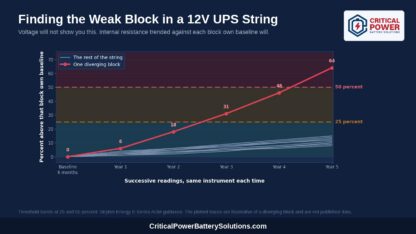
- Internal resistance more than 20 to 25% above the commissioning baseline. A rising-resistance trend is an early warning that a cell is degrading.
- Temperature-adjusted age has run out. Use the table above: if your room temperature points to an effective life you have already passed, treat the string as end-of-life regardless of the calendar.
- Physical end-of-life signs. Jar or cover swelling, post-seal weepage, heavy terminal corrosion, or any post-thermal-event damage means replace now, not later.
If none of these are present, a healthy 10-year string can keep serving with monitoring. If even one is present on a critical load, plan the replacement. Reaching end-of-life at 10 to 14 years in a warm, hard-working room is normal and expected, not a sign you were sold a bad battery.
What to do next: test it, size it, replace it
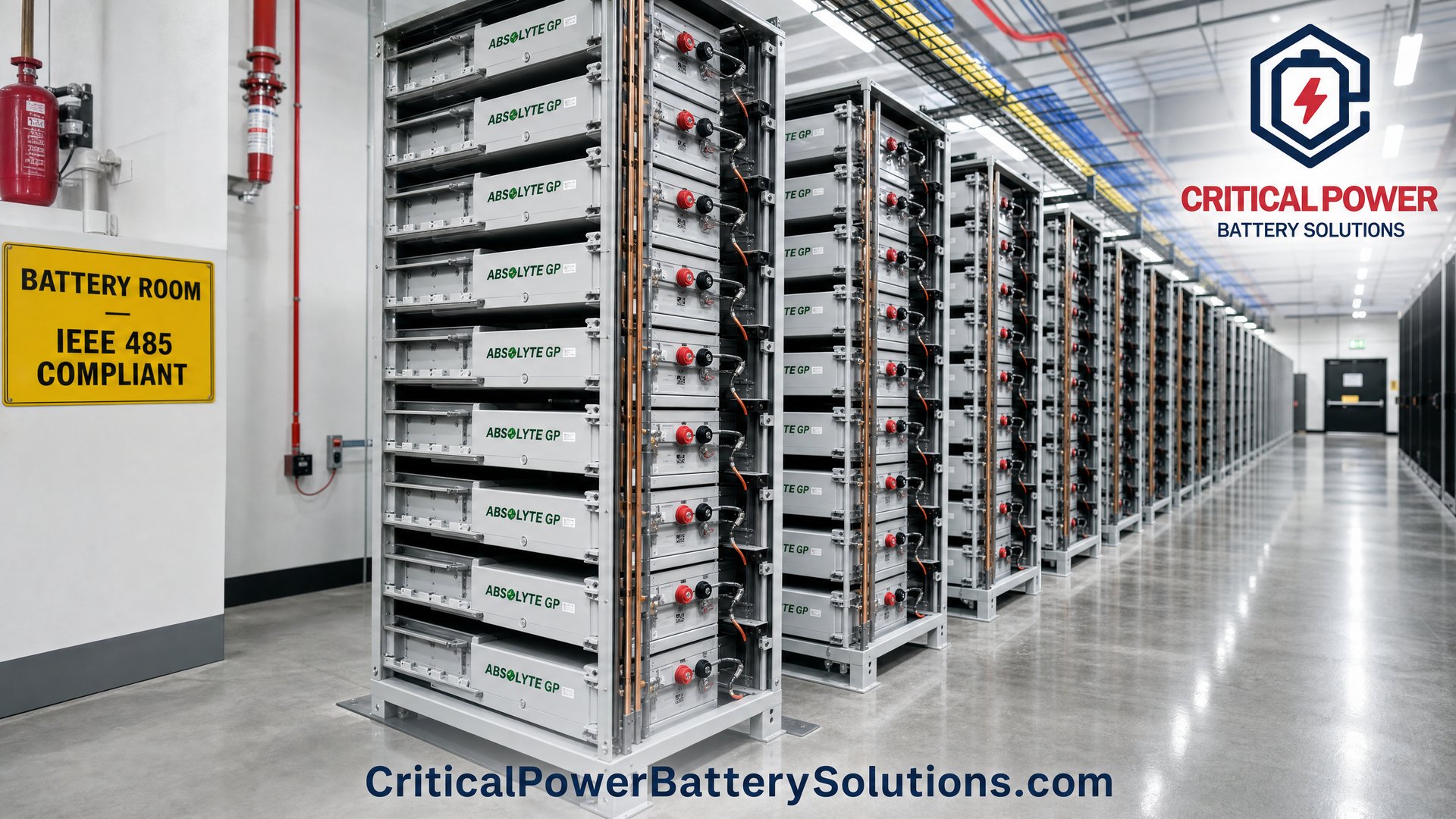
Once you know roughly how old the string is, the path forward is short: confirm condition with a test, size the replacement to current load, and plan a like-for-like Stryten Absolyte AGP swap. Each step has a dedicated guide so you are not starting from scratch.
- Test it. A date stamp tells you when the battery was built; a capacity or internal-resistance test tells you how it performs today. Start with the UPS battery testing guide.
- Size the replacement (IEEE 485). Loads change over a 10 to 14 year life, so resize rather than assuming the old rating. See the VRLA sizing guide for the IEEE 485 method.
- Replace like-for-like. GNB Absolyte replaces directly with Stryten Absolyte AGP in the same rack. Use the telecom and data center field guide and the GNB Absolyte GP replacement guide for the procedure and cross-reference.
- Call Tom. For an authoritative age read, a cross-reference from your GNB part number, current lead time, and a sizing or replacement quote, contact Tom Kierna at 630-984-9718 or sales@criticalpowerbatterysolutions.com.
🎯 Verify the brand continuity yourself. If a procurement, warranty, or AHJ question comes up about replacing a GNB-stamped battery with a Stryten unit, these three Stryten primary-source documents close it.
- Stryten E-Series Branding Change Letter: the March 2023 announcement that formally renamed the GNB-branded industrial portfolio to Stryten.
- Manufacturer’s Declaration of Design Continuity: Stryten’s August 2023 statement that the design, engineering, and manufacturing are unchanged from GNB, only the name changed.
- CPBS / ATS Authorized Reseller Letter: signed authorization confirming CPBS as an authorized Stryten channel for Absolyte AGP.
Frequently Asked Questions
How old are my GNB Absolyte batteries? Read the manufacture date stamped on the steel module, then check it against your commissioning or purchase records, and use the in-service date as the baseline. If the stamp is unreadable or the format is ambiguous, email a photo to CPBS for verification, or run a capacity test to confirm true electrical age.
Where is the date code on a GNB or Stryten Absolyte module? It is usually engraved into the steel module lip or side casing, or molded into the terminal cover near the lead posts. The original system nameplate and your packing or commissioning paperwork are secondary sources. On older strings the engraving outlasts the paper label.
How do I read a GNB Absolyte battery date code? There is no single public key, because the stamp format varied by plant and era across GNB, Exide, and Stryten production. Photograph the stamp and have it verified rather than guessing from a generic online chart, since a wrong read can leave a degraded string in service.
What is the design life of a GNB Absolyte battery? The Stryten Absolyte AGP, which is the current form of GNB Absolyte, carries a 20-year design life rated at 25 C (77 F) float on a properly maintained string. Real-world service life is shorter in warmer rooms, commonly 10 to 14 years.
Why is my 20-year Absolyte battery struggling at 12 years? The 20-year figure is a design life measured at 25 C. VRLA life roughly halves for every 10 C above that, so a 33 to 35 C room cuts real life to about 10 to 12 years. A string weakening at 12 in a warm room is behaving as expected, not failing prematurely.
What is the difference between battery design life and service life? Design life is the manufacturer’s rated life under ideal conditions (25 C float, proper maintenance). Service life is what you actually achieve in the field, which is shortened by heat, float-voltage drift, and discharge cycles. Design life is the ceiling; service life is reality.
How does temperature affect Absolyte battery life? Service life is cut roughly in half for every 10 C above 25 C. A 20-year design life becomes about 14 years at 30 C, about 10 years at 35 C, and about 7 years at 40 C. Heat is the single largest factor in real-world VRLA aging.
How does float voltage affect Absolyte battery life? The correct float is 2.25 volts per cell at 25 C, temperature-compensated at 3 mV per cell per F (5.5 mV per cell per C). Float that runs high, or that is uncompensated in a hot room, accelerates grid corrosion and dry-out; float that runs low causes sulfation. Both shorten life.
When should I replace a GNB Absolyte battery string? Replace when measured capacity falls below 80% of nameplate, internal resistance rises more than 20 to 25% above the commissioning baseline, the temperature-adjusted age has run out, or physical signs appear such as jar swelling, post-seal weep, or heavy corrosion. Any one on a critical load is enough.
Are GNB Absolyte batteries still made, and is GNB now Stryten? Yes. GNB Absolyte GP and IIP are now sold as Stryten Absolyte AGP. Stryten’s 2023 Manufacturer’s Declaration confirms the design, engineering, and manufacturing are unchanged, only the name changed, so replacement is a like-for-like swap.
Can I replace only part of an aging Absolyte string? It is generally not advised. Mixing new and old cells in one string forces the new cells to work against the higher resistance of the aged cells, which drags down the whole string and shortens the new modules’ life. Replace the full string and resize per IEEE 485.
How do I confirm battery age if the date code is unreadable? Fall back to your commissioning report, purchase order, or CMMS install record. If no records exist, a capacity or internal-resistance test reveals the battery’s true electrical age and remaining health regardless of any stamp. CPBS can help interpret the results.
👤 Article by:Tom Kierna, Battery Systems Specialist at Critical Power Battery Solutions, a division of Advanced Technical Services Inc. (ATS).
Reviewed by: CPBS Engineering Team. Last updated: May 20, 2026.
Credentials: 40+ years in industrial battery systems, including 15 years at GNB and Stryten. Authorized Stryten Energy reseller, ISO 9001 certified, IEEE standards member. For an authoritative date-code read or a replacement cross-reference, reach Tom directly at 630-984-9718 or sales@criticalpowerbatterysolutions.com.
References
- Institute of Electrical and Electronics Engineers. IEEE 1188: Recommended Practice for Maintenance, Testing, and Replacement of Valve-Regulated Lead-Acid (VRLA) Batteries for Stationary Applications. IEEE.
- Institute of Electrical and Electronics Engineers. IEEE 485: Recommended Practice for Sizing Lead-Acid Batteries for Stationary Applications. IEEE.
- Stryten Energy. Absolyte AGP Installation and Operations Manual (SE2001). Stryten Manufacturing.
- Stryten Energy. Manufacturer’s Declaration: GNB to Stryten Brand Change. Stryten Manufacturing, August 17, 2023. Hosted PDF.
- Stryten Energy. E-Series Product Branding Change Letter. Stryten Manufacturing, March 6, 2023. Hosted PDF.
- Stryten Energy. CPBS / ATS Stryten Energy Authorized Reseller Letter. Stryten Energy, 2023. Hosted PDF.