Telecom Battery Backup Systems for 5G: How Network Operators Are Redesigning Power for the RAN
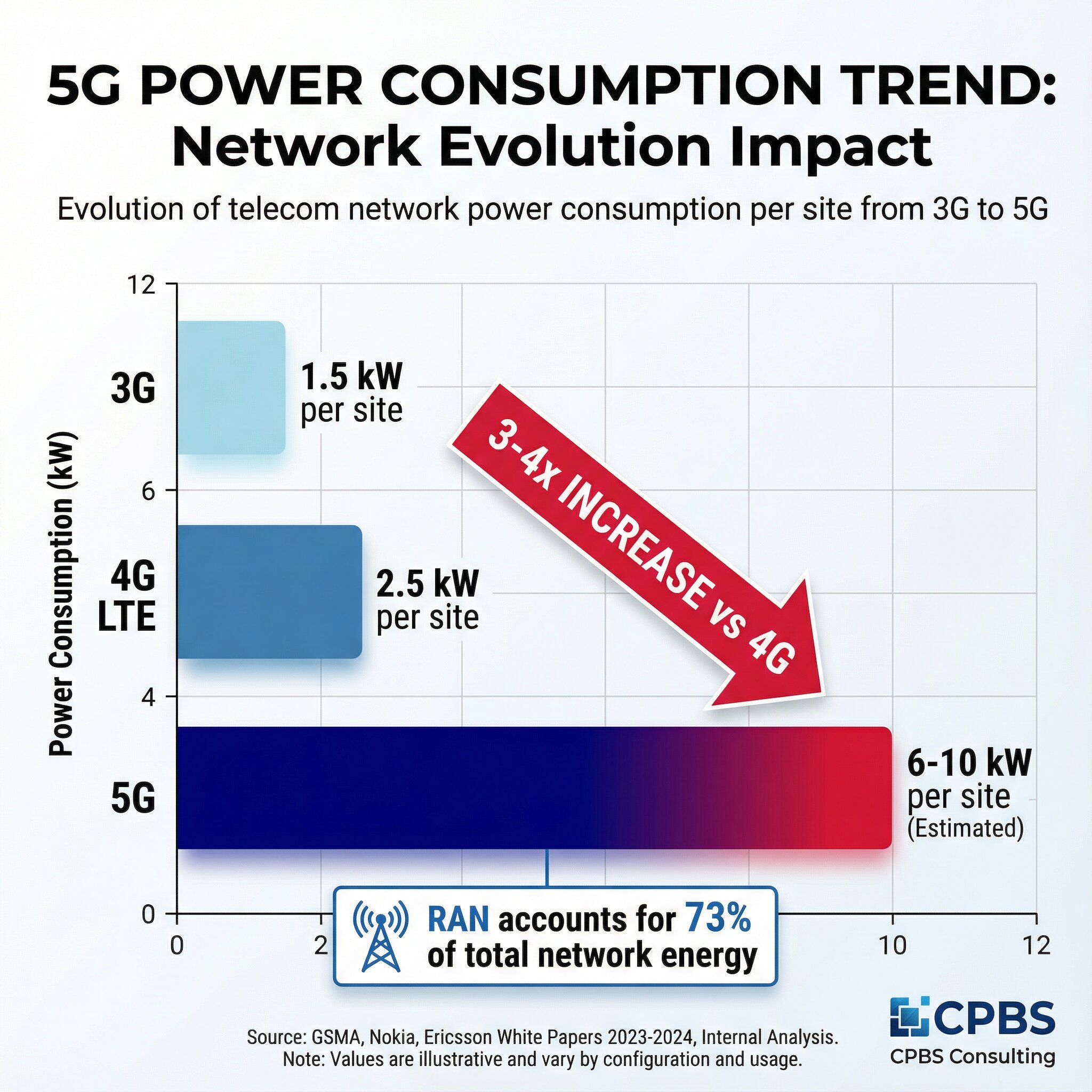
5G base stations consume roughly 3–4 times more power than 4G LTE sites when you factor in massive MIMO, beamforming, and dense small cell deployments. At the same time, 5G networks overall can be 4–5 times more energy‑intensive than 4G, fundamentally changing how every telecom battery backup system must be sized, deployed, and managed. We work with network operators every day who are rethinking 5G backup power, from macro cell sites to edge computing nodes, to meet these new demands without excessive CAPEX or operational risk.
Key Takeaways
| Question | Answer |
|---|---|
| How is 5G changing telecom battery backup system design? | 5G’s higher power density and site count require larger battery strings, better thermal design, and tighter lifecycle planning for 5g backup power, especially at macro and small cell sites. |
| What are the core elements of a robust telecom battery backup system? | A carrier-grade solution integrates rectifiers, DC power plants, telecom ups battery banks, distribution, monitoring, and clear telecom battery specifications per site type. |
| Why does NEBS Level 3 matter for telecom batteries? | NEBS Level 3 batteries are tested for seismic, thermal, fire, and EMI performance, which is non‑negotiable for central offices, data centers, and critical telecom power systems. |
| Which chemistries are best suited for outdoor 5G sites? | Long‑life VRLA and advanced technologies from Stryten and Leoch provide reliable outdoor telecom battery performance across temperature extremes when correctly sized and managed. |
| How much runtime should operators target? | At minimum, design for FCC guidance of 8 hours at cellular sites and 24 hours at central offices, with site‑specific adjustments based on generator coverage and SLA tiers. |
| Where can I see telecom‑specific solutions? | We outline our dedicated telecommunications battery backup systems offering for macro, small cell, DAS, and central office deployments. |
| How do I start planning a fleet‑wide replacement? | You can browse our full portfolio of telecommunications battery solutions and engage our engineering team for sizing and lifecycle planning across your telecom battery fleet. |


👤 Written by: Tom Kierna
Reviewed by: Tom Kierna – CPBS
Last updated: 08 January 2026
1. 5G Power Reality: Why Traditional Cell Tower Batteries Are No Longer Enough
In 4G LTE, a macro site might draw 2–3 kW under typical load; 5G macro cells with 64T64R massive MIMO can easily drive site power demands into the 6–10 kW range, depending on spectrum and carrier aggregation. When you multiply that across thousands of sites, the impact on your network backup power strategy is substantial.
This power increase affects not just rectifier sizing but also the amp‑hour capacity and string configuration of each cell tower battery bank. Runtime expectations are not decreasing—regulators and customers expect sites to stay up, which means your macro cell backup power must scale with these new loads without creating unsupportable footprints or truck roll frequency.
We see operators moving from “minimum compliance” to tiered backup strategies: premium 5G sites receive extended runtime, while lower‑tier sites align closely to minimum regulatory guidance. That requires careful modeling of 5g power requirements, ambient conditions, and cabinet space at each location.
2. Core Architecture of a Carrier‑Grade Telecom Battery Backup System
A modern telecom battery backup system is more than a rack of batteries. For macro cell, small cell, DAS, and central office applications, a complete solution typically includes:
- AC input, surge protection, and rectifier shelves
- DC power plant with hot‑swappable rectifiers and distribution
- One or more strings of telecom UPS battery modules (often 48 V nominal systems)
- Battery disconnects, fusing, and cabling engineered for fault currents
- Environmental controls (HVAC or passive cooling) and mechanical protection
- Telecom battery monitoring and networked smart BMS for fleet visibility
The design objective is simple: guarantee that your wireless network backup performs on the worst day, not the best. That means correctly specifying float voltage, temperature compensation, and string balancing, and ensuring the telecom battery specifications match real‑world load profiles—transmit power peaks, backhaul, and auxiliary loads like site routers and edge computing.
3. Sizing Batteries for 5G: Practical Capacity Planning Guidance
RAN now accounts for about 73% of a telecom network’s total energy consumption, so sizing 5G backup correctly starts at the radio layer. For each site, you should baseline:
- Total DC load at the battery bus (RRHs, BBU/DU, fronthaul/backhaul, router/switches, lighting, security)
- Target runtime (e.g., 4, 8, 12, or 24 hours depending on SLA and generator availability)
- Ambient temperature and available cooling in the cabinet or shelter
A useful planning formula for lead‑acid telecom batteries is:
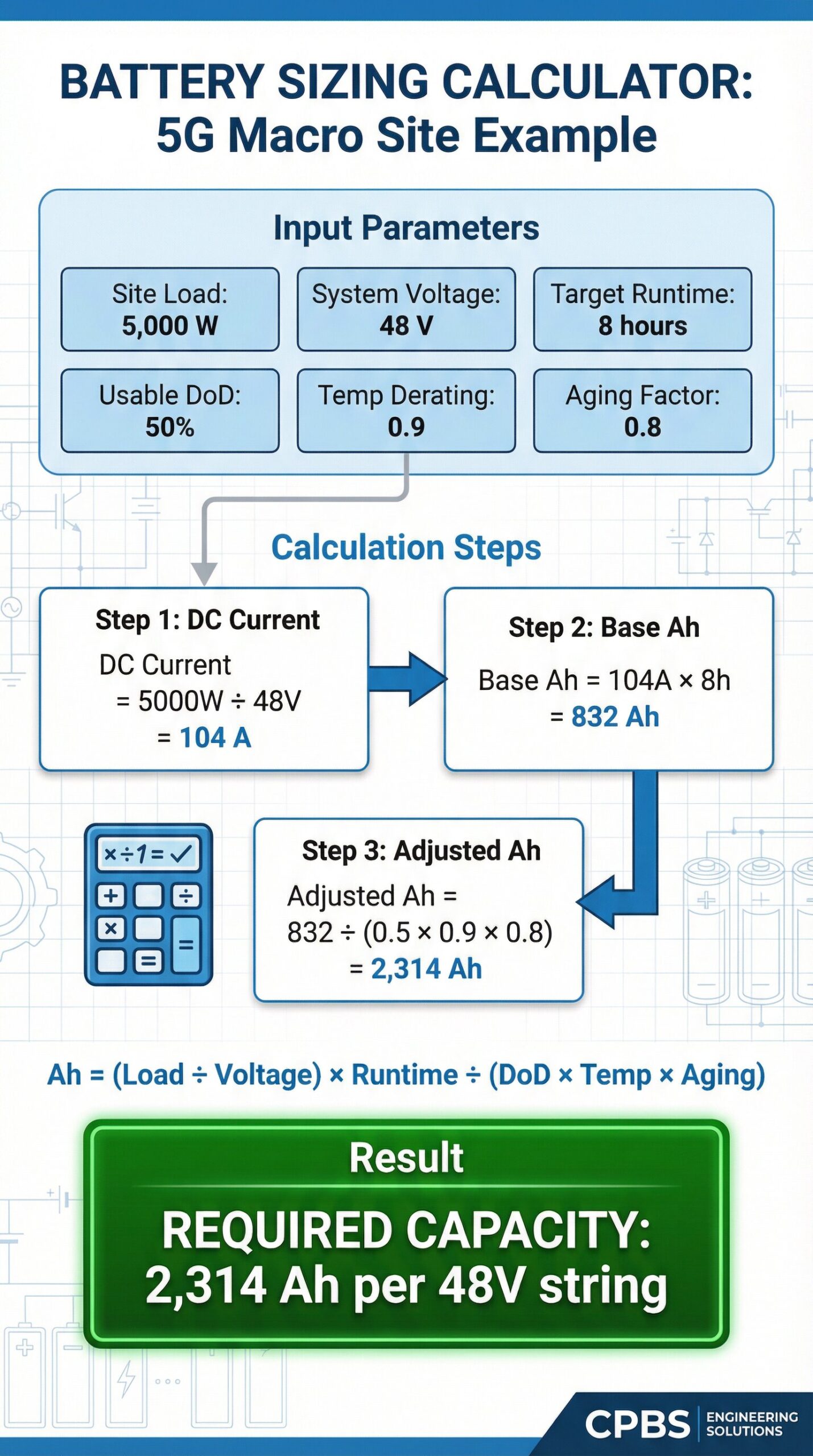
Required Ah per string ≈ (Site Load in Watts ÷ System Voltage) × (Runtime Hours) ÷ [Usable DoD × Temp Derating × Aging Factor]
For example, a 48 V 5G macro site drawing 5 kW, with an 8‑hour target runtime, 50% usable depth of discharge, 0.9 temperature derating, and 0.8 aging factor would need approximately:
- DC current: 5000 W ÷ 48 V ≈ 104 A
- Base Ah: 104 A × 8 h ≈ 832 Ah
- Adjusted Ah: 832 ÷ (0.5 × 0.9 × 0.8) ≈ 2314 Ah per 48 V string
At this scale, operators often deploy multiple high‑capacity modules such as 300–400 Ah units in parallel strings. Our sizing team routinely optimizes these configurations to avoid oversizing while meeting 5g backup power requirements across temperature extremes.
4. Stryten Energy Telecom Heritage: From GNB Industrial Power to 5G Infrastructure
Stryten Energy, formerly known across the industry as GNB Industrial Power, has supplied telecommunications battery solutions to central offices, cell sites, and network operations centers for decades. That heritage matters—these products have already proven themselves in continuous duty, high‑reliability environments where downtime is not acceptable.
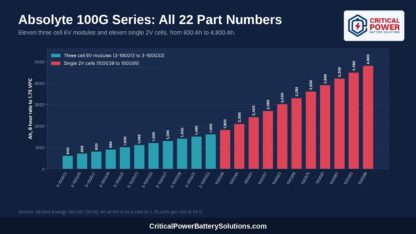
For operators looking for a rugged carrier grade battery for harsh environments, Stryten’s E‑Series Absolyte AGP line is a reference standard. These designs are built for stationary applications including telecom shelters, central offices, and edge data environments with long design life, stable float performance, and excellent cycling characteristics.
We see Absolyte AGP commonly deployed in scenarios where operators require high reliability over 15–20 years and are consolidating both telecom and IT loads—particularly where edge computing battery capacity must coexist with RAN and backhaul equipment in the same power system.
5. NEBS Level 3 Battery Requirements: Non‑Negotiable for Carrier‑Grade Reliability
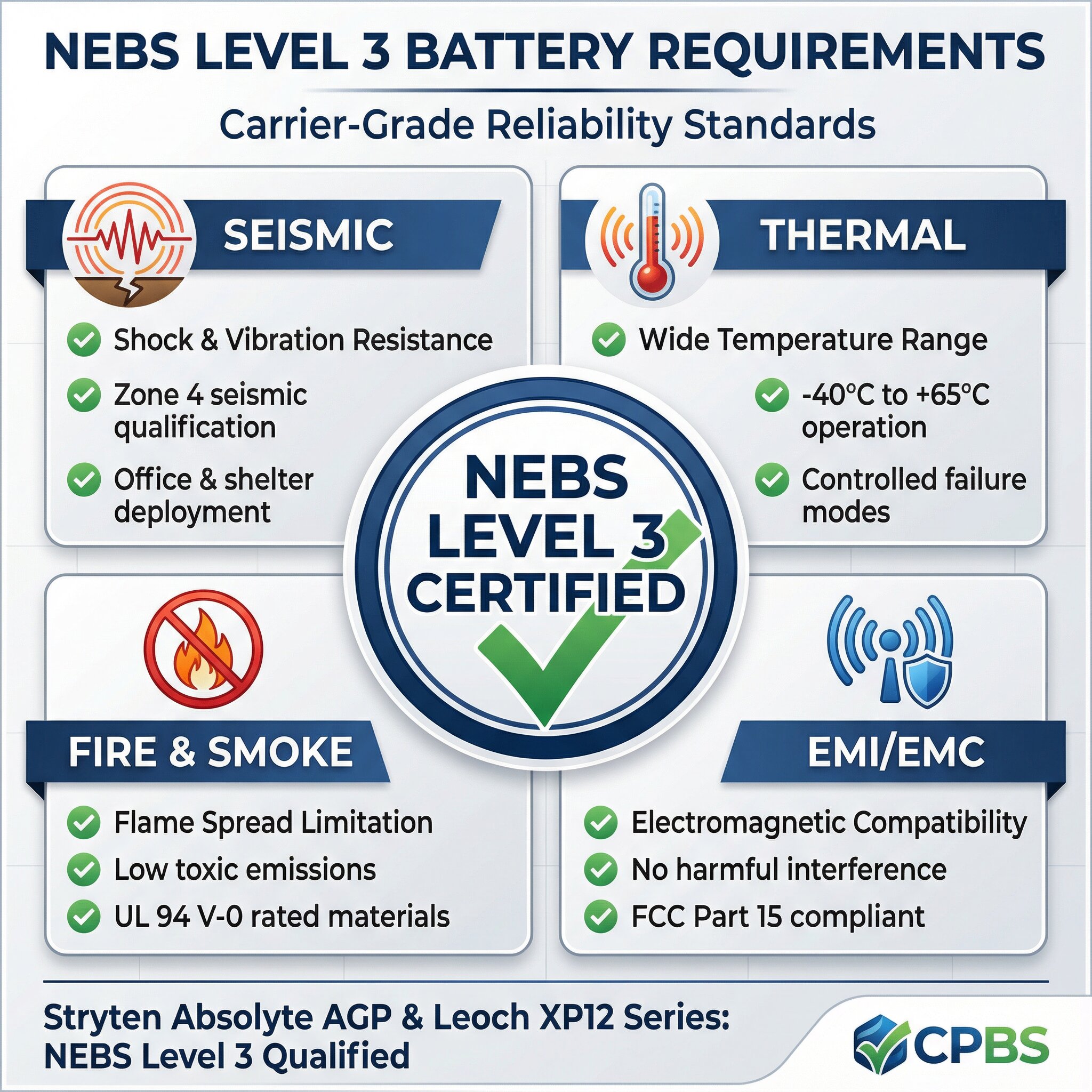
NEBS (Network Equipment‑Building System) is the baseline framework for North American telecom infrastructure. For batteries, NEBS Level 3 is the benchmark for carrier‑grade deployment, covering:
- Seismic performance: shock and vibration resistance for central offices and shelters
- Thermal robustness: operation across wide temperature ranges with controlled failure modes
- Fire and smoke performance: limiting flame spread and toxic emissions
- EMI/EMC compatibility: ensuring no harmful interference with network equipment
When we specify a NEBS battery for a central office or critical aggregation point, we treat Level 3 compliance as mandatory. Stryten’s portfolio, built on the GNB telecom legacy, has been successfully qualified into numerous NEBS Level 3 applications and is routinely selected for central office battery and telecom power systems upgrades where compliance audits are strict.
6. Outdoor Telecom Battery Challenges: Temperature, Space, and Security
Remote macro towers, rooftop sites, and outdoor DAS nodes place severe demands on any outdoor telecom battery. Ambient temperatures can swing from ‑40°C winters to cabinet hotspots exceeding +60°C in summer sun. Limited or no HVAC, restricted footprint, and exposure to theft or vandalism amplify the risk profile.
To support these sites, we typically recommend robust VRLA constructions such as Leoch XP12 series or Stryten Absolyte AGP, depending on form factor and capacity needs. These products offer wide temperature ranges, strong deep‑discharge recovery, and vibration resistance that suit cell tower UPS and remote site battery installations.
Design considerations include locating battery enclosures away from direct solar gain, providing adequate ventilation, and using locking or reinforced cabinets. Every incremental improvement in battery life at these sites directly reduces truck rolls and total cost of ownership.
7. Front‑Terminal Pure Lead for Racks, Hubs, and DAS: Leoch PLH Series
Front‑Terminal Design for High‑Density Telecom Racks
Where space is constrained—indoor DAS rooms, fiber hubs, small cell aggregation cabinets—a front‑terminal format simplifies installation and maintenance. The Leoch PLH front terminal family is designed specifically for these applications, offering 12 V modules with 100–170 Ah capacity and easy access from the front of the rack.
The PLH series uses pure lead technology with 99.99% lead plates, yielding extended float life (15+ years design life) and up to 1200 cycles at 50% DoD. This makes them well suited for DAS battery backup, small central offices, and indoor small cell controller rooms where high availability and limited floor space intersect.
Typical Use Cases: Small Cell, DAS, and Edge Compute Rooms
We commonly specify PLH front‑terminal modules for:
- Indoor small cell battery banks in multi‑tenant buildings
- Campus and stadium DAS battery backup panels
- Fiber aggregation and local edge compute hubs feeding RAN and enterprise traffic
In these scenarios, the ability to service batteries from the front without pulling trays reduces maintenance time and safety risks. Pure lead chemistry also provides better high‑rate performance and standby stability, key for network reliability battery roles at these nodes.
8. Application‑Specific Recommendations: Macro, Small Cell, DAS, and Central Office
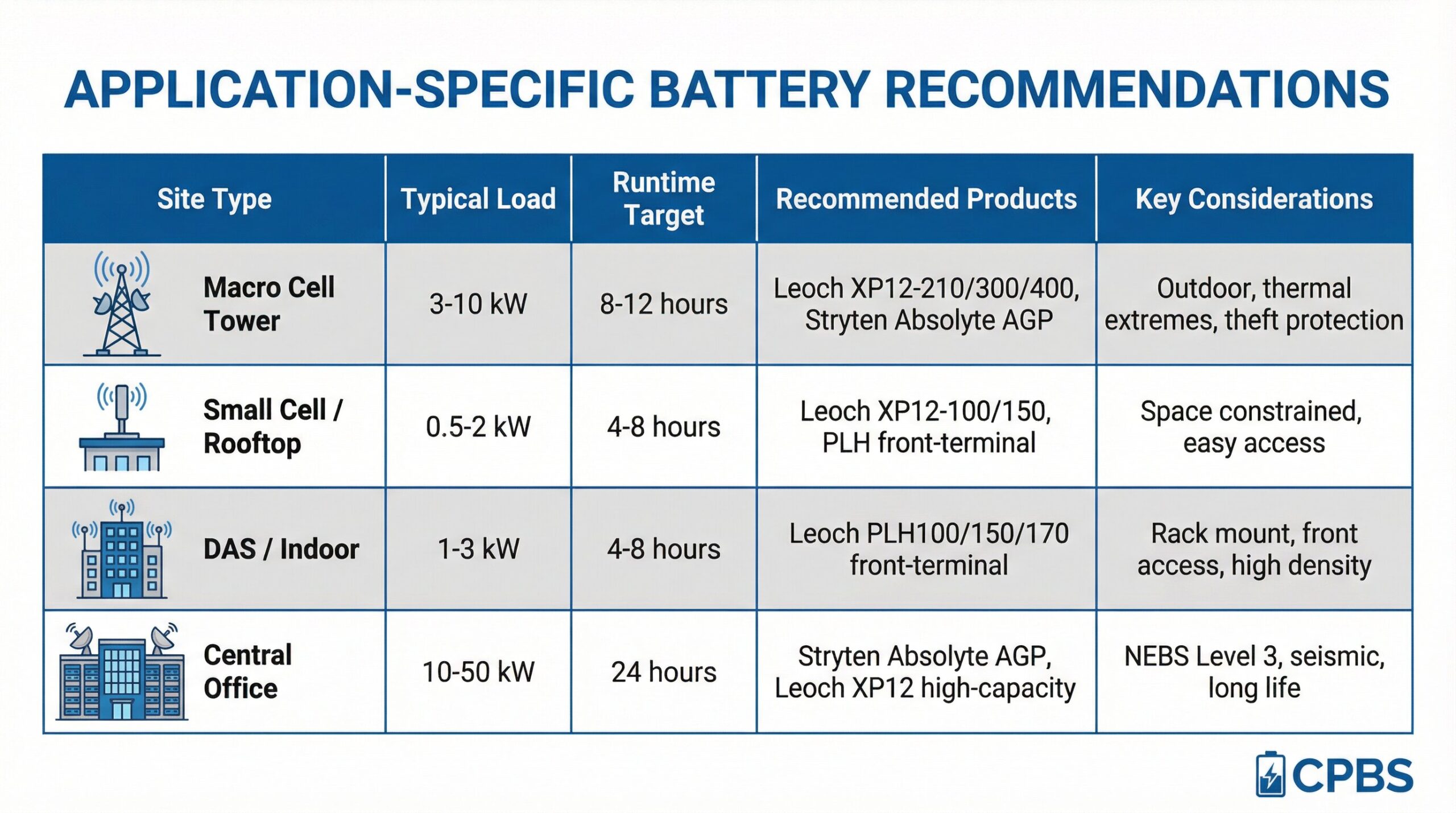
Different site types impose different constraints on your telecom battery backup system. Below is a high‑level comparison to guide initial product families and capacity ranges.
| Site Type | Typical Load | Runtime Target | Recommended Battery Families | Notes |
|---|---|---|---|---|
| Macro Cell Tower | 3–10 kW | 8–12 hours | Leoch XP12‑210/300/400, Stryten Absolyte AGP | Outdoor cabinets, thermal extremes, theft protection |
| Small Cell / Rooftop | 0.5–2 kW | 4–8 hours | Leoch XP12‑100/150, PLH front‑terminal | Tight spaces, weight limits, often no HVAC |
| DAS (Indoor Venues) | 1–5 kW | 4–8 hours | Leoch PLH100/150/170 | Rack‑based, accessible maintenance |
| Central Office / MSC | 10–100+ kW | 24 hours | Stryten Absolyte AGP, other NEBS Level 3 strings | High NEBS, seismic and runtime requirements |
| Edge Computing Node | 3–20 kW | 8–24 hours | Mix of Absolyte AGP and PLH/XP12 depending on design | Shared telecom + IT loads, higher power density |
These recommendations are starting points. Our engineering team typically refines them with site‑specific data to ensure 5g infrastructure power and network backup power remain aligned to your SLAs and CAPEX constraints.
9. Fleet‑Wide Telecom Battery Replacement and Monitoring Strategy
For operators with hundreds or thousands of sites, individual site optimization is not enough. You need a coordinated strategy for telecom battery replacement, monitoring, and lifecycle management across the entire telecom battery fleet.
Key elements we recommend include:
- Standardized product families per site type (e.g., XP12 for macros, PLH for DAS, Absolyte for central offices)
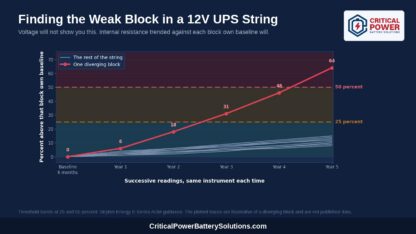
- Centralized telecom battery monitoring with per‑string voltage, temperature, and internal resistance tracking
- Predictive maintenance rules to trigger replacements before failure while maximizing service life
- Consolidated procurement and logistics to reduce per‑site deployment cost
With a well‑managed fleet, operators can significantly reduce unplanned truck rolls and minimize service interruptions from aging batteries, even in remote or hard‑to‑access cell site battery locations.
10. Integrating Telecom, Data Center, and Utility Power for Converged Networks
5G and fiber buildouts increasingly blur the lines between classic telecom, data center, and utility infrastructure. Many operators now run micro data centers, edge compute nodes, and aggregation hubs that need both telecom power systems and IT‑grade backup.
Solutions such as Stryten Absolyte AGP and Leoch PLH/XP series allow us to design converged power plants supporting RAN, routing, and compute loads with harmonized maintenance and lifecycle strategies. For high‑power facilities, coordination with utility and substation backup designs also becomes important to ensure cascading resilience from grid to RAN.
Our broader engineering capabilities across telecom, data center, and utility environments allow us to apply lessons from each sector to your 5g infrastructure power projects, especially where you are consolidating power rooms or building new edge locations.
Conclusion: Powering Your 5G Network Expansion
5G has permanently changed the power profile of telecom networks. Higher RAN loads, denser deployments, edge computing, and strict reliability expectations demand that every telecom battery backup system—from macro towers to DAS closets—be engineered, not guessed.
As a specialized division backed by over 40 years of electrical engineering experience through Advanced Technical Services (ATS), we focus on delivering carrier‑grade battery solutions from trusted manufacturers like Stryten Energy and Leoch. Our goal is to help you meet 5g power requirements with precision while controlling lifecycle cost across your entire network.
To support your next phase of 5G and fiber rollout, we offer:
- Free 5G power requirements assessment – We’ll review representative sites and propose right‑sized backup architectures.
- Telecom battery selection guidance – Matching Stryten and Leoch options to your cell tower battery, small cell, DAS, and central office needs.
- Fleet‑wide replacement proposals – Standardizing chemistries and models to streamline your telecom battery fleet management.
- Technical consultations – Direct access to our telecom battery specialists for NEBS compliance, runtime modeling, and deployment planning.
If you’re planning new 5G sites, upgrading existing 4G infrastructure, or rationalizing a mixed legacy fleet, we’re ready to work with your engineering and operations teams to design a telecom battery backup system that supports your network reliably for the long term.
Telecom Battery Projects in India: 5G & Tower Infrastructure
India’s 5G rollout, led by Reliance Jio, Bharti Airtel, and Vi, is one of the world’s largest active telecom buildouts.
Where CPBS engages on Indian telecom projects:
- Operators & EPCs: Jio, Airtel, Vi network buildouts and tower contractor programs
- Geography: Mumbai, Delhi NCR, Bangalore, Hyderabad, Chennai
- Scope: IEEE-485 sizing, Stryten and Leoch system specification, project-scale sourcing
- Engagement: EPC contractors, tower companies, telecom infrastructure teams
Project-scale deployments only, contact our engineering team to scope sizing and timelines.
India FAQ
Q: Does Critical Power Battery Solutions support telecom battery projects in India?
A: Yes, for large-scale, project-based deployments. We work with EPC contractors, tower operators, and telecom infrastructure teams on Stryten, Leoch, and Absolyte specifications across Mumbai, Delhi NCR, Bangalore, Hyderabad, and Chennai. Engagement is project-scale specification, IEEE-485 sizing, and sourcing, not retail or stocked shipments.