How To Install Stryten Absolyte AGP Correctly
If you are planning how to install Stryten Absolyte AGP in a data center, telecom site, utility substation, or renewable plant, the way you design, place, wire, and commission the system will determine how close you get to its 20‑year design life at 25°C in real operation.
Key Takeaways
| Question | Answer |
|---|---|
| How do I size and select an Absolyte AGP system before installation? | Use IEEE 485 based sizing or request an engineering report from us when you specify Stryten E‑Series Absolyte AGP, then confirm DC bus voltage, Ah capacity, and runtime requirements. |
| What clearances and environment do I need for Absolyte AGP? | Follow NEC and local codes, maintain at least 90 cm lateral access and 80 cm at covers, and control ambient temperature close to 24–25°C to protect design life. |
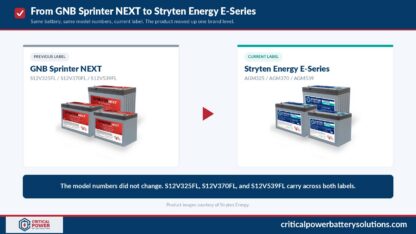
| How do I replace older GNB Absolyte batteries with Stryten AGP? | Treat it as a like‑for‑like 2 V cell upgrade, verify string voltage and rack layout, then follow a structured changeout plan similar to any “how to replace GNB batteries” project using our GNB to Stryten compatibility guidance. |
| What charging settings are required during commissioning? | Set float to about 2.25 V per cell at 25°C and follow Stryten’s equalization recommendations before placing the UPS or DC system into full service. |
| How do I test UPS batteries after installation? | Perform baseline voltage, ohmic, and system discharge checks in line with IEEE 1188 to document performance and support future “how to test UPS batteries” programs. |
| Who should install Stryten Absolyte AGP systems? | For large, high‑voltage, or seismic installations, we recommend working with qualified battery professionals, using us as your authorized Stryten Energy technical partner with over 40 years of experience and ISO 9001 backed processes through ATS. |
👤 Article by: Tom Kierna
Reviewed by: CPBS Engineering Team
Last updated: February 6, 2026
Credentials: Authorized Stryten Energy battery Reseller, ISO 9001 Certified, IEEE Standards Member
Understanding Stryten Absolyte AGP And Why Installation Quality Matters
Before you focus on how to install Absolyte AGP step by step, it helps to understand what you are installing and why the details matter so much.
Stryten E‑Series Absolyte AGP is a 2 V VRLA AGM cell, typically in the 104–4,800 Ah range, designed for long duration backup in data centers, telecom networks, utilities, and renewables where failure is not acceptable.
As an authorized Stryten Energy distributor, we have supported Absolyte systems from the original GNB Industrial Power designs through today’s Stryten platforms, so we have seen how proper commissioning supports the full 20‑year design life and how shortcuts shorten it dramatically.
The Absolyte AGP platform is NEBS Level 3 and seismic qualified, UL recognized, and manufactured in the USA, which makes it a premium choice when you are deciding how to choose industrial batteries for mission‑critical applications.
If you are planning how to select data center batteries for a 20‑year infrastructure roadmap, Absolyte AGP is often the default recommendation because it combines long design life, NEBS compliance, and strong deep‑cycle performance.
That performance is only delivered if the system is correctly sized, installed, and maintained, so this guide focuses on how to install Stryten batteries correctly rather than just what they are.
Pre‑Installation Planning: Sizing, Runtime, And System Design
The first step in how to install Stryten Absolyte AGP is not unpacking cells, it is getting the design right so you are installing the correct system in the first place.
In our experience, most installation headaches trace back to earlier decisions on how to size battery systems, how to calculate battery runtime, or how to commission battery systems for the actual load profile.

Step-by-step planning workflow from IEEE 485 sizing to installation readiness
How to size battery systems for Absolyte AGP
For new installations, start with DC bus voltage and required backup duration at end of life, then use IEEE 485 methods or request our IEEE 485 battery sizing report to define the cell count and Ah rating.
If you are working out how to replace GNB batteries such as legacy Absolyte IIP or GX with Stryten AGP, you can typically match the existing string configuration, then confirm that capacity still meets today’s load and runtime requirements.
How to calculate Absolyte battery runtime accurately
Use manufacturer discharge tables for Absolyte AGP at the expected temperature and end voltage, then cross check against your UPS or DC system requirements.
We recommend building a simple table that shows runtime at beginning of life and expected end of life so that facilities managers and engineering directors can plan when to extend capacity or plan battery replacement.
If you are comparing how to choose industrial batteries across technologies, remember that Absolyte AGP typically offers 20‑year design life at 25°C, while many commodity VRLA options provide only 10‑year design life, which doubles your long‑term replacement frequency.
Use that difference to inform lifecycle cost calculations, especially in high‑labor or remote sites where replacement work is expensive.
Site Preparation: Environment, Clearances, And Racking
Once you know what you are installing, the next phase is preparing the room, conduit, and racking so that installation is safe, code compliant, and maintainable.
This is where questions like how to maintain VRLA batteries and how to extend battery lifespan start during the design stage, not years later when problems appear.

Three-column checklist covering environment, clearances, and racking requirements
Absolyte Environmental and HVAC requirements
Absolyte AGP can operate from roughly -40°F to around 122°F, but Stryten specifies an optimal ambient of 24–25°C for full design life, and higher temperatures cut life quickly.
For practical planning, if life is 20 years at 25°C and the average temperature is closer to 35°C, you can expect something closer to 10 years, which has obvious implications for HVAC design and battery replacement budgets.
Floor layout, clearances, and access
Lay out your racks so that you maintain at least 90 cm side access and about 80 cm at covers or service sides, following Stryten’s guidance and any local code requirements.
Provide clear aisles so technicians can perform inspections, IR scanning, torque checks, and capacity tests without needing to move heavy equipment or work unsafely around energized parts.
Absolyte Racking and seismic considerations
Use manufacturer approved racks or seismic frames compatible with Absolyte modules, particularly in regions that reference IEEE 693 or telecom sites that need NEBS Level 3 performance.
Anchor racks according to structural engineering requirements so the system can withstand seismic and fault conditions without shifting, twisting, or stressing the intertier cables.
At this stage, also address grounding provisions and cable routing so that battery leads, DC bus bars, and UPS terminations can be landed without strain or unsafe bending radii.
We recommend preparing as much conduit and cable tray work as possible before cells arrive to minimize handling time in the battery room.
What You Will Need: Tools, PPE, And Documentation
Having the correct tools and safety equipment in place before the shipment arrives will keep the installation organized and compliant with your safety policies.
Since Absolyte AGP is a VRLA product, there is no routine electrolyte handling, but it still involves high DC energy that can cause severe injury if mishandled.

Complete inventory of required tools and personal protective equipment for safe installation
Tools and materials checklist
- Insulated tools rated for the system voltage.
- Calibrated torque wrench capable of reaching Stryten’s recommended torque for terminals (for example 100 in‑lb for many intercell connectors, confirm in the current manual).
- Digital multimeter and, ideally, a low‑ohm meter or impedance tester.
- Labeling materials for string ID, polarity markings, and safety signage.
- Cable lugs, heat shrink, and appropriately rated DC cabling for intertier and bus connections.
PPE and safety procedures
Follow your organization’s lockout/tagout procedures and NFPA 70E guidance, and equip technicians with voltage‑rated gloves, eye protection, and arc‑rated clothing suitable for the calculated incident energy.
Even though VRLA systems have minimal gas release in normal operation, provide ventilation and avoid ignition sources while connections are being made and verified.
Documentation and manufacturer data
Print or have offline access to the current Stryten Absolyte AGP installation and operation manual, UPS vendor wiring diagrams, and any site‑specific method statements.
We also recommend preparing standard forms that your team will use later when they document how to maintain Stryten batteries, including periodic inspections and test results.
For teams that also manage flooded systems, keep separate procedures for how to maintain flooded batteries to avoid confusion with VRLA handling practices.
Clear documentation reduces variability between technicians and supports consistent installation quality across multiple sites.
Step‑By‑Step: Installing Stryten Absolyte AGP Cells And Strings
With design and preparation complete, you can begin the physical installation of Absolyte AGP modules, being methodical about placement, polarity, and torque.
This section provides a structured procedure that field technicians and electrical engineers can adapt to their specific project scope.

Five-stage installation process from receiving to commissioning
Receiving, inspection, and storage
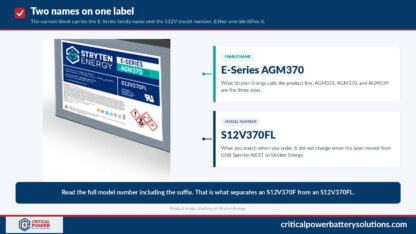
On arrival, inspect pallets and modules for physical damage, verify model numbers against your bill of materials, and measure a sample of open‑circuit voltages to confirm proper charge.
If installation will not begin immediately, store modules indoors in a cool, dry area, ideally below 25°C, and plan for refresh charges if storage exceeds about six months.
Placing racks and modules
- Confirm rack alignment, anchoring, and clearances against your layout drawings.
- Use appropriate lifting equipment or team‑lift procedures to place Absolyte blocks into each rack level, keeping positive and negative posts oriented according to your wiring diagram.
- Verify that module labels match the planned string order so that string numbering is consistent for future maintenance and testing.
Making intercell and intertier connections
- Install intercell connectors one string at a time, beginning at the negative end and moving toward the positive, always verifying polarity before landing each connector.
- Snug bolts initially, then return with a calibrated torque wrench to tighten to Stryten’s specified value, typically around 100 in‑lb for many Absolyte designs, unless the current manual specifies otherwise.
- Install intertier and output cables, routing them neatly to avoid mechanical stress and ensuring that correct string polarity reaches the DC breaker or UPS input.
Document torque values, string voltages, and any anomalies as you progress, since this record will be helpful when you later troubleshoot battery issues or compare against baseline commissioning data.
Before energizing any connected equipment, have a second qualified person verify polarity and terminations end to end.
Initial Charging, Equalization, And UPS Integration
After mechanical installation and wiring, you need to bring the battery to a full, balanced state of charge and integrate it with the charger or UPS according to Stryten’s charging recommendations.
This is a key part of how to commission battery systems correctly and avoid early capacity issues.
Setting float and equalize voltages
Configure the charger or UPS to float the battery near 2.25 V per cell at 25°C, which means setting total string voltage accordingly and enabling temperature compensation if supported.
Attach the temperature sensor directly to a representative battery near the center of the string, not to ambient, so that compensation reflects actual cell temperature.
Performing the initial equalization
Apply an initial equalization charge based on Stryten’s current manual, typically in the range of about 2.30 V per cell for 24 hours or 2.35 V per cell for 12 hours, adjusted for temperature and site rules.
Monitor cell or block voltages and system current during this period, confirming that no units are overheating and that voltages converge within acceptable spread.
Integrating with the UPS or DC system
Once the equalize step is complete and the system has returned to float, enable the UPS or DC system input so it can support the load and keep the battery floated.
At this point, you can perform initial discharge tests or UPS runtime tests to validate that the actual runtime matches the design values used when you were working out how to calculate battery runtime during the planning phase.
If you operate mixed fleets including products like Stryten E‑Series PDQ or MCX, align their charger settings to each product’s specifications, since flooded batteries and VRLA require different float and equalize regimes.
Document all final charger settings, so future technicians do not have to guess what was originally intended during the commissioning phase.
Baseline Testing: How To Test UPS Batteries After Installation
A professional Absolyte AGP installation does not stop at energization, it includes a structured testing program so you know that the system performs as designed.
This also builds the baseline for long‑term programs such as how to maintain VRLA batteries and how to troubleshoot battery issues years later.

Two-column checklist covering pre-commissioning and commissioning validation steps
Electrical measurements and visual checks
Record individual cell or block voltages, total string voltage, and float current after the system has stabilized on float for several hours.
Perform a full visual inspection for loose hardware, incorrect labels, damaged insulation, or any signs of shipping damage that were not visible earlier.
Functional discharge or runtime test
Coordinate with operations to perform a controlled discharge test using the UPS or a load bank, ideally at a fraction of rated capacity that still validates runtime expectations without excessive stress on a brand‑new system.
Monitor string voltage and, if practical, unit‑level voltages during the discharge to identify any weak units or wiring issues early.
Setting up ongoing monitoring
Implement a schedule for periodic voltage, temperature, and ohmic testing aligned with IEEE 1188, and configure any available monitoring systems or BMS tools to alarm on out‑of‑band values.
This is where a thoughtful approach to how to test UPS batteries becomes part of your ongoing reliability program rather than a one‑time event.
Data center operators and telecom network managers often integrate these measurements with their broader asset management systems so that trends in internal resistance or temperature prompt early intervention.
Doing this from day one makes future decisions on how to plan battery replacement far more data driven and defensible.
Common Mistakes To Avoid When Installing Absolyte AGP
After installing and supporting many Absolyte systems, we see the same avoidable mistakes repeatedly, often from well‑intentioned teams rushing to meet deadlines.
Avoiding these issues will improve safety, protect warranties, and extend useful life.
Incorrect torque or loose connections
Under‑torquing creates high resistance and heat, while over‑torquing can crack posts or strip threads.
Always use a calibrated torque wrench and follow Stryten’s current table rather than relying on generic values or “feel.”
Poor temperature control and ventilation assumptions
Although Absolyte AGP recombines most gas internally and is maintenance free, some teams misinterpret this as meaning temperature is not important.
As discussed earlier, sustained operation far above 25°C is one of the main reasons field life falls well short of the 20‑year design target.
Configuration and polarity errors
Reversed cells, miswired strings, or incorrectly landed main leads can damage equipment or require extensive rework.
Use clear diagrams, polarity labels, and a two‑person verification step before energizing any connected loads.
Finally, do not mix installation practices between technologies; guidelines for how to maintain flooded batteries, such as Stryten E‑Series MCT or MCX, are different from best practices for sealed Absolyte AGP systems.
Keep your procedures and technician training specific to the battery technology in front of them.
Integrating Absolyte AGP With Broader Battery Strategies
Most organizations that ask how to install Stryten Absolyte AGP are also managing a portfolio of UPS, telecom, and utility batteries from multiple generations and technologies.
Taking a strategic view at the time of installation will position you to simplify operations and procurement later.
Coordinating VRLA and flooded systems
For example, you might deploy Absolyte AGP in data center UPS applications while using Stryten E‑Series MCX or MCT flooded batteries in substations, each with different maintenance and testing regimes.
Document which sites use which products so that your teams know when they are dealing with VRLA versus flooded, and how to maintain Stryten batteries correctly in each case.
Planning lifecycle and replacement windows
Use the installation date and design life to seed your asset management system with expected replacement windows, then refine those projections using real test data over time.
This is the practical foundation of how to plan battery replacement, especially when coordinating budgets for multiple large systems across a region or portfolio.
Working with an authorized partner that understands both legacy GNB Industrial Power products and current Stryten lines helps you standardize across generations while keeping compatibility in mind.
This is especially valuable when you are evaluating how to select data center batteries or telecom batteries across a large network with varied site histories.
When To Consult A Professional For Absolyte AGP Installations
Although many in‑house electrical and facilities teams are capable of basic battery replacement, there are situations where professional assistance is prudent or required by policy.
Knowing when to call in specialized support protects your personnel and your investment in premium batteries.
High‑energy and complex systems
Large multi‑string installations, high‑voltage DC buses, and systems integrated with complex UPS or DC plant controls can involve significant risk if handled by technicians without specific battery experience.
In those cases, engaging specialists who routinely handle projects like how to install Stryten batteries at scale helps avoid costly mistakes.
Seismic, NEBS, and compliance driven projects
Telecom central offices, carrier hotels, and utility substations often have strict requirements such as NEBS Level 3, IEEE 693 seismic ratings, and detailed documentation of installation methods.
Partnering with an authorized Stryten distributor that follows ISO 9001 certified processes, such as our parent company Advanced Technical Services Inc., helps you demonstrate compliance during audits.
Limited internal resources or tight outage windows
Data center and telecom operators with tight uptime SLAs sometimes decide that their teams should focus on core operations rather than one‑off battery changeouts.
In those cases, using a partner that can guide how to commission battery systems remotely, assist with how to test UPS batteries, and support planning ensures the work is handled efficiently and safely.
Whether you are working through how to install Absolyte AGP for a single site or standardizing across an entire fleet, the key is to combine solid technical planning with disciplined field execution.
That combination is what turns a 20‑year design life on paper into real‑world performance in your critical power systems.
Conclusion
Installing Stryten E‑Series Absolyte AGP correctly is a multi‑step process that starts with proper sizing and site preparation, continues through disciplined mechanical and electrical work, and finishes with controlled charging and testing.
If you approach it methodically, you can support your uptime targets, protect your investment, and simplify long‑term maintenance for your data center, telecom, utility, or renewable application.
Next steps you can take right now:
- Review the technical overview and request a quote for your project on the Stryten E‑Series Absolyte AGP product page.
- Explore complementary Stryten E‑Series options such as NXT, PDQ, MCX, and MCT for other parts of your power infrastructure using our consolidated industrial battery catalog.
- Schedule a remote consultation with our engineering team to discuss how to size battery systems, how to maintain VRLA batteries, or how to plan battery replacement across your sites.
- Contact us for technical support if you are preparing a major upgrade from legacy GNB systems and want expert guidance on how to install Stryten batteries as drop‑in replacements.