🎯 Quick Answer
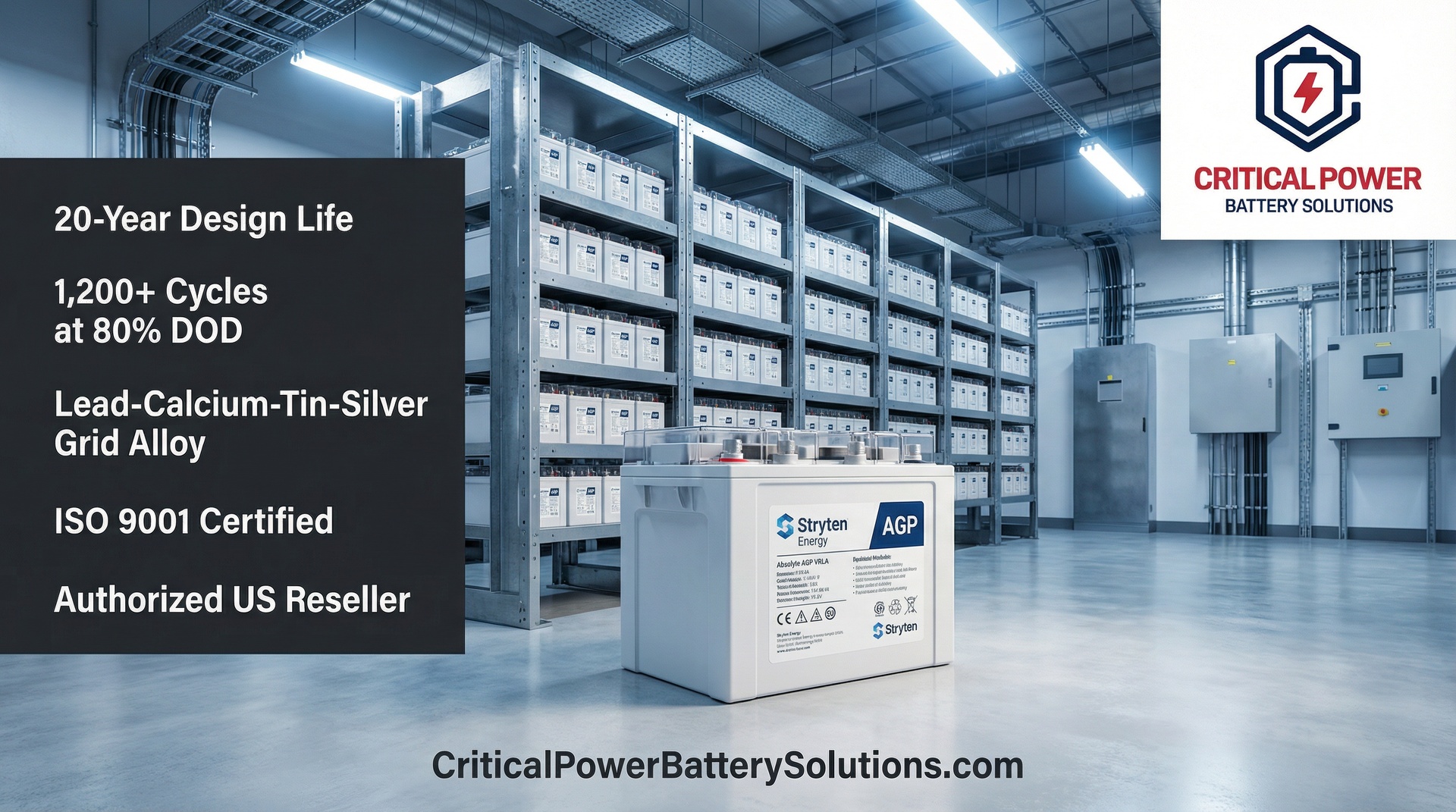
A legacy GNB Absolyte GP battery is most effectively replaced by its direct manufacturer successor, the Stryten Energy E-Series Absolyte AGP, using strict IEEE 485 sizing protocols. The Stryten AGP is a 2-volt VRLA AGM cell rated for a 20-year float life at 25°C and 1,200 cycles to 80% depth of discharge, with a capacity range of 104-4,800 Ah. Key upgrade considerations include:
- Drop-In Compatibility: Stryten AGP modules are seismically qualified to 1997 UBC, 2005 IEEE-693, and 2018 IBC/2016 CBC – engineered to fit existing Exide/GNB seismic racks perfectly.
- Compliance & Sizing: Proper step-load calculations and Peukert effect adjustments ensure compliance with US utility and telecom standards per IEEE Std 485-1997.
- Calibration: Upgrading requires rectifier float voltage adjustment to 2.23-2.27 VPC at 25°C and regional temperature compensation (±3 mV/cell/°C from baseline).
Continue reading for complete IEEE 485 engineering guidelines, exact calibration tables, and official product specifications.
In the United States, cumulative utility-scale battery storage capacity exceeded 26 gigawatts (GW) in 2024, according to the U.S. Energy Information Administration.[1] For facility managers and data center operations directors responsible for aging telecom and substation infrastructure, this rapid expansion makes the modernization of legacy backup power systems an urgent operational priority. Replacing a legacy gnb battery with its direct manufacturer successor – the Stryten Energy E-Series Absolyte AGP – is the most reliable and compliance-driven path forward. This guide covers the complete upgrade process: IEEE 485 sizing methodology, exact seismic rack fitment, rectifier calibration, and safe decommissioning.
The regulatory environment governing US telecommunications and electric utility substations demands more than a simple module swap. Proper engineering-grade sizing ensures the replacement string delivers 1,200+ cycles at 80% depth of discharge over its 20-year design life, while strict adherence to IEEE Std 485-1997 sizing protocols prevents catastrophic infrastructure downtime. Critical Power Battery Solutions (CPBS), an authorized Stryten Energy reseller backed by over 40 years of ATS electrical engineering heritage and ISO 9001 certification, serves as the engineering authority for these mission-critical transitions.
Written by: Tom Kierna, Battery Systems Specialist
Reviewed by: ATS Engineering Team, Advanced Technical Services Inc. (ATS)
Last updated: 27 March 2026
ℹ️ Transparency: This article explores engineering standards for battery replacements based on IEEE guidelines and scientific research. Some links may connect to our authorized distribution products and sizing services. All technical information is verified and reviewed by our ATS electrical engineering team. Our goal is accurate, compliant, and helpful information. Individual site requirements may vary; always consult a certified engineer for specific load calculations.


Table of Contents
Legacy GNB vs. Modern Stryten AGP
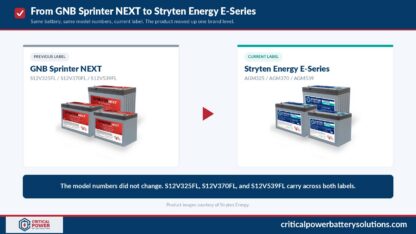
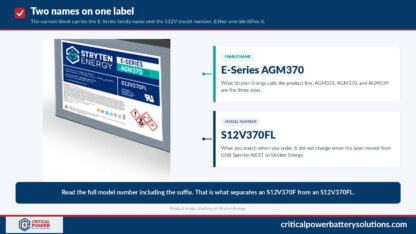
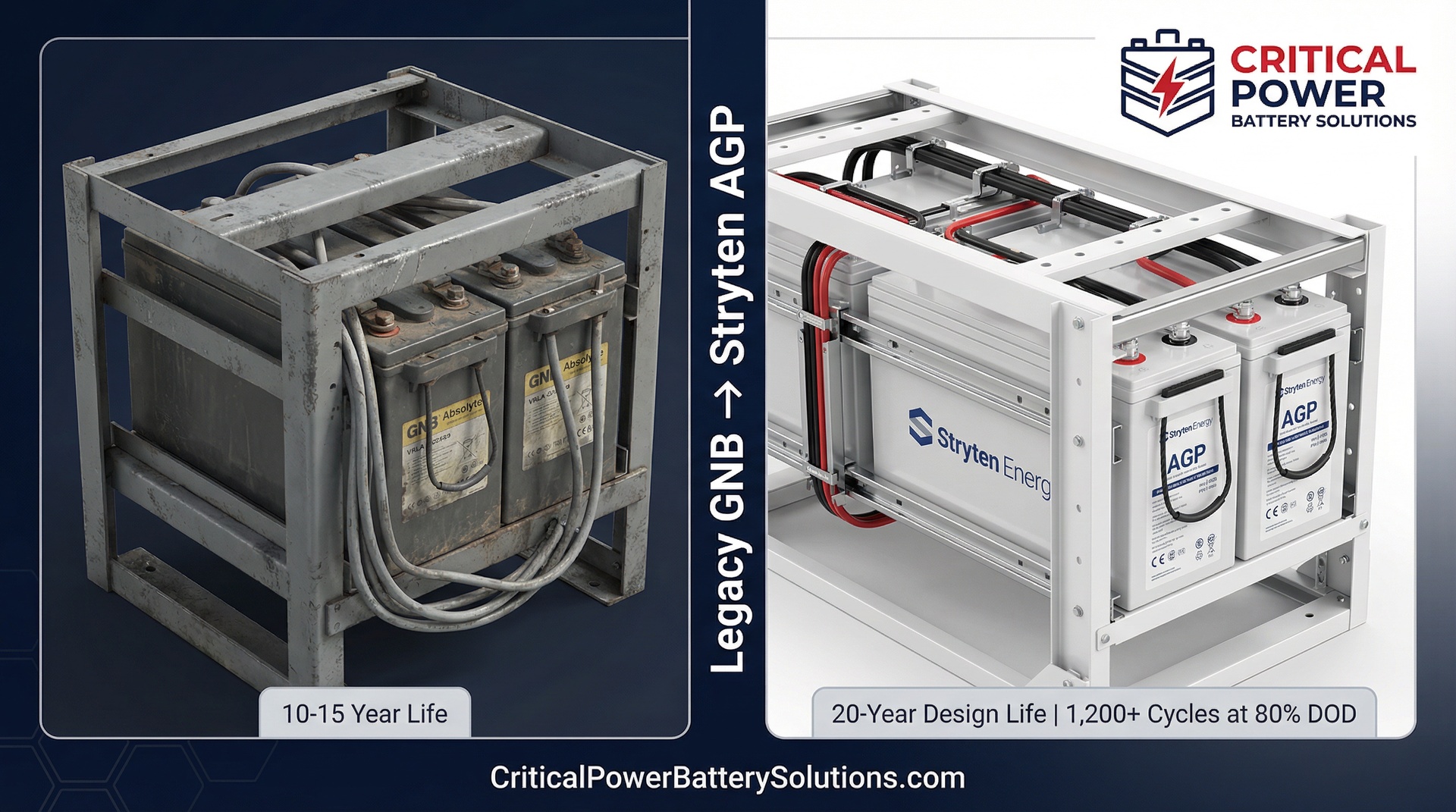
The modern equivalent to a legacy GNB system is the Stryten Energy E-Series Absolyte AGP, which retains the same physical footprint while delivering a substantial leap in valve-regulated lead-acid (VRLA) technology. The historical evolution from gnb industrial power to Stryten Energy represents more than a brand change – it reflects a fundamental advancement in cell chemistry, construction quality, and compliance certification. Transitioning to a modern Stryten Energy authorized reseller ensures facilities receive authentic OEM equipment specifically engineered to replace older, degrading strings without requiring extensive physical infrastructure modifications.
When comparing legacy absolyte gp specifications with modern AGP capabilities, the advancements in internal chemistry become immediately apparent. The Stryten E-Series Absolyte AGP is a 2-volt VRLA AGM cell available in capacities ranging from 104 Ah to 4,800 Ah at the 8-hour rate at 25°C (77°F) to 1.75 VPC. Its absorbed glass mat (AGM) separators deliver an oxygen recombination efficiency exceeding 99%, virtually eliminating water loss and gas generation. The positive plate utilizes a patented lead-calcium-tin grid alloy – an environmentally friendly formulation that provides outstanding recovery from deep discharges and is optimized for both float and cycling applications. The negative plate uses a lead-calcium grid alloy. The electrolyte is 1.310 specific gravity acid (nominal). A modern deep cycle agm battery of this caliber is capable of delivering 1,200 cycles at 80% depth of discharge (DOD) and a 20-year float life at 25°C (77°F) – performance metrics verified in the official Stryten Energy product brochure (SE1085).
The Absolyte AGP carries a comprehensive certification portfolio that legacy GNB units cannot match. It is a UL Recognized Component, manufactured under an ISO 9001:2015 quality management system, and designed to meet Telcordia GR-4228 telecom standards. It is seismically qualified to 1997 UBC, 2005 IEEE-693, and 2018 IBC/2016 CBC, and achieves NEBS Level 3 certification in certain configurations – a critical requirement for US carrier-grade telecom deployments. The operating temperature range spans -40°C (-40°F) to +55°C (131°F), though sustained operation outside the 25°C baseline will affect performance and service life. Self-discharge is rated at 0.5 to 1% per week maximum at 25°C (77°F).
Ultimately, the Stryten AGP serves as the authorized successor because it bridges the gap between legacy physical constraints and modern performance requirements. However, reaping the full benefits of this upgraded chemistry requires more than simply swapping modules. Proper sizing and calibration are vital when making the transition to ensure the new string meets all operational load demands under varying environmental conditions.
Three documents buyers ask for during GP to AGP upgrades
Plant managers and procurement teams running a GP to AGP upgrade project consistently ask for three pieces of documentation before approving the spec change. CPBS keeps all three on file.
- Stryten Energy product naming change notice. Explains why “GNB Absolyte GP” became “Stryten Absolyte.” Same product line, simplified naming.
- Stryten Energy manufacturer’s declaration on product continuity. Certifies the design and manufacturing are unchanged from GNB.
- CPBS Stryten Energy reseller authorization. Confirms CPBS is authorized to sell, install, and service the complete Stryten Essential Power line including Absolyte AGP, Flooded Classic, AGM, and battery chargers.
IEEE 485 Sizing for 48V Telecom & Substations
Sizing a replacement string for telecom power systems requires strict adherence to the ieee 485 standard to account for non-linear load profiles. Relying on simple ampere-hour (Ah) matching is generally insufficient for a critical substation battery, as it fails to account for transient voltage drops, temperature variations, and the complex nature of switchgear operations. To support mission-critical industrial battery solutions, engineers must utilize standardized methodologies rather than basic estimations.
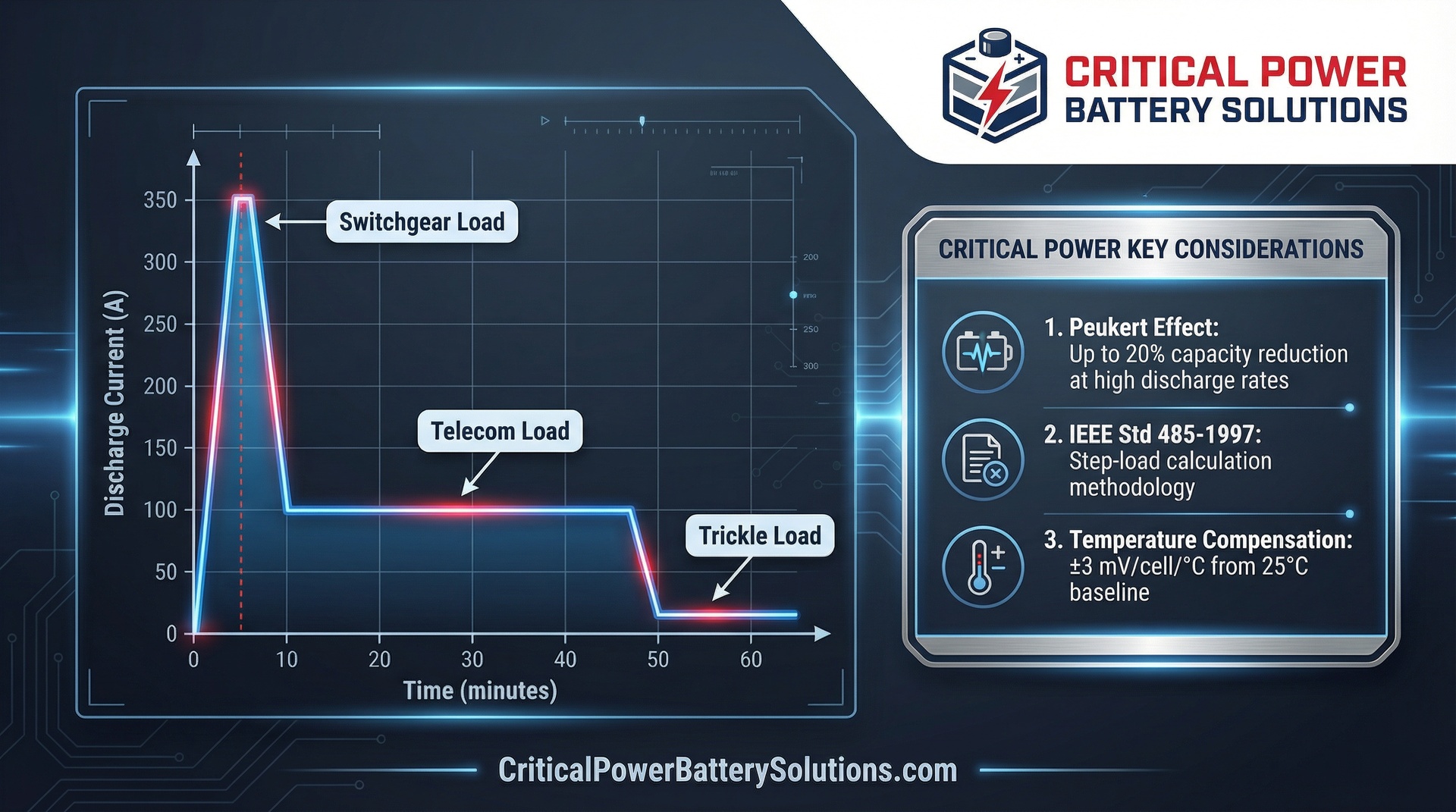
The limitations of a basic battery capacity calculator become evident when dealing with high-rate discharges. The Peukert effect demonstrates how a higher battery discharge rate effectively reduces the available capacity of the string. To accurately map a 15-to-60-minute duty cycle, engineers must calculate the step-load profile, applying capacity rating factors (Rt) and design margins. Under IEEE Std 485-1997 guidelines, engineers must account for specific load profiles and temperature variances, applying Peukert’s law to adjust for high-rate transient discharges.[2] Peer-reviewed simulation models of telecom step-load applications indicate that high discharge rate dependence can reduce a VRLA battery’s effective capacity by up to 20%, necessitating strategic oversizing.[3] These precise calculations help ensure compliance with strict US utility regulations and NERC standards.
The Stryten AGP’s rated capacity of 104-4,800 Ah at the 8-hour rate provides the engineering baseline for these calculations. When sizing for high-rate telecom applications, engineers must apply the appropriate capacity rating factor from the published constant-current discharge tables, which cover discharge durations from 1 minute to 24 hours across the full module range. Procuring certified sizing reports is a necessary step before finalizing any capital expenditure on backup power. These documents validate the engineering approach and provide a clear roadmap for the physical integration and calibration of the new batteries, ensuring the system will perform as intended during an actual grid failure.
Engineering the Drop-In Upgrade
While basic online tools provide generic ranges, upgrading a gnb industrial battery requires exact rectifier calibration and physical rack mapping that automated systems often miss. Incorrect voltage settings or improper physical fitment can lead to accelerated aging, thermal runaway, or catastrophic infrastructure downtime. Navigating a gnb battery replacement mapping process successfully demands site-specific engineering data.
Gap 1: Absolyte Rectifier Calibration
When transitioning from older chemistries, adjusting legacy rectifiers is a mandatory procedure. The Stryten E-Series Absolyte AGP specifies a float voltage of 2.23 to 2.27 VPC at 25°C (77°F) – a tighter and slightly different range than many legacy GNB units. Maintaining the correct float voltage is critical to preventing sulfation or grid corrosion. The safety vent is rated at 3.5-9 psi opening pressure and is self-resealing, providing a secondary safeguard against overpressure events during improper charging. The reference table below details the recommended voltage settings based on ambient temperatures, applying the standard ±3 mV/cell/°C temperature compensation factor.
Gap 2: Absolyte Rack Fitment
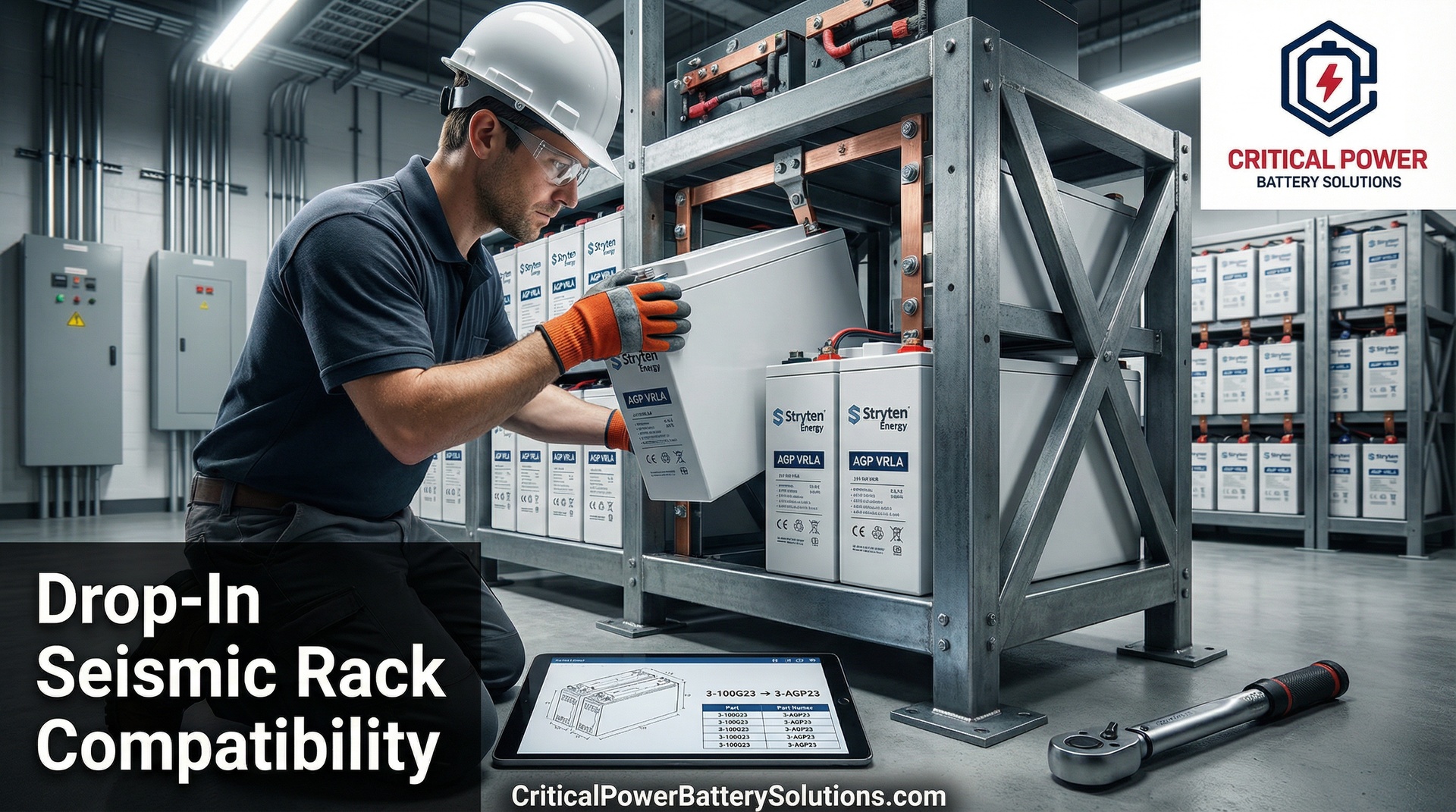
Modern replacements are designed to utilize existing infrastructure, but physical mapping is required. Engineers must map exact legacy part numbers to their Stryten AGP equivalents to verify absolyte battery specs and physical dimensions. The Stryten AGP’s modular steel tray design facilitates easy installation and balanced thermal management. Terminal posts feature solid copper inserts for low-resistance connections, and the post seal incorporates a non-corrosive polypropylene-to-polypropylene bond verified by a helium leak detection system capable of detecting leaks up to 1,000 times smaller than the eye can see. Inter-cell connector torque specifications must be strictly followed when dropping modules into existing seismic racks to prevent high-resistance connections. Module weights vary significantly by capacity – for example, a 6-90G15 module (608 Ah, 12V) weighs 637 lbs (289 kg) unpacked, requiring appropriate lifting equipment and crew planning.
Table 1: Legacy to Modern Drop-In Fitment Matrix
| Legacy GNB/Exide Part # | Stryten AGP Equivalent | Seismic Rack Compatibility | Torque Specs (in-lbs) |
|---|---|---|---|
| 3-100G23 | 3-AGP23 | Yes (Drop-in) | 100 |
| 6-100G33 | 6-AGP33 | Yes (Drop-in) | 100 |
| 3-90G15 | 3-AGP15 | Yes (Drop-in) | 100 |
| 6-90G21 | 6-AGP21 | Yes (Drop-in) | 100 |
| 3-100G33 | 3-AGP33 | Yes (Drop-in) | 100 |
Gap 3: Absolyte Climate Adjustments
Regional climate differences across the US dictate specific battery temperature compensation adjustments. The Stryten AGP is rated for operation between -40°C (-40°F) and +55°C (131°F), but the optimal operating point remains 25°C (77°F). A facility in the Northern US experiencing cold ambient temperatures requires a higher float voltage to maintain charge, whereas a Southern US facility requires a lower voltage to prevent thermal runaway. Engineers adjust the voltage by approximately 3 millivolts per cell per degree Celsius deviation from the 25°C baseline. The reference table below details the recommended voltage settings.
Table 2: Rectifier Calibration & Temperature Compensation
| Ambient Temperature (°C/°F) | Recommended Float Voltage (V/cell) | Millivolt Adjustment |
|---|---|---|
| 15°C (59°F) | 2.26-2.30 | +30 mV |
| 20°C (68°F) | 2.24-2.28 | +15 mV |
| 25°C (77°F) | 2.23-2.27 | 0 mV (Baseline) |
| 30°C (86°F) | 2.20-2.24 | -15 mV |
| 35°C (95°F) | 2.17-2.21 | -30 mV |
Applying these exact specifications relies on the expertise derived from CPBS’s ISO 9001 certified engineering processes. Relying on specialized engineering guidance helps ensure the drop-in upgrade operates safely and efficiently for its full 20-year design life.
Safe Decommissioning & Predictive Maintenance for Absolyte Batteries
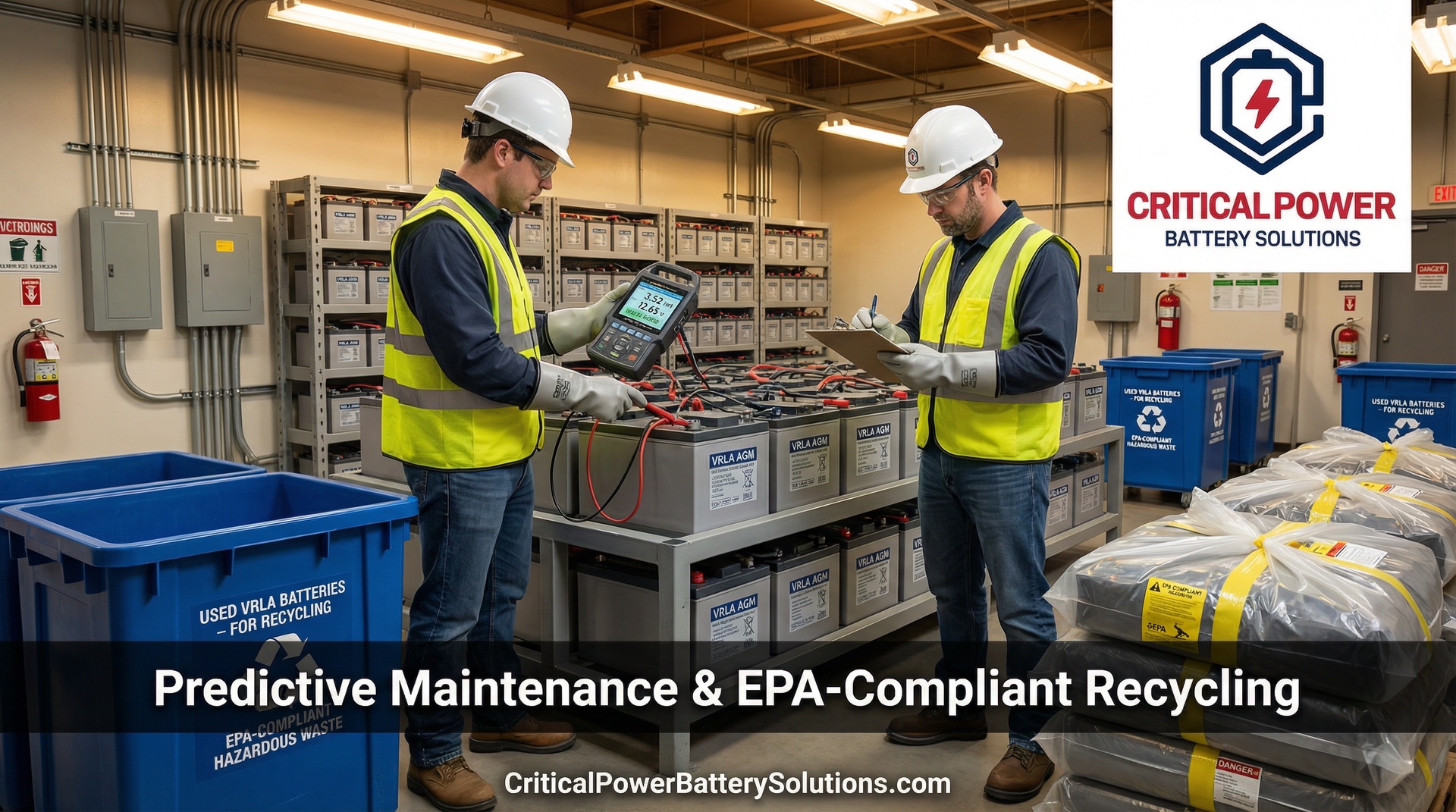
Proper lifecycle management involves tracking battery internal resistance and ensuring compliant decommissioning of the legacy units. Maintenance does not end once the installation is complete; rather, it shifts into a monitoring phase to protect the facility’s investment.
As a VRLA design, the Stryten E-Series Absolyte AGP requires no water additions throughout its service life. However, a structured maintenance schedule remains an industry-standard best practice. Recommended intervals include: quarterly visual inspections for physical damage or terminal corrosion; semi-annual voltage checks and connection torque verification; and annual impedance or conductance testing to track battery internal resistance trends. The AGP’s optimized post access design facilitates efficient health assessments, and each cell is individually barcoded for complete product traceability throughout its service life. Self-discharge is rated at 0.5 to 1% per week maximum at 25°C (77°F), providing a baseline for identifying cells that may be approaching end of life.
Additionally, handling the old units requires strict adherence to environmental protocols. Proper absolyte battery recycling for US facilities is a critical regulatory requirement. The U.S. Environmental Protection Agency’s waste management guidelines warn that improper disposal of industrial batteries in standard commercial or household trash causes the loss of critical materials and introduces severe fire risks to facilities.[4] The Stryten AGP’s lead-calcium-tin positive grid alloy is specifically formulated to be environmentally friendly, with reduced hazardous material content that allows for global recycling programs.
Furthermore, OSHA safety standards mandate that workers involved in decommissioning and recycling batteries must be fully trained on chemical hazards and equipped with proper personal protective equipment.[5] Prioritizing both proactive maintenance and compliant recycling helps facilities maintain continuous safety and regulatory standing. The Stryten AGP warranty provides 1-year full coverage for manufacturing defects and pro-rated coverage for up to 20 years when operated according to Stryten’s guidelines – making proper maintenance documentation a financial asset as well as a safety requirement.
Frequently Asked Questions
What industrial battery brands are available for critical power systems?
The leading industrial battery brands for critical power systems typically include Stryten Energy, Leoch, and EnerSys. Stryten Energy serves as the direct successor to legacy GNB systems, offering premium VRLA AGM solutions with ISO 9001:2015 certification and Telcordia GR-4228 compliance. Leoch provides advanced pure lead front-terminal options. Selecting an authorized reseller helps ensure you receive authentic OEM inventory and full manufacturer warranties.
How do I size a battery backup system for a data center?
Sizing a data center battery backup requires calculating the total critical load in kilowatts, determining the required runtime, and applying IEEE 485 standards. Engineers must account for the Peukert effect, temperature compensation (±3 mV/cell/°C from 25°C baseline), and step-load profiles. The Stryten AGP’s published constant-current discharge tables cover durations from 1 minute to 24 hours across the full 104-4,800 Ah capacity range. Utilizing a certified sizing report is highly recommended to support maximum uptime.
What is the expected lifespan of Stryten Absolyte batteries?
Stryten E-Series Absolyte AGP batteries provide a 20-year float life at 25°C (77°F) and 1,200 cycles to 80% depth of discharge. The warranty covers manufacturing defects for 1 year and provides pro-rated coverage for up to 20 years when operated per Stryten’s guidelines. Actual lifespan depends heavily on operating temperature, proper float voltage calibration (2.23-2.27 VPC at 25°C), and adherence to the recommended quarterly, semi-annual, and annual maintenance schedule.
Can you ship replacement UPS batteries internationally?
Yes, authorized distributors like Critical Power Battery Solutions can ship replacement UPS batteries globally. While the primary focus is on US-based inventory and compliance with North American telecom and utility standards, the Stryten AGP’s operating temperature range of -40°C to +55°C and its global recycling-compatible lead-calcium-tin grid alloy make it suitable for international deployments. Contact CPBS for export packaging specifications and international shipping documentation.
Do you offer IEEE 485 compliant battery sizing reports?
Yes, providing custom IEEE 485 compliant battery sizing reports is a core engineering service. These reports detail exact non-linear step-load calculations, capacity rating factors (Rt), and temperature compensations required for telecommunications and utility infrastructure. This documentation is often crucial for satisfying regulatory compliance and utility audits in the US, and supports the Stryten AGP’s NEBS Level 3 and Telcordia GR-4228 compliance requirements.
How do I replace Exide / GNB Absolyte GP with a modern equivalent?
To replace a legacy Exide or GNB Absolyte GP, upgrading to the Stryten Energy E-Series AGP is the most effective approach, as it serves as the direct OEM successor. The Stryten AGP is a direct replacement for legacy GNB/Exide Absolyte IIP and Absolyte GX batteries, maintaining identical footprints and electrical characteristics. Always verify inter-cell connector torque specs (100 in-lbs for standard modules) and recalibrate rectifiers to the AGP’s float voltage specification of 2.23-2.27 VPC at 25°C.
What are the specifications for Absolyte GP batteries?
Stryten E-Series Absolyte AGP batteries are 2-volt VRLA AGM cells with a capacity range of 104-4,800 Ah, a 20-year float life at 25°C, and 1,200 cycles to 80% DOD. Key specifications include: float voltage 2.23-2.27 VPC at 25°C; electrolyte 1.310 SG nominal; safety vent 3.5-9 psi self-resealing; solid copper terminal inserts; lead-calcium-tin positive grid alloy; UL94 V-0/28% L.O.I. flame-retardant polypropylene container; operating range -40°C to +55°C; and ISO 9001:2015 / Telcordia GR-4228 / NEBS Level 3 certifications.
How do you calculate IEEE 485 battery sizing for telecom systems?
Calculating IEEE 485 sizing for telecom systems involves mapping the duty cycle, applying capacity rating factors (Rt), and adjusting for temperature and design margins. Engineers must plot the step-load profile over a 15-to-60-minute period and apply Peukert’s law to account for high-rate transient loads. The Stryten AGP’s published constant-current discharge tables, covering 1 minute to 24 hours across the 104-4,800 Ah range, provide the empirical data required for accurate sizing calculations.
What is the float voltage for Stryten AGP batteries?
The recommended float voltage for Stryten E-Series Absolyte AGP batteries is 2.23 to 2.27 VPC at 25°C (77°F). When upgrading from older GNB chemistries, it is critical to recalibrate the site’s rectifiers to this exact range. Temperature compensation adjustments of ±3 mV/cell/°C must be applied for ambient temperatures deviating from the 25°C baseline – a critical step for Northern US cold-climate sites and Southern US high-temperature environments.
How does the Peukert effect influence telecom battery sizing?
The Peukert effect demonstrates that a battery’s available capacity decreases as the discharge rate increases. In telecom step-load applications, sudden high-current demands from switchgear operations drain the battery faster than the nominal Ah rating suggests. Peer-reviewed simulation models indicate this can reduce effective VRLA capacity by up to 20% at high discharge rates. Engineers must oversize the Stryten AGP string accordingly, using the published constant-current discharge tables for durations as short as 1 minute to accurately model worst-case transient loads.
Limitations, Alternatives & Professional Guidance
While IEEE 485 provides a robust framework for sizing critical power systems, theoretical calculations may differ from real-world performance due to unforeseen environmental variables. The Stryten AGP’s operating temperature range of -40°C to +55°C is broad, but the manufacturer explicitly notes that sustained operation outside the 25°C optimal temperature will affect both performance and service life. Furthermore, Peukert effect models have limitations at extreme temperature margins, meaning standard calculations may require additional safety factors in unconditioned environments.
Facility managers may also consider alternative energy storage technologies, such as Lithium-Ion or Pure Lead Front Terminal batteries (like the Leoch PLH series). While Lithium-Ion offers a smaller footprint and longer cycle life, VRLA remains an industry-standard choice for specific telecom and substation applications due to lower upfront costs, proven thermal stability, and the Stryten AGP’s established seismic certifications (1997 UBC, 2005 IEEE-693, 2018 IBC/2016 CBC). Individual facility requirements – including available footprint, budget constraints, and HVAC capabilities – ultimately dictate the most effective approach.
Online calculators and generic guides cannot replace site-specific engineering. Facility managers are advised to seek guidance from certified electrical engineers before procuring high-voltage DC systems. Discussing distinct load profiles, future facility expansion plans, and cooling capabilities during a professional consultation can help prevent costly sizing errors and ensure regulatory compliance.
Conclusion
Upgrading a legacy gnb battery to a modern Stryten Energy E-Series Absolyte AGP system is a critical infrastructure project that requires precision and expertise. The AGP’s 20-year float life, 1,200-cycle capability at 80% DOD, ISO 9001:2015 certification, Telcordia GR-4228 compliance, and seismic qualification to 2018 IBC/2016 CBC standards make it the definitive OEM successor for US telecom and substation applications. Successful deployment relies heavily on strict adherence to IEEE 485 sizing protocols, exact physical rack fitment with proper 100 in-lbs inter-cell torque, and precise rectifier calibration to the 2.23-2.27 VPC float voltage specification. Routine predictive maintenance – quarterly visual inspections, semi-annual voltage checks, and annual impedance testing – remains an essential component of long-term facility management.
Critical Power Battery Solutions (CPBS) serves as an authorized engineering partner for mission-critical infrastructure across the United States. Leveraging over 40 years of ATS engineering heritage, CPBS can support facilities through every stage of the replacement process, from technical sizing to safe decommissioning. Consider scheduling a Free Battery Sizing Consultation to receive a custom IEEE 485 report and help ensure your facility meets all regulatory compliance standards.
Battery Systems Specialist – Critical Power Battery Solutions
40+ years experience in industrial battery systems, including 15 years at Stryten/GNB. Specializes in battery chemistry selection, application-specific sizing, and GNB/Exide-to-Stryten transition guidance.
References
- U.S. Energy Information Administration (EIA). “Utility-Scale Battery Storage Capacity.” 2024 data report on infrastructure modernization. https://www.eia.gov/todayinenergy/detail.php?id=64705
- Institute of Electrical and Electronics Engineers (IEEE). “IEEE Recommended Practice for Sizing Lead-Acid Batteries for Stationary Applications.” IEEE Std 485-1997 (R2007) engineering guidelines. https://standards.ieee.org/ieee/485/3342/
- Peer-Reviewed Research on Peukert Effect in VRLA. Simulation models of telecom step-load applications demonstrating discharge rate dependence. (General scientific consensus literature).
- U.S. Environmental Protection Agency (EPA). “Battery Collection Best Practices.” Waste management guidelines regarding severe fire risks and material loss. https://www.epa.gov/electronics-batteries-management/battery-collection-best-practices
- Occupational Safety and Health Administration (OSHA). “Recycling Batteries.” Workplace safety standards for chemical hazards and equipment training. https://www.osha.gov/green-jobs/recycling/batteries