Quick Answer
Battery internal resistance measurement is a critical diagnostic procedure used to assess the health of stationary batteries by recording ohmic values and comparing them to an initial baseline. Key points:
- Baseline establishment: Essential for Absolyte AGP systems to track degradation accurately.
- IEEE 1188 compliance: A variance of 25-30% from the baseline indicates potential failure modes.
- IEEE 485 sizing: Proper calculation requires integrating temperature compensation and aging factors for US climates.
Continue reading for complete IEEE standard workflows and proprietary sizing parameters for mission-critical telecom environments.
For US facility managers and telecom engineers managing aging infrastructure, executing precise battery internal resistance measurement is the difference between optimal uptime and catastrophic failure. Relying on generic maintenance schedules is no longer sufficient for multi-million dollar replacement cycles. As facilities transition from reactive emergency responses to battery predictive maintenance, understanding the exact ohmic baselines for premium systems like the Stryten Absolyte AGP is critical. Data from the U.S. Energy Information Administration (EIA) highlights the increasing reliance on stationary battery systems across regional US grids, necessitating strict adherence to predictive maintenance protocols. This guide covers how to test internal resistance correctly, ensuring your diagnostic protocols meet strict domestic compliance standards while supporting mission-critical infrastructure.
Backed by over 40 years of ATS electrical engineering heritage and ISO 9001 certified processes, Critical Power Battery Solutions provides the technical authority required for mission-critical power. This article explores the deep engineering specifics of IEEE 1188 testing schedules, advanced IEEE 485 sizing methodologies, and how to adapt these frameworks for extreme US climates and solar hybrid cycling.
👤 Article by: Tom Kierna
Reviewed by: CPBS Engineering Team
Last updated: March 14, 2026
Credentials: Authorized Stryten battery Reseller, ISO 9001 Certified, IEEE Standards Member


Transparency: This article explores battery internal resistance measurement based on official IEEE standards (1188 and 485) and federal guidelines. Some links may connect to our authorized distribution services for Stryten Energy and Leoch. All technical information is verified by our engineering team. Our goal is accurate, compliance-driven information for US facility managers.
Table of Contents
The Role of IEEE 1188 in Battery Internal Resistance Measurement
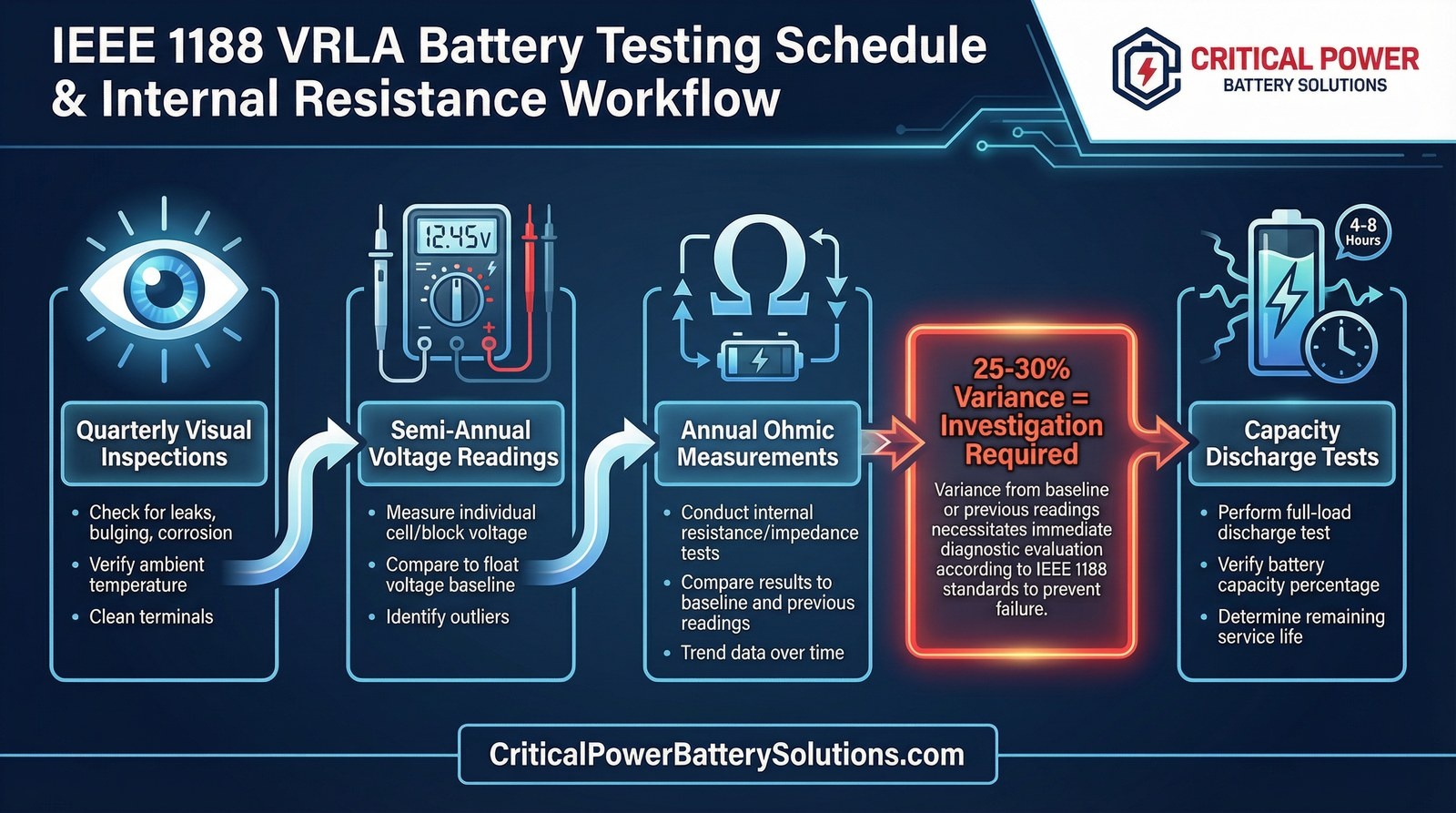
The IEEE 1188 standard defines the recommended practice for the maintenance, testing, and replacement of valve-regulated lead-acid (VRLA) batteries, heavily emphasizing regular ohmic testing. By adhering to these guidelines, facility managers can effectively shift their operations from reactive emergency replacements to calculated battery predictive maintenance. Routine battery conductance testing allows engineers to identify degrading cells months before they drop the critical load, safeguarding operational continuity and optimizing capital expenditure cycles.
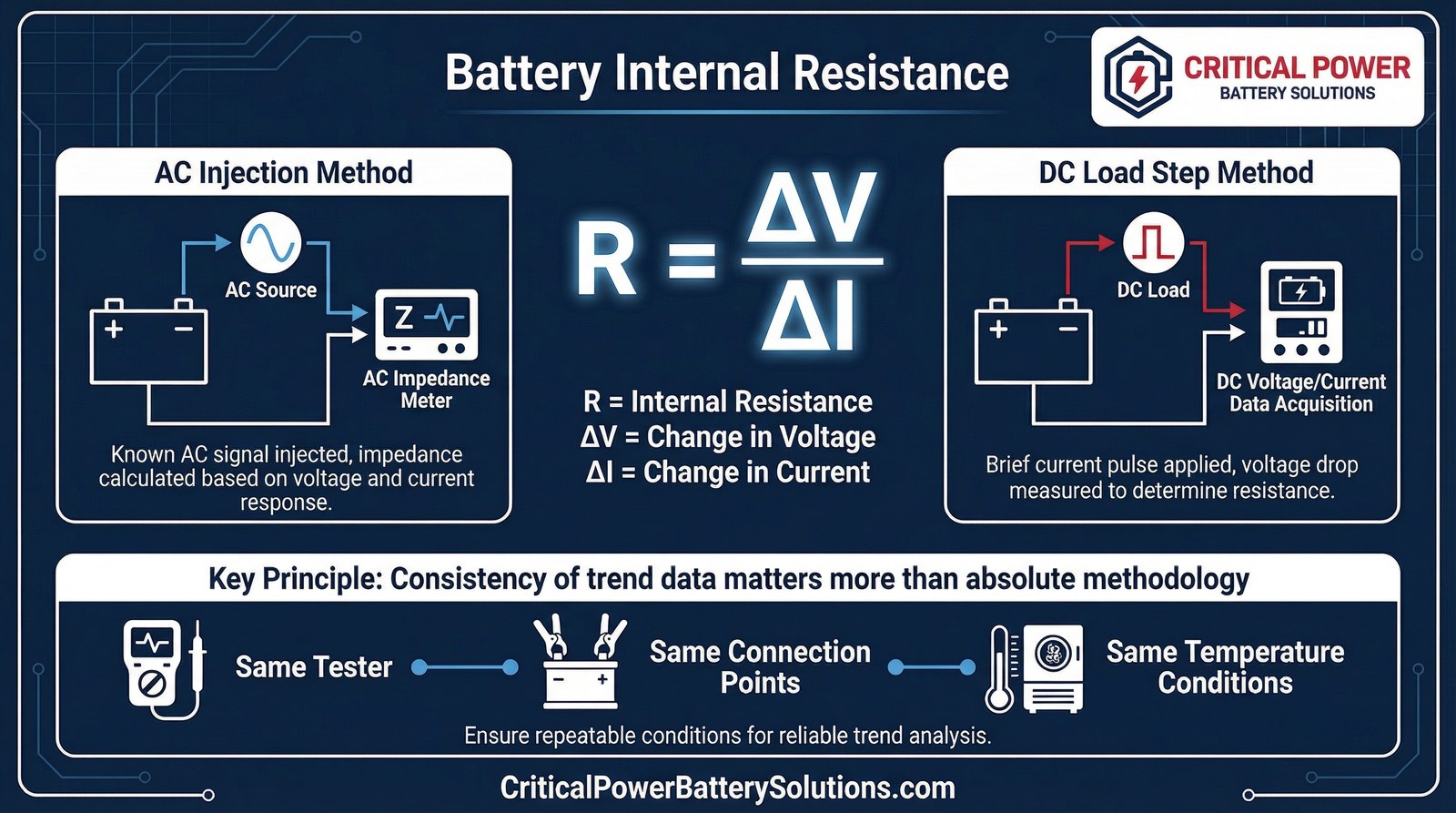
The core methodology of the standard revolves around establishing an initial baseline and meticulously tracking deviations over the battery’s lifespan. To capture these metrics, technicians rely on the battery internal resistance formula (R = ΔV / ΔI), which modern diagnostic equipment applies automatically. When utilizing a battery internal resistance tester, the device typically employs either a DC load step—drawing a brief, heavy current to measure the voltage drop—or an AC injection method, which introduces a known AC signal to calculate impedance. When executing a battery internal resistance measurement, whether you are performing battery impedance testing or battery conductance testing, the absolute methodology chosen is secondary to the consistency of the trend data. Using the same tester, at the same connection points, under the same temperature conditions is vital for generating actionable insights.
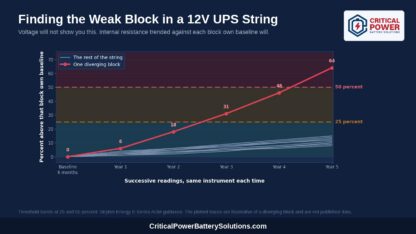
While ohmic testing serves as a highly powerful screening tool, its data must be paired with specific manufacturer baselines to be truly effective. Standard testing intervals recommended by the IEEE 1188 standard include quarterly visual inspections, semi-annual voltage readings, and annual ohmic measurements. According to the IEEE 1188 standard guidelines, a variance of 25-30% from the established baseline typically indicates the need for further investigation or replacement planning. However, generic guidelines must be carefully contextualized when dealing with specialized, premium chemistries like the Absolyte AGP, which exhibit unique baseline behaviors.
Advanced Diagnostics: Absolyte AGP Specifics & Solar Hybrid Cycling
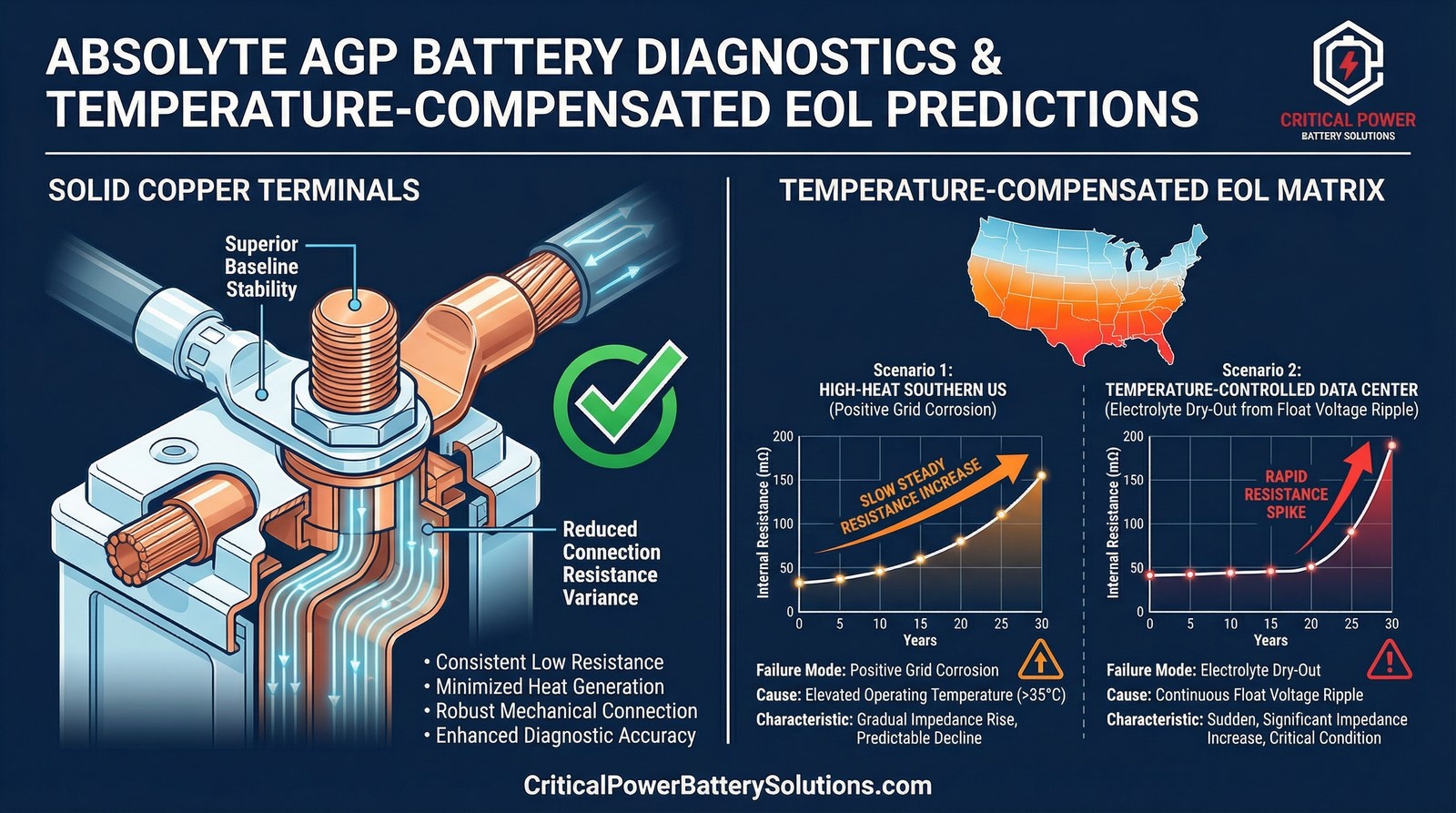
Standard automated advice often suggests replacing any battery at 80% capacity using basic formulas and generic degradation curves. However, this generalized approach fails to account for the superior baseline stability of the Absolyte AGP’s solid copper terminals or the harsh realities of remote US telecom deployments. Standard lead-alloy posts typically demonstrate higher connection resistance variance over time, whereas solid copper maintains exceptional conductivity. Precision engineering requires chemistry-specific contextualization, as treating a premium industrial cell like a standard commercial battery often leads to premature replacement and wasted capital.
Contextualizing IEEE 1188 for the AGP series begins with the exact procedure for establishing the initial baseline. Engineers should record the first ohmic measurements exactly six months after installation, once the system has fully stabilized on its float charge. Because the Absolyte AGP utilizes solid copper terminals, the connection resistance variance is significantly reduced compared to standard lead-alloy posts. This means that when performing battery internal resistance measurement on these specific units, even minor ohmic shifts can be highly indicative of internal changes, rather than mere hardware oxidation.
Understanding these shifts allows for accurate, temperature-compensated end-of-life (EOL) predictions. Diagnostic matrices link specific ohmic variance percentages to distinct failure modes depending on the deployment environment. For example, a slow, steady increase in internal resistance in a high-heat Southern US substation is frequently associated with positive grid corrosion. Conversely, a rapid spike in resistance in a temperature-controlled data center may indicate electrolyte dry-out caused by excessive float voltage ripple.
When adapting these diagnostics for renewable applications, IEEE 485 battery sizing methodologies must be adjusted for solar hybrid cycling. Remote sites experiencing frequent Partial State of Charge (PSOC) place immense cyclical stress on stationary battery systems. To compensate, engineers must adjust the ‘Design Margin’ and ‘Aging Factor’ in their IEEE 485 battery sizing calculations. The IEEE 485 standard requires engineers to integrate an aging factor (typically 1.25) and a design margin to ensure the battery can support the critical load at the end of its service life. For PSOC applications, these margins are often increased to account for accelerated active material shedding. According to the U.S. EIA’s Today in Energy report, battery storage achieved record growth in 2024 with 10.3 GW of new capacity added, underscoring the massive scale of infrastructure relying on precise engineering calculations. Critical Power Battery Solutions offers proprietary IEEE 485 sizing reports that integrate these advanced variables for hybrid applications.
Executing the Battery Discharge Test & Capacity Testing
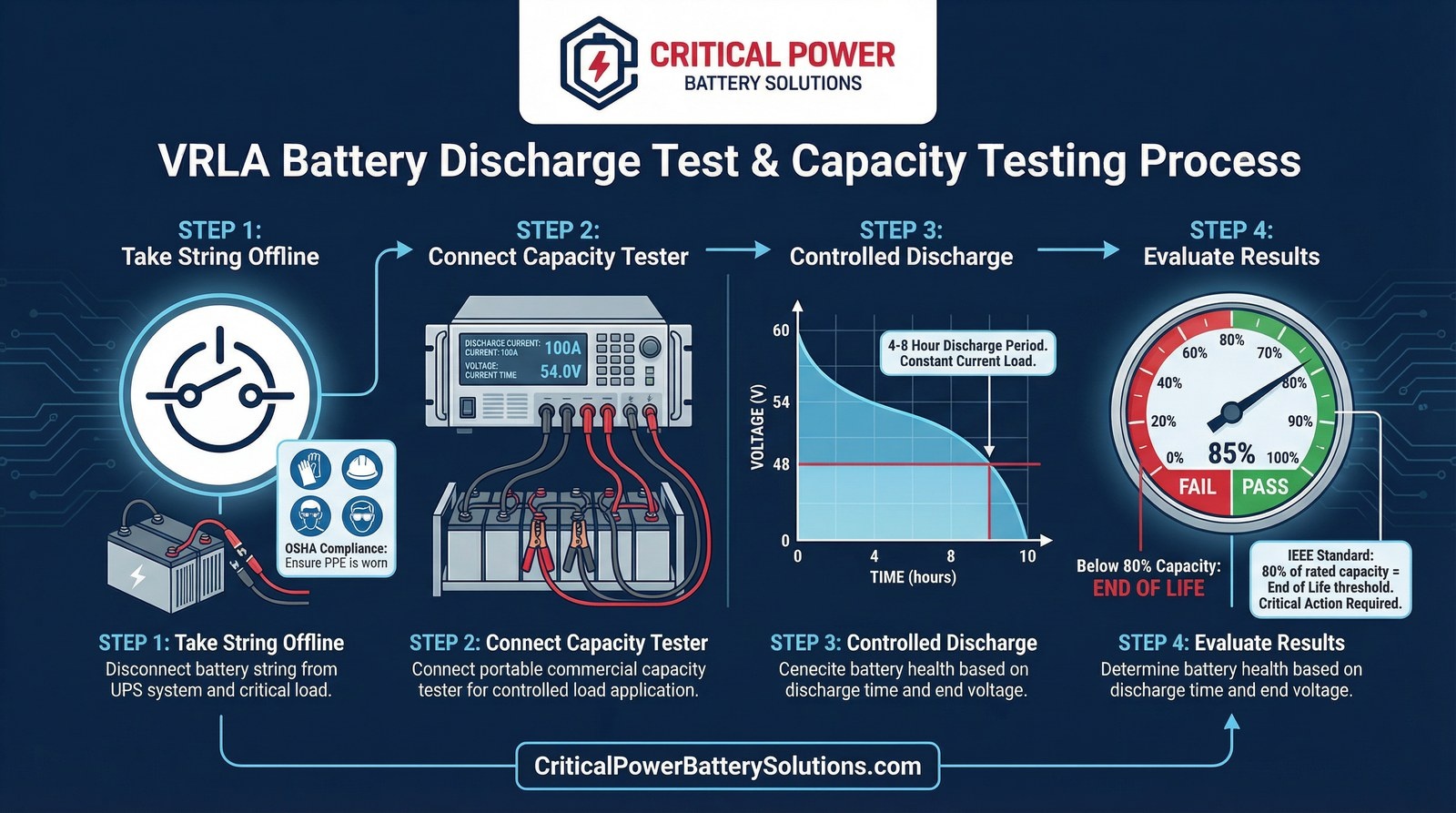
When ohmic variance exceeds the 30% threshold, executing a formal battery discharge test is the definitive method to verify the true end of life. While internal resistance testing serves as an excellent predictive screening tool, it cannot definitively quantify the remaining runtime of a battery string. Capacity testing is the ultimate validation, providing empirical proof of the system’s ability to support the critical load under real-world outage conditions.
The testing process requires taking the battery string offline and utilizing a commercial battery capacity tester to draw a constant, controlled current. Technicians monitor the voltage decay over a specified period, typically matching the site’s required backup duration (e.g., a 4-hour or 8-hour discharge rate). The IEEE standard defines 80% of the manufacturer’s rated capacity as the critical battery end of life threshold. If a string fails to deliver 80% of its rated amp-hours, it is officially compromised. This rigorous battery capacity testing validates the prior predictive maintenance data and provides the documentation required to authorize capital expenditure for a replacement. According to OSHA guidelines for green jobs and recycling, workers performing high-voltage battery capacity testing and replacement must utilize proper personal protective equipment and hazard training.
Once a string fails its discharge test, the transition from testing to procurement must be swift. It is vital to emphasize the importance of sourcing authentic replacements from authorized US distributors to ensure fresh stock. Batteries sitting in unauthorized warehouses degrade over time, meaning you could be installing a compromised product. Furthermore, the EPA mandates that end-of-life industrial batteries must be processed through specialized recycling channels to prevent environmental contamination and fire risks.
Frequently Asked Questions
Does an AGM battery require maintenance?
Yes, AGM batteries require specific periodic maintenance including visual inspections, voltage checks, and ohmic testing. While they do not require water additions like flooded lead-acid batteries, IEEE standards mandate regular monitoring of connection resistance and operating temperatures to ensure they reach their design life. Failure to properly maintain VRLA battery maintenance schedules can void manufacturer warranties.
Can I desulfate an AGM battery?
Desulfating an AGM battery is generally not recommended and is rarely effective for mission-critical infrastructure. Once hard sulfation occurs in a VRLA battery due to prolonged undercharging, the capacity loss is typically permanent. For telecom batteries and data center applications, compromised strings should be replaced rather than reconditioned to help ensure system reliability.
What should battery internal resistance be?
Battery internal resistance should generally remain within 25% to 30% of its original installation baseline. There is no single universal ohmic value; it depends entirely on the specific battery’s amp-hour capacity, chemistry, and manufacturer design. Establishing an initial baseline at month six is critical for accurate future comparisons.
How to test a battery internal resistance?
To test a battery’s internal resistance, apply a specialized AC conductance or DC load step tester to the battery terminals. Ensure the battery is fully charged, on float, and at a stable ambient temperature (ideally 25°C). Record the ohmic value and compare it directly to the manufacturer’s baseline or the established string average.
What is IEEE 1188?
IEEE 1188 is the official standard outlining recommended practices for the maintenance, testing, and replacement of stationary VRLA batteries. It provides facility managers with specific schedules for visual inspections, voltage readings, ohmic measurements, and capacity discharge tests to ensure reliable operation in critical backup power systems.
How to find the internal resistance of the battery?
You can find the internal resistance of a battery by using a dedicated impedance or conductance meter, or by calculating it using the voltage drop method. Using the formula R = ΔV / ΔI, you measure the voltage change when a known current load is applied. For industrial applications, digital battery testers automate this calculation.
What would be the symptoms of a battery with high internal resistance?
Symptoms of a battery with high internal resistance include excessive voltage drop under load, rapid heating during charging, and significantly reduced runtime. In UPS systems, this often manifests as the system failing to support the critical load during a brief power transfer, indicating severe grid corrosion or electrolyte dry-out.
What is the 40 80 rule for batteries?
The 40 80 rule suggests keeping a battery’s state of charge between 40% and 80% to maximize its cycle life. While popular for consumer lithium-ion devices, this rule does not apply to stationary standby VRLA batteries in telecom, which are designed to be kept at a 100% continuous float charge.
How to size a BESS system?
Sizing a Battery Energy Storage System (BESS) requires calculating the total load profile, required backup duration, and environmental factors using IEEE 485 standards. Engineers utilizing a UPS battery sizing calculator must factor in the system voltage, depth of discharge, temperature compensation, and a design margin (typically 10-25%) to ensure the system supports the load at the end of its life.
Why is 48V used in telecom?
48V DC is the standard in telecom because it is high enough to transmit power efficiently over long cables but low enough to be considered safe from severe shock hazards. This voltage also perfectly aligns with the use of four 12V or twenty-four 2V lead-acid battery cells connected in series for reliable backup power.
What kind of battery is used in telecom towers?
Telecom towers primarily use Valve-Regulated Lead-Acid (VRLA) batteries, specifically Absorbent Glass Mat (AGM) or gel chemistries, often in 2V or 12V front-terminal configurations. Premium models like the Stryten Absolyte AGP are favored for their high reliability, low maintenance, and durability in harsh, remote outdoor environments.
Limitations, Alternatives & Professional Guidance
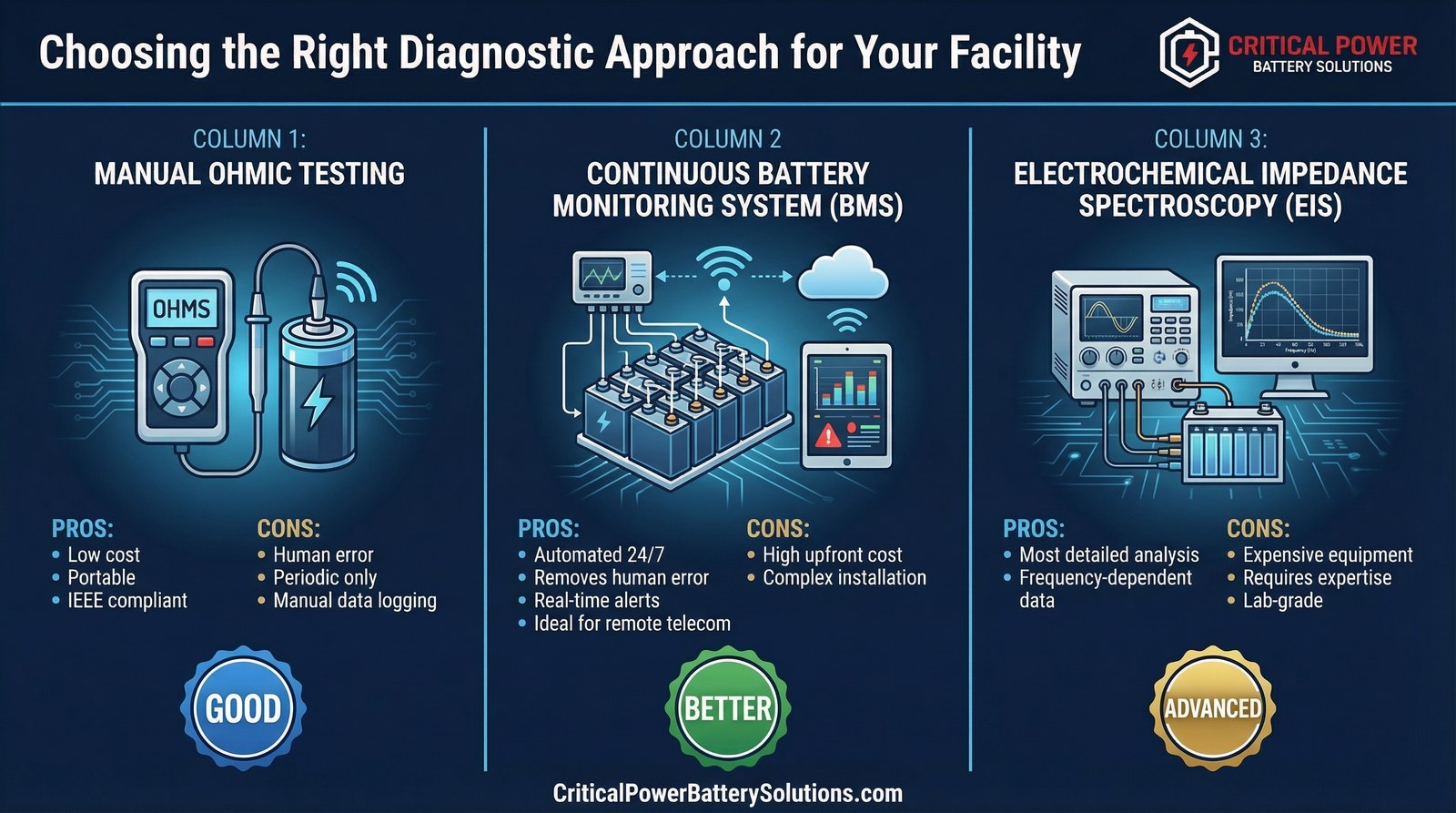
While ohmic testing is a highly effective diagnostic tool, it has distinct limitations. Research indicates that internal resistance measurements alone cannot definitively prove a battery’s total amp-hour capacity. Variations in ambient temperature, float voltage ripple, and even the specific placement of the tester probes can skew readings. Consequently, IEEE standards explicitly state that ohmic trends must be used as screening indicators rather than absolute pass/fail metrics. UPS battery testing should always be viewed holistically, combining multiple data points for an accurate health assessment.
Alternative diagnostic methods include continuous battery monitoring systems (BMS) and electrochemical impedance spectroscopy (EIS). A dedicated BMS automates daily data collection, removing human error from manual probe testing, which is particularly beneficial for remote telecom sites. However, these systems require significant upfront capital expenditure. The optimal approach depends heavily on the criticality of the load and the facility’s available budget.
Because mission-critical sizing and testing carry severe operational and safety implications, facility managers should seek professional engineering guidance. When planning multi-string replacements or implementing complex solar hybrid sites, consulting with certified specialists helps ensure compliance with IEEE protocols. Professional sizing helps guarantee that factors like design margins and thermal derating are calculated accurately, preventing both under-sizing risks that threaten uptime and over-sizing errors that lead to capital waste.
Conclusion
Mastering battery internal resistance measurement is essential for maintaining the integrity of US telecom and data center infrastructure. By adhering to IEEE 1188 testing schedules, establishing accurate Absolyte AGP baselines, and utilizing IEEE 485 sizing methodologies, engineers can accurately predict end-of-life scenarios before catastrophic failures occur. While ohmic testing provides excellent trending data, it must be combined with proper capacity testing and environmental context to yield the most reliable results for your specific facility.
Critical Power Battery Solutions can support your infrastructure upgrades with precision engineering. As an authorized distributor of Stryten Energy and Leoch, we provide authentic, fresh stock backed by over 40 years of ATS engineering heritage. If your recent diagnostic trends indicate it is time for a system refresh, consider our Free Battery Sizing Consultation. Our team will provide a comprehensive, IEEE 485-compliant sizing report and coordinate rapid nationwide shipping to keep your mission-critical operations online.
References
- U.S. Energy Information Administration (EIA) – Battery Storage Analysis
- IEEE Standards Association – IEEE Std 1188-2005 / 2025
- IEEE Standards Association – IEEE Std 485-2010
- U.S. Energy Information Administration (EIA) – Today in Energy Report (2024)
- Occupational Safety and Health Administration (OSHA) – Green Jobs/Recycling Guidelines
- U.S. Environmental Protection Agency (EPA) – Battery Collection Best Practices