⚡ Quick Technical Summary
The Stryten Energy Absolyte AGP is the gold standard for industrial backup power in long-duration, mission-critical environment, IF properly maintained. Design life of 20 years is achievable, but only with strict adherence to temperature-compensated float voltage, seismic compliance (UBC Zone 4), and torque specifications.
- Design Life: 20 years at 25°C (77°F)
- Float Voltage: 2.25 vpc (±0.01V) at 25°C, with -3mV/°C temperature compensation
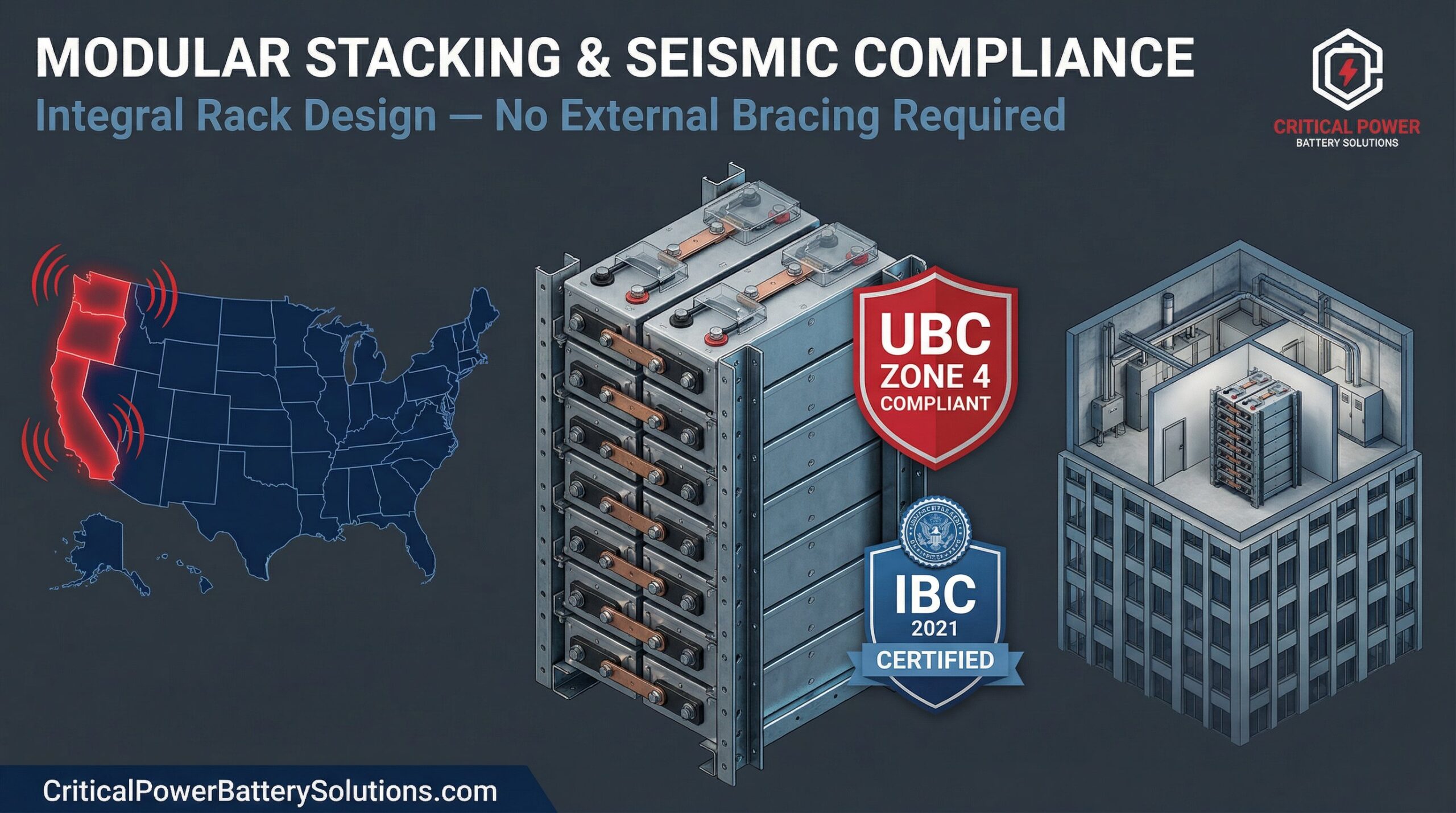
- Seismic Compliance: Modular stacking meets UBC Zone 4 / IBC 2021 requirements without external bracing (up to certain stack heights)
Continue reading for the complete troubleshooting guide, temperature compensation charts, and field maintenance protocols.
Stryten Energy Absolyte AGP Battery Review: Technical Guide & Troubleshooting
If you’ve been working in telecom or utility backup power, you probably know this battery as the “GNB Absolyte.” When Exide Technologies acquired GNB Industrial Power, the brand became Stryten Energy, but the engineering DNA remained the same: proven, robust, and unforgiving of mistakes. This isn’t a sales brochure. It’s a field guide.
The challenge: Stryten publishes a “20-year design life” spec sheet based on lab conditions (constant 25°C / 77°F). Real-world US climates tell a different story. Arizona heat accelerates grid corrosion. Minnesota cold steals capacity. California seismic codes demand specific rack configurations. This technical review cuts through the marketing and shows you exactly how to keep your Absolyte string alive in the climate where it’s actually installed.
At Critical Power Battery Solution, a division of Advanced Technical Services Inc. (ATS) with 40+ years of electronics engineering heritag, we are an Authorized Stryten Reseller and have installed, maintained, and troubleshot thousands of these batteries across North America. This guide is built from field experience, IEEE standards, and Stryten’s own engineering manuals.
Absolyte Technical Specifications & Design Features
The Absolyte AGP uses Absorbent Glass Mat (AGM) technolog, not gel. This matters. AGM separators allow faster gas recombination during charging, which means lower float voltages and safer operation in sealed VRLA cells. The “AGP” designation means “Absolute Power” in Stryten’s nomenclature; the AGM chemistry is the core differentiator. For full product specifications, visit the Stryten E-Series Absolyte AGP product page.
Modular Stacking Design. Unlike traditional battery strings that require individual mounting racks, the Absolyte is engineered for horizontal modular stacking. Picture a NYC data center or a telecom shelter in the Pacific Northwest: you can stack batteries 8-high (or more, depending on seismic zone approval) without external bracing frames. The integral racking of each unit eliminates the need for expensive external steel frameworks in many installations.
Seismic Advantage. The modular design also simplifies seismic compliance. In high-seismic zones (California, Washington, Oregon), the integral racking of the Absolyte meets UBC Zone 4 and IBC 2021 requirements without external reinforcement up to certain stack height, pending local AHJ (Authority Having Jurisdiction) approval and specific model certification. This is a major cost saving for critical installations in seismic-active regions.
Absolyte Troubleshooting Voltage Drift & Float Issues
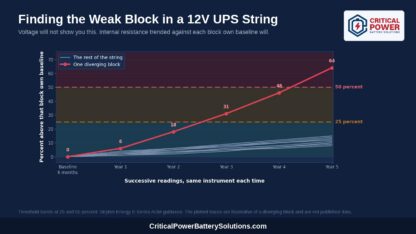
This is where field reality diverges from the spec sheet. After 3–5 years of service, especially in warm climates, individual cells in a long string begin to “drift”, their float voltages creep upward relative to their neighbors. One cell might be at 2.27V while its neighbor sits at 2.23V. This 40mV spread is not catastrophic, but it accelerates aging in the higher-voltage cell through increased electrolyte consumption and grid corrosion.
The “Float Drift” Phenomenon
Why cells drift. Over years of float charging, subtle differences in manufacturing (thickness of the glass mat, purity of the lead alloy, separator distribution) accumulate. Temperature gradients inside the cabinet also play a role. The cells at the top of the stack run warmer and experience slightly different electrochemical reactions than cells at the bottom. Without intervention, this drift accelerates.
The fix: Boost Charge. Stryten’s solution is a controlled “equalization” or “boost” charge, not to be confused with a full equalize. Here’s the procedure:
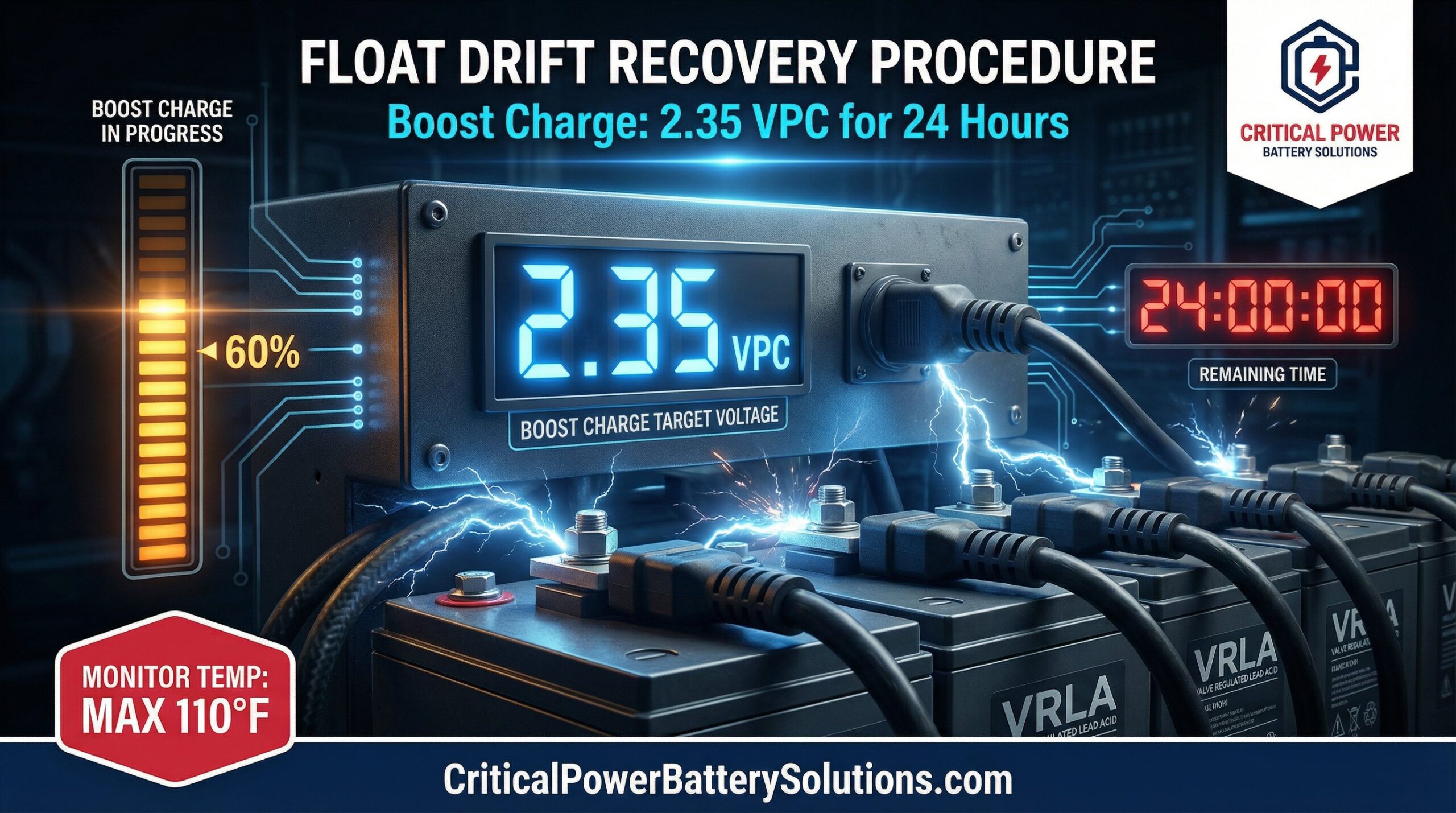
- Voltage Target: Increase the charger setpoint to 2.35 vpc (volts per cell) for 24 hours. This is higher than the normal 2.25V float, which pushes current through all cells simultaneously and re-balances their internal states.
- Temperature Monitoring: Watch the battery temperature closely during this boost. If it exceeds 110°F (43°C), reduce the current or terminate the boost and wait for the battery to cool. Overheating during boost can accelerate positive grid corrosion and cause gas venting.
- Post-Boost Float: After 24 hours, return the charger to standard 2.25 vpc float voltage.
Field Note: Many facilities never perform boost charges, which is why they see shortened battery lifespans (8–12 years instead of 20). The boost takes just one day and requires minimal supervision. It is part of any proactive maintenance program. For a complete maintenance schedule, see our Absolyte AGP 20-year design life maintenance guide.
Absolyte Temperature Corrected Float Voltage
This is the #1 mistake we see in the field: maintaining 2.25V float voltage in a battery room that’s 95°F.
The Rule: For every 1°C rise above 25°C (77°F), reduce the float voltage by approximately 3 mV per cell. This is called “temperature compensation” and it is non-negotiable for VRLA battery longevity.
Why it matters: A VRLA battery is a sealed system with a fixed electrolyte volume. If you charge at 2.25V when the battery is hot, you are pushing extra current into a thermally accelerated system, which generates even more heat. This feedback loop is thermal runaway, it can lead to jar swelling, electrolyte dry-out, and catastrophic failure in hours.
Absolyte Battery Temperature-Corrected Float Voltage Table:
| Temperature (°F) | Temperature (°C) | Recommended Float Voltage (VPC) | Adjustment from 77°F |
|---|---|---|---|
| 50°F | 10°C | 2.32 vpc | +70 mV |
| 68°F | 20°C | 2.28 vpc | +30 mV |
| 77°F | 25°C | 2.25 vpc | Baseline |
| 86°F | 30°C | 2.22 vpc | -30 mV |
| 95°F | 35°C | 2.19 vpc | -60 mV |
| 104°F | 40°C | 2.16 vpc | -90 mV |
| 113°F | 45°C | 2.13 vpc | -120 mV |
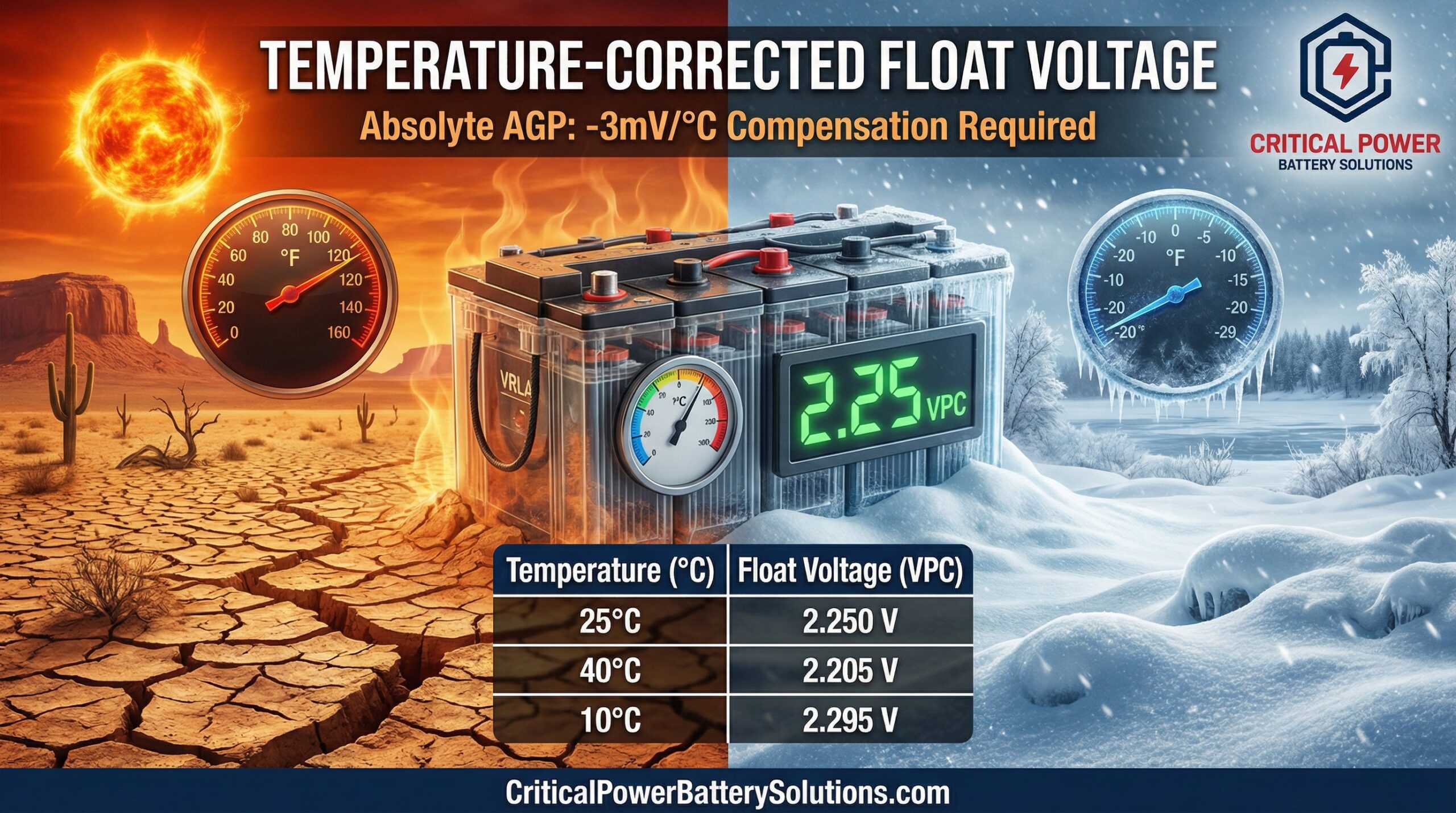
Practical Example: A facility in Phoenix maintains its battery room at a stable 95°F year-round (typical for uncontrolled equipment rooms). Instead of setting the charger to 2.25V, the technician should dial in 2.19 vpc to safely float the batteries. That single adjustment can add 5–7 years to battery life by preventing thermal acceleration.
Absolyte Connection Resistance & Torque
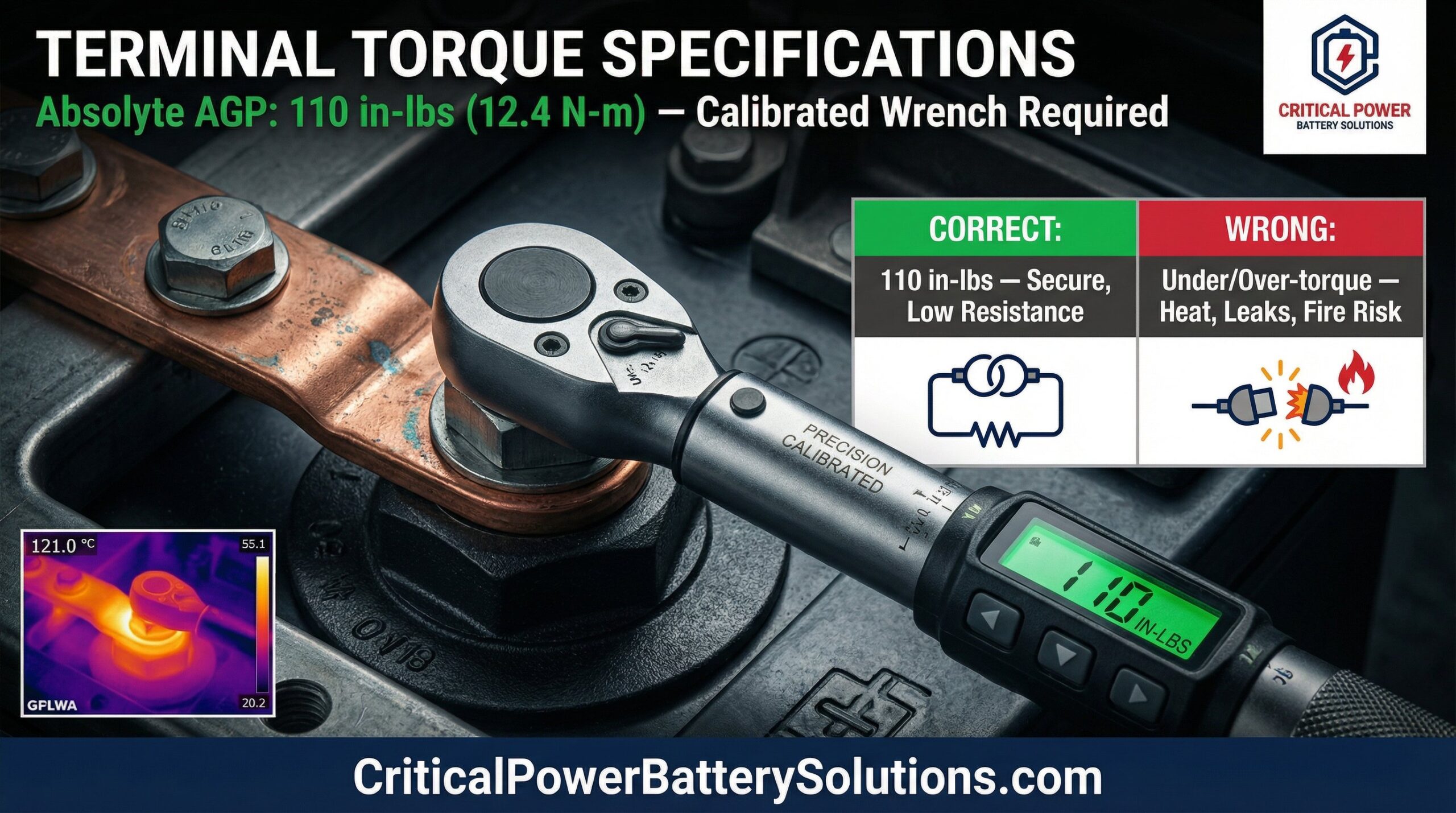
Under-torqued battery terminals create high electrical resistance, which generates localized heat and accelerates corrosion. Over-torqued terminals crack the post seal and cause internal leaks. Both mistakes shorten life dramatically.
Absolyte Torque Specification: The Stryten Absolyte AGP terminals require 100–110 inch-pounds (11.3–12.4 Nm) of torque per the SE2001 manual. Always use a calibrated torque wrench, not a standard wrench tightened “snug.” A calibrated wrench ensures consistent, repeatable connections across the entire string.
Absolyte Installation Best Practice: After torquing, measure the connection resistance with a micro-ohmmeter (0–100 mΩ range). A properly torqued connection should measure less than 1 mΩ (milliohm) per connection. If a connection reads 2–5 mΩ, it’s still functional but is generating excess heat under load. Re-torque and retest.
Common Field Mistake: Many technicians torque the main inter-cell connectors but skip the final connection to the load. This terminal, which carries full string current during discharge, is the #1 failure point. Torque it first, then torque every inter-cell connector in sequence, and re-check each one annually.
Regional Environmental Optimization
The “20-year design life” assumes ideal conditions: constant 25°C (77°F), low humidity, no seismic stress, and perfect maintenance. No facility in the continental US experiences these conditions. This section localizes the technical guidance for three distinct regional climate and code challenges.
High-Temp Zones (TX, AZ, FL)
Risk: Thermal Runaway. In hot climates, the primary threat is accelerated aging from elevated temperature. There’s a rule in battery engineering called the Arrhenius equation, a mathematical model describing how chemical reaction rates double for every 10°C (18°F) rise in temperature. Applied to VRLA batteries, this means: battery life halves for every 10°C above 25°C.
If a battery is rated for 20 years at 77°F, operating at 95°F (18°F warmer) theoretically reduces life to 10 years. Operating at 113°F reduces it to 5 years. This is not pessimistic; it is chemical fact.
Mitigation in Hot Climates: The first line of defense is room temperature management. If the facility can maintain the battery room below 85°F (29°C) through HVAC, do it. The ROI on a small dedicated A/C unit often breaks even in extended battery life within the first 5 years.
If room temperature control is not feasible, then aggressive temperature compensation on the rectifier becomes critical. Use the table above and dial in the float voltage dynamically based on actual room temperature. Many modern UPS/charger systems support automatic temperature compensation via a thermistor probe placed inside the battery. Retrofit this capability if your equipment is older.
Annual Capacity Testing. In hot zones, capacity testing should be annual, not every 2–3 years. Once capacity drops below 85% of nameplate (not the typical 80% threshold), schedule replacement. The degradation curve accelerates dramatically in the final 10–15% of life in warm climates.
Seismic Zones (CA, WA, OR)
For installations in California, Washington, and Oregon, compliance with seismic codes is mandatory.
- Compliance Standard: The Absolyte AGP modular rack is designed to meet UBC Zone 4 and IBC 2021 requirements. Per ASCE 7-16 seismic design standards, the system can often be installed without external bracing up to certain stack heights (typically 8 batteries high, depending on the specific model and local soil conditions).
- Permitting Tip: If you are in California, ensure your installation permit cites the specific seismic certification for the rack configuration you are using. Seismic battery racks are a critical inspection point for local AHJs (Authorities Having Jurisdiction). Never rely on verbal approval; get written seismic compliance documentation from the battery distributor or from Stryten directly.
- Seismic Anchor Bolts: Even within approved stack heights, some jurisdictions require anchor bolts to the floor. These must be installed per the rack manufacturer’s drawing-not improvised. Under-bolting may pass initial inspection but creates a failure risk during actual seismic activity.
Cold Zones (MN, NY, New England)
In colder climates, the risk shifts from degradation to capacity loss.
- Cold Performance Loss: Electrochemical reactions slow down in the cold. At 50°F (10°C), a battery may only deliver approximately 85% of its nameplate capacity. At 32°F (0°C), this drops to 70%. This is temporary, once the battery warms, capacity returns, but it means undersizing during winter sizing calculations is dangerous.
- Derating in Sizing: When sizing systems for unheated rooms (common in northern data centers or outdoor telecom shelters), you must apply a temperature derating factor. If your load requires 100Ah at 77°F, and the room will be 50°F in winter, you may need to purchase a 120Ah or even 130Ah battery to guarantee full capacity year-round.
- Ventilation Challenge: Cold battery rooms also challenge ventilation design. While hydrogen gas (vented during charge) is less of a concern in heated rooms due to natural air mixing, in very cold rooms, hydrogen can stratify near the ceiling. Ensure ventilation fans are sized to run even at low ambient temperatures.
Absolyte Battery Maintenance & IEEE 1188 Compliance
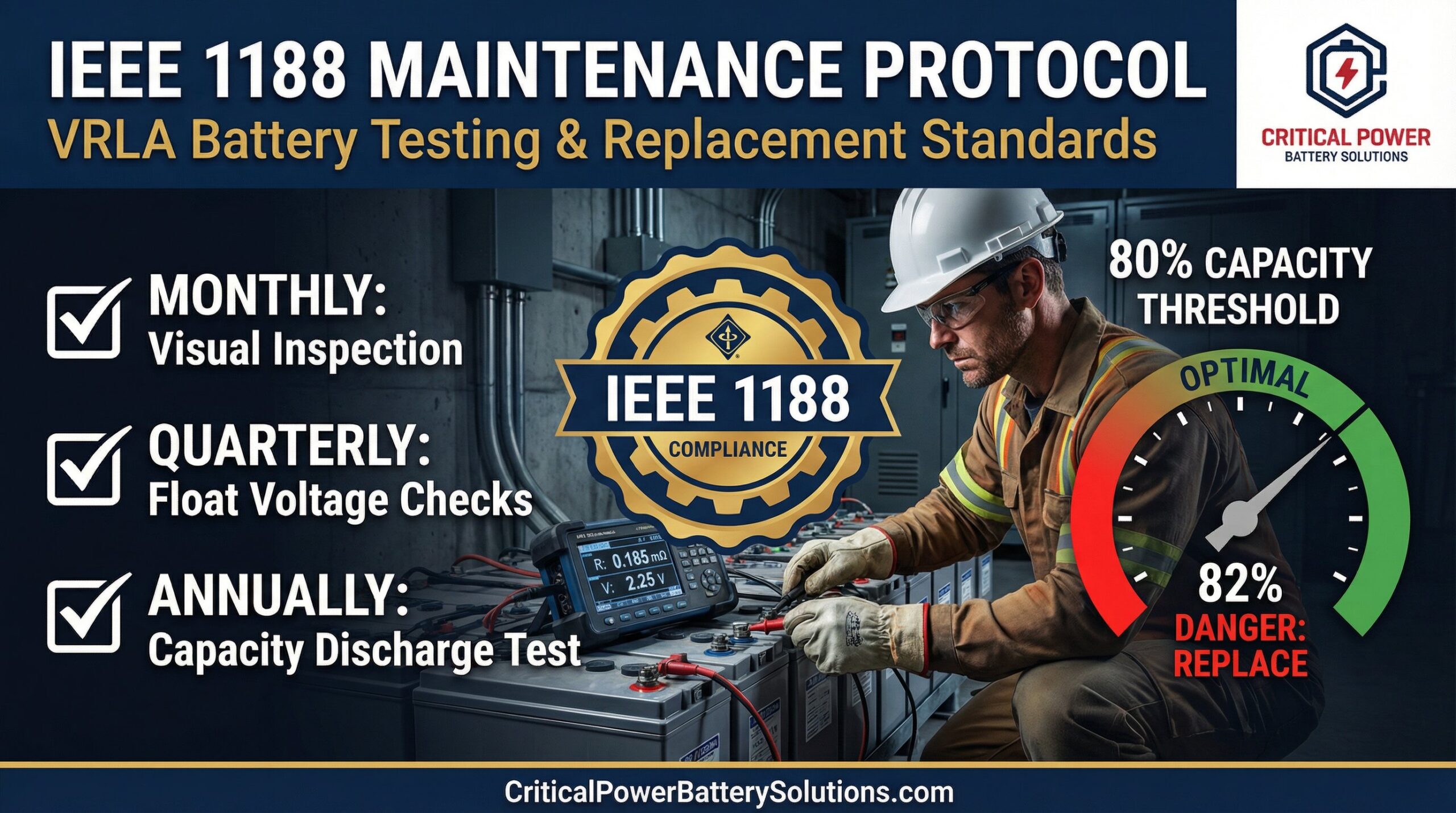
Proper maintenance is not optional; it is a requirement for warranty validity and safety. We follow the guidelines set forth in IEEE 1188, the Recommended Practice for Maintenance, Testing, and Replacement of VRLA Batteries.
Absolyte Recommended Frequency
- Monthly: Conduct a visual inspection. Look for evidence of jar swelling, post seal leaks, or corrosion on inter-cell connectors. Check the ambient temperature and pilot cell voltage.
- Quarterly: Measure and record the float voltage of every cell in the string.
- Annually: Perform VRLA battery connection resistance testing using a micro-ohmmeter. Resistance readings should not vary by more than 20% from the baseline or average.
Absolyte Battery Capacity Testing Procedure
The only way to truly verify the health of a battery is through a discharge test.
- Procedure: Isolate the battery string from the load (ensure a backup is present). Discharge the battery at a constant current (usually the 8-hour rate) until the voltage drops to the end-of-discharge limit (typically 1.75 vpc). For help determining discharge duration, see our guide on how to calculate battery runtime.
- Replacement Criteria: According to IEEE 1188, a battery should be replaced when its capacity drops below 80% of the manufacturer’s nameplate rating. At this stage, the rate of degradation accelerates rapidly.
Verifying the reviewer: authorization and engineering continuity
A rigorous Absolyte AGP review should answer two trust questions before issuing a verdict: is the reviewer authorized to evaluate and supply this product, and is the product itself genuinely the same engineering buyers have trusted under the GNB brand? CPBS holds documentation on both.
- Stryten authorized reseller documentation on file. Confirms CPBS is authorized across Absolyte, Flooded Classic, AGM, and chargers.
- Stryten Energy Absolyte AGP continuity declaration. Certifies that Absolyte AGP retains the unchanged design, engineering, and manufacturing of the GNB Absolyte product family. Every electrochemical specification continues unchanged.
Frequently Asked Questions
What is the float voltage for Absolyte AGP batteries?
The standard float voltage is 2.25 volts per cell (vpc) at 77°F (25°C). However, this must be temperature compensated. For every 1°C rise in temperature, voltage should be reduced by approximately 3mV to prevent thermal runaway. Always consult the SE1097 manual for your specific model to ensure compliance with warranty terms.
How do you test Absolyte batteries for capacity?
Capacity testing should follow IEEE 1188 standards. This involves isolating the battery string and discharging it at a constant current (usually the 8-hour rate) until it reaches the end-of-discharge voltage (typically 1.75 vpc). If the battery delivers less than 80% of its rated time, it should be replaced immediately.
What causes thermal runaway in Absolyte AGP batteries?
Thermal runaway is caused by excessive charging current generating heat faster than the battery can dissipate it. This is common in hot climates (like Arizona or Texas) if the float voltage is not lowered (temperature compensated) as the battery heats up. It leads to jar swelling, electrolyte dry-out, and potentially catastrophic failure.
What is the life expectancy of Stryten Absolyte batteries?
The design life is 20 years at 77°F (25°C). However, real-world service life varies significantly by temperature. Operating at 95°F (35°C) continuously can reduce life to approximately 10 years due to accelerated grid corrosion and electrolyte loss.
How to read the date code on Stryten batteries?
Stryten (formerly GNB to Stryten transition) date codes are typically stamped on the negative post or label. They often use a letter for the month (A=January) and a number for the year (6=2026). Contact Critical Power Battery Solutions with your serial number for exact decoding, as formats can vary by production batch.
Can Absolyte AGP batteries be installed horizontally?
Yes, the Absolyte AGP is designed for horizontal stacking. This is its primary installation method, allowing for high-density “modular” stacks that save floor space while maintaining proper electrolyte contact with the plates through the glass mat separator.
What are the torque specifications for Absolyte terminals?
Torque specifications are critical; typically 100–110 inch-pounds for standard connections. Under-torquing causes high resistance and heat buildup; over-torquing can crack the post seal, leading to leaks. Always use a calibrated torque wrench during installation and maintenance.
Does Absolyte AGP require specific ventilation?
Yes, per OSHA 1910.178(g) and IEEE standards. While VRLA batteries emit less gas than flooded types, they still vent hydrogen during charge. Adequate room ventilation is required to keep hydrogen levels below 1% concentration to prevent explosion hazards. For sizing ventilation, see our guide on battery room ventilation calculation.
Limitations, Alternatives & Disposal
If you are weighing the Absolyte AGP against other manufacturers, see the Stryten Absolyte AGP vs EnerSys, C and D, and NorthStar industrial VRLA battery comparison for a like for like, brand by brand evaluation.
While the focus of this Stryten Energy Absolyte AGP Battery Review has been on the strengths of the Absolyte line, it is important to acknowledge its limitations. The Absolyte is a “long duration” battery, optimized for discharges lasting 1 to 8 hours. For applications requiring extremely high-rate, short-duration discharges (such as 5-minute UPS bursts), a Pure Lead High Rate battery (like the Leoch PLH) might be more cost-effective and space-efficient.
Disposal & Recycling Services
Proper disposal is not just an environmental responsibility; it is a legal requirement.
- Regulation: Under EPA 40 CFR Part 273, lead-acid batteries are classified as Universal Waste.
- Service: Critical Power Battery Solutions offers full removal and EPA-certified battery recycling services.
- Safety: Never dispose of industrial battery disposal items in standard trash; the lead and sulfuric acid content are hazardous materials that require chain-of-custody documentation.
Conclusion
To summarize this Stryten Energy Absolyte AGP Battery Review, the Absolyte AGP remains the gold standard for long-life reliability in telecom and utility sectors, provided it is maintained correctly. The “20-year” life is achievable, but only with strict adherence to float voltage limits, temperature compensation, and torque specifications. Whether you are in a seismic zone in California or a heat zone in Texas, the modular design offers a robust solution for critical power needs.
However, sizing these systems correctly is complex. Don’t guess on your replacement. Get a Free Battery Sizing Consultation from our engineering team. We provide IEEE 485 compliant sizing reports to ensure your telecom battery backup systems meet your exact load requirements.
References
- Stryten Energy, “Network Power Installation & Operating Instructions (SE1097),” Stryten Energy Official Documentation.
- IEEE Standards Association, “IEEE 1188 – Recommended Practice for Maintenance, Testing, and Replacement of VRLA Batteries,” IEEE Xplore.
- International Code Council, “International Building Code (IBC) 2021 / ASCE 7-16,” ICC Safe.
- U.S. Environmental Protection Agency, “40 CFR Part 273 – Standards for Universal Waste Management,” EPA.gov.
- ScienceDirect, “Arrhenius Equation and Thermal Degradation,” ScienceDirect Topics.
👤 Article by: Tom Kierna
Reviewed by: CPBS Engineering Team
Last updated: March 22, 2026
Credentials: Authorized Stryten battery Reseller, ISO 9001 Certified, IEEE Standards Member