How To Calculate Battery Runtime Accurately For UPS, Telecom, And Industrial Systems
If you manage critical power systems, knowing how to calculate battery runtime is essential to protect uptime and budget, especially as modern devices are designed to retain about 80% of their original capacity after hundreds of charge cycles, which directly changes real-world backup time over the battery’s life.
Key Takeaways
| Question | Answer |
|---|---|
| How do I calculate basic battery runtime in hours? | Use the core formula: Runtime (hours) ≈ (Total battery Wh × usable depth of discharge) ÷ load W. For VRLA and Stryten battery systems, we recommend conservative depth-of-discharge assumptions when you size VRLA battery systems. |
| Why does battery type matter for runtime? | VRLA, flooded, and TPPL battery chemistries respond differently to high-rate discharge and temperature, so runtime tables and derating factors differ. Our technical guide to Leoch HXP / PLH shows how this affects critical power deployments. |
| How does UPS load profile affect runtime? | Non-linear UPS efficiency and step-loads reduce runtime versus a simple constant‑W assumption. When you plan telecom battery backup systems, always differentiate between peak and average load. |
| What else should I consider beyond the formula? | Temperature, battery aging, discharge rate, and safety margin all shorten real-life runtime. Our team applies these factors when you evaluate industrial battery suppliers and engineering support. |
| How can I verify calculated runtime in the field? | Perform controlled discharge tests per IEEE 1188 for VRLA and IEEE 450 for flooded cells when you schedule UPS battery testing support with our engineers. |
| Where can I see examples of batteries used in runtime planning? | Review our data center battery selections for real-world VRLA and flooded options that we regularly model in runtime calculations. |
👤 Article by: Tom Kierna
Reviewed by: CPBS Engineering Team
Last updated: 19 January 2026
Credentials: Authorized Stryten battery Reseller, ISO 9001 Certified, IEEE Standards Member


1. Why Accurate Battery Runtime Calculations Matter In Critical Power
When you operate data centers, telecom networks, or utility substations, miscalculating battery runtime can mean the difference between a controlled shutdown and unexpected outage. We have seen undersized banks fail minutes before generator start, even though nameplate capacity looked adequate on paper.
Accurate runtime estimation is also foundational for how to size battery systems, how to plan battery replacement, and how to choose industrial batteries that actually meet your uptime SLAs. Your calculations drive capital planning, space allocation, cabling, and charger selection.
As an authorized Stryten Energy and Leoch distributor supported by ISO 9001 processes through Advanced Technical Services (ATS), we build runtime models every day for UPS, telecom, and utility clients worldwide. The same approach we use in those projects is what we outline for you in this guide.
Once you understand how to calculate battery runtime precisely, you are in a much stronger position to decide how to maintain VRLA batteries, how to maintain flooded batteries, and how to extend battery lifespan while keeping runtime predictable across the system’s life.
2. Core Battery Runtime Formula: From Nameplate To Usable Hours
At its simplest, battery runtime is a function of stored energy and load. The starting point is to convert ampere‑hours (Ah) to watt‑hours (Wh), then relate that to your actual connected load in watts.
For a single battery or total string, use this base formula:
Step 1: Total Wh = Nominal Voltage (V) × Capacity (Ah)
Step 2: Usable Wh = Total Wh × Usable Depth of Discharge (DoD fraction)
Step 3: Runtime (hours) ≈ Usable Wh ÷ Load (W)
For example, a 12 V, 100 Ah VRLA battery has 1,200 Wh nominal. If you limit to 80% DoD for longevity, you have about 960 Wh usable. At a 200 W load, the simple runtime estimate is 960 ÷ 200 ≈ 4.8 hours, before real-world derating.
When you move from a single battery to a full bank, calculate the total energy of the string by multiplying series voltage and parallel Ah, then apply the same structure. This is the quantitative foundation for how to select data center batteries that can meet a required backup window, such as 15 minutes at full IT load plus margin.
In practice, that simple calculation is a starting estimate, not a final design value. You still need to correct for discharge rate, temperature, and aging, which we cover in the next sections.
Our engineers always add a design margin on top of the math, typically 20 to 30 percent, to ensure the installed runtime stays within spec even as batteries age and real loads fluctuate.

Diagram showing the 3-step core runtime formula
3. Mapping Load Profiles To Runtime: Constant, Variable, And Peak Loads
Many online examples treat load as a constant watt value, but real systems rarely operate that way. IT racks, telecom DC plants, and control systems often cycle between idle, normal, and peak demand, and UPS efficiency shifts with loading.
To model runtime accurately, start by segmenting your load over time:
- Average continuous load (kW) over the backup window.
- Short‑term peaks, such as server boot surges or telecom RF ramp up.
- Non‑critical loads that can be shed automatically during an outage.
For runtime calculations, it is usually safer to size against the higher of: the true average load after non‑critical shedding, or a conservative percentage of peak, for example 80 to 90 percent of worst case. This aligns your runtime expectation with realistic worst‑case events.
In telecom and data center environments, we also recommend modeling a stepped discharge profile when you plan how to commission battery systems. That means calculating runtime for an initial high‑load period, then a lower stabilized load once non‑essential systems are offline.
This infographic breaks down a simple five-step method to estimate battery runtime so you can approximate how long your system can operate on stored energy.
Once peak and average loads are defined, you can plug those values into your runtime formula, with separate calculations for each segment if needed. This approach is particularly useful when you design staged shutdown sequences in large facilities.
From our field experience, aligning load modeling with your UPS management strategy is just as important as the battery math itself.

4. Using Real Battery Data: Example Runtime Calculations With Leoch TPPL
Theoretical formulas are only useful if you combine them with real product data. As an authorized Leoch distributor, we routinely calculate runtimes for TPPL VRLA models like the XP and PLH series.
Consider a 12 V Leoch XP12‑300, a 300 Ah VRLA battery used in UPS and telecom DC systems. Nameplate energy is approximately 3,600 Wh.
| Parameter | Value |
|---|---|
| Nominal Voltage | 12 V |
| Capacity | 300 Ah |
| Total Energy | 12 × 300 = 3,600 Wh |
| Assumed usable DoD | 80 percent |
| Usable Energy | 3,600 × 0.8 = 2,880 Wh |
If your DC load is 720 W, a simple runtime estimate is 2,880 ÷ 720 ≈ 4 hours. In practice, we further derate based on discharge rate, temperature, and aging, which might reduce the planning runtime to around 3.2 to 3.5 hours.
When multiple batteries are used in series or parallel, repeat the same approach at the string level and always check manufacturer discharge tables at the target runtime. These tables often show that available Ah decreases at higher discharge rates, which is why relying only on the 20‑hour Ah rating can mislead runtime planning.
This step, relating manufacturer curves to your exact runtime target, is where our application engineers can save you significant time and rework. We already know how each family of batteries behaves at 5, 15, or 60 minutes of discharge under different conditions.
If your runtime requirement is tight relative to space or budget, it is vital to work from these real curves rather than only from nameplate Ah values.
5. Stryten E‑Series Absolyte AGP, Absolyte GP, Absolyte GX And Other Models In Runtime Planning
For many mission‑critical environments, Stryten Energy’s E‑Series (Absolyte, NXT, MCX, PDQ, H1T, MCT) family is our preferred platform for runtime‑sensitive designs. Understanding how these batteries behave under load is key when you calculate backup time.
Stryten E‑Series Absolyte AGP For Long‑Life VRLA Runtime
Absolyte AGP is a 2 V VRLA AGM system with a 20‑year design life, NEBS Level 3 certification, and capacities from roughly 104 to 4,800 Ah. In practice, this product is ideal when you want multi‑hour runtimes at moderate discharge rates for data centers, telecom, and industrial UPS.
For example, a 48 V string using 2 V, 1,000 Ah Absolyte cells has about 48,000 Wh of nominal energy. At 80 percent usable DoD, that is ~38,400 Wh. At a 10 kW load, your base runtime is 3.84 hours before derating for temperature, age, and discharge rate.

Other Stryten E‑Series Batteries In Runtime Design
For VRLA applications with rack‑mount or jar‑based configurations, we often use E‑Series NXT and H1T, which provide strong high‑rate performance for shorter runtime UPS and telecom applications. For flooded designs in utility and industrial environments, MCX, MCT, and PDQ deliver long life and robust high‑current behavior.
Whether you are learning how to install Absolyte AGP or Absolyte GP, how to maintain Stryten batteries, or how to replace GNB batteries with modern equivalents, the same runtime calculation approach applies. You always start from energy, then apply manufacturer curves and derating factors to reach a conservative, realistic design value.


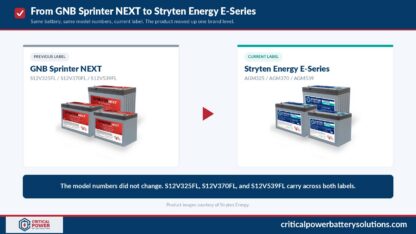
Because Stryten’s E‑Series products are direct descendants of legacy GNB designs, we can often match or exceed existing runtime in retrofit projects with minimal changes to racks or cabling. That compatibility is critical when you plan battery replacement in constrained spaces.
If you are unsure how a specific Stryten model will behave at your required runtime, our engineers can model different options side by side and document the expected backup time at various loads.
6. Real‑World Derating: Temperature, Rate, And Aging Effects On Runtime
The basic formula and product data give you a theoretical runtime. To reach a number you can trust in critical operations, you need to derate for environmental and operational reality.
We typically consider three major factors:
- Temperature: Below 25 °C (77 °F), available capacity drops. At 0 °C, some VRLA batteries can lose 20 to 30 percent of effective capacity.
- Discharge rate: High‑rate discharges yield less usable Ah than the 20‑hour rating suggests.
- Aging: Over years, capacity declines toward 80 percent of original, which is often your replacement trigger.
As an example, if your environment runs at 10 °C and your application uses a 15‑minute high‑rate discharge, we might apply a combined derating factor of 0.6 to 0.7 against theoretical runtime. That means a nominal 15 minutes could be treated as 9 to 10.5 minutes in design.
Our team uses manufacturer temperature correction factors and discharge curves to pick the right derating values rather than guessing. This method is essential for NEBS and IEEE compliance in regulated industries.
Derating also interacts with how to extend battery lifespan. For example, if you size capacity so that typical discharges stay within 50 percent DoD instead of 80 percent, your batteries will generally deliver both better sustained runtime and longer cycle life.
That tradeoff between up‑front capex and long‑term performance is where rigorous runtime calculation provides significant lifecycle savings.

7. Step‑By‑Step: How To Calculate Battery Runtime For Your System
To put everything together, here is a practical process you can follow for any critical power application, whether you are planning how to test UPS batteries, how to commission battery systems, or how to size battery systems from scratch.
- Define the load profile. List all connected loads, identify non‑critical circuits, and determine worst‑case kW after shedding.
- Set the required backup duration. For example, 15 minutes at full load plus 5 minutes margin.
- Select candidate battery models. Use application‑appropriate families, such as Stryten Absolyte AGP or E‑Series NXT for VRLA applications, or MCX / MCT for flooded utility use.
- Compute theoretical energy. Convert Ah and voltage to Wh at the string level, using the formula in Section 2.
- Apply DoD, temperature, and rate derating. Multiply theoretical runtime by combined derating factors based on environment and discharge rate.
- Compare to required runtime. If calculated runtime is below your requirement plus margin, increase capacity or add strings, then recalculate.
- Document assumptions. Record temperatures, load profiles, and derating factors so that future maintenance and testing can validate or adjust the design.
For large or complex sites, we often build these steps into a spreadsheet tool with manufacturer data embedded. That lets you adjust loads and quickly see the impact on runtime and required capacity.
This same workflow helps you quantify the effect of system changes, such as adding more IT racks or telecom carriers, before you commit to them in production.
If you prefer not to build your own tools, our team can apply this same structured process using our internal calculators and return a documented sizing and runtime report for your review.
That report becomes your reference for operations teams when they evaluate changes, maintenance plans, or modernization projects.

8. Verifying Runtime: How To Test UPS Batteries Against Your Calculations
Even the best calculation is still a model. To confirm that your installed system actually delivers the expected backup time, you need structured testing aligned with IEEE standards.
For VRLA banks, follow IEEE 1188 guidance, and for flooded batteries, use IEEE 450. At a high level, we recommend three layers of verification:
- Acceptance testing at commissioning. Perform a controlled discharge to a specific voltage or time to validate design assumptions.
- Periodic performance testing. At defined intervals, conduct discharge tests on representative strings to track capacity over time.
- Online monitoring correlations. Use system logs from UPS or DC plant controllers to correlate predicted runtime with actual event data.
When you plan how to test UPS batteries, careful attention to safety is mandatory. Follow lockout/tagout procedures, verify all test equipment ratings, and ensure that any discharge testing does not compromise critical load during live operations.
In many facilities, we recommend coordinating testing with planned maintenance windows to avoid exposing critical services to unnecessary risk.
Over time, test data help refine your derating assumptions. If acceptance testing shows significantly higher or lower runtime than predicted, we adjust the model and update future sizing accordingly.
This closed‑loop approach is how we continuously improve reliability and cost‑effectiveness across our client base.

9. Common Mistakes In Battery Runtime Calculations And How To Avoid Them
Across hundreds of installations, we see the same modeling errors appear repeatedly. Avoiding these will save you from runtime shortfalls and unplanned upgrades.
- Using 20‑hour Ah ratings for high‑rate designs. Always use manufacturer high‑rate data for 5 to 30 minute UPS runtimes.
- Ignoring temperature impact. Designing at 25 °C, then operating at 10 °C or lower, can reduce runtime far below expectations.
- Assuming new‑battery capacity for end‑of‑life. Always model at 80 percent capacity, which aligns with typical replacement thresholds.
- Not including safety margin. Designing for exactly 15 minutes without margin leaves no room for growth or measurement uncertainty.
- Overlooking non‑linear UPS efficiency. Efficiency losses at partial load can add several percent to effective load in watts.
These issues are often compounded by lack of documentation. If you do not record assumptions, future teams cannot easily understand why runtime is lower than nameplate suggests.
We strongly recommend a simple calculation sheet attached to each system’s maintenance records, updated whenever loads, environment, or batteries change.
If you suspect your current runtime is not matching expectations, start by checking for these common modeling errors before assuming the batteries themselves are at fault.
In many troubleshooting cases, load growth and temperature shifts explain the discrepancy more than battery defects do.
10. When To Consult A Professional For Runtime Calculations
Many small and mid‑size systems can be modeled accurately with the methods in this guide. However, there are situations where professional engineering support is strongly recommended.
Examples include:
- High‑voltage DC systems and large industrial UPS installations.
- NEBS Level 3 or IEEE 693 seismic compliance projects.
- Complex duty cycles such as switchgear tripping and reclosing operations.
- Retrofits where you replace GNB batteries with Stryten or Leoch equivalents and must match existing runtime in constrained spaces.
In these cases, runtime interacts with code compliance, thermal management, and detailed manufacturer modeling. Getting the math wrong can have regulatory as well as operational consequences.
Our team at Critical Power Battery Solutions combines over 40 years of electrical and battery engineering experience, backed by ATS’s ISO 9001 certified processes, to support you through these higher‑risk designs.
We can also help your team integrate runtime modeling with broader questions like how to choose industrial batteries, how to maintain VRLA batteries and flooded batteries, and how to troubleshoot battery issues before they affect uptime.
When you involve our specialists early, you reduce the risk of oversizing, under sizing, or missing compliance considerations that can be costly to correct later.
Conclusion
Calculating battery runtime is not just a theoretical exercise. It is a practical engineering task that protects your uptime, budget, and reputation across data center, telecom, and industrial environments.
By combining a clear load profile, sound energy calculations, manufacturer discharge data, and realistic derating for temperature and aging, you can design systems that reliably meet runtime requirements from day one through end of life.
Whether you are evaluating how to install Stryten batteries, how to maintain flooded batteries, or how to calculate battery runtime for your next UPS upgrade, our technical team is ready to assist.
Next steps:
- Review Stryten E‑Series batteries for your next runtime‑critical project.
- Explore data center battery replacement options aligned with your backup window.
- See utility substation battery systems where runtime and duty cycle are tightly engineered.
- Browse our full product catalog to compare capacities and chemistries for runtime planning.