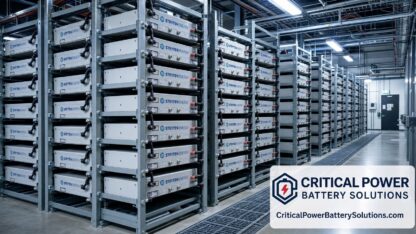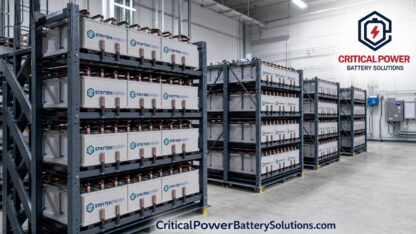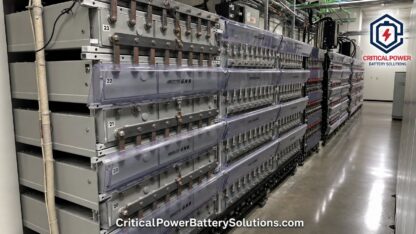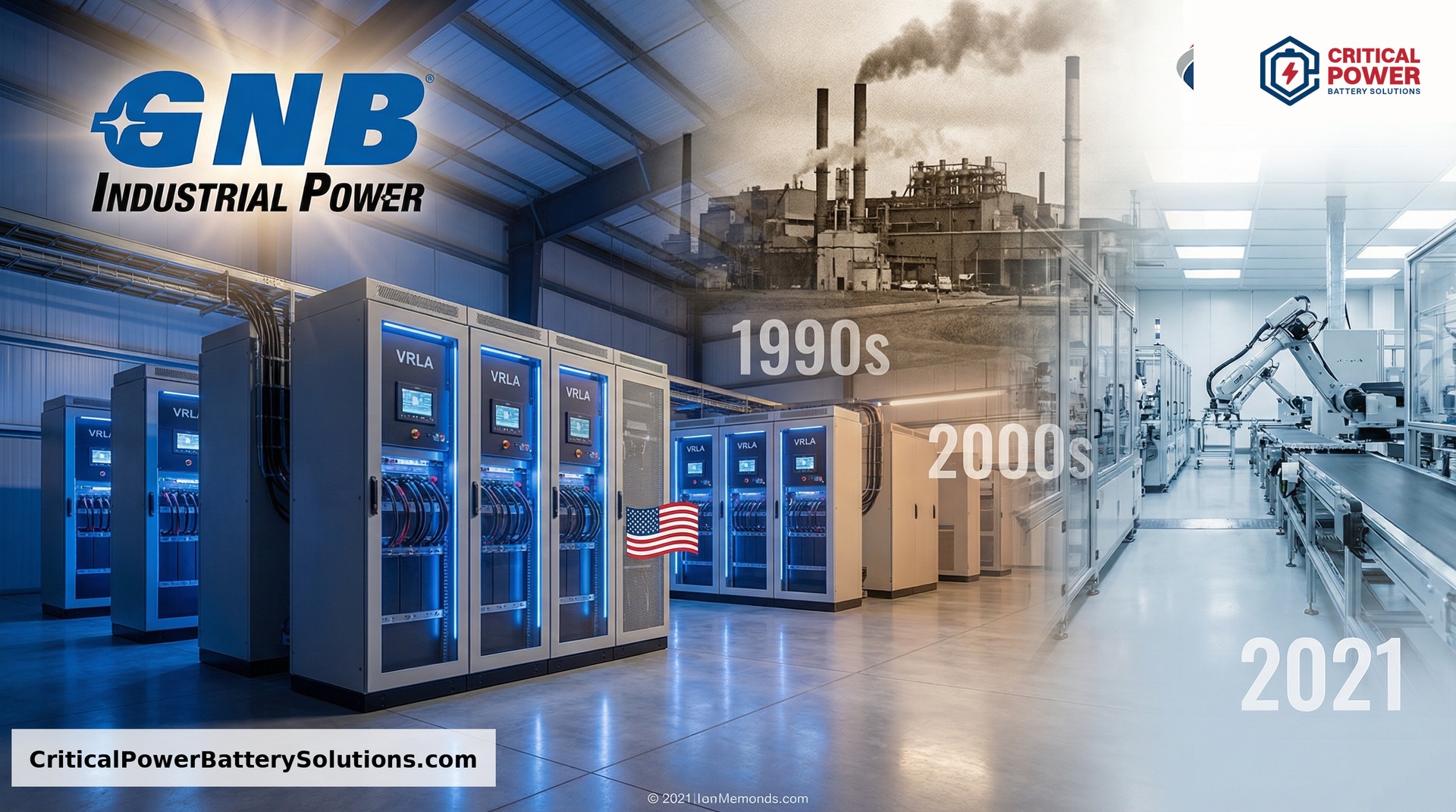


The Evolution of GNB (Exide to Stryten)
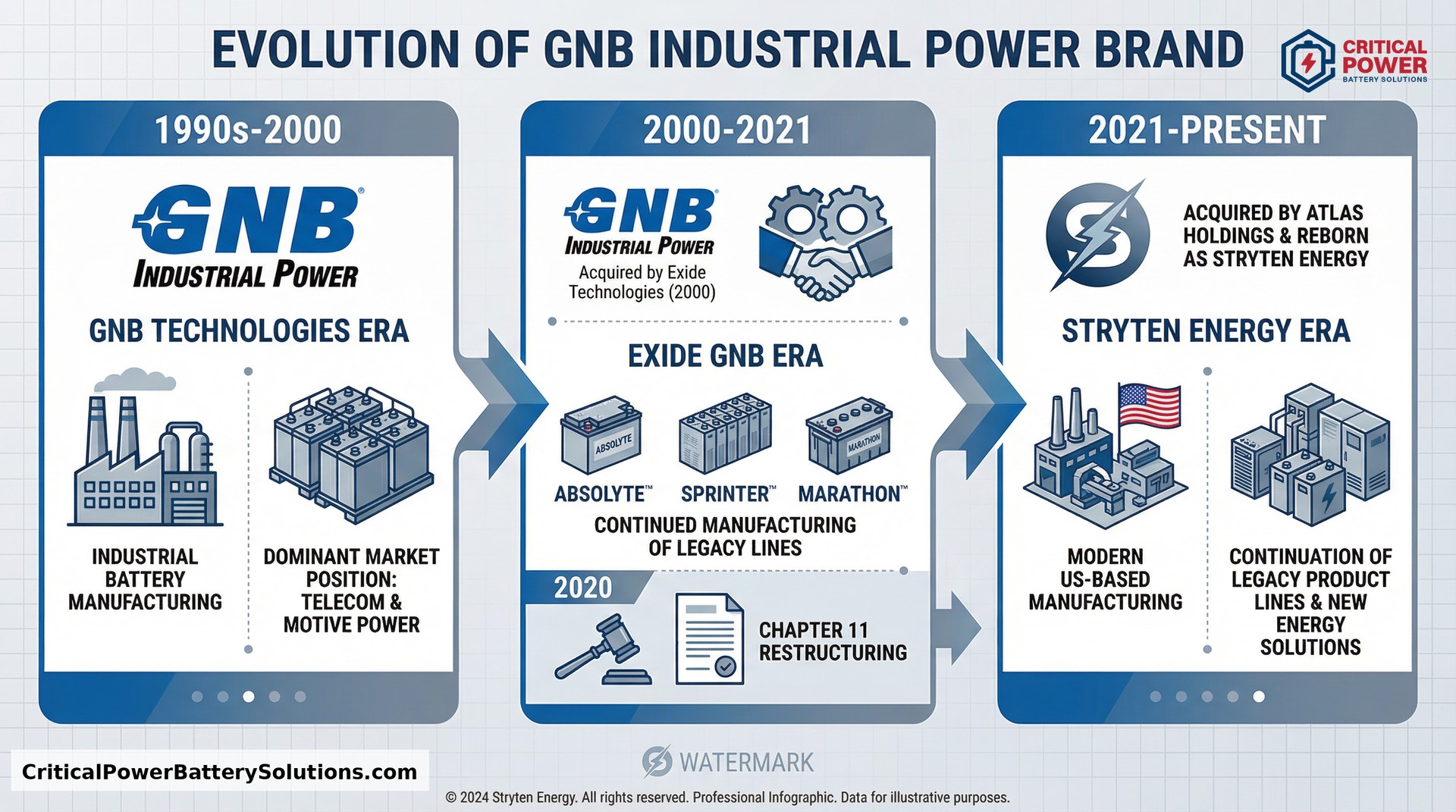
Understanding the corporate timeline is essential for facility managers seeking authentic replacements for GNB Industrial Power systems. The engineering specifications that defined the GNB era have been preserved, but the manufacturing entity has evolved.
The GNB Era and Exide Acquisition
Throughout the 1990s and early 2000s, GNB Technologies established itself as a dominant force in the motive and network power sectors. Their “Absolyte” line became synonymous with seismic stability in telecom applications. In 2000, Exide Technologies acquired GNB, integrating it into its global portfolio. For two years, the products were marketed as Exide GNB, solidifying the link between the two giants.
The 2020/2021 Pivot
In 2020, Exide Technologies entered Chapter 11 restructuring. This process resulted in a strategic separation of the company’s automotive and industrial assets. While the automotive arm was sold separately, the industrial division, which held the intellectual property for GNB’s network power solutions, was acquired by Atlas Holdings.
The Birth of Stryten Energy
In August 2020, Atlas Holdings launched Stryten Energy as a standalone company. According to corporate press releases from the acquisition, this move was designed to focus specifically on energy storage solutions for the North American market. Today, Stryten Energy continues to manufacture the Absolyte, Marathon, and Sprinter product lines in the United States. For buyers, this means that while the sticker on the jar now reads “Stryten,” the internal plate geometry, alloy composition, and performance curves remain true to the original GNB specifications.
From GNB to Stryten: the original source documents
The GNB Industrial Power to Stryten Energy transition is one of the most asked about brand changes in the industrial battery world. Three primary source documents settle every question buyers and engineers raise.
-
Stryten Energy GNB rebrand announcement. Formally introduced the E-Series naming for the entire industrial portfolio in March 2023. -
Stryten Energy manufacturer’s declaration. Certifies that “the design, engineering, and product manufacturing remains unchanged from the GNB product to the Stryten Energy product.” -
Stryten Energy authorized reseller letter for CPBS. Confirms CPBS’s good standing across the complete Essential Power line, covering Absolyte, Flooded Classic, AGM, and chargers.
Innovation Case Study: The Absolyte Revolution
The Absolyte battery is not merely a battery; it is a structural engineering solution designed for hostile environments. Its ubiquity in US Telecom infrastructure is largely due to its ability to withstand significant physical stress without compromising electrical continuity.
The Problem: Seismic Instability
Telecom huts and remote utility sites on the West Coast face a unique challenge: UBC Zone 4 seismic activity. In these high-risk areas, standard battery racks can buckle under lateral forces, causing catastrophic system failure during an earthquake, precisely when communication networks are most critical. The International Building Code (IBC) mandates that essential facilities in Seismic Design Categories D, E, and F must maintain function during seismic events, requiring equipment to resist lateral forces often exceeding 0.5 times the system weight.
The Solution: Modular Stacking
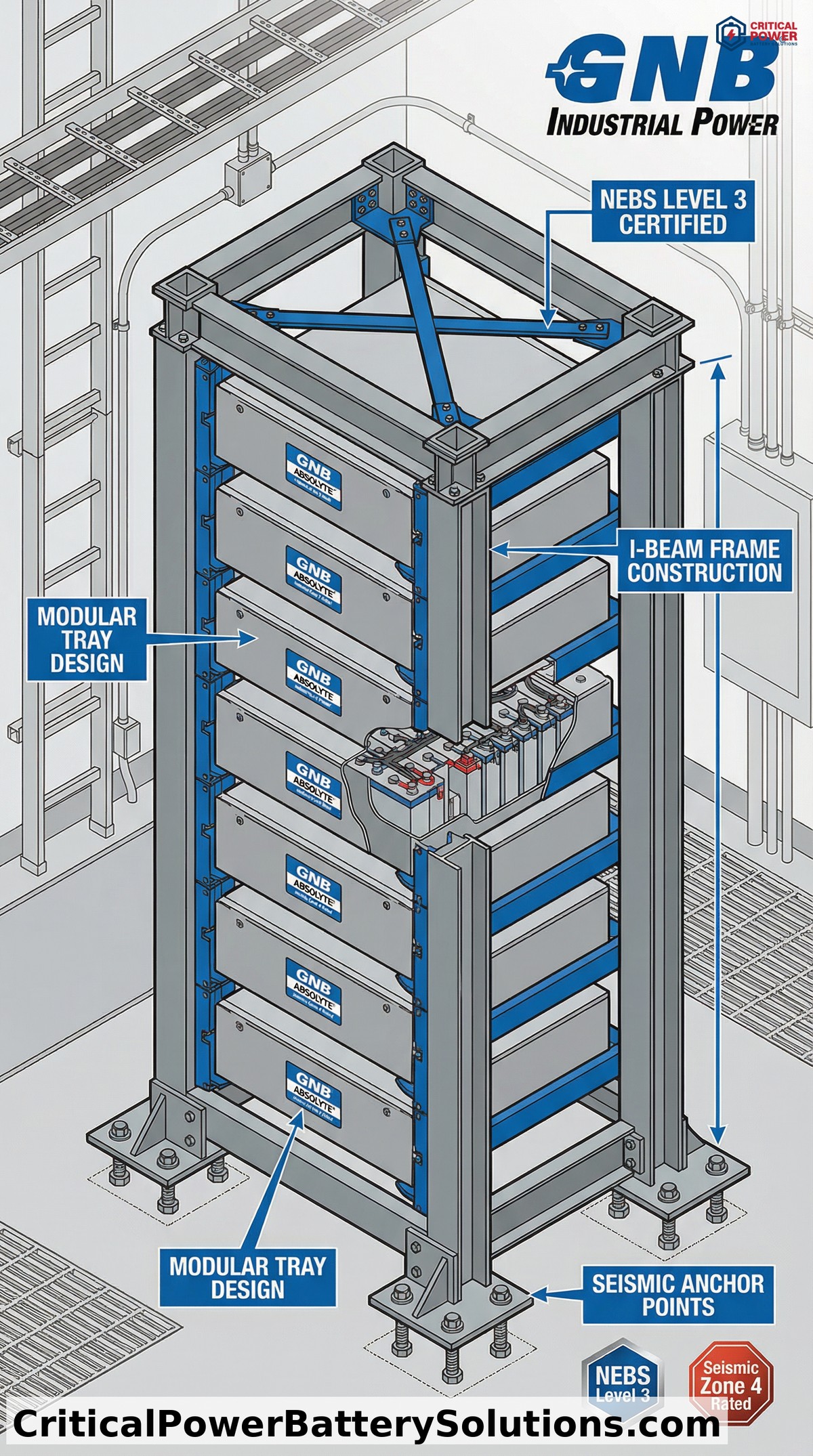
GNB engineers addressed this by developing the Absolyte’s unique modular tray design. Rather than sitting on open shelves, Absolyte cells are encased in steel modules that stack vertically. This creates a “solid wall” of energy storage.
I-Beam Construction: The stacking frame functions like a steel I-beam, providing immense structural rigidity.
NEBS Level 3: The design meets Network Equipment-Building System (NEBS) Level 3 criteria, ensuring operation even during severe tremors.
Seismic Certification: When properly anchored, these systems are rated for Zone 4 applications.
For facilities requiring these specific seismic capabilities, the modern Stryten Absolyte GP remains the industry standard.
👉 Find Replacements: Stryten Energy Absolyte replacements
Innovation Case Study: Data Center Reliability
While Absolyte conquered the telecom mountains, the Sprinter battery and Marathon series became the workhorses for Uninterruptible Power Supply (UPS) systems in data centers.
The Problem: Density & Heat
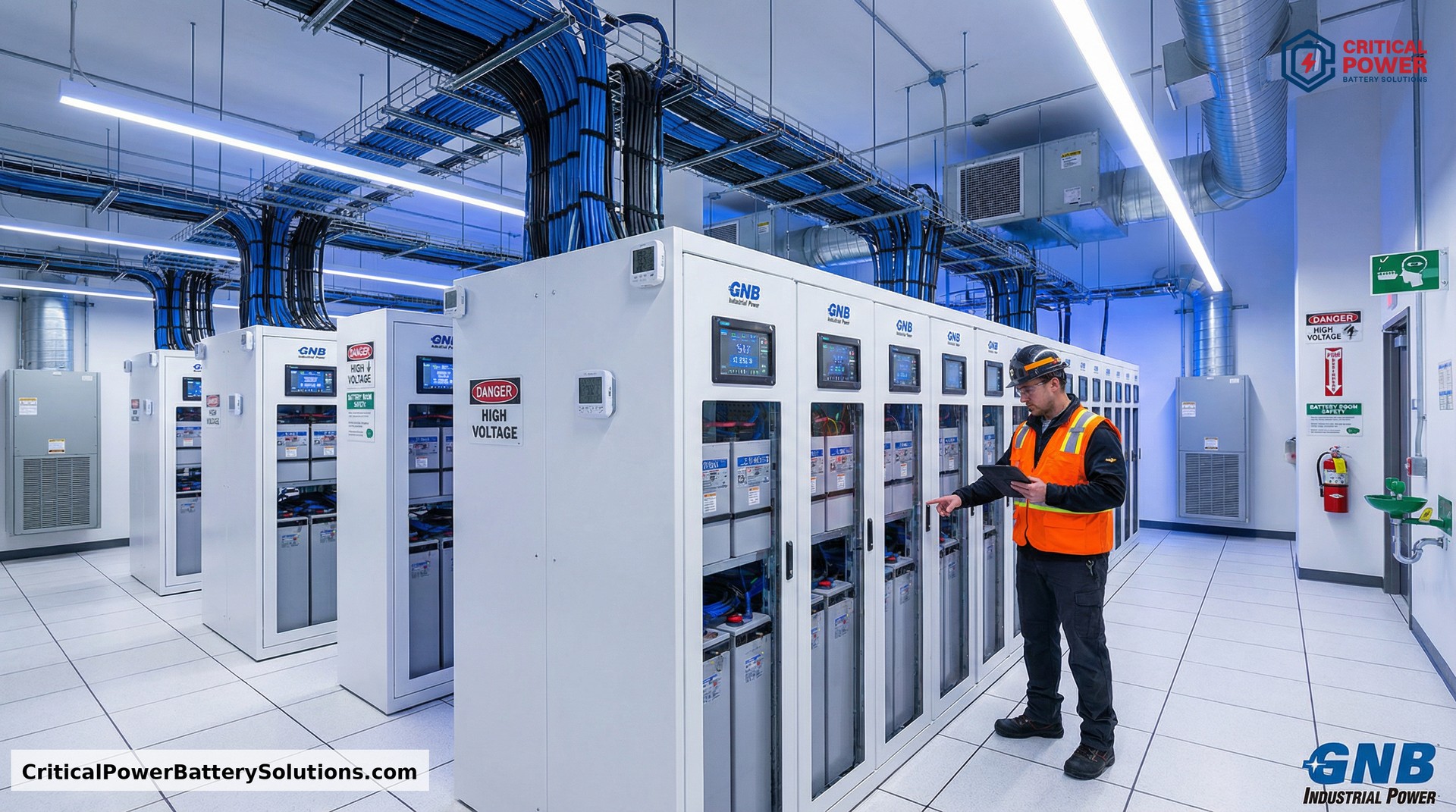
Data centers, particularly in hubs like Northern Virginia and Texas, operate under intense pressure to maximize power density. Facility managers often pack Valve Regulated Lead Acid (VRLA) strings into tight cabinets to save floor space. This density creates a significant risk of battery thermal runaway, a condition where a battery generates more heat than it can dissipate, leading to a self-sustaining temperature rise that can melt casings or cause fires. IEEE 1188 guidelines recommend strict temperature monitoring to prevent thermal runaway in VRLA systems.
The Solution: Valve-Regulated Tech
The GNB Sprinter series was engineered with a specific lead-calcium-tin alloy and a high-pressure relief valve design to mitigate these risks.
Recombination Efficiency: The chemistry achieves a recombination efficiency of greater than 99%, meaning the hydrogen and oxygen generated during charging are recombined back into water within the cell.
Thermal Management: This high efficiency reduces off-gassing and lowers the thermal burden on the facility’s HVAC system.
High-Rate Discharge: The internal grid structure is optimized for the rapid, high-current discharge required to bridge the gap between a grid outage and generator startup.
For operators looking to replace aging UPS strings, the Stryten Sprinter and Marathon lines retain these critical safety features.
👉 Compare High-Rate Options: Front-terminal telecom batteries
AI Gap: Engineering the “Drop-In” Replacement
Artificial Intelligence tools can generate general advice, but they cannot read the dust-covered date code on a battery that has been sitting in your switchgear room for a decade. Replacing a legacy GNB Industrial Power unit requires precise cross-referencing to ensure the new system matches the load profile and physical footprint of the old one.
Reading Legacy Date Codes
Before ordering replacements, you must verify the age of your current string to determine if it is under warranty or past its design life. On most legacy GNB industrial blocks, the date code is hot-stamped into the plastic cover, often near the negative terminal.
Format: Typically a 4-5 character alphanumeric code.
Decoder: The first letter often represents the month (A=January, B=February, skipping ‘I’), and the following numbers represent the year.
Note: If the stamp is illegible due to dust or heat warping, check the serial number on the main label.
The Cross-Reference Guide
Use the table below to identify the modern Stryten equivalent for your legacy GNB model.
| Legacy GNB Model | Application | Modern Stryten Replacement | Notes |
|---|---|---|---|
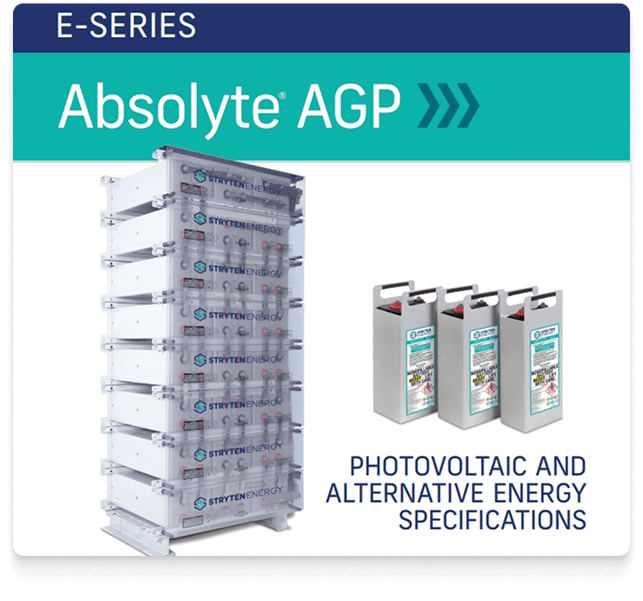
| GNB Absolyte II / IIP | Telecom / Solar | Stryten Absolyte GP | Check adapter plates; footprint is identical but stack height may vary slightly. |
| GNB Sprinter S12V370 | UPS / Data Center | Stryten E-SeriesAGM370 S12V370FL | Direct drop-in. Verify terminal torque specs on new units. |
| GNB Marathon M12V | Utility / Switchgear | Stryten E-Series AGM155/AGM180 | Ensure the “F” (Front Terminal) or “T” (Top Terminal) suffix matches your cabling. |
| GNB Flooded Classic | Utility | Stryten Classic Flat Plate (MCX, PDQ, H1T, NXT) | Requires specific gravity checks upon commissioning. |
Sizing & Capacity Checks
Warning: Never replace a battery based solely on physical dimensions.
Battery capacity degrades over time, and your facility’s load has likely increased since the original installation. Simply swapping “like-for-like” based on a 10-year-old spec sheet may leave you underpowered.
According to IEEE 485, proper sizing requires analysis of load profiles and aging factors. The standard dictates that batteries should be sized to handle the “End of Life” capacity (typically 80%), not just the fresh capacity. A Stryten Energy replacement should be calculated to meet your current load requirements, including a safety margin for aging.
Frequently Asked Questions
Who makes GNB batteries now?
Stryten Energy manufactures GNB industrial batteries. Following the acquisition of the GNB Industrial Power division from Exide Technologies in 2021, the products were rebranded but retained their original engineering specifications, manufacturing tooling, and US-based production facilities.
Is Exide Technologies still in business?
Exide Technologies underwent restructuring in 2020. While the automotive division was sold separately, the industrial power division (GNB) was acquired by Atlas Holdings and became Stryten Energy. The Exide brand primarily exists today in the automotive sector, distinct from the industrial network power solutions.
What is the lifespan of a GNB industrial battery?
Design life varies by model. Absolyte batteries typically feature a 20-year design life in float applications at 25°C (77°F). Sprinter and Marathon series typically offer a 10-12 year design life. Real-world life depends heavily on maintenance and operating temperature; for every 8°C (15°F) rise above 25°C, battery life is cut in half.
Can I replace GNB batteries with Leoch?
Yes, in many applications. Leoch offers high-quality VRLA and Pure Lead batteries (like the PLH series) that can serve as excellent alternatives to legacy GNB models. Leoch battery alternatives are often used when specific GNB models have long lead times, but always verify footprint and terminal placement before switching brands.
How do I read a GNB battery date code?
Look for a hot stamp on the cover near the negative terminal. The code typically starts with a letter indicating the month (A-M, skipping I) followed by digits for the year. For example, “C15” would indicate March 2015. If the stamp is faded, the serial number on the label can be decoded by the manufacturer.
What is the float voltage for GNB Absolyte batteries?
The recommended float voltage for Absolyte batteries is typically 2.25 volts per cell (VPC) at 25°C (77°F). However, temperature compensation is critical; consult the specific I&O manual or IEEE 485 guidelines for adjustments. Operating without temperature compensation can lead to undercharging in cold weather or thermal runaway in heat.
Limitations, Alternatives & Professional Guidance
Limitations of Lead-Acid
While GNB/Stryten lead-acid technology is robust and proven, it does have limitations. These systems are heavy, requiring reinforced floors, and they demand regular maintenance (visual inspections and torque checks). For facilities where weight or space is a primary constraint, Lithium-Ion solutions are emerging as a viable alternative, offering higher energy density and reduced weight, though often at a higher initial capital cost.
The Importance of Accurate Sizing
“Guessing” on replacements can lead to system failure. As the EIA reports record growth in US battery capacity, the demand for reliable storage is higher than ever. However, reliability is only as good as the sizing calculation. IEEE 485 standards emphasize that load profiles must be calculated precisely. Replacing a battery without accounting for the aging factor or temperature derating can result in a system that fails minutes before the generator kicks in.
Professional Consultation
For simple UPS replacements, a direct swap may suffice. However, for complex strings, sites located in seismic zones, or critical uptime requirements (like 911 centers or hospitals), professional consultation is recommended. An expert can evaluate the DC plant, verify the charger settings, and ensure the new string meets both current load demands and future growth projections.
Conclusion
The name on the jar may have changed, but the engineering DNA remains intact. GNB Industrial Power has evolved into Stryten Energy, continuing a legacy of reliability that powers America’s most critical infrastructure. Whether you require the seismic resilience of the Absolyte GP or the high-density performance of the Sprinter series, the technology persists.
Don’t leave your critical power infrastructure to chance or outdated specifications. Ensure your legacy replacement fits perfectly and meets modern safety standards. Request a Free IEEE 485 Battery Sizing Consultation today from Critical Power Battery Solutions a proud authorized distributor of Stryten Energy Absolyte Batteries.
References
- IEEE Standards Association. (2020). IEEE Std 485-2020 – IEEE Recommended Practice for Sizing Lead-Acid Batteries for Stationary Applications. Link
- International Code Council. (2018). International Building Code (IBC) – Seismic Design Categories. Link
- IEEE Standards Association. (2005). IEEE 1188 – Recommended Practice for Maintenance, Testing, and Replacement of Valve-Regulated Lead-Acid (VRLA) Batteries for Stationary Applications. Link
- Stryten Energy. (2021). Stryten Energy Launches as New Energy Storage Solutions Provider. Link
- U.S. Energy Information Administration. (2024). Battery Storage in the United States: An Update on Market Trends.* Link