Written by: Tom Kierna, Battery Systems Specialist | Critical Power Battery Solutions
Reviewed by: CPBS Technical Director, 40+ Years Electrical Engineering Experience
Last updated: 01 May 2026
Transparency: This article explores industrial battery specifications based on IEEE standards and scientific research. Some links connect to our authorized Stryten and Leoch products. All technical sizing information is verified by our ISO 9001 certified engineering team. Our goal is to provide accurate, defensible procurement data.
This post is the playbook for HOW to write defensible Stryten Absolyte AGP RFQ spec language and run a structured bid response. Its companion, Stryten Absolyte AGP Specifications by Application, is the spec DATA library you Ctrl+F or paste from: master Tier 1+2+3 spec table, per-application certification blocks for Telecom (NEBS Level 3, Telcordia GR-4228), Data Center (UL94 V-0, IBC fire), Utility Substation (IEEE 693-2005 seismic, NERC PRC-005), and Federal/Defense (Buy American Act, IATF 16949, IEEE-535 Class 1E), plus the Legacy GNB cross-reference table with Berger Manufacturer’s Declaration substitution authority.
Table of Contents
Quick Answer: Defensible industrial battery specifications for Stryten Absolyte AGP procurement require four engineering anchors: (1) IEEE 485 sizing with the mandatory 1.25 aging factor at a 77°F (25°C) baseline, (2) explicit 2-volt VRLA AGM cell architecture with documented capacity range (104 to 4,800 Ah), (3) seismic certification to 1997 UBC Zone 4 and 2005 IEEE-693 plus UL 94 V-0 jar flammability, and (4) a mandatory authorized U.S. distributor clause to prevent gray-market substitution and protect OEM warranty pass-through.
Poorly written procurement documents are one of the most costly and preventable failures in industrial power infrastructure. When a Request for Quotation (RFQ) lacks precise engineering language, it opens the door to gray-market suppliers, non-compliant hardware, and voided manufacturer warranties. For facility managers and data center operations directors responsible for 100% uptime, the stakes could not be higher. This guide provides the exact battery specifications, IEEE 485 sizing protocols, and copy-paste RFQ language needed to protect your facility and procurement process.
Critical Power Battery Solutions (CPBS) is an authorized, ISO 9001 certified U.S. industrial battery supplier backed by over 40 years of electrical engineering heritage. Our engineering team conducts IEEE 485 battery sizing calculations daily for mission-critical U.S. infrastructure across data center, telecom, and utility substation environments, giving us the field-verified expertise to provide defensible, engineering-grade procurement documentation that generic AI tools simply cannot replicate.
Understanding VRLA and AGM Battery Specifications
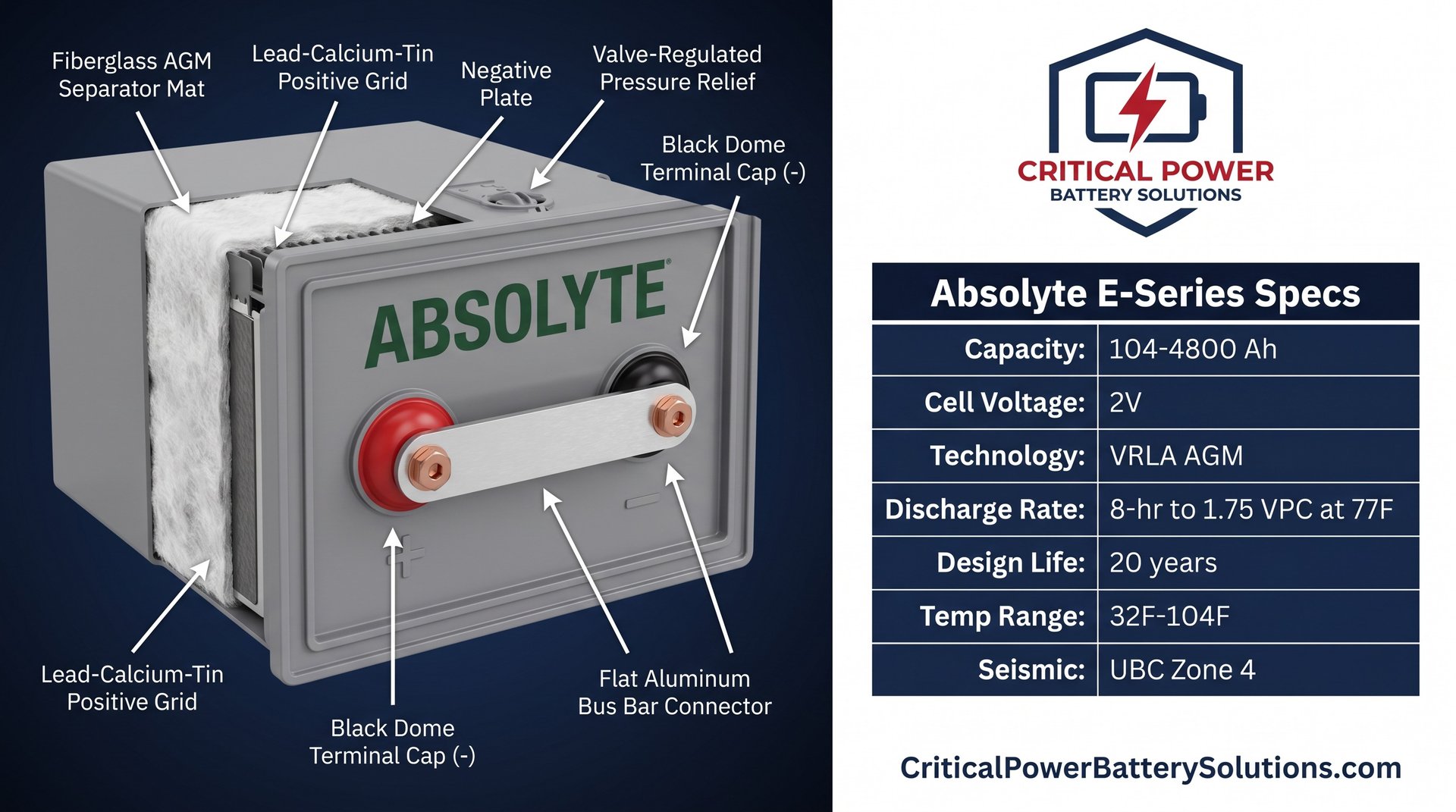
Understanding precise VRLA and AGM battery specifications is essential for selecting the correct power architecture for telecom and data center environments. Valve-Regulated Lead-Acid (VRLA) and Absorbed Glass Mat (AGM) configurations form the foundational technology for modern stationary power systems. By establishing a firm grasp of these chemical and structural parameters, procurement engineers can better evaluate the specific capabilities of premium tier products like the Stryten Energy Absolyte AGP VRLA AGM batteries and ensure their facilities remain operational during grid instability.
A common point of confusion in procurement is the exact relationship when comparing a VRLA vs AGM battery. It is important to clarify that an AGM battery is simply a specialized sub-category of the broader VRLA battery family. While all AGM units are VRLA, not all VRLA units are AGM (the other primary variant being Gel). In an AGM configuration, the liquid electrolyte is suspended within a fine fiberglass mat rather than floating freely. This internal architecture makes the Absolyte battery highly resistant to vibration, completely spill-proof, and exceptionally well-suited for the high-rate discharge demands typical of modern data center battery replacement systems and telecommunications hubs.
When drafting procurement documents, specifying the exact capacity range is critical. The Stryten Absolyte E-Series offers a massive operational range from 104 to 4800 Ampere-hours (Ah) across multiple module configurations (2-cell and 4-cell), with each cell delivering a 2V nominal output. These 2V cells are typically strung together in series to create large-scale 48V telecom plants or massive UPS battery strings. The 2V configuration is favored in utility infrastructure because it allows for granular system sizing and easier single-cell replacement compared to monolithic 12V monoblocs. However, engineers must also note operational limitations: expected depth of discharge (DoD), float voltage windows of 2.23 to 2.27 VPC at 25°C, and strict thermal management requirements all play a significant role in the system’s overall lifecycle. Operating these units outside of their specified thermal windows can accelerate chemical degradation and shorten the manufacturer’s published 20-year design life.
Because of their high energy density and minimal maintenance requirements, Stryten Energy Absolyte VRLA AGM batteries remain the industry standard for stationary standby power. Their robust construction, including a flame-retardant polycarbonate container and copper-alloy insert terminals with lead-plated posts, supports the growing demands of national power grids. According to the U.S. Energy Information Administration’s 2024 energy market data, cumulative utility-scale battery storage capacity in the U.S. exceeded 26 gigawatts, highlighting the massive scale of domestic standby power requirements.[1] As these deployments grow, relying on precise mathematical sizing frameworks becomes increasingly vital. For a deeper review of the product itself, see our full Stryten Absolyte AGP technical review.


IEEE 485 Battery Sizing & Temperature Compensation
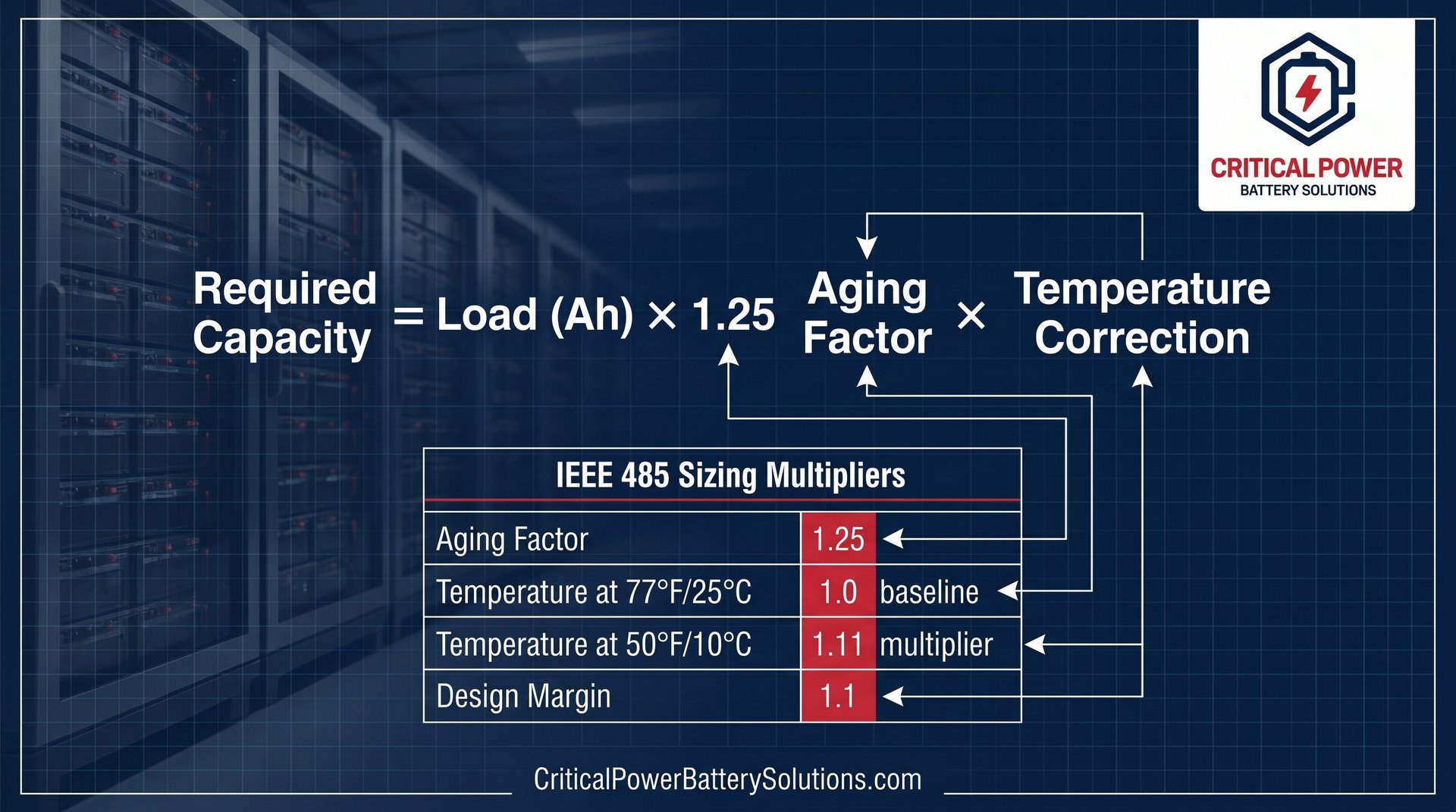
IEEE 485 battery sizing is the industry-standard methodology used to determine the exact capacity required for stationary lead-acid batteries to support a specific critical load. In mission-critical environments, relying on a generic battery sizing calculator or a basic UPS battery sizing calculator often leads to dangerous under-sizing. These generic tools typically fail to account for the complex variables of long-term chemical degradation, ambient temperature fluctuations, and variable discharge rates. To achieve true reliability, engineers must apply the specific mathematical factors required by U.S. standards. For an accessible primer on the broader sizing methodology, see our VRLA battery sizing guide.
The IEEE 485 standard breaks down battery sizing into a series of core mathematical multipliers. The most critical of these is the mandatory 1.25 aging factor. Because lead-acid batteries naturally lose capacity over their operational lifespan, IEEE guidelines stipulate that a battery must be sized 25% larger than the load requires on day one. This ensures that at the very end of its 20-year design life, the battery can still deliver 100% of the required critical load. The 2020 IEEE 485 standard mandates specific mathematical multipliers, including this 1.25 aging factor, to ensure batteries maintain sufficient capacity at the end of their design life.[2]
Temperature correction multipliers are equally vital. Lead-acid battery capacity is rated at a strict U.S. baseline operating temperature of 77°F (25°C). If a facility operates at lower temperatures, the battery’s available capacity temporarily decreases, requiring a multiplier greater than 1.0 to compensate (for example, 1.11 at 50°F / 10°C). Conversely, while higher temperatures may temporarily increase available capacity, they severely degrade the battery’s overall lifespan; the float-voltage temperature coefficient for Absolyte AGP is -1.67 mV/°C per cell from the 25°C base. Furthermore, engineers must account for Peukert’s Law, adjusting the discharge rate calculations for high-current loads, as batteries discharge less efficiently when subjected to rapid, heavy electrical draws.
Failing to apply these exact calculations introduces a severe risk of under-sizing, which may result in catastrophic load drops during extended utility outages. Because the mathematics can be complex and highly specific to individual load profiles, CPBS provides custom IEEE 485 Battery Sizing reports for our clients. For a detailed breakdown of common calculation errors, see our guide on IEEE 485 battery sizing mistakes in telecom applications. By establishing these exact mathematical requirements first, procurement teams can confidently move to the next phase: drafting the actual RFQ language to secure the necessary hardware.
Copy-Paste Stryten Absolyte RFQ Language (AI Gap)
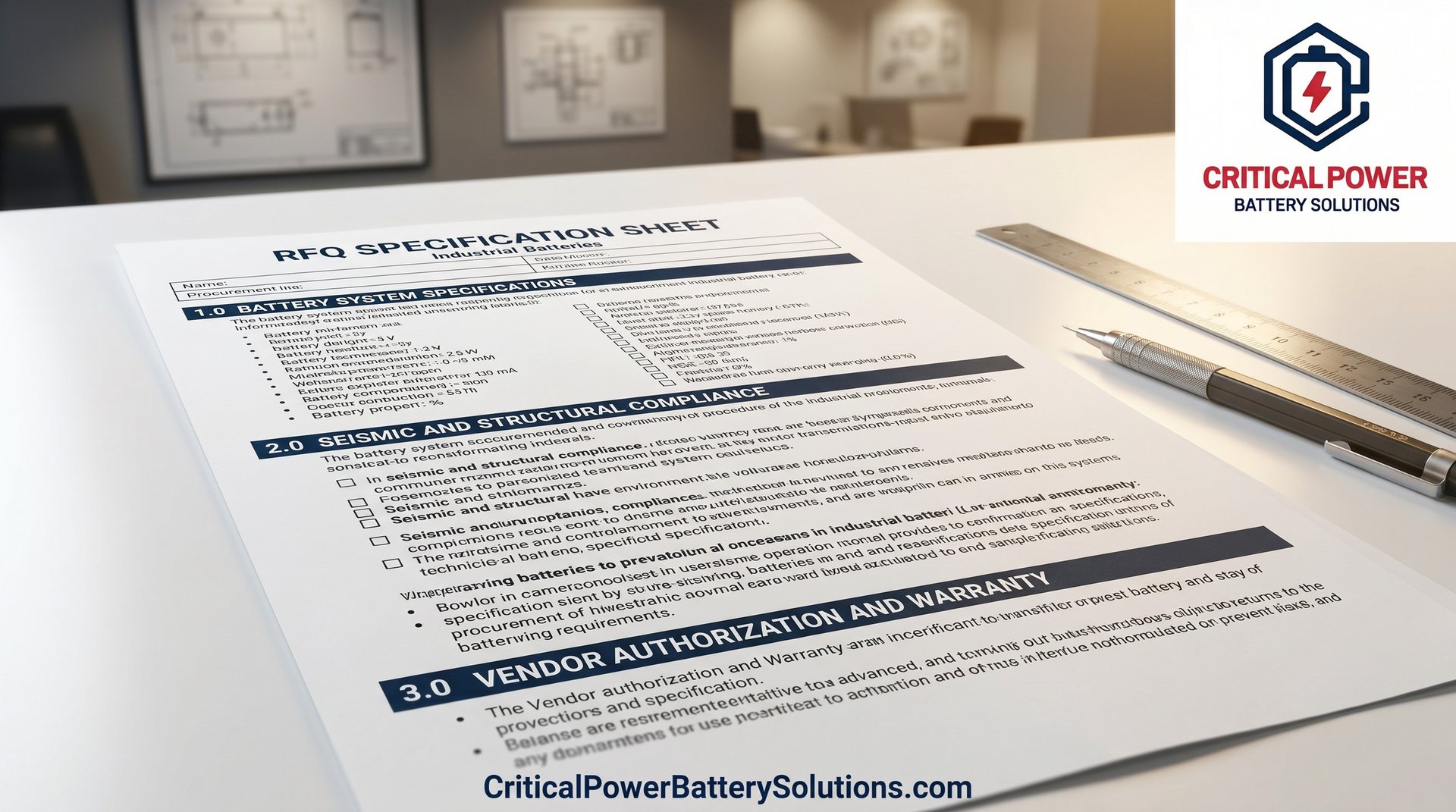
AI tools and generic templates often provide standard procurement boilerplate that leaves facilities vulnerable to unauthorized vendors and non-compliant hardware. What is frequently missing from generic AI advice are the exact capacity ranges, specific seismic certifications, and strict warranty protection clauses required for industrial deployments. Using precise, engineering-backed language helps lock out gray-market suppliers and supports total domestic compliance. As an authorized industrial battery supplier with over 40 years of engineering heritage, CPBS provides the following defensible, copy-paste bid language mapped directly to U.S. building codes and national infrastructure requirements.
Section 1: Core Capacity & Cell Specifications
To ensure you receive the correct VRLA AGM architecture, your RFQ must stipulate the exact cell configuration and internal chemistry.
1.0 BATTERY SYSTEM SPECIFICATIONS
1.1 The stationary battery system shall utilize Valve-Regulated Lead-Acid (VRLA) Absorbed Glass Mat (AGM) technology.
1.2 The system shall be comprised of 2-volt individual cells configured to meet the specified nominal plant voltage.
1.3 The approved product line is the Stryten Energy Absolyte E-Series (or engineer-approved equivalent), with an available capacity range spanning from 104 Ah to 4800 Ah at the 8-hour discharge rate to 1.75 Volts Per Cell (VPC) at 77 deg F (25 deg C).
1.4 Cells must feature a proprietary lead-calcium-tin positive grid alloy to minimize grid growth and reduce gassing.
1.5 Float voltage shall be 2.25 VPC plus or minus 0.02V at 25 deg C, with a temperature coefficient of -1.67 mV/deg C per cell.
Section 2: Seismic & Safety Compliance
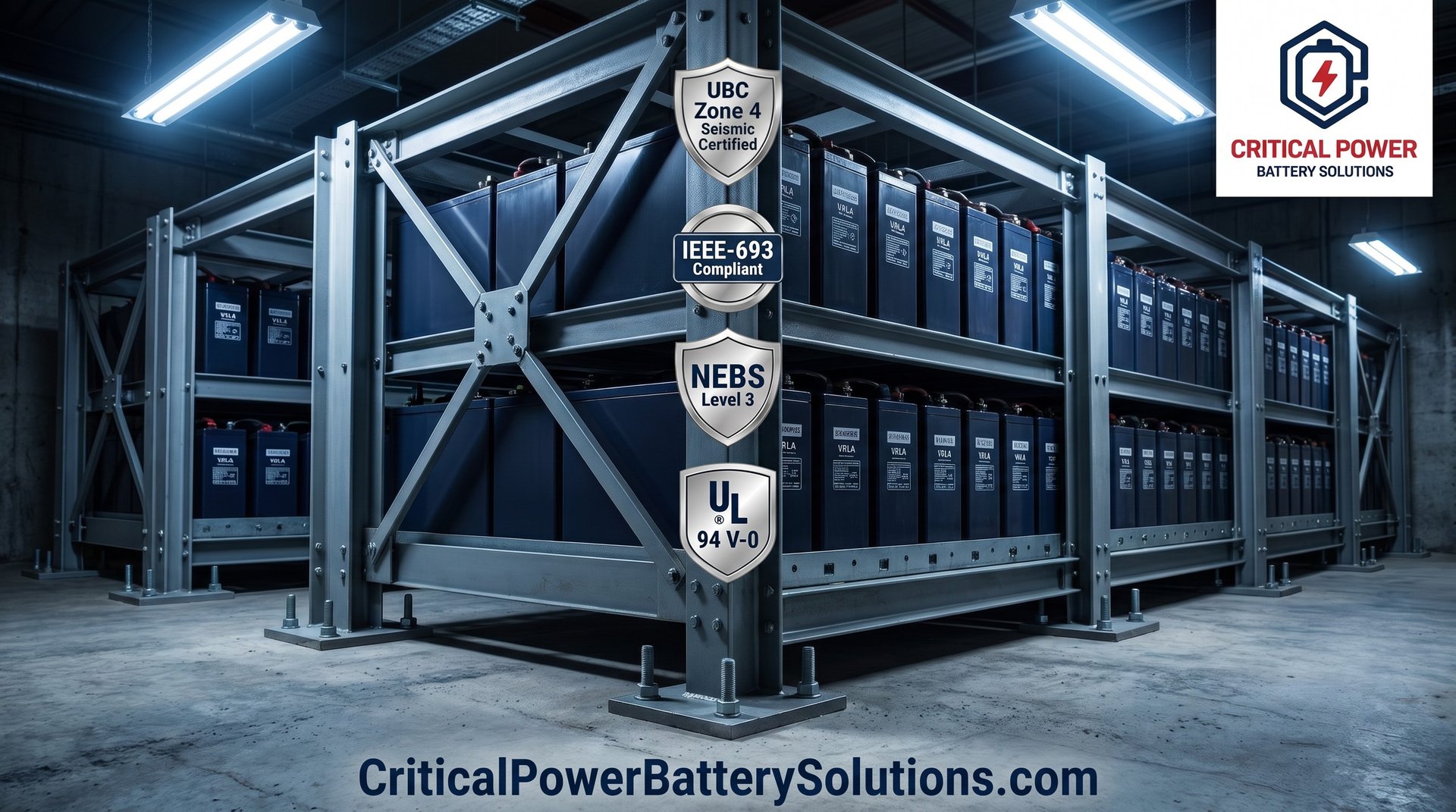
Mission-critical infrastructure must survive environmental anomalies. Specify exact building code compliance to ensure the racking and cell jars meet structural integrity standards.
2.0 SEISMIC AND STRUCTURAL COMPLIANCE
2.1 The battery system and its associated racking must be seismically qualified and certified to meet the 1997 Uniform Building Code (UBC) Zone 4 requirements.
2.2 The system must comply with the 2005 IEEE-693 standard for seismic qualification of battery racks.
2.3 For telecommunications applications, the system must meet NEBS (Network Equipment-Building System) Level 3 certification for spatial and environmental requirements.
2.4 Cell jars must be constructed of flame-retardant polycarbonate with an Oxygen Index of 28 or greater, compliant with UL 94 V-0 standards.
2.5 Battery room ventilation shall comply with IEEE 1635 hydrogen dilution calculations for VRLA systems.
Section 3: U.S. Supply Chain & Authorization
The most common point of failure in procurement is utilizing unauthorized third-party vendors, which often voids the manufacturer warranty.
3.0 VENDOR AUTHORIZATION AND WARRANTY
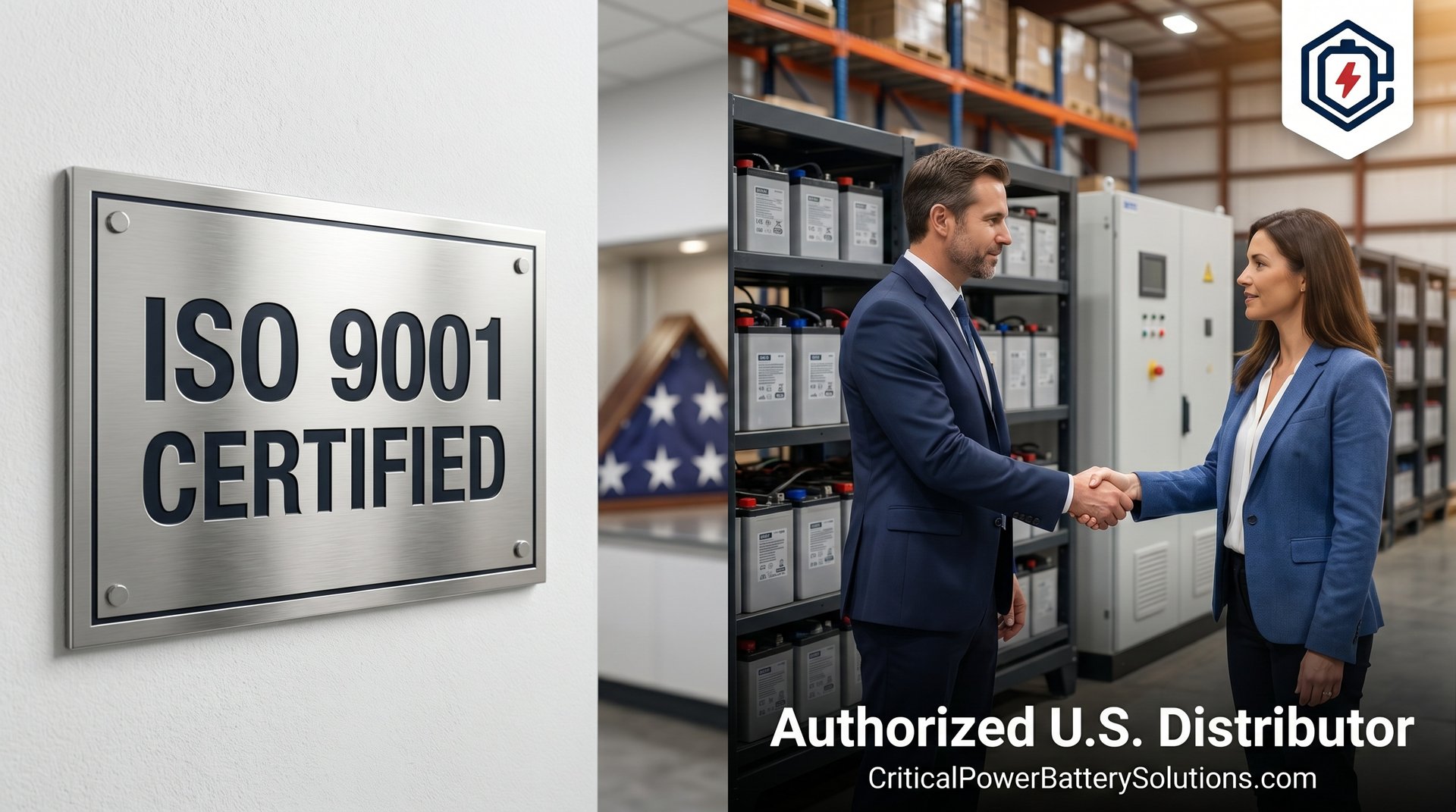
3.1 The bidding vendor must be a direct, Authorized U.S. Distributor for the specified battery manufacturer (Stryten Energy).
3.2 The vendor must possess an active ISO 9001 certification for quality assurance and engineering processes.
3.3 Sourcing through unauthorized "gray-market" brokers or third-party resellers is strictly prohibited and will result in immediate bid disqualification.
3.4 The vendor must provide a direct OEM warranty pass-through, guaranteeing full factory support and rapid domestic shipping for all replacement parts.
3.5 Vendor must furnish, upon request, written manufacturer authorization and current product traceability documentation.
Bonus Step: Verify Against the Primary-Source Documents
For an additional layer of authentication, reference the three signed Stryten Manufacturing letters published on this site. They establish reseller authorization scope, brand continuity from the GNB era, and the official E-Series naming convention:
- Stryten Manufacturing Reseller Authorization Letter (PDF), scope of authorized product line
- Stryten Energy Manufacturer’s Declaration (August 17, 2023, PDF), GNB-to-Stryten product continuity
- Stryten Energy Essential Power Branding Change Letter (March 6, 2023, PDF), E-Series naming announcement
When in doubt, contact Stryten Energy customer service through their official channels at stryten.com to confirm authorization status of any supplier.
Section 4: Installation & Maintenance Requirements
Proper installation and end-of-life disposal are critical for environmental compliance and workplace safety.
4.0 INSTALLATION AND DISPOSAL COMPLIANCE
4.1 All installation personnel must possess documented OSHA safety training specific to industrial battery hazards, spill containment, and proper PPE utilization.
4.2 Inter-cell connections shall be torqued to manufacturer specification (100 in-lb / 11.3 Nm for Absolyte AGP) and connection resistance recorded as commissioning baseline per IEEE 1188.
4.3 The vendor must provide a comprehensive end-of-life recycling plan utilizing approved secondary lead smelters.
4.4 Battery collection and disposal must strictly adhere to current EPA guidelines for lead-acid battery management.
4.5 Quarterly maintenance shall include cell-level voltage readings, visual inspection, and ambient temperature recording per IEEE 1188.
Including these specific clauses offers significant financial protection. As outlined by OSHA’s workplace safety standards for green jobs, facilities must ensure that all personnel handling industrial batteries have documented hazard training and proper safety equipment.[3] Furthermore, procurement documentation should include strict adherence to the EPA’s best practices for battery collection, as improper disposal presents significant environmental and fire risks.[4] Utilizing an authorized U.S. Stryten distributor ensures these regulatory requirements are met seamlessly.
Frequently Asked Questions
What is IEEE 485?
IEEE 485 is the standard recommended practice for sizing lead-acid batteries for stationary applications. It provides the engineering methodology to calculate the exact battery capacity needed to support critical loads during power outages. The standard incorporates specific multipliers for temperature correction, design margin, and a mandatory 1.25 aging factor to ensure reliability throughout the system’s 20-year design life.
Is VRLA the same as AGM?
AGM (Absorbed Glass Mat) is a specific type of VRLA (Valve-Regulated Lead-Acid) battery. While all AGM batteries fall under the VRLA category, not all VRLA batteries are AGM; the other common type is Gel. AGM batteries use a fiberglass mat to absorb the electrolyte, making them spill-proof and well-suited for high-rate discharge applications in data centers.
What voltage is a 50% discharge of an AGM battery?
A 12-volt AGM battery typically reads approximately 12.05 to 12.10 volts at a 50% depth of discharge (DoD) when resting. For 2V industrial cells, 50% DoD is roughly 2.01 volts per cell. Operating voltages vary slightly based on temperature and specific manufacturer design. Always consult your specific battery specifications sheet to ensure accurate load testing.
What should a 6 volt AGM battery read when fully charged?
A fully charged 6-volt AGM battery should read between 6.40 and 6.50 volts after resting off the charger for at least 24 hours. If the resting voltage drops below 6.25 volts, the battery may be sulfated or nearing the end of its operational lifespan. Results may vary slightly depending on ambient room temperature.
What are three types of VRLA batteries?
The three primary types of VRLA batteries are AGM (Absorbed Glass Mat), Gel (Gelled Electrolyte), and Pure Lead (Thin Plate Pure Lead or TPPL). AGM is highly favored for UPS and telecom systems due to its high power density. Gel batteries excel in deep-cycle, high-temperature environments. Pure Lead, such as the Leoch PLH front-terminal series, offers extended service life and rapid recharge capabilities.
Can I charge a VRLA battery with an AGM charger?
Yes, you can typically charge a VRLA battery with an AGM charger if the battery itself is an AGM type. However, if the VRLA battery is a Gel type, using an AGM charger may overcharge and damage it, as Gel batteries require lower charging voltages. Always match the charger’s voltage profile to the manufacturer’s exact operational specifications.
What batteries does Stryten make?
Stryten Energy manufactures advanced lead-acid and lithium-ion batteries for motive power, essential power, and network applications. Their flagship industrial products include the Absolyte AGP (VRLA AGM) series, widely used in telecommunications, utilities, and switchgear. They also produce flooded lines such as the E-Series NXT, MCX, MCT, H1T, and PDQ for various high-demand commercial environments.
Who is the CEO of Stryten Energy?
Mike Judd serves as the Chief Executive Officer and President of Stryten Energy. Under his leadership, the company focuses on advanced battery manufacturing and energy storage solutions across the United States. Stryten operates multiple domestic manufacturing facilities to support U.S. infrastructure and supply chain security.
Limitations, Alternatives & Professional Guidance
While VRLA AGM batteries, like the Stryten Energy Absolyte AGP, are the industry standard for stationary standby power, they have specific operational limitations. Research indicates that lead-acid battery lifespan is heavily dependent on ambient temperature; operating continuously above the 77°F (25°C) baseline will significantly degrade capacity and accelerate aging. Furthermore, deep discharging beyond recommended thresholds can permanently impact the battery’s chemical structure. Facility managers must carefully monitor environmental controls to maximize the return on their infrastructure investment.
Depending on facility requirements, alternative energy storage technologies may be considered. Lithium-ion UPS systems offer a smaller physical footprint and longer cycle life, though they require stricter fire suppression systems and carry a higher initial capital expenditure. Pure Lead Front Terminal configurations from authorized Leoch distributors are another alternative, providing excellent high-rate discharge for compact telecom racks. The optimal choice depends heavily on individual facility constraints and load profiles. With the EIA’s 2024 statistical report noting a record addition of 10.3 GW in new battery storage capacity, facilities have more technological alternatives to evaluate than ever before.[5]
Procuring industrial batteries should rarely be done through guesswork. Facility managers should seek guidance from authorized engineers to conduct comprehensive load testing and site audits prior to purchasing. Engaging a professional ensures that your system meets IEEE 485 sizing standards, complies with local fire codes, and qualifies for full manufacturer warranty protection. An authorized assessment can help identify potential failure points before they impact your critical operations.
Conclusion
Drafting robust battery specifications is the first line of defense in maintaining 100% uptime for mission-critical infrastructure. By understanding the specific parameters of VRLA AGM technology, applying rigorous IEEE 485 sizing factors, and mandating strict compliance standards in your RFQs, you can help protect your facility from premature power failures. Remember that while generic templates may help start the process, exact engineering calculations and authorized supply chains are what ultimately help ensure system reliability.
Critical Power Battery Solutions (CPBS) can support your procurement process as an authorized, ISO 9001 certified U.S. distributor with access to a full range of industrial battery products. Our engineering team leverages over 40 years of experience to provide accurate, defensible data for your facility. Consider requesting our Free Battery Sizing Consultation to receive a custom IEEE 485 compliant sizing report tailored to your specific load requirements. Discover how partnering with an authorized expert can streamline your procurement and support total warranty compliance.
About the Author: Tom Kierna is the Battery Systems Specialist at Critical Power Battery Solutions, with 40+ years of experience in industrial battery systems including 15 years at Stryten/GNB. Tom specializes in battery chemistry selection, application-specific sizing, IEEE 485 load profile analysis, and GNB/Exide-to-Stryten transition guidance for mission-critical infrastructure.
Companion guide: once your specification and RFQ are written, the Absolyte Battery Procurement Guide walks the purchase itself end to end: quote readiness, RFQ to quote, supplier evaluation, purchase order, lead time, and delivery.
References
- According to the U.S. Energy Information Administration’s 2024 energy market data, cumulative utility-scale battery storage capacity in the U.S. exceeded 26 gigawatts, highlighting the massive scale of domestic standby power requirements. EIA Today in Energy: Utility-Scale Storage
- The 2020 IEEE 485 standard mandates specific mathematical multipliers, including a 1.25 aging factor, to ensure batteries maintain sufficient capacity at the end of their design life. IEEE Std 485-2020 Recommended Practice
- As outlined by OSHA’s workplace safety standards for green jobs, facilities must ensure that all personnel handling industrial batteries have documented hazard training and proper safety equipment. OSHA Green Jobs: Battery Recycling
- Furthermore, procurement documentation should include strict adherence to the EPA’s best practices for battery collection, as improper disposal presents significant environmental and fire risks. EPA Universal Waste Regulations (40 CFR Part 273)
- With the EIA’s 2024 statistical report noting a record addition of 10.3 GW in new battery storage capacity, facilities have more technological alternatives to evaluate than ever before. EIA Today in Energy: Battery Storage Capacity Additions