Quick Answer: Battery thermal runaway occurs when a battery generates heat faster than it can dissipate it, driving a self-accelerating temperature rise and potential failure. Sealed VRLA batteries such as the Stryten Absolyte AGP are more susceptible because they trap recombination heat, so they require precise temperature-compensated charging. Flooded lead-acid systems vent gas and act as an aqueous heat sink, making them more thermally stable. NFPA 855 exempts specific telecom and utility lead-acid systems, and IEEE 1635 requires ventilation that keeps hydrogen below 1 percent by volume.
Key takeaways:
- What it is: A self-reinforcing loop where rising temperature lowers internal resistance, which pulls more current and generates still more heat.
- VRLA vs flooded: Sealed VRLA (AGM) traps heat and is more prone to thermal runaway; flooded cells vent and stay more stable.
- Lead-acid vs lithium: Both lead-acid types are non-flammable and far less fire-prone than lithium-ion, which can enter cell-to-cell thermal runaway.
- NFPA 855: Applies to lead-acid ESS over 70 kWh, with exemptions for telecom and utility systems under 50 VAC or 60 VDC that meet NFPA 76.
- IEEE 1635: Size ventilation with Q = 0.054 x I x N at the worst-case equalize charge rate to hold hydrogen below 1 percent by volume.
For facility managers and data center engineers, battery thermal runaway is a catastrophic threat to mission-critical infrastructure. When UPS battery systems generate heat faster than they can shed it, the failure compromises uptime and introduces a fire hazard. With over 40 years of engineering heritage through Advanced Technical Services Inc. (ATS), founded in 1981, and ISO 9001 certified processes, Critical Power Battery Solutions helps ensure your next installation is both safe and fully compliant.
The Physics of Battery Thermal Runaway
Thermal runaway is a thermodynamic instability: it starts the moment internal heat generation exceeds the heat a cell and its surroundings can dissipate. From there, a positive feedback loop takes over.

Internal heat is driven by resistive heating, electrochemical reactions, and oxygen recombination. In an experimental study floating 100 Ah AGM VRLA batteries at elevated voltages, researchers observed that thermal runaway is a transition from stable equilibrium to an unstable state once heat production exceeds cooling capacity.
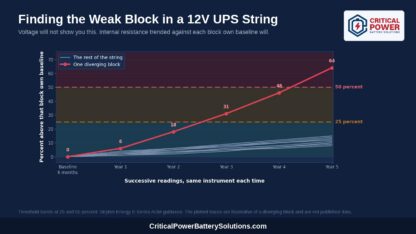
The loop is self-accelerating. As temperature rises, internal resistance drops. Lower resistance draws more float current from the charger, which speeds up oxygen recombination and generates even more heat. Left unchecked, this cycle can end in a lead-acid battery fire or a ruptured casing.

This failure mode is far more severe in lithium-ion. According to the EPA, lithium-ion batteries pose severe fire risks and require separate hazardous-waste handling. By contrast, the lead-acid versus lithium trade-off favors lead-acid on inherent fire safety when the battery is properly maintained and ventilated.
Because chemistry and physical design dictate how heat is managed, the choice between VRLA and flooded systems becomes a critical engineering decision for the whole facility.


VRLA vs Flooded Lead-Acid Fire Safety
Both share the same lead-acid chemistry, but they handle overcharge heat very differently: sealed VRLA traps it, while flooded cells vent it. That single difference drives their fire-safety profiles.

| Attribute | VRLA AGM (Stryten Absolyte AGP) | Flooded / Vented (Stryten E-Series) |
|---|---|---|
| Electrolyte | Immobilized in glass mat, sealed | Free liquid, vented |
| Overcharge heat | Internal oxygen recombination traps heat | Vents hydrogen and oxygen, aqueous heat sink |
| Thermal runaway risk | Higher (heat retained in sealed cell) | Lower (heat carried off by venting) |
| Charging sensitivity | Temperature-compensated charging is critical | More tolerant of temperature swings |
| Maintenance | Maintenance-free, no watering | Requires watering and specific-gravity checks |
| Ventilation | Low hydrogen on float; room ventilation still advised | Hydrogen ventilation required per IEEE 1635 |
| Fire behavior | Non-flammable, UL94 V-0 flame-retardant case | Non-flammable, Pre-Vent flame arresters |
| Best fit | Data centers, telecom, low-maintenance sites | Utility substations, high-temperature or long-life sites |
A flooded (vented) battery uses a dilute liquid electrolyte as a large thermal heat sink. During overcharge, excess energy electrolyzes water into hydrogen and oxygen, which vent away and carry heat with them. That makes flooded cells inherently robust against temperature swings.
A VRLA battery instead runs a closed oxygen-recombination cycle, regenerating water internally. This makes it maintenance-free, but the exothermic reaction traps heat inside the sealed cell, raising thermal runaway susceptibility. A thermodynamic analysis found VRLA batteries convert significantly more overcharge energy into internal heat than flooded batteries.
Manufacturers design safeguards around this. The Stryten Energy Absolyte AGP uses an immobilized glass mat electrolyte and a UL94 V-0 flame-retardant case, while Stryten E-Series flooded cells use Pre-Vent flame arresters. For VRLA, precise temperature-compensated charging remains mandatory.
Navigating US Compliance: NFPA 855 and IEEE 1635
Compliant design comes down to two standards: NFPA 855 sets the fire-mitigation threshold for stationary batteries, and IEEE 1635 sets the ventilation target for hydrogen. Generic AI summaries miss the exemptions and the worst-case sizing nuance below.

| Standard | Applies when / target | Key engineering nuance |
|---|---|---|
| NFPA 855 (2023) | Lead-acid ESS over 70 kWh (252 MJ) aggregate capacity | Exemptions exist for telecom and utility systems under 50 VAC or 60 VDC that comply with NFPA 76 |
| IEEE 1635 / ASHRAE 21 | Keep hydrogen below 1 percent by volume (25 percent of the 4 percent LFL) | Size airflow with Q = 0.054 x I x N using worst-case equalize current, with exhaust mounted high |
NFPA 855. The standard sets a 70 kWh (252 MJ) aggregate threshold for lead-acid batteries. Under NFPA 855 (2023), systems above that are subject to Energy Storage System requirements, with specific exemptions for facilities operating under 50 VAC or 60 VDC.
To qualify for those exemptions, systems typically must:
- Operate under 50 VAC or 60 VDC nominal voltage
- Remain under the exclusive control of communications or electric utilities
- Comply with NFPA 76 (Fire Protection of Telecommunications Facilities)
- Be located in dedicated spaces or deployed outdoors
- Use approved telecom batteries designed for these environments
IEEE 1635. The standard mitigates hydrogen explosion risk by keeping concentrations below 1 percent by volume, a 25 percent margin under hydrogen’s 4 percent Lower Flammability Limit. IEEE 1635 sizes mechanical ventilation to the maximum expected hydrogen generation rate.
When sizing a battery room ventilation fan, engineers use Q = 0.054 x I x N. The nuance most people miss: “I” must be the equalize or boost charge rate, the worst case, not the float rate, and “N” is the number of cells. Because hydrogen is lighter than air, exhaust intakes must sit at the highest point in the room. Our team uses these exact parameters when generating IEEE 485 compliant sizing reports for fire-marshal approval.
Frequently Asked Questions
What is the difference between VRLA and flooded battery?
Flooded batteries use a free liquid electrolyte and vent gas during charging; VRLA batteries use an immobilized electrolyte and are sealed. Flooded cells need periodic watering, while VRLA recombines oxygen internally, making it maintenance-free but more sensitive to high temperatures.
Which batteries are most likely to catch fire?
Lithium-ion batteries are the most fire-prone and most likely to experience severe thermal runaway. Among lead-acid types, sealed VRLA has a higher thermal-runaway susceptibility than flooded, though actual lead-acid fires remain rare when the batteries are properly maintained.
What are the disadvantages of VRLA batteries?
The main disadvantages are a shorter lifespan in hot environments and higher thermal-runaway susceptibility. Because they are sealed, VRLA cells cannot dissipate heat as well as flooded cells and require precise temperature-compensated charging to prevent dry-out and premature failure.
Which is better, a VRLA or a lead-acid battery?
A VRLA battery is a type of lead-acid battery, so the real choice is VRLA versus flooded lead-acid. VRLA suits low-maintenance, spill-proof settings such as data centers. Flooded suits extreme-temperature or maximum-lifespan applications where maintenance is feasible.
Are flooded batteries the same as lead-acid batteries?
Yes, flooded batteries are the most traditional type of lead-acid battery. They use lead plates submerged in a liquid sulfuric-acid electrolyte, distinguished from VRLA batteries, which immobilize the electrolyte. Both rely on the same lead-acid chemistry.
Does NFPA 855 apply to lead-acid batteries?
Yes, NFPA 855 applies to lead-acid systems when aggregate capacity exceeds 70 kWh (252 MJ). Systems under 50 VAC or 60 VDC used exclusively for telecommunications or electric-utility control may be exempt from certain requirements if they comply with standards such as NFPA 76.
How do you calculate battery room ventilation for IEEE 1635?
Size airflow to keep hydrogen below 1 percent of room volume using Q = 0.054 x I x N. The current (I) must be the worst-case equalize or boost charge rate, not the float rate, and exhaust intakes must be mounted high because hydrogen is lighter than air.
What causes thermal runaway in a VRLA battery?
It is triggered when internal heat generation exceeds the cell’s ability to dissipate it. High ambient temperature or excess charging voltage lowers internal resistance, drawing more current, accelerating oxygen recombination, and creating a self-reinforcing heat loop that can destroy the battery.
Do flooded lead-acid batteries experience thermal runaway?
Rarely. Flooded cells act as an aqueous heat sink: excess charging energy electrolyzes water into hydrogen and oxygen, which vent out and carry heat away through evaporative cooling, making them inherently more thermally stable than sealed VRLA batteries.
Are Stryten Absolyte batteries prone to fire?
No, they are engineered to resist fire when properly installed and maintained. Stryten Absolyte AGP uses UL94 V-0 flame-retardant jars and covers. Like all VRLA, it must run on a calibrated temperature-compensated charger. Consult an engineer for IEEE 485 compliant sizing.
Limitations, Alternatives and Professional Guidance
Lab physics is well understood, but real-world fire data is thinner, so field conditions and maintenance quality matter as much as chemistry.

A review by the NFPA Research Foundation notes that while VRLA is more prone to thermal runaway than flooded, the published fire database for lead-acid is far smaller than for lithium-ion. HVAC reliability, localized thermal gradients in large racks, and charger calibration mean lab testing may not fully replicate the field.
Two alternatives help in thermally challenging sites. Migrating from VRLA to flooded improves thermal stability at the cost of watering maintenance. Adding a cell-level Battery Management System (BMS) lets operators catch temperature and resistance drift before a thermal event begins.
Because codes vary by municipality, work with a qualified industrial battery supplier. When planning a substation or large-scale data center upgrade, have engineers perform accurate battery sizing and load calculations, verify HVAC exhaust, and match charging parameters to the specific chemistry.
Conclusion
Preventing battery thermal runaway takes an understanding of thermodynamics, chemistry, and code. VRLA offers maintenance-free convenience but demands strict thermal management, while flooded batteries bring an inherent heat-sink advantage. Meeting the 70 kWh NFPA 855 threshold and the 1 percent IEEE 1635 hydrogen limit are core steps toward a safe installation.
When planning your next UPS battery replacement, an authorized expert helps ensure the system is safe, compliant, and correctly sized. Critical Power Battery Solutions brings 40-plus years of engineering expertise and ISO 9001 quality assurance to mission-critical infrastructure nationwide. Reach out for a Free Battery Sizing Consultation to meet IEEE 485 standards and local fire codes.
👤 Article by: Tom Kierna, Battery Systems Specialist
Reviewed by: CPBS Engineering Team
Last updated: July 10, 2026
Credentials: Authorized Stryten Energy Reseller, ISO 9001 Certified, IEEE Standards Member
References
- NFPA 855 (2023 Edition) – Lead-acid battery systems exceeding a 70 kWh (252 MJ) aggregate capacity threshold are subject to ESS requirements, with exemptions for telecommunications and utility facilities operating under 50 VAC or 60 VDC.
- IEEE Std 1635-2022 / ASHRAE Guideline 21-2022 – Recommends sizing mechanical ventilation to maintain steady-state hydrogen concentrations below 1 percent by volume (25 percent of the Lower Flammability Limit).
- U.S. Environmental Protection Agency (EPA) – Lithium-ion batteries pose severe fire risks and must be taken to separate hazardous waste collection points, contrasting with the closed-loop recycling profile of lead-acid systems.
- Journal of Power Sources (Catherino, 2006) – VRLA batteries convert significantly more overcharge energy into internal heat than flooded batteries due to their internal oxygen recombination cycle.
- Journal of Power Sources (Rand, Moseley et al., 2004) – Thermal runaway represents a transition from stable equilibrium to an unstable state once internal heat production exceeds cooling capacity.
- NFPA Research Foundation – While VRLA batteries are more prone to thermal runaway than flooded types, the published fire database for lead-acid systems is substantially smaller than for lithium-ion.