A discontinued label on a UPS block battery is one of the more stressful things a facility manager can find in a cabinet. The block is the consumable in that cabinet, the cabinet itself usually is not, and the question that matters is narrow: which current model do you order in its place. This page answers that for the GNB Sprinter line, maps the legacy blocks to the current GNB Sprinter NEXT models, and sets out what has to be measured before an order goes out.
Quick answer
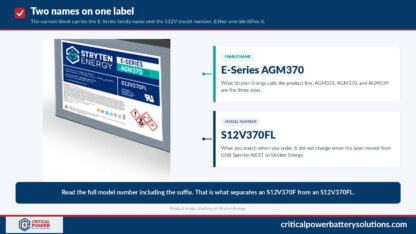
If you are holding a discontinued GNB Sprinter 12V UPS block, the current replacement is a Stryten Energy E-Series AGM model: AGM325, AGM370, or AGM539 depending on the rated capacity of the block you have. These carry the model numbers S12V325FL, S12V370FL, and S12V539FL, and the same three blocks were sold under the GNB Sprinter NEXT label before the Stryten Energy rebrand. The current blocks are smaller and lighter than the legacy blocks they replace, so cabinet fit and terminal type must be confirmed before ordering rather than assumed. This is a battery replacement, not a UPS replacement.
Key points
- The current line is Stryten Energy E-Series AGM: AGM325 at 324.9 watts per cell, AGM370 at 370.3 watts per cell, and AGM539 at 539.0 watts per cell.
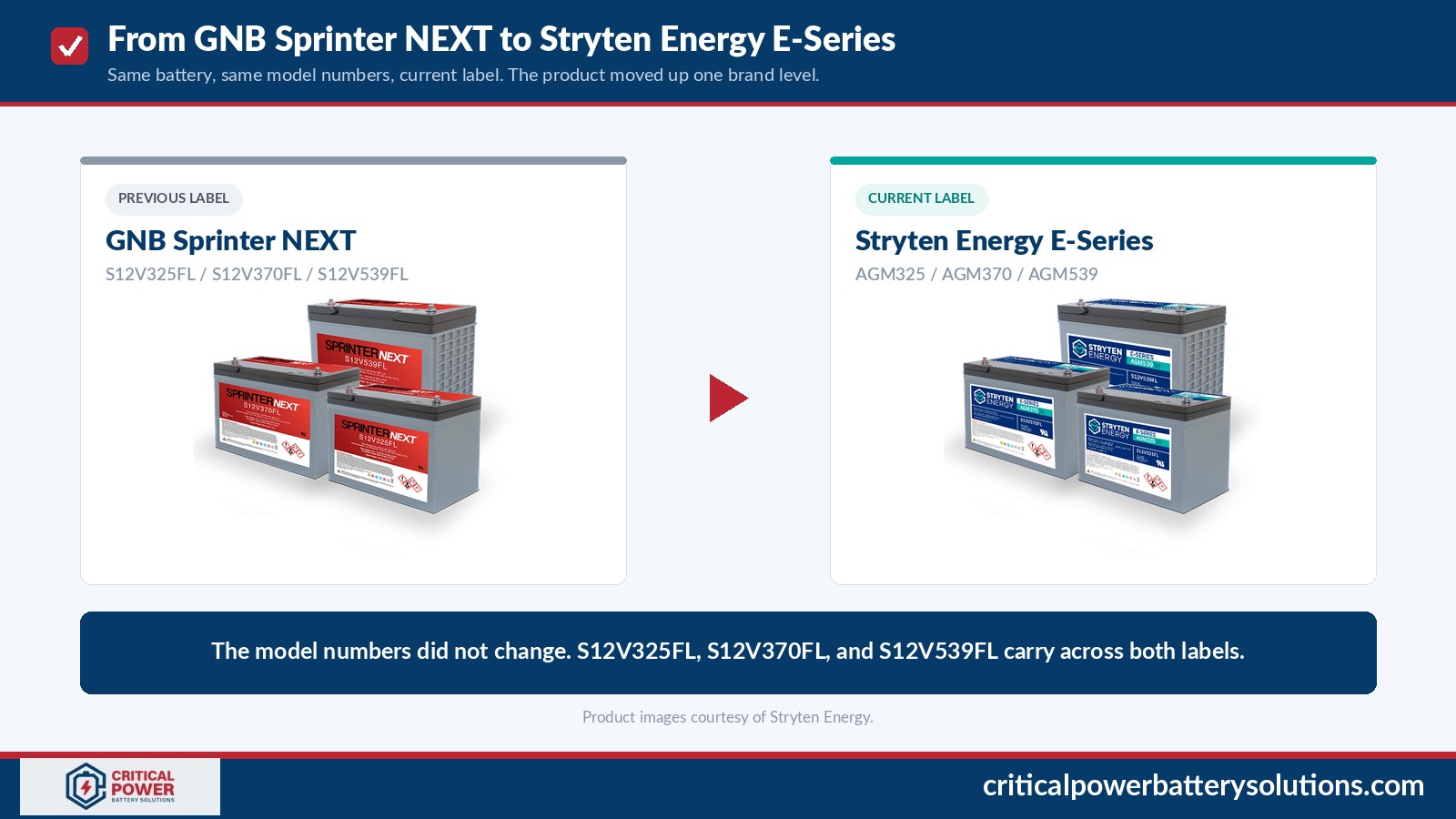
- Those three carry the model numbers S12V325FL, S12V370FL, and S12V539FL. They were sold as GNB Sprinter NEXT before the rebrand and the model numbers did not change.
- Four legacy blocks are still common in the field: S12V300F, S12V370F, S12V370NGF, and S12V550NGF.
- The 370 capacity class ran three generations, so the suffix on the label matters as much as the number.
- Every current block is smaller and lighter than the legacy block it replaces, which changes tray clearance, terminal height, and cable reach.
- Capacity on these products is quoted in watts per cell at a stated end voltage and duration, not in amp hours.
- Confirm the physical installation before ordering. A label lookup on its own is not enough.


Which Sprinter blocks are discontinued and which are current
Four legacy Sprinter blocks are still widely installed and none of them are still manufactured: S12V300F, S12V370F, S12V370NGF, and S12V550NGF. The current line is the Stryten Energy E-Series AGM range, built by Stryten Energy, and it covers three models.
The legacy blocks date from the Exide era of the Sprinter line, which is why an older selection guide or a label in a cabinet may carry Exide branding while current product literature carries GNB and Stryten branding. The product family is continuous across those eras. What changed is the manufacturing entity behind it and, more importantly for anyone ordering, the physical design of the blocks themselves.
All of these are 12V monobloc block batteries, which is the format used inside UPS cabinets and racks. They are a different product class from the 2V cells supplied in steel trays for switchgear and substation duty, and the two are not interchangeable in a UPS string.
Discontinued has a specific and fairly narrow meaning here. It means the model is no longer in production, so new units cannot be ordered against that part number. It does not mean the installed population stops working, and it does not mean the UPS itself is at end of life. A large number of these blocks are still in service and performing normally. The decision in front of most buyers is a battery decision on a normal replacement cycle, not a capital decision about the UPS, and it stays that way as long as the current product can be made to fit the existing cabinet.
Why the brand name on your block may not match the current product
The Sprinter line has been sold under several brand names, and none of those changes altered what the product is.
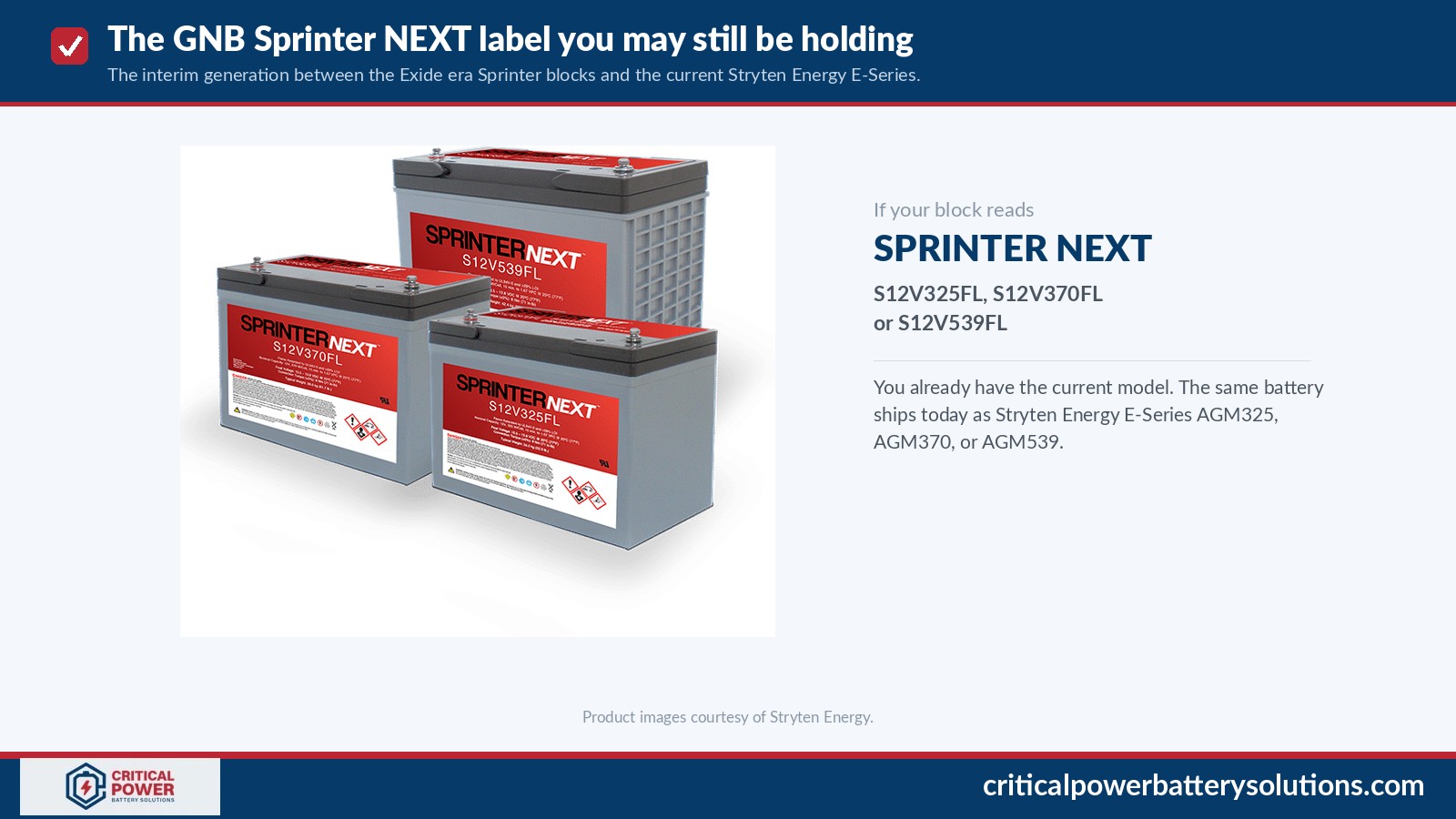
Blocks in service today span several brand eras. The oldest blocks and the original Sprinter selection guide carry Exide branding, from the period when GNB Industrial Power was a division of Exide Technologies. The blocks that followed were sold under the GNB Sprinter NEXT label. The company behind the line today is Stryten Energy, and the current product is the Stryten Energy E-Series AGM range.
The ownership change behind those names happened in 2020. Atlas Holdings acquired the Americas operations of Exide Technologies and the industrial battery business became Stryten. Manufacturing for the Americas continued through that transition. Exide Technologies international operations continue separately in Europe as Exide Group, which is why a European Exide listing is not the same thing as the North American Sprinter line.
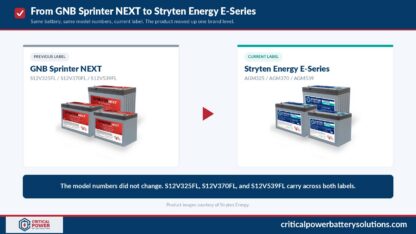
The most recent step is the one most likely to cause confusion at the point of ordering. The blocks sold as GNB Sprinter NEXT are now sold as Stryten Energy E-Series AGM. The model numbers S12V325FL, S12V370FL, and S12V539FL carry across both labels unchanged, so a quote against either name is a quote for the same battery.
For a buyer the practical effect is narrow. The brand on the label is a rough age indicator and nothing more. It does not tell you which generation you are holding, and it does not change which current model replaces it. Both of those come from the model number and the case dimensions.
The generation lineage: F, NGF, and FL
The suffix on a Sprinter model number tells you which generation you are holding, and the 370 capacity class has three of them in service at the same time. F is the oldest generation, NGF is the middle generation, and FL is the current generation.
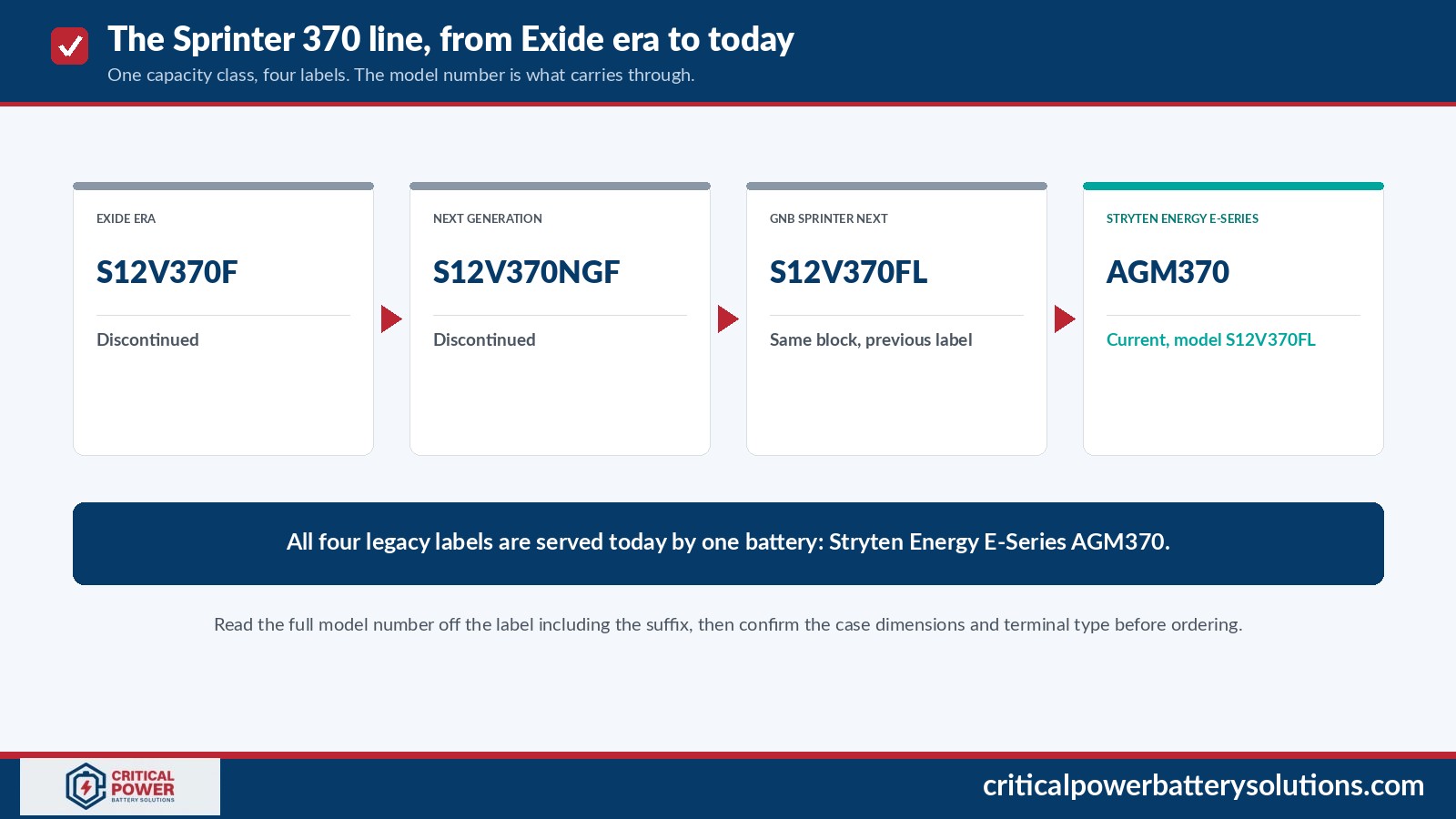
That progression is the reason a single label lookup can mislead. Two blocks can carry the same 370 capacity number and be physically different products from different decades. The S12V370NGF is the clearest example: it does not appear on the older Exide era selection guide at all, because it arrived after that guide was published, which independently confirms it sits between the F and the FL generations.
Identifying which generation you have is a two step job and both steps happen at the cabinet. Read the full model number off the label including everything after the capacity figure, because the difference between an F and an NGF is entirely in those trailing characters. Then measure the case, because labels fade, get painted over, or get replaced during earlier service work, and the dimensions are the fallback identifier when the print is no longer readable. If the label is gone completely, the case dimensions and the terminal style together will usually place the block in the right generation.
This suffix logic applies to the models listed on this page. It is not a decoder that can be run backwards to invent a model number that is not on the current list. A companion post covers how Sprinter NEXT and E-Series model numbers are constructed, including what each part of S12V325FL means.
The replacement map
Use the rated capacity of the block you are holding to find the current model, then confirm the physical installation before ordering.
| Legacy model | Legacy rated capacity (WPC) | Current Stryten Energy E-Series | Current rated capacity (WPC) | What to confirm before ordering |
|---|---|---|---|---|
| S12V300F | 306 | AGM325 (S12V325FL) | 324.9 | Length is close to the legacy block. Width and height both reduce and weight drops by roughly 10 lbs. |
| S12V370F | 373 | AGM370 (S12V370FL) | 370.3 | Length stays at 12.05 in. Width and height both reduce and weight drops by roughly 12 lbs. |
| S12V370NGF | See note below | AGM370 (S12V370FL) | 370.3 | Middle generation and absent from the legacy selection guide. Confirm the label and the case dimensions. |
| S12V550NGF | 550 | AGM539 (S12V539FL) | 539.0 | Closest dimensional match of the group. Weight drops by roughly 5 lbs. |
The current column gives the Stryten Energy E-Series name with the model number in brackets, because both appear on the label and either one will identify the block. This is a comparable replacement map rather than a guarantee of fit. Confirm physical fit and terminal type before ordering. The Sprinter NEXT blocks differ from the legacy blocks in width, height, and weight, so cabinet clearance and cable reach have to be checked against the actual installation. The S12V370NGF is not listed on the older selection guide, so its published legacy rating is not available from that document and the block itself has to be read.
What changed physically between generations, and why fit has to be confirmed
Every current block is smaller and lighter than the legacy block it replaces, and the terminal design changed as well. Those two facts together are why the confirmation step exists.
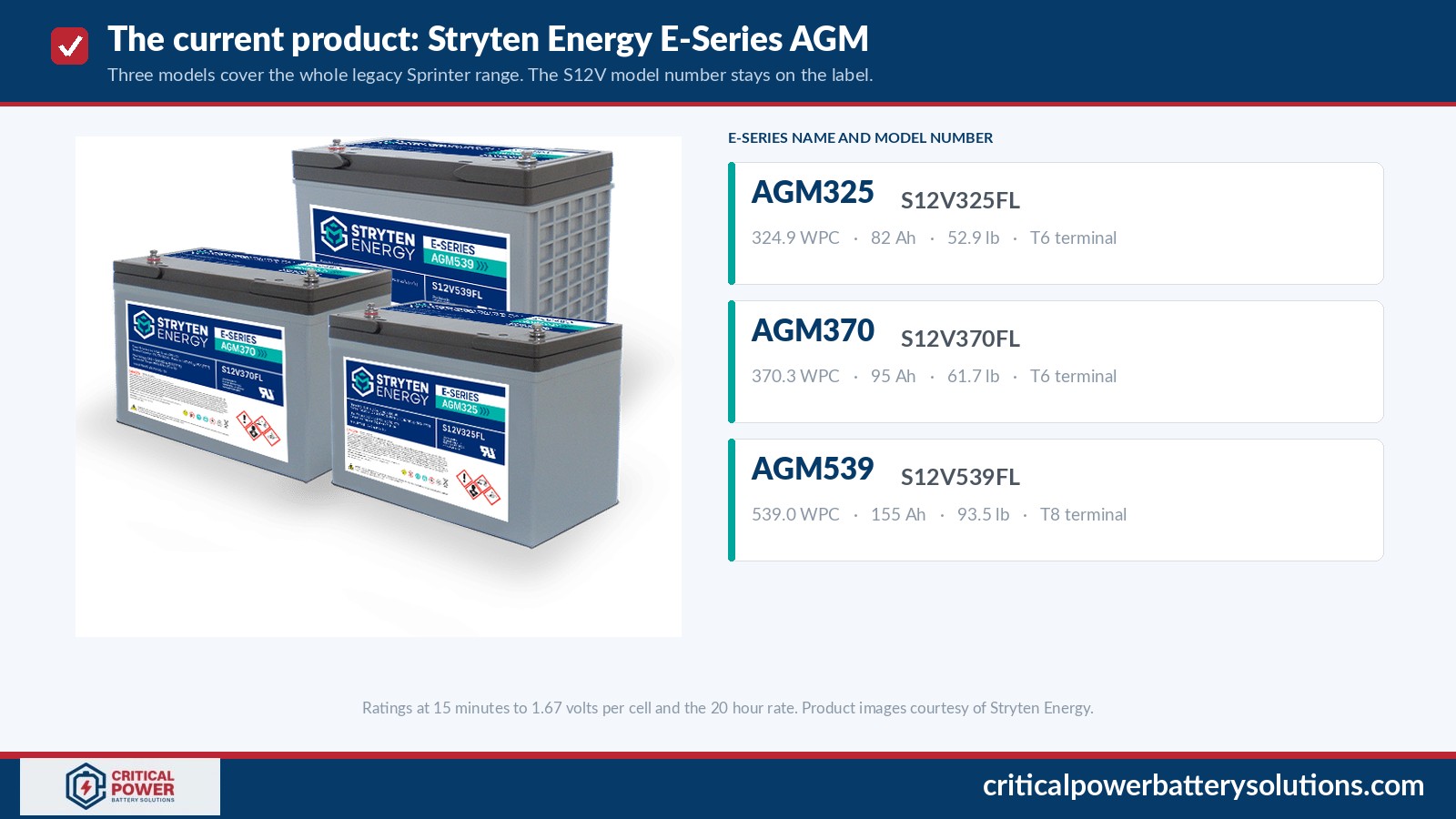
The current models publish the following case data. The S12V325FL measures 10.24 by 6.61 by 8.19 in with a terminal height of 8.31 in and weighs 52.9 lbs. The S12V370FL measures 12.05 by 6.61 by 8.15 in with a terminal height of 8.27 in and weighs 61.7 lbs. The S12V539FL measures 13.19 by 6.77 by 10.83 in with a terminal height of 10.95 in and weighs 93.5 lbs.
Smaller blocks in the same shelf are not automatically an easier install. A block that loses an inch of width can leave an interconnecting cable short, and a change in terminal height moves the lug landing point. The legacy blocks on the older selection guide use an Insert M6 terminal. The current E-Series AGM uses a T6 or T8 threaded insert, tin plated copper alloy, taking a 6 mm bolt at 71 in-lb of torque. A similar bolt size on its own does not confirm that the existing hardware and cables will land correctly, so terminal height and lug fit both need to be checked.
Weight matters for the shelf and for the people doing the work. The S12V539FL at 93.5 lbs is a two person lift in most cabinets, and reduced weight per block changes the loading on a tier that was specified around the older product.
It is worth deciding the swap sequence before the pallet arrives. A string is taken out of service as a unit, so the work window, the temporary load arrangement, and the disposal path for the old blocks all need to be settled in advance. Lead acid blocks are recycled through established channels and the old units generally have scrap value, so confirm who is handling collection rather than leaving several hundred pounds of batteries on the floor of the room.
Reading the legacy selection guide if you own a competitor block
If the block in your cabinet carries another manufacturer name, the Exide era Sprinter UPS Block Battery Selection Guide shows which Sprinter block it was listed against, and the replacement map above then points to the current model.
That document is a manufacturer published historical selection guide. It reflects the products and ratings that were current when it was issued and is used here for that purpose only. It is not a statement about any competitor product as it is specified today, and specifications from other manufacturers should be confirmed against their own current literature.
| Manufacturer | Model on the legacy guide | Listed against | Current model to quote |
|---|---|---|---|
| C&D | UPS12-300MR | S12V300F | S12V325FL |
| C&D | UPS12-310FR | S12V300F | S12V325FL |
| East Penn / Deka | 27HR3500 | S12V300F | S12V325FL |
| EnerSys | HX330-12FR | S12V300F | S12V325FL |
| Douglas | DSU12-350 | S12V300F | S12V325FL |
| FIAMM | 12 FLX 300 | S12V300F | S12V325FL |
| CSB | HRL12330W | S12V300F | S12V325FL |
| Power | PRC/TC 12100S | S12V300F | S12V325FL |
| C&D | UPS12-400MR | S12V370F | S12V370FL |
| C&D | UPS12-350MR | S12V370F | S12V370FL |
| C&D | UPS12-370FR | S12V370F | S12V370FL |
| East Penn / Deka | 31HR4000 | S12V370F | S12V370FL |
| EnerSys | HX400-12FR | S12V370F | S12V370FL |
| Douglas | DSU12-400 | S12V370F | S12V370FL |
| FIAMM | 12 FLX 350 | S12V370F | S12V370FL |
| CSB | HRL12390W | S12V370F | S12V370FL |
| CSB | XHRL12360W | S12V370F | S12V370FL |
| Power | PRC/TC 12120S | S12V370F | S12V370FL |
| C&D | UPS12-540MR | S12V550NGF | S12V539FL |
| C&D | UPS12-540FR | S12V550NGF | S12V539FL |
| EnerSys | HX540-12FR | S12V550NGF | S12V539FL |
| East Penn / Deka | HR5500 | S12V550NGF | S12V539FL |
| Northstar | NSB 12-540 | S12V550NGF | S12V539FL |
| Power | TC 12160C | S12V550NGF | S12V539FL |
| FIAMM | 12 FLX 540 | S12V550NGF | S12V539FL |
The same confirmation step applies at the end of that path. Finding your block on the guide narrows the model. It does not measure your cabinet.
How capacity is rated, and the watts per cell versus amp hours trap
UPS block batteries are rated in watts per cell at a stated end voltage and duration, and comparing amp hour numbers across manufacturers is the most common way a string ends up undersized.
A UPS discharge is a high rate event over a short window, so the meaningful rating is constant power over that window. The Sprinter NEXT models are published at 15 minutes to 1.67 volts per cell: 324.9 watts per cell for the S12V325FL, 370.3 for the S12V370FL, and 539.0 for the S12V539FL. Those same models carry 20 hour amp hour ratings of 82, 95, and 155 Ah, measured to 1.80 volts per cell, which is a completely different duty. Quoting one number against the other is how two blocks that look equivalent on a spreadsheet turn out not to be.
End voltage matters as much as duration. The published constant power tables run from 1.85 down to 1.60 volts per cell across durations from 5 to 90 minutes, and the number moves substantially across that range. If you are working the sizing yourself, the method is set out in our VRLA battery sizing guide, and the errors that show up most often are covered in IEEE 485 battery sizing mistakes. For translating a load into a runtime figure, see how to calculate battery runtime.
The Sprinter NEXT models also publish internal resistance and short circuit current: 4.5 milliohms and 1640 A for the S12V325FL, 4.0 milliohms and 1900 A for the S12V370FL, and 3.1 milliohms and 3100 A for the S12V539FL. Those figures give a service technician a documented starting baseline, which is useful when you set up a testing program. Method is covered in our UPS battery testing guide and in internal resistance measurement. If the question is whether the string is due rather than what replaces it, when to replace backup batteries covers the timing signals.
What to confirm before you order
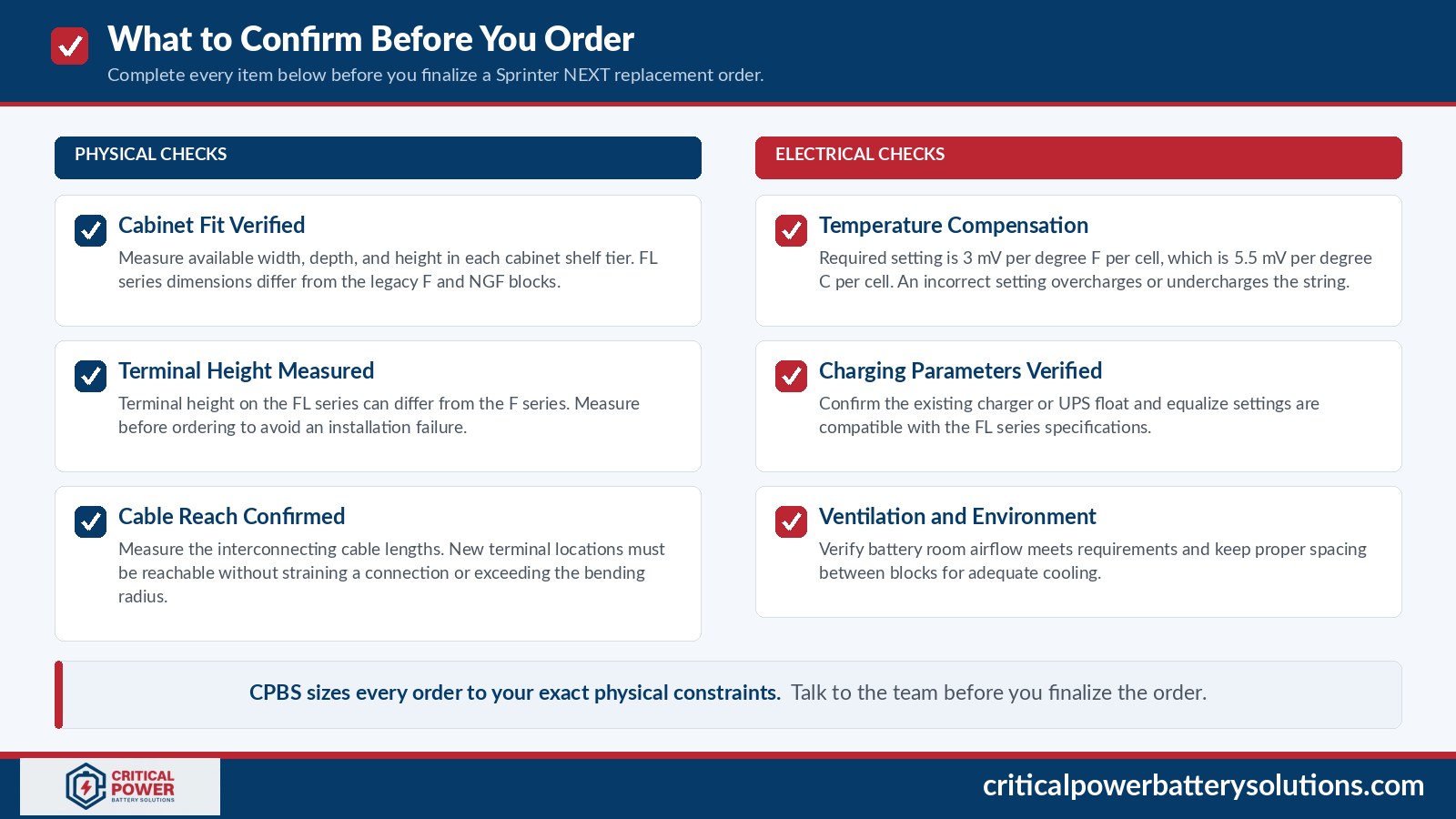
Six checks close the gap between a model number and a block that lands correctly in your cabinet. Work through them before the order goes out rather than on the loading dock.
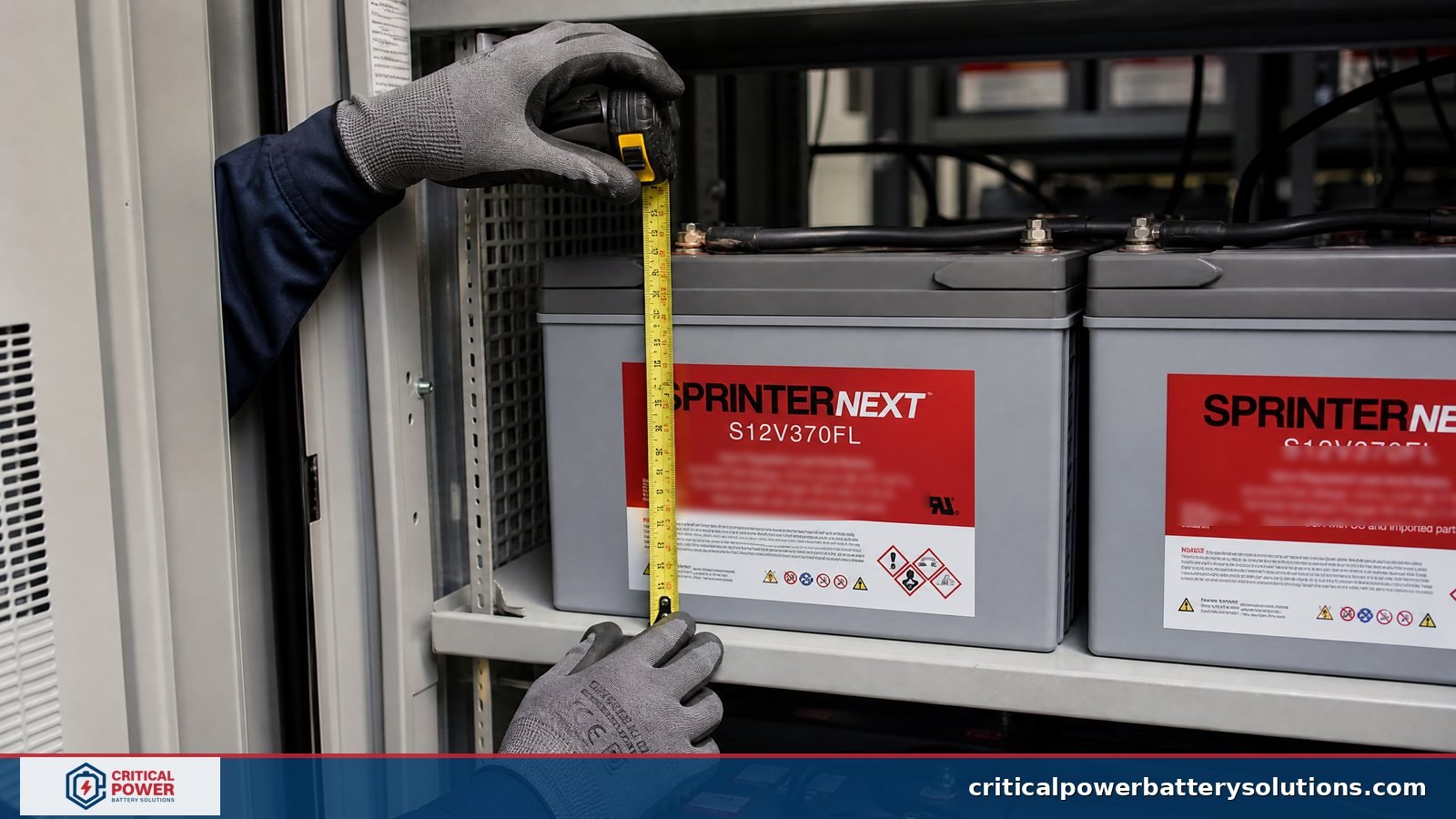
- Read the block itself. Record the full model number including the suffix, and note the case dimensions. This is the step that separates an S12V370F from an S12V370NGF.
- Measure the shelf. Capture the usable width, depth, and height of each cabinet tier, and account for anything that intrudes into that space.
- Measure terminal height and check lug fit. The current blocks use a T6 or T8 threaded insert taking a 6 mm bolt at 71 in-lb. Confirm the existing hardware and cable lugs land on it correctly.
- Check cable reach. Smaller cases move terminal positions. Confirm the interconnecting cables reach without strain and without exceeding the bending radius.
- Confirm charger settings. Verify float and equalize settings against the current specifications, and set temperature compensation at 3 mV per degree F per cell, which is 5.5 mV per degree C per cell.
- Confirm the room. Ventilation and spacing requirements do not change because the blocks got smaller. Our battery room ventilation calculation covers the method.
If the cabinet sits in a data center, the surrounding decisions are covered in UPS battery solutions for data centers and data center battery replacement.
How CPBS handles the order and what documentation comes with it
Critical Power Battery Solutions is an authorized Stryten Energy reseller, and Tom Kierna confirms model, fit, and quantity before anything ships. Tom has more than 40 years in industrial batteries, including 15 at GNB and Stryten, which is the span that covers every generation discussed on this page.
The scope here is aftermarket replacement of 12V VRLA block batteries inside a UPS that is already installed. CPBS does not supply turnkey UPS systems, cabinets, breakers, switchgear, or integration work, and the service is consulting based rather than an on-site installation, commissioning, or maintenance offering. What comes with an order is the product documentation, country of origin and certificate of conformance paperwork where it is required, and the sizing rationale behind the model selected.
Lead time on domestic product typically runs 8 to 10 weeks, which is worth knowing early if the string is already showing its age. Warranty is the Stryten factory pass-through with nothing added by CPBS. Quotes are built around the model, the quantity, the documentation package, and the delivery window.
One clarification worth making, because the part numbers look similar in a search: the GNB Absolyte line is a separate 2V cell product supplied in steel trays for switchgear, substation, and telecom DC plant duty. It is not an alternative to a 12V Sprinter block in a UPS string, and if that is what you are actually holding, the cross reference for that line is the right starting point.
To get a model confirmed and quoted, call 630-984-9718 or email sales@criticalpowerbatterysolutions.com with the model number on the block, the quantity in the string, and the cabinet make if you have it.
Frequently asked questions
What replaces a discontinued GNB Sprinter UPS battery?
A current Stryten Energy E-Series AGM model replaces it: AGM325, AGM370, or AGM539 depending on the rated capacity of the block you are holding. Those carry the model numbers S12V325FL, S12V370FL, and S12V539FL and were previously sold as GNB Sprinter NEXT. Match on rated capacity first, then confirm cabinet clearance, terminal height, and cable reach against the actual installation before ordering.
Is the S12V370NGF still available?
No. The S12V370NGF is discontinued and is replaced by the S12V370FL at 370.3 watts per cell. The FL block is smaller and lighter than the NGF it replaces, so confirm the shelf space and the cable reach before you order rather than assuming the new block lands the same way.
What is the difference between S12V370F, S12V370NGF, and S12V370FL?
They are three generations of the same capacity class. F is the oldest, NGF is the middle generation, and FL is the current generation. They differ in case dimensions, weight, and terminal design, which is why the suffix on the label matters as much as the 370 number in front of it.
Does a Sprinter NEXT battery fit in my existing UPS cabinet?
Usually yes, because the current blocks are smaller than the legacy blocks, but it has to be measured rather than assumed. Check the usable width, depth, and height of the shelf tier, the terminal height, and whether the interconnecting cables still reach without strain.
What does the FL suffix mean on a Sprinter NEXT model number?
FL marks the current generation of the block. It distinguishes the currently manufactured blocks from the older F and NGF generations still installed in the field. The FL blocks are sold today as Stryten Energy E-Series AGM325, AGM370, and AGM539. If the label on your block ends in FL, you are already on the current generation.
Which Sprinter NEXT model replaces the S12V550NGF?
The S12V539FL at 539.0 watts per cell. Of the four legacy blocks it is the closest dimensional match to its replacement, with weight dropping by roughly 5 lbs. It uses a T8 threaded insert, so confirm the terminal height and lug fit before ordering.
Which Sprinter NEXT model replaces the S12V300F?
The S12V325FL at 324.9 watts per cell. Length is close to the legacy block but width and height both reduce and weight drops by roughly 10 lbs, so confirm shelf clearance and cable reach before the order goes out.
What terminal type does the Sprinter NEXT use?
T6 on the S12V325FL and S12V370FL, and T8 on the S12V539FL. Both are threaded inserts in tin plated copper alloy taking a 6 mm bolt at 71 in-lb of torque. The legacy blocks on the older selection guide use an Insert M6 terminal, so confirm terminal height and lug fit rather than relying on bolt size alone.
How long does a Sprinter NEXT battery last?
The published design life is 10 years at 25 degrees C, which is 77 degrees F. Service life in practice depends on operating temperature, discharge frequency, and whether charging and temperature compensation are set correctly. Sustained operation above the rated temperature is the single largest factor in shortening it.
What is watts per cell and why is it used instead of amp hours?
Watts per cell states constant power delivered to a defined end voltage over a defined duration, which is what a UPS discharge actually demands. Amp hour ratings describe long, low rate discharges. Comparing an amp hour figure from one manufacturer against a watts per cell figure from another is a common route to an undersized string.
Can I replace only some of the blocks in my UPS string?
Replacing the full string is the standard practice. In a series string the weakest block sets the limit, so mixing blocks of significantly different age or state of health means the new blocks work against the old ones. If you have a specific situation, such as a single failed block in a recently installed string, send the details to CPBS and it can be assessed on the facts.
How do I get a quote for GNB Sprinter NEXT replacement batteries?
Call 630-984-9718 or email sales@criticalpowerbatterysolutions.com. Send the model number from the label, the quantity in the string, and the cabinet make if you have it. Tom Kierna confirms the model and the fit before a quote is issued so the blocks that arrive are the blocks that install.
About the author: Tom Kierna is a Battery Systems Specialist at Critical Power Battery Solutions, the battery division of Advanced Technical Services Inc. (ATS), an ISO 9001 certified company serving mission-critical power since 1981. Tom has more than 40 years in industrial battery systems, including 15 years at GNB and Stryten, and specializes in chemistry selection, application sizing, and the GNB and Exide to Stryten transition. CPBS is an authorized Stryten Energy reseller. Last reviewed July 31, 2026.
References
- Stryten Energy. E-Series AGM325/370/539 Product Brochure, document SE1075. stryten.com
- Stryten Energy. E-Series AGM325/370/539 Installation and Operating Instructions, document SE2006.
- GNB Sprinter NEXT UPS Batteries, battery specifications sheet. Previous label for the same three blocks.
- Sprinter UPS Block Battery Selection Guide, UPS Top Terminal Valve Regulated Lead Acid (VRLA) Block Batteries. Exide era manufacturer selection guide, used here as a historical reference.
- IEEE 485, Recommended Practice for Sizing Lead-Acid Batteries for Stationary Applications. IEEE Standards Association. standards.ieee.org
- IEEE 1188, Recommended Practice for Maintenance, Testing, and Replacement of Valve-Regulated Lead-Acid (VRLA) Batteries for Stationary Applications. IEEE Standards Association.
- IEEE 1187, Recommended Practice for Installation Design and Installation of Valve-Regulated Lead-Acid Batteries for Stationary Applications. IEEE Standards Association.
- IEEE 1635 and ANSI/IEEE 1635, Guide for the Ventilation and Thermal Management of Batteries for Stationary Applications. IEEE Standards Association.