Quick answer: Legacy GNB Absolyte GP batteries in solar and off-grid systems are replaced by the current Stryten Absolyte AGP, which continues the same product line and the same 50G, 90G, and 100G part number scheme. Only the brand name changed when GNB Industrial Power became Stryten Energy. The exact current part number, tray and terminal fitment, and the float or cycling rating for your duty are confirmed for your string by a specialist at Critical Power Battery Solutions (CPBS), an authorized Stryten reseller.
Key points
- The successor: legacy GNB Absolyte GP solar and off-grid strings map to the Stryten Absolyte AGP, the current generation of the same family, not a substitute brand.
- Same numbering: the 50G, 90G, and 100G series carries into the AGP line, so your legacy number is the fastest route to the current equivalent.
- Confirmed, not assumed: exact part number, fitment, seismic configuration, and float versus cycling rating are confirmed per string, never treated as an automatic drop-in.
- Built for the duty: the Absolyte GP was the first large-format VRLA deep-cycle battery developed for photovoltaic use, engineered with Sandia National Laboratories and in field service since 1983.
- Where to start: send your Absolyte part number or a label photo to Tom Kierna at 630-984-9718 or sales@criticalpowerbatterysolutions.com.
This absolyte solar battery replacement guide answers the question an operator or integrator asks when a legacy Absolyte string in a remote enclosure reaches the end of its service life: the number on the module label points to a battery family that seems to have changed names, so which current battery replaces it, and how do you order the right one for a photovoltaic or off-grid duty cycle? The reassuring short version is that the product family never stopped. The Absolyte GP line that has powered solar and off-grid systems since the 1980s continues today as the Stryten Absolyte AGP, and there is a verified path from the legacy number on your label to the current orderable successor.
Critical Power Battery Solutions (CPBS) is an authorized Stryten reseller and the battery division of Advanced Technical Services Inc. (ATS), an ISO 9001 certified, family owned company serving industrial customers since 1981. Tom Kierna, the CPBS battery specialist, brings more than 40 years in industrial batteries, including 15 years at GNB and Stryten, so he supported this line through the eras your label may reference. This guide owns the solar and off-grid application. It hands the generic part-number lookup, the sizing math, lifespan depth, and hot-climate derating to the CPBS guides that own each of those lanes, and links them where they belong.
GNB to Stryten: The Brand Continuity Behind the Replacement
The Absolyte line did not disappear; it changed names. Stryten Energy (formerly GNB Industrial Power, a division of Exide Technologies) builds the Absolyte AGP today in the USA, continuing the same design and the same part number scheme.
Line continuity is documented in the Stryten Energy Manufacturer Declaration of August 17, 2023, which affirms that the design, engineering, and manufacturing of the product carried over from the GNB battery to the Stryten battery, with the brand name being the change. The deeper history, from the GNB years through the Stryten transition, lives in the Absolyte battery history guide. One geographic note keeps the story accurate: in the Americas the Absolyte line is a Stryten Energy product, while Exide Technologies international operations continue separately in Europe as Exide Group.
| On your legacy label | Current name today |
|---|---|
| GNB Industrial Power | Stryten Energy |
| GNB Absolyte GP | Stryten Absolyte AGP |
| Absolyte GP 50G / 90G / 100G series | Stryten Absolyte AGP, same series scheme continues |
Three steps take you from the legacy string to the confirmed successor:
- Read the label: record the family name and part number from the module or cell, for example a number like 100G99 or 3-100G25.
- Gather site data: note the string voltage, module count, application, and site conditions such as temperature range and autonomy target.
- Send the worksheet: pass both to CPBS and receive the confirmed Absolyte AGP equivalent, sized to your duty cycle, with a quote.
If your concern is simply whether the line is still available at all, the GNB availability guide covers supply reassurance in full; this guide moves straight to the solar and off-grid replacement itself.
Where Legacy Absolyte GP Batteries Show Up in Solar and Off-Grid Systems
Absolyte GP strings sit at the heart of remote DC power, wherever a reliable reserve has to ride through days without grid support. If any of these describe your site, the string on the wall is very likely an Absolyte:
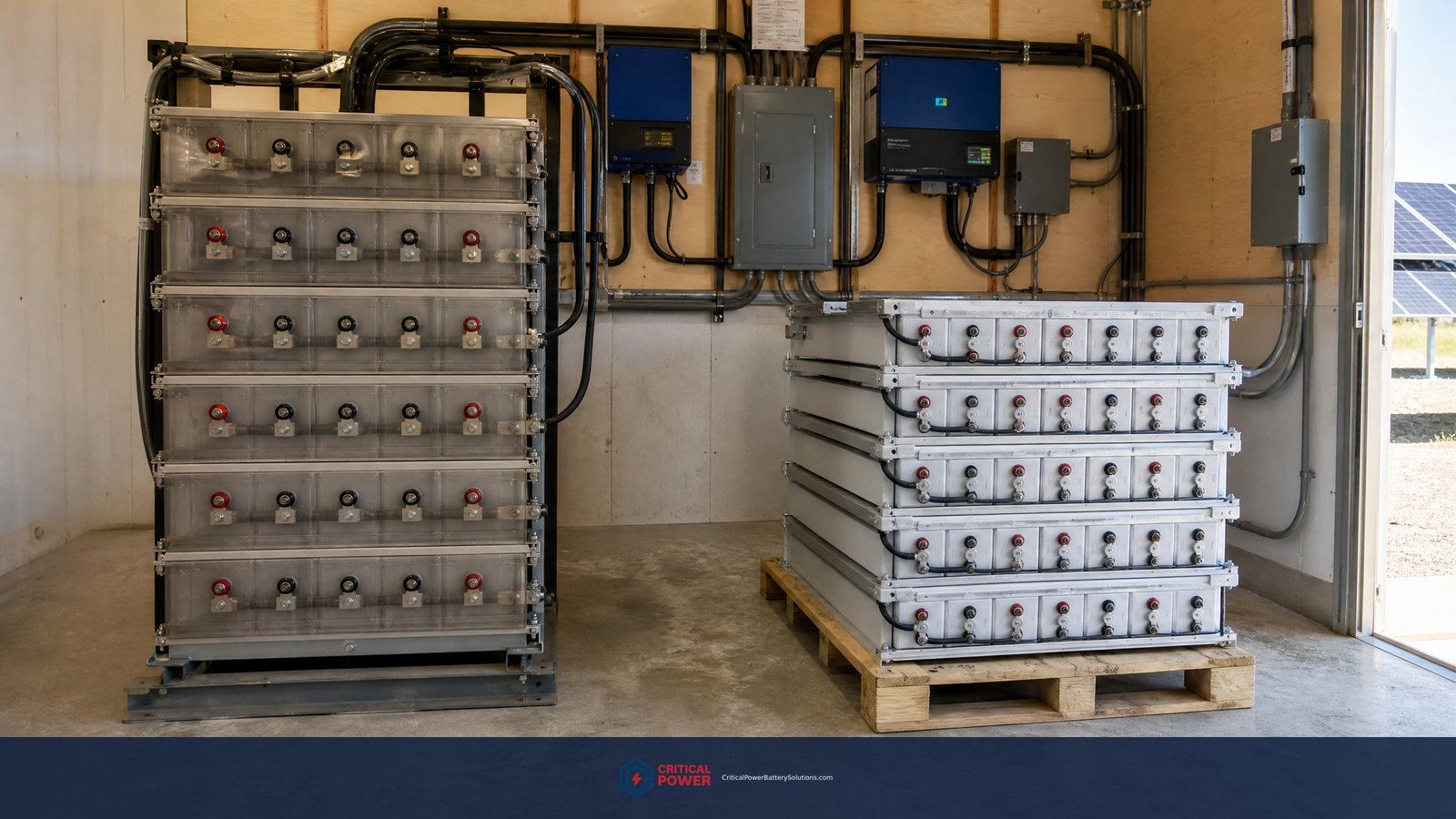
- Standalone PV and solar-plus-storage: the battery bank that carries the load overnight and through low-sun days.
- Remote telecom, microwave, and repeater sites: off-grid or hybrid enclosures backing communications equipment hours from the nearest service road.
- Railroad and transit signaling: trackside reserve power for signals and grade-crossing systems.
- Navigational aids: buoys, beacons, and remote markers running on solar with battery reserve.
- Cathodic protection: impressed-current systems protecting pipelines and structures at remote nodes.
- Village electrification and microgrids: community-scale off-grid banks where autonomy and deep discharge recovery matter most.
Across all of them the pattern is the same: a large-format, low-maintenance reserve that tolerates partial-state-of-charge operation and deep discharge, in a place where sending a technician is expensive. That duty profile is exactly what the Absolyte GP was designed for, and it is why the replacement conversation is about matching the duty, not just the amp-hour number.

Why the Absolyte GP Became the Off-Grid Standard
The Absolyte GP was the first large-format VRLA deep-cycle battery developed for photovoltaic use, engineered with Sandia National Laboratories and in field service since 1983. Several design traits made it the default choice for solar and off-grid reserve power, and they are attributes of the legacy GP line as documented:
- Partial-state-of-charge tolerance: it holds up under the incomplete recharges that are normal in solar duty, where the sun does not always return the full charge each day.
- Deep discharge recovery: the line is documented at 1,200 cycles at 80 percent depth of discharge at 25 C per the I and O Manual, a legacy GP line rating.
- Freezing tolerance: a battery held at a higher state of charge resists freezing better, which suits cold remote sites.
- Sealed recombinant design: more than 99 percent internal gas recombination means no watering and no separate battery room.
- Modular steel trays: the tray-and-module construction supports large banks in compact, serviceable footprints.
Those qualities are legacy GP line attributes documented for that product. Whether a specific current unit carries a given rating for your duty is confirmed by the specialist rather than assumed, which is the honest way to carry a proven design forward into a new order.


The Legacy Part Numbers You Are Replacing
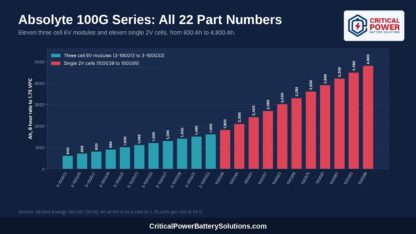
Legacy Absolyte GP renewable part numbers follow the 50G, 90G, and 100G scheme, and the leading digit tells you the module voltage. The table below lists verified GNB Absolyte GP renewable numbers with their capacity at the 100 hour rate, the discharge rate used for solar and off-grid duty. These are examples buyers hold on module labels, drawn from the GNB Absolyte GP renewable specification.
| Legacy GNB Absolyte GP number | Module type | Capacity at the 100 hour rate |
|---|---|---|
| 6-50G05 | 12V module | 140 Ah |
| 6-50G13 | 12V module | 430 Ah |
| 6-90G07 | 12V module | 360 Ah |
| 6-90G15 | 12V module | 840 Ah |
| 3-100G25 | 6V module | 1,500 Ah |
| 3-100G33 | 6V module | 2,100 Ah |
| 100G39 | 2V cell | 2,370 Ah |
| 100G99 | 2V cell | 6,300 Ah |
The leading digit is the fastest read on the label: 1 is a 2V single cell, 3 is a 6V three-cell module, and 6 is a 12V six-cell module. That is the concept, not a full decode key; the complete series and capacity reference is owned by the companion Absolyte GP model-number and capacity reference guide, which is publishing alongside this one. For the generic part-number lookup workflow across all Absolyte families, the GNB Absolyte part number cross reference guide owns the method and its worksheet.

What Replaces Them: The Stryten Absolyte AGP
The current successor is the Stryten Absolyte AGP, which continues the same 50G, 90G, and 100G series scheme. Authorized-channel listings show current AGP units carrying the same G-series numbers, for example 100G87 and 3-100G25, so the legacy number on your label is the direct route into the current series. The AGP is a sealed recombinant VRLA AGM battery: 2V modular cells in steel trays, a lead-calcium-tin-silver positive grid, more than 99 percent internal gas recombination, operating excursions from minus 40 C to plus 50 C, no separate battery room, and made in the USA.
Two honest limits keep this path sound. First, this is not a blanket drop-in and the AGP is not marketed as a purpose-built solar battery; the specialist confirms the correct series and the float versus cycling rating for your specific duty. Second, exact part number, tray and terminal fitment, and seismic configuration are confirmed for your string, because a solar bank, a signaling cabinet, and a substation reserve can carry the same family under different configurations. For selection across the wider Stryten line beyond Absolyte, the E-Series selection guide owns that comparison.

What to Confirm Before You Order
A solar or off-grid replacement is scoped to the duty cycle, not just the old amp-hour number. These are the variables that shape the correct AGP configuration, framed here at concept level; the calculation itself is owned by the sizing guides linked below:
- Autonomy days: how long the bank must carry the load with no charging, the core driver of capacity.
- Depth of discharge: the working DOD that balances usable energy against cycle life.
- Site temperature range: capacity falls as temperature drops, and float voltage uses temperature compensation of 3 mV per degree F per cell (5.5 mV per degree C per cell).
- Partial-state-of-charge exposure: how often the bank runs below full charge, which shapes the series and rating choice.
- String voltage and module count: the configuration that has to match the existing plant and footprint.
The runtime and sizing math lives in the VRLA battery sizing guide and the battery capacity calculation for telecom loads, with basic method in the how to calculate battery runtime guide. For hot-climate derating on high-temperature sites, the extreme temperature guide owns that depth, and lifespan is covered by how long Absolyte batteries last. Renewable and off-grid storage as a whole is covered on the renewable energy battery storage systems page.
The Cross-Reference and Quote Worksheet
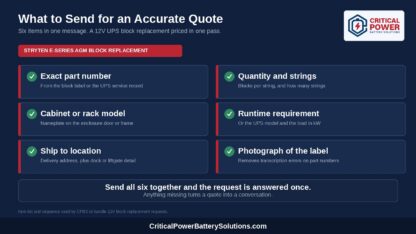
Five inputs are enough for CPBS to confirm the Absolyte AGP equivalent and return a quote. Gather them from the string and the site, then send them to Tom Kierna:
- Photo of the module label: a clear image of the face where the family name and part number appear.
- Full part number: the exact designation, for example 100G99 or 3-100G25, recorded character for character.
- Modules and string voltage: the module count and the total string voltage of the bank.
- Application and duty: photovoltaic float or cycling, remote telecom, signaling, or another off-grid duty.
- Site conditions: temperature range, autonomy target, and enclosure type.
Send those to Tom and you receive the confirmed Absolyte AGP equivalent, sized to the duty cycle, with a quote. Standard domestic lead time is 8 to 10 weeks, confirmed at quote. CPBS is consulting and supply based, so the site work itself, the removal and installation, is carried out by you or your integrator; what CPBS owns is getting you the right battery, confirmed and documented. To verify any supplier claim, including this one, the authorized Stryten distributor verification guide shows how, and Stryten specification sheets are on the CPBS resources and spec sheets page.

Start Your Absolyte Solar Replacement
Send a photo of your battery label or your part number to Tom Kierna and the replacement conversation starts today. Call 630-984-9718, email sales@criticalpowerbatterysolutions.com, or begin with the pre consultation checklist and the CPBS contact page. Tom spent 15 of his more than 40 years at GNB and Stryten, and he scopes every off-grid and solar Absolyte replacement personally. Same-day series identification is available on most requests. The name on the label changed; the product, and the person who can replace it, did not go anywhere.
Frequently Asked Questions About Absolyte Solar and Off-Grid Battery Replacement
What replaces GNB Absolyte GP batteries in solar and off-grid systems?
The Stryten Absolyte AGP replaces legacy GNB Absolyte GP batteries in solar and off-grid systems. It continues the same product line and the 50G, 90G, and 100G part number scheme. CPBS confirms the exact current part number and the rating for your duty cycle before you order.
Is Stryten Absolyte AGP used for off-grid and solar applications?
Yes. The Absolyte line has served photovoltaic and off-grid systems since the GNB Absolyte GP era, and the Stryten Absolyte AGP continues that line. The specialist confirms the correct series and the float or cycling rating for your specific solar or off-grid duty rather than assuming a match.
Are GNB Absolyte batteries deep cycle?
The legacy GNB Absolyte GP line is documented at 1,200 cycles at 80 percent depth of discharge per the I and O Manual. Treat that as a legacy GP line attribute and confirm the rating for your current duty with the specialist rather than assuming a blanket drop-in.
What is the Stryten equivalent of Absolyte GP 100G99?
The 100G99 is a legacy 2V 100-series cell rated 6,300 Ah at the 100 hour rate. Its current successor sits in the same Stryten Absolyte AGP 100G series, and the exact part number, tray fitment, and duty rating are confirmed per string by the specialist.
Do the old Absolyte GP part numbers still work for ordering?
The legacy 50G, 90G, and 100G designations identify your string and carry into the Stryten Absolyte AGP series, so they are the starting point, not the final order. CPBS confirms the exact current part number, fitment, and duty rating before quoting.
Can I replace one Absolyte module in a solar bank or do I replace the string?
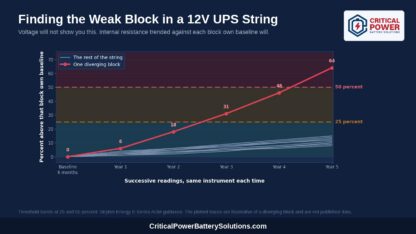
Plan at the string level. Mixing a new module into an aged string is discouraged, because the string performs to its weakest module and mixed aging complicates charging. Have the string assessed by the specialist rather than swapping a single module.
Where is the part number on an off-grid Absolyte battery?
The part number is on the module or cell label, next to the family name and date code, usually facing the aisle or terminal side in a remote enclosure. Record it exactly, or send a clear photo of the label, and CPBS identifies the series for you.
Do Stryten Absolyte AGP batteries need a separate battery room?
No. The Absolyte AGP is a sealed recombinant VRLA AGM battery with more than 99 percent internal gas recombination, so it needs no separate battery room and suits enclosed off-grid and remote sites. Room ventilation still follows the applicable code.
Can Absolyte batteries handle cold or freezing off-grid sites?
The Absolyte GP line has long served cold remote sites, and a battery held at a higher state of charge resists freezing better. Capacity falls as temperature drops, and float voltage uses temperature compensation of 3 mV per degree F per cell. See the extreme temperature guide for hot-climate derating.
How long do Absolyte GP solar batteries last?
The Absolyte family carries a 20 year design life at 25 C, and real service life depends on temperature, depth of discharge, and cycling in PV duty. A string installed in the 1990s or 2000s is a replacement candidate on age alone. The lifespan guide covers design versus service life.
How do I size an Absolyte replacement for my solar autonomy needs?
Size from autonomy days, depth of discharge, load profile, and site temperature using IEEE 485, not the old amp-hour number alone. The VRLA sizing guide and the telecom load calculation guide own the math, and CPBS confirms the Absolyte AGP configuration against it.
Where can I buy Stryten Absolyte AGP off-grid replacement batteries?
Through an authorized Stryten Energy reseller such as Critical Power Battery Solutions. Send your Absolyte part number or a label photo to Tom Kierna at 630-984-9718 or sales@criticalpowerbatterysolutions.com for a confirmed AGP equivalent and quote.
About the author: Tom Kierna is a Battery Systems Specialist at Critical Power Battery Solutions, the battery division of Advanced Technical Services Inc. (ATS), an ISO 9001 certified company serving mission-critical power since 1981. Tom has more than 40 years in industrial battery systems, including 15 years at GNB and Stryten, and specializes in chemistry selection, application sizing, and off-grid and solar Absolyte replacement. CPBS is an authorized Stryten Energy reseller. Last reviewed July 15, 2026.
References
- Stryten Energy, Absolyte AGP Product Brochure (SE1085). stryten.com
- GNB Industrial Power, Absolyte GP Renewable Energy Systems Battery Specification and Installation and Operating Instructions. stryten.com
- Sandia National Laboratories, photovoltaic battery development program. sandia.gov
- IEEE 485, Recommended Practice for Sizing Lead-Acid Batteries for Stationary Applications. standards.ieee.org