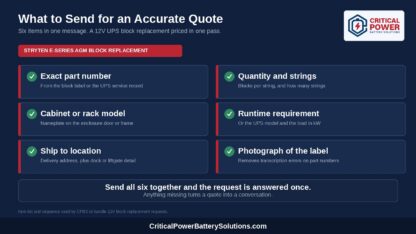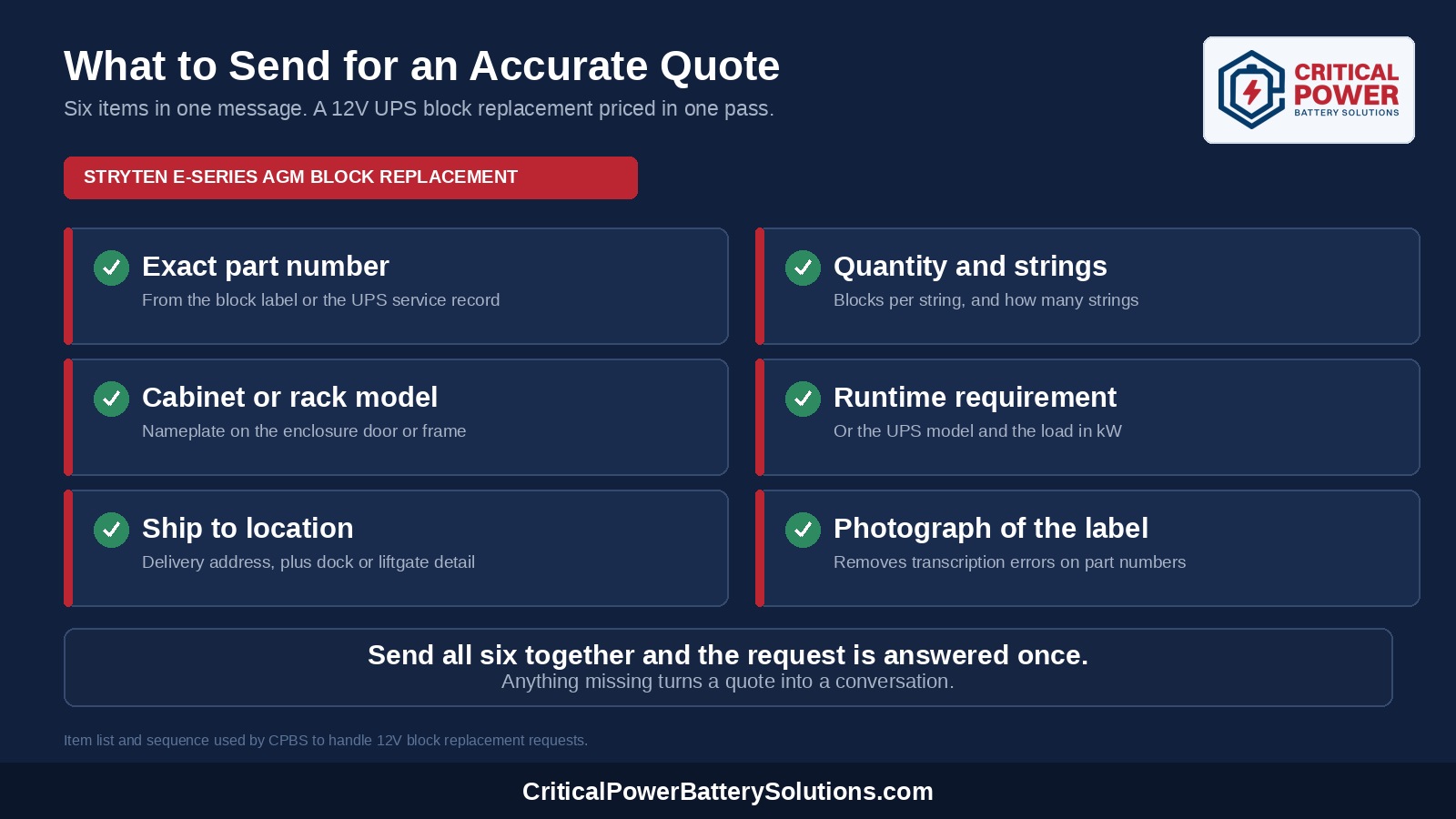
Quick answer: Critical Power Battery Solutions (CPBS), an authorized Stryten Energy reseller, can quote a Stryten E-Series AGM 12V block replacement in one pass when five things arrive together: the exact part number on the block label, the quantity in the string, the make and model of the cabinet or rack the blocks sit in, the runtime the string has to support, and the ship to location. The three current blocks are the S12V325FL, the S12V370FL and the S12V539FL. Anything missing turns a quote into a conversation, and a photograph of the block label is the sixth item that removes the most round trips.
Key points
- Five items price the job and a sixth confirms it: part number, quantity and string count, cabinet or rack make and model, runtime requirement, ship to location, and a photograph of the block label.
- Replacement is priced at string level rather than per block, so the count that matters is blocks per string and the number of strings.
- The enclosure decides whether a block can be installed at all. Shelf width, depth, tier clearance and connector reach are all set by the cabinet or rack, and none of them can be read off a part number.
- Rated capacity moves across a generation change, so the runtime requirement is checked rather than assumed to carry over.
- Blocks are heavy freight. Dock or liftgate detail at the delivery address belongs in the first message, not in the third.
- CPBS supplies and sizes batteries as an authorized Stryten Energy reseller. It does not supply UPS systems, cabinets, racks or breakers, and it does not install.
- Lead time on domestic supply is 8 to 10 weeks, so a planned order and an emergency order are two different conversations.
Most requests for a battery price arrive with about half of what it takes to answer them. The part number is there, or a photograph of something that might be the part number, and nothing else. What follows is two or three rounds of email that establish facts the sender already had in front of them at the cabinet.
This guide sets out what a replacement request for the current 12V block batteries needs to carry so it can be answered once, why each item changes the answer, and what happens to the request after it arrives. It is a transaction guide rather than a technical one. Where a question is technical, it hands off to the article that owns it.
Critical Power Battery Solutions (CPBS) is the battery division of Advanced Technical Services Inc., founded in 1981 and ISO 9001 certified, and is an authorized Stryten Energy reseller. Tom Kierna, who has more than 40 years in industrial batteries including 15 across GNB and Stryten, sizes every order personally before it is quoted. That is why the request needs the enclosure and the runtime as well as the part number: the order is sized, not looked up.
Who this Stryten E-Series AGM quote guide is for
This Stryten E-Series AGM quote guide is for anyone who already knows roughly what they need and now wants a price without three rounds of email. It assumes the string is installed, the decision to replace has been made or is close, and the remaining question is commercial rather than diagnostic.
- Facility and critical power managers raising a replacement against a budget cycle or a maintenance window.
- UPS service technicians who have the site in front of them and want the request to leave the building complete.
- Telecom and utility power engineers replacing blocks in an installed DC backup plant.
- Procurement staff who have been handed a part number and need a written quote with a lead time on it.
If the question is still whether the string is due at all rather than what it will take to replace it, that decision is worked through in the article on when a Sprinter string is actually due, and this guide picks up after it.


Current 12V blocks: specifications and quote
Published specifications, drawings and manuals for each current model, and the request form for a written quote.
Legacy blocks S12V300F, S12V370F, S12V370NGF and S12V550NGF are succeeded by these models. They differ in case dimensions, terminal design and weight, so fit is confirmed before ordering.
What CPBS can and cannot quote on a 12V block replacement
CPBS quotes stationary standby 12V monobloc batteries for installed UPS and DC backup systems, and 2V industrial cells, as an authorized Stryten Energy reseller. That is the whole of the supply scope, and stating it plainly saves both sides a wasted exchange.
CPBS is consulting based: it supplies and sizes batteries and does not perform on site installation, commissioning, testing, or maintenance. Supplying or specifying UPS systems, cabinets, racks, or breakers is out of scope for CPBS. The blocks that go inside the enclosure are the product. The enclosure, the switchgear and the labour belong to the site and to whoever maintains it.
The supply boundary is why CPBS asks for the cabinet make and model rather than supplying the enclosure. CPBS needs to know what the Stryten E-Series AGM blocks are going into in order to confirm they will go in, but it is not the party that provides or modifies the enclosure itself.
If the block on the label carries a brand CPBS does not carry, the fastest path is still to send the part number. The succession may run to a model CPBS does supply, and that check takes one reply rather than a conversation. Sending it costs nothing and occasionally resolves the whole request in a single message.
Buyers who need to confirm the supply chain before they raise a purchase order can work through how to verify an authorized distributor. That check is worth doing once and is then settled for every order that follows.
What to send for a Stryten E-Series AGM battery quote
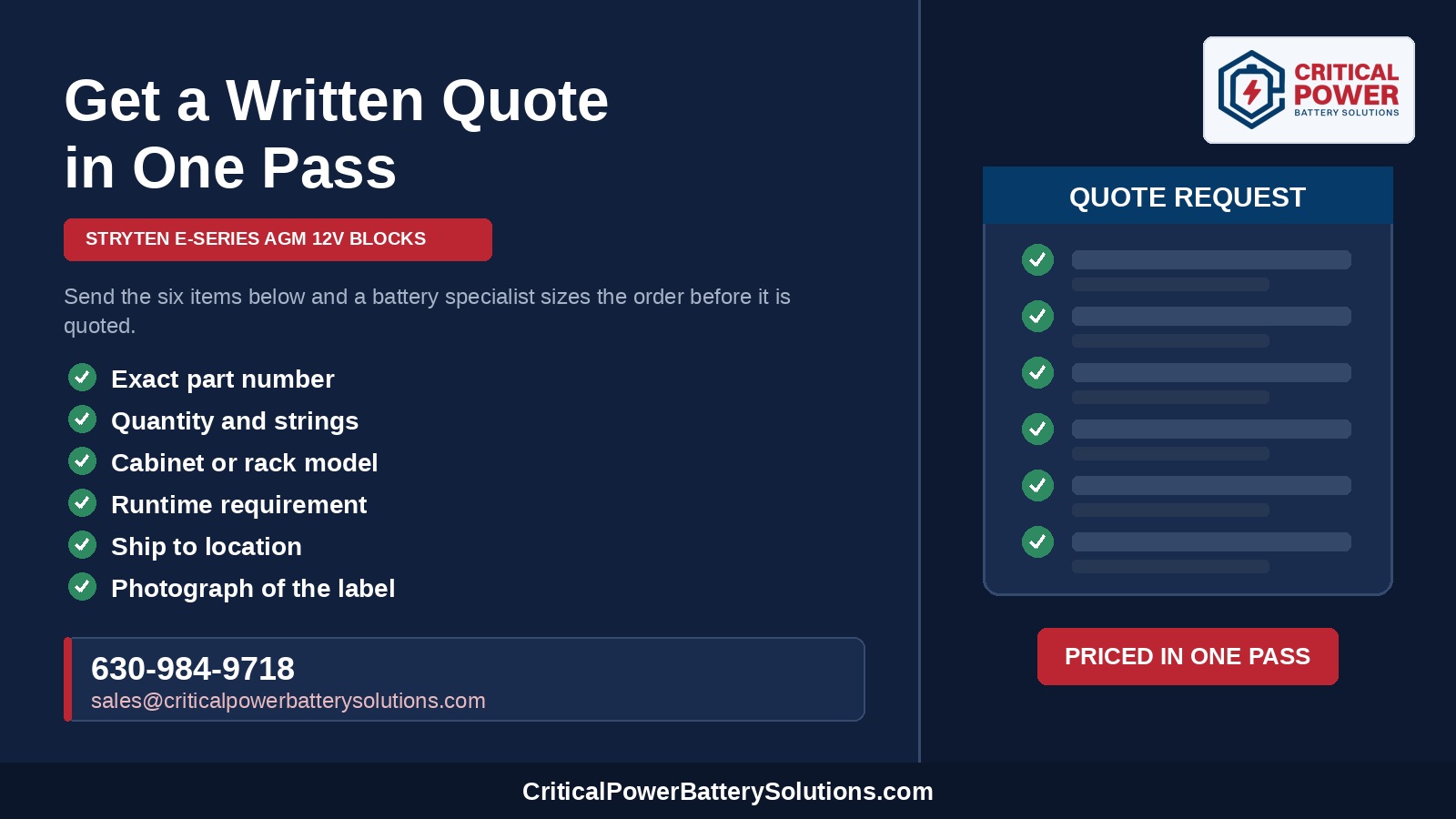
Six items answer a replacement request completely: the exact part number, the quantity and string count, the cabinet or rack make and model, the runtime requirement, the ship to location, and a photograph of the block label. Every one of them changes the answer, and every one of them is readable at the cabinet in the same visit.
| What to send | Where to find it | Why it changes the quote |
|---|---|---|
| Exact part number on the block label | Printed on the block face, and on the UPS service record | Sets which current block is being quoted and whether the item is a current or a succeeded model |
| Quantity in the string, and number of strings | Count the blocks on the tiers, or read the UPS single line | Replacement is priced at string level, not per block |
| Cabinet or rack make and model | Nameplate on the enclosure door or frame | Determines shelf width, depth, tier clearance and connector reach, which decide whether a given block can be installed at all |
| Runtime the string has to support, or the UPS model and load in kW | UPS nameplate, or the original sizing document | Rated capacity differs across a generation change, so the block that met the runtime before may not after |
| Ship to location and site access | The delivery address, plus dock or liftgate detail | Blocks are heavy freight and the delivery method affects lead time |
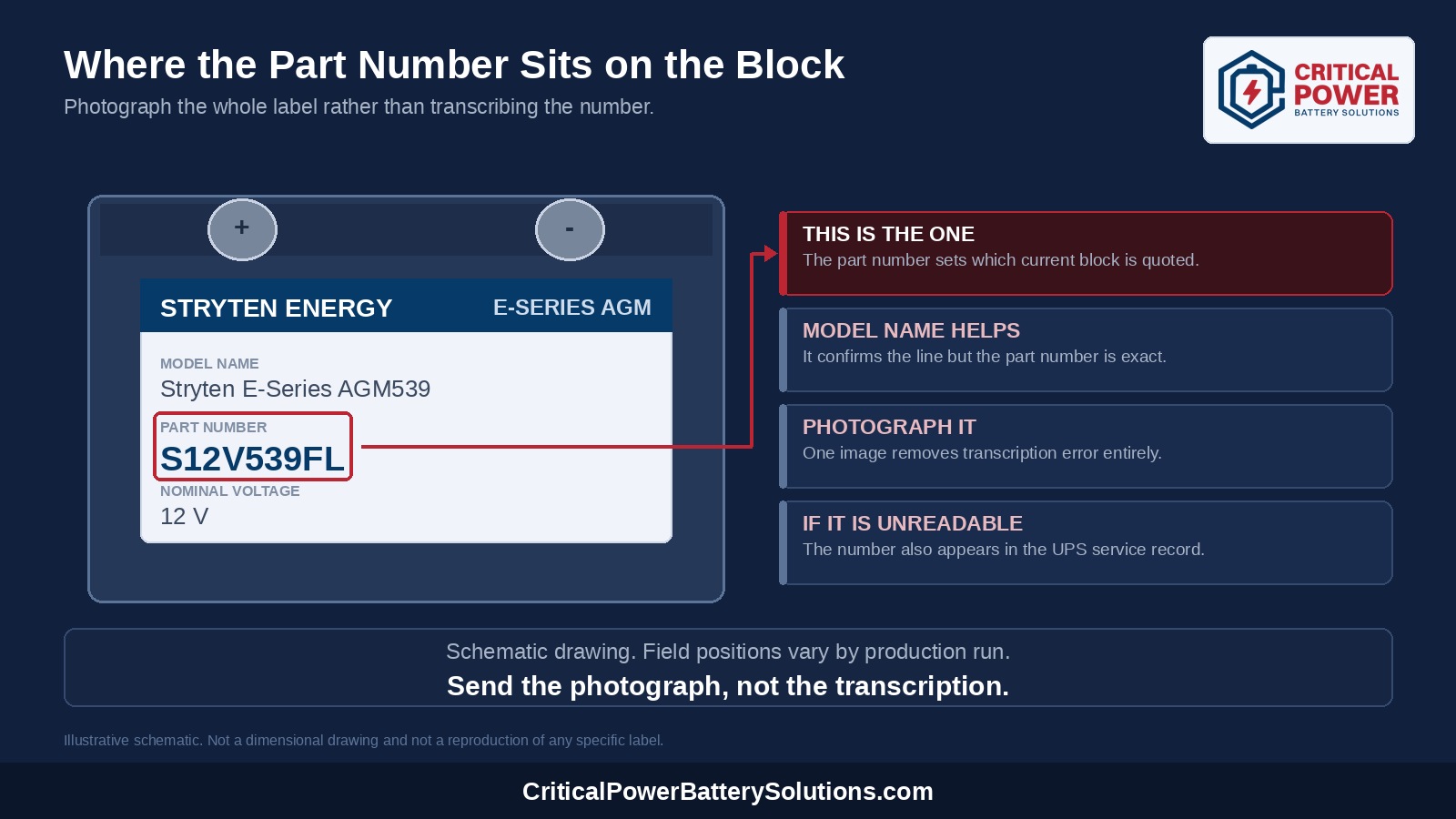
| A photograph of the block label | Phone camera | Removes transcription errors on part numbers, which is the single most common cause of a second email |
Why the exact part number decides the quote
The part number is the anchor. It sets which current block is being quoted and whether the item on the shelf is a current model or one that has been succeeded. Legacy numbers still in service include the S12V300F, S12V370F, S12V370NGF and the S12V550NGF, and each of them resolves to a current block. Which one it resolves to is set out in the guide to which current block succeeds which legacy block. If the printing on the label has faded past reading, the article on how the model number is put together covers where else on the block and in the service record the number appears.
Why quantity means the whole string, not one block
Quantity is the item most often sent wrong, and it is sent wrong in a predictable direction. A request names one block because one block is what the sender is looking at. Replacement is priced at string level, not per block, so the number needed is how many blocks make up a string and how many strings the system runs. Both are countable on the tiers, and both appear on the UPS single line drawing if one is held.
Why CPBS needs the cabinet or rack make and model
The cabinet or rack make and model carry more weight than they look like they should. Shelf width, shelf depth, tier clearance and connector reach are all fixed by the enclosure, and they decide whether a given block can be installed at all rather than merely whether it is the correct electrical match. A block that is correct on paper and too tall for the tier is not a solution. What moves and what does not on an enclosure is covered in the article on cabinet and rack fit.
Why the runtime requirement cannot be assumed to carry over
The runtime requirement is the item most often assumed. Rated capacity is not constant across a generation change, so a block that met a runtime specification in the previous generation does not automatically meet it in the current one. Sending the required duration, or the UPS model and the load it carries in kW, lets the requirement be checked instead of inherited. The method behind that check is set out in the guides to calculating battery runtime and sizing a VRLA string.
Why the ship to location changes a 12V block quote
The ship to location is not an afterthought on this product. These are heavy blocks moving as freight, and the delivery method changes both the cost basis and the lead time. A dock is one situation, a liftgate and a hand truck through a service corridor is another, and a site with restricted access hours is a third. All of that belongs in the first message.
Why a photograph of the block label saves a round trip
The photograph is the cheapest item on the list and removes the most work. It carries the part number, the manufacturer marking and usually the date code in one image, and it removes transcription error, which is the single most common cause of a second email. A photograph of one full shelf alongside it answers most of what remains about the enclosure.
The three current Stryten E-Series AGM 12V blocks at a glance
The current Stryten Energy E-Series AGM line runs three 12V blocks: the S12V325FL, the S12V370FL and the S12V539FL. The table below is for self identification only, so a reader with a block in front of them can see which line they are on before sending the request.
| Part number | Model name | 15 min WPC | 20 hr Ah | Terminal | Weight lb |
|---|---|---|---|---|---|
| S12V325FL | Stryten E-Series AGM325 | 324.9 | 82 | T6 | 52.9 |
| S12V370FL | Stryten E-Series AGM370 | 370.3 | 95 | T6 | 61.7 |
| S12V539FL | Stryten E-Series AGM539 | 539.0 | 155 | T8 | 93.5 |
Rated capacity in the third column is watts per cell at 15 minutes to 1.67 volts per cell. The fourth column is the 20 hour rate to 1.80 volts per cell. Both come from the Stryten Energy E-Series AGM325, AGM370 and AGM539 product brochure. The full published set, including the constant power tables at every end voltage, the dimensional data and the construction detail, is in the specification guide for all three blocks and is not repeated here.
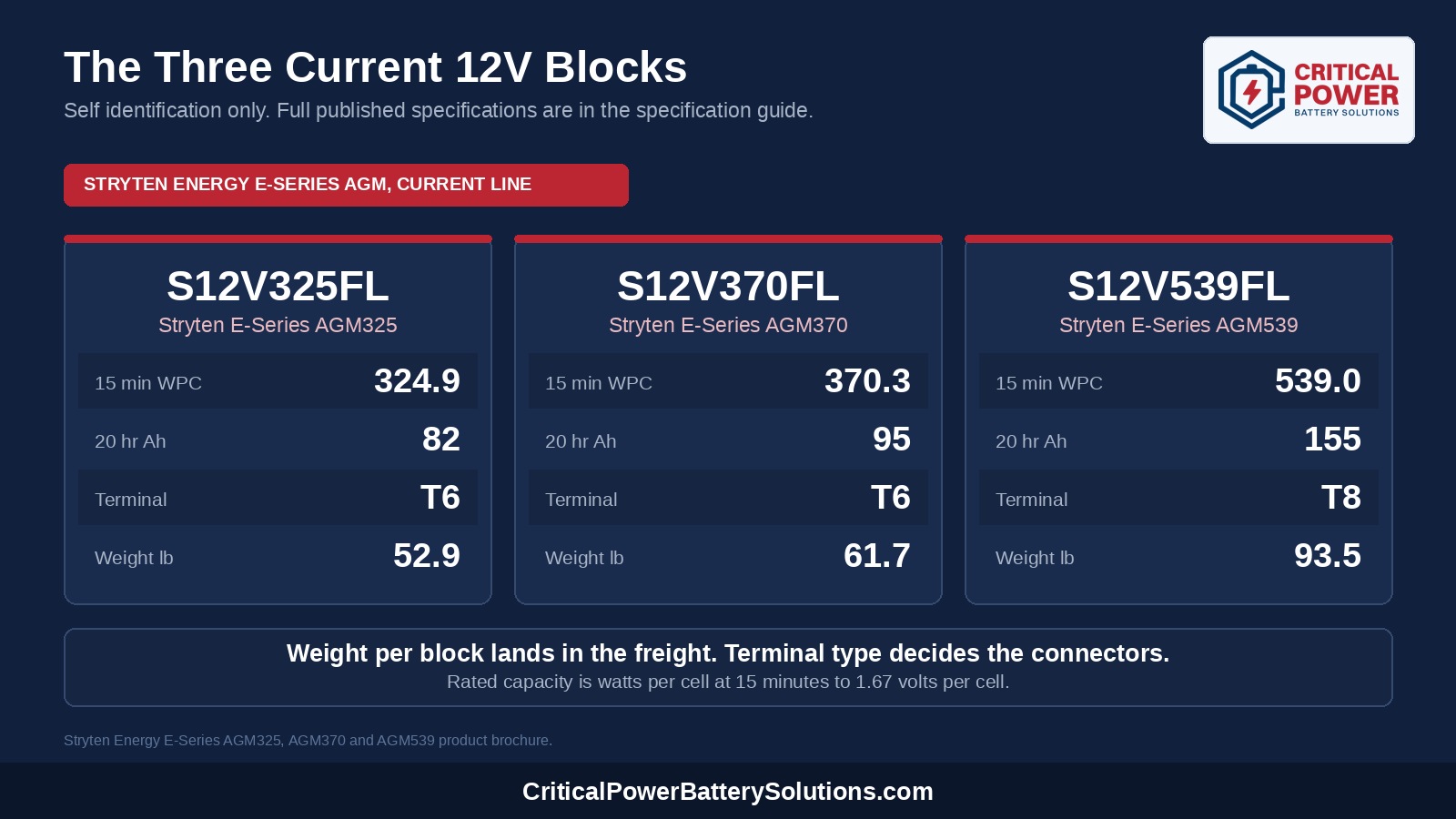
Two things on that table change a quote directly. Weight per block multiplies by the block count and lands in the freight, so a string of the largest blocks is a materially different shipment from a string of the smallest. Terminal type decides whether the connector hardware already on site suits the new landing, and connectors are ordered with the blocks rather than found afterwards.
Naming a current block in the request is useful but not required. A legacy part number is enough to start, because the succession is a lookup. What cannot be inferred from any part number is the enclosure and the duty the string has to carry, which is why those two are asked for every time.
How a 12V block quote request becomes a purchase order
Eight steps take a request from the block label to a placed order, and the first five of them all happen at the cabinet in a single visit. Doing them in one pass is the whole of the difference between a same day answer and a fortnight of email.
- Read and photograph the label. Record the part number exactly as printed on the block face.
- Count the string. Record the number of blocks per string and the number of strings.
- Read the enclosure nameplate. Record the cabinet or rack make and model.
- Record the runtime requirement. Or record the UPS model and the load it carries.
- Send it in one message. All five items together, with the ship to location.
- CPBS confirms the block. Which current block applies, checked against the enclosure, returned as a written quote with lead time.
- Confirm fit before ordering. A current block that succeeds a legacy block is a different case.
- Plan against lead time. Domestic supply runs 8 to 10 weeks.
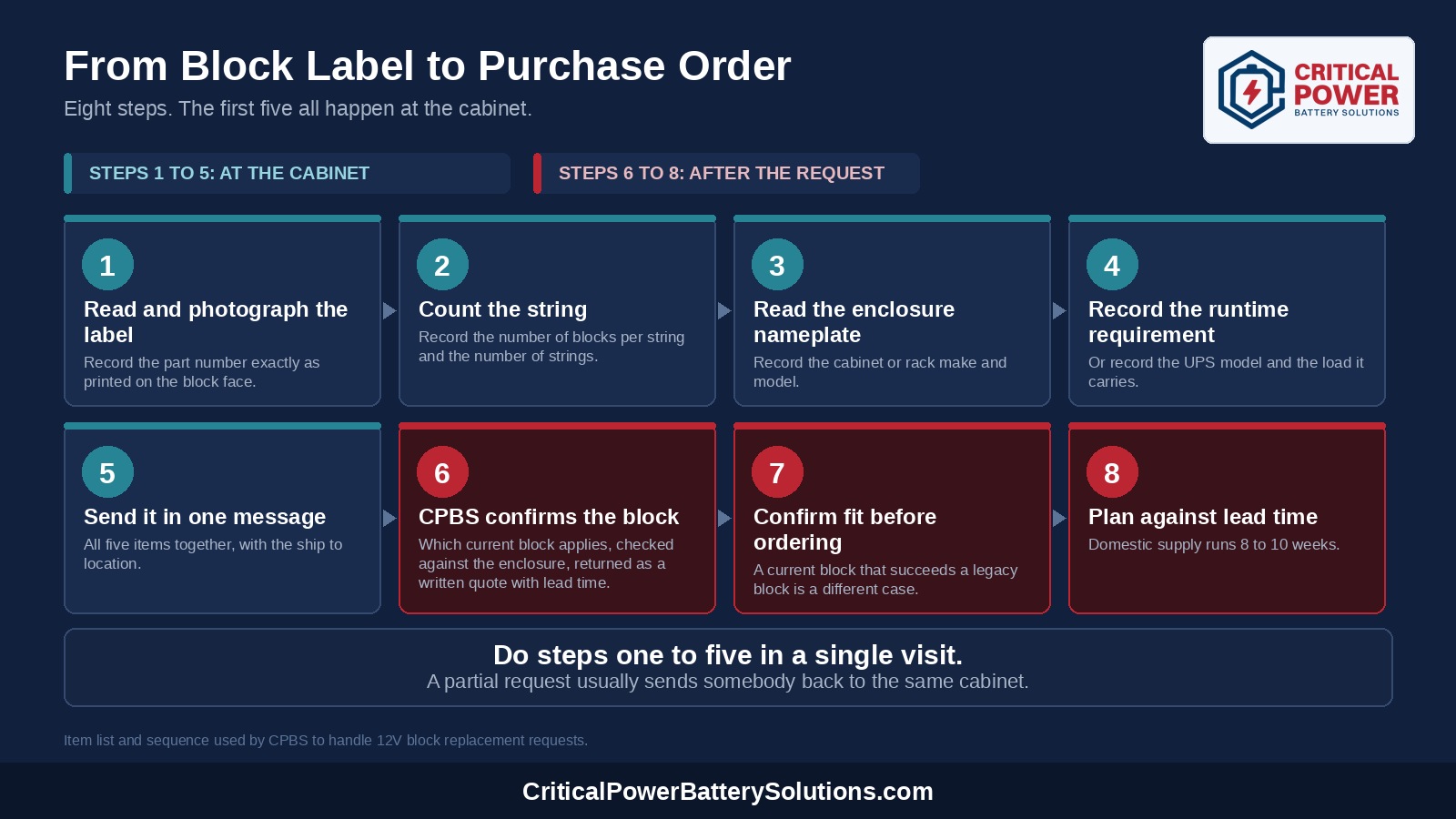
Steps one to five are site work and take about as long as walking the row. A partial request does not just delay the answer, it usually sends somebody back to the same cabinet for a fact that was two feet from the first one.
Step six is where the request is actually worked. The part number is resolved to a current block, the block is checked against the enclosure that was named, the capacity is checked against the runtime that was stated, and a written quote comes back with a lead time on it. If something in the request does not resolve, that is the point at which a question comes back instead of a price.
Step seven is the one buyers skip. A current block that succeeds a legacy block is not the same physical object as the block coming out. The two differ in case dimensions, terminal design and weight, so fit is confirmed before ordering. On a shelf with slack that is a restraint question, and on a tight tier it is a go or no go question. Either way it is answered before the order is placed rather than on the day the pallet arrives.
Step eight is procurement rather than engineering. Domestic supply runs 8 to 10 weeks, which is comfortable as a scheduled purchase and difficult as an emergency. A string that is approaching the end of its service life is worth quoting early, because the quote costs nothing to hold and the lead time cannot be compressed after the fact. The manufacturer cross reference behind the succession lookup is set out in the Sprinter cross reference and replacement guide.
Why a 12V block quote comes back as a question
A request turns into a question when the data in it does not fully define either the physical fit or the electrical duty. There are five causes and they account for nearly all of the round trips. Each one maps to exactly one item that would have prevented it.
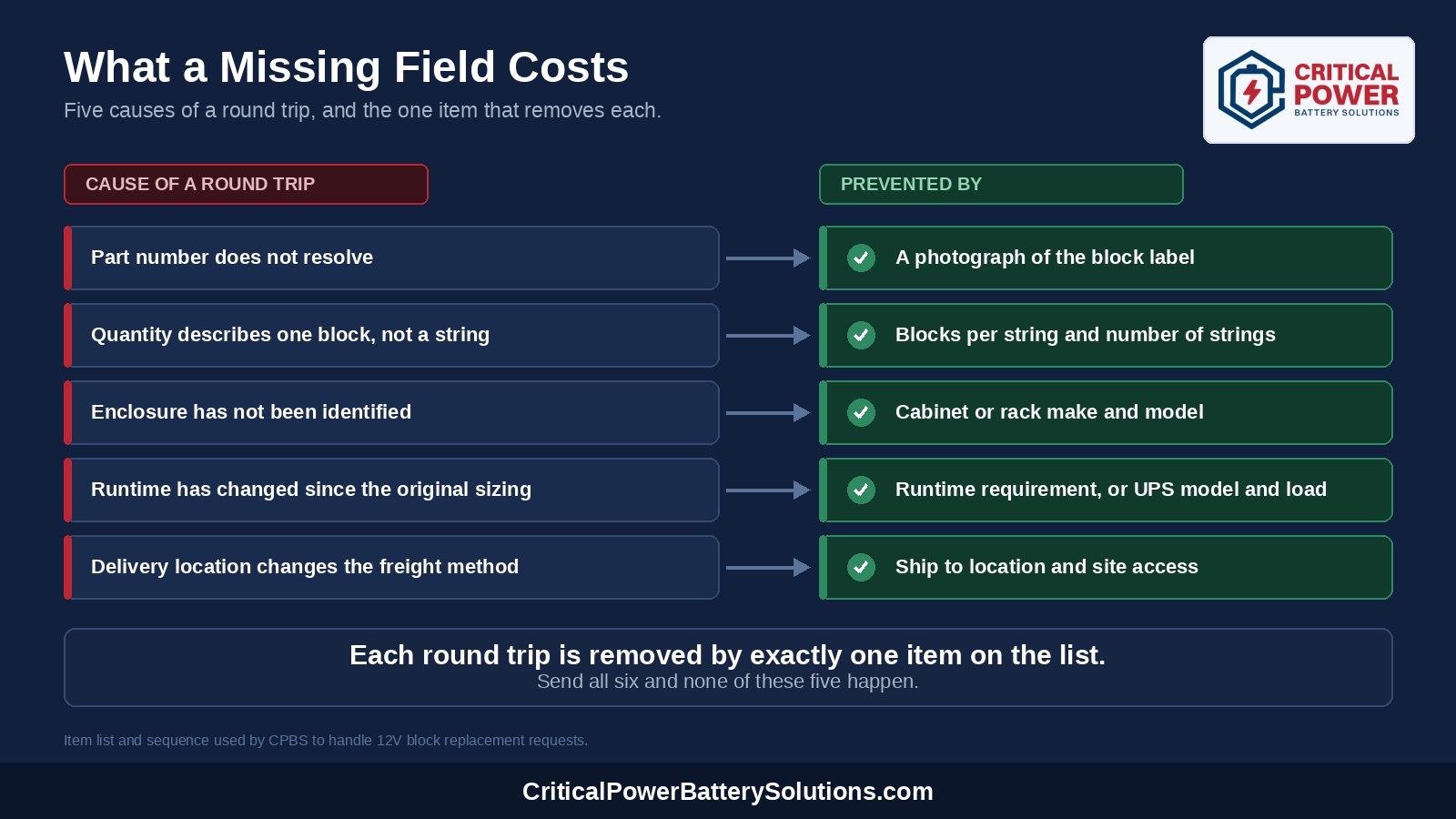
- Part number does not resolve. Prevented by: A photograph of the block label.
- Quantity describes one block, not a string. Prevented by: Blocks per string and number of strings.
- Enclosure has not been identified. Prevented by: Cabinet or rack make and model.
- Runtime has changed since the original sizing. Prevented by: Runtime requirement, or UPS model and load.
- Delivery location changes the freight method. Prevented by: Ship to location and site access.
A part number that does not resolve is usually a transcription problem rather than an unknown model. Characters that look alike on a worn label are read across, and the resulting number belongs to nothing. The photograph settles it in one step, which is why it is on the list even though it is not strictly a specification.
A quantity that describes one block is the second cause and the most expensive one, because it produces a quote for the wrong thing rather than no quote at all. A string is replaced as a set. Putting new blocks into an aged string pulls the new blocks down to the condition of the string they joined, so a single block order is rarely the right commercial answer even when it looks like the cheapest one.
An unidentified enclosure stops the fit check dead. Nothing about shelf depth or tier clearance can be derived from a battery part number, so an unnamed cabinet means the physical question simply cannot be answered and has to be asked.
A runtime requirement that has moved since the original sizing is the quiet one. Loads get added to a plant over a service life and nobody revisits the sizing document. If the required duration is stated in the request, the check happens as part of the quote. If it is not, the assumption carries forward and is only tested when the string is called on.
A delivery location without access detail changes the freight method after the quote has already gone out, which means the quote is revised rather than accepted. Dock, liftgate and access hours are three lines in the first email.
What drives the number on a 12V block replacement quote
Five things shape a replacement quote: how many blocks, which block, what the terminal requires, how the freight moves, and whether the order is planned or urgent. None of them are negotiable inputs and all of them are settled by the six items in the request.
- Quantity and string count. The baseline. Blocks per string multiplied by the number of strings sets the whole of the material requirement.
- The specific model and its rated capacity. Which of the three current blocks the duty calls for, which is decided by the runtime requirement rather than by the block that came out.
- Terminal type and connector hardware. Whether the existing connectors carry over to the new landing, and what has to be ordered alongside the blocks if they do not.
- Freight class and delivery method. Heavy goods on a pallet, with the delivery method set by the dock and access detail at the ship to address.
- Lead time and urgency. A planned order inside the 8 to 10 weeks window and an emergency replacement are handled differently.
Most of that list is logistical rather than electrical. Once the part number and the duty are known, the Stryten E-Series AGM block decision is the quickest part of the exercise. What takes time is the building, the shelf and the dock, and those are what a request most often leaves out.
What CPBS does after the quote request goes in
A complete request comes back as a written quote naming the current block, the quantity, the fit confirmation and the lead time. Most requests that arrive complete are identified the same day.
The request is reviewed by a battery specialist rather than processed. The part number is resolved against the manufacturer records, the resulting block is checked against the enclosure named in the request, and the rated capacity is checked against the stated duty. Where the duty and the block disagree, the reply says so rather than quoting the same block count and leaving the shortfall to be discovered later.
Where the request is complete but the answer is not the obvious one, the quote says which block is being proposed and why. That happens most often when the runtime requirement has moved, when the enclosure constrains the choice, or when the string count in the request does not match the configuration the load needs.
To start one, send the six items to Tom Kierna at 630-984-9718 or sales@criticalpowerbatterysolutions.com, or use the request form on any of the product pages. The battery division of Advanced Technical Services handles supply nationally, so the ship to location changes the freight arrangement rather than whether the order can be filled.
Frequently asked questions about Stryten E-Series AGM battery quotes
How do I get a quote for Stryten E-Series AGM batteries?
Send CPBS six items in one message: the exact part number on the Stryten E-Series AGM block label, the quantity per string and the number of strings, the cabinet or rack make and model, the runtime requirement or the UPS model and load, the ship to location with dock or liftgate detail, and a photograph of the block label. Send them to Tom Kierna at 630-984-9718 or sales@criticalpowerbatterysolutions.com. A request that arrives with all six is normally identified the same day and comes back as a written quote with a lead time on it.
What information do you need to price a UPS battery job?
CPBS needs the part number, the string quantity, the enclosure make and model, the required runtime and the delivery address to price a Stryten E-Series AGM block replacement. Those five settle which block, how many, whether it fits, whether it carries the duty, and how it ships. A photograph of the label is the sixth item and it is the one that removes transcription error, which is the most common reason a request needs a second email.
Where can I buy a Stryten E-Series AGM539?
Through an authorized Stryten Energy reseller, which is what CPBS is. The S12V539FL is the largest of the three current blocks at 93.5 lb each, so the ship to location and the site access detail are needed to arrange the freight. Every order is sized by a battery specialist before it is quoted rather than filled from a part number alone.
Who is an authorized Stryten reseller?
An authorized reseller is a supplier appointed by the manufacturer to sell and support the line, which can be confirmed with the manufacturer directly. CPBS is the battery division of Advanced Technical Services Inc., founded in 1981 and ISO 9001 certified, and supplies the Stryten Energy E-Series AGM line nationally. The checks worth running before raising a purchase order are set out in the CPBS guide to verifying an authorized Stryten distributor.
Do I need the cabinet make and model to get a quote?
Yes. Nothing about the enclosure can be derived from a Stryten E-Series AGM part number, so CPBS asks for it every time. Shelf width, shelf depth, tier clearance and connector reach are all fixed by the cabinet or rack, and they decide whether a block can physically be installed. Without the make and model the electrical answer can be given and the physical one cannot, which is a quote that has to be revisited.
Can you quote from a photo of the battery label?
A photograph gives CPBS the part number reliably, which is the starting point, but it is not a complete request on its own. The image removes transcription error and usually carries the manufacturer marking and the date code as well. The string quantity, the enclosure, the runtime requirement and the delivery address still have to come with it.
Do you quote single blocks or whole strings?
CPBS quotes complete strings. A Stryten E-Series AGM replacement is priced at string level because a string is replaced as a set. New blocks installed alongside aged ones are pulled down to the condition of the string they joined, so the single block order that looks cheapest usually is not. Single blocks are supplied where a specific reason calls for it, but the quote is built from the string.
How long does delivery take once an order is placed?
Lead time on domestic supply of Stryten E-Series AGM blocks is 8 to 10 weeks. That window is the reason a string approaching the end of its service life is worth quoting before it is needed rather than after. Two months is manageable as a scheduled purchase and difficult as an emergency, and the site access detail at the delivery address affects the final leg on top of it.
What if the part number on my label is discontinued?
Send it to CPBS anyway. A superseded number still identifies the correct current block. The legacy numbers still in the field each resolve to the S12V325FL, the S12V370FL or the S12V539FL, and that lookup takes one reply. Which number resolves to which block is set out in the CPBS guide to which current Stryten E-Series AGM block succeeds each legacy block. What a discontinued label does change is the planning horizon, because the replacement is no longer something available at short notice.
Do you install the batteries as well as supply them?
No. CPBS supplies and sizes the batteries and the site handles the physical work. On site installation, commissioning, testing and maintenance all sit outside what CPBS does. Installation is handled by the site or by its own qualified service contractor. What CPBS does provide is the sizing review, the fit confirmation against the enclosure and the written quote.
Do you supply the UPS cabinet or rack?
No. UPS systems, cabinets, racks and breakers are all outside what CPBS supplies or specifies. The blocks that go inside the enclosure are the product. That is exactly why the cabinet or rack make and model are asked for during quoting: CPBS confirms the blocks will fit the enclosure that is already there.
What if my block is a brand you do not carry?
Send the part number regardless, because the succession may run to a model CPBS does supply. Manufacturer cross reference material maps a great many block batteries against the same current line, so a brand CPBS does not stock frequently resolves to a block it does. The check takes one reply. If it does not resolve, the reply says so and nothing has been lost.
About the author: Tom Kierna is a Battery Systems Specialist at Critical Power Battery Solutions with more than 40 years in industrial battery systems, including 15 years across GNB and Stryten. He sizes every 12V block and 2V cell order personally, and specializes in Stryten E-Series AGM selection, legacy part number succession and UPS application sizing. Last updated August 20, 2026.
References
- Stryten Energy. E-Series AGM325, AGM370 and AGM539 product brochure: rated capacity in watts per cell at 15 minutes to 1.67 volts per cell, capacity at the 20 hour rate to 1.80 volts per cell, weight and terminal type for the S12V325FL, S12V370FL and S12V539FL.
- Stryten Energy. E-Series AGM installation and operating instructions: terminal preparation and torqueing practice, connection requirements and string configuration guidance.
- Sprinter UPS Block Battery Selection Guide, UPS top terminal valve regulated lead acid block batteries. Manufacturer published, historical guide only: the legacy block part numbers still found on installed strings and the current models they map to.
- IEEE Standards Association. IEEE 485 Recommended Practice for Sizing Lead-Acid Batteries for Stationary Applications, referenced at the method level as the framework for duty cycle sizing and aging margin. IEEE 485 is a recommended practice, not a battery certification.
- Advanced Technical Services Inc. ISO 9001 quality management system certification, held by the parent company of Critical Power Battery Solutions.