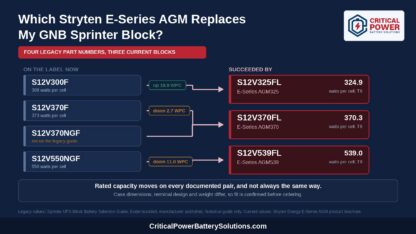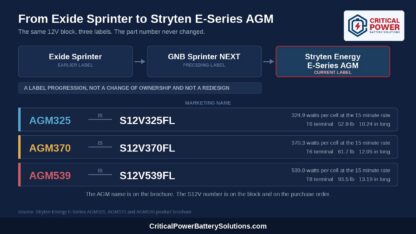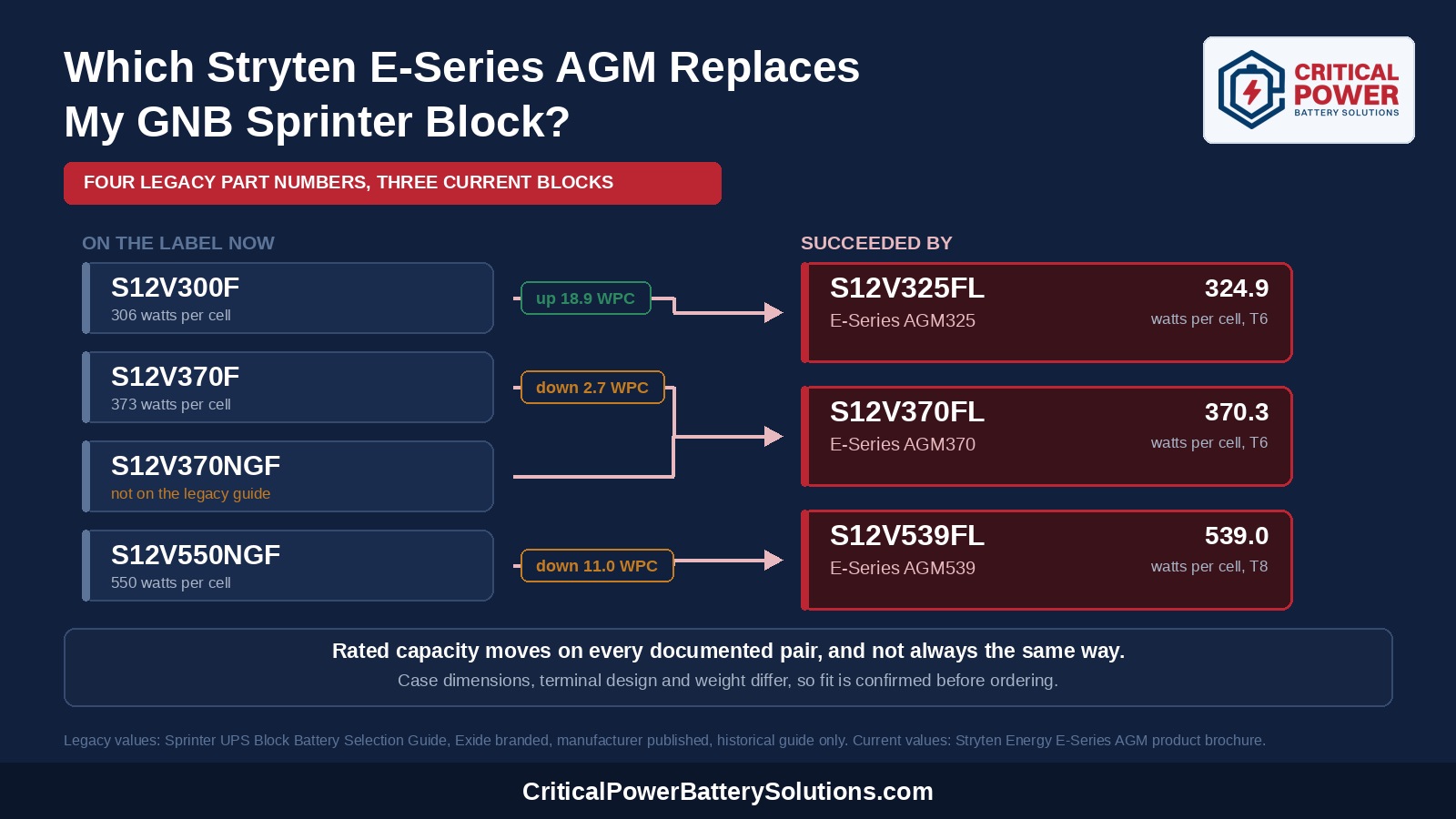
Quick answer: On a GNB Sprinter battery replacement there are four legacy part numbers still in the field and three current Stryten E-Series AGM blocks that succeed them. The S12V300F is succeeded by the S12V325FL, sold as the E-Series AGM325. The S12V370F and the S12V370NGF are both succeeded by the S12V370FL, the AGM370. The S12V550NGF is succeeded by the S12V539FL, the AGM539. Naming the successor is the easy half. Rated capacity does not carry across unchanged and it does not move in the same direction on every pair, and the blocks differ in case dimensions, terminal design and weight, so fit is confirmed before ordering.
Key points
- The S12V325FL is rated 18.9 watts per cell above the S12V300F it succeeds. The S12V370FL is 2.7 below the S12V370F, and the S12V539FL is 11.0 below the S12V550NGF.
- A string sized with no spare margin can therefore fall short of its original backup duration after a straight block for block swap, even though the successor is the correct model.
- Every current block is lighter. The S12V370FL saves 12.3 lb per block against the S12V370F, which is the largest per block reduction of the three.
- Case dimensions move on every swap. Width and height both reduce on the two smaller pairs, which leaves slack on the shelf rather than interference.
- The terminal changes from an Insert M6 on every legacy block to a T6 or a T8 on the current line.
- The S12V370NGF is the one legacy number with no published figures. It is absent from the Selection Guide, so its envelope is measured rather than looked up.
- The legacy and current capacity columns are published on different documents and the legacy column does not state its duration or end voltage, so treat the comparison as direction and rough size rather than a certified rating difference.
Current 12V blocks: specifications and quote
Full specifications, drawings, manuals and warranty documents for each current model.
Legacy blocks S12V300F, S12V370F, S12V370NGF and S12V550NGF are succeeded by these models. Case dimensions, terminal design and weight differ, so fit is confirmed before ordering.
Knowing which current block succeeds your legacy Sprinter block is the easy half of the question. The harder half is what that swap actually costs you, because the successor is a different battery in a different case with a different terminal and, in two cases out of three, a lower published rating.
The published figures behind the three current blocks, including the constant power tables at every end voltage, are set out in the E-Series AGM325, AGM370 and AGM539 specification guide. This guide sets those figures beside the legacy ones and works through what each change means for a string that is already installed.
If what you need first is simply which model replaces which, that mapping is set out in the Sprinter cross reference and replacement guide, and this guide picks up where it stops.
Critical Power Battery Solutions (CPBS) is the battery division of Advanced Technical Services Inc., founded in 1981 and ISO 9001 certified, and is an authorized Stryten Energy reseller. Tom Kierna, who has more than 40 years in industrial batteries including 15 across GNB and Stryten, sizes every order personally.
Who this comparison is for
This guide is for anyone who already knows which current block they have been quoted and now needs to know what changes when it goes in. The successor model is settled. What is not settled is whether the string still does the job it was commissioned to do.
- Facility and critical power managers signing off a replacement string against an original runtime specification.
- UPS service technicians who have the quote and need to know what moves on the shelf and at the terminal.
- Telecom and utility power engineers checking a swap against a duty cycle rather than against a part number.
- Procurement staff who need the difference documented before the order is defended.
CPBS is consulting based: it supplies and sizes batteries and does not perform on site installation, commissioning, testing, or maintenance. Supplying or specifying UPS systems, cabinets, racks, or breakers is out of scope for CPBS.


Rated capacity does not carry across the swap
Two of the three current blocks are rated below the legacy block they succeed, and one is rated above it. That is the single most consequential fact on this page, because a block for block swap silently assumes the rating carried over.
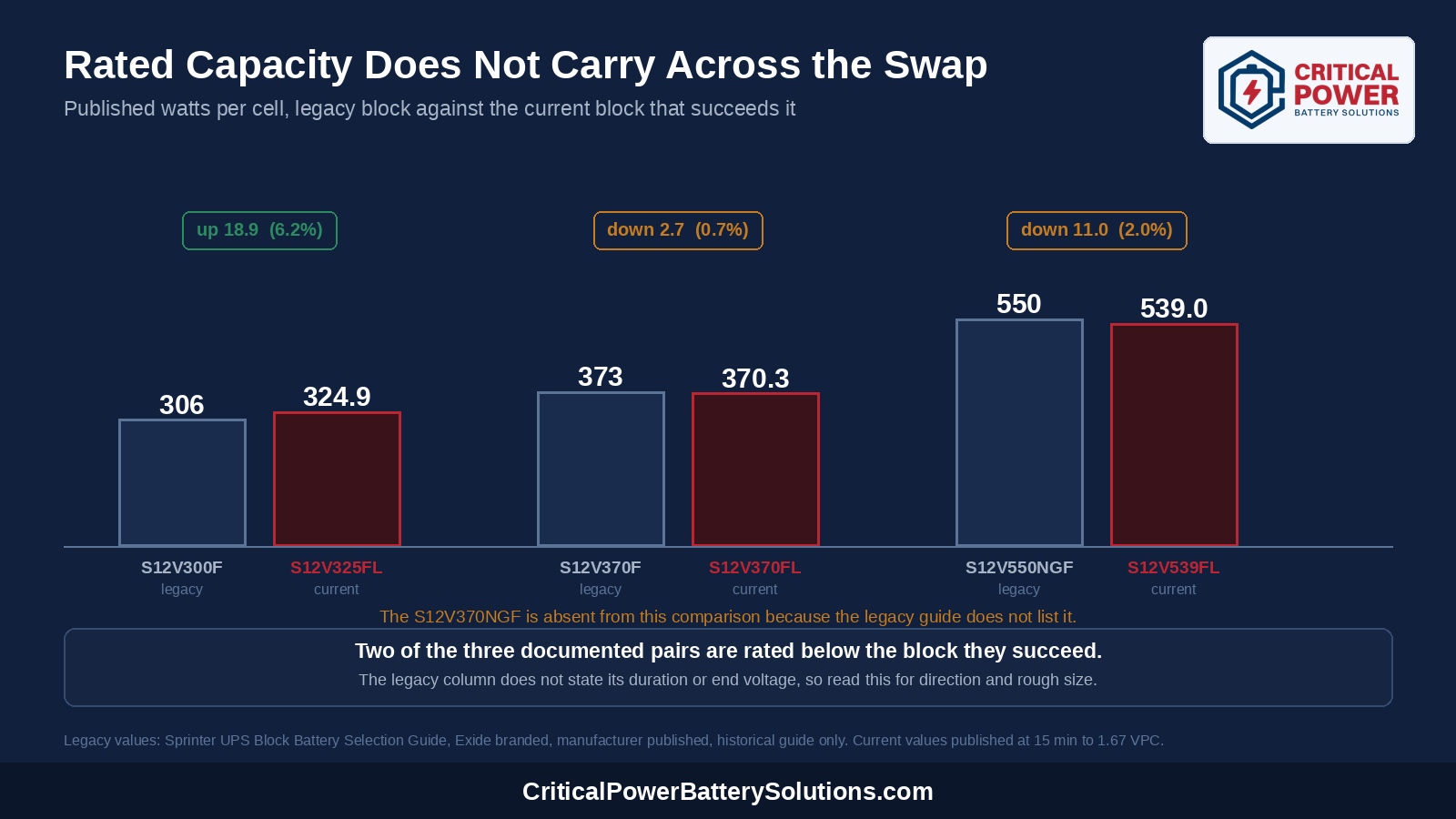
| Legacy block | Legacy watts per cell | Succeeded by | Current watts per cell | Change | Change as a percentage |
|---|---|---|---|---|---|
| S12V300F | 306 | S12V325FL | 324.9 | up by 18.9 | 6.2 percent |
| S12V370F | 373 | S12V370FL | 370.3 | down by 2.7 | 0.7 percent |
| S12V550NGF | 550 | S12V539FL | 539.0 | down by 11.0 | 2.0 percent |
The S12V370NGF is not in this table because the Selection Guide does not list it, and CPBS will not infer a rating for it from the block that succeeds it.
Read the comparison for its direction, not as a certified rating difference. The current figures are published at 15 minutes to 1.67 volts per cell. The legacy guide prints a bare watts per cell column without stating its duration or end voltage, so the two columns are not guaranteed to share a basis.
What the table does establish is that the direction of change is real and that it is not uniform across the three pairs. Two go down. That is enough to make the runtime check a required step rather than a formality.
What the table does not do is settle whether your particular string still meets its target. That depends on how much margin it was sized with, which is the next section.
What a small capacity change does to backup duration
A string sized with generous margin absorbs a two percent reduction without anyone noticing. A string sized tight to its duty cycle does not. Which of those you have is the question the swap forces you to answer.
UPS loads are close to constant power, so as the string voltage falls through a discharge the current rises to hold that power. Compare watts per cell at the duration you actually need and at the end voltage the system is set to. Comparing amp hours across generations will mislead you.
There are three ways a string that no longer meets its target can be brought back, and they are not equally available.
- Accept a shorter duration. Viable when the original specification carried margin over what the load actually needs today.
- Add blocks or a parallel string. Viable only if the cabinet has the positions, the floor takes the weight and the charger supports the configuration.
- Move up a block size. Changes the envelope again, so the fit checks restart from the beginning.
Working the required watts per cell out of the UPS rating and the string configuration is the sizing step, and it is set out in the VRLA battery sizing guide. If the question is simply how long a given string holds a given load, that arithmetic is in the guide to calculating battery runtime.
What the case does on each swap
The two smaller pairs lose 0.24 in of width and about six tenths of an inch of height, while the S12V539FL is 0.01 in wider than the S12V550NGF it succeeds. Smaller is not automatically easier: it leaves slack on the shelf, and slack still has to be restrained so the block cannot move. Nor is every change a reduction, which is why the envelope is measured rather than assumed.
| Model | Length in | Width in | Height in | Height over terminals in | Weight lb | Terminal |
|---|---|---|---|---|---|---|
| S12V300F (legacy) | 10.25 | 6.85 | 8.80 | not published | 63.0 | Insert M6 |
| S12V325FL (current) | 10.24 | 6.61 | 8.19 | 8.31 | 52.9 | T6 |
| S12V370F (legacy) | 12.05 | 6.85 | 8.80 | not published | 74.0 | Insert M6 |
| S12V370FL (current) | 12.05 | 6.61 | 8.15 | 8.27 | 61.7 | T6 |
| S12V550NGF (legacy) | 13.24 / 12.77 | 6.76 / 6.62 | 10.88 | not published | 99.0 | Insert M6 |
| S12V539FL (current) | 13.19 | 6.77 | 10.83 | 10.95 | 93.5 | T8 |
Legacy figures come from the Sprinter UPS Block Battery Selection Guide, which is Exide branded, manufacturer published, and a historical guide only. Current figures come from the Stryten Energy E-Series AGM product brochure.
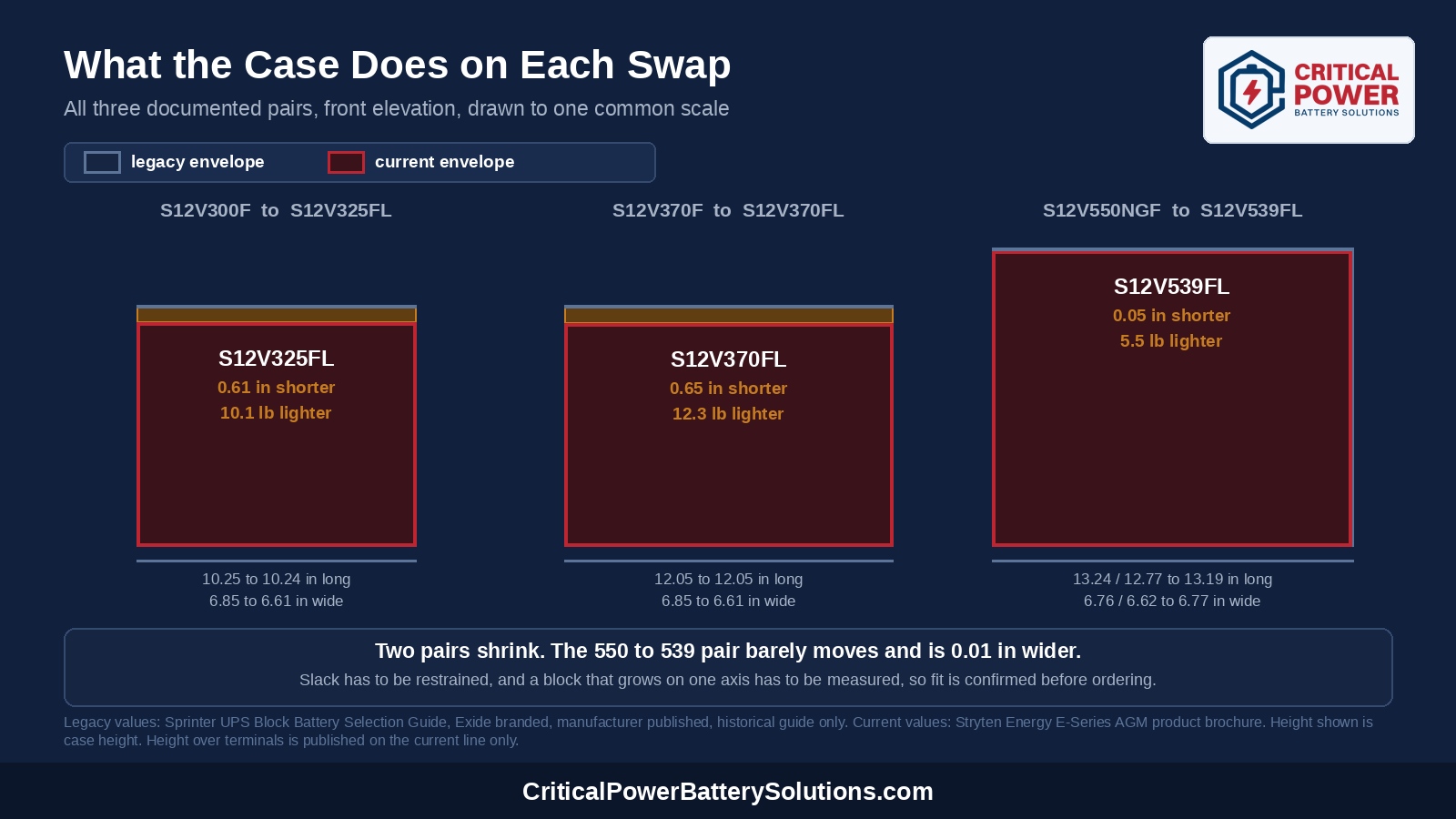
Two details in that table are worth pulling out.
Height over terminals is published only on the current line. No legacy block publishes it, so the legacy height column is a case height and the current height column has a companion figure that sits about a tenth of an inch above it. Compare like with like when you work out shelf clearance.
The Selection Guide prints two length and two width figures for the S12V550NGF. They are reproduced exactly as published. Where a source gives two figures without explaining them, the safe reading is the larger one, and the actual block is measured before the order.
Turning these numbers into shelf clearance, connector reach and floor loading is a separate exercise, and it is worked through in the guide to fitting a replacement block string into an existing cabinet.
Weight comes down on every swap, and the string is what counts
Per block the reduction runs from 5.5 lb to 12.3 lb. Multiplied across a full string it is the number that changes a floor loading conversation.
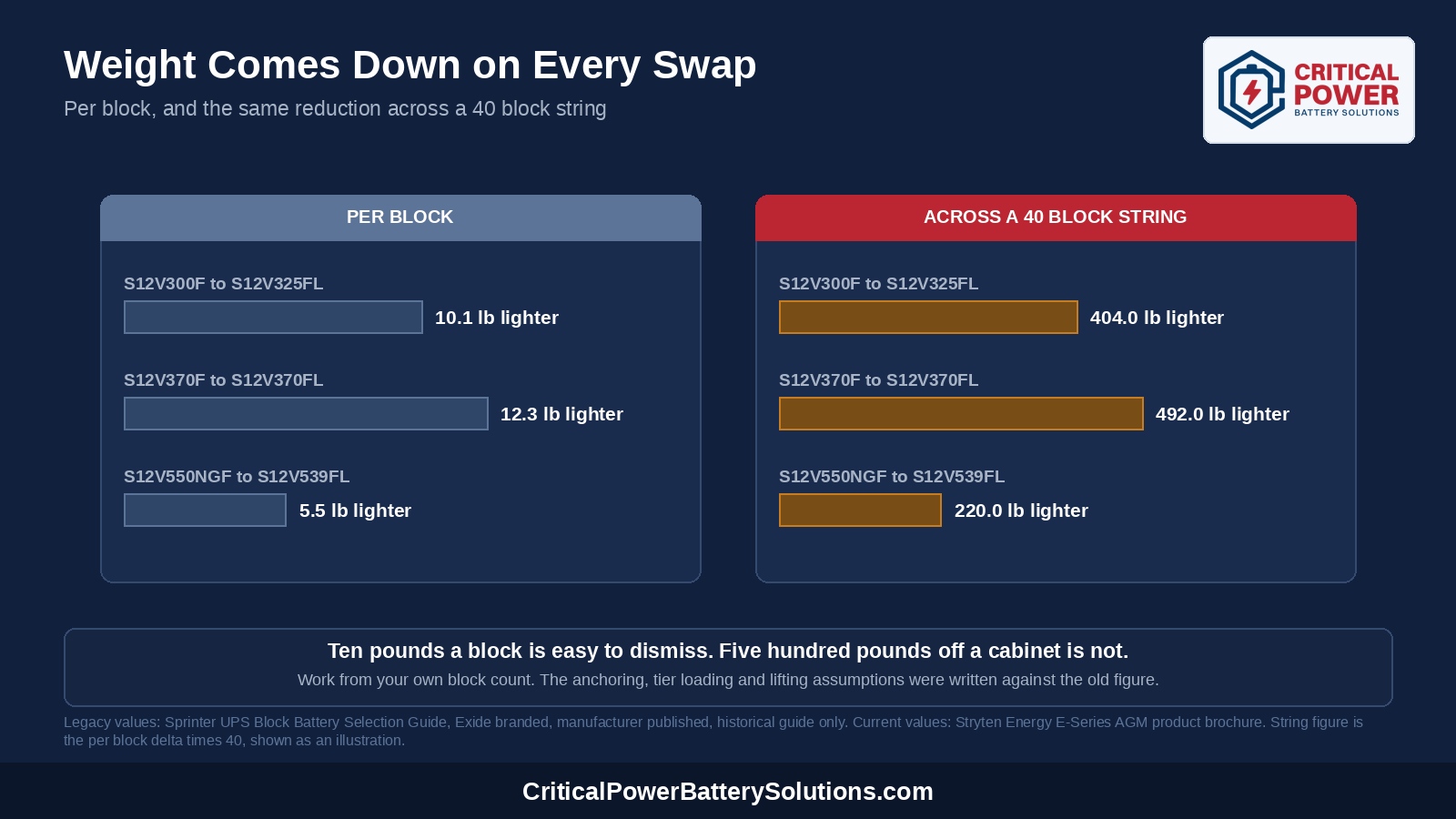
Take the middle pair. The S12V370FL saves 12.3 lb against the S12V370F, which is 16.6 percent of the block. Across a forty block string that is close to five hundred pounds off the cabinet and the floor beneath it.
That is usually good news, and it is still worth writing down. A cabinet specified around the heavier block is not at risk from a lighter one, but the seismic anchoring calculation, the tier loading assumption and the lifting plan for the crew were all written against the old figure.
Work from your own block count rather than from a percentage. Multiply the per block delta in the table above by the number of blocks in series, then by the number of strings in parallel.
The S12V370NGF is the one number with no published legacy figures
The Selection Guide lists the S12V300F, the S12V370F and the S12V550NGF. It does not list the S12V370NGF. That block sits in the middle of the three generation 370 lineage, and no published capacity, dimension or weight figure for it is held.
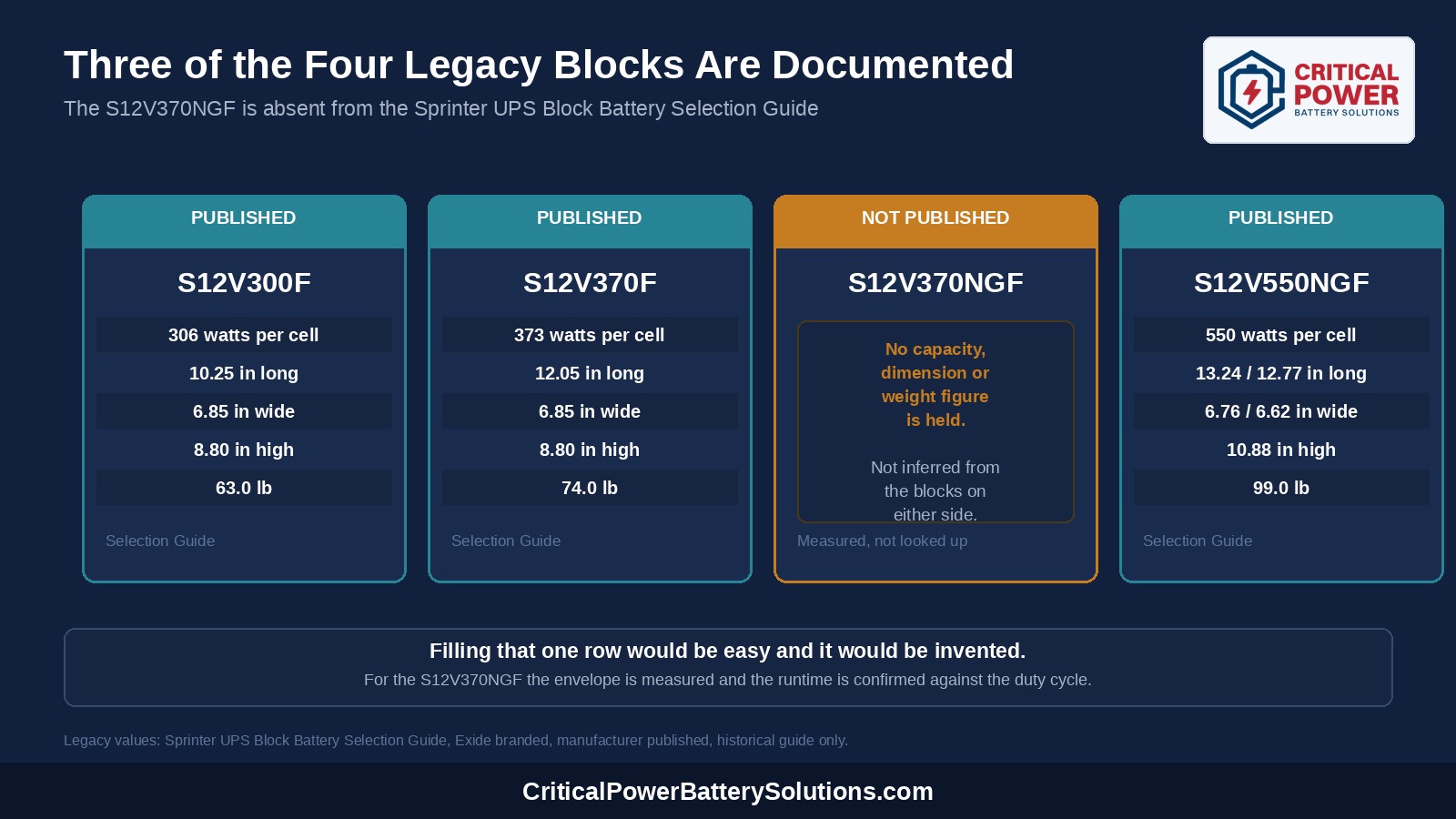
It would be easy to fill that row. The block it succeeds is known, the block that succeeds it is known, and a figure sitting between them would look entirely reasonable on the page. It would also be invented, and somebody would order against it.
So for the S12V370NGF specifically, the envelope is measured on the actual block and the runtime requirement is confirmed against the duty cycle rather than against a published legacy rating. CPBS confirms both before quoting.
If the characters on the label are what is in question rather than the figures behind them, the suffix and generation breakdown is in the guide to what a Sprinter NEXT model number means.
The terminal changes on every one of these swaps
Every legacy block in this group lands on an Insert M6. Every current block lands on a threaded insert in tin plated copper alloy, T6 on the AGM325 and the AGM370 and T8 on the AGM539, all three taking a 6 mm bolt at 71 in-lb.
The shared bolt size is what makes this easy to wave through. Bolt size is one item, terminal type is a second, and whether the ring lug already crimped to your connector suits the new landing is a third. Confirm all three separately and treat connectors as part of the order.
What each change means for a string that is already installed
Four things move on every swap, and each one lands on a different part of the installation.
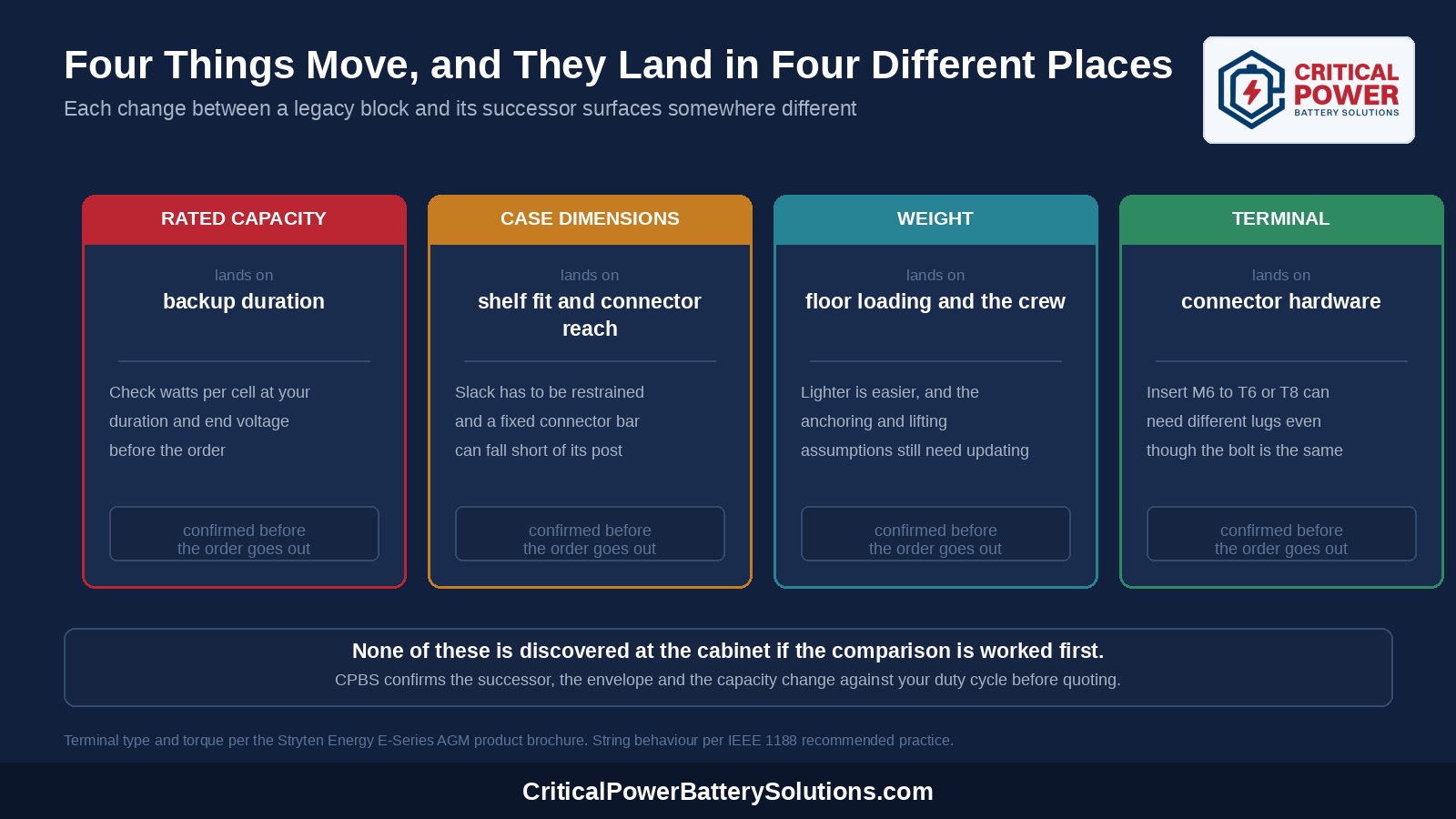
- Rated capacity lands on backup duration. Check watts per cell at your duration and end voltage before the order, not after the first discharge test.
- Case dimensions land on shelf fit and connector reach. A smaller block leaves slack that has to be restrained, and it can leave a fixed connector bar short of its post.
- Weight lands on floor loading and on the crew. Lighter is easier, and the anchoring and lifting assumptions still need updating.
- Terminal lands on hardware. An Insert M6 to T6 or T8 change can require different lugs even though the bolt is the same size.
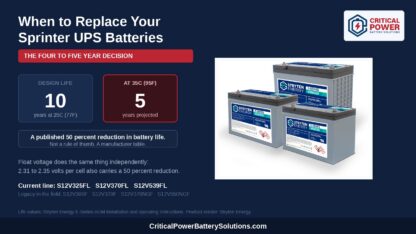
Whether the string is due for replacement at all is a separate question from what changes when it is, and it is decided on age against actual conditions, float voltage, ohmic trend and capacity. That decision is worked through in the guide to replacing these blocks at the four to five year mark, and the test procedures behind it are in the UPS battery testing guide. Tracking ohmic drift between those tests is covered in the guide to internal resistance measurement.
If the number on your label is not one of these four
Send the part number to CPBS for confirmation against the manufacturer records rather than reading a successor off the digits.
The number inside a Sprinter part number is not a straight capacity code and the lineages do not extend predictably. The 370 line runs exactly three generations and that pattern does not transfer to any other number in the range.
The Selection Guide also lists blocks from other manufacturers against each Sprinter model. If the block in your cabinet carries a different manufacturer name, that competitor mapping is reproduced in the cross reference guide linked at the top of this page, and it points at the same current models.
Discontinued is a lead time problem before it is a battery problem
A discontinued part number is not by itself a reason to replace the string. Discontinued means unavailable when it eventually fails, which is a procurement question rather than a condition question.
Lead time on domestic supply is 8 to 10 weeks. That is the gap between the day a string fails and the day a replacement can land if nothing was ordered in advance, and it is the reason a discontinued label is worth acting on early even when the batteries are healthy.
What to have ready before you call
The first three items answer most of the comparison above, and the rest close it out.
- The legacy part number and the quantity, read off an existing block.
- The required backup duration and the system minimum voltage, which are what the capacity comparison is checked against.
- A photograph of the label and a photograph of one full shelf.
- Number of blocks in series and number of strings in parallel.
- Shelf to shelf clearance and shelf depth, measured rather than estimated.
- Cabinet or rack make and model, if it is known.
- Existing connector type and lug size, if visible without disassembly.
- Ambient temperature of the room the cabinet sits in.
How CPBS handles a Sprinter replacement
CPBS confirms the successor, checks the capacity change against your duty cycle, and documents what was quoted and why. Tom Kierna reviews the part number, the measurements and the photographs personally before anything is quoted.
The installation stays with your own technicians or your service contractor, and the cabinet, rack, breakers and UPS equipment stay with the facility and its integrator. What CPBS owns is the battery decision and the paperwork that supports it.
Buyers who want to confirm reseller status before sending a part number can work through the steps for verifying an authorized Stryten distributor. It is a reasonable check on any supplier holding a discontinued part number.
Send the part number and the photographs to Tom Kierna at 630-984-9718 or sales@criticalpowerbatterysolutions.com. Most requests are identified the same day.
Frequently asked questions
Does the current block have the same rated capacity as the block it replaces?
No. The rating changes on every one of the three documented pairs, and it does not change in the same direction. The S12V325FL is published at 324.9 watts per cell against 306 for the S12V300F, which is an increase. The S12V370FL is published at 370.3 against 373 for the S12V370F, and the S12V539FL at 539.0 against 550 for the S12V550NGF, both of which are reductions.
Is the S12V539FL rated lower than the S12V550NGF it succeeds?
On the published figures, yes, by about 11.0 watts per cell, or roughly 2.0 percent. The two figures come from different documents and the legacy guide does not state the duration or end voltage behind its column, so treat the gap as an indication rather than a certified difference. It is still enough to make the runtime check worth doing on a string that was sized tight.
Will my backup runtime change after a Sprinter replacement?
It can, and whether it does depends on how much margin the string was sized with. A string with comfortable margin absorbs a small reduction with no practical effect. A string sized close to its duty cycle may fall short of the duration it was commissioned to deliver. Compare watts per cell at your required duration and at the end voltage the system is actually set to, rather than comparing amp hours.
How much lighter are the current blocks than the legacy blocks?
Between 5.5 lb and 12.3 lb per block. The S12V325FL is 10.1 lb lighter than the S12V300F, the S12V370FL is 12.3 lb lighter than the S12V370F, and the S12V539FL is 5.5 lb lighter than the S12V550NGF. Multiply the per block figure by your own block count before revisiting floor loading.
Will the current block occupy the same space in the cabinet?
Not exactly. The two smaller pairs lose 0.24 in of width and about six tenths of an inch of height, while the S12V539FL is 0.01 in wider than the S12V550NGF it succeeds. Case dimensions, terminal design and weight differ, so fit is confirmed before ordering. The two smaller pairs lose about a quarter of an inch of width and roughly half an inch of height. That direction of change leaves slack rather than interference, and slack still has to be restrained so the block cannot shift on the shelf.
Why is no published dimensional data held for the S12V370NGF?
Because it is absent from the Sprinter UPS Block Battery Selection Guide, which is where the published legacy figures come from. The guide lists the S12V300F, the S12V370F and the S12V550NGF but not the S12V370NGF. CPBS will not infer its capacity, dimensions or weight from the blocks on either side of it in the lineage, so for that model the envelope is measured and the runtime requirement is confirmed against the duty cycle.
Does my connector hardware carry over when the terminal changes?
Not reliably. Every legacy block in this group uses an Insert M6 and every current block uses a threaded insert, T6 on the AGM325 and AGM370 and T8 on the AGM539, all taking a 6 mm bolt at 71 in-lb. A matching bolt size does not confirm that the ring lug suits the new landing, and connector bars are fixed hardware that cannot be stretched if a shorter case moves the post position. Treat connectors as part of the order.
Should I change the number of blocks in the string to hold the same runtime?
Only after the sizing calculation says so, and only if the installation can take it. Adding blocks or a parallel string restores capacity but needs spare positions in the cabinet, floor capacity for the extra weight and a charger that supports the configuration. The alternatives are accepting a shorter duration where the original specification carried margin, or moving up a block size, which changes the envelope again and restarts the fit checks.
My part number is not one of these four, what do I do?
Send the part number to CPBS for confirmation against the manufacturer records rather than guessing from the numbering pattern. The number inside a Sprinter part number is not a straight capacity code and the lineages do not extend predictably from one model to the next. If the block carries a different manufacturer name altogether, the Selection Guide lists it against a Sprinter model and that mapping points at the same current blocks.
Does a discontinued part number mean I have to replace the string now?
No. Discontinued means unavailable when the string eventually fails, which is a procurement question rather than a condition question. Whether the string is actually due is decided on age against actual conditions, float voltage, ohmic trend and capacity. What a discontinued label does change is the planning horizon, because the replacement can no longer be treated as something available on short notice.
How long does it take to get replacement blocks?
Lead time on domestic supply is 8 to 10 weeks. That is the reason a discontinued part number is worth planning around before the string fails rather than after. Two months of exposure is manageable as a scheduled purchase and difficult as an emergency, so the useful move on finding a discontinued label is to start the conversation early.
What information does CPBS need to quote a Sprinter replacement?
The legacy part number, the quantity, the required backup duration and the system minimum voltage. The duration and voltage matter more on this decision than they used to, because they are what the capacity change is checked against. A photograph of the label and a photograph of one full shelf answer most of what remains. Send them to Tom Kierna at 630-984-9718 or sales@criticalpowerbatterysolutions.com and most requests are identified the same day.
About the author: Tom Kierna is a Battery Systems Specialist at Critical Power Battery Solutions with more than 40 years in industrial battery systems, including 15 years across GNB and Stryten. He specializes in Sprinter and E-Series AGM block battery selection, legacy part number succession, and UPS application sizing. Last updated August 14, 2026.
References
- Sprinter UPS Block Battery Selection Guide, UPS top terminal valve regulated lead acid block batteries. Exide branded, manufacturer published, historical guide only: published watts per cell, length, width, height, weight and terminal type for the legacy S12V300F, S12V370F and S12V550NGF, and the competitor blocks listed against each. The S12V370NGF does not appear on this guide.
- Stryten Energy. E-Series AGM325, AGM370 and AGM539 product brochure: rated capacity in watts per cell at 15 minutes to 1.67 volts per cell, nominal dimensions, height over terminals, weight, terminal type, and the 6 mm bolt torque figure of 71 in-lb stated for both the T6 and T8 terminals.
- Stryten Energy. E-Series AGM installation and operating instructions: connection preparation and torqueing practice, retorque intervals, float guidance and string requirements.
- GNB Industrial Power, a division of Stryten Manufacturing LLC. Marathon and Sprinter NEXT installation and operating instructions: installation practice for the preceding generation of the same blocks.
- IEEE Standards Association. IEEE 485 Recommended Practice for Sizing Lead-Acid Batteries for Stationary Applications, referenced at the method level for duty cycle sizing and aging margin.
- IEEE Standards Association. IEEE 1188 Recommended Practice for Maintenance, Testing, and Replacement of Valve-Regulated Lead-Acid Batteries for Stationary Applications, referenced at the method level for ohmic baselines and capacity testing.