Quick answer: The Stryten Energy E-Series AGM325, AGM370 and AGM539 are the three current 12V blocks, and they carry the part numbers S12V325FL, S12V370FL and S12V539FL. Rated capacity at the 15 minute rate to 1.67 volts per cell is 324.9, 370.3 and 539.0 watts per cell, and 20 hour capacity to 1.80 volts per cell is 82, 95 and 155 amp hours. The AGM325 and AGM370 take T6 terminals and the AGM539 takes T8, all three on a 6 mm bolt at 71 in-lb. Design life is ten years at 25C (77F) in UPS float service.
Key points
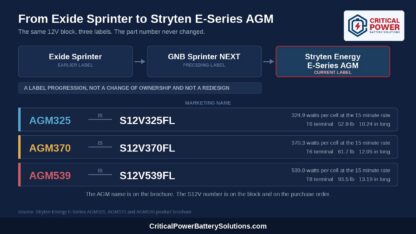
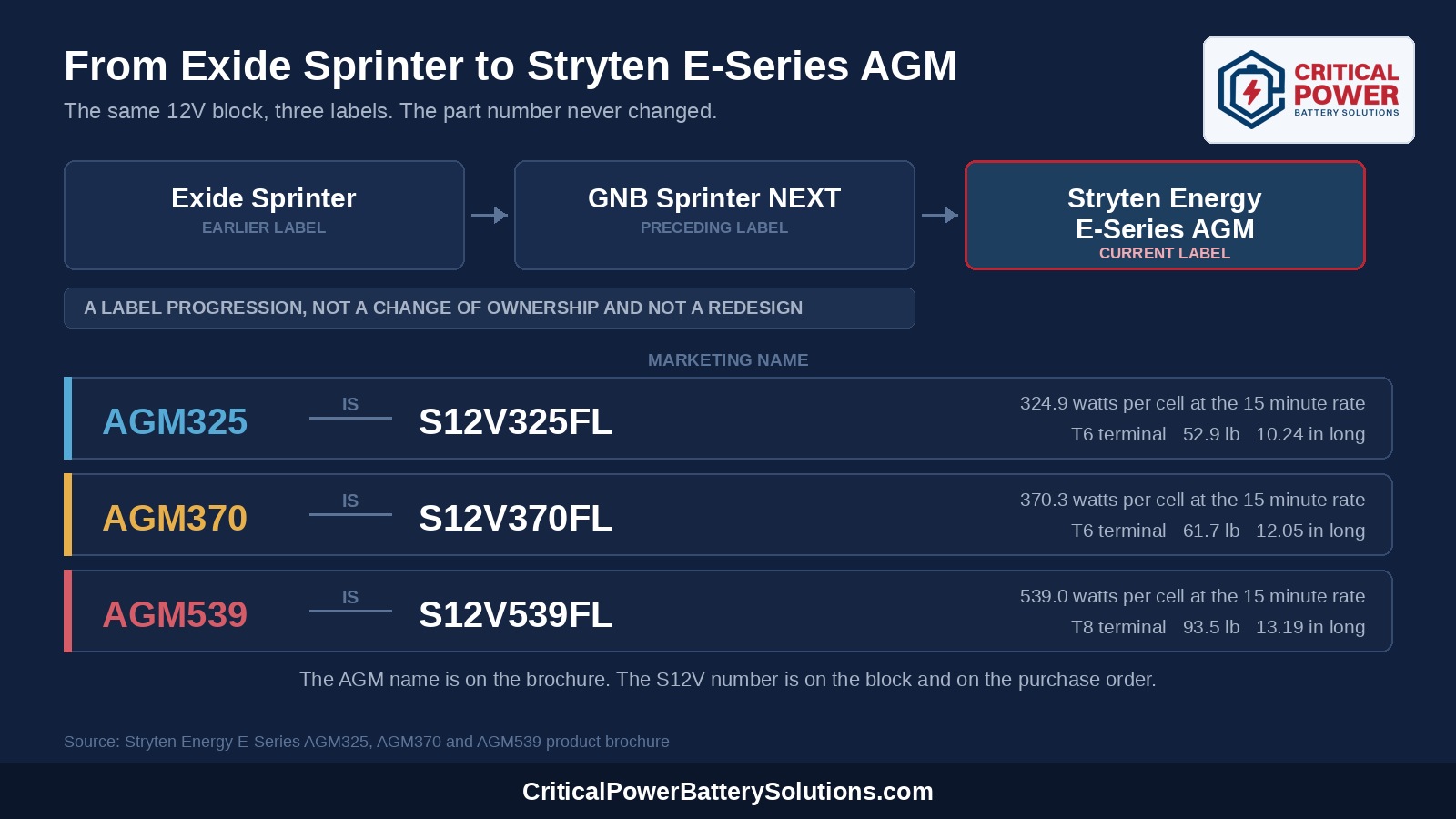
- AGM325 is S12V325FL, AGM370 is S12V370FL and AGM539 is S12V539FL. The AGM name is the label used in brochures and listings. The S12V number is printed on the block and is the one that belongs on a purchase order.
- The number in the name is the 15 minute watts per cell rating at 1.67 volts per cell. 324.9 rounds to AGM325, 370.3 rounds to AGM370 and 539.0 rounds to AGM539.
- The chain reads Exide Sprinter, then GNB Sprinter NEXT, then Stryten Energy E-Series AGM. That is a label progression, not a change of ownership and not a redesign.
- Height over terminals sits 0.12 in above case height on all three blocks, so the numbers to measure a shelf against are 8.31 in, 8.27 in and 10.95 in.
- Terminals are threaded tin plated copper alloy inserts. T6 on the AGM325 and AGM370, T8 on the AGM539, both taking a 6 mm bolt at 71 in-lb.
- Internal resistance is 4.5, 4.0 and 3.1 milliohms. Short circuit current is 1640, 1900 and 3100 amps, which is the figure that sizes protective devices.
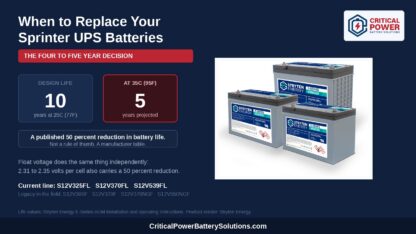
- Design life is ten years at 25C (77F) in UPS float service, which is a rating taken at a stated temperature rather than a promise about any particular room.
Current 12V blocks: specifications and quote
Full specifications, drawings, manuals and warranty documents for each current model.
Legacy blocks S12V300F, S12V370F, S12V370NGF and S12V550NGF are succeeded by these models. Case dimensions, terminal design and weight differ, so fit is confirmed before ordering.
Somebody sends a quote that says AGM370. The label on the block sitting in the rack says S12V370FL. Those are the same battery, and the entire purpose of this reference is to say so plainly and then publish every verified figure behind it, so that a purchase order can be written without a phone call.
Stryten Energy manufactures these blocks. The E-Series AGM line covers three 12V valve regulated lead acid monoblocs sold for uninterruptible power supply float service. This page carries the full Stryten E-Series AGM specifications for all three side by side:
- Rated capacity in watts per cell and in amp hours
- Length, width, case height, height over terminals and weight
- Internal resistance and short circuit current
- Terminal type, bolt size and torque
- Plate, separator, container and vent construction
- Charging limits, float voltage windows and temperature compensation
Every number comes from the manufacturer product brochure or the installation and operating instructions. Nothing has been interpolated, averaged or estimated.
Critical Power Battery Solutions (CPBS) is the battery division of Advanced Technical Services Inc., founded in 1981 and ISO 9001 certified, and is an authorized Stryten Energy reseller. Tom Kierna, who has more than 40 years in industrial batteries including 15 across GNB and Stryten, sizes every order personally. CPBS is consulting based: it supplies and sizes batteries and does not perform on site installation, commissioning, testing, or maintenance.
Who this specification reference is for
This reference is for anyone who has to put a part number on a purchase order and defend it. It assumes the UPS is staying, the enclosure is staying, and the question is which of the three current blocks meets the requirement and whether it will physically go where the old one came out.
- Facility and critical power managers signing off a replacement string.
- UPS service technicians who arrive holding a label and need the published figures behind it.
- Telecom and utility power engineers sizing for a stated runtime at a stated end voltage.
- Oil and gas technicians maintaining backup power at unmanned sites.
- Procurement staff who need the order to be defensible on paper before it is placed.
Supplying or specifying UPS systems, cabinets, racks, or breakers is out of scope for CPBS. Those stay with the facility and its integrator. What follows is the battery data.


The naming bridge: AGM325 is S12V325FL, AGM370 is S12V370FL, AGM539 is S12V539FL
The AGM name and the S12V part number identify the same block. AGM325 is S12V325FL. AGM370 is S12V370FL. AGM539 is S12V539FL. Same battery, same part number moulded and printed on the case, new label on the brochure.
The confusion is worth explaining because it costs orders. A distributor listing, a service report and a manufacturer brochure can each use a different one of the two names for the same unit, and a buyer comparing them side by side reasonably concludes there are two products. There is one. The AGM designation is the marketing name Stryten Energy uses in the E-Series literature. The S12V designation is the engineering part number, it is what appears on the block itself, and it is what a supplier needs in order to quote.
The full chain reads Exide Sprinter, then GNB Sprinter NEXT, then Stryten Energy E-Series AGM. That progression is a sequence of labels applied to a product line over time as ownership of the brand moved, and it is not a redesign of the battery. Readers working backwards from an older label will find the model number structure broken down in the reference on how the S12V model numbers decode.
What the number in the name actually means
The number in the AGM name is the 15 minute watts per cell rating at 1.67 volts per cell, rounded. 324.9 watts per cell becomes AGM325. 370.3 becomes AGM370. 539.0 becomes AGM539. Almost nobody publishes this, and it is the single most useful thing to know about the naming, because it means the model name itself carries a performance figure rather than an arbitrary sequence number.
Two things follow from that, and both matter when sizing:
- The name is not the number to size with. The rating behind the name is taken at 1.67 volts per cell, a deeper end voltage than the 1.75 volts per cell most UPS systems are designed around.
- Watts per cell and amp hours answer different questions. Watts per cell describes what the block holds under a high rate load for a short duration. The 20 hour amp hour figure at 1.80 volts per cell describes a long, slow discharge that a UPS string rarely sees.
Comparing amp hours across generations of block is the most common sizing mistake in this lane. The correct comparison is watts per cell at the duration and end voltage that the application actually requires, which is Table 2 below.
Table 1: published battery specifications for all three blocks
Every physical and electrical figure Stryten Energy publishes for the three current blocks appears in one place below. The source for these Stryten E-Series AGM specifications is the E-Series AGM325, AGM370 and AGM539 product brochure.
| Model number | Nominal voltage | 15 min WPC at 1.67 VPC | 20 hr Ah at 1.80 VPC | Length in | Width in | Height in | Height over terminals in | Weight lb | Internal resistance milliohms | Short circuit current A | Terminal type |
|---|---|---|---|---|---|---|---|---|---|---|---|
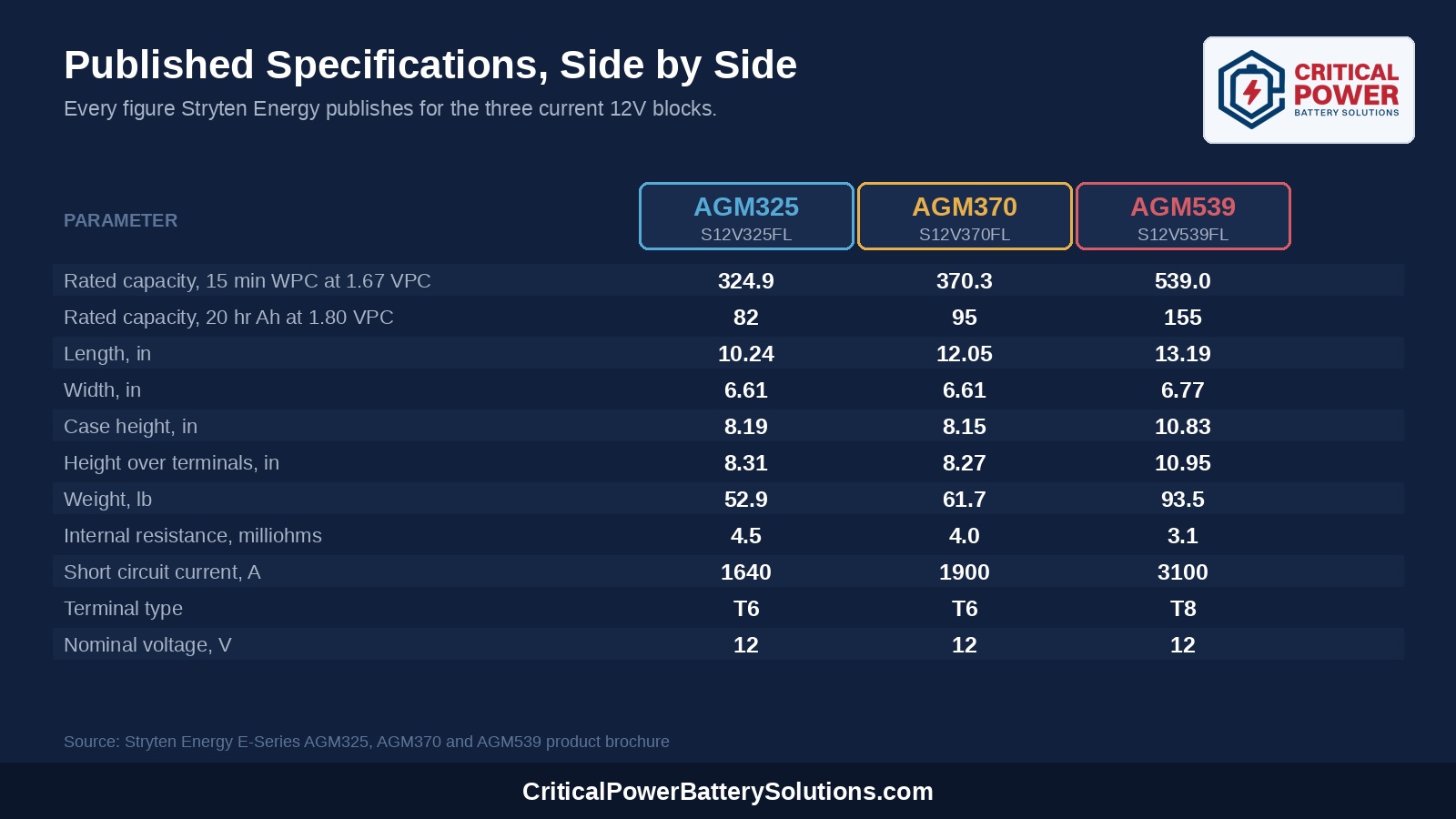
| S12V325FL (AGM325) | 12 | 324.9 | 82 | 10.24 | 6.61 | 8.19 | 8.31 | 52.9 | 4.5 | 1640 | T6 |
| S12V370FL (AGM370) | 12 | 370.3 | 95 | 12.05 | 6.61 | 8.15 | 8.27 | 61.7 | 4.0 | 1900 | T6 |
| S12V539FL (AGM539) | 12 | 539.0 | 155 | 13.19 | 6.77 | 10.83 | 10.95 | 93.5 | 3.1 | 3100 | T8 |
Reading across the rows, capacity climbs steeply while the case grows modestly until the AGM539, which is a different size class. The AGM325 and AGM370 share a 6.61 in width and sit within 0.04 in of each other in case height, so the AGM370 buys 45.4 more watts per cell and 13 more amp hours for 1.81 in of extra length and 8.8 lb. The AGM539 adds 10.83 in of case height, 6.77 in of width and 93.5 lb of block weight, and it is the only one of the three on a T8 terminal.
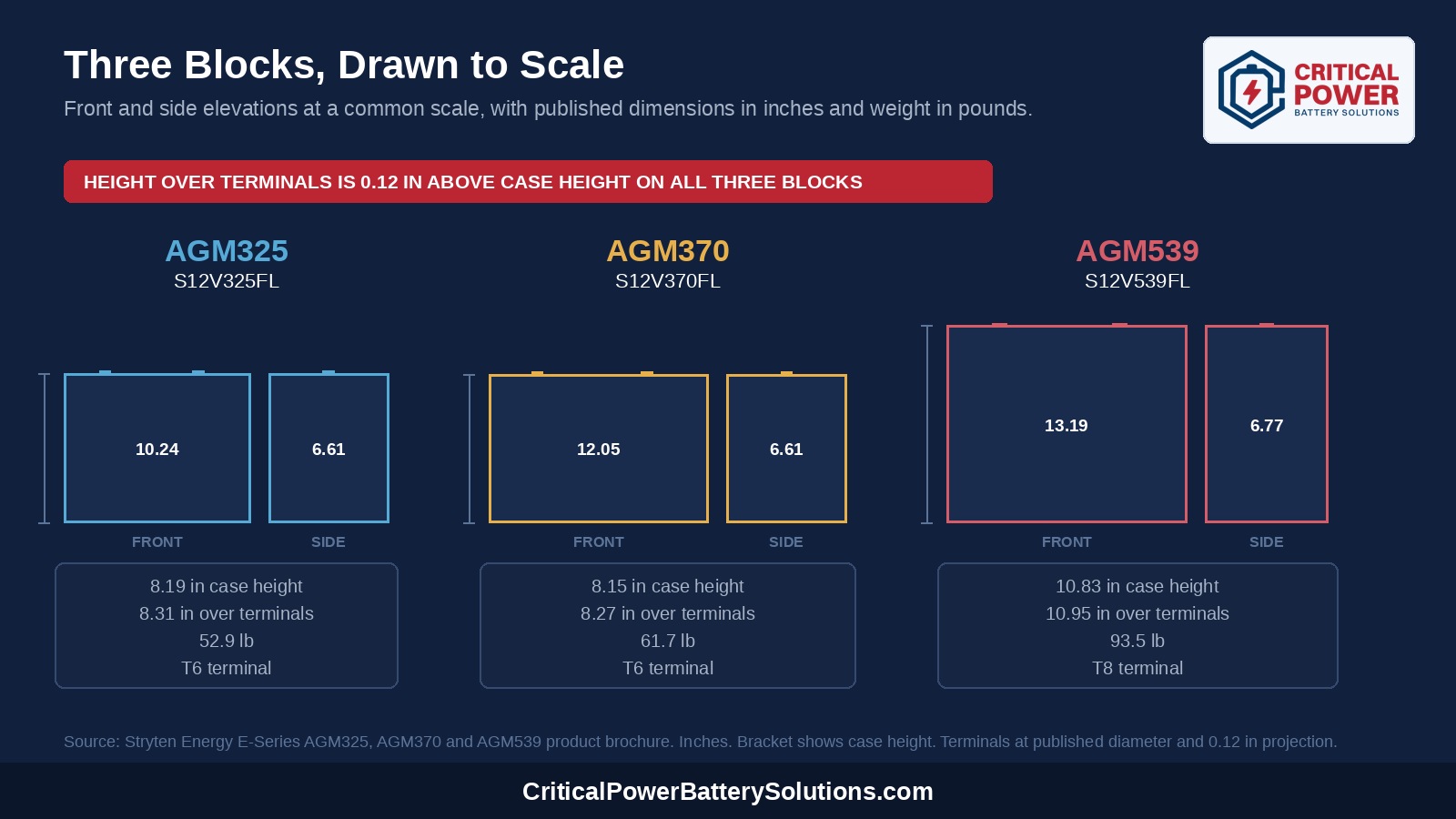
Height over terminals, not case height, is the number that decides whether a block goes onto a shelf. The published difference is 0.12 in on all three, which sounds trivial until a shelf was set with no margin. The bolt head, the washer and the connector bar all sit in that space, and a connector run between two blocks needs more of it again. Shelf clearance, connector reach and string weight are handled in full in the cabinet and rack fitment guide, and are not repeated here.
Weight matters twice. Once for the block, where 93.5 lb is at the practical limit of a two person lift, and once for the string, where block weight multiplied by block count is what the cabinet structure and the floor slab actually carry. A 40 block string of AGM539 weighs 3,740 lb before the enclosure is counted.
Internal resistance and short circuit current are the two figures on this table that get overlooked. Internal resistance, at 4.5, 4.0 and 3.1 milliohms, is the published starting point against which later ohmic readings are compared, and the method for using it correctly is set out in the guide to internal resistance measurement and IEEE 485 sizing. Short circuit current, at 1640, 1900 and 3100 amps, is what a protective device between the string and the load has to be rated to interrupt.
Table 2: constant power discharge at 1.75 volts per cell
This is the table a UPS string is actually sized from. The figures are watts per cell at 25C, discharged at constant power down to an end voltage of 1.75 volts per cell.
| Model | 5 min | 10 min | 15 min | 20 min | 30 min | 60 min | 90 min |
|---|---|---|---|---|---|---|---|
| S12V325FL (AGM325) | 441.8 | 325.1 | 290.0 | 244.5 | 182.2 | 107.2 | 80.0 |
| S12V370FL (AGM370) | 499.6 | 401.3 | 330.8 | 276.0 | 206.7 | 121.6 | 90.5 |
| S12V539FL (AGM539) | 710.1 | 530.7 | 458.9 | 398.9 | 312.2 | 190.2 | 142.9 |
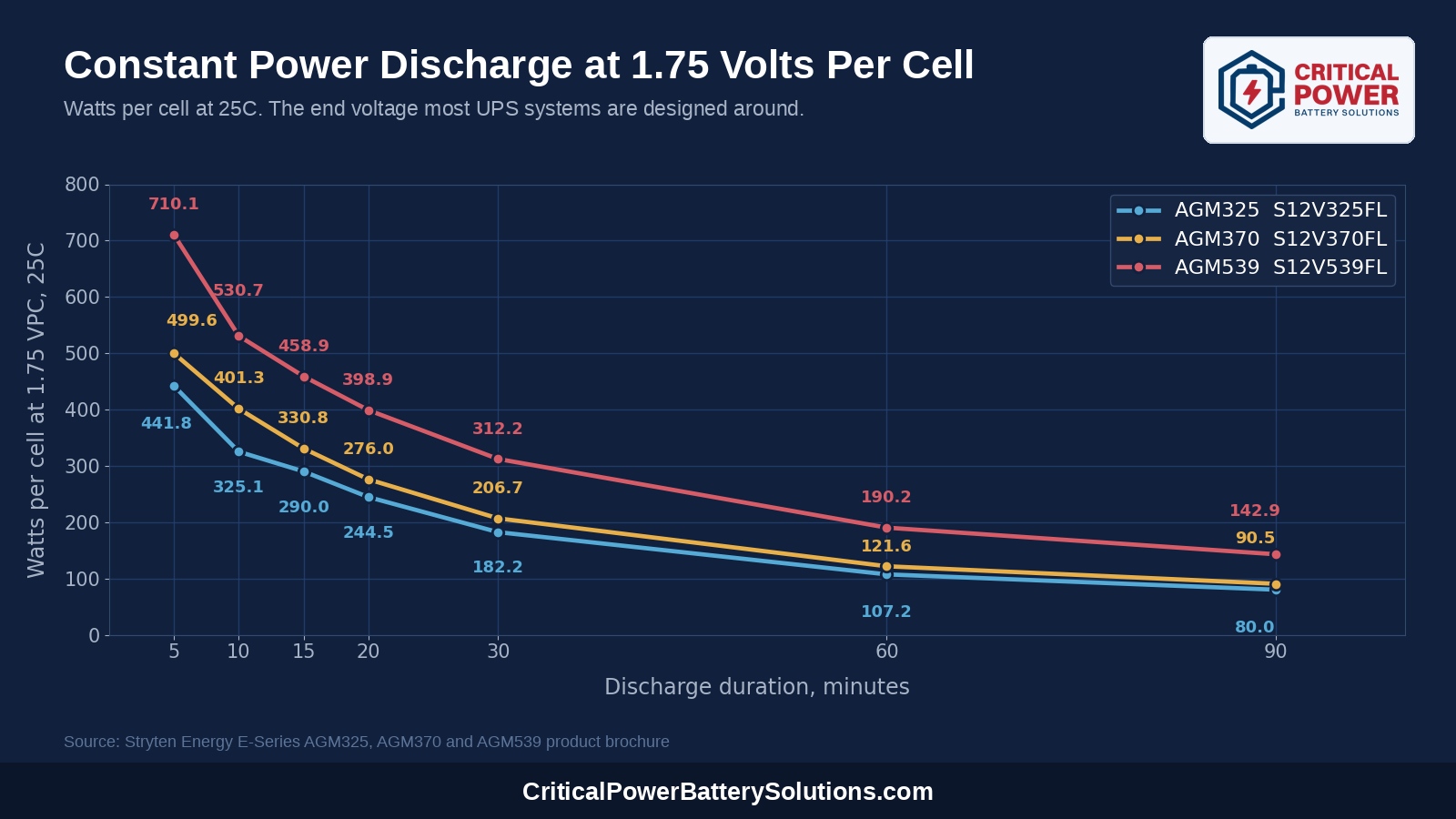
Stryten Energy publishes this table at six end voltages, namely 1.85, 1.80, 1.75, 1.70, 1.67 and 1.60 volts per cell, and publishes six more tables in constant current amps. Only the 1.75 volts per cell constant power set is reproduced here, because it is the common UPS design end voltage. A sizing calculation must use the end voltage at which the UPS in question actually cuts off. Taking figures from the wrong end voltage table is a quiet error that produces a string which tests fine and then falls short on the day it is needed.
The shape of the data is worth reading:
- At 5 minutes the AGM539 delivers 710.1 watts per cell against 441.8 for the AGM325, a difference of 268.3.
- At 90 minutes the same pair delivers 142.9 against 80.0, a difference of 62.9.
- The larger block therefore returns most of its advantage in short, hard discharges, which is the profile of a facility riding through a transfer to standby generation.
- For long duration holdover the advantage narrows, and block count starts to matter more than block size.
Two neighbouring references carry the method rather than the data. The VRLA battery sizing guide covers duty cycle construction, aging margin and design margin, and how to calculate battery runtime works through converting a load in kilowatts into watts per cell for a given string.
Table 3: construction and charging limits
Construction and charging limits decide how the charger has to be programmed and whether the block is acceptable to the room it goes into. These figures are published for the E-Series AGM line as a whole and apply to all three models.
| Parameter | Specification |
|---|---|
| Positive and negative plate | Lead calcium grids |
| Separator | Microporous glass fibre AGM, electrolyte fully absorbed |
| Terminal insert | Threaded tin plated copper alloy, T6 and T8, 6 mm bolt at 71 in-lb |
| Container | ABS, flame retardant to UL94 V-0 |
| Venting valve | EPDM rubber, resealing 0.44 to 2.18 PSI, releasing 1.45 to 5.08 PSI |
| Maximum charging current | Less than 0.3C A |
| Maximum AC ripple | Plus or minus 0.02 V per cell |
| Self discharge | Less than 3 percent per month at 20C |
| Equalize charge voltage | 14.1 to 14.4 V at 25C |
| Nominal operating temperature | 20C to 25C (68F to 77F) |
| Discharge temperature | minus 20C to 55C (minus 4F to 131F) |
| Charge temperature | 0C to 50C (32F to 122F), temperature compensated charger |
Three entries in that table do work that is easy to miss:
- UL94 V-0 container rating. A flammability classification that many commercial and industrial critical power rooms require by specification, so it belongs in the submittal rather than in a footnote.
- Maximum AC ripple of plus or minus 0.02 V per cell. This is a charger property rather than a battery property. A UPS running ripple above the limit heats the block internally and accelerates grid corrosion however correct the float voltage looks on a meter.
- Self discharge below 3 percent per month at 20C. This sets the maximum shelf time before stored blocks need a freshening charge.
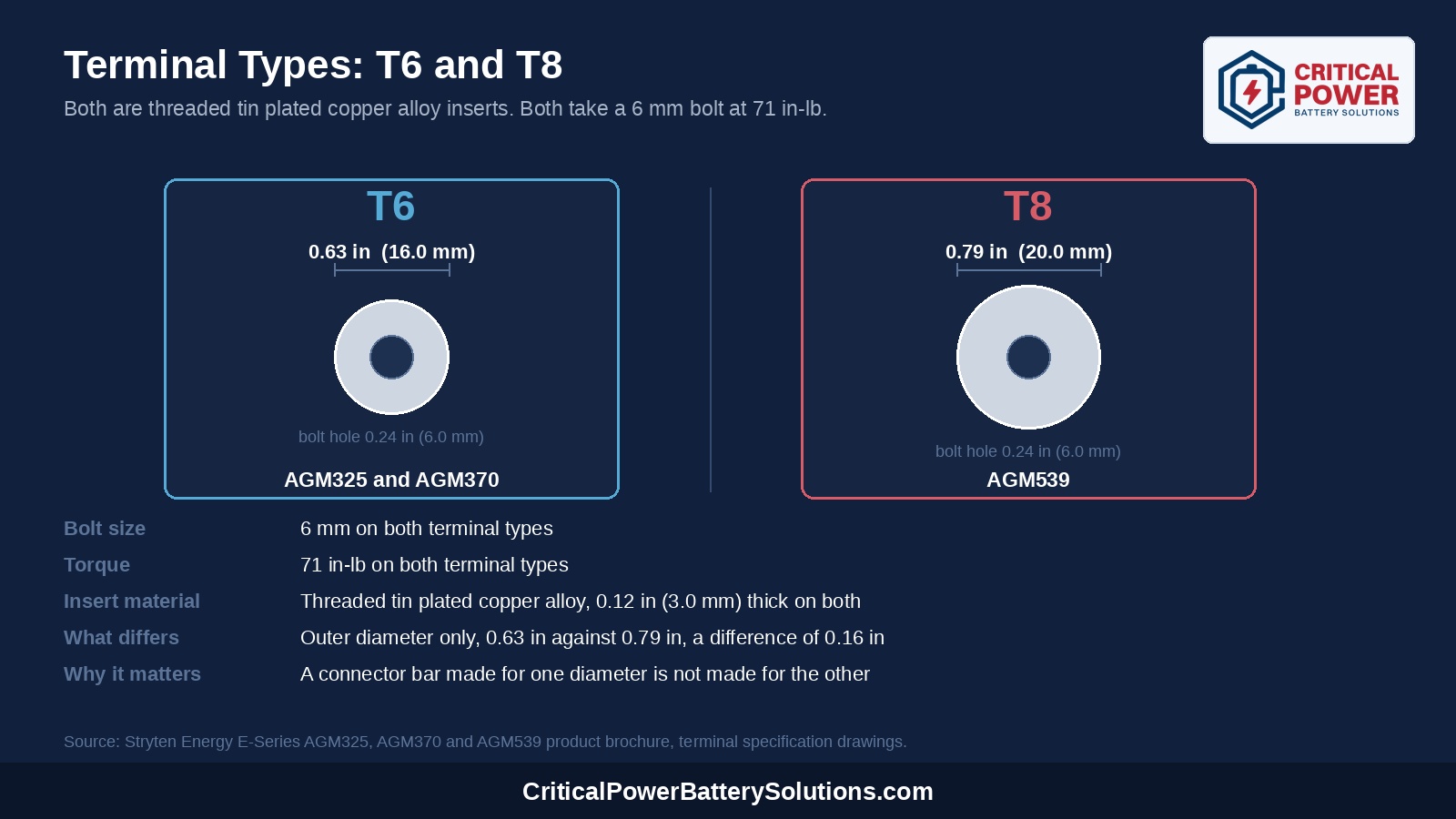
Both terminal types are threaded tin plated copper alloy inserts, both take a 6 mm bolt, and both torque to 71 in-lb. The published difference between them is the outer diameter:
- T6 measures 0.63 in (16.0 mm) across, and is used on the AGM325 and the AGM370.
- T8 measures 0.79 in (20.0 mm) across, and is used on the AGM539.
- Both carry a 0.24 in (6.0 mm) bolt hole and both stand 0.12 in (3.0 mm) proud of the lid, which is where the 0.12 in between case height and height over terminals comes from.
That 0.16 in difference in diameter is the reason a T8 block and a T6 block do not accept the same connector bar even though the bolt size matches. Matching bolt size is not a confirmation of lug match, and confirming the connector hardware before the truck arrives avoids an install that stops halfway.
Torque is not a detail to approximate. Under torque leaves a joint with resistance in it, which heats under load, and over torque strips or distorts the threaded insert, which is not repairable in the field. Retorque at the interval the maintenance programme sets, and record it.
Float voltage and temperature compensation
Recommended float is 2.25 to 2.30 volts per cell at 25C for the AGM325 and AGM370, and 2.25 to 2.35 volts per cell for the AGM539. The minimum temperature corrected float is 2.21 volts per cell and the maximum is 2.40 volts per cell. At block level the brochure states 13.5 to 13.8 V at 25C, which is the same window expressed across six cells.
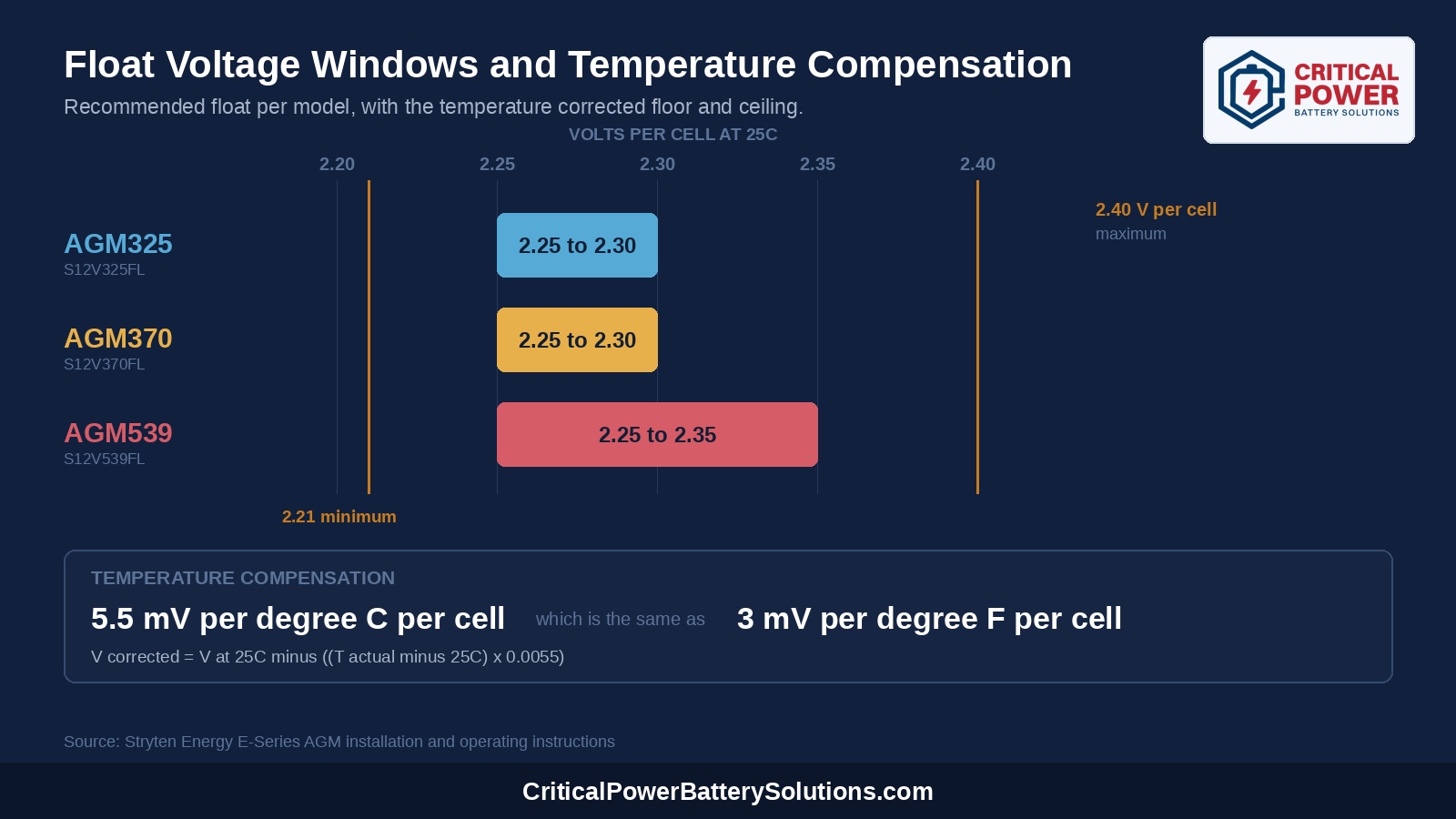
Above or below 25C (77F) the charge voltage is corrected at 5.5 mV per degree C per cell, which is the same thing as 3 mV per degree F per cell. The formula is V corrected equals V at 25C minus the quantity T actual minus 25C, multiplied by 0.0055. A string floating in a room held at 30C therefore wants roughly 0.0275 V per cell less than the 25C setpoint, or about 0.165 V less across a 12V block.
Getting this wrong in either direction costs capacity. Float too low and the plates sulphate and the string never reaches full charge. Float too high and gassing and grid corrosion accelerate, and in a warm room with no compensation the two effects compound. The consequences of sustained overcharge in a warm enclosure are covered in the thermal runaway prevention guide.
Design life and what the rating actually promises
Stryten Energy publishes a ten year design life at 25C (77F) in UPS float service for the E-Series AGM line. Design life is a rating at a stated temperature, not a guarantee of service life in any installation.
A ten year design life describes what the block is engineered to achieve under a defined set of conditions:
- Float service rather than repeated cycling
- Correct float voltage, correctly temperature compensated
- An ambient of 25C (77F)
- A discharge history the design anticipated
Room temperature is the variable that moves the outcome furthest, and the published relationship between operating temperature and expected life belongs to the article on when to replace a Sprinter UPS block string, which sets out the manufacturer table rather than the rule of thumb usually quoted in its place.
Knowing where a string actually sits against its design life is a measurement question rather than a calendar question, and the procedure is set out in the UPS battery testing guide.
How to pick between the AGM325, AGM370 and AGM539
Pick by required watts per cell at the duration and end voltage the application runs at, then confirm the block physically fits and the terminal matches. Working in that order stops the two failure modes that actually occur, which are a string that fits but does not hold, and a string that holds but does not fit.
- Read the label on the block you have and record the part number and the quantity. A photograph of one label and one full shelf answers most follow up questions.
- Establish the end voltage your UPS cuts off at. 1.75 volts per cell is the common design point and is the basis of Table 2 above. If the UPS cuts off elsewhere, the figures in Table 2 are the wrong ones to use.
- Establish the runtime you must hold and the load in watts per cell. Divide the total load by the number of cells in the string, remembering that each 12V block contains six cells.
- Read Table 2 at your runtime column and find the model whose published figure meets or exceeds the required watts per cell, with margin for aging and for design growth.
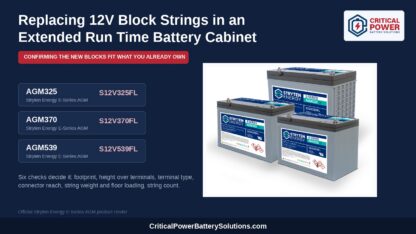
- Check the physical envelope. Length, width, height over terminals and weight all differ, and the AGM539 is the tallest and heaviest by a wide margin. Shelf clearance, connector reach and floor loading are handled in the cabinet fitment reference linked above.
- Confirm the terminal. The AGM325 and AGM370 are T6 and the AGM539 is T8. All three take a 6 mm bolt at 71 in-lb, and the bolt match does not confirm the connector match.
- Send CPBS the part number, quantity, cabinet or rack make and runtime requirement. Tom Kierna sizes the order and confirms the fit before anything ships.
The three current blocks differ in case dimensions, terminal design and weight, so fit is confirmed before ordering.
The legacy blocks still in the field
The legacy blocks still running in installed strings are the S12V300F, S12V370F, S12V370NGF and S12V550NGF, and each of them has a comparable current model in the E-Series AGM line.
That mapping is published in full, model by model, in the GNB Sprinter cross reference and replacement guide, and it is not repeated here. What matters at this page is the principle behind it. The succeeding block is selected on published watts per cell at the required duration and then checked against the physical envelope, because case dimensions, terminal design and weight differ across a generation change and fit is confirmed before ordering.
Buyers verifying that a supplier is entitled to sell the line at all will find the checks set out in the guide to authorized Stryten distributor verification.
What CPBS needs in order to quote
The part number and quantity from an existing label, the required backup duration, the system end voltage, the cabinet or rack make, and the room ambient temperature. With those five things a sized quote can usually be built the same day.
- A photograph of one block label and one full shelf.
- Blocks in series per string and number of strings in parallel.
- Required runtime and the load the string has to carry.
- The voltage at which the UPS transfers or shuts down.
- Shelf to shelf clearance and shelf depth if the enclosure is staying.
Send them to Tom Kierna at 630-984-9718 or sales@criticalpowerbatterysolutions.com. CPBS supplies and sizes the batteries; the enclosure, the connections and the commissioning stay with the facility and its service provider.
Frequently asked questions
Is the AGM370 the same as the S12V370FL?
Yes. AGM370 is the marketing name for the block whose part number is S12V370FL. One battery, two names. The AGM designation appears in Stryten Energy E-Series literature and in distributor listings, while the S12V number is printed on the case and is what a purchase order should carry.
What does the number in AGM539 mean?
The number is the 15 minute watts per cell rating at 1.67 volts per cell, rounded. The published rating for that block is 539.0 watts per cell, which rounds to 539. The same rule produces AGM325 from 324.9 watts per cell and AGM370 from 370.3 watts per cell.
What is the difference between the AGM325, AGM370 and AGM539?
Capacity, case size, weight and terminal type. Rated capacity at the 15 minute rate runs 324.9, 370.3 and 539.0 watts per cell, and 20 hour capacity runs 82, 95 and 155 amp hours. The AGM539 is the largest at 13.19 by 6.77 by 10.83 in and 93.5 lb, and it is the only one of the three on a T8 terminal. They differ in case dimensions, terminal design and weight, so fit is confirmed before ordering.
What terminal type does each E-Series AGM block use?
The AGM325 and AGM370 use T6 terminals and the AGM539 uses T8. Both are threaded tin plated copper alloy inserts. The insert pattern and footprint differ between the two types, so a connector bar made for one is not made for the other.
What torque do the terminal bolts take?
71 in-lb on a 6 mm bolt, on both the T6 and the T8 terminal. Under torque leaves resistance in the joint that heats under load. Over torque distorts the threaded insert, which cannot be repaired in the field.
How much does a Stryten E-Series AGM block weigh?
The AGM325 weighs 52.9 lb, the AGM370 weighs 61.7 lb and the AGM539 weighs 93.5 lb. String weight is block weight multiplied by block count, and that total is what the cabinet structure and the floor have to carry.
What is the design life of an E-Series AGM battery?
Ten years at 25C (77F) in UPS float service. That figure is a design rating measured at a stated temperature, and the life a specific string reaches depends on its own conditions. Ambient temperature, float accuracy and discharge history all move the outcome.
What is the recommended float voltage for these blocks?
2.25 to 2.30 volts per cell at 25C for the AGM325 and AGM370, and 2.25 to 2.35 volts per cell for the AGM539. The minimum temperature corrected value is 2.21 volts per cell and the maximum is 2.40. At block level the brochure states 13.5 to 13.8 V at 25C, the same window across six cells.
How do I correct float voltage for room temperature?
Correct at 5.5 mV per degree C per cell, which is 3 mV per degree F per cell. The formula is V corrected equals V at 25C minus the quantity T actual minus 25C, multiplied by 0.0055. A room held at 30C therefore wants about 0.0275 V per cell below the 25C setpoint.
What is the internal resistance of each block?
4.5 milliohms for the AGM325, 4.0 milliohms for the AGM370 and 3.1 milliohms for the AGM539. These are published values. A field ohmic programme compares a block against its own baseline on the same instrument rather than against another block.
Which E-Series AGM block replaces my older Sprinter block?
The legacy blocks still in the field are the S12V300F, S12V370F, S12V370NGF and S12V550NGF, and each has a comparable current model. The model by model mapping is published in the CPBS cross reference guide. Case dimensions, terminal design and weight differ across a generation change, so fit is confirmed before ordering.
How do I get a quote on E-Series AGM batteries?
Send CPBS the part number, quantity, cabinet or rack make and runtime requirement. Tom Kierna sizes every order. Contact 630-984-9718 or sales@criticalpowerbatterysolutions.com, and most requests are identified the same day.
About the author: Tom Kierna is a Battery Systems Specialist at Critical Power Battery Solutions with more than 40 years in industrial battery systems, including 15 years across GNB and Stryten. He specializes in Sprinter and E-Series AGM block battery selection, UPS application sizing, and fitment confirmation for cabinet and rack installations. Last updated August 14, 2026.
References
- Stryten Energy. E-Series AGM325, AGM370 and AGM539 product brochure: rated capacity in watts per cell and amp hours, nominal dimensions, height over terminals, weight, internal resistance, short circuit current, terminal type, construction materials, charging limits, and constant power discharge tables at six end voltages.
- Stryten Energy. E-Series AGM installation and operating instructions: recommended float voltage windows, minimum and maximum temperature corrected float, the temperature compensation coefficient, terminal torque, and connection practice.
- IEEE Standards Association. IEEE 485 Recommended Practice for Sizing Lead-Acid Batteries for Stationary Applications, referenced at the method level for duty cycle sizing, aging margin and design margin.
- IEEE Standards Association. IEEE 1188 Recommended Practice for Maintenance, Testing, and Replacement of Valve-Regulated Lead-Acid Batteries for Stationary Applications, referenced at the method level for ohmic baselines and capacity testing.