Quick answer: A GNB Sprinter NEXT model number such as S12V325FL breaks into four parts: S for the Sprinter family, 12V for nominal voltage, 325 for the rated watts per cell at the 15 minute rate to 1.67 volts per cell, and FL for the current generation. The current line is S12V325FL, S12V370FL, and S12V539FL. An F or NGF suffix means you are looking at an earlier generation still in the field.
Key points
- Read the model number left to right: family letter, nominal voltage, capacity index in watts per cell, generation suffix.
- The capacity index is watts per cell at the 15 minute rate to 1.67 volts per cell, so S12V325FL carries a published rating of 324.9 watts per cell.
- The suffix is the generation key. F is the oldest, NGF is the generation that followed it, and FL is the current line.
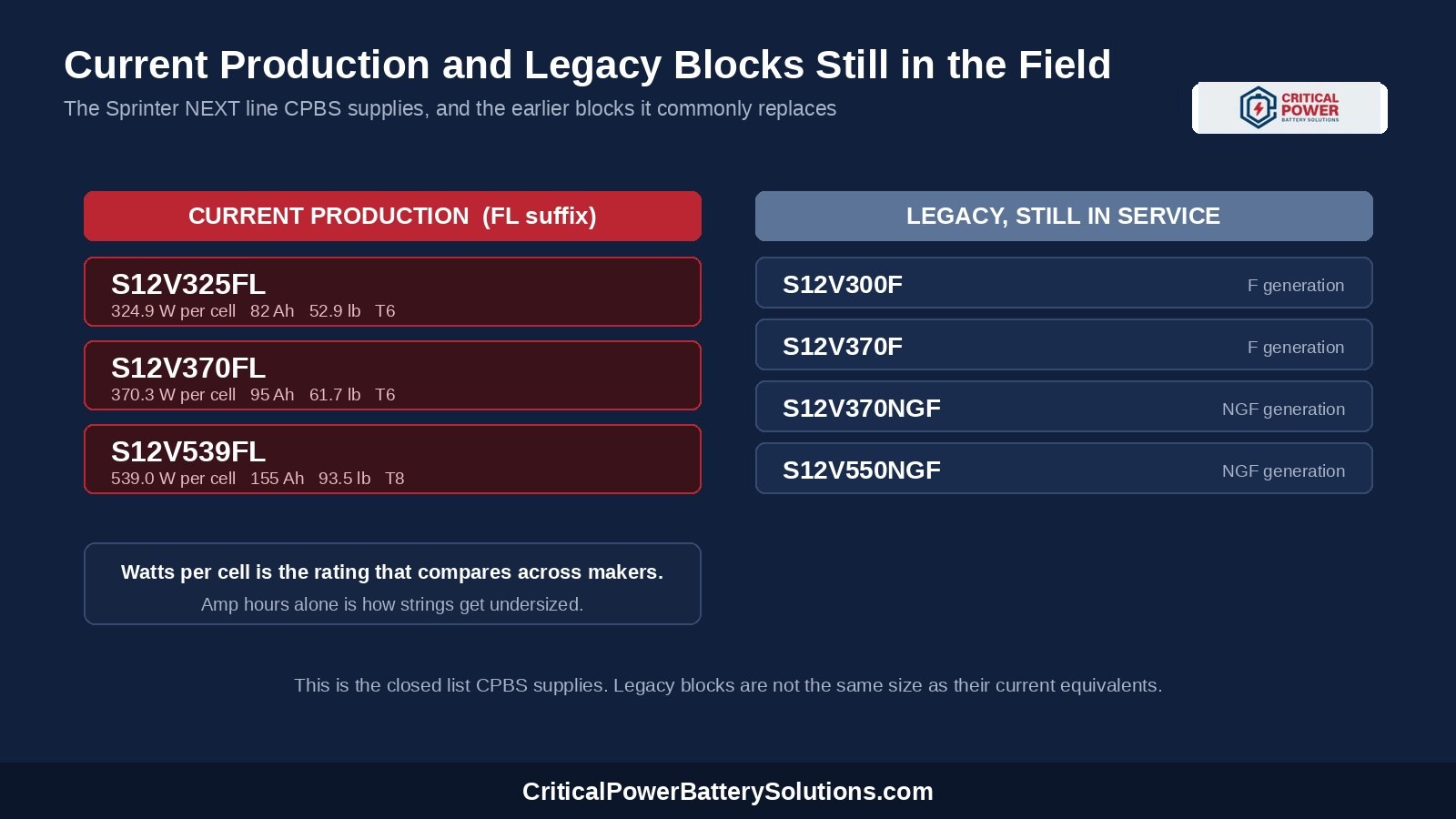
- The current line is three blocks: S12V325FL, S12V370FL, and S12V539FL. Legacy blocks still in service include S12V300F, S12V370F, S12V370NGF, and S12V550NGF.
- Watts per cell, not amp hours, is the rating that compares honestly across manufacturers on a UPS duty cycle.
- Published internal resistance and short circuit current give a technician a documented baseline for future testing.
If you are standing in front of an open UPS cabinet with a label in your hand, this reference tells you what the number on that label means and whether the block is current production or an earlier generation. It is written for facility and data center managers, UPS service technicians, oil and gas SCADA technicians, and procurement staff who need an accurate read without calling the original vendor.
The line comes from Stryten Energy, and the current product is the Stryten Energy E-Series AGM range. Critical Power Battery Solutions (CPBS), the battery division of Advanced Technical Services Inc., is an authorized Stryten Energy reseller, and Tom Kierna sizes every order personally. This guide covers identification and the published specification reference for 12 volt block batteries. CPBS supplies replacement blocks for existing UPS systems and does not supply turnkey UPS systems, cabinets, breakers, or integration work.
How to read a Sprinter NEXT model number
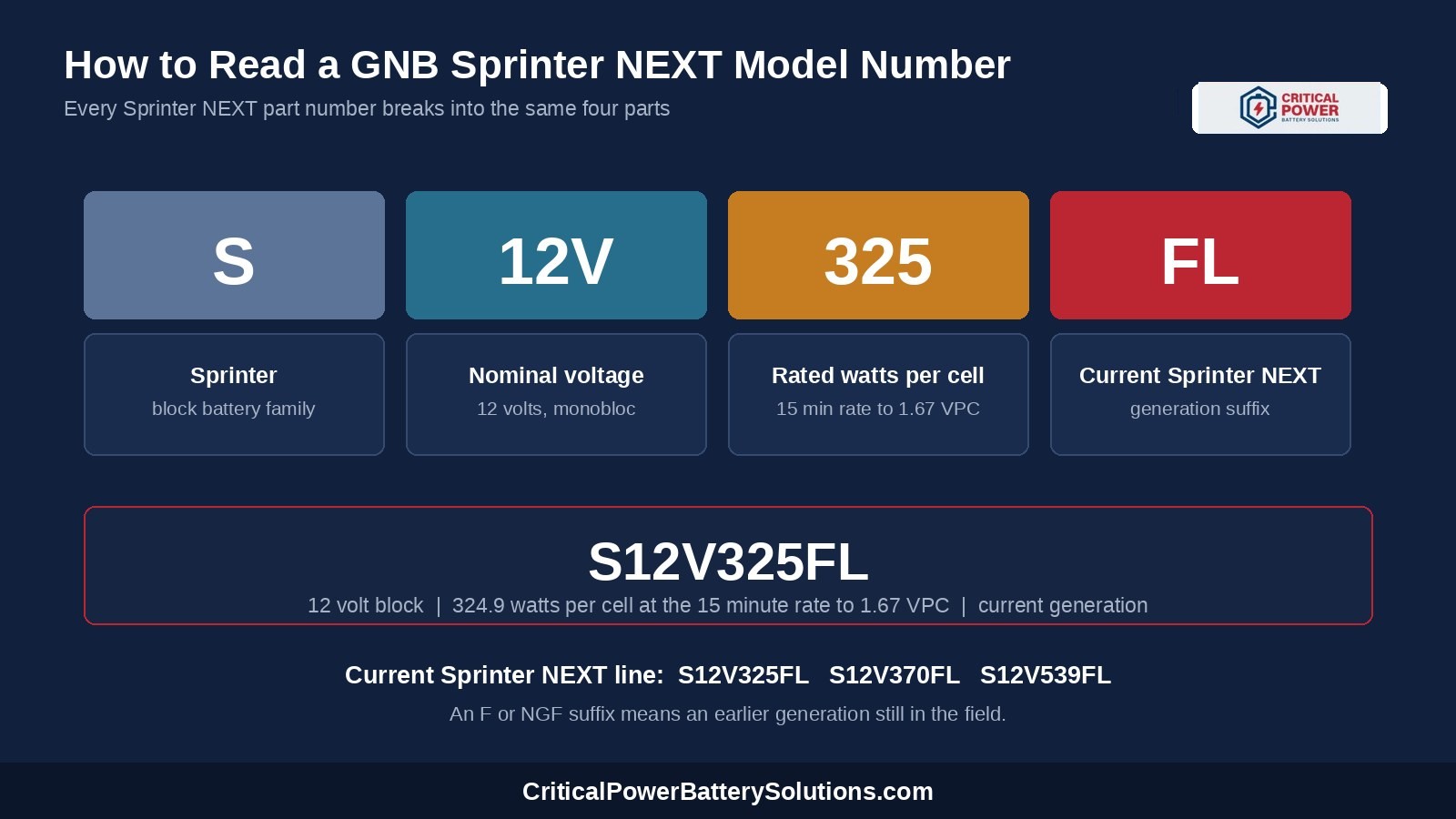
Every Sprinter NEXT part number breaks into the same four parts, read left to right. Once you know the pattern, any label in the cabinet becomes readable in a few seconds.
- S identifies the Sprinter block battery family. It is a family designator, not a description of the case or the chemistry.
- 12V is the nominal voltage. Twelve volts is what makes this a monobloc block battery rather than a single 2 volt cell, and it is why these blocks suit UPS cabinets built around block strings.
- 325 is the rated capacity index. It corresponds to the watts per cell rating at the 15 minute rate to 1.67 volts per cell. The published figure for S12V325FL is 324.9 watts per cell, so the number in the model is that rating rounded.
- FL is the generation suffix, and on this block it marks the current generation.
Applied to the rest of the current line, the same reading holds. S12V370FL is a 12 volt block rated 370.3 watts per cell at 15 minutes to 1.67 volts per cell. S12V539FL is a 12 volt block rated 539.0 watts per cell on the same basis. The capacity index tracks the published rating closely enough that you can use it as a first sort, then confirm against the specification table before you requisition anything.
One limit is worth stating plainly. The reading above applies to the Sprinter blocks CPBS supplies, listed in full further down this page. Do not extend the pattern to model numbers outside that list or infer a part number that you have not seen on a label or a submittal.
A note on the brand names you will see
The Sprinter line has been sold under more than one brand, so the name on an older block will not always match the name on current literature.
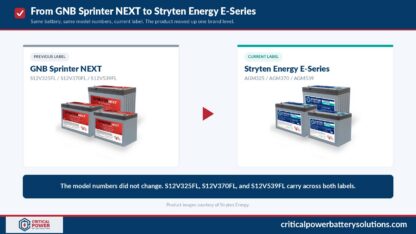
The oldest Sprinter blocks carry Exide branding, from the period when GNB Industrial Power was a division of Exide Technologies. The blocks that followed were sold under the GNB Sprinter NEXT label. The company behind the line today is Stryten Energy, and the same three blocks are sold now as Stryten Energy E-Series AGM325, AGM370, and AGM539. The Americas industrial battery business moved to the Stryten name in 2020, after Atlas Holdings acquired the Exide Technologies operations there, and manufacturing continued through that transition. Exide Technologies international operations continue separately in Europe as Exide Group, so a European Exide listing is not the same thing as the North American Sprinter line.
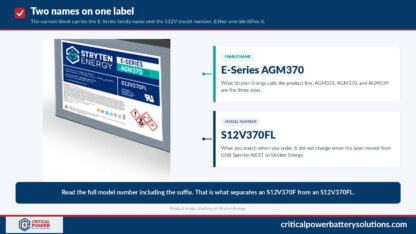
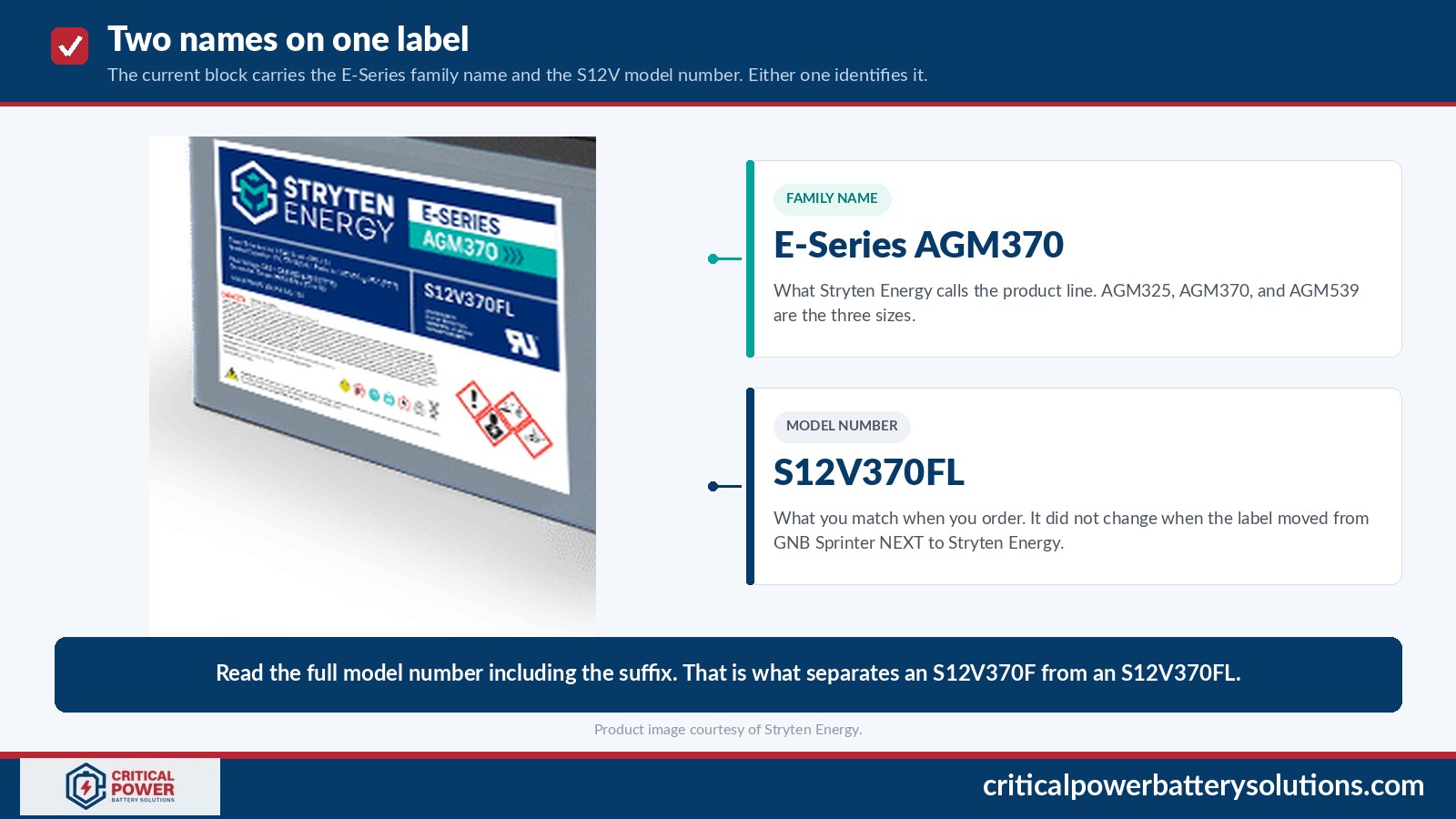
None of that changes how a model number is read. The S12V prefix, the capacity figure, and the generation suffix work the same way across every brand era, and the S12V325FL, S12V370FL, and S12V539FL model numbers carry across the Sprinter NEXT and E-Series labels unchanged.
The generation suffix key: F, NGF, and FL
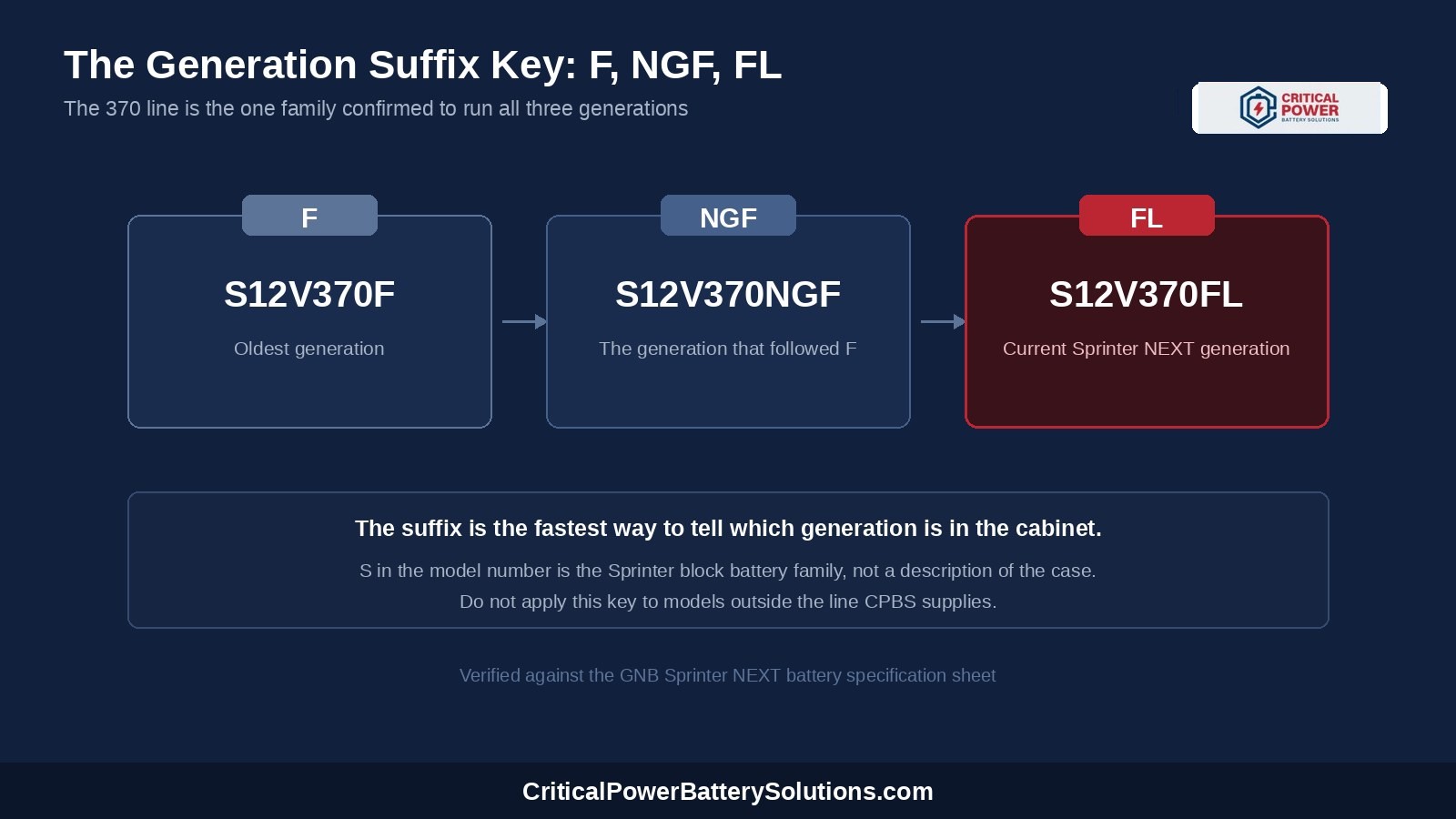
The suffix is the single most useful character group on the label, because it tells you which production generation you are holding. Three suffixes appear across the blocks CPBS supports.
- F is the oldest generation.
- NGF is the generation that followed F.
- FL is the current generation.
The 370 line is the worked example, because it is the one family confirmed to run all three generations in sequence: S12V370F, then S12V370NGF, then S12V370FL. If you find a 370 block in a cabinet, the suffix alone tells you roughly how old the installation is and whether the block on the shelf is current production.
What the suffix does not tell you is which current block belongs in place of a legacy one. That mapping depends on published ratings, case dimensions, terminal type, and how the string is configured, and it is covered in the GNB Sprinter cross reference and replacement guide rather than repeated here.


Sprinter NEXT specification table
These are the published figures for the three current blocks, taken directly from the manufacturer specification sheet. Everything a specifier needs for a first pass sits in one place: rating, capacity, footprint, weight, internal resistance, short circuit current, and terminal type.
| Model | Nominal voltage | 15 min WPC to 1.67 VPC | 20 hr Ah to 1.80 VPC | L x W x H (in) | Terminal height (in) | Weight (lbs) | Internal resistance (mOhm) | Short circuit current (A) | Terminal |
|---|---|---|---|---|---|---|---|---|---|
| S12V325FL | 12 | 324.9 | 82 | 10.24 x 6.61 x 8.19 | 8.31 | 52.9 | 4.5 | 1640 | T6 |
| S12V370FL | 12 | 370.3 | 95 | 12.05 x 6.61 x 8.15 | 8.27 | 61.7 | 4.0 | 1900 | T6 |
| S12V539FL | 12 | 539.0 | 155 | 13.19 x 6.77 x 10.83 | 10.95 | 93.5 | 3.1 | 3100 | T8 |
All three blocks share a set of common attributes. Design life is 10 years at 25 degrees C (77 degrees F). The jar and cover are ABS rated UL94 V-0. The construction is multicell with heavy duty copper alloy terminals. Both terminal types are threaded inserts in tin plated copper alloy taking a 6 mm bolt at 71 in-lb of torque.
Two columns on that table do more work than specifiers usually give them credit for. Internal resistance and short circuit current are published values, which means a technician commissioning a new string has a documented factory baseline to measure against for the life of the installation. That is the whole basis of trend based capacity assessment, and it is covered in detail in the guides on battery internal resistance measurement and UPS battery capacity testing.
What the discharge ratings mean
A single capacity figure is meaningless unless you also state how far the block is discharged and for how long. The manufacturer publishes constant power discharge in watts per cell at six end voltages, 1.85, 1.80, 1.75, 1.70, 1.67, and 1.60 volts per cell, across seven durations from 5 minutes to 90 minutes, all at 25 degrees C.
That is 42 published numbers per block, and the reason for all of them is simple. The same block delivers a very different wattage depending on the end voltage your UPS is configured to accept and the runtime the load actually needs. Quoting a block on capacity alone, without both of those numbers attached, is how strings end up undersized.
The table below is the 1.67 volts per cell row set, which is the basis the model numbers themselves are built on.
| Model | 5 min | 10 min | 15 min | 20 min | 30 min | 60 min | 90 min |
|---|---|---|---|---|---|---|---|
| S12V325FL | 527.5 | 376.7 | 324.6 | 267.6 | 196.7 | 112.0 | 83.0 |
| S12V370FL | 600.7 | 457.2 | 370.3 | 304.6 | 223.9 | 127.2 | 94.0 |
| S12V539FL | 852.0 | 630.1 | 539.0 | 454.3 | 344.4 | 203.8 | 152.3 |
Read across any row and the pattern is clear. S12V325FL delivers 527.5 watts per cell if the load only needs 5 minutes, but 112.0 watts per cell if it has to hold for an hour. That is a factor of nearly five between the two ends of the same row, on the same block.
Two conditions attach to every figure in that table. All of them are published at 25 degrees C, so a cabinet running consistently warmer will not deliver the tabulated performance over the life of the string. And all of them are per cell, so a 12 volt block carrying six cells delivers six times the tabulated figure. Both points sound obvious written down, and both are routinely missed when a rating gets copied off a datasheet into a requisition.
Turning those numbers into an actual string size is a duty cycle calculation, not a table lookup. That work belongs in the VRLA battery sizing guide and the walkthrough of IEEE 485 battery sizing mistakes, with runtime conversion covered in how to calculate battery runtime.
Terminals: T6, T8, and why terminal height matters
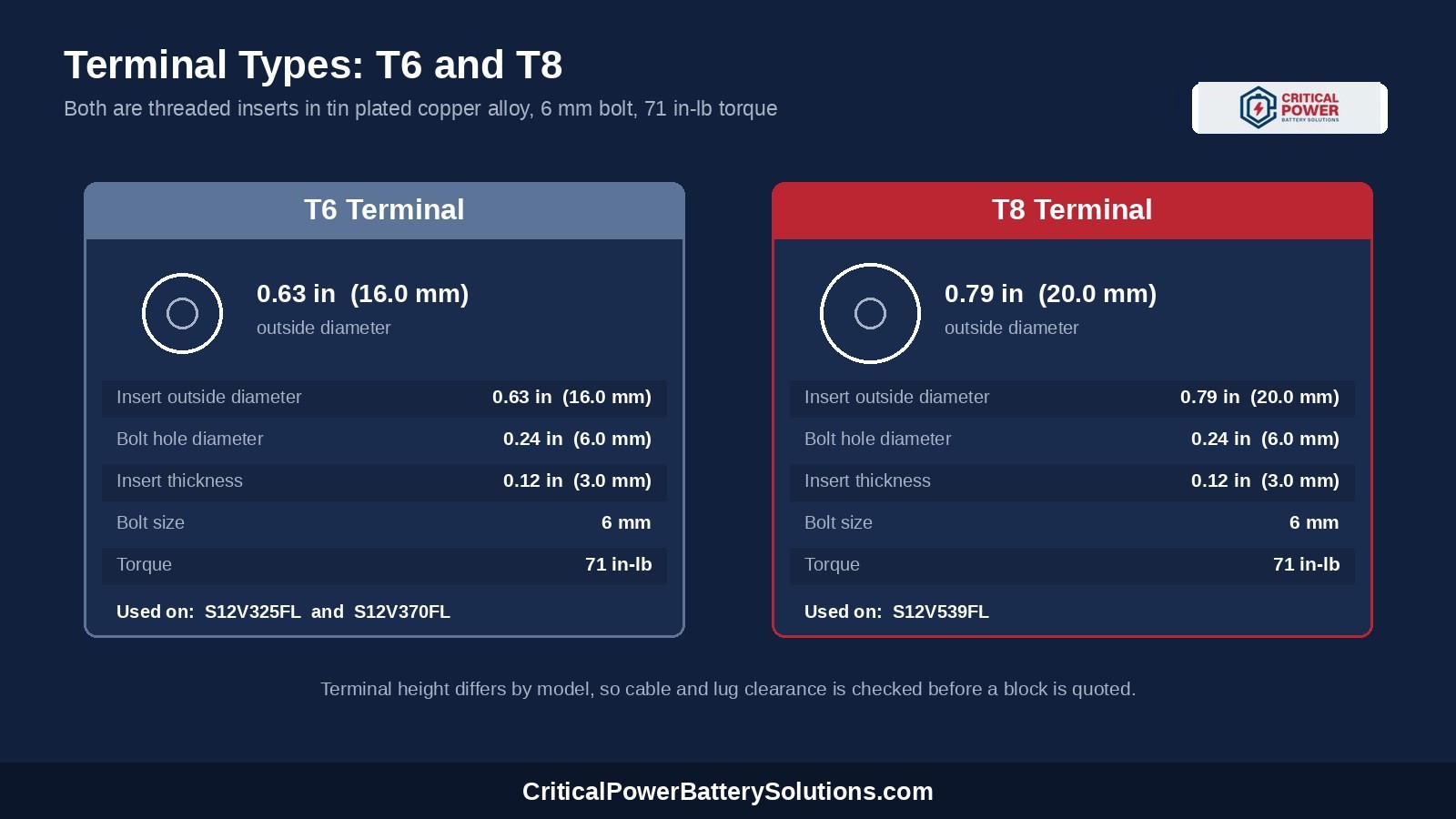
Two terminal types cover the current line, and both take the same bolt at the same torque. S12V325FL and S12V370FL use a T6 terminal. S12V539FL uses a T8. Both are threaded inserts in tin plated copper alloy, both take a 6 mm bolt, and both are torqued to 71 in-lb.
The practical difference is the size of the landing. The T6 insert is 0.63 inches (16.0 mm) across, and the T8 insert is 0.79 inches (20.0 mm) across. Both take the same 0.24 inch (6.0 mm) bolt hole. If you are moving from a T6 block to a T8 block, the existing ring lug may be undersized for the larger landing even though the bolt still fits.
Terminal height is the number people skip, and it is on the specification table for a reason. It is 8.31 inches on S12V325FL, 8.27 inches on S12V370FL, and 10.95 inches on S12V539FL. That figure sets your cable and lug clearance inside the cabinet. A block that fits the shelf footprint can still fail to fit once the inter block connectors and the cabinet lid are accounted for, which is why CPBS checks terminal height and cable routing before quoting rather than after.
Identifying a block when the label is worn or missing
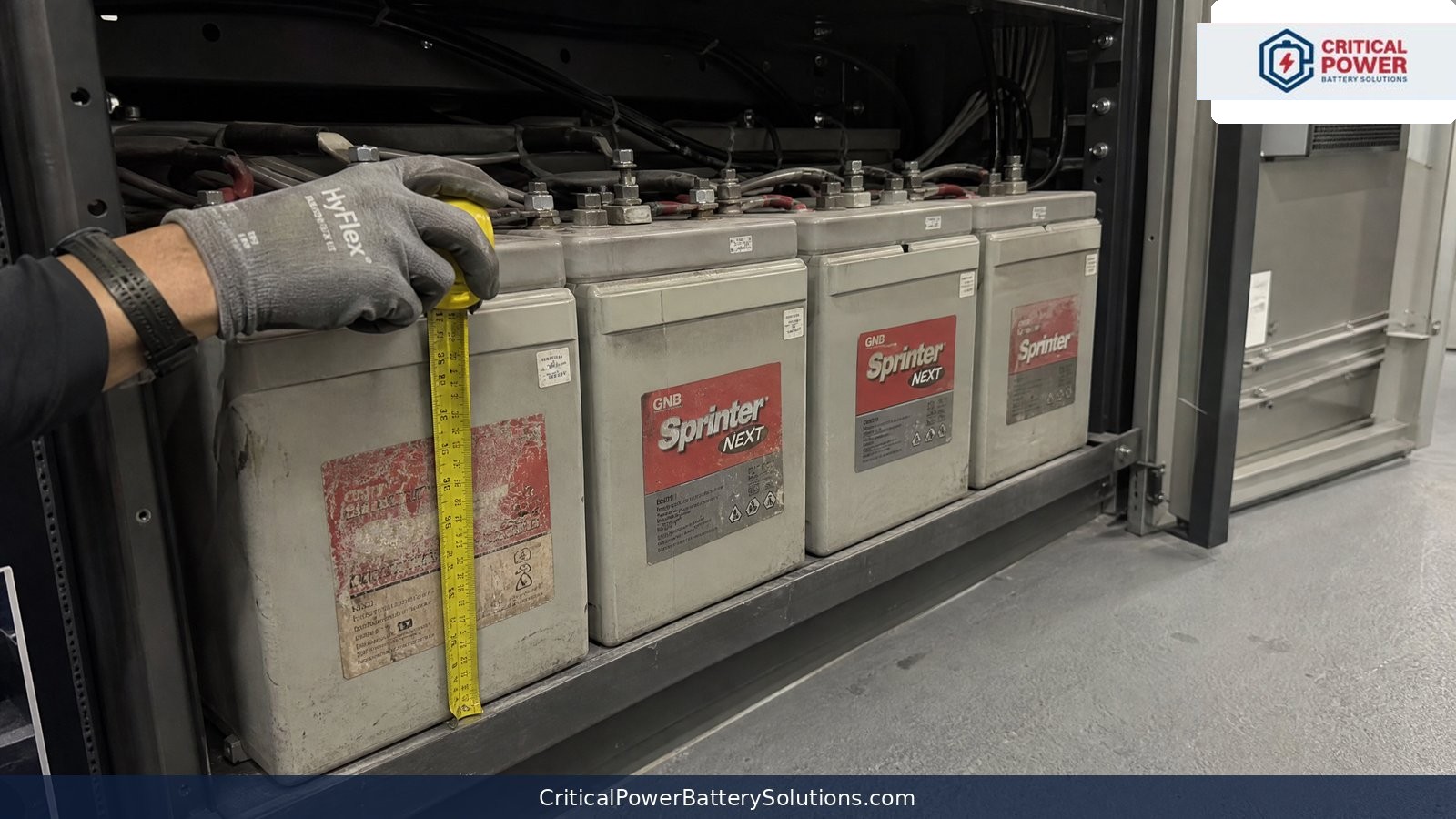
A block with no readable label can still be identified from its physical characteristics. In a warm cabinet the adhesive labels degrade, and on a 10 year old installation it is common to find at least one block where the model number is gone entirely.
Work through these in order:
- Case dimensions. Measure length, width, and height and compare against the specification table. The three current blocks are far enough apart that dimensions alone usually narrow it to one candidate.
- Terminal type. A T8 landing at 0.79 inches across points to the largest block in the line. A T6 landing points to one of the two smaller ones.
- Weight. If you can safely lift the block, weight separates the candidates cleanly. The current line runs 52.9, 61.7, and 93.5 pounds.
- Terminal height. Measured from the base, this separates blocks that have similar footprints.
- The rest of the string. Blocks are rarely installed alone. A readable label on an adjacent block in the same string is usually the fastest answer available.
If none of that resolves it, the original submittal package or the system one line drawing will carry the part number. Failing that, send photographs of the block, the terminals, and a tape measure against the case to CPBS at 630-984-9718 or sales@criticalpowerbatterysolutions.com, and Tom Kierna will identify it from the physical evidence.
If you have a legacy block
An F or NGF suffix tells you the block predates the current line, and that the replacement is a specification exercise rather than a like for like reorder. The legacy blocks still commonly found in service are S12V300F, S12V370F, S12V370NGF, and S12V550NGF.
Legacy blocks and current blocks are not the same size. Case dimensions, terminal height, terminal type, and weight all changed between generations, and the older blocks used an M6 insert terminal rather than the current T6 and T8 landings. Any replacement therefore has to be checked against the cabinet, the shelf spacing, the inter block connectors, and the string configuration, not just against the capacity rating.
That full mapping, including the competitor cross reference for blocks from other manufacturers, is the subject of the GNB Sprinter cross reference and replacement guide. This page stays on what the number means. If the block you are holding is already at or past the 4 to 5 year mark, the decision framework in when to replace your backup batteries is the place to start.
One clarification, because the two lines get confused. The Sprinter NEXT range is 12 volt monobloc block batteries. It is a separate product line from the Absolyte 2 volt cell range, which uses its own numbering scheme covered in the GNB Absolyte GP part number guide. Absolyte 2 volt cells are not an alternative to a Sprinter block and the two schemes do not translate to each other.
How CPBS confirms the model before a quote
Every order is checked against the physical installation before anything is quoted. The sequence is short and it exists because guessing from a part number alone is what produces blocks that do not fit.
- You send the model number from the label, or photographs and dimensions if the label is unreadable.
- Tom Kierna confirms the block against the published specification and the generation suffix.
- Cabinet fit is checked: footprint, terminal height, terminal type, and lug compatibility.
- The duty cycle is reviewed against the published discharge data at the end voltage your UPS actually uses.
- You get a confirmed part number with lead time, typically 8 to 10 weeks domestic.
CPBS is a consulting and supply operation. Identification, specification, and supply are what CPBS does, and on site installation, commissioning, and maintenance are not part of the engagement. For context on how block selection fits into a wider critical power design, see the overview of UPS battery solutions for data centers.
Frequently Asked Questions
What does S12V325FL mean?
S12V325FL is a GNB Sprinter NEXT 12 volt block battery. S is the Sprinter family, 12V is the nominal voltage, 325 is the capacity index corresponding to the rated watts per cell at the 15 minute rate to 1.67 volts per cell, and FL is the current generation suffix. The published rating is 324.9 watts per cell, with 82 Ah at the 20 hour rate to 1.80 volts per cell.
What does the FL suffix mean on a GNB Sprinter NEXT battery?
FL marks the current generation. A block with an FL suffix is current production. The current line is S12V325FL, S12V370FL, and S12V539FL.
What is the difference between F, NGF, and FL Sprinter model numbers?
They are three production generations of the same line. F is the oldest, NGF is the generation that followed F, and FL is the current generation. The 370 line runs all three: S12V370F, then S12V370NGF, then S12V370FL. The suffix tells you the generation, not the replacement path.
What are the current GNB Sprinter NEXT model numbers?
There are three: S12V325FL rated 324.9 watts per cell, S12V370FL rated 370.3 watts per cell, and S12V539FL rated 539.0 watts per cell, all at the 15 minute rate to 1.67 volts per cell. Legacy blocks still in service include S12V300F, S12V370F, S12V370NGF, and S12V550NGF.
What does watts per cell mean on a UPS battery?
Watts per cell is the constant power a single 2 volt cell within the block can deliver for a stated duration down to a stated end voltage. A 12 volt block contains six cells, so the block rating is the per cell figure multiplied by six. It is quoted this way because UPS loads are constant power loads, not constant current loads.
Why is a Sprinter NEXT battery rated in watts per cell instead of amp hours?
Because a UPS draws roughly constant power, and as the battery voltage falls during discharge the current rises to hold that power. An amp hour figure taken at a 20 hour rate does not describe behavior on a 15 minute UPS duty cycle. Watts per cell at a stated duration and end voltage does, which is why it is the figure that compares meaningfully across manufacturers.
What is the difference between a T6 and a T8 terminal?
Both are threaded inserts in tin plated copper alloy taking a 6 mm bolt at 71 in-lb of torque. The T6 insert is 0.63 inches (16.0 mm) in outside diameter and the T8 is 0.79 inches (20.0 mm). S12V325FL and S12V370FL use T6 terminals, and S12V539FL uses T8. The larger landing may need a different ring lug.
How long does a GNB Sprinter NEXT battery last?
The published design life is 10 years at 25 degrees C (77 degrees F). Actual service life depends on operating temperature, float voltage accuracy, and discharge history. Sustained temperatures above 25 degrees C shorten life significantly, which is why cabinet temperature is worth monitoring.
What is the internal resistance of a Sprinter NEXT battery?
The published values are 4.5 milliohms for S12V325FL, 4.0 milliohms for S12V370FL, and 3.1 milliohms for S12V539FL. These are factory reference figures. Record your own commissioning readings on installation, because internal resistance trended against that baseline over time is a far better health indicator than any single absolute reading.
How do I identify a Sprinter block if the label is unreadable?
Measure the case, check the terminal type and terminal height, and weigh the block if you can do so safely, then compare against the published specification table. A readable label on an adjacent block in the same string is often faster. If that fails, send photographs and measurements to CPBS at 630-984-9718 and the block will be identified from the physical evidence.
Is the S12V325FL the same size as the block it replaces?
No. The S12V325FL measures 10.24 by 6.61 by 8.19 inches and weighs 52.9 pounds, while the legacy S12V300F it commonly succeeds measures 10.25 by 6.85 by 8.80 inches and weighs 63.0 pounds. The newer block is narrower, shorter, and about 10 pounds lighter, and the terminal changes from an M6 insert to a T6 landing. Shelf fit, connector length, and lug compatibility all have to be checked. The full generation mapping is covered in the GNB Sprinter cross reference and replacement guide.
Where can I buy GNB Sprinter NEXT batteries?
CPBS, the battery division of Advanced Technical Services Inc., is an authorized Stryten Energy reseller. Send your model number or photographs of the label to Tom Kierna at 630-984-9718 or sales@criticalpowerbatterysolutions.com. Most requests get same day identification, with 8 to 10 week domestic lead time on current line blocks.
About the author: Tom Kierna is a Battery Systems Specialist at Critical Power Battery Solutions with more than 40 years in industrial battery systems, including 15 years across GNB and Stryten. He specializes in Sprinter NEXT block battery identification, UPS application sizing, and legacy to current generation transition guidance. Last updated July 31, 2026.
References
- Stryten Energy. E-Series AGM325/370/539 Product Brochure, document SE1075, battery specification table: rated capacity, nominal dimensions, weight, internal resistance, short circuit current, and terminal type for S12V325FL, S12V370FL, and S12V539FL.
- Stryten Energy. E-Series AGM325/370/539 constant power discharge tables, watts per cell at 1.85, 1.80, 1.75, 1.70, 1.67, and 1.60 volts per cell across 5 to 90 minute durations at 25 degrees C.
- Stryten Energy. E-Series AGM325/370/539 Installation and Operating Instructions, document SE2006, terminal specifications: T6 and T8 threaded inserts in tin plated copper alloy, 6 mm bolt, 71 in-lb torque.
- Sprinter UPS Block Battery Selection Guide, UPS top terminal valve regulated lead acid block batteries: published dimensions, weight, and terminal type for legacy Sprinter blocks including S12V300F, S12V370F, and S12V550NGF.
- IEEE Standards Association. IEEE 485 Recommended Practice for Sizing Lead-Acid Batteries for Stationary Applications (duty cycle sizing referenced at the method level).