Critical Power Battery Solutions

Absolyte Battery History: GNB to Stryten Evolution (2026)

January 16, 2026Battery Selection Guides, Battery Technology, Industry Insights, StrytenComments Off on Absolyte Battery History: GNB to Stryten Evolution (2026)

Absolyte Battery History GNB Stryten Energy Evolution

Absolyte Battery History: The Evolution from GNB to Stryten Energy

🎯 Quick Answer

Stryten Energy is the current manufacturer of the Absolyte battery, having acquired the GNB Industrial Power brand in 2020. The technology originated from a 1983 collaboration between GNB and Sandia National Laboratories, evolving from the cadmium-based Absolyte IIP to the modern Lead-Calcium-Tin Absolyte GP, now Absolyte AGP.

Critical Warning: Never mix Absolyte IIP and GP cells in the same string due to voltage mismatches.
Current Standard: Absolyte AGP is the eco-compliant replacement.

Continue reading for the complete engineering history and IEEE 485 sizing compliance.

If you are looking for GNB Industrial Power, you are now looking for Stryten Energy. While the branding on the jar has changed following the 2020 acquisition, the “Large 2-Volt VRLA” technology remains the industry standard for telecommunications and utility backup across the United States. This article serves as the definitive Absolyte battery engineering timeline, clarifying the transition of ownership and the technical evolution of the product line.

The technology traces its roots back to a foundational 1983 partnership with Sandia National Laboratories. According to Department of Energy records, this collaboration aimed to solve specific grid-storage challenges that flooded lead-acid batteries could not address. The result was a shift from the legacy Absolyte IIP to the modern Absolyte GP (Lead-Calcium-Tin) chemistry. Understanding this evolution is critical for facility managers, as mixing these generations can lead to catastrophic system failure.


👤 Article by: Tom Kierna
Reviewed by: CPBS Engineering Team
Last updated: 15 January 2026
Credentials: Authorized Stryten Absolyte Reseller, ISO 9001 Certified, IEEE Standards Member


ℹ️ Transparency: This historical guide explores the engineering evolution of Absolyte batteries based on DOE reports and manufacturer datasheets. Critical Power Battery Solutions is an Authorized Reseller of Stryten Energy. Our goal is accurate technical continuity for US facility managers.


Table of Contents

The GNB Era & Sandia Collaboration (1983–2000)

The engineering pedigree of the Absolyte battery began well before it became a staple in modern data centers. In the early 1980s, the U.S. Department of Energy (DOE) initiated the “Utility Battery Storage Systems Program.” The objective was to develop a deep-cycle battery capable of utility load leveling and renewable energy storage without the heavy maintenance requirements of flooded lead-acid systems.

GNB Industrial Power (formerly Gould National Batteries) partnered with the government to meet these rigorous demands. According to Sandia National Laboratories Report SAND93-3899 (“Utility Battery Storage Systems Program Report for FY93“), this collaboration focused on validating VRLA (Valve Regulated Lead Acid) performance for utility-scale applications. The research aimed to create a sealed design that retained the capacity of flooded cells while eliminating the need for water addition.

The resulting innovation was a modular, stackable steel tray design. This allowed for high-density vertical stacking, a crucial feature for maximizing footprint in telecom shelters. The design was rigorously tested to meet UBC Zone 4 seismic requirements, making it the preferred choice for installations in earthquake-prone regions like California. This era established the “Genealogy of Quality” that continues to define the product line today.

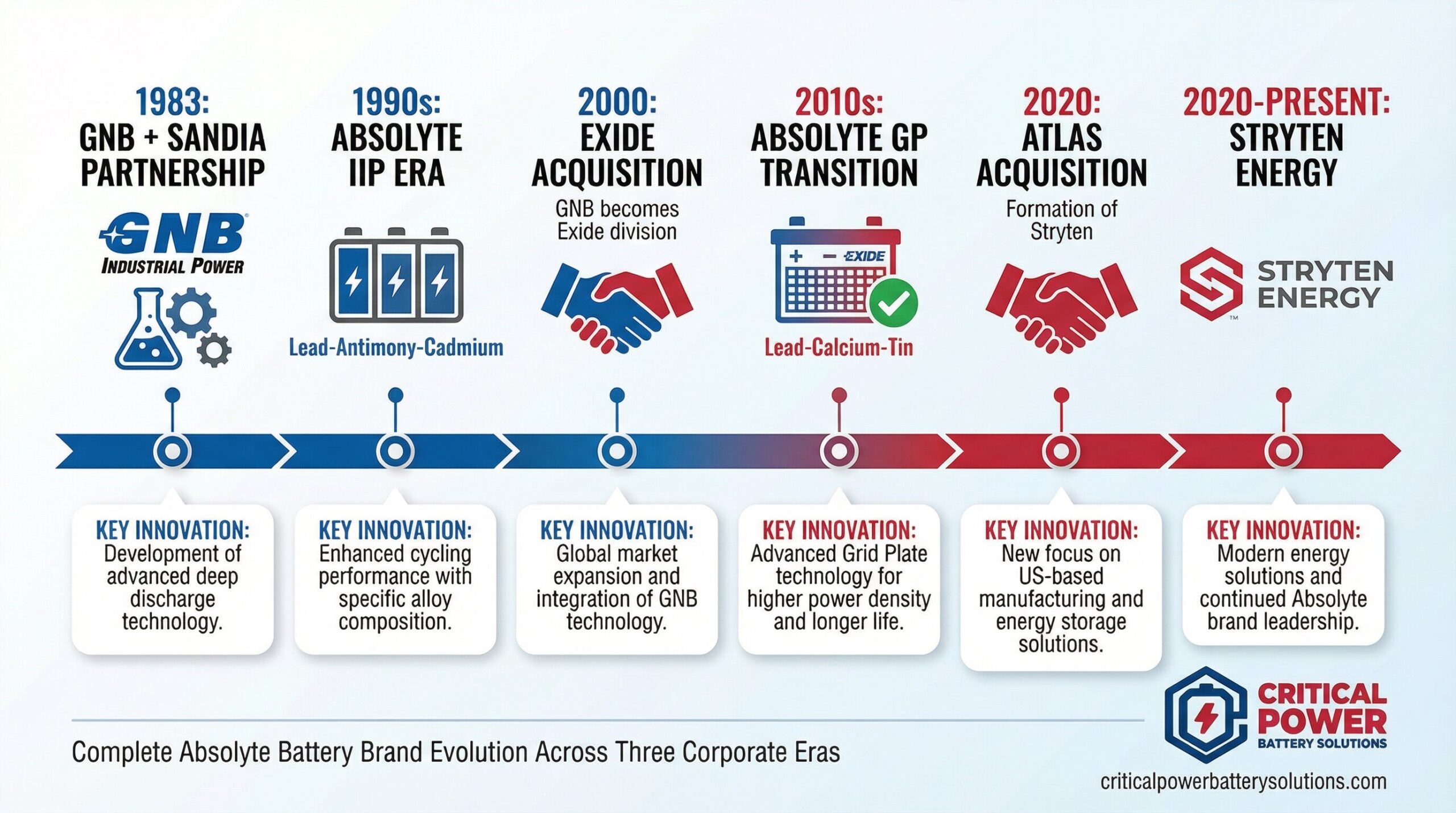
Complete Absolyte battery brand evolution timeline showing six major milestones: 1983 GNB+Sandia Partnership, 1990s Absolyte IIP Era, 2000 Exide Acquisition, 2010s Absolyte GP Transition, 2020 Atlas Acquisition, and 2020-Present Stryten Energy - demonstrating 43 years of continuous innovation


Technology Timeline: Absolyte II vs. IIP vs. GP

The most critical technical distinction in the history of this product line is the shift in grid alloy metallurgy. Facility managers must understand that while the physical dimensions of the jars have remained largely consistent, the internal chemistry has evolved significantly.

The table below outlines the key engineering differences between the discontinued Absolyte IIP and the Absolyte GP then the current Absolyte AGP Battery:

Feature Absolyte IIP (Discontinued) Absolyte GP
Grid Alloy Lead-Antimony-Cadmium Lead-Calcium-Tin
Cycle Life (80% DOD) ~1,000 cycles ~1,200+ cycles
Float Voltage 2.23–2.25 VPC 2.25–2.27 VPC
Sealing Tech Early VRLA Advanced M-Series Seal
Environmental Contains Cadmium (Hazardous) Cadmium-Free (Eco-compliant)

\Note: Early iterations of the IIP utilized Cadmium to enhance cycle life, which presented environmental disposal challenges.


The Metallurgy Shift: From Cadmium to Calcium-Tin

The legacy Absolyte IIP relied on a Lead-Antimony-Cadmium alloy. Cadmium was originally used to improve the battery’s deep discharge recovery and cycle life. However, due to increasing environmental regulations regarding cadmium toxicity and disposal, a chemical shift was necessary.

The modern Absolyte GP utilizes a proprietary Lead-Calcium-Tin alloy. The addition of Tin is the critical innovation here; it stabilizes the grid structure, helping to prevent corrosion and extending the design life without the environmental penalty of Cadmium. Furthermore, the Calcium-Tin alloy typically offers better charge acceptance and more stable float currents. This evolution ensures that the modern Absolyte battery meets current environmental standards while maintaining the robust cycling capabilities required by the telecom industry.


The Stryten Energy Era (2020–Present)

For many long-time facility managers, the disappearance of the “GNB” brand caused significant confusion. The transition occurred in August 2020, when Atlas Holdings acquired the assets of GNB Industrial Power.

According to the August 25, 2020 Press Release from Atlas Holdings, this acquisition led to the formation of Stryten Manufacturing, which was later rebranded as Stryten Energy. It is important to note that while the corporate entity changed, the manufacturing continuity remained intact. The Stryten Energy battery lines, including Absolyte and Marathon, continue to be produced in the same United States facilities (such as Kansas City and Fort Smith) using the original engineering specifications and tooling.

Today, Stryten Energy is the sole manufacturer of the Stryten Energy Absolyte GP, GX lines and AGP lines. For warranty purposes, the chain of custody is critical. Procurement through an Authorized Reseller ensures that the factory warranty is valid and that the product is factory-fresh, rather than surplus stock that may have degraded during improper storage.


Primary source archive

Primary source documents behind the Absolyte brand transition

Absolyte’s brand journey from GNB Industrial Power to Stryten Energy is well documented in primary sources. Two manufacturer letters tell the full story.

  • Stryten Energy industrial battery branding announcement. Issued March 6, 2023. Stryten Energy announced the new product names that simplified the company’s portfolio, including the move that made “GNB Absolyte” into the Stryten Absolyte product line.
  • GNB to Stryten product continuity declaration. Issued August 17, 2023. Verbatim language: “the design, engineering, and product manufacturing remains unchanged from the GNB product to the Stryten Energy product. The only change is the name.”


Critical Engineering: Replacement & Compliance

Replacing an industrial battery string is rarely a “plug-and-play” operation, especially when dealing with legacy infrastructure. There are three critical engineering factors that must be addressed during replacement.

⚠️ Engineering Advisory: Do Not Mix IIP and GP

Do not install Absolyte IIP and Absolyte GP cells in the same series string.

While the jars may look identical physically, the internal resistance and float voltage requirements differ due to the alloy changes (Cadmium vs. Calcium-Tin).

The Risk: Mixing these chemistries typically leads to voltage mismatches. One set of cells may undercharge while the other overcharges.
The Result: This imbalance can lead to thermal runaway, accelerated grid corrosion, and premature failure of the entire string.

  • The Solution: If you have failing IIP cells, the entire string must be replaced with Absolyte GP to ensure safety and performance.

Seismic Code Evolution: UBC vs. IBC

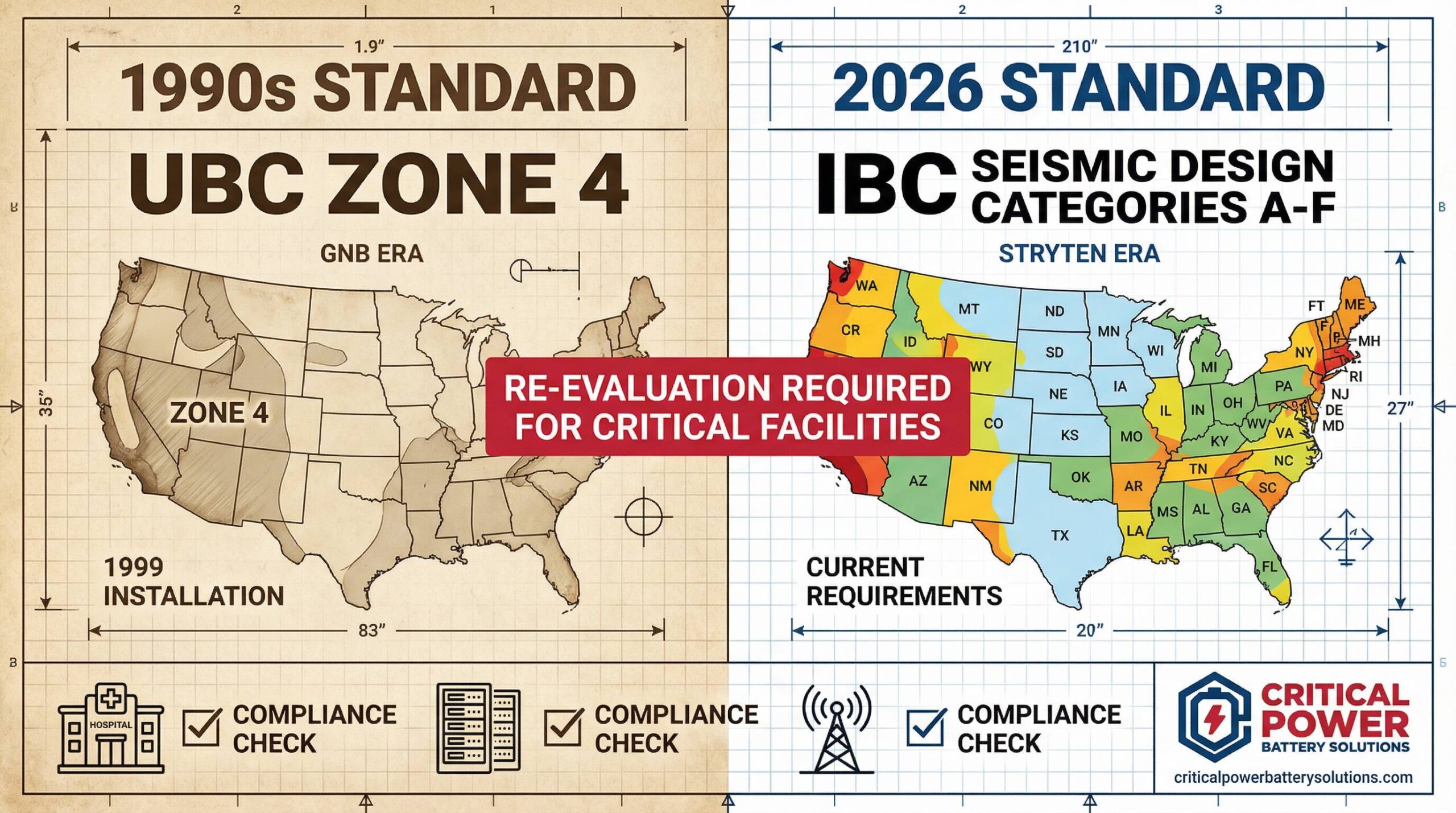
Many legacy Absolyte installations from the 1990s utilize racking systems rated for UBC (Uniform Building Code) Zone 4. However, the UBC has been superseded by the IBC (International Building Code) across the United States.

According to IBC Chapter 16, seismic design is now categorized by Seismic Design Categories (A through F) rather than simple zones. A rack installed in 1999 rated for “Zone 4” does not automatically meet current IBC requirements for critical infrastructure. When replacing batteries, facility managers should re-evaluate the racking system to ensure it complies with modern code, particularly for essential facilities like hospitals or data centers.


IEEE 485 Sizing Standards

Proper sizing is governed by IEEE 485-2020 (“Recommended Practice for Sizing Lead-Acid Batteries”). It is a common misconception that a battery’s nameplate capacity equals its real-world capacity at the end of its life.

IEEE 485 sizing calculations account for:

  1. Aging Factor: Batteries lose capacity over time; the standard typically adds a 125% margin to ensure the battery can support the load at the end of its service life.
  2. Temperature Correction: Capacity drops as temperature drops.
  3. Design Margin: A safety buffer for unforeseen load growth.

Our engineering team uses these standards to ensure that your replacement string is not just a like-for-like swap, but a calculated solution that meets your actual load profile.

Seismic compliance code evolution comparison: 1990s UBC Zone 4 standard (GNB era) versus 2026 IBC Seismic Design Categories A-F (Stryten era) with re-evaluation requirements for critical facilities including hospitals, data centers, and telecom sites


Frequently Asked Questions

Who makes GNB batteries now?

Stryten Energy manufactures GNB batteries today. Following the acquisition of GNB Industrial Power assets in 2020, Stryten Energy continues to produce the Absolyte and Marathon lines in the USA using the original specifications and manufacturing facilities.

What is the difference between Absolyte IIP and GP?

The primary difference is the grid alloy chemistry. Absolyte IIP (discontinued) utilized a Lead-Antimony-Cadmium alloy, while the modern Absolyte GP uses a Lead-Calcium-Tin alloy. This change eliminates hazardous Cadmium and improves corrosion resistance, but it also means the two types have different float voltages and cannot be mixed.

Are GNB Absolyte batteries still available?

Yes, but they are now branded as Stryten Energy Absolyte AGP. The product specifications, dimensions, and performance characteristics remain identical to the legacy GNB models, ensuring backward compatibility for rack footprints (though not for mixed strings). The Absolyte battery remains a core product in Stryten’s portfolio.

Can you mix Absolyte IIP and Absolyte GP batteries?

No, you should never mix Absolyte IIP and GP batteries in the same string. They require different float voltages and have different internal resistance profiles. Mixing them will cause charge imbalances, leading to reduced capacity and potential safety hazards.

What is the life expectancy of an Absolyte battery?

The design life of an Absolyte AGP battery is 20 years at 25°C (77°F). However, real-world service life typically ranges from 12 to 15 years depending on operating temperature, discharge frequency, and maintenance adherence.


Limitations & Professional Guidance

Research Limitations

While VRLA technology is mature, lifespan claims are often based on controlled laboratory conditions at 25°C. In real-world applications, particularly in unconditioned outdoor cabinets, the Arrhenius equation applies: for every 10°C (18°F) rise in operating temperature above the optimum, the battery life is cut in half.

Alternatives

For sites with extreme cycling needs or severe weight constraints, Front Terminal VRLA alternatives or Lithium Iron Phosphate (LiFePO4) solutions may offer a better Total Cost of Ownership (TCO). However, the Absolyte line remains superior for ease of recycling (99% recyclability) and proven safety records in occupied spaces.

Professional Consultation

Due to the complexity of IEEE 485 sizing and IBC seismic compliance, we recommend a professional sizing consultation before ordering replacements. This ensures that your new system meets all modern code requirements and that the Stryten Energy warranty remains valid.


Conclusion

From the research labs of Sandia to the manufacturing lines of Stryten Energy, the Absolyte battery remains the gold standard for industrial backup power. While the name on the jar has changed from GNB, the engineering rigor, specifically the Lead-Calcium-Tin innovation, continues to power critical US infrastructure.

Don’t risk compliance with outdated sizing or incompatible chemistries. Contact Critical Power Battery Solutions for a Free IEEE 485 Battery Sizing Consultation. Our engineers will verify your load profile, check your seismic zone requirements, and ensure your replacement string meets all modern Stryten Energy warranty standards.


References

  1. Sandia National Laboratories – Utility Battery Storage Systems Program Report for FY93 (SAND93-3899)
  2. Atlas Holdings Establishes Stryten Manufacturing (August 25, 2020)
  3. IEEE 485-2020 Recommended Practice for Sizing Lead-Acid Batteries
  4. International Building Code (IBC) Chapter 16: Structural Design
  5. U.S. Department of Energy – Energy Storage Systems Program


Comments are closed.

Critical Power Battery News

ISO 9001 Certified – Through Our Parent Company , ATS

Our operations are supported by ISO 9001-certified processes through Advanced Technical Services Inc.
(ATS), providing you with confidence in every order and continuous commitment to improvement.

Expert Battery Sizing When Precision Matters

Don't risk undersizing or overspending on your critical power system. Our battery sizing experts bring over four decades of experience to ensure your installation meets exact specifications for optimal performance and longevity.

Why Schedule a Battery Sizing Consultation:

Precision engineering icon for advanced battery systems and technical expertise
Precision Engineering

Get exact calculations based on your specific load requirements and runtime needs

Application-specific icon for customized battery solutions and expert sizing
Application-Specific Expertise

Benefit from specialized knowledge in telecom, data center, utility, and renewable energy applications

Cost optimization icon for battery replacement services and value engineering
Cost Optimization

Avoid unnecessary expenses from oversizing or costly downtime from undersizing

Compliance assurance icon for battery standards and regulatory requirements
Compliance Assurance

Ensure your battery system meets all relevant industry standards and regulations

Future-proofing icon for UPS battery solutions and technology advancement
Future-Proofing

Plan for growth with scalable solutions that accommodate your evolving power needs

Our battery sizing experts will analyze your critical load requirements, environmental conditions, and backup duration needs to recommend the perfect solution for your application.

DELIVERABLE – IEEE 485 Battery Sizing report as well as a detailed pricing quote.

Free Battery Sizing Consultation