Introduction: Why a Absolyte Battery Migration Demands Ventilation Recalculation
Replacing an aging GNB Absolyte GP or Absolyte GX battery system with the current-generation Stryten Absolyte AGP is one of the most common retrofit projects in US data centers, telecom central offices, and utility substations. The Absolyte platform has been the dominant VRLA choice for mission-critical stationary power since the 1980s, and thousands of legacy GP and GX installations are now reaching end-of-life after 15–20 years of service.
Most facility engineers treat this as a straightforward swap: remove the old batteries, install the new ones, reconnect, and commission. But this approach overlooks a critical safety requirement: the battery room ventilation system must be recalculated for the replacement battery’s specific electrochemical parameters.
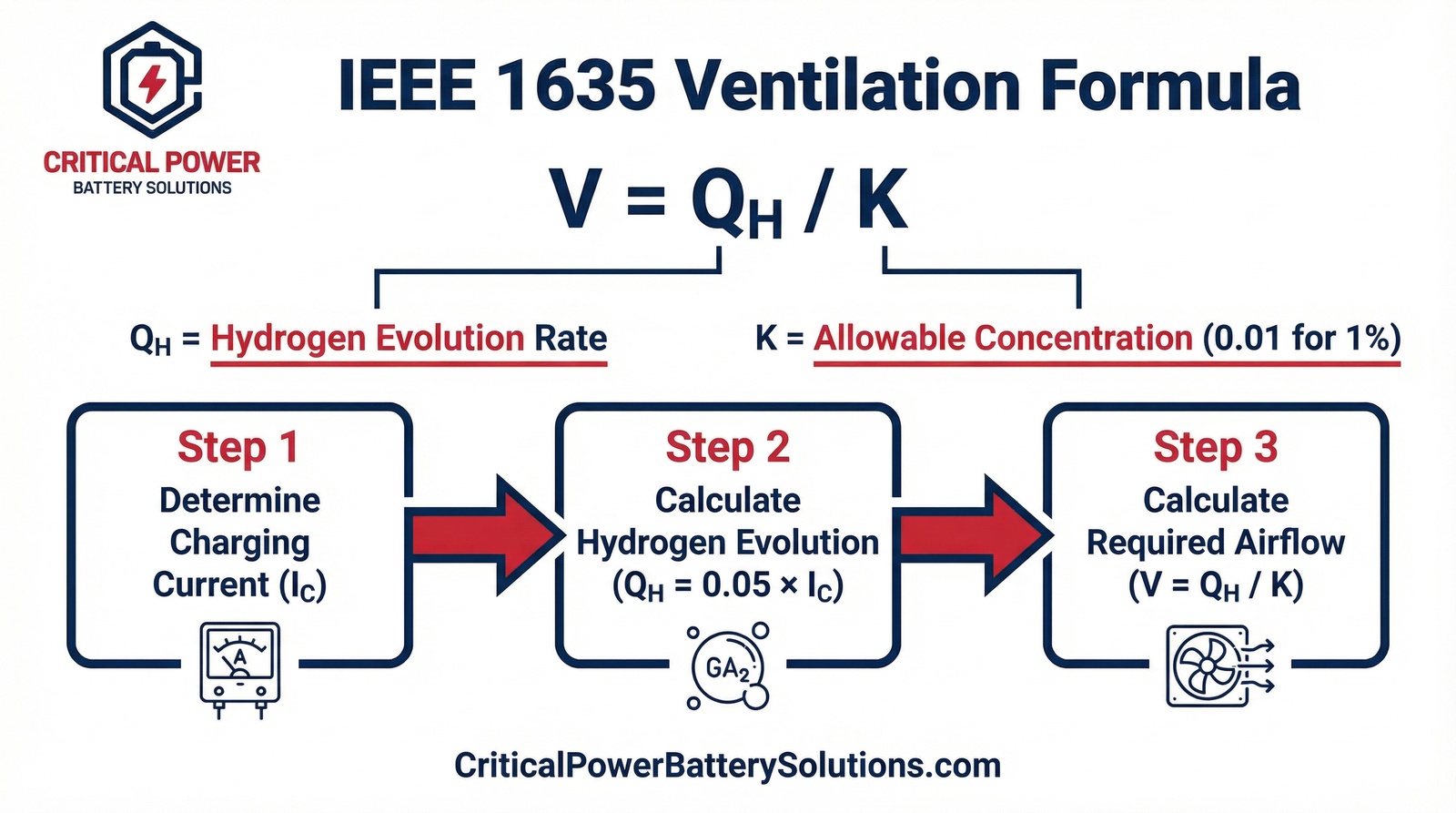
The IEEE 1635 hydrogen dilution formula — Q = 0.054 × I × N — does not change between battery generations. However, the inputs that drive that formula absolutely do. Float voltage ranges, equalize charge voltages, electrolyte specific gravity, recombination efficiency under overcharge conditions, and even the physical cell count in a system can all shift when migrating from one Absolyte generation to another. A ventilation system that was correctly sized for a GNB Absolyte GX at 2.25 VPC float may not be correctly sized for a Stryten Absolyte AGP at 2.27 VPC float, even if the system Ah capacity is identical.
This guide provides the complete engineering framework for recalculating battery room ventilation during a GP/GX-to-AGP migration. We compare every ventilation-relevant parameter across all three Absolyte generations, walk through a migration-specific worked example, and provide the compliance checklist for AHJ notification.
👤 Article by: Tom Kierna
Reviewed by: CPBS Engineering Team
Last updated: March 6, 2026
Credentials: Authorized Stryten battery Reseller, ISO 9001 Certified, IEEE Standards Member


Understanding the Absolyte Legacy: GNB Absolyte GP & Absolyte GX
Before planning a migration, engineers must understand what they are replacing. The GNB Absolyte GP and Absolyte GX were manufactured by GNB Industrial Power (later Exide Technologies, now succeeded by Stryten Energy) and represent two distinct generations of the Absolyte VRLA platform.
GNB Absolyte GP: The Original Workhorse
The Absolyte GP (General Purpose) was the foundational product in the Absolyte line, a tubular-plate VRLA battery designed for float standby applications in telecom and UPS systems. Key engineering parameters that affect ventilation design:
- Float voltage: 2.23–2.27 VPC at 77°F (25°C)
- Equalize charge: 2.30 VPC for 24 hours or 2.35 VPC for 12 hours
- Recombination efficiency: >99% under normal float conditions
- Positive grid alloy: Lead-Calcium-Tin
- Separator: Absorbed Glass Mat (AGM)
- Design life: 20 years at 25°C (77°F)
- Recharge efficiency: 105–110% of ampere-hours removed
The GP established the engineering template, high recombination, low gassing under float, and a 20-year design life that became the benchmark for critical infrastructure batteries. Many GP installations from the early-to-mid 2000s are now reaching or exceeding their rated life, making them prime candidates for AGP replacement.
GNB Absolyte GX: The High-Capacity Modular Platform
The Absolyte GX was developed for large-capacity applications where standard GP modules could not provide enough energy density. The GX introduced modular designs ranging from 2,000 to 6,000 Ah – significantly larger than typical GP configurations, and incorporated a patented positive grid alloy.
- Float voltage: 2.23–2.25 VPC at 77°F (25°C) — narrower range than GP or AGP
- Equalize charge: 2.30 VPC for 24 hours, 2.33 VPC for 18 hours, or 2.35 VPC for 12 hours
- Cycle voltage (by DOD): 2.28 ± 0.02 VPC at 0–2% DOD; 2.33 ± 0.02 VPC at 3–5% DOD; 2.38 ± 0.02 VPC at >5% DOD
- Electrolyte specific gravity: 1.295
- Safety vent pressure: 3–10 psi
- Recombination efficiency: >99% (99% or more gases recombined within cell under normal conditions)
- Positive grid alloy: Patented Lead-Calcium-Tin-Silver
- Separator: “S”-wrap AGM
- Design life: 20 years at 25°C (77°F)
- Cycle life: 1,200 cycles to 80% depth of discharge
- Operating temperature: -40°C to +50°C
- Module configurations: GX2000, GX3000, GX4000, GX5000, GX6000
- Open circuit voltage: ~2.14 VPC
- Float voltage life impact: 2.23–2.25 VPC = 0% life reduction; 2.28–2.30 VPC = 50% reduction; 2.33–2.35 VPC = 75% reduction
- Temperature compensation: 0.003 V/°F (0.0055 V/°C) per cell
The critical detail for ventilation engineers: the GX has a narrower recommended float range (2.23–2.25 VPC) compared to both the GP and AGP (2.23–2.27 VPC). This means GX systems were typically floated at the lower end of the voltage spectrum, producing less overcharge gassing. Migrating to AGP may involve adjusting the charger to a higher float voltage within the wider AGP range, which directly affects hydrogen evolution and therefore ventilation requirements.
The Successor: Stryten Absolyte AGP
The Stryten E-Series Absolyte AGP is the current-generation replacement for both the GP and GX lines. Manufactured by Stryten Energy (the successor to GNB/Exide’s industrial battery division), the AGP retains the core Absolyte VRLA architecture while incorporating modern manufacturing improvements and expanded certification coverage.
AGP Core Engineering Specifications
- Float voltage: 2.23–2.27 VPC at 77°F (25°C)
- Initial charge: 2.30 VPC for 24 hours or 2.35 VPC for 12 hours (Table B)
- Equalize charge: 2.30 VPC for 24 hours, or 2.35 VPC for 12 hours (Table C)
- Cycle voltage (by DOD): 2.28 ± 0.02 VPC at 0–2% DOD; 2.33 ± 0.02 VPC at 3–5% DOD; 2.38 ± 0.02 VPC at >5% DOD
- Electrolyte specific gravity: 1.310
- Safety vent pressure: 3.5–9 psi
- Recombination efficiency: >99%
- Positive grid alloy: Lead-Calcium-Tin
- Separator: Absorbed Glass Mat (AGM)
- Design life: 20 years at 25°C (77°F)
- Cycle life: 1,200 cycles to 80% depth of discharge
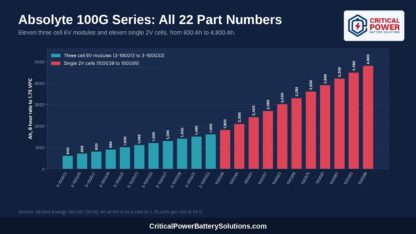
- Capacity range: 104–4,800 Ah
- Open circuit voltage: ~2.15 VPC
- Container: UL94 V-0 flame retardant / 28% Limiting Oxygen Index
- Recharge efficiency: 105–110% of ampere-hours removed
- Maximum storage interval: 6 months at 77°F
- Float voltage life impact: 2.23–2.27 VPC = 0% life reduction; 2.28–2.32 VPC = 50% reduction; 2.33–2.37 VPC = 75% reduction
- Temperature compensation: 0.003 V/°F (0.0055 V/°C) per cell
AGP Certifications & Seismic Qualifications
One of the most significant upgrades in the AGP is its expanded certification portfolio — particularly seismic qualifications that are increasingly required for US infrastructure:
- Seismic: Qualified to 1997 UBC, 2005 IEEE-693, 2018 IBC / 2016 CBC
- NEBS: Level 3 certified (Telcordia GR-63-CORE, GR-1089-CORE)
- UL: Listed to UL 1778 (UPS applications)
- Maintenance standard: IEEE-1188 recommended
For facilities in seismic zones (California, Pacific Northwest, New Madrid zone), the AGP’s modern 2018 IBC certification may itself justify the migration, older GP/GX installations may not meet current seismic requirements even if the batteries still have remaining capacity.
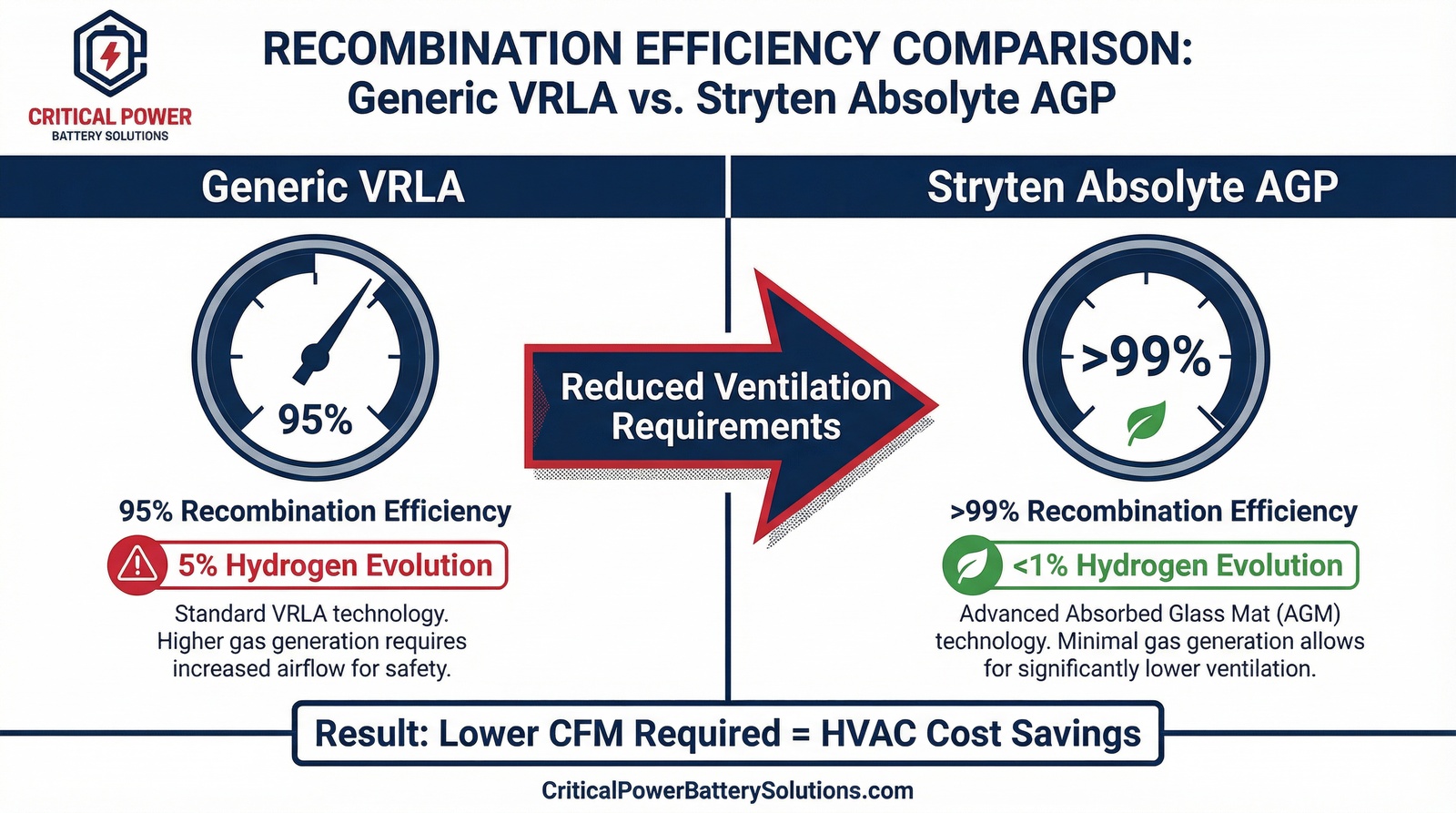
Absolyte GP vs. GX vs. AGP: Three-Generation Engineering Comparison
The following comparison matrix captures every parameter that affects ventilation design across all three Absolyte generations. Engineers planning a migration should verify their existing system’s actual operating parameters against the legacy column before calculating the AGP replacement requirements.
| Parameter | GNB Absolyte GP | GNB Absolyte GX | Stryten Absolyte AGP |
|---|---|---|---|
| Recommended Float Voltage | 2.23–2.27 VPC | 2.23–2.25 VPC | 2.23–2.27 VPC |
| Equalize Voltage / Time | 2.30 VPC / 24 hrs or 2.35 VPC / 12 hrs | 2.30 VPC / 24 hrs, 2.33 VPC / 18 hrs, or 2.35 VPC / 12 hrs | 2.30 VPC / 24 hrs or 2.35 VPC / 12 hrs |
| Electrolyte Specific Gravity | Not published (est. ~1.300) | 1.295 | 1.310 |
| Safety Vent Pressure | Not published | 3–10 psi | 3.5–9 psi |
| Recombination Efficiency | >99% | >99% | >99% |
| Positive Grid Alloy | Lead-Calcium-Tin | Lead-Calcium-Tin-Silver (patented) | Lead-Calcium-Tin |
| Separator | AGM | “S”-wrap AGM | AGM |
| Capacity Range | Varies by model | 2,000–6,000 Ah (modular) | 104–4,800 Ah |
| Design Life | 20 years at 25°C | 20 years at 25°C | 20 years at 25°C |
| Cycle Life | 1,200 cycles @ 80% DOD | 1,200 cycles @ 80% DOD | 1,200 cycles @ 80% DOD |
| Open Circuit Voltage | ~2.14 VPC | ~2.14 VPC | ~2.15 VPC |
| Temperature Compensation | 0.0055 V/°C per cell | 0.0055 V/°C per cell | 0.0055 V/°C per cell |
| Float Voltage — 0% Life Reduction | 2.23–2.27 VPC | 2.23–2.25 VPC | 2.23–2.27 VPC |
| Float Voltage — 50% Life Reduction | 2.28–2.30 VPC | 2.28–2.30 VPC | 2.28–2.32 VPC |
| Float Voltage — 75% Life Reduction | 2.33–2.35 VPC | 2.33–2.35 VPC | 2.33–2.37 VPC |
| Recharge Requirement | 105–110% of Ah removed | 105–110% of Ah removed | 105–110% of Ah removed |
| Seismic Qualification | Varies by installation era | Available (older standards) | 1997 UBC, 2005 IEEE-693, 2018 IBC/2016 CBC |
| Container Flame Rating | Standard | Standard | UL94 V-0 / 28% L.O.I. |
| Connection Torque | 11.3 N-m (100 in-lbs) | 11.3 N-m (100 in-lbs) | 11.3 N-m (100 in-lbs) |
| Manufacturer | GNB Industrial Power / Exide | GNB Industrial Power / Exide | Stryten Energy |
Five Critical Differences That Affect Ventilation
While the three generations share the same core VRLA architecture and >99% recombination efficiency, five specific engineering differences require a ventilation recalculation during migration:
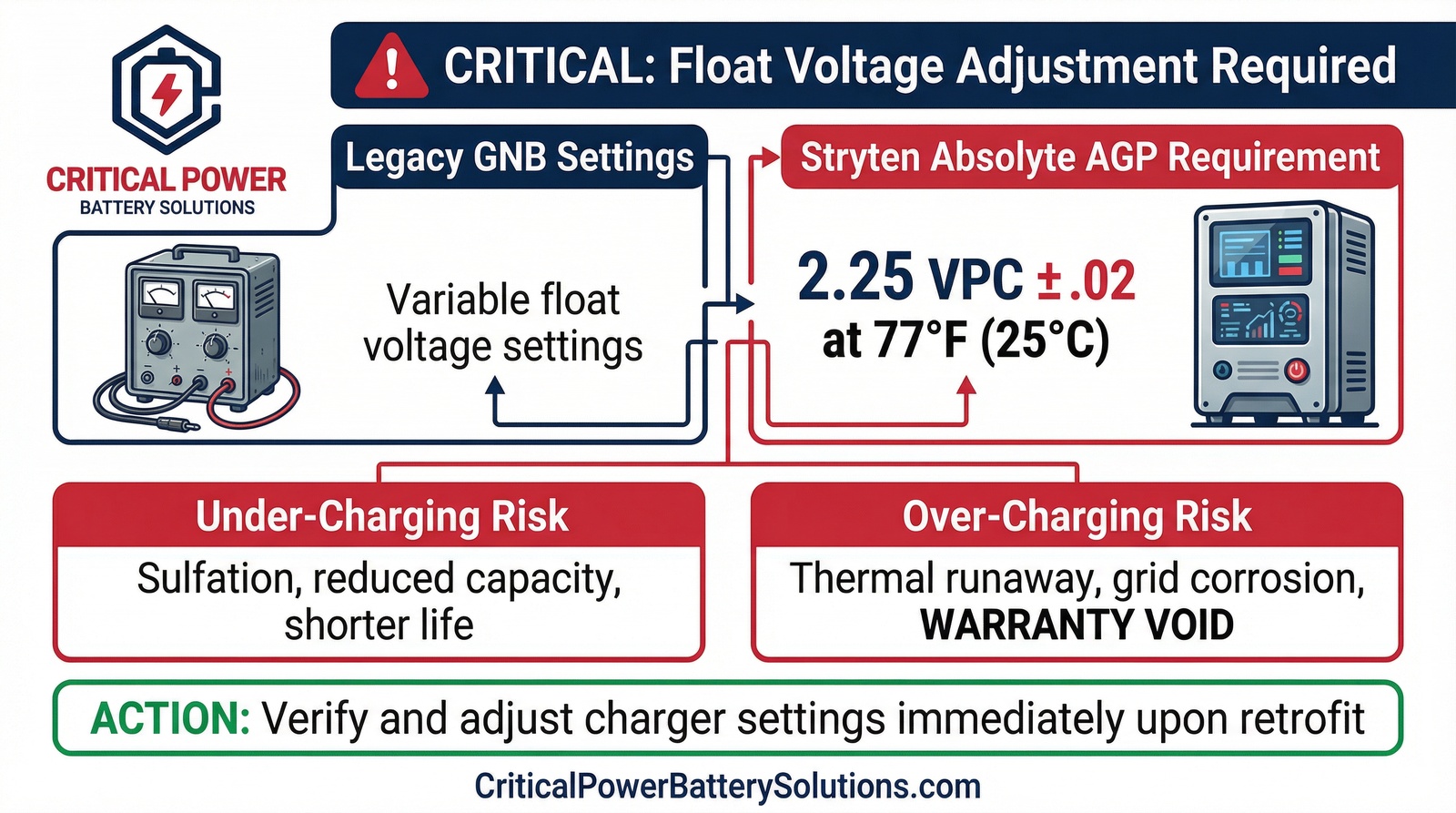
1. Float Voltage Range. The GX’s narrow 2.23–2.25 VPC range means legacy GX systems were typically floated at 2.25 VPC or lower. The AGP’s wider 2.23–2.27 VPC range gives engineers more flexibility, but if the charger is adjusted upward to 2.27 VPC (still within AGP’s 0% life reduction zone), the overcharge current and associated hydrogen evolution increase compared to the GX’s operating point. The IEEE 1635 calculation must reflect the actual planned float voltage, not a generic assumption.
2. Electrolyte Specific Gravity. The AGP uses a higher SG (1.310) compared to the GX (1.295). Higher specific gravity means denser sulfuric acid, which affects the internal electrochemistry, including the overcharge reaction kinetics that produce hydrogen. While recombination efficiency remains >99% under normal conditions, the AGP’s higher SG alters the gassing profile during abnormal conditions (overcharge, thermal excursion) that drive worst-case ventilation sizing.
3. Safety Vent Pressure Range. The GX vents at 3–10 psi; the AGP vents at 3.5–9 psi. The AGP’s tighter, slightly higher low-end threshold means the cell contains more pressure before venting — recombining more gas internally. However, the narrower high-end (9 psi vs. 10 psi) means the AGP releases pressure slightly sooner at the upper threshold. For worst-case ventilation modeling, the vent pressure affects the rate at which accumulated gas enters the room during an overcharge event.
4. Cell Count Configuration Changes. The GX’s modular range (2,000–6,000 Ah in fixed module sizes) often resulted in specific cell counts per system. The AGP’s broader capacity range (104–4,800 Ah) allows different sizing approaches. If the replacement AGP system uses a different cell count than the legacy GX — whether due to resizing, adding redundancy, or changing from 48V to higher voltage architecture, the “N” variable in Q = 0.054 × I × N changes directly.
5. Grid Alloy Composition. The GX used a patented Lead-Calcium-Tin-Silver grid alloy; the AGP returns to Lead-Calcium-Tin without silver. The silver additive in the GX was designed to improve grid corrosion resistance and cycle life. The AGP achieves equivalent performance through manufacturing process improvements rather than alloy chemistry. While this does not directly change the ventilation calculation, it affects the long-term overcharge behavior and aging characteristics that influence end-of-life gassing rates.
Recalculating Ventilation for a Absolyte GP/GX → AGP Migration
The IEEE 1635 hydrogen dilution formula remains the foundation:
Where Q = required CFM, I = maximum charging current (Amps), and N = total number of individual 2V cells. For a detailed derivation and worked examples of this formula, see our companion guide: Battery Room Ventilation Calculation: Engineer’s Guide to VRLA Safety.
In a migration context, the recalculation process has additional steps beyond a greenfield design:
Step 1: Document the Legacy Absolyte GP/GX System’s Actual Parameters
Before removing the old batteries, record the actual operating parameters, not just the nameplate specifications:
- Actual float voltage at the battery terminals (may differ from charger setpoint due to cable losses)
- Actual equalize voltage and frequency (how often equalize charges are performed)
- Total cell count (N) in the existing system
- Maximum charger output current (I) during equalize mode
- Battery room temperature – actual measured, not HVAC setpoint
- Existing ventilation capacity in CFM
This establishes your baseline. Many facilities discover during migration planning that their existing ventilation was either undersized (relying on the battery’s high recombination to compensate) or oversized (using conservative generic VRLA assumptions rather than Absolyte-specific data).
Step 2: Define the Absolyte AGP Replacement System Parameters
Work with your battery supplier to establish the AGP system configuration:
- AGP model and capacity (determines physical cell count per module)
- Total cell count (N) – may differ from legacy if system voltage or redundancy changes
- Planned float voltage – typically 2.25 VPC for data center/UPS or per the AGP’s recommended 2.23–2.27 VPC range
- Charger equalize current – verify the existing charger is compatible with AGP requirements, or if a new charger is part of the project
Step 3: Worked Example – Absolyte GX to AGP Migration
Consider a telecom central office replacing a GNB Absolyte GX system:
Legacy GX System:
- Configuration: 48V system, 24 cells (2V each)
- Model: GX3000 modules (3,000 Ah)
- Float voltage: 2.25 VPC (top of GX’s recommended range)
- Equalize current: 30A maximum
- Existing ventilation: Q = 0.054 × 30 × 24 = 38.88 CFM
Replacement AGP System:
- Configuration: 48V system, 24 cells (2V each) – same cell count
- Model: AGP equivalent capacity modules
- Planned float voltage: 2.27 VPC (top of AGP’s 0%-life-reduction range)
- New charger equalize current: 35A maximum (upgraded charger)
- Recalculated ventilation: Q = 0.054 × 35 × 24 = 45.36 CFM
Step 4: Apply Temperature Correction
Temperature correction factors remain identical across all three Absolyte generations — all use the same 0.0055 V/°C compensation factor. However, migration projects often coincide with facility upgrades that change HVAC conditions. Apply the standard correction:
| Room Temperature | Correction Factor | Example: 45.36 CFM base |
|---|---|---|
| 77°F / 25°C (baseline) | 1.0× | 45.36 CFM |
| 86°F / 30°C | ~1.4× | 63.50 CFM |
| 95°F / 35°C | ~2.0× | 90.72 CFM |
| 104°F / 40°C | ~2.8× | 127.01 CFM |
Per ASHRAE guidelines, the hydrogen evolution rate approximately doubles for every 10°C (18°F) increase above the 25°C baseline. For hot-climate facilities (ASHRAE Climate Zones 1–3), apply a minimum 1.5× correction factor even if the HVAC system targets 77°F, to account for cooling system degradation or failure scenarios.
Physical Absolyte Battery Installation Considerations for Migration
Ventilation is not the only engineering concern during a GP/GX-to-AGP migration. Several physical differences affect installation planning:
Absolyte Footprint and Weight Changes
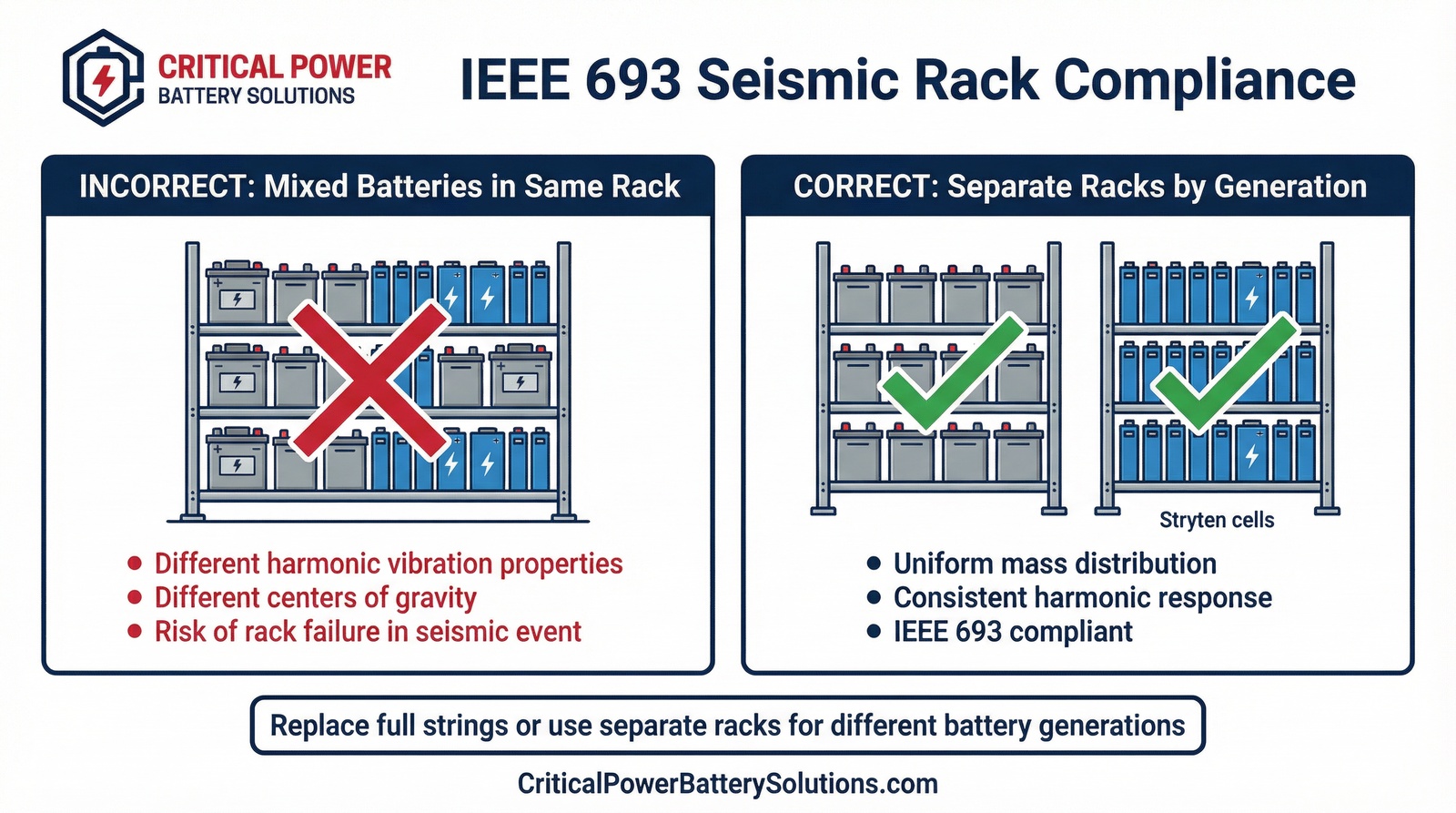
The GX’s modular design (GX2000 through GX6000) had specific footprints and weights. For reference, GX modules ranged from approximately 315 kg (695 lbs) for the GX2000 to significantly heavier for GX5000/6000 configurations. The AGP’s broader capacity range (104–4,800 Ah) means the replacement system may use a different number of modules with different individual weights. Verify that the existing battery rack, floor loading, and seismic restraints are rated for the AGP configuration.
Absolyte Seismic Retrofit Opportunity
The AGP’s qualification to 2018 IBC / 2016 CBC seismic standards is a significant upgrade over legacy GP/GX installations. In seismic zones, the migration is an opportunity to upgrade battery racks and anchoring systems to current code. This may also affect ventilation ductwork routing if the seismic bracing requires relocation of exhaust points.
Absolyte Charger Compatibility
The AGP requires constant voltage charging — the only method allowed. Verify that the existing charger can be programmed for the AGP’s recommended float range (2.23–2.27 VPC) and equalize voltages. The charger’s output voltage must be checked at the battery terminals, not at the charger output, to account for cable voltage drop. Both the GX and AGP manuals specify the same temperature compensation formula: V corrected = V25°C – ((T actual – 25°C) × 0.0055 V/°C). Ensure the charger’s temperature compensation is configured correctly for the new batteries.
Code Compliance During a Absolyte AGP Retrofit Migration
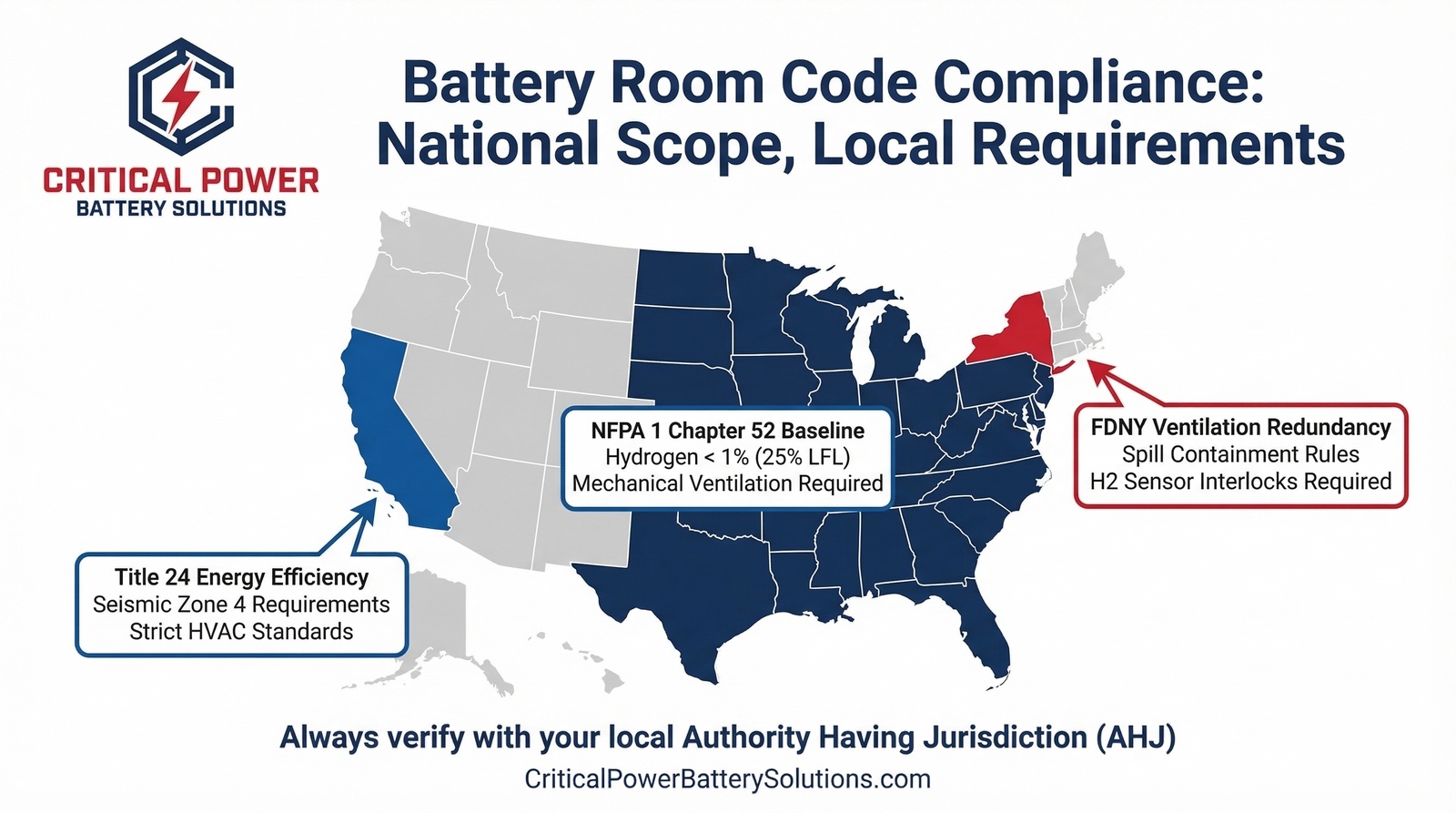
A battery replacement triggers code compliance obligations that may not have existed when the original GP or GX was installed. Engineers must address these during the migration:
AHJ Notification Requirements
Most jurisdictions require notification to the Authority Having Jurisdiction (AHJ) when battery systems exceeding certain thresholds are replaced. The AHJ may require updated ventilation calculations, hydrogen detection verification, and fire suppression review before the replacement batteries are energized.
Code Evolution Since Original Absolyte Battery Installation
If the original GP or GX was installed 15–20 years ago, the applicable fire codes have likely been updated. IFC Section 608 requirements for stationary storage battery systems have expanded significantly in recent code cycles. NFPA 1 Section 52 requirements for hydrogen detection, emergency ventilation activation, and signage may now apply to installations that were “grandfathered” under older codes. A battery replacement may trigger a requirement to bring the entire battery room up to current code.
Absolyte Battery Migration-Specific Compliance Checklist
- [ ] Recalculate ventilation per IEEE 1635 using AGP-specific parameters (float voltage, equalize current, cell count)
- [ ] Apply temperature correction factors for actual battery room conditions
- [ ] Verify existing exhaust fan capacity meets recalculated CFM requirement
- [ ] Confirm hydrogen detection sensors are operational and calibrated (alarm at 25% LEL / 1% H₂)
- [ ] Notify AHJ of battery system replacement per local requirements
- [ ] Review IFC 608 changes since original installation date
- [ ] Verify seismic restraints meet current IBC requirements for AGP configuration
- [ ] Confirm charger programming matches AGP recommended voltage ranges
- [ ] Update battery room signage if system specifications have changed
- [ ] Document new ventilation calculation in facility engineering records
- [ ] Schedule post-commissioning ventilation verification with hydrogen monitoring
Frequently Asked Questions about Absolyte batteries
Can I use the same ventilation system when replacing Absolyte GP/GX with Absolyte AGP?
Only if the recalculation confirms it. While all three generations share >99% recombination efficiency, differences in charger output current, cell count, and float voltage can change the required CFM. Never assume the existing ventilation is adequate — always recalculate using the AGP’s actual parameters and the IEEE 1635 formula (Q = 0.054 × I × N).
Why does the Absolyte GX have a narrower float voltage range than the Absolyte AGP?
Different grid alloy chemistry. The GX’s patented Lead-Calcium-Tin-Silver alloy was optimized for a narrower voltage window (2.23–2.25 VPC). The AGP’s Lead-Calcium-Tin alloy, combined with improved manufacturing processes, tolerates a wider range (2.23–2.27 VPC) without accelerated life reduction. This wider range gives engineers more design flexibility but may increase steady-state overcharge current at the upper end.
How does the higher electrolyte specific gravity in Absolyte AGP affect ventilation?
The AGP’s 1.310 SG (vs. GX’s 1.295) primarily affects overcharge gassing behavior under abnormal conditions. Under normal float, both achieve >99% recombination and produce negligible hydrogen. During overcharge events (equalize, charger malfunction), the higher SG acid in the AGP has slightly different electrolysis kinetics. The IEEE 1635 formula’s worst-case assumptions account for this, so the primary ventilation impact is captured through the “I” (current) variable rather than an explicit SG adjustment.
What if my Absolyte AGP replacement uses a different cell count than the legacy system?
The cell count (N) directly scales the ventilation requirement. If you are migrating from a 48V/24-cell system to a higher-voltage architecture with more cells, or adding parallel strings for redundancy, the ventilation must be recalculated for the new total cell count. This is the most common source of ventilation undersizing during migrations.
Do I need to adjust my charger when switching from Absolyte GX to Absolyte AGP?
Yes — charger reprogramming is mandatory. The GX and AGP have different recommended float ranges (GX: 2.23–2.25 VPC, AGP: 2.23–2.27 VPC). While there is overlap at the lower end, verify the charger’s float setpoint, equalize voltage, equalize timer, and temperature compensation are all programmed to AGP specifications. The charger must also be capable of delivering the initial charge per the AGP’s requirements: 2.30 VPC for 24 hours or 2.35 VPC for 12 hours.
Does the Absolyte AGP’s seismic certification affect ventilation ductwork?
Indirectly, yes. If the migration triggers a seismic upgrade to battery racks and restraints per the Absolyte AGP’s 2018 IBC qualification, the new rack configuration may alter the physical layout of the battery room. Changes to rack height, spacing, or orientation can affect airflow patterns and may require repositioning of exhaust vents to eliminate “dead zones” where hydrogen could accumulate per IEEE 1635 airflow sweep recommendations.
Is the migration process different for Absolyte GP vs. Absolyte GX replacements?
The process is the same, but the starting parameters differ. GP-to-AGP migrations are typically simpler because the Absolyte GP and Absolyte AGP share the same 2.23–2.27 VPC float range. GX-to-AGP migrations require more attention because the GX’s narrower float range (2.23–2.25 VPC) means the AGP may be operated at a higher float voltage than the system it replaces — directly affecting the ventilation calculation.
How long does a typical GP/GX-to-AGP migration take?
Plan for 2–6 months from engineering review to commissioning. The timeline includes: ventilation recalculation and review (2–4 weeks), equipment procurement including Absolyte AGP batteries (4–8 weeks), installation and charger programming (1–2 weeks), initial charge per AGP requirements (12–24 hours), and post-commissioning verification including ventilation testing (1–2 weeks). AHJ review, if required, can add 2–4 additional weeks.
Absolyte AGP Professional Consultation
A Absolyte GP/GX-to-AGP migration involves more than swapping batteries, it requires integrated engineering across electrical, mechanical (ventilation), structural (seismic), and regulatory (code compliance) disciplines. Critical Power Battery Solutions provides comprehensive migration support including:
- IEEE 1635 ventilation recalculation using your facility’s actual parameters
- IEEE 485 battery sizing to optimize the AGP configuration for your load profile
- Charger compatibility assessment and reprogramming specifications
- Seismic compliance review for facilities in IBC-regulated zones
- AHJ documentation packages for jurisdictional approval
As an authorized Stryten Energy distributor with over 40 years of electronics engineering heritage through our parent company Advanced Technical Services Inc. (ATS), we have access to manufacturer technical data and gassing curves not publicly available, enabling precision ventilation calculations specific to your exact AGP model and configuration.
Conclusion
Migrating from legacy GNB Absolyte GP or GX batteries to the Stryten Absolyte AGP is one of the most consequential infrastructure upgrades a facility engineer can undertake. The AGP delivers modern seismic certification, enhanced container flame ratings, and a broader capacity range, but it also introduces parameter differences that demand a fresh ventilation calculation.
The five critical differences, float voltage range, electrolyte specific gravity, safety vent pressure, cell count flexibility, and grid alloy composition, may seem subtle on a datasheet, but they translate directly into changes to the IEEE 1635 hydrogen dilution equation. An engineer who treats a GP/GX-to-AGP swap as a simple “like-for-like” replacement without recalculating ventilation is accepting unnecessary risk.
Contact Critical Power Battery Solutions for a complimentary migration assessment including ventilation recalculation, charger compatibility review, and seismic compliance evaluation. Our engineering team will ensure your AGP migration is safe, code-compliant, and optimized for 20 years of reliable service.
References
- IEEE Std 1635-2018, “IEEE Guide for the Ventilation and Thermal Management of Batteries for Stationary Applications,” IEEE Xplore.
- NFPA 1, “Fire Code, Section 52 — Stationary Storage Battery Systems,” National Fire Protection Association.
- International Fire Code (IFC), “Section 608 — Stationary Storage Battery Systems,” International Code Council.
- Stryten Energy, “Absolyte AGP Installation and Operating Instructions,” Document SE2001.
- Exide Technologies / GNB Industrial Power, “Absolyte GX Installation and Operating Manual,” Document RS-092020.
- Exide Technologies / GNB Industrial Power, “Absolyte GP Installation and Operating Instructions.”
- ASHRAE Handbook — HVAC Applications, “Chapter 47 — Design of Data Centers,” ASHRAE.
- IEEE Std 1188, “IEEE Recommended Practice for Maintenance, Testing, and Replacement of VRLA Batteries for Stationary Applications.”