Oil Field Battery Replacement Batteries from Stryten Energy
Key Takeaway
Stryten Absolyte AGP is the direct, authorized solution for oil field and gas battery replacement, offering Class 1 Div 2 compliance for hazardous locations.
- Drop-in compatibility with existing GNB seismic racks (UBC/IBC Zone 4).
- Maintenance-free VRLA design eliminates watering at remote SCADA sites.
- Meets IEEE 485 sizing standards for critical backup loads.
Continue reading for the complete retrofit engineering guide and float voltage specifications.
Written by:Tom Kierna, Battery Systems Specialist
Reviewed by: Senior Applications Engineer, Critical Power Battery Solutions
Last updated: February 28, 2026


Transparency: This article explores oil and gas battery replacements based on IEEE standards and NEC codes. Some links connect to our authorized Stryten Energy inventory. All technical data is verified by our engineering team.
Table of Contents
- Introduction
- Critical Power for Hazardous Locations (Class 1 Div 2)
- The Stryten Advantage for SCADA & Wellsites
- Retrofit Engineering Guide
- Step-by-Step Replacement Protocol
- Disposal & Compliance (EPA & DOT)
- Frequently Asked Questions
- Limitations, Alternatives & Professional Guidance
- Conclusion
- References
Introduction
Replacing aging GNB Absolyte batteries in oil rigs and gas refinery facilities is not a simple one-for-one swap. It demands expertise in hazardous location classifications, IEEE 485 sizing standards, SCADA integration, and EPA/DOT disposal regulations. Aging backup power systems at remote wellsites, pump stations, and distribution centers pose operational risk—but improper replacement can introduce compliance violations and equipment incompatibility that are even costlier to fix.
The Stryten Absolyte AGP is the authorized successor to legacy GNB systems used throughout North American oil field and gas refinery infrastructure. Since 2007, when Stryten Energy acquired GNB Industrial Power, the Absolyte AGP has been the standard upgrade path for oil and gas battery systems requiring Class 1 Division 2 compliance and remote monitoring capability.
This guide walks facility managers, electrical engineers, and operations teams through the complete transition—from compliance verification and system sizing, through installation and commissioning, to EPA/DOT decommissioning of old batteries. You will learn why float voltage management is critical in elevated-temperature wellsite environments, how to maintain seismic rack compatibility, and how to document your replacement project for audit and warranty purposes.
Critical Power for Hazardous Locations (Class 1 Div 2)
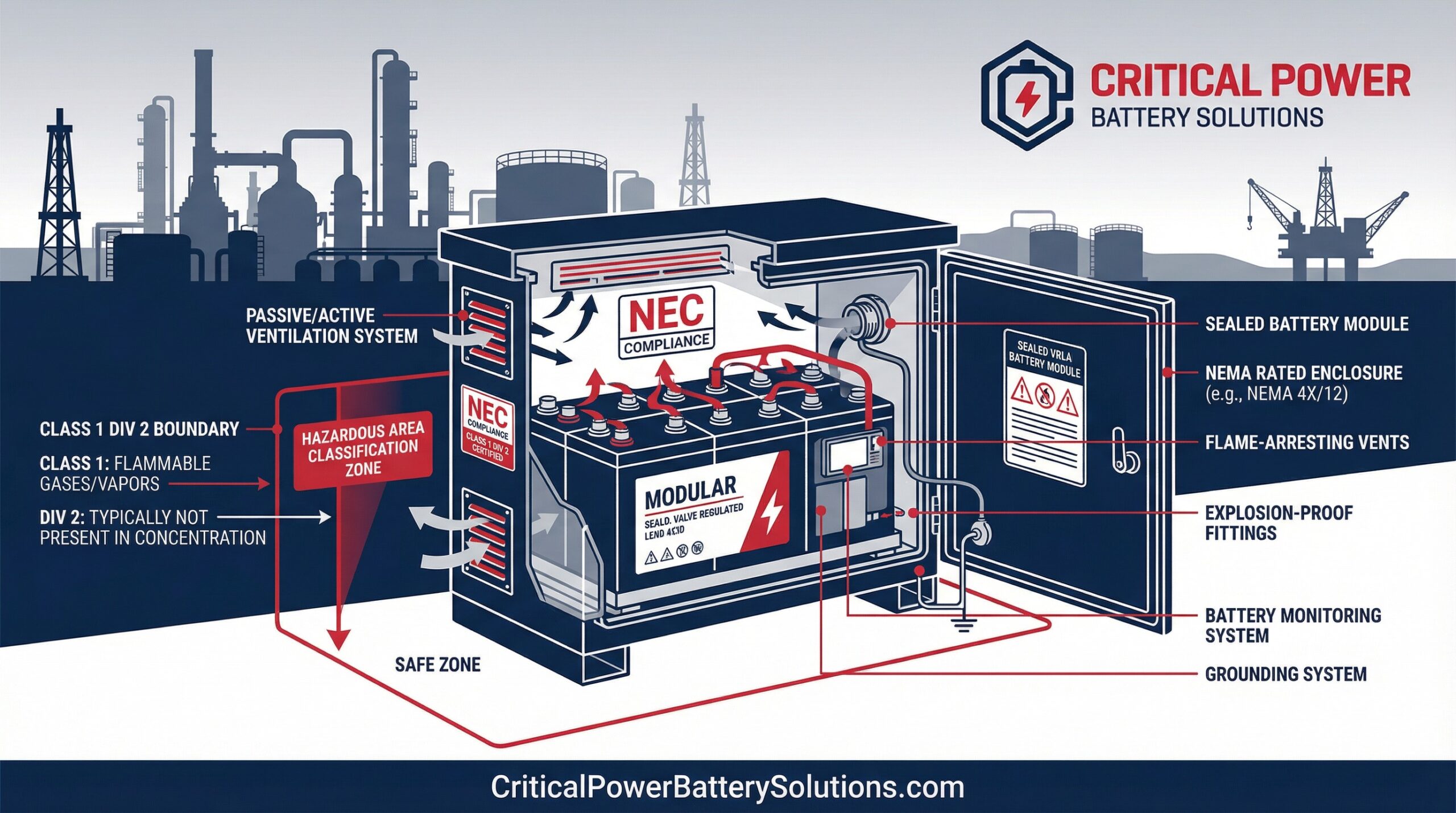
The National Electrical Code (NEC) Article 500 defines hazardous locations based on the presence or potential presence of flammable gases or vapors. Most oil and gas producing facilities fall into Class 1 Division 2 classification—meaning hazardous atmospheres are not normally present but can occur under abnormal conditions.
When selecting backup batteries for these environments, you must verify three compliance points:
- Manufacturer certification: The battery must carry UL or CSA certification for Class 1 Div 2 use. GNB Absolyte and Stryten Absolyte AGP both carry this certification, so replacement is direct.
- Container and terminal design: VRLA (valve-regulated lead-acid) batteries are preferred because their sealed design eliminates hydrogen gas generation, reducing the risk of explosive atmosphere ignition.
- Installation environment: The battery room or cabinet must meet NEC ventilation, temperature, and electrical isolation requirements regardless of the specific battery model.
The good news: Stryten Absolyte AGP is UL-certified for Class 1 Div 2 hazardous location use and is a direct replacement for GNB Absolyte systems. No re-engineering of the backup power infrastructure is required, and your facility remains code-compliant during the swap.
The Stryten Advantage for SCADA & Well sites
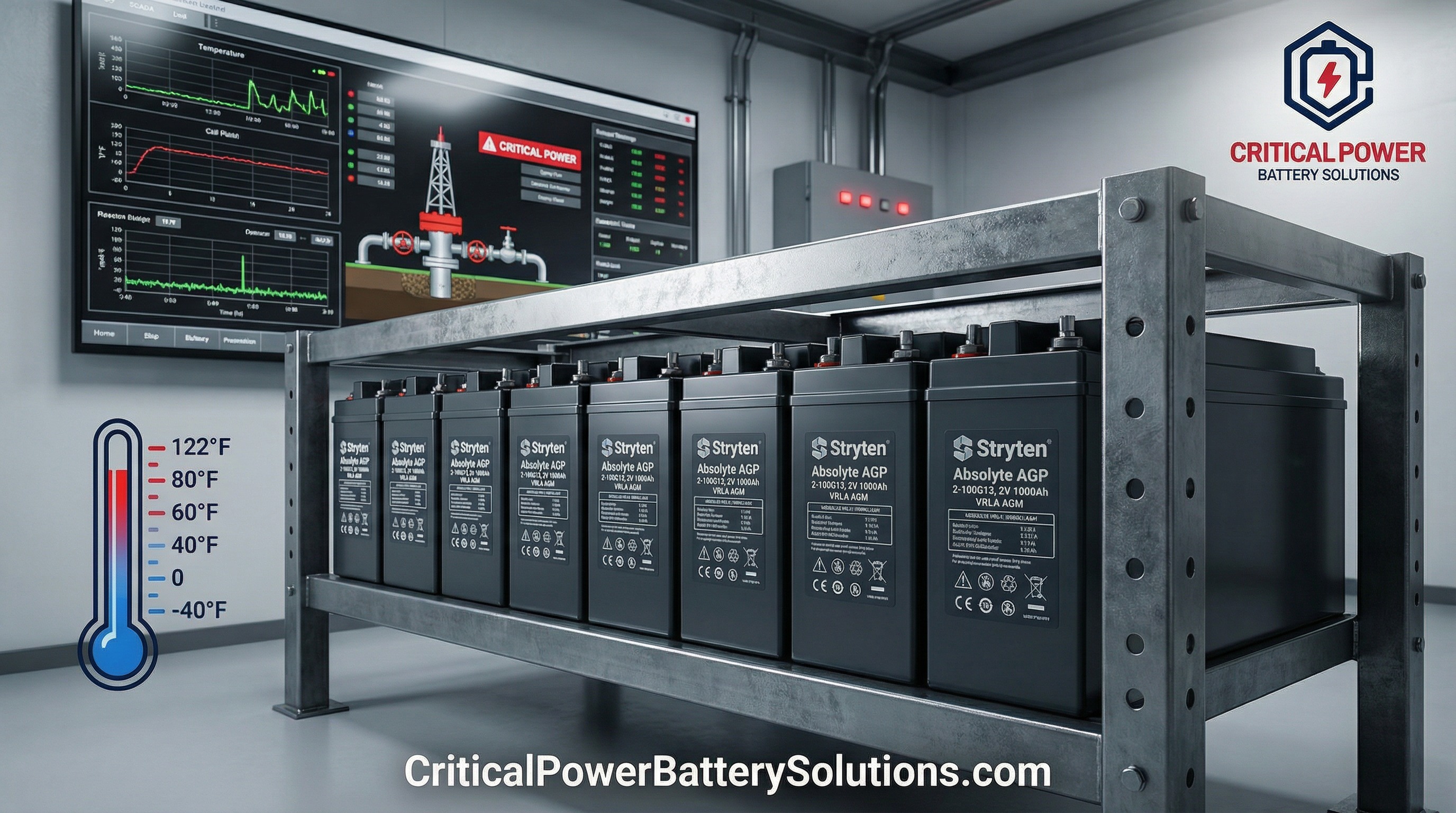
Oil fields and gas refinery operations depend on SCADA (Supervisory Control and Data Acquisition) systems to monitor wellhead pressure, flow rates, and emergency shutdown commands from remote locations across Texas, Oklahoma, Colorado, and the Permian Basin. Battery backup systems must endure extreme conditions that data centers and telecom facilities rarely face:
- Temperature extremes: Wellsite battery cabinets experience 140°F+ surface temperatures in summer and sub-zero conditions in winter. Stryten Absolyte AGP cells are rated for -4°F to 131°F continuous operation, maintaining full capacity in these swing conditions.
- Vibration and seismic movement: Pump skids, compressor vibration, and occasional seismic activity subject batteries to sustained mechanical stress. Stryten’s rugged design and secure terminal connections resist vibration-induced failures that accelerate degradation in older GNB designs.
- Cycling capability: Many wellsites experience frequent power transients or intentional load cycling as part of normal operations. Absolyte AGP batteries are rated for 800+ shallow-discharge cycles at 80% depth of discharge, compared to flooded batteries that typically degrade faster under this duty.
- Remote monitoring: SCADA integration requires batteries with stable float characteristics and low self-discharge so monitoring intervals can extend to quarterly or semi-annual rounds instead of monthly or weekly checks.
For these reasons, Stryten Absolyte AGP is the preferred drop-in replacement. It addresses the shortcomings of legacy GNB designs while maintaining physical and electrical compatibility with existing racks, chargers, and monitoring systems.
Retrofit Engineering Guide
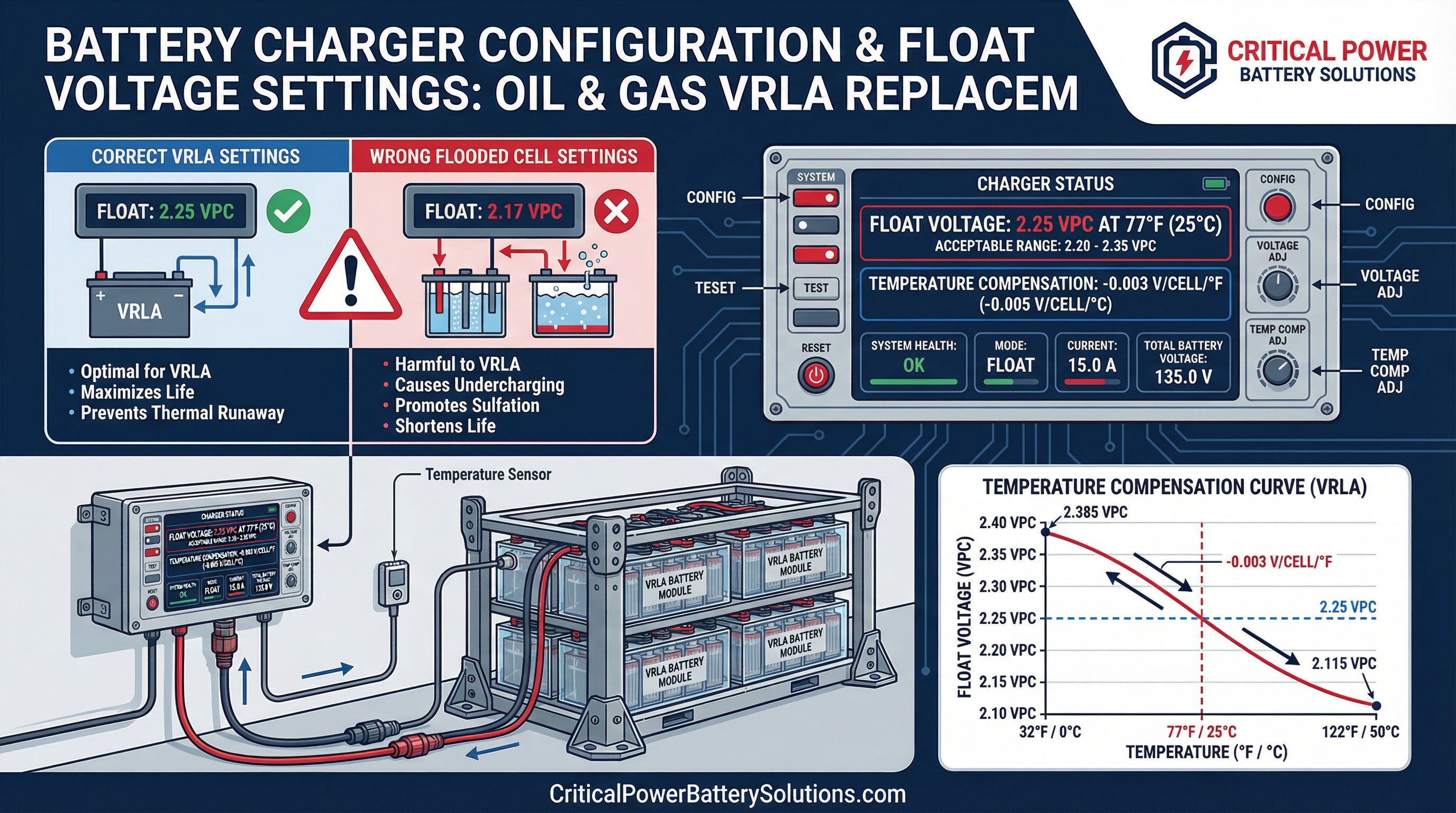
Before ordering Stryten batteries, you must validate three retrofit engineering parameters: charger float voltage configuration, physical fitment in existing racks, and hazardous location verification.
Absolyte Float Voltage Specification for oil rigs & Gas Refineries
The most common retrofit error is installing a new battery without adjusting charger float voltage for the new chemistry and site temperature. GNB Absolyte and Stryten Absolyte AGP have nearly identical float voltage windows, but drift over time and temperature have cumulative effects.
Recommended float voltage for Stryten Absolyte AGP:
| Site Average Temperature | Float Voltage (2V cell) | Float Voltage (12V string) |
| 32°F to 59°F (cold) | 2.27 V/cell | 13.62 V |
| 59°F to 86°F (moderate) | 2.25 V/cell | 13.50 V |
| 86°F to 104°F (warm) | 2.23 V/cell | 13.38 V |
| Above 104°F (hot wellsite) | 2.21 V/cell | 13.26 V |
Most wellsite chargers require manual adjustment. Critical Power Battery Solutions can review your charger manual and provide exact configuration steps for your specific model. A deviation of just 0.05V per cell can cut battery life by 50% in high-temperature environments, so verification is essential.
Absolyte Physical Fitment and Seismic Compliance
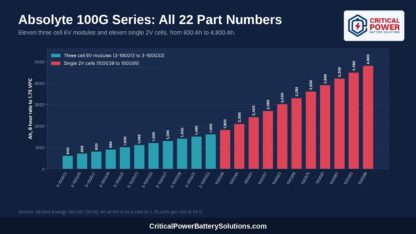
Stryten Absolyte AGP is offered in 2V and 6V modules. Most oil and gas installations use 6V or 12V string configurations with seismic racks that comply with UBC/IBC Zone 4 earthquake standards. The Absolyte AGP 6V module fits directly into GNB-legacy racks without modification.
Confirm the following before ordering:
- String voltage: Verify that your system requires 48V, 120V, or 240V DC backup. Absolute AGP can be configured in series for any standard voltage.
- Amp-hour capacity: Work from an IEEE 485 battery sizing study to determine required capacity. Do not assume nameplate capacity of the old system is still adequate—load profiles change, and proper sizing avoids undersizing risk.
- Rack dimensions and anchor points: GNB seismic racks have standard bolt patterns, but confirm with a site survey that Absolyte AGP modules align and that anti-tip bracing is compatible.
Absolyte Battery Hazardous Location Verification Checklist
| Verification Step | Status | Notes |
| Verify NEC Class 1 Div 2 designation at facility | ☐ | Review facility electrical classification documents or request from site electrical engineer. |
| Confirm Stryten UL 1971 certification | ☐ | Request latest UL certificate from supplier or Stryten website. |
| Inspect cabinet ventilation paths | ☐ | Ensure air inlets and outlets are clear; hydrogen venting remains adequate for VRLA. |
| Document charger isolation and grounding | ☐ | Electrical inspector may request proof of proper isolation from main utility feed. |
| Schedule pre-installation site survey | ☐ | Critical Power Battery Solutions can coordinate with your facility team. |
Step-by-Step Absolyte Replacement Protocol for oil rigs
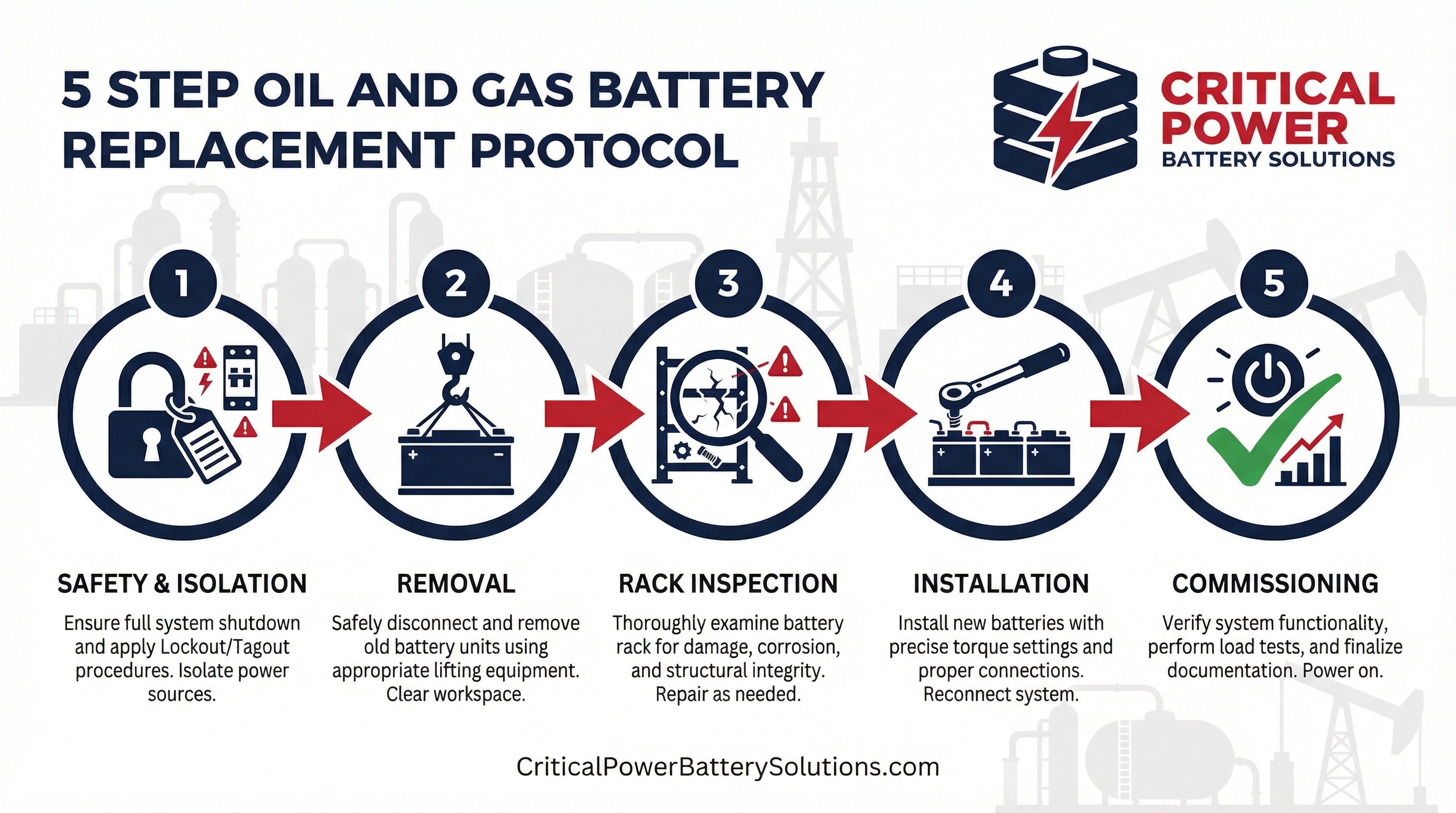
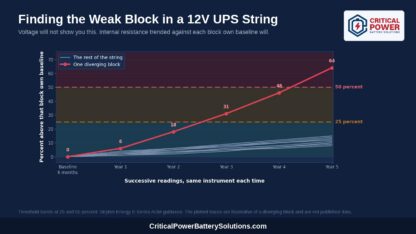
- Pre-replacement assessment. Verify existing system voltage, capacity, and condition with a load test or internal resistance measurement. Document baseline performance and review the GNB to Stryten cross-reference guide to confirm product matching. Request the latest Stryten installation manual and charger configuration guide specific to your model.
- Charger preparation. Power down the charger and isolate the battery string using the DC disconnect switch. Measure the open-circuit voltage of the existing battery to confirm it is de-energized before proceeding. Review charger float and equalize voltage settings against the Stryten VRLA battery sizing guide and adjust for site temperature as shown in the retrofit engineering table above.
- Physical removal and replacement. With proper PPE (gloves, eye protection, and insulated tools), disconnect the old battery string following the manufacturer wiring diagram. Label the positive and negative terminals clearly before disconnection. Remove the old batteries from the rack and prepare them for EPA/DOT compliant disposal (covered below). Position new Stryten batteries in the rack, confirming proper orientation and secure seismic anchorage.
- Series and parallel connections. Make all connections using specified torque values (typically 30-50 inch-pounds for terminal posts, per manufacturer specs). Verify polarity at each connection point using an insulated multimeter. For strings longer than six modules, consider using a wiring diagram projected on the wall or printed for technician reference to prevent reversed connections or open circuits. Record the voltage across each module after connection but before energization.
- Initial charge and commissioning verification. Enable the charger and observe the initial charge current and voltage rise. The Absolyte AGP will accept a full equalize charge immediately after installation. Measure float voltage under load after the initial charge cycle and compare to the site temperature-adjusted target from the retrofit engineering table. Document all readings (cell voltage, string voltage, ambient temperature, float current) in a commissioning record. This baseline data is essential for future maintenance trending and warranty support.
Absolyte Battery Disposal & Compliance (EPA & DOT)
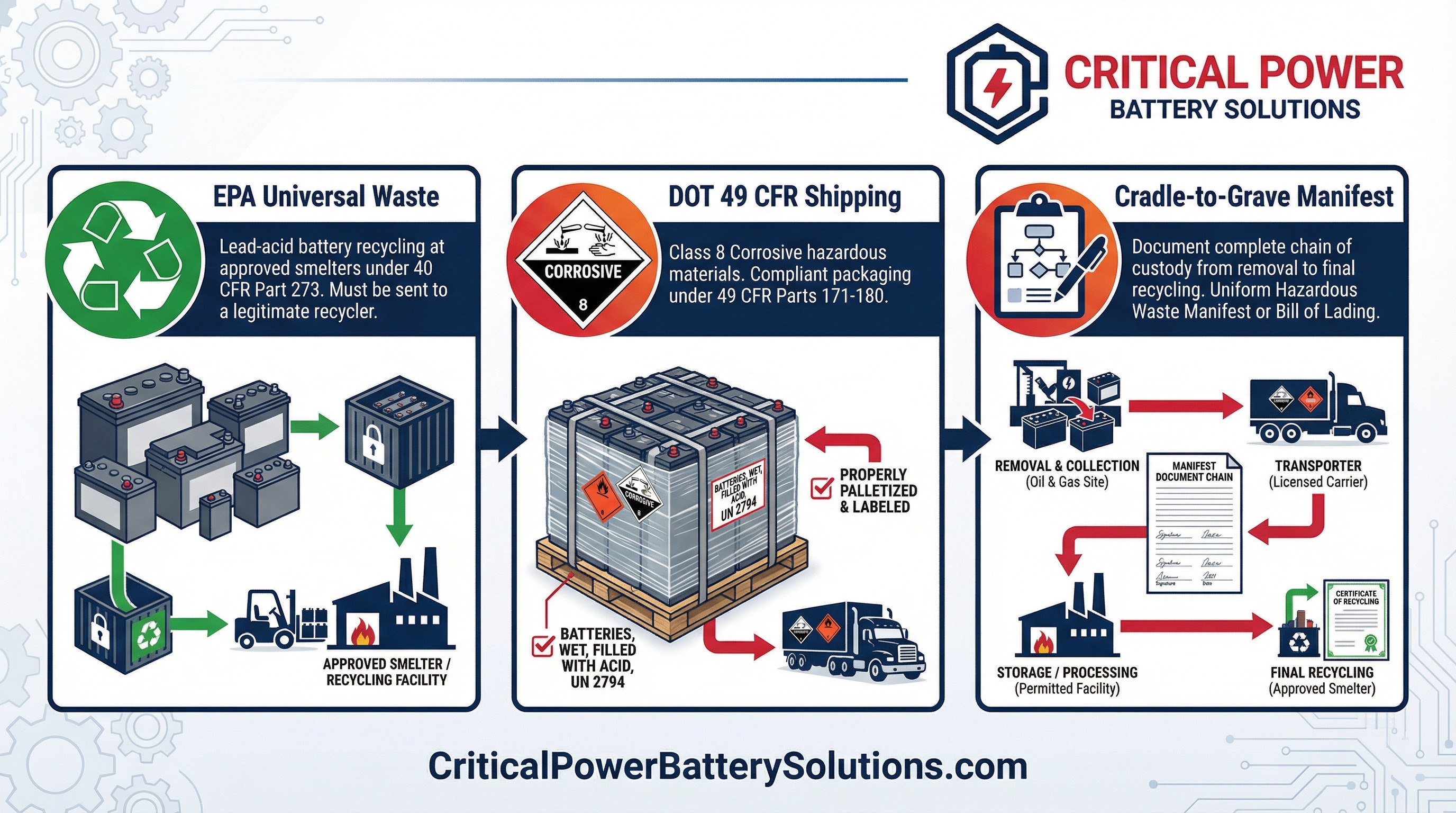
Old GNB batteries are classified as hazardous waste under EPA regulations. Lead-acid batteries contain lead, sulfuric acid, and plastic components that must be handled, transported, and recycled according to strict federal and state standards.
EPA Hazardous Waste Requirements
- Generator responsibility: Your facility is the “hazardous waste generator” and must ensure proper handling and documentation from the moment batteries are removed until they reach a permitted recycler.
- Storage limits: Batteries can be stored on-site for up to one year in a designated area, but the area must be prepared to contain acid spills (secondary containment tray, absorbent materials, spill kit).
- Documentation: Complete a hazardous waste manifest (EPA Form 8700-22) for each shipment to a recycling facility. This form tracks the battery waste from generator to transporter to recycler and must be kept on file for at least three years.
DOT Transportation Requirements
- Shipper certification: Batteries must be packed and labeled by a DOT-certified shipper. Leaking, damaged, or improperly connected batteries cannot be transported.
- Labeling and placarding: All shipments require Class 8 (corrosive) labels on the outside of the container and DOT placards on transport vehicles.
- Transporter licensing: Only licensed hazardous materials transporters can move batteries off-site. Do not allow a general waste contractor to handle battery disposal.
Critical Power Battery Solutions Disposal Service
Critical Power Battery Solutions coordinates EPA/DOT compliant battery disposal and decommissioning as part of our replacement service. When you engage us for your Stryten retrofit project, we manage:
- On-site battery assessment and safe removal.
- EPA manifest preparation and hazardous waste documentation.
- Coordination with DOT-certified transporters and EPA-permitted recycling facilities.
- Final certification of battery destruction and lead recovery.
This end-to-end service eliminates compliance risk and ensures your facility meets auditable disposal requirements.
Frequently Asked Questions
Q1: Can I install Stryten Absolyte AGP batteries without modifying my existing charger?
Yes, in most cases. Stryten Absolyte AGP has the same float voltage window as GNB Absolyte, so the charger can remain in place. However, you should review and adjust the float voltage for your specific site temperature. Many oil rig and gas refinery facilities operate at elevated ambient temperatures that require a downward voltage adjustment to prevent overcharging and premature cell failure. We recommend a pre-installation charger audit by a qualified technician.
Q2: How long does a Stryten Absolyte AGP battery last in a wellsite application?
Typically 10-15 years in moderate temperature conditions, or 5-8 years in high-temperature wellsite environments (above 95°F average). Battery life depends critically on float voltage management, ambient temperature, and maintenance discipline. Facilities that implement quarterly visual inspections and annual internal resistance testing typically achieve the upper end of this range. Facilities that defer maintenance often see premature failure within 5-7 years due to thermal runaway or cell sulfation.
Q3: What is the difference between Absolyte AGP and other Stryten E-Series products for oil rigs and gas?
Absolyte AGP is the sealed (VRLA) version; other E-Series products include flooded cells (MCX, MCT) and different performance grades. For oil and gas hazardous locations, sealed VRLA batteries (Absolyte AGP) are preferred because they eliminate hydrogen gas generation and require zero watering—critical for remote wellsites with infrequent maintenance visits. Flooded batteries require monthly water top-offs and are not suitable for unmanned facilities. The Stryten Absolyte AGP installation guide details the sealed design benefits for SCADA-monitored sites.
Q4: How do I verify that my facility’s battery system meets IEEE 485 sizing standards?
Request an IEEE 485 load study from a qualified electrical engineer or consult the CPBS technical team. IEEE Std 485 requires a documented analysis of the backup load (in amperes), available charging current, battery capacity, and temperature effects. Many older systems are under-sized because the original study did not account for equipment upgrades or SCADA expansion. An updated sizing study ensures your Stryten battery selection will deliver the required runtime under all operating conditions. Check our VRLA battery sizing guide for sizing methodology details.
Q5: Are old GNB Absolyte batteries still being manufactured, or is Stryten the only option?
GNB Absolyte production was discontinued in 2010. Stryten Energy (formerly Enersys/Powerex division) acquired GNB Industrial Power in 2007 and transitioned all GNB product lines to Stryten E-Series equivalents. For oil and gas facilities, the GNB to Stryten cross-reference guide provides direct model matching so you can specify equivalent Stryten batteries with confidence. Stryten offers improved temperature tolerance, cycling capability, and remote monitoring features compared to legacy GNB designs.
Limitations, Alternatives & Professional Guidance
VRLA Thermal Sensitivity
Stryten Absolyte AGP, like all VRLA batteries, is sensitive to elevated temperature. Each 8°C (14°F) increase above 25°C (77°F) cuts battery life in half. For wellsite cabinets that regularly exceed 95°F in summer, passive cooling (increased cabinet ventilation) or active cooling (cabinet-mounted fans) may be necessary to extend battery life. Flooded battery alternatives (such as Stryten MCX or MCT) tolerate higher temperatures but require monthly water top-offs, which is impractical at remote, unmanned sites.
Nickel-Cadmium Alternative
Some legacy oil field and gas refinery installations originally used nickel-cadmium batteries, which tolerate temperature extremes and seismic vibration better than lead-acid. However, NiCad batteries are expensive, require specialized recycling, and are no longer widely manufactured. Stryten does not produce NiCad equivalents. For the vast majority of oil and gas applications, properly sized and maintained Stryten Absolyte AGP provides superior cost-to-life value compared to NiCad retrofit options.
When to Consult a Professional
You should engage Critical Power Battery Solutions and our parent company Advanced Technical Services Inc. (ATS) if your situation involves any of these factors:
- Seismic zone installations that must meet IEEE-693 or updated UBC codes.
- Systems larger than 500 amp-hours where voltage or current imbalances can cause premature failure.
- High-temperature environments (above 100°F average) requiring advanced cooling strategies.
- Mixed legacy equipment (chargers, monitoring, racks) requiring compatibility verification.
- Facilities subject to NERC (North American Electric Reliability Corporation) standards or other regulatory audits.
Our team brings 40+ years of industrial electronics expertise and Absolyte battery maintenance specialization. We can conduct a site survey, review your charger and rack configuration, and provide a detailed retrofit specification document that addresses your specific compliance and operational requirements.
Conclusion
Replacing aging GNB Absolyte batteries with Stryten is more than a parts swap, it is an opportunity to strengthen your oil and gas facility’s backup power resilience for the next 10-15 years. By understanding Class 1 Division 2 compliance requirements, properly sizing and configuring float voltage for wellsite temperatures, and implementing a disciplined maintenance program, you can confidently transition to Stryten Absolyte AGP without compromising operational uptime or regulatory standing.
Critical Power Battery Solutions is a specialized division of Advanced Technical Services Inc., with 40+ years of electronics expertise and deep experience in oil and gas critical power applications. Request Your Sizing Report to learn how we can support your next battery replacement project—from compliance verification through commissioning to EPA/DOT decommissioning of your legacy systems.
Next steps:
- Schedule a pre-installation site survey with our technical team to assess your current system and facility compliance status.
- Request an IEEE 485 battery sizing study if your system has not been updated in the past 5 years.
- Review the GNB to Stryten cross-reference guide to identify your specific battery models and equivalent Stryten products.
- Contact us to discuss charger configuration, float voltage adjustment, and replacing Exide batteries with Stryten for multi-brand legacy environments.
References
- National Fire Protection Association (NFPA). NFPA 70 National Electrical Code (NEC), Article 500 – Hazardous (Classified) Locations. https://www.nfpa.org/codes-and-standards/nfpa-70-standard-development/70
- Institute of Electrical and Electronics Engineers (IEEE). IEEE Std 485 – IEEE Recommended Practice for Sizing Lead-Acid Batteries for Stationary and Motive Auxiliary Power Applications. https://standards.ieee.org
- U.S. Environmental Protection Agency (EPA). Used Lithium-Ion Batteries. https://www.epa.gov/recycle/used-lithium-ion-batteries
- Stryten Energy Inc. Stryten E-Series Absolyte AGP Installation and Operation Manual, Model SE2001. https://www.stryten.com
Oil & Gas Battery Projects in India: Upstream & Offshore
Indian oil and gas, ONGC offshore platforms, Reliance Jamnagar, ADNOC joint ventures, runs on the same SCADA / UPS battery discipline as the Permian and Bakken.
Where CPBS engages on Indian O&G projects:
- Operators: ONGC offshore (Mumbai High), Reliance, ADNOC India joint ventures
- Geography: Mumbai offshore, Vadodara, Jamnagar, Visakhapatnam, Assam (Digboi / Duliajan)
- Scope: Stryten Absolyte AGP for SCADA UPS, ESD systems, ATEX-zoned battery rooms
- Engagement: EPC contractor specification, project sourcing, lifecycle consultation
Project-scale only, contact our oil & gas team to scope your battery system.
India FAQ
Q: Does CPBS supply Stryten Absolyte AGP for oil and gas projects in India?
A: Yes, for project-scale upstream, offshore, and refinery deployments. We support ONGC offshore programs (Mumbai High), Reliance, and ADNOC joint-venture projects, and operators in Vadodara, Jamnagar, Visakhapatnam, and Assam (Digboi / Duliajan) with Stryten Absolyte AGP specification for SCADA, UPS, and ESD applications.