Quick Answer: GNB Industrial Power batteries (IIP, GX, GP series) are discontinued. Stryten Energy’s Absolyte AGP is the authorized replacement, offering superior temperature resilience (-40°C to 50°C), seismic compatibility (IEEE 693), and float voltage control (2.23-2.27 VPC) required for oil rigs and gas SCADA backup systems. Cross-reference: GNB IIP → AGP 100G, GNB GX → AGP 6-90G, GNB GP → AGP. At Critical Power Battery Solutions, we provide retrofitting expertise and supply for seamless O&G transitions.
| Question | Answer |
|---|---|
| What is the drop-in replacement for GNB IIP batteries? | Stryten Absolyte AGP 100G (2V cells) or as series configurations. Verify charger float voltage compatibility (2.23-2.27 VPC). |
| Can I retrofit GNB batteries into existing seismic racks? | No. Seismic Zone 4 racks (IEEE 693) require rigid cell bars and flexible main connectors. GNB trays use different mechanical footprints. AGP requires rack re-engineering. |
| What temperature range do Absolyte AGP batteries support? | -40°C to 50°C, exceeding O&G SCADA requirements (-40°C to 45°C). Valve-regulated lead-acid (VRLA) technology ensures no freeze risk in northern latitudes. |
| How do I size AGP for solar hybrid backup systems? | Use IEEE 485 methodology: multiply daily kWh requirement by float reserve (typically 3-5 days), then select AGP cell count. Tom Kierna’s consulting process includes load analysis and Trout Software modeling. |
| What is the expected cycle life of Absolyte AGP in O&G? | 2,000-3,000 deep cycles at 80% depth-of-discharge (DoD). Partial state-of-charge (PSOC) solar applications extend life to 10+ years due to shallow cycling. |
| Should I be concerned about grey market Stryten batteries? | Yes. Counterfeit AGP cells and unauthorized refurbished units lack traceability and IEEE 485 compliance. Source directly from Critical Power Battery Solutions or verified Stryten distributors only. |
👤 Article by: Tom Kierna
Reviewed by: CPBS Engineering Team
Last updated: February 27, 2026
Credentials: Authorized Stryten battery Reseller, ISO 9001 Certified, IEEE Standards Member


For four decades, GNB Industrial Power dominated oil rigs and gas refinery backup power systems. Their IIP, GX, and GP series batteries powered SCADA remote terminals (RTUs), cathodic protection systems, and pipeline monitoring nodes across the continent. But in 2012, Stryten Energy acquired GNB’s manufacturing assets, and by 2020, those legacy models were discontinued.
Today, hundreds of remote O&G installations still rely on aging GNB batteries approaching end-of-life. The question isn’t if you’ll replace them—it’s how and when. And the answer requires more than a simple swap.
At Critical Power Battery Solutions, we’ve retrofitted dozens of oil field and gas refinery operations from Alaska to the Permian Basin. This guide provides the technical cross-reference, installation nuances, and compliance framework to move from GNB to Stryten Absolyte AGP safely and confidently. As Tom Kierna, our 40+ year battery systems specialist, says: “The right replacement isn’t just about matching voltage and capacity—it’s about understanding seismic zones, float voltage control, and supply chain integrity.”
Legacy GNB to Stryten Cross-Reference Map
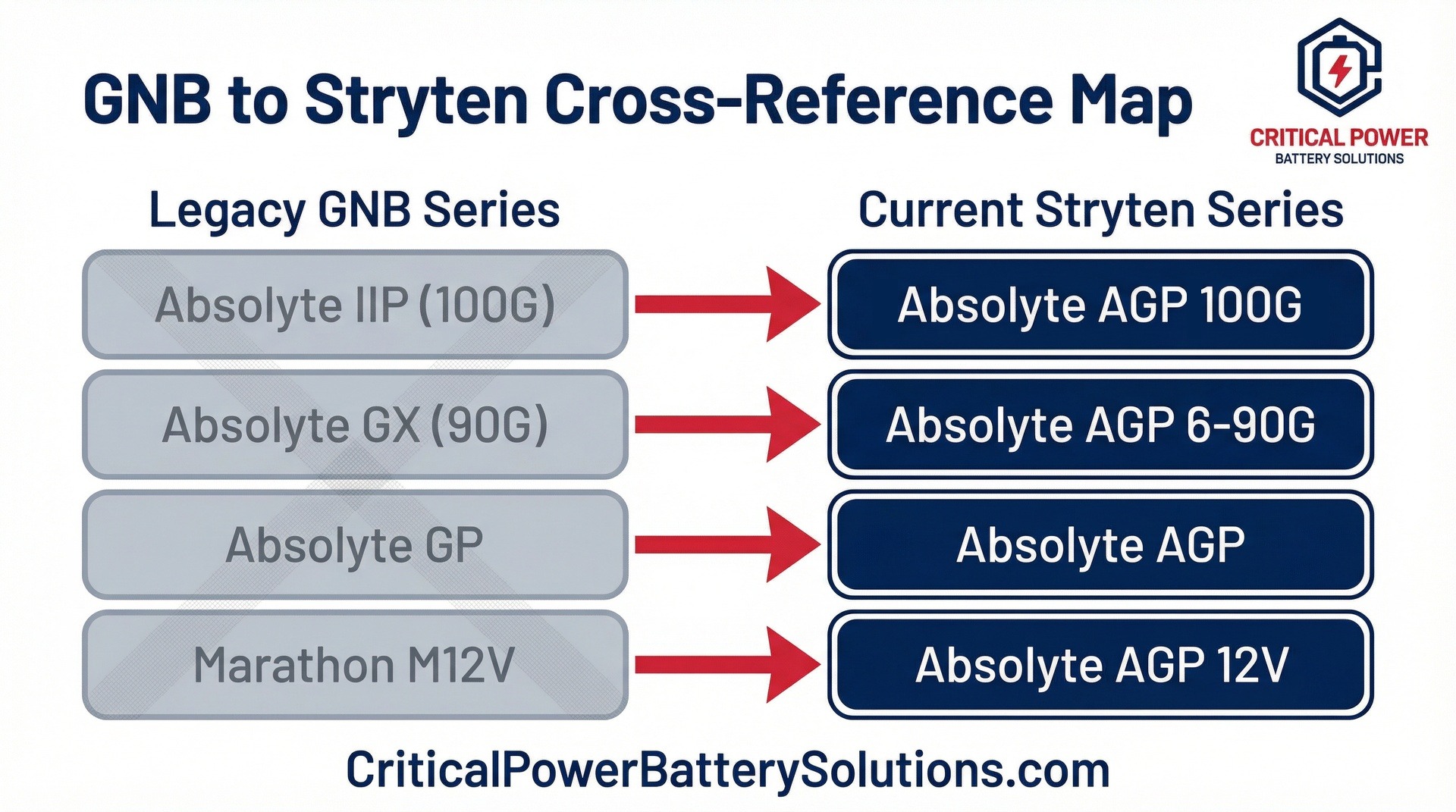
The transition from GNB to Stryten isn’t a 1:1 part number swap. GNB’s cell architecture and tray geometry differ from modern VRLA design. However, voltage and capacity parity is achievable with proper series/parallel configuration.
| Legacy GNB Series | Absolyte AGP Equivalent | Voltage | Capacity Range |
|---|---|---|---|
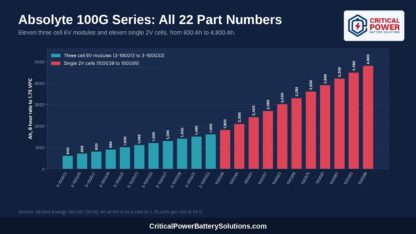
| GNB IIP (Industrial Installation Power) | Absolyte AGP 100G | 2V (per cell) | 100–6,000 Ah |
| GNB GX (General eXtended) | Absolyte AGP 6-90G | 12V (6 cells) | 100–900 Ah |
| GNB GP (General Purpose) | Absolyte AGP (2V or 6V custom) | 2V, 6V, or 12V | 100–1,200 Ah |
| Marathon M12V | Absolyte AGP 12V | 12V (6 cells) | 150–600 Ah |
Critical Note: These cross-references assume equivalent lead-acid chemistry (flooded or VRLA). If your installation uses flooded GNB cells, AGP (VRLA) requires charger recalibration. If you’re moving to lithium-ion (emerging in O&G), a different engineering approach applies. Tom Kierna’s consulting process includes load analysis, charger compatibility audits, and seismic verification before final specification. For Exide legacy systems, see our Exide to Stryten replacement guide.
Cross reference backed by authorization and engineering certification
Operations teams running a GNB to Stryten cross reference for SCADA and oil and gas backup systems need two things on file before specifying replacements: proof the supplier is authorized, and proof the replacement product is the same engineering as the original. CPBS has both.
- Stryten Energy authorized reseller verification. Confirms CPBS is authorized to specify, supply, and service the complete Stryten Essential Power line, covering Absolyte AGP, Flooded Classic, AGM, and battery chargers, for ATS and its subsidiaries.
- Stryten Energy GNB to Stryten engineering declaration. Certifies that the products buyers are cross referencing carry unchanged design, engineering, and manufacturing from the GNB product line.
Why Absolyte AGP for Oil Rigs & Gas Applications
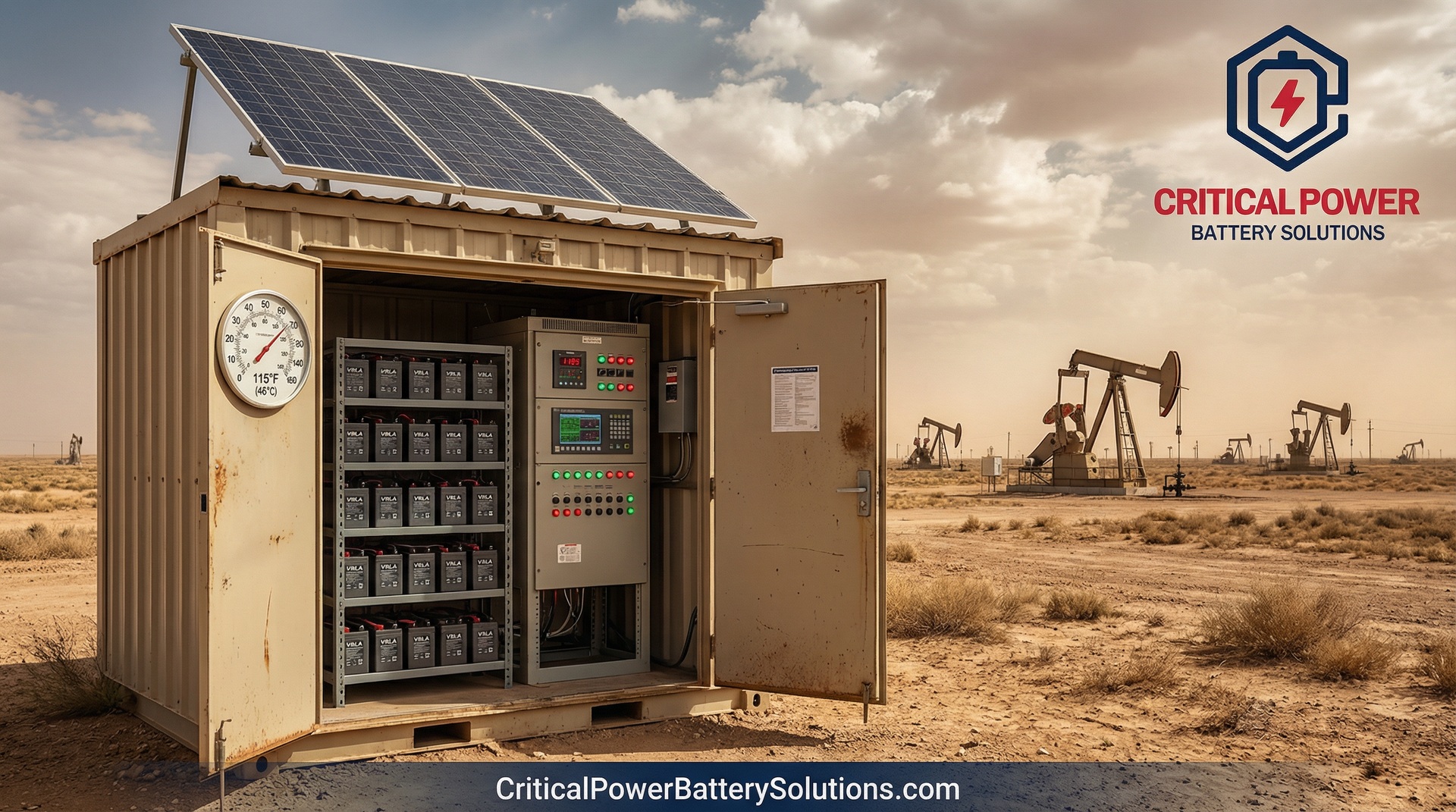
Oil field and gas refinery sites—particularly remote SCADA nodes, cathodic protection systems, and pipeline monitoring stations—operate in environments that demand more than generic lead-acid chemistry. Absolyte AGP is engineered specifically for these three critical challenges:
Temperature Resilience (-40°C to 50°C)
O&G installations span Arctic pipelines to desert gas fields. GNB flooded cells risked electrolyte freeze in northern climates and thermal runaway in high-temperature environments. Stryten Absolyte AGP uses valve-regulated lead-acid (VRLA) technology, which:
- Immobilizes electrolyte in absorbent glass mat (AGM), preventing freeze stratification.
- Incorporates pressure relief valves, maintaining oxygen recombination and preventing gas escape in extreme heat.
- Operates from -40°C to 50°C, exceeding API-recommended O&G specs (-40°C to 45°C).
- Maintains capacity retention above 80% across the full temperature envelope when sized for float service.
For field installations in Alaska’s North Slope or Middle Eastern desert operations, AGP eliminates the need for heated enclosures or temperature controllers—a significant cost and maintenance savings.
Vibration Resistance (Modular Steel Tray)
Compressors, pump jacks, and helicopter approach corridors create continuous vibration. GNB’s older tray designs were subject to terminal loosening and cell cracking under sustained shock. Absolyte AGP cells sit in modular steel trays with resilient corner supports, absorbing vibration while maintaining electrical integrity. The design has passed IEC 60721-3-5 (Class 5M3) vibration testing—equivalent to heavy industrial shock environments.
Cycling Capability (PSOC, Solar Hybrid)
Many modern O&G backup systems integrate solar arrays for cost reduction and environmental compliance. Partial state-of-charge (PSOC) cycling—where batteries cycle between 20% and 80% depth-of-discharge rather than sitting at float—places different demands on chemistry than traditional float service. Absolyte AGP is optimized for both:
- Float service: 10–15 year lifespan at constant 2.23–2.27 VPC (volts per cell).
- PSOC cycling: 2,000–3,000 deep cycles at 80% DoD, extending float life in hybrid systems to 12+ years due to shallow daily cycling.
- Grid-tied microgrids: New O&G facilities pair AGP with solar and AC inverters for peak demand reduction, and AGP handles the resulting variable charge/discharge profile.
How to Install Stryten Absolyte AGP provides detailed PSOC commissioning procedures.
Critical Retrofit & Installation Nuances
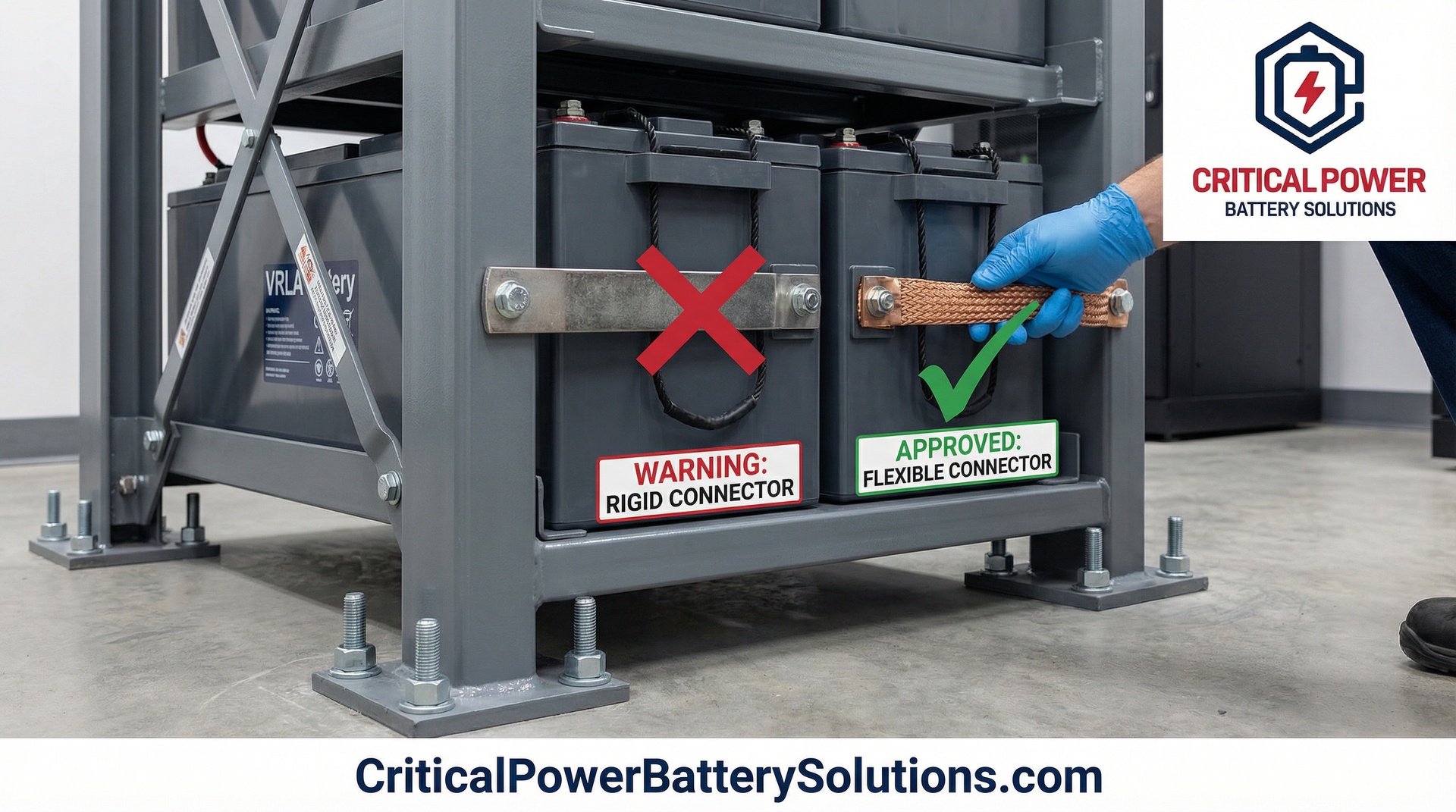
A GNB-to-AGP swap isn’t purely technical—it’s logistical and regulatory. Here are the installation realities Tom Kierna navigates on every O&G retrofit:
Seismic Zone 4 Rack Compatibility (IEEE 693)
California operations and Canadian west-coast installations fall under seismic design code IEEE 693. The standard requires:
- Rigid cell bars (not flexible straps) bonding each cell to a structural frame.
- Flexible main connectors (cable, not busbar) between the rack and DC switchboard, allowing thermal and seismic expansion without cell fracture.
- Anchor bolt footprint verification: GNB tray bolt patterns do not match AGP mechanical templates.
If your site is in a seismic zone, a simple cell swap will fail inspection. The entire rack assembly must be re-engineered with AGP-compatible cell bars and connections. Tom’s typical retrofit budget includes $5,000–$15,000 in mechanical engineering and rack fabrication. Skipping this step risks regulatory non-compliance and catastrophic system failure during seismic events.
Charger Configuration & Float Voltage (2.23–2.27 VPC)
GNB flooded batteries historically ran at 2.25–2.30 VPC. Modern Absolyte AGP VRLA requires tighter float control: 2.23–2.27 VPC. Voltage above this range accelerates water loss and degrades cycle life; below it, undercharging promotes sulphation.
Your existing charger may not support this narrow window. If your system uses older Power Conversion Equipment (PCE) or generic industrial rectifiers, recalibration or replacement is often necessary. This is a hidden cost many organizations overlook. Tom Kierna includes charger audits in every O&G retrofit proposal—ask for a bench test of your existing unit before commitment.
Grey Market Supply Chain Risk
Stryten Energy’s success has spawned counterfeiting. Unauthorized distributors sell:
- Refurbished cells (stripped from recycled systems, re-wrapped with fake labels).
- Commingled batches (mixing AGP with generic VRLA from other manufacturers).
- Undocumented manufacturing dates (cutting years of shelf life information).
These units lack traceability and IEEE 485 compliance documentation. For O&G critical infrastructure, this is unacceptable. Critical Power Battery Solutions sources Absolyte AGP directly from Stryten’s authorized distributor network. Every cell arrives with manufacturing date verification, compliance certifications, and a full 10-year warranty. If cost pressure is forcing you toward grey market options, talk to us—warranty savings often offset premium pricing.
Technical Specifications (2V, 6V, 12V)
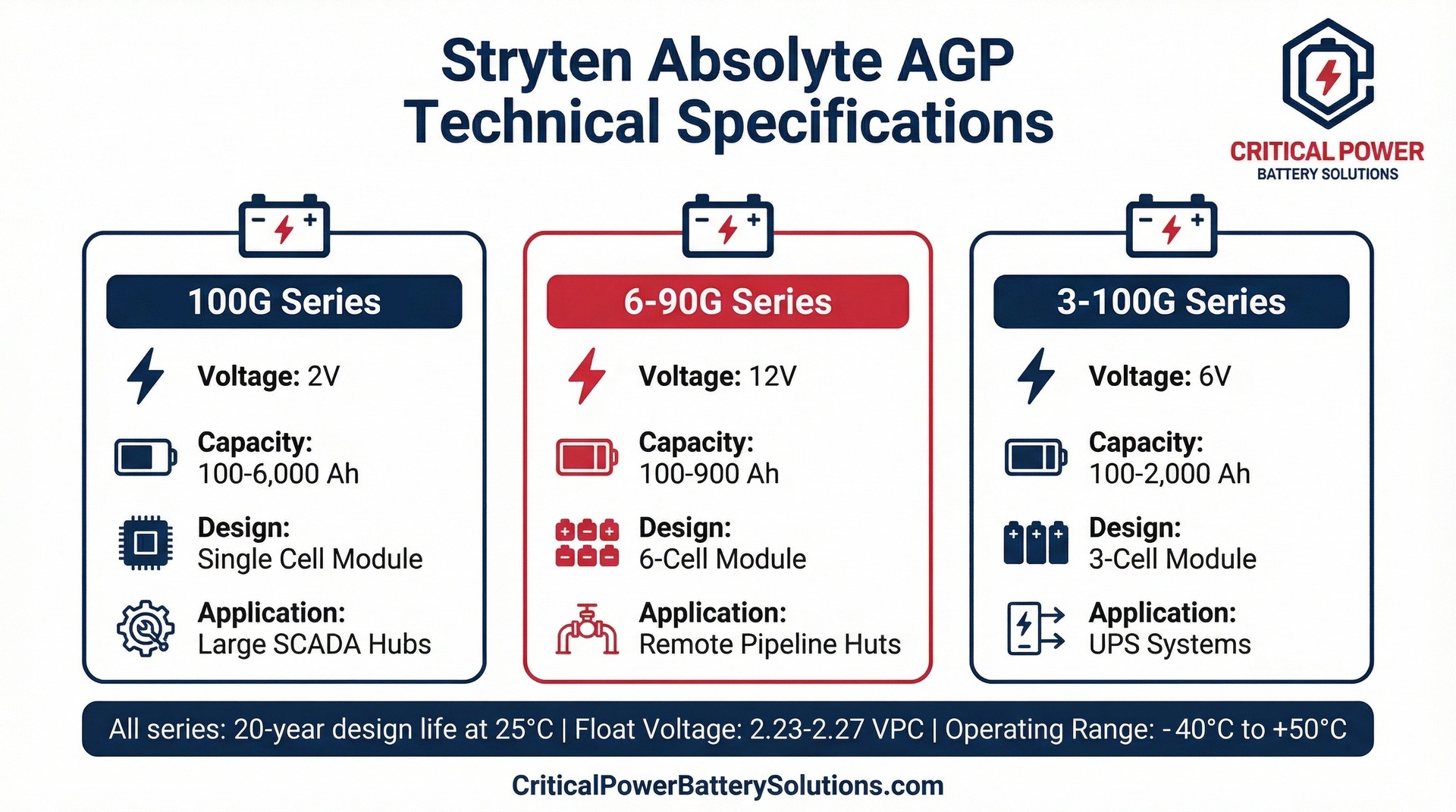
Proper cell selection depends on three factors: required voltage, load profile, and reserve time. Oversizing is common—and expensive. The following table provides Stryten’s rated specifications at the 20-hour discharge rate (industry standard for backup power):
| Model | Voltage | Capacity Range (Ah @ 20h) | Weight per Cell | Float Life |
|---|---|---|---|---|
| Absolyte AGP 100G | 2.0V | 100–6,000 Ah | 12–85 kg (depending on size) | 10–15 years |
| Absolyte AGP 6-90G | 12V (6 cells in series) | 100–900 Ah | 180–1,200 kg per 12V unit | 10–15 years |
| Absolyte AGP 3-100G | 6V (3 cells in series) | 100–2,000 Ah | 90–600 kg per 6V unit | 10–15 years |
IEEE 485 Sizing Methodology: Oil and gas SCADA systems use a standardized load profile method. The process involves:
- Quantifying peak inverter load (kW) and average standby load (W) from RTU datasheets.
- Calculating daily energy requirement (kWh) over the expected mission (typically 3–7 days autonomy).
- Applying a depth-of-discharge (DoD) de-rating factor (typically 60–80% for float applications).
- Selecting cell count to meet the calculated Ah requirement with margin.
Tom Kierna uses Trout Software (IEEE 485-certified modeling) for every O&G design. This software accounts for temperature de-rating, duty cycle variation, and charger efficiency. A manual calculation often undersizes by 15–25%, leading to premature cell failure in the field.
Frequently Asked Questions
Can I mix Absolyte AGP cells with my existing GNB batteries?
No. Mixing chemistries (flooded GNB + VRLA AGP) causes voltage regulation instability and accelerates failure in both sets. Replace the entire battery string as a single unit.
What is the warranty on Absolyte AGP batteries?
Stryten provides a 10-year manufacturer’s warranty on Absolyte AGP when sourced through authorized distributors like Critical Power Battery Solutions. Warranty covers defects in materials and workmanship, but excludes misuse, overcharging, and physical damage.
How often should I monitor AGP float voltage?
Monthly checks are recommended for float applications. Use a calibrated multimeter to verify 2.23–2.27 VPC. Annual charger load tests (discharging to 50% depth and recharging) are industry best practice. Tom Kierna’s MaxCare preventive maintenance plan includes quarterly voltage audits.
Are there any disposal or recycling requirements for old GNB batteries?
Yes. Lead-acid batteries are classified as hazardous waste under EPA and state environmental law. All GNB batteries must be sent to certified recycling facilities. Critical Power Battery Solutions arranges safe recycling through our Stryten partnership at no cost to customers (battery replacement contracts). Do not dispose of batteries as general waste.
What happens if my charger doesn’t support 2.23–2.27 VPC?
Contact Tom Kierna for a charger evaluation. If existing equipment can be recalibrated (trim pot adjustment), cost is minimal ($200–$500). If replacement is necessary, modern 48V or 240V rectifiers with integrated load-sharing cost $3,000–$8,000. This is a one-time investment protecting your backup power for 10+ years.
Can Absolyte AGP operate in hazardous (classified) locations?
Absolyte AGP VRLA cells are intrinsically safe (no hydrogen gas release under normal operation), making them suitable for Class I, Division 1 hazardous locations per NEC Article 500. Verify with your site’s electrical engineer that your specific configuration is compliant.
How do I calculate reserve time for my O&G SCADA system?
Reserve time (hours of runtime on battery backup) depends on the site’s load and cell capacity. Formula: Reserve Hours = (Battery Capacity in Ah × Usable DoD × 12V nominal) / (Peak Load in Watts). For example, a 600 Ah @ 12V AGP system with 80% usable DoD and a 500W peak load provides roughly 11.5 hours of continuous runtime. IEEE 485 software refines this with temperature and efficiency factors.
Is lithium-ion a better choice than AGP for oil and gas?
Not universally. Lithium-ion batteries (LiFePO₄) offer higher energy density and cycle life, but require sophisticated battery management systems (BMS) and cost 3–5× more than lead-acid. Oil and gas sites with >5 years mission life and limited budget favor AGP. Newer sites (2025+) with grid-tied solar microgrids may justify lithium. Tom Kierna’s consulting process evaluates both pathways.
Can Absolyte AGP handle extreme cold (Arctic operations)?
Yes. AGP’s VRLA design prevents electrolyte stratification and freeze risk down to -40°C. However, capacity de-rates by ~5% per 10°C below 20°C. For Arctic installations, size batteries 15–20% larger than the baseline IEEE 485 calculation to preserve usable capacity in extreme cold.
What is the typical failure mode for Absolyte AGP in O&G?
When properly sized and charged at 2.23–2.27 VPC, AGP typically reaches end-of-life through natural plate sulfation after 10–15 years of float service. Premature failure (3–5 years) usually stems from overcharging (>2.30 VPC), undercharging (<2.23 VPC), or operating outside the -40°C to 50°C envelope. Regular voltage monitoring prevents >95% of field failures.
Do I need a separate equalizing charge for Absolyte AGP?
No. VRLA technology eliminates the need for manual equalization. Stryten chargers include automatic equalization algorithms that balance cell voltages without operator intervention. This is a major maintenance advantage over legacy flooded GNB systems.
How does Absolyte AGP perform in partial state-of-charge (PSOC) cycling?
Excellently. PSOC cycling (shallow daily discharges in solar hybrid systems) extends AGP cycle life by reducing the total depth-of-discharge stress. A system cycling 50% DoD daily will last 15–20% longer than a system at constant float. Tom Kierna designs many O&G backup systems around PSOC to maximize equipment lifespan and reduce total cost of ownership.
Limitations, Alternatives & Professional Guidance
While Absolyte AGP is the industry standard for O&G SCADA backup, it is not universally optimal. Understanding its constraints ensures you make the right choice:
Energy Density & Physical Space: Lead-acid batteries are heavy. A 600 Ah @ 12V Absolyte AGP system weighs roughly 800 kg. If your O&G site has footprint or weight constraints, lithium-ion LiFePO₄ (150 kg equivalent capacity) is lighter but costs 2–3× more.
Cold Temperature Performance: While AGP operates at -40°C, capacity de-rates significantly. Arctic installations should apply aggressive temperature de-rating factors or consider heated enclosures. Flooded cells are sometimes preferred in extreme cold due to lower internal resistance, but require temperature monitoring and freeze prevention.
Cycle Life in High-DoD Applications: If your O&G site requires daily 80% depth-of-discharge (not typical for backup systems), cycle life drops to 2,000–3,000 cycles (~6–8 years). For sites with frequent deep cycling, lithium-ion’s 10,000+ cycle rating justifies the premium cost.
The Arrhenius Equation and Thermal Acceleration: Battery life degrades exponentially with temperature. For every 10°C rise above 25°C ambient, float life reduces by ~50%. A site in the Middle East at 50°C ambient will see 5–7 year lifespan instead of 10–15 years. Proper ventilation, shade structures, or air conditioning are cost-effective investments in long-term reliability.
Maintenance Cost Comparison: AGP requires quarterly voltage monitoring and annual load testing (~$500/year). Flooded cells require monthly water top-ups and equalization ($1,500/year). Lithium-ion requires BMS software monitoring ($200/year but demands faster response to faults). For unmanned remote O&G sites, AGP’s low-maintenance profile wins.
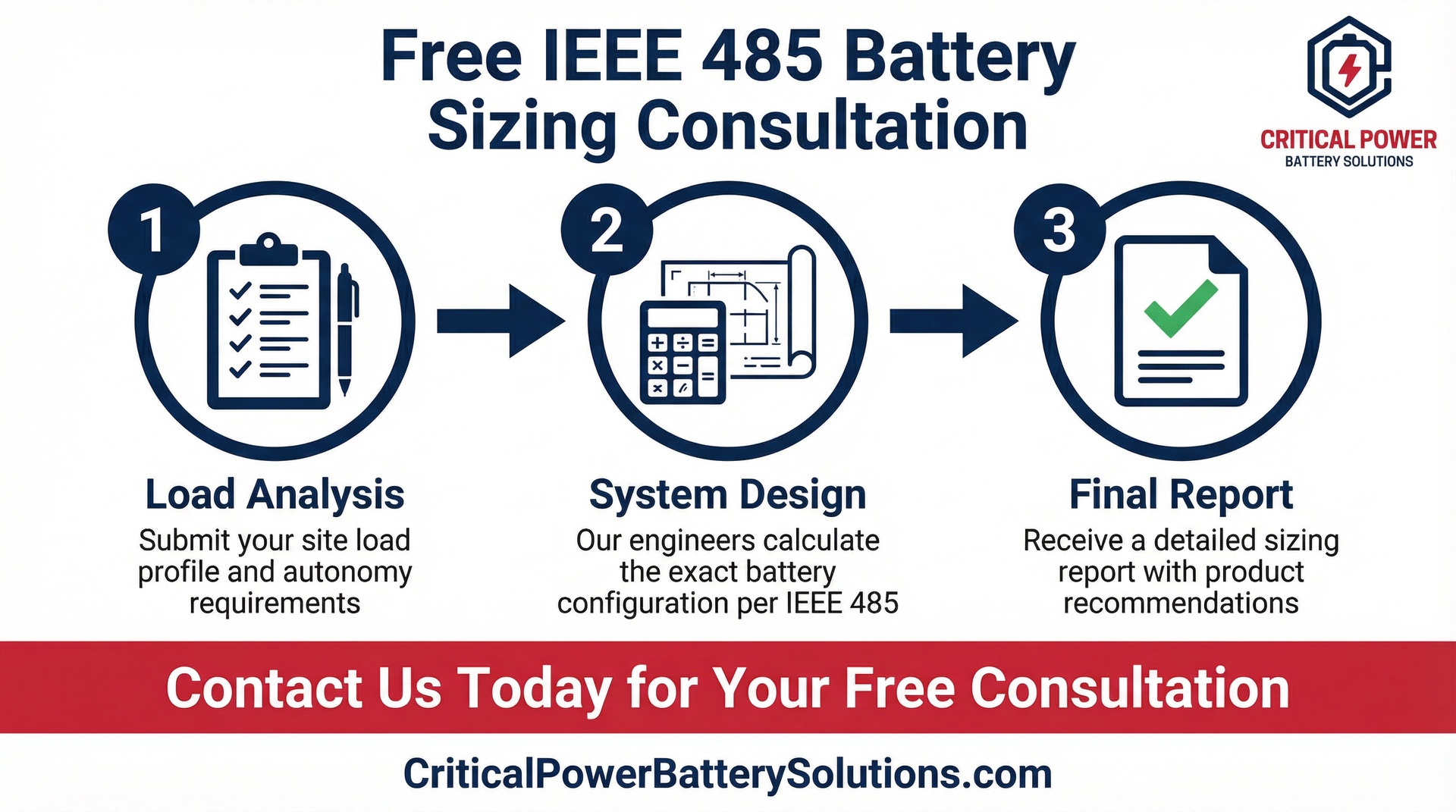
Tom Kierna recommends an IEEE 485 consulting session before final specification. He will evaluate your exact site conditions, duty cycle, environmental constraints, and budget to recommend AGP, flooded, or lithium-ion with confidence.
Conclusion
The retirement of GNB Industrial Power batteries marks a transition in O&G backup power. Stryten Absolyte AGP is the authorized successor, offering proven temperature resilience, seismic compatibility, and cycle capability that legacy systems cannot match.
But the transition requires planning. Seismic retrofits, charger audits, grey market avoidance, and IEEE 485 sizing are non-negotiable steps. Cutting corners on these fronts risks system failure when it matters most—during an unplanned outage or natural disaster.
Critical Power Battery Solutions specializes in GNB-to-AGP retrofits for oil rigs and gas operations. Tom Kierna and our team have executed dozens of transitions across remote SCADA systems, cathodic protection stations, and pipeline monitoring nodes. We provide:
- IEEE 485-certified load analysis and cell sizing
- Seismic rack re-engineering (IEEE 693) for California and Canadian west-coast installations
- Authorized Stryten battery sourcing with full traceability and 10-year warranty
- Charger evaluation and recalibration
- Installation supervision and load testing
- Preventive maintenance plans (EssentialCare, ProCare, MaxCare) ensuring long-term reliability
If your O&G operation still runs legacy GNB batteries, or if you’re planning a new SCADA retrofit, contact us today to discuss your requirements. Tom Kierna is available for site assessments, equipment audits, and retrofit consulting.
References
- IEEE 485: IEEE Recommended Practice for Sizing Lead-Acid Batteries for Stationary and Motive Auxiliary Power Applications. Published by the Institute of Electrical and Electronics Engineers.
- IEEE 693: IEEE Recommended Practice for Seismic Design of Substations. Governs battery rack design in seismic zones.
- Stryten Energy Absolyte AGP Technical Documentation & Installation Manual. Available through authorized distributors.
- EIA (Electronic Industries Alliance) Battery Testing Standards: Battery test methods for cycle life, temperature performance, and load testing.
- Trout Software IEEE 485 Battery Modeling Tool: Industry-standard battery sizing and life prediction software. https://www.troutsoftware.com/
GNB-to-Stryten Cross-Reference for Indian Refineries
Indian refineries with installed GNB Absolyte fleets need clean cross-reference paths as GNB phases out and Stryten Absolyte AGP becomes the successor.
Where CPBS engages on Indian refinery cross-reference work:
- Operators: IOCL, BPCL, HPCL, Reliance refineries, Nayara Energy
- Geography: Jamnagar, Vadi, Mathura, Panipat, Visakhapatnam
- Scope: GNB-to-Stryten Absolyte AGP cross-reference, drop-in replacement specification
- Engagement: Engineering review of installed base, phased replacement planning
Project-scale only, request a GNB cross-reference review for your refinery.
India FAQ
Q: Can CPBS cross-reference GNB batteries to Stryten Absolyte AGP for Indian refineries?
A: Yes, for project-scale refinery and petrochemical deployments. We perform GNB-to-Stryten Absolyte AGP cross-reference and drop-in replacement specification for IOCL, BPCL, HPCL, Reliance, and Nayara Energy facilities in Jamnagar, Vadi, Mathura, Panipat, and Visakhapatnam.
About the Author: Tom Kierna is Critical Power Battery Solutions’ Battery Systems Specialist with 40+ years of experience in industrial backup