ℹ️ Transparency: This article analyzes the Absolyte GP battery based on manufacturer specifications and industry standards (IEEE, UBC). As an authorized reseller for Stryten Energy, we supply these systems, but our TCO analysis is based on objective engineering data to help you make informed infrastructure decisions.
Absolyte GP Specifications & Design Life
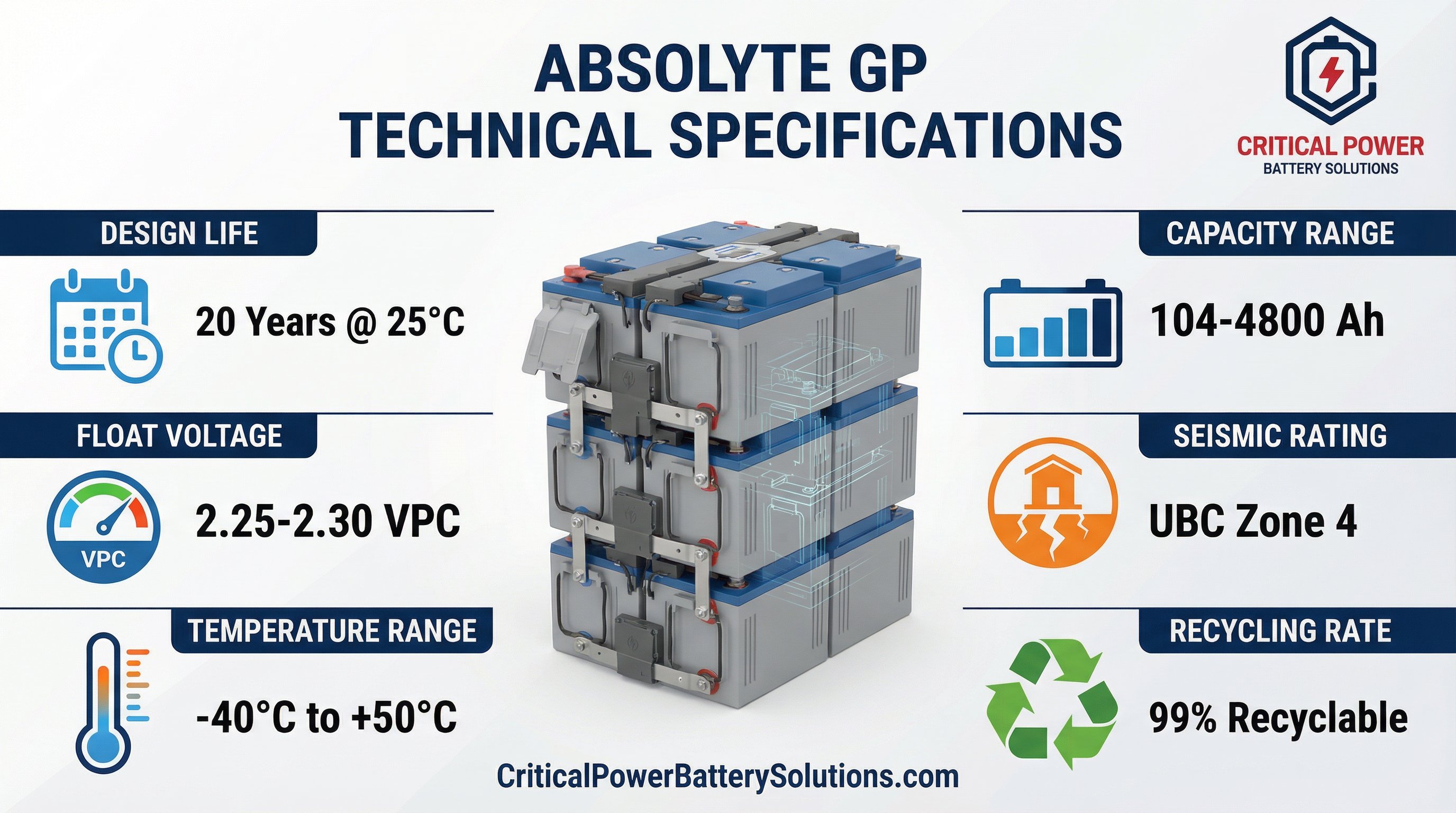
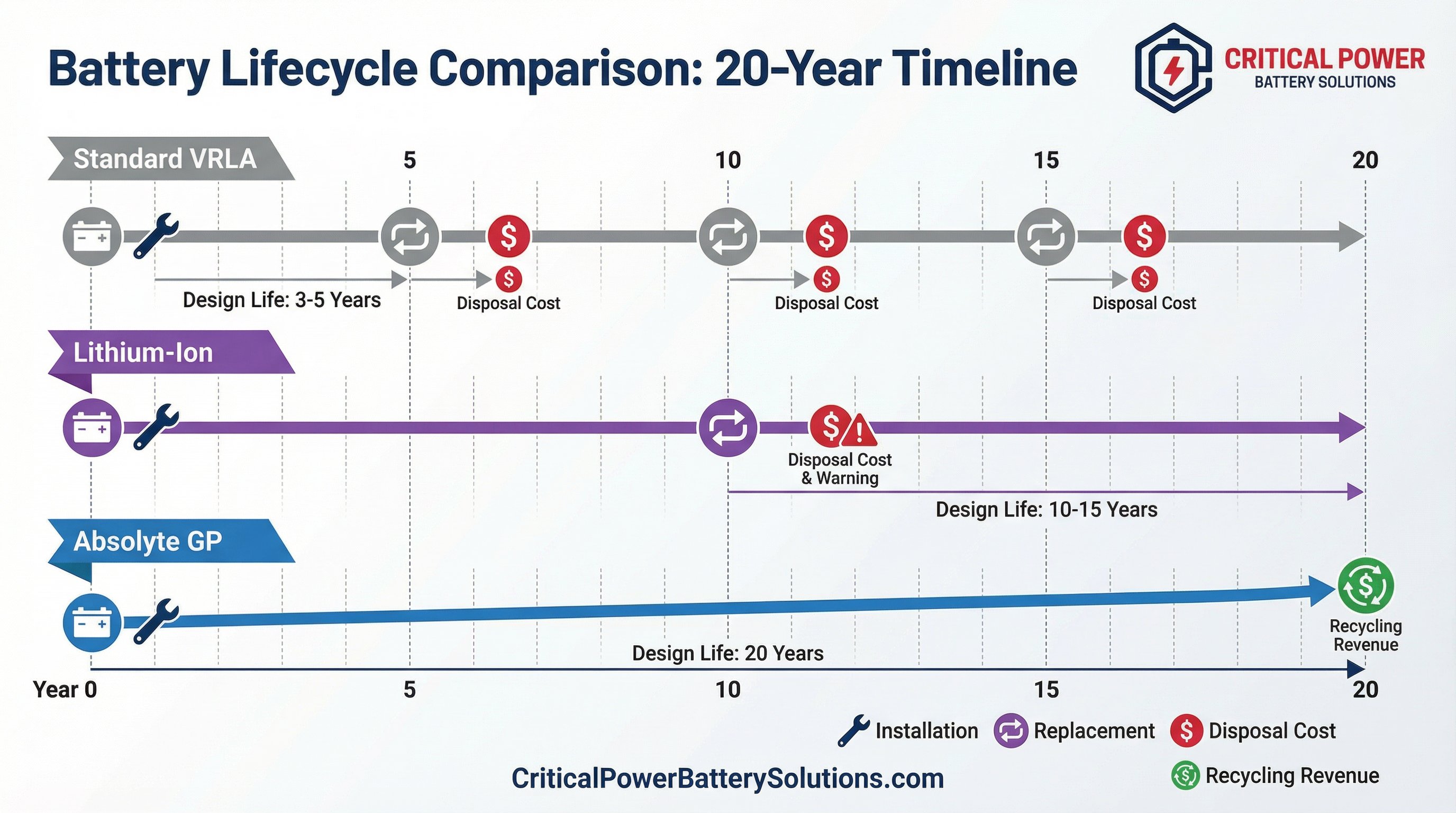
To understand the financial value of this system, one must first understand the engineering capabilities. According to manufacturer specifications, the Absolyte GP battery is rated for a 20-year design life at 25°C (77°F) [1]. This lifespan significantly outlasts standard VRLA batteries, which typically require replacement every 3 to 5 years. The Absolyte utilizes Absorbent Glass Mat (AGM) technology combined with a Valve-Regulated Lead-Acid (VRLA) design, which results in a system that requires zero water maintenance and produces negligible gassing under normal operating conditions.
Technical Deep Dive
The longevity of the Absolyte GP is driven by specific electrochemical parameters.
Float Voltage:
To achieve the 20-year design life, the system requires a strict battery float voltage of 2.25–2.30 VPC (Volts Per Cell). For a standard 12V nominal block, this translates to a float charge of 13.50–13.80V. Adhering to this voltage range is critical; deviations can accelerate grid corrosion or sulfation, shortening the battery’s effective life.
Capacity Range:
The system is highly scalable, with capacities ranging from 104 Ah to 4800 Ah. This flexibility allows engineers to size the battery string precisely to the load, avoiding unnecessary capital expenditure on oversized systems.
Temperature Tolerance:
Unlike Lithium-ion chemistries, which often require strict climate control to maintain safety and warranty compliance, the Absolyte GP operates safely from -40°C to +50°C. This wide thermal window is a primary driver of operational savings.
Table 1: Absolyte GP Technical Snapshot
| Specification |
Value |
Impact on Data Center |
Design Life
|
20 Years @ 25°C |
Reduced replacement frequency (1 install vs 3-4) |
Float Voltage
|
2.25 – 2.30 VPC |
Standard charging compatibility |
Temp Range
|
-40°C to +50°C |
Reduced HVAC dependency |
Seismic Rating
|
UBC Zone 4 |
Safe for West Coast/Fault line zones |
For a complete list of Absolyte battery specs
engineers should consult the official Stryten Energy data sheets to ensure compatibility with existing rectifiers and chargers.
The Financial Case: TCO Analysis
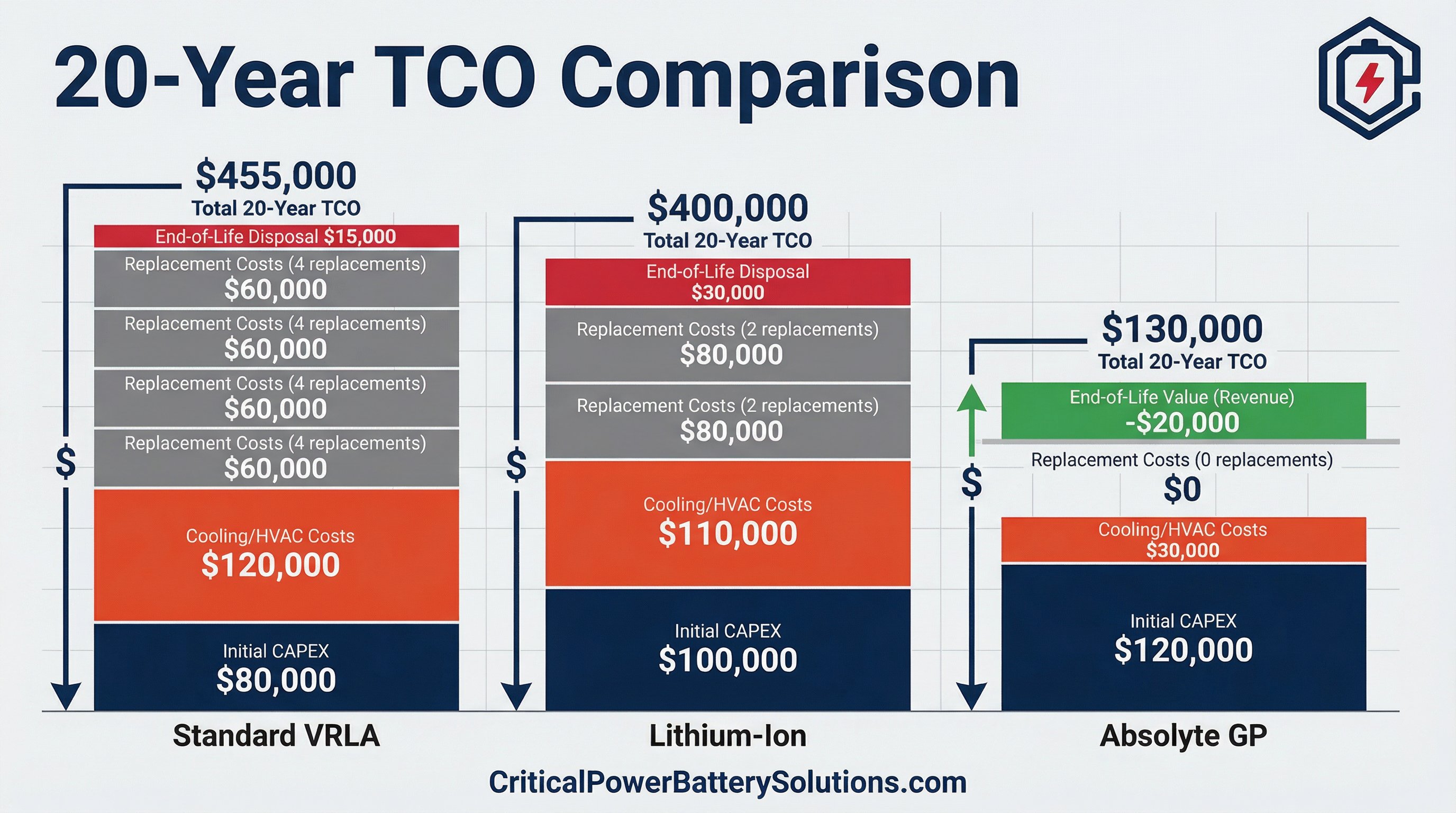
When evaluating infrastructure, the initial Capital Expenditure (CAPEX) is only the tip of the iceberg. A comprehensive battery TCO analysis reveals that Operational Expenditure (OPEX)—specifically HVAC energy consumption and replacement labor—often constitutes the bulk of a system’s lifetime cost. While the Absolyte GP typically commands a higher upfront price than standard VRLA blocks, the long-term math tells a different story.
The CAPEX vs. OPEX Reality
Standard VRLA batteries are inexpensive to buy but expensive to own. A facility manager might replace a standard string three to four times over a 20-year period. Each replacement event incurs not just the cost of the new batteries, but also shipping, installation labor, disposal fees for the old units, and the operational risk associated with downtime during the switch. The Absolyte GP is designed to be a “one-and-done” installation for the lifespan of the facility’s primary equipment.
Case Study: The “Texas Cooling” Advantage
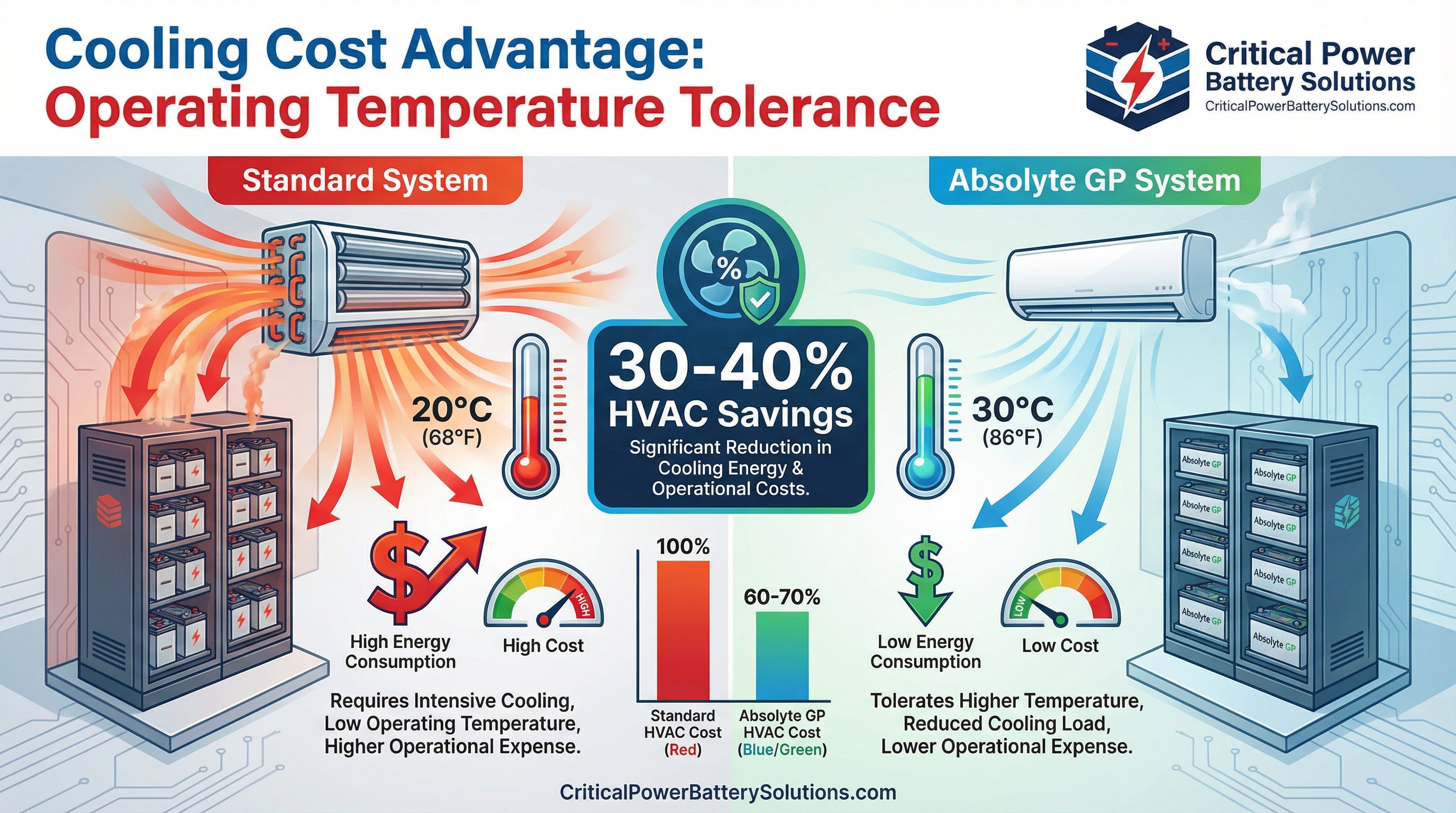
Consider a hypothetical data center located in Dallas, Texas, where ambient temperatures can soar. We compare two cooling scenarios:
System A (Standard VRLA/Lithium): Most standard battery warranties and safety profiles require the environment to be maintained at a strict 20°C (68°F). Deviating from this can void warranties or, in the case of Lithium, increase the risk of thermal events. This requires aggressive, 24/7 air conditioning.
System B (Absolyte GP): This system can safely operate at 30°C (86°F) continuously without voiding the warranty or suffering catastrophic degradation (though some life reduction occurs at higher temps, it is far less severe than in standard VRLA).
The Math: Industry guidelines suggest that raising a data center thermostat by 1°C can reduce cooling energy costs by approximately 3-4%. Raising the setpoint by 10°C (18°F)—from 68°F to 86°F—can theoretically reduce cooling energy consumption by 30-40%.
In a large facility, this reduction in HVAC load can amount to tens of thousands of dollars annually. Over a 20-year horizon, these energy savings often exceed the initial purchase price of the battery string itself.
Maintenance Savings
Beyond energy, the maintenance profile contributes to ROI. The VRLA AGM design means there are no specific gravity checks and no water additions required. The system offers “install and forget” reliability, requiring only annual visual inspections and voltage checks to ensure the charger is operating correctly.
Absolyte vs. Lithium & Standard VRLA
A common question in modern procurement is: “Is the Absolyte battery lithium?” The answer is no, it is an advanced Lead-Acid (AGM) system. However, in the context of static energy storage, this chemistry offers a distinct financial advantage regarding end-of-life value.
The Recycling Revenue Gap
The disposal phase of a battery’s life cycle is often omitted from ROI calculations, yet it represents a significant financial swing.
Lithium Reality: Currently, Lithium-ion recycling rates are estimated to be low. Because the recovery process is complex and expensive, facility managers typically pay a disposal fee to remove these batteries at the end of their service life. This is a “negative cost” that hurts the final ROI.
Absolyte Reality: Lead-acid batteries have a recycling rate of approximately 99%, according to the EPA [2]. Lead is a commodity with high market value.
The Check is in the Mail: At the end of the 20-year project, a certified recycler will often pay the owner for the scrap lead contained in an Absolyte GP battery system. This creates a revenue stream at the project’s conclusion rather than a disposal expense.
Table 2: 20-Year Lifecycle Comparison
| Feature |
Standard VRLA |
Lithium-Ion |
Absolyte GP |
Lifespan
|
3-5 Years |
10-15 Years |
20 Years |
Thermal Runaway
|
Low Risk |
Moderate Risk |
Negligible Risk |
End-of-Life
|
Cost to recycle/neutral |
High cost to dispose |
Revenue (Scrap Value)
|
Cooling Needs
|
High (Strict 20°C) |
High (Strict BMS) |
Low (Tolerates 30°C+) |
When factoring in Absolyte battery recycling
values, the Total Cost of Ownership gap between Absolyte and Lithium widens further in favor of the lead-acid solution for stationary applications.
Installation & Seismic Compliance
Physical infrastructure constraints are a major concern for
mission-critical data center applications. The Absolyte GP addresses space and safety through its industrial design.
Modular Stacking
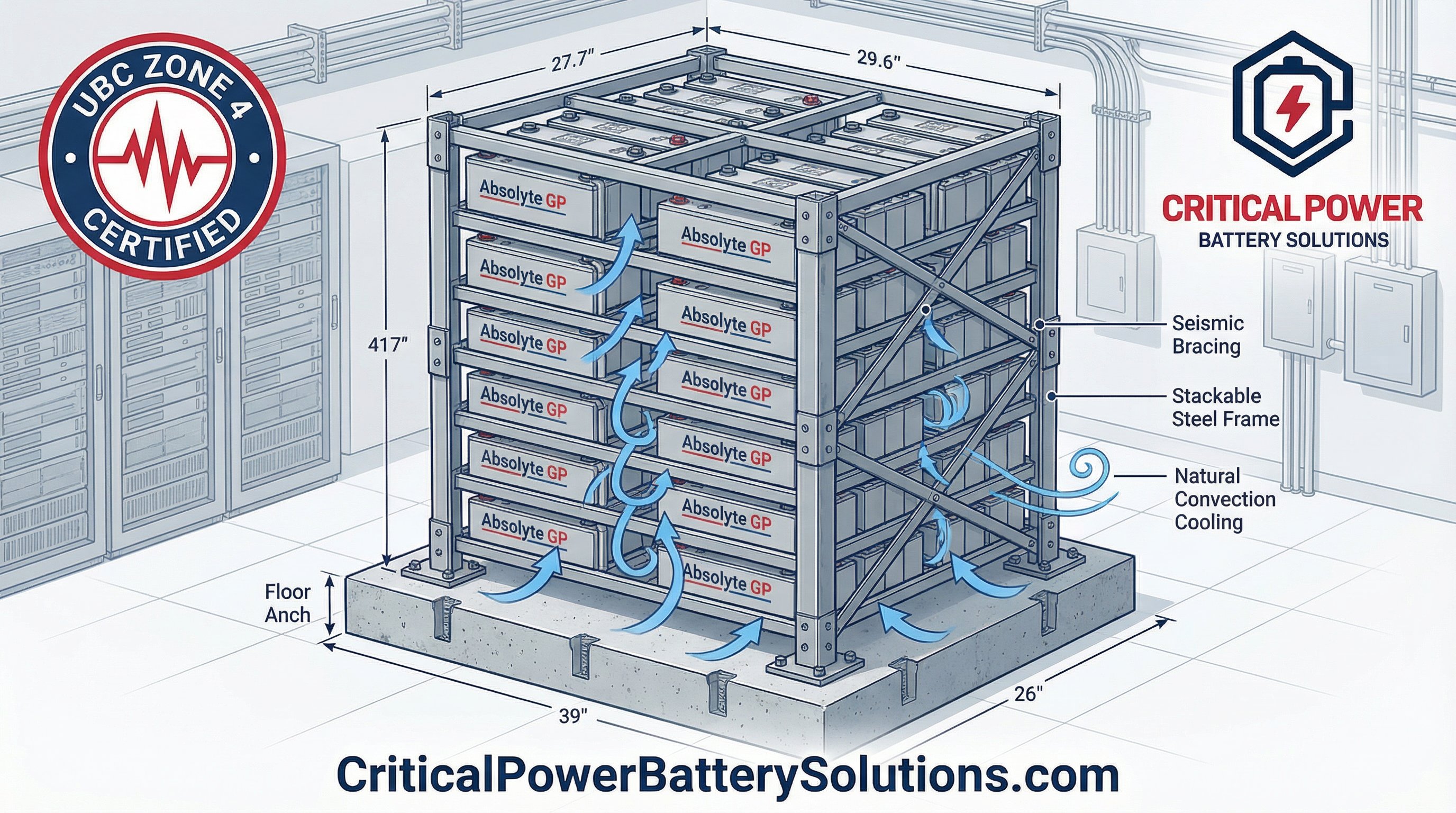
The Absolyte system features a unique stackable steel module design. This allows the battery cells to be stacked horizontally, up to eight or ten tiers high. This vertical density significantly reduces the footprint compared to traditional racks that require aisle space for maintenance access. The modular design also facilitates natural convection cooling, allowing air to flow between the cells to dissipate heat effectively without forced air systems.
Seismic Zone 4 Compliance
For facilities located in high-risk geographical areas, such as the West Coast of the United States, seismic compliance is non-negotiable.
What is Zone 4?
It refers to the highest seismic risk classification in the Uniform Building Code (UBC), covering areas near major fault lines.
Absolyte Performance: The modular steel frame of the Absolyte GP acts as its own seismic rack. The system is certified to meet
UBC Zone 4
requirements [4]. This ensures that during a seismic event, the battery string remains structurally intact and operational, providing critical power when the grid is most likely to fail.
Ventilation Requirements
Does the Absolyte GP require a separate battery room? Generally, no. As a VRLA battery, it operates on a recombination principle where 99% of the gases generated during charging are recombined within the cell. Under normal operating conditions, it does not emit hazardous levels of hydrogen. This allows the system to be installed near sensitive electronic equipment [3], subject to local fire codes and IEEE standards, potentially saving the cost of constructing a dedicated, ventilated battery vault.
Frequently Asked Questions
What is the life expectancy of an Absolyte battery?
The Absolyte GP battery has a design life of 20 years at 25°C (77°F).
While real-world service life varies based on operating temperature, discharge frequency, and maintenance, it is engineered to significantly outlast standard VRLA batteries, which typically require replacement every 3 to 5 years.
How do I size a battery backup system for a data center?
Sizing should follow IEEE 485 standards.
This rigorous process involves calculating the specific load profile (Amps or Watts), required runtime, temperature correction factors, and an aging margin to ensure the battery delivers full power at the end of its life. We recommend requesting a professional IEEE 485 battery sizing report to ensure compliance.
How to recycle Absolyte GP batteries?
Absolyte batteries are 99% recyclable.
Unlike Lithium-ion batteries which often incur disposal fees, Absolyte units can be sent to authorized lead smelters where the lead, plastic, and acid are recovered for reuse. In many market conditions, this results in a credit (payment) to the facility owner.
What are the dimensions of Absolyte GP stackable modules?
Dimensions vary by model capacity (104 Ah to 4800 Ah).
The modular design allows for vertical stacking up to 10 tiers high, which minimizes the horizontal floor footprint. Facility managers should consult the specific Stryten specification sheet for exact footprint and floor loading data.
What is the warranty on Stryten Absolyte batteries?
Warranties typically range from 3 to 20 years pro-rated, depending on the specific application and adherence to maintenance protocols. As an Authorized Reseller, Critical Power Battery Solutions manages warranty claims directly with Stryten Energy for our US clients.
Limitations & Engineering Considerations
While the Absolyte GP is a robust solution, transparency regarding its limitations is essential for proper engineering.
Weight Considerations
Lead-acid chemistry is dense. While the stackable design saves floor space, it concentrates weight. A fully stacked system can impose significant point loads on the floor. Structural engineers must verify that the facility’s floor loading capacity can support the system’s weight before installation.
Charging Requirements
VRLA AGM batteries require specific charging profiles. Using a charger designed for flooded cells or Lithium-ion can damage the Absolyte GP. Operators must verify that their rectifiers can be set to the required float voltage of 2.25–2.30 VPC. Improper charging is a leading cause of premature failure.
Professional Sizing
“One size does not fit all” in critical power. Relying on rough estimates for battery sizing can lead to system failure during an outage. We strongly advise using IEEE 485 standards to calculate the necessary capacity, ensuring the battery can support the load not just on day one, but at the end of its service life.
Conclusion
The Absolyte GP battery represents more than just a backup power source; it is a 20-year financial asset for data center operations. By tolerating higher operating temperatures, it allows facilities to reduce cooling costs significantly. Furthermore, its high recyclability offers a potential revenue stream at the end of its life, contrasting sharply with the disposal costs associated with other chemistries.
When the Total Cost of Ownership is analyzed—factoring in HVAC savings, reduced replacement labor, and end-of-life value, the Absolyte GP often emerges as the most cost-effective solution for static UPS applications. Don’t guess on your critical power sizing. Ensure 100% uptime with a verified system.
Contact Critical Power Battery Solutions today for your free IEEE 485 Battery Sizing Report and Absolyte GP quote.
References
- Stryten Energy Absolyte GP Specifications
- EPA Battery Recycling Guidelines
- IEEE 485 Standard
- UBC Zone 4 Seismic Standards
- U.S. Energy Information Administration (EIA)