Lead Acid vs Lithium Battery Comparison for Critical Power: What Really Matters for UPS, Data Centers, and Telecom
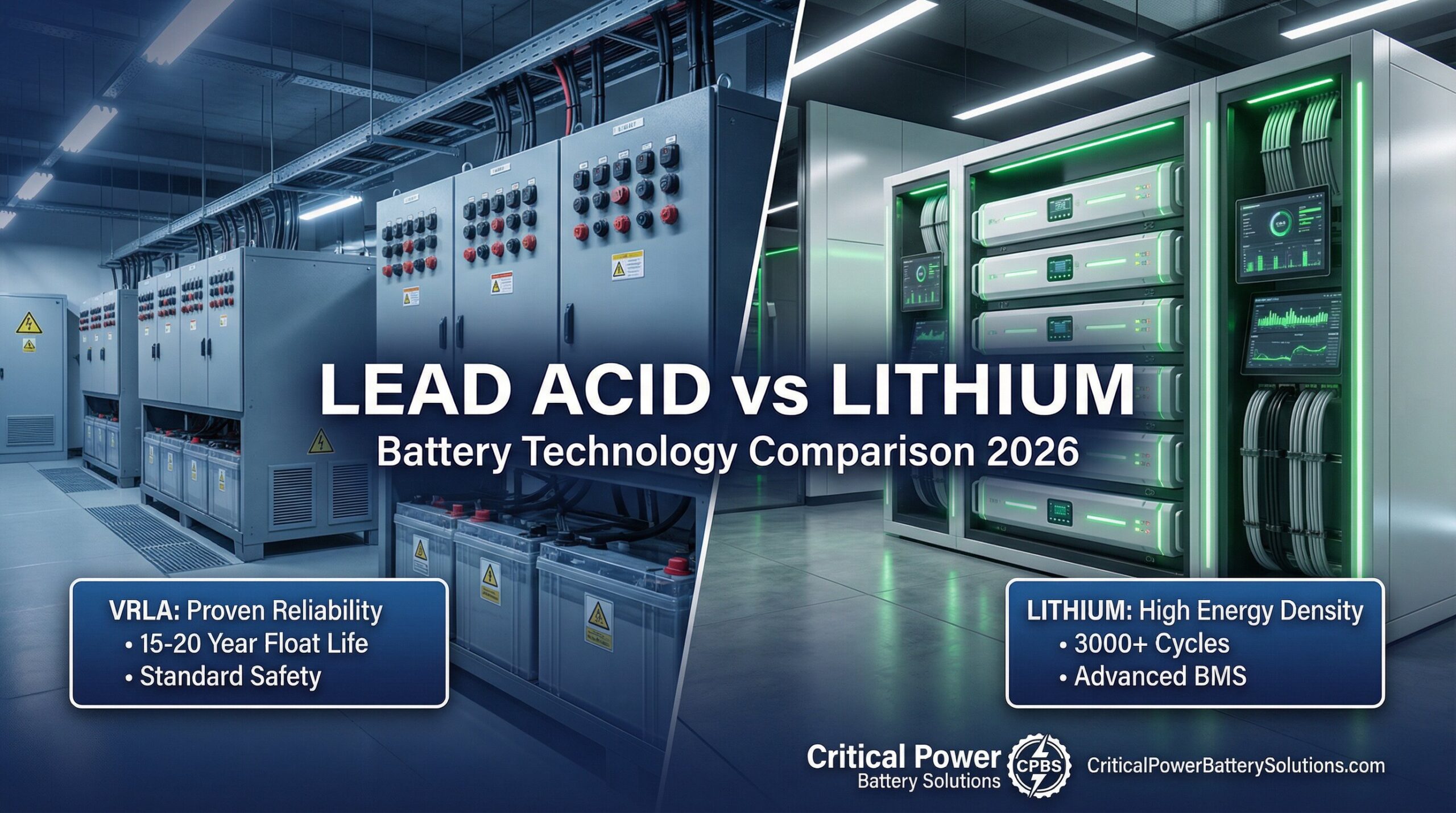
Lithium-ion batteries dominate headlines for good reason, especially with energy densities roughly 3–5x higher than lead-acid (about 150–200 Wh/kg vs. 30–50 Wh/kg). But for stationary critical power applications, the lead acid vs lithium battery comparison is far more nuanced than marketing suggests. When you are responsible for uptime, safety, and budget over a 15–20 year horizon, vrla vs lithium ion is not a trend decision—it is an engineering and risk management decision. In this article, we share how we evaluate lithium vs lead acid UPS solutions every day for data centers, telecom, utilities, and industrial facilities, based on 40+ years deploying and supporting both technologies.
Key Takeaways
| Question | Answer |
|---|---|
| Is lithium always better than VRLA for UPS and standby power? | No. For float service (UPS, telecom, substations), advanced VRLA often delivers better risk-adjusted value due to lower cost, simpler safety requirements, and proven 15–20 year field performance. See how we support data center battery replacement systems with VRLA as the default technology. |
| Where does lithium-ion clearly win in a battery technology comparison? | Lithium wins in high-cycle, high-energy-density applications (microgrids, EVs, mobile systems) where 3,000–5,000+ cycles and compact size matter. In these cases, lithium’s higher upfront cost can be justified over the lifecycle. |
| How does safety compare: VRLA battery vs lithium ion? | Valve regulated lead acid vs lithium have fundamentally different failure modes. VRLA has no thermal runaway mode and is covered by mature codes; lithium requires more complex thermal monitoring and fire suppression. This is why many risk-averse data centers still favor VRLA for critical power battery comparison decisions. |
| What about total cost of ownership (TCO) over 15–20 years? | For float/standby duty, TCO battery comparison often favors advanced VRLA once you factor in fire suppression, HVAC, monitoring, insurance, and disposal. For high-cycle applications, lithium can win on lifecycle cost per delivered kWh. |
| Are advanced lead acid batteries still evolving? | Yes. Modern AGM and pure-lead systems like Stryten E-Series Absolyte AGP and NXT narrow the performance gap with lithium while retaining VRLA’s safety and reliability advantages. See Stryten offerings at our Stryten Energy brand page. |
| How do I choose for telecom and utility substations? | For telecom battery vrla vs lithium and utility substation backup, the application profile is almost always float service. In most of these stationary battery comparison scenarios, high-quality VRLA remains the lowest-risk, most proven option. |
| Where can I get help with a site-specific recommendation? | We offer application-specific engineering support and technology-neutral recommendations. Learn about our team and approach on our About Us page. |


👤 Written by: CPBS Engineering Team
Reviewed by: Tom Kierna – CPBS
Last updated: 06 January 2026
1. Lead Acid vs Lithium: Core Differences for Critical Power Applications
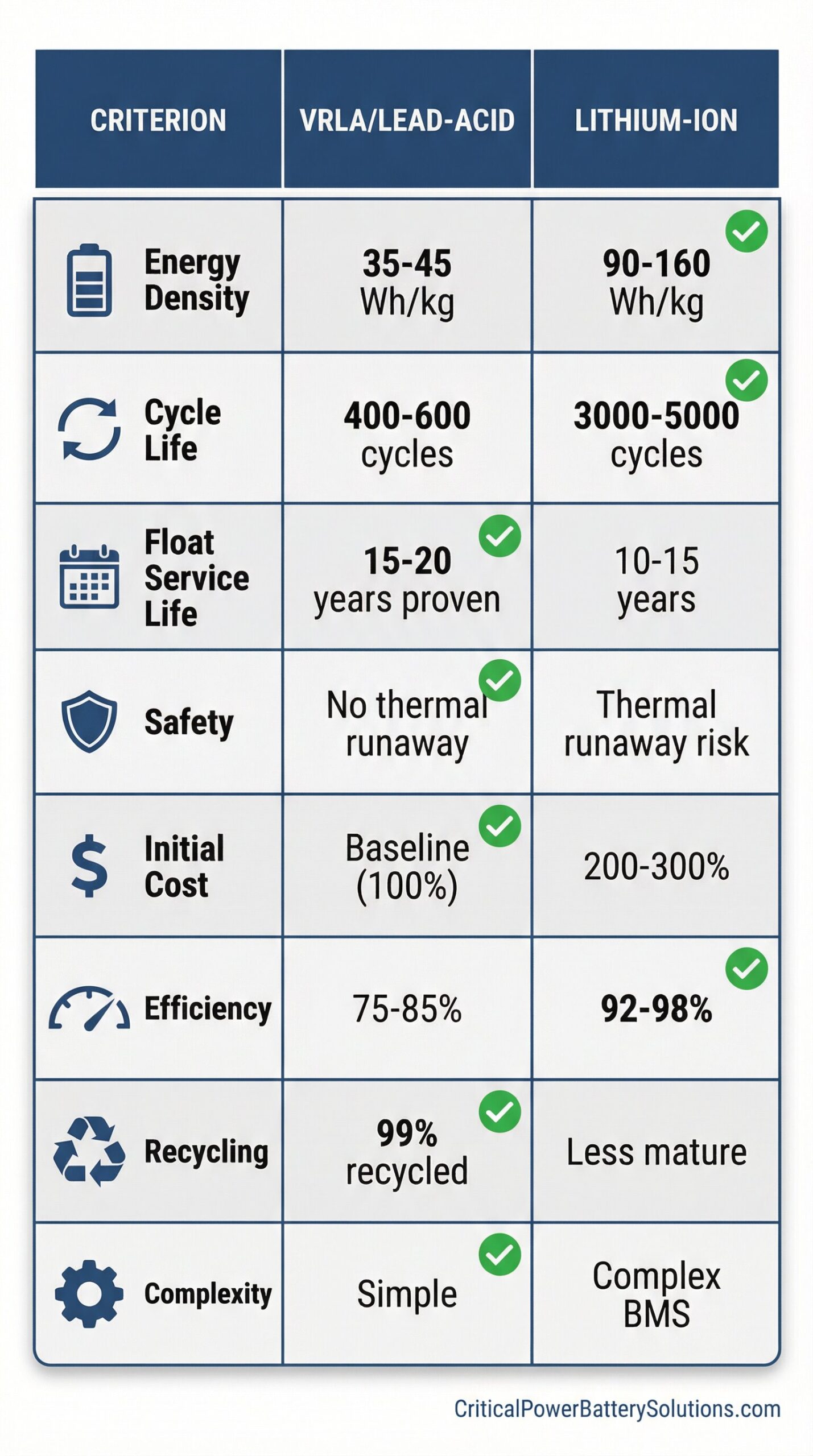
When we support engineering teams on a lead acid vs lithium battery comparison, we start with how the system will actually operate. Most UPS, data center, and telecom systems run in float service: batteries are kept fully charged and only discharge during infrequent outages or periodic testing. In that profile, the classic lithium advantages—fast charge, very high cycle life—are rarely used.
In contrast, vrla battery vs lithium discussions for mobile, cycling, or microgrid service look completely different. There, lithium ion vs agm battery comparisons often favor lithium because energy density, round-trip efficiency, and 3,000–5,000+ cycles at high depth of discharge (DoD) are fully utilized. Application defines which technology “wins.”
| Criterion | Advanced VRLA (AGM / Pure Lead) | Lithium-Ion (LFP Typical) |
|---|---|---|
| Energy density | ~35–45 Wh/kg | ~90–160 Wh/kg |
| Typical use profile (critical power) | Float, occasional discharges | Either float or cycling |
| Failure mode | Gradual capacity loss | Includes possibility of thermal runaway |
| Fire suppression & codes | Covered by mature standards, standard systems | Evolving standards (NFPA 855, IFC), often special systems |
| Upfront cost (per kWh) | Lower baseline | Typically 2–3x VRLA for full system |
From an engineering standpoint, the right question is not “Is lithium better?” but “For this UPS, telecom, or substation profile, which failure modes, safety requirements, and lifecycle costs are acceptable?” For most stationary backup power battery comparison exercises, VRLA remains the reference technology.
2. VRLA (AGM and Pure Lead) vs Lithium-Ion: Technology Overview
2.1 Advanced VRLA and AGM vs Lithium Battery Fundamentals
Valve regulated lead-acid (VRLA) batteries—including AGM and pure-lead designs—are sealed, maintenance-free systems optimized for float service. In absorbent glass mat vs lithium comparisons, AGM holds electrolyte in glass fiber separators, allowing leak-proof operation and low gas emission. These are the core of many data center battery technology deployments.
Modern advanced lead acid batteries such as pure-lead front-terminal designs push VRLA performance further. Products like Leoch XP12 and PLH series show how sealed lead acid vs lithium is not a legacy vs modern story; it is a proven, evolving technology that continues to match critical power requirements.
2.2 Lithium-Ion Chemistry and Behavior in Stationary Systems
Lithium-ion systems used in stationary battery comparison work are typically LiFePO₄ (LFP) due to its better thermal stability than NMC or NCA chemistries. Lithium brings high energy density, high round-trip efficiency, and thousands of cycles at deep discharge, which are compelling in microgrids and EVs.
In float service for UPS battery lithium vs lead acid applications, those strengths are under-utilized. Instead, engineers must address battery safety comparison factors, including thermal runaway lithium batteries risk, stringent thermal management, and more complex battery management systems (BMS) than VRLA requires.
3. Head-to-Head: Performance and Lifecycle Metrics
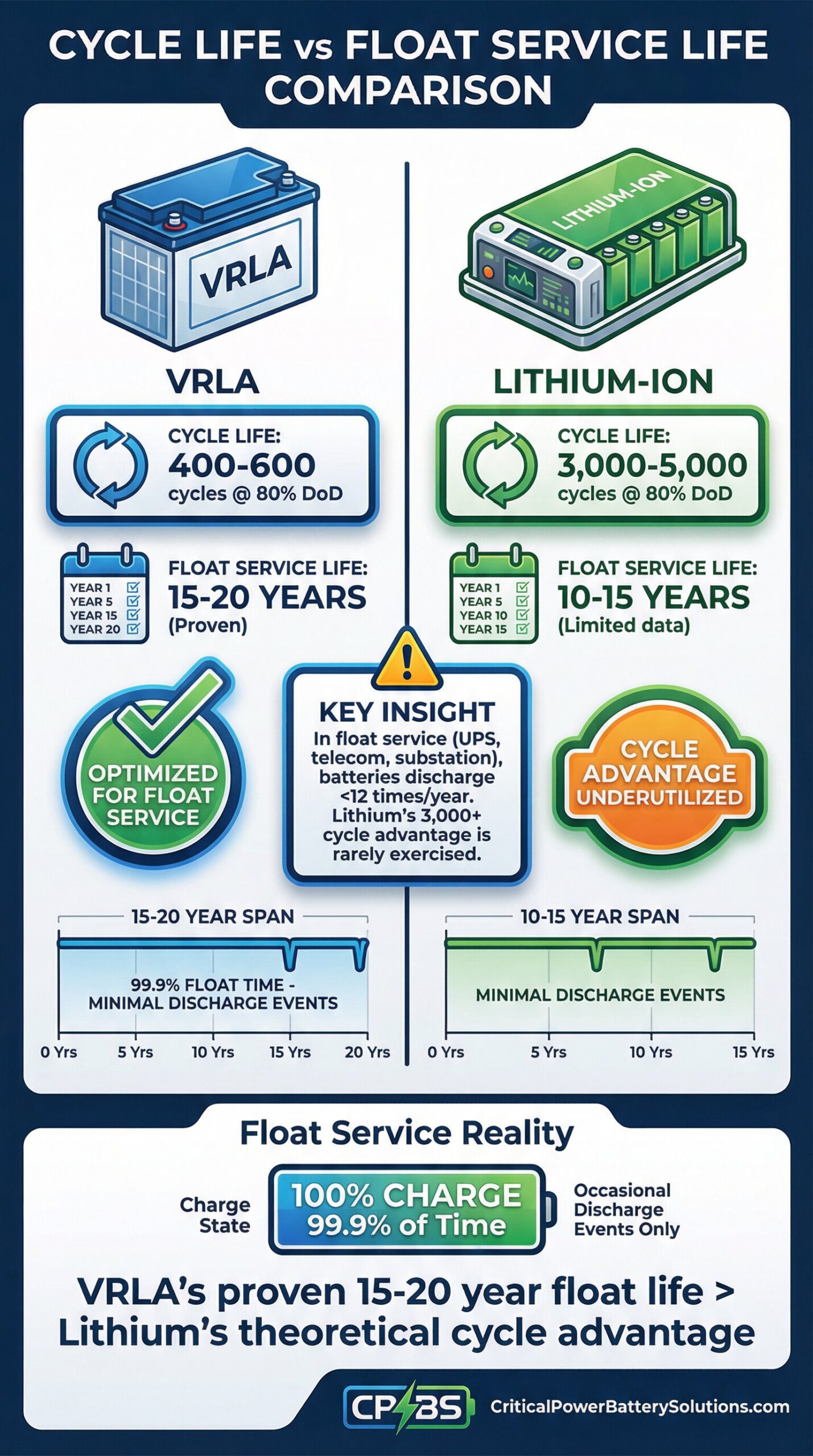
At the core of any lead acid battery vs lithium ion evaluation is a quantitative battery technology comparison across energy density, cycle life, calendar life, and float performance. The table below summarizes the key metrics for float/standby applications.
| Metric | Advanced VRLA (e.g., AGM / Pure Lead) | Lithium-Ion (LFP) | More Relevant for Float Service |
|---|---|---|---|
| Energy density | 35–45 Wh/kg | 90–160 Wh/kg | Lithium (but often irrelevant in fixed rooms) |
| Cycle life @ 80% DoD | 400–600 cycles | 3,000–5,000 cycles | Lithium (for cycling applications) |
| Float service life (25°C) | 15–20 years (well-documented) | 10–15 years (limited long-term data in UPS) | VRLA (proven longevity) |
| Round-trip efficiency | ~75–85% | ~92–98% | Lithium (important in daily cycling) |
| Typical UPS duty profile | Float / rare discharges | Often float in UPS; cycling in other uses | VRLA matched to actual duty |
In float-oriented critical power battery comparison work, the cycle life advantage of lithium is rarely exercised. Batteries spend 99.9% of their time on float, not cycling, which explains why proven VRLA remains the default in many Tier III/IV facilities.
For stationary UPS and standby power battery technology, that cycle-count advantage only matters if your batteries actually cycle frequently—which most critical power systems do not.
4. Safety, Thermal Runaway, and Compliance: VRLA Reliability vs Lithium
Safety and regulatory implications often dominate vrla vs lithium ion decisions in confined, high-value facilities. VRLA AGM vs lithium battery systems differ fundamentally in their failure modes.
4.1 VRLA Safety Profile
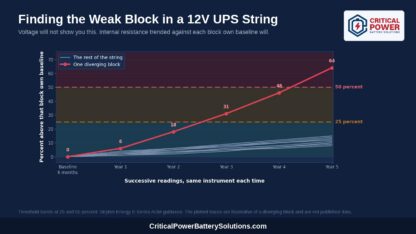
VRLA systems do not exhibit thermal runaway in the same way as lithium. Their predominant failure mode is gradual capacity loss over years of float service. This gives engineering teams advance warning via periodic testing and monitoring, enabling planned replacements without catastrophic events.
Hydrogen generation is manageable with standard ventilation and adherence to IEEE and NEC guidelines. Fire detection and suppression for VRLA typically use existing building systems, avoiding specialized Class D suppression equipment required for some lithium installations.
4.2 Lithium Safety and Thermal Runaway Lithium Batteries
Lithium-ion cells store energy in a different way and can enter thermal runaway if abused, damaged, or subjected to certain fault conditions. While modern BMS designs and conservative LFP chemistries reduce incidence, the failure mode is more severe: potential for fire, off-gassing, and propagation across cells and modules.
This is why ups battery lithium vs lead acid projects must evaluate:
- Compliance with NFPA 855, IFC energy storage chapters, and local AHJ interpretations.
- Additional gas detection, fire detection, and fire suppression requirements.
- Insurance implications and premium differentials for lithium installations.
From a risk-adjusted perspective, many data center directors and facilities managers conclude that proven battery technology with predictable, non-catastrophic failure modes (VRLA) remains preferable where zero-tolerance uptime and life safety are the top priorities.
5. Space, Weight, and Mechanical Constraints in Stationary Battery Comparison
Lithium’s energy density advantage is significant. In pure battery technology comparison terms, lead-acid is generally 50–70% heavier and bulkier than lithium for the same kWh. For mobile systems, vehicles, or severely space-constrained telecom huts, this is decisive.
For stationary float service battery rooms in data centers or utility substations, that advantage is often less critical. Many facilities already allocate sufficient floor space and structural capacity for VRLA strings, and retrofit projects frequently reuse existing racks and cabling with updated VRLA blocks.
Space/weight may justify lithium in:
- Retrofits where footprint must halve due to building changes.
- Mobile containers or modular data centers with strict weight limits.
- Telecom shelters where every rack unit is contested.
For most traditional battery rooms designed around VRLA, the mechanical advantage of lithium does not on its own offset its higher complexity and cost.
6. Total Cost of Ownership (TCO) Battery Comparison Over 15–20 Years
Lifecycle cost is where lithium marketing often focuses, and in cycling applications lithium frequently does win. However, in lithium vs lead acid UPS scenarios with float service, TCO analysis is more nuanced. We typically break TCO into the components below.
| Cost Component | Advanced VRLA System | Lithium-Ion System | Comment for Float Service |
|---|---|---|---|
| Initial battery cost | Baseline (100%) | 200–300% of VRLA | Lithium pack and BMS cost premium |
| Installation labor | Standard practices | 20–30% higher | More complex integration and commissioning |
| Fire suppression | Use existing building systems | Often specialized systems required | Significant added capex for lithium |
| Thermal management / HVAC | Standard ambient cooling | Enhanced HVAC and tighter setpoints | Opex penalty for lithium |
| Monitoring | String/monoblock voltage & temp | Cell-level + thermal monitoring | Higher cost and complexity for lithium |
| Maintenance | Periodic inspections, testing | Specialized inspections, BMS checks | VRLA simpler in many facilities |
| Replacement interval | 15–20 years (proven) | 10–15 years (less long-term data) | VRLA may require fewer full replacements |
| Disposal and recycling | Mature, economical; ~99% recycled | Less mature, higher disposal cost | VRLA favored for sustainability and cost |
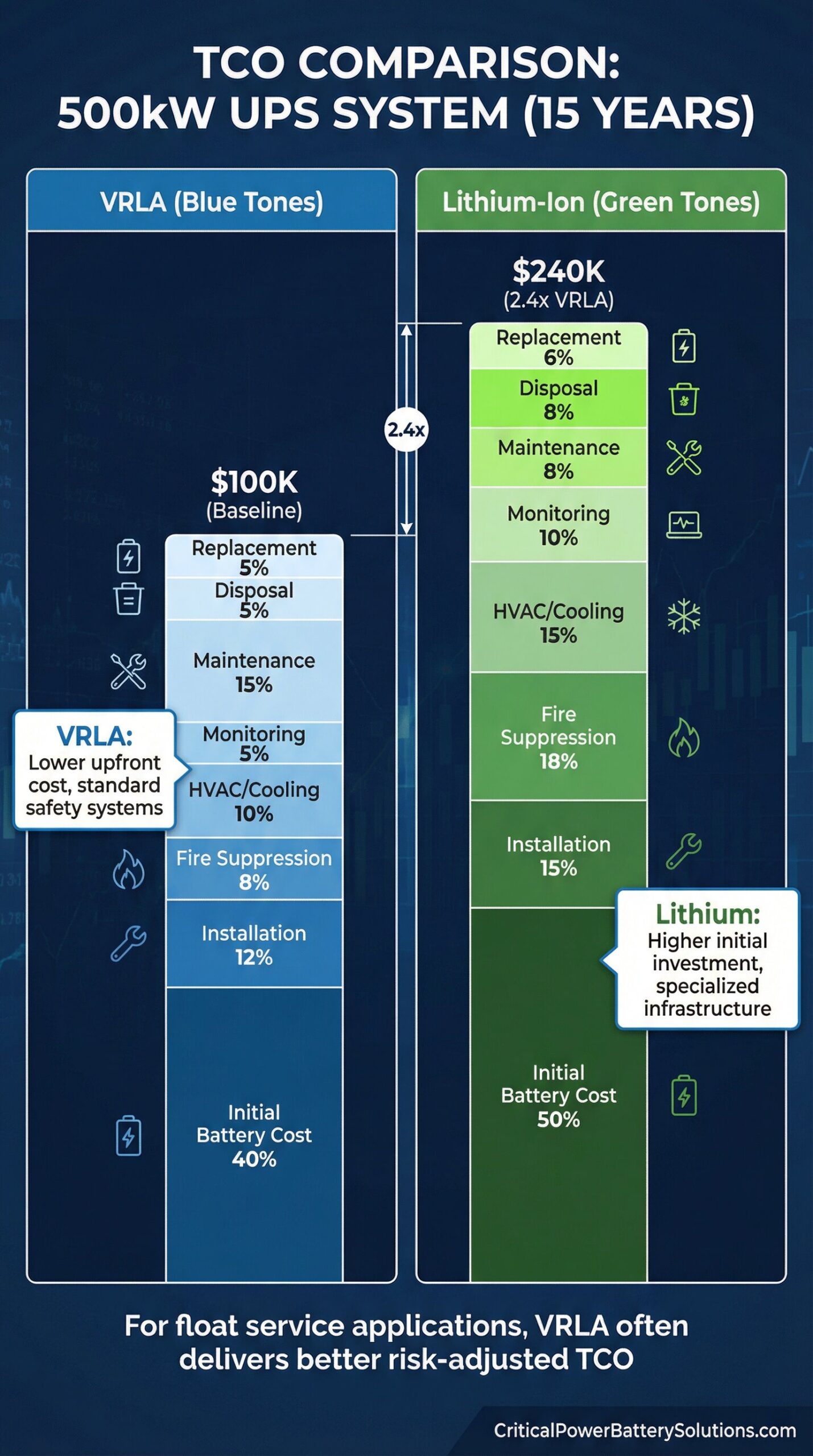
In a hypothetical 500 kW UPS system evaluated over 15 years:
- VRLA-based system: lower capex, standard HVAC and suppression, established disposal. Risk profile is well understood.
- Lithium-based system: higher battery and system capex, additional HVAC and suppression, possibly one replacement cycle within 15 years depending on design assumptions.
For float service battery technology comparison, lifecycle cost batteries analysis often shows VRLA as the lower TCO choice once all ancillary systems and risk factors are accounted for.
This recycling infrastructure is a major factor in battery disposal comparison and long-term sustainability planning.
7. Application-Specific Guidance: Where Each Technology Fits Best
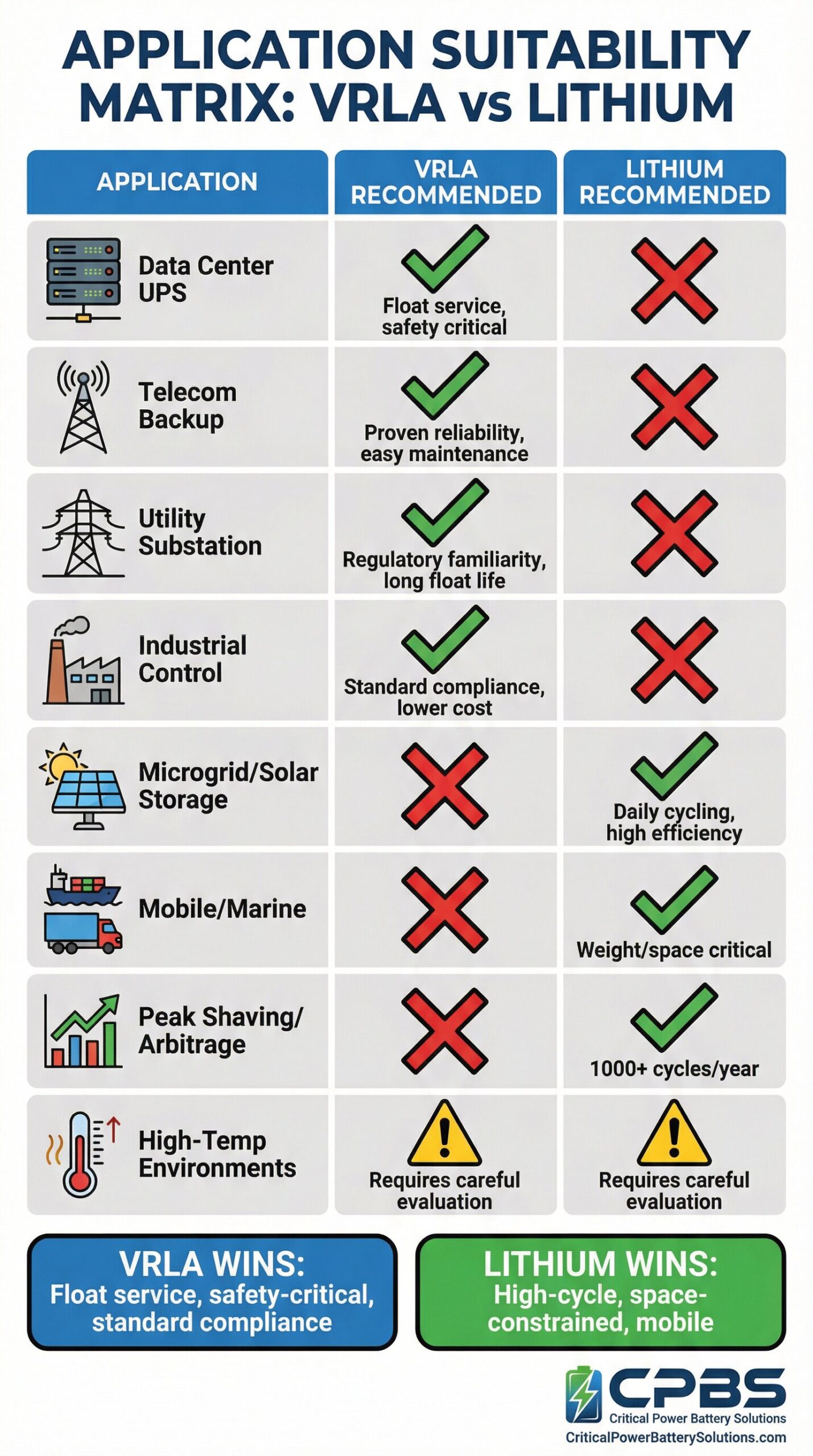
The most defensible stationary battery comparison decisions start with application profile, not technology preference. Below is how we usually segment decisions.
7.1 Applications That Typically Favor Advanced VRLA
For these float service applications, vrla reliability vs lithium and safety profile drive decisions:
- Data center UPS (Tier III/IV) where uptime and predictable failure modes are paramount.
- Telecom battery backup (central offices, cell sites) where front-terminal pure-lead AGM offers high reliability and easy maintenance.
- Utility substation and SCADA systems, where regulatory familiarity with VRLA is high.
- Industrial control and emergency lighting where proven battery technology and straightforward compliance are key.
In these cases, lithium vs lead acid UPS decisions usually tilt toward VRLA due to simpler safety engineering, lower TCO, and decades of real-world data.
7.2 Applications Where Lithium May Be Justified
Lithium’s strengths align with:
- Microgrids and energy storage battery types that cycle daily for arbitrage or peak shaving.
- Mobile, marine, or transportation applications where weight and volume are constrained.
- High-temperature environments where VRLA life would degrade rapidly (with appropriate lithium thermal management).
Here, the long cycle life and high efficiency can amortize the higher capex and complexity.
7.3 Hybrid Strategies
Some large enterprises pursue hybrid industrial battery technology strategies, using:
- VRLA for standby UPS and safety-critical systems.
- Lithium for high-cycle applications such as on-site energy storage or mobile assets.
This splits risk and optimizes each technology for what it does best.
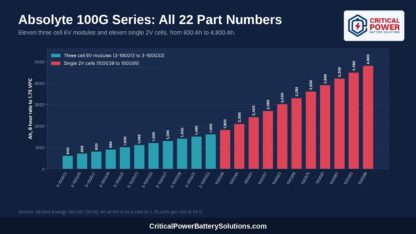
8. Stryten Absolyte vs Lithium: VRLA “Middle Ground” for Critical Power
In vrla vs lithium ion decisions for high-value facilities, premium advanced VRLA like Stryten’s E-Series platforms occupy an important middle ground: modern performance with a VRLA safety and compliance profile.
8.1 Stryten E-Series Absolyte AGP
Stryten Absolyte AGP is a sealed, recombinant, advanced lead-acid system designed for long life in float service, with:
- 20-year design life at 25°C in appropriate conditions.
- Rugged TPPL/pure-lead construction and high-rate discharge capabilities.
- Configurations tailored for data center battery technology and utility uses.
For stryten absolyte vs lithium decisions, many risk-averse facilities choose Absolyte because it narrows the performance gap while avoiding lithium’s thermal runaway and special code requirements.
8.2 Stryten E-Series NXT
The Stryten E-Series NXT line is a next-generation AGM platform designed to deliver higher energy density and reduced footprint compared with legacy VRLA blocks, while maintaining VRLA’s established codes and safety frameworks.
In lithium ion vs agm battery projects where space is somewhat constrained but not extreme, Stryten NXT often provides a practical compromise: better footprint, proven VRLA lifecycle, and no need for lithium-specific suppression or compliance changes.
9. Real-World Use Cases: Data Center, Telecom, and Utility Scenarios
We regularly see similar patterns in industrial battery technology decisions across sectors:
9.1 Data Center Battery Technology Choices
Most Tier III/IV operators still specify advanced VRLA (including Stryten and premium AGM) for core UPS strings. The reasons are:
- Clear, well-understood codes and insurance frameworks.
- Predictable aging, allowing planned outages and staged replacement.
- Lower risk of thermal events in white space-adjacent areas.
Lithium is more commonly introduced for dedicated energy storage battery types or power quality systems that cycle frequently, separate from the main UPS backup strings.
9.2 Telecom and Utility: VRLA vs Lithium Ion
For telecom battery VRLA vs lithium, front-terminal pure lead AGM such as the Leoch PLH series remains widely deployed because it is:
- Mechanically optimized for racks and cabinets.
- Proven in harsh, wide-temperature outdoor conditions.
- Supported by decades of maintenance and service know-how.
Utility substations likewise continue to depend heavily on proven VRLA due to conservative risk postures and long asset lifecycles.
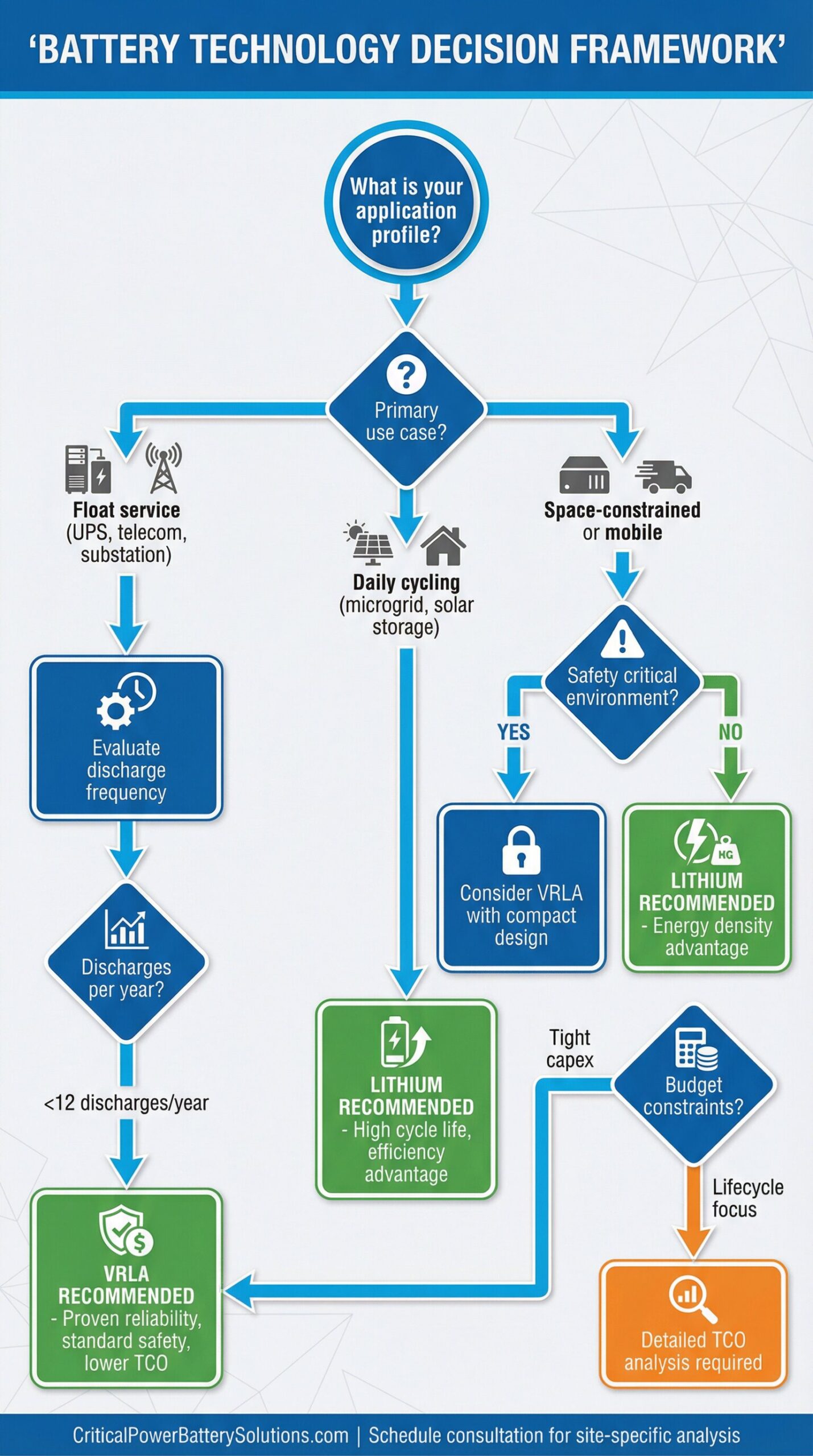
10. Practical Decision Framework: Choosing Between VRLA and Lithium
To make vrla vs lithium ion decisions defensible to management, risk, and finance teams, we recommend a structured approach:
- Define duty profile: Float vs daily cycling; expected DoD; required autonomy.
- Map constraints: Floor space, weight limits, ambient temperature, existing infrastructure.
- Quantify risk tolerance: What level of battery safety comparison risk is acceptable?
- Model TCO: Include capex, HVAC, fire suppression, monitoring, maintenance, insurance, and disposal.
- Align with codes and insurance: Verify requirements for each technology with AHJ and insurers.
For many standby power battery technology projects, this process leads to advanced VRLA. For high-cycle applications, it often justifies lithium despite the higher system complexity.
A key advantage of working with proven VRLA and lithium suppliers is the ability to run side-by-side models for lithium vs lead acid UPS at the same site, using realistic load profiles and ambient conditions.
Conclusion
For engineering managers, data center directors, and facilities leaders, the lead acid vs lithium battery comparison is not about following industry hype; it is about matching technology to application, risk profile, and lifecycle economics. In float service environments—UPS, telecom, utilities, industrial control—advanced VRLA (AGM and pure lead) remains a strong, often superior choice in terms of safety, proven reliability, and total cost of ownership.
Lithium-ion brings genuine advantages in energy density, efficiency, and cycle life, and it is often the right tool for high-cycle or space-constrained use cases. The key is to apply each technology where its strengths matter and its risks can be appropriately managed.
If you need help deciding between vrla vs lithium ion for a specific UPS, telecom, or utility project, we offer:
- Free technology assessment consultations.
- Application-specific stationary battery comparison and TCO modeling.
- Neutral guidance on critical power battery comparison across multiple manufacturers.
To discuss your project, request a site-specific recommendation, or schedule a technical deep-dive with our engineers, you can reach our team directly via our contact page. We will work with you to identify the right battery technology for your application—grounded in data, real-world performance, and your facility’s risk and budget constraints.