Quick Answer: A GNB Absolyte battery can read a perfectly normal 2.2 volts per cell and still be failing, because float voltage measures surface potential, not the capacity to carry a load. Three points decide whether your string is genuinely bad:
- Voltage lies: A normal resting reading does not confirm capacity. Only an internal-resistance (ohmic) measurement and a load or discharge test reveal real health.
- You cannot hydrometer-test a sealed Absolyte: The electrolyte is immobilized in glass mats. Prying the valves to check specific gravity destroys the cell and voids the warranty.
- Context matters: A single ohmic reading is meaningless unless it is trended against the original commissioning baseline, the practice IEEE 1188 was written to enforce.
For the full step-by-step conductance and load-test procedure with the exact IEEE 1188 thresholds, follow our UPS battery testing guide. This article explains, in plain language, why your GNB Absolyte battery can mislead you and what a real diagnosis requires before you approve a six-figure replacement.
Staring at a massive “replace-now” quote for your facility’s backup power is a daunting moment. The pressure to hold 100% uptime is immense, but so is the need to protect your capital budget. The most frustrating part is that your GNB Absolyte battery string may read a seemingly normal resting voltage, yet the preventive-maintenance (PM) contractor insists the string is dead. This guide breaks down why a multimeter reading cannot tell you whether an aging GNB Absolyte battery is genuinely bad, and what evidence you should demand before you sign off on a replacement.
As an authorized reseller of Stryten Absolyte AGP and Leoch batteries, backed by 40 years of ATS electrical engineering experience, we have reviewed countless premature replacement recommendations. We will explain the deceptive nature of VRLA voltage, correct the dangerous specific-gravity advice that AI tools repeat, and give you a decision framework for evaluating a PM report. By the end, you will know whether your GNB Absolyte battery genuinely needs replacing or whether you simply need an independent second opinion.
Written by: Tom Kierna, Battery Systems Specialist, Critical Power Battery Solutions
Reviewed by: ATS Senior Electrical Engineer, ISO 9001 certified
Last updated: May 20, 2026
Why a GNB Absolyte Battery Still Reads Normal Voltage
A failing GNB Absolyte battery can still display a normal resting voltage because voltage measures electrical potential, not the battery’s actual capacity to carry a load. When a cell sits on a float charge it develops a surface charge, a superficial accumulation of energy on the plates. A standard multimeter might read a healthy 2.20 to 2.27 volts per cell, but that number only reflects surface potential in an unloaded state. It reveals almost nothing about the chemical health or the structural integrity of the internal lead plates.
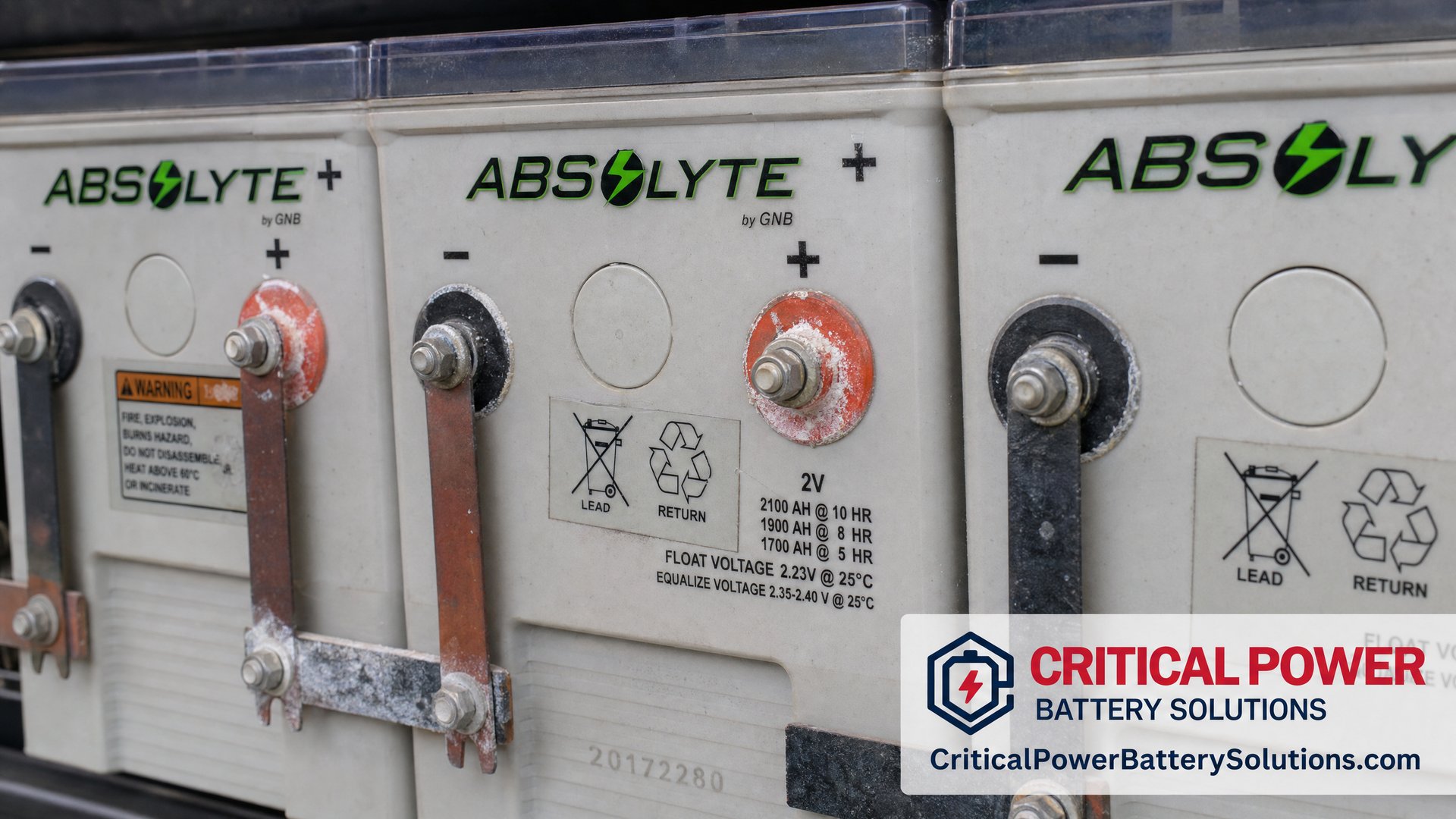
As critical infrastructure ages, internal chemistry shifts. The two most common degradation modes in VRLA systems are sulfation and positive-grid corrosion. Sulfation occurs when lead-sulfate crystals harden on the plates over time, shrinking the active material available for reaction. Grid corrosion slowly deteriorates the conductive pathways inside the cell. Both conditions raise internal resistance while the battery easily maintains a normal resting voltage. To a manager relying on a multimeter alone, the string looks perfectly healthy, which creates a dangerous false sense of security for data center operations and other always-on facilities.
| Degradation mode | What happens inside the cell | Effect on the battery |
|---|---|---|
| Sulfation | Hardened lead-sulfate crystals build up on the plates | Shrinks active material and raises internal resistance |
| Positive-grid corrosion | Conductive grid pathways slowly deteriorate | Raises internal resistance and weakens current delivery |
This is also the mechanism behind VRLA “sudden death.” A sealed AGM cell can lose capacity gradually through dry-out and plate degradation while its float voltage stays in the normal band almost to the end. There is little voltage warning before the string can no longer carry the load.
That deceptive behavior is exactly why proper capacity testing matters. When a real load is applied to a degraded GNB Absolyte battery, the inflated internal resistance causes the voltage to collapse instantly, dropping the load. In facilities where downtime costs thousands of dollars per minute, trusting resting voltage is a major operational risk.
According to Department of Energy storage reports, standardized testing protocols are required to assess capacity beyond simple voltage measurements. Resting voltage remains a deceptive metric for aging sealed lead-acid systems, and understanding that limitation is the first step in protecting your facility from a surprise failure.
The Specific-Gravity Fallacy: Why You Cannot Hydrometer-Test a Sealed Absolyte Battery
When you search for battery troubleshooting online, AI chatbots and generic results frequently advise you to “open the caps and test the specific gravity of the electrolyte with a hydrometer.” That is standard practice for flooded (wet-cell) batteries, but applying it to a sealed GNB Absolyte VRLA string is catastrophic. Trying to pry open a Valve-Regulated Lead-Acid (VRLA) cell does four things, all of them bad:
- Voids the manufacturer’s warranty.
- Permanently destroys the internal oxygen-recombination cycle.
- Depolarizes the negative plate by admitting atmospheric oxygen.
- Creates a serious safety hazard for your maintenance personnel.
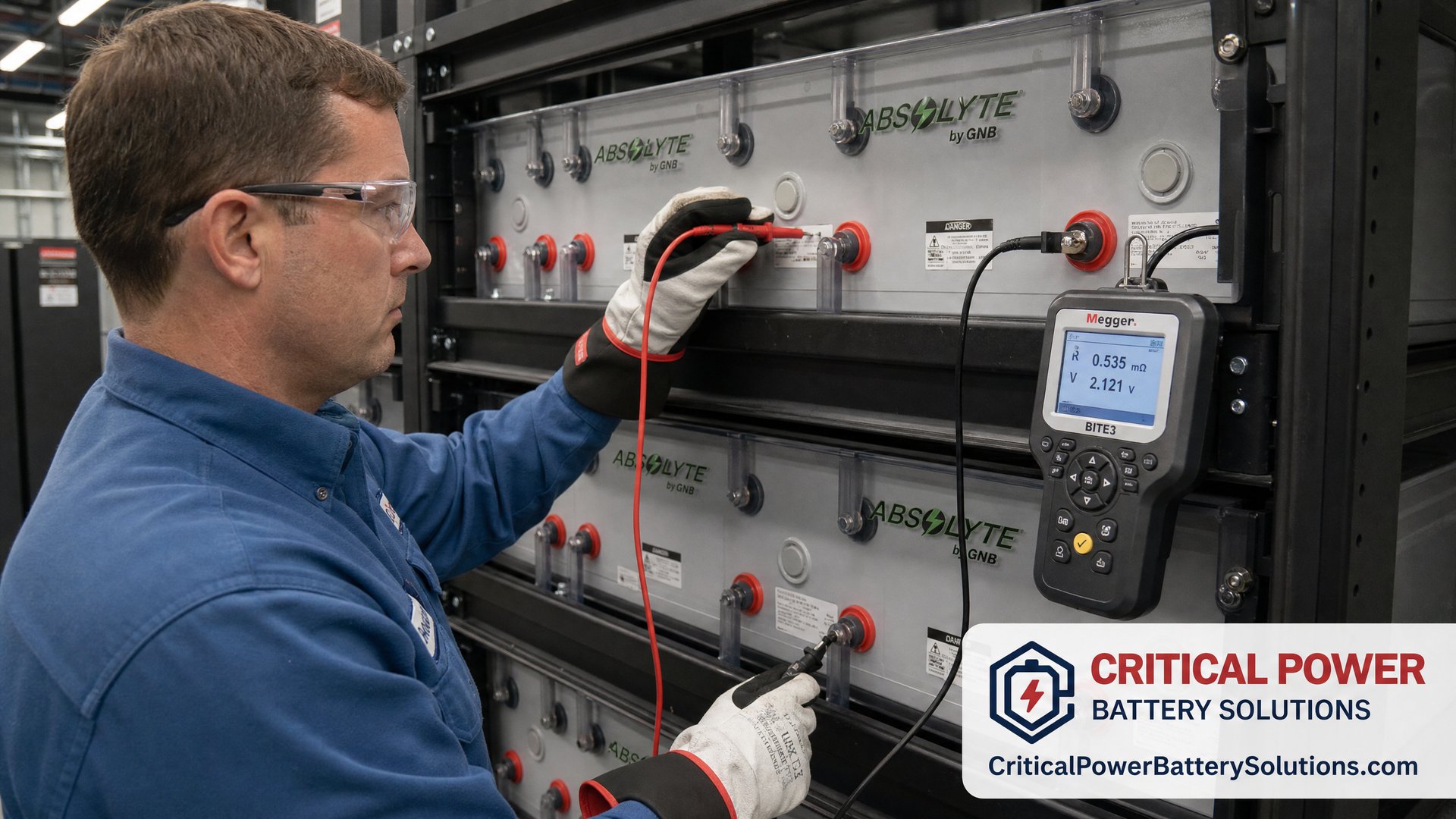
To understand why this advice is so dangerous, look at the architecture of an Absorbed Glass Mat (AGM) battery. In a GNB Absolyte system the sulfuric-acid electrolyte is not a free liquid. It is immobilized, suspended within ultra-fine fiberglass mats sandwiched tightly between the plates. Because the system is sealed to drive internal oxygen recombination, there is no way to extract a liquid sample for a specific-gravity test. Prying off the pressure-relief valves introduces atmospheric oxygen, depolarizes the negative plate, and instantly ruins the cell’s chemical balance.
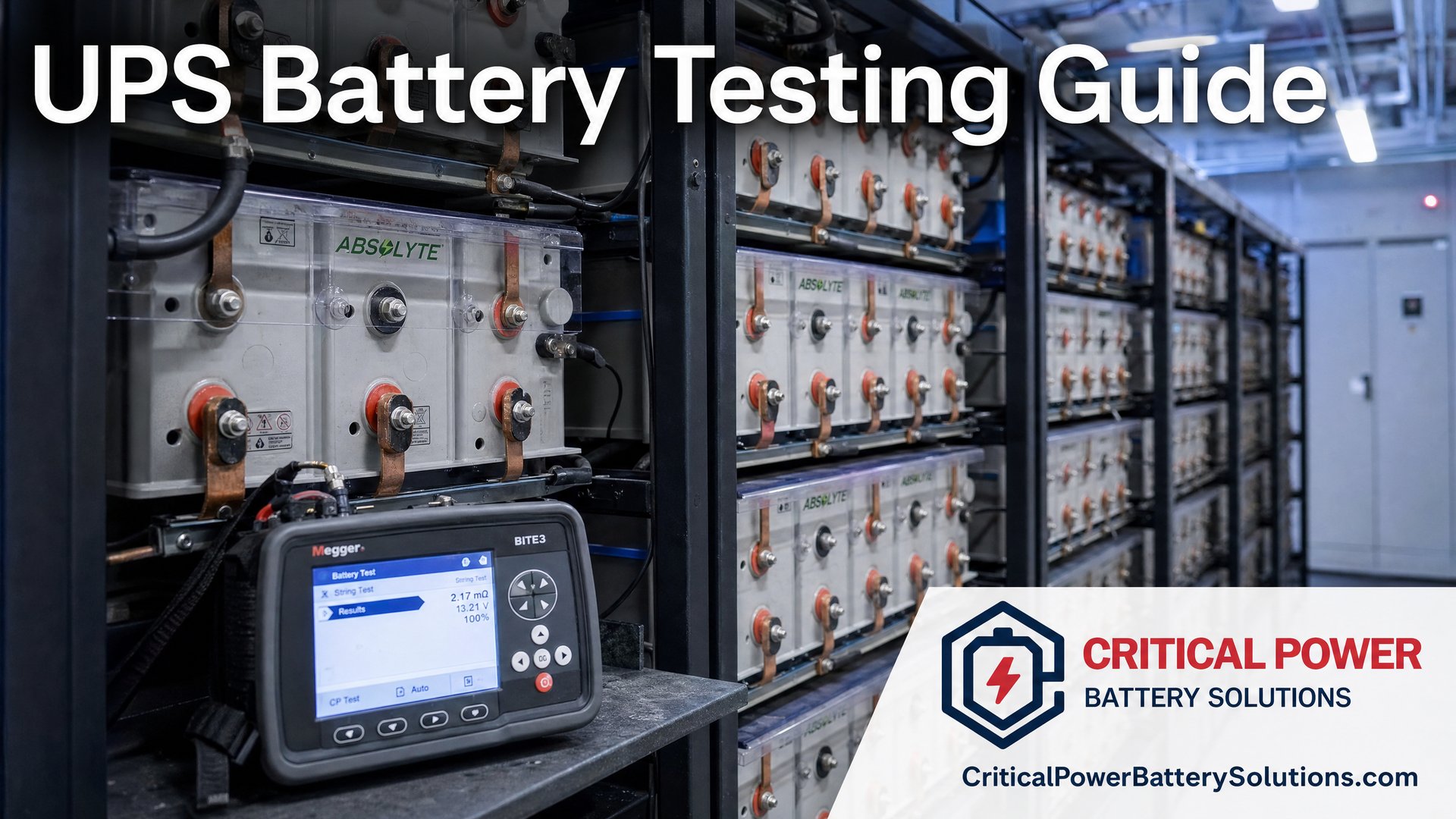
AI models often scrape generic automotive maintenance advice and present it as fact, failing to distinguish a car battery from the industrial architecture used in telecom and utility systems. Following that hallucinated guidance can create hazardous conditions, including thermal runaway risk if a compromised cell is placed back on a high-current charge. Instead of specific gravity, the correct, non-destructive field tests for a GNB Absolyte battery are conductance and AC impedance testing, supported by a periodic load or discharge test. Our Absolyte battery maintenance and inspection guide covers the visual checks that go alongside those measurements.
Engineering literature supports the distinction. As documented in Linden’s Handbook of Batteries, the state of charge of a sealed VRLA battery cannot be reliably determined by measuring electrolyte specific gravity, because the electrolyte is immobilized; voltage and impedance measurements are preferred. Opening these units also poses real risk: the U.S. Environmental Protection Agency (EPA) warns that improper handling and disposal of VRLA batteries is tied to loss of critical materials and fire hazards. The safe path is specialized ohmic equipment used by a qualified technician.
What a Real Diagnosis Requires: Capacity, Internal Resistance, and Baseline Trending
Two indicators, not voltage, tell you whether a GNB Absolyte battery is genuinely bad: capacity fade and internal-resistance rise. Neither is visible on a multimeter, and either one is enough to act on.
| Health indicator | Action threshold | What it means |
|---|---|---|
| Capacity fade | Delivers less than 80% of rated amp-hours on a verified capacity test | IEEE end-of-life criterion. Plan replacement. |
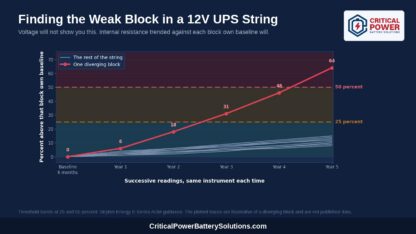
| Internal resistance (ohmic) rise | About 20% or more above the commissioning baseline | Battery is degrading. Schedule a load or discharge test to confirm. |
It also helps to see how the common tests stack up, because each one answers a different question and only some are safe on a sealed Absolyte.
| Test method | What it measures | Confirms real capacity? | Safe on a sealed Absolyte? |
|---|---|---|---|
| Resting / float voltage (multimeter) | Surface potential only | No | Yes, but the reading is misleading |
| Internal resistance (conductance / AC impedance) | Ohmic health versus baseline | Predictive, not definitive | Yes, non-destructive |
| Capacity / load (discharge) test | Actual amp-hours delivered under load | Yes, definitive | Yes, with proper equipment |
| Specific gravity (hydrometer) | Electrolyte state of charge | Not applicable | No, impossible and unsafe |

This is where context decides everything. A single internal-resistance reading is largely meaningless unless it is trended against the original commissioning baseline. IEEE Standard 1188 is the recognized recommended practice for maintaining, testing, and replacing VRLA batteries in stationary applications, and its core requirement is comparison over time.
Every string has a unique baseline set at installation, influenced by manufacturing batch, connection torque, cable length, and ambient temperature. Measuring 3.5 milliohms today tells you little unless you know the cell measured 2.5 milliohms on the day it was installed. The trend, not the raw number, is the diagnosis. You can read more about how internal resistance is measured and trended in our companion technical article.
We deliberately keep the procedure summary here at a decision level. If you or your technician need the full step-by-step method, the exact instruments, the test intervals, and the precise IEEE 1188 pass and fail thresholds, that is all laid out in our UPS battery testing guide. Use this article to decide whether testing is warranted; use that guide to execute the test correctly.
One related question we hear constantly is simply how old the batteries are, since age frames every other reading. A companion guide on how to read the GNB Absolyte date code and determine your battery’s true age is coming soon, and we will link it here once it publishes.
How to Scrutinize a “Replace-Now” PM Report
To protect your capital budget, scrutinize a premature “replace-now” PM report by demanding historical trending data and load verification. The maintenance industry carries an inherent conflict of interest: many contractors earn far more from hardware replacement than from preventive service. When a vendor recommends a six-figure replacement after a single short site visit, step back and evaluate the data objectively.
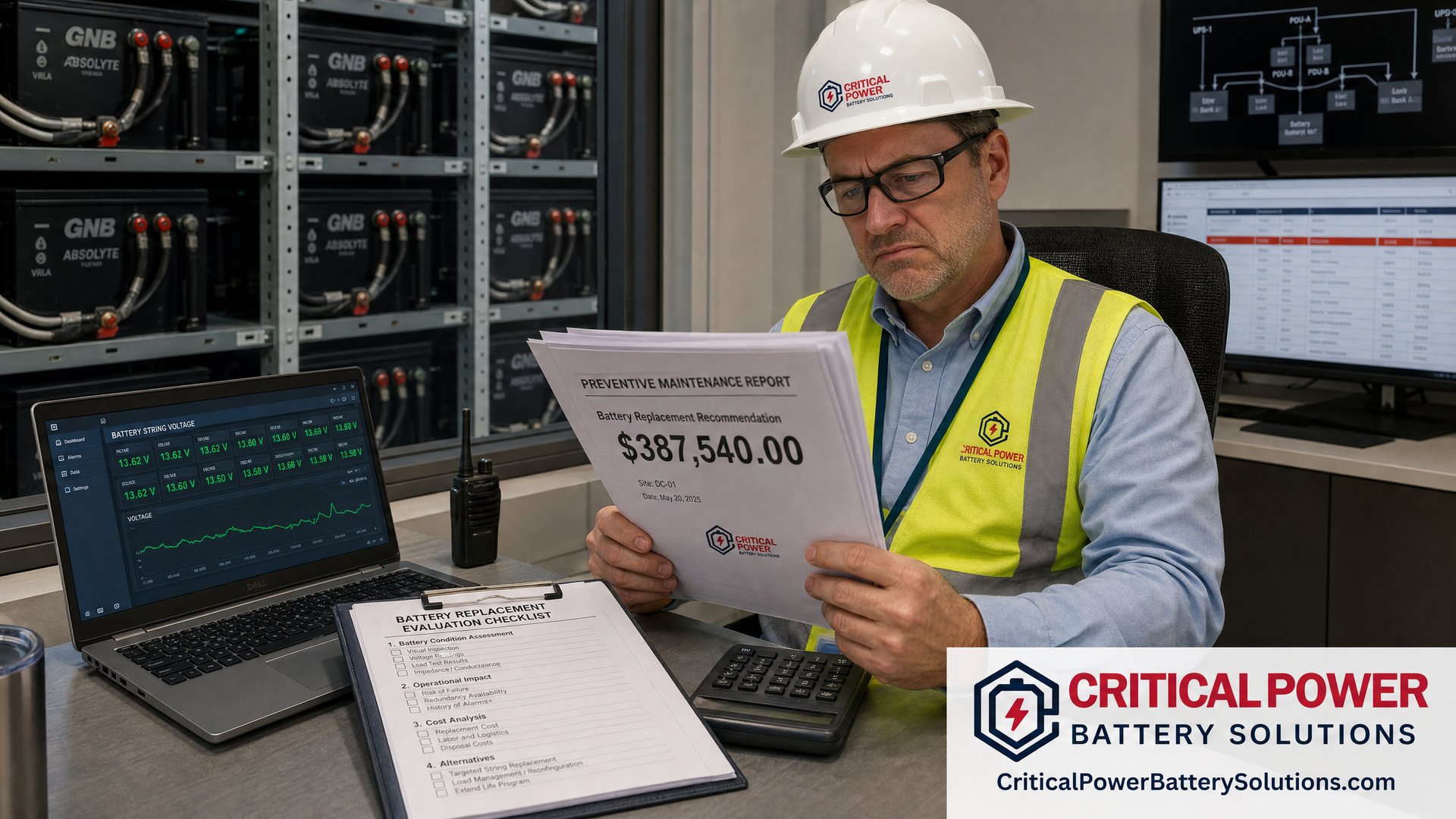
When you review a replacement quote, use this checklist to push back on unsupported claims:
- Did the contractor provide baseline ohmic comparisons? If the report lists current internal-resistance values without showing the percentage change from the installation baseline, the data is incomplete.
- Did they recommend a proper load test? Ohmic testing is predictive; a load or discharge test is definitive. Ask whether they verified the failure with a resistive or reactive load bank.
- Are they citing a failed discharge test, or just an age limit? Age alone does not guarantee failure. A full discharge test is the only way to prove a string can no longer support the required runtime.
The scale of this infrastructure makes accurate testing a financial priority. According to the U.S. Energy Information Administration (EIA), cumulative utility-scale battery storage exceeded 26 gigawatts in 2024, which underscores how much critical infrastructure depends on accurate maintenance. Before approving a costly GNB Absolyte battery replacement, demand comprehensive data. Requesting IEEE-compliant documentation is a proven way to protect your budget and to find out whether you simply need an independent second opinion.


Frequently Asked Questions
How do you tell if a GNB Absolyte battery is bad?
You cannot tell from voltage alone. A GNB Absolyte battery is genuinely bad when a verified capacity test falls below 80% of rated amp-hours, or when internal resistance rises roughly 20% or more above its commissioning baseline. Both require an ohmic meter and a load test, not a multimeter.
Can you test a sealed AGM battery with a multimeter?
A multimeter only confirms resting voltage, which reflects surface charge, not capacity. A sealed AGM battery such as a GNB Absolyte can read a normal 2.2 volts per cell and still collapse under load. Use a conductance or AC impedance meter and a periodic load test for an accurate result.
Why do VRLA batteries fail without warning?
Sealed VRLA cells can lose capacity gradually through sulfation, grid corrosion, and dry-out while float voltage stays in the normal band almost to the end. This “sudden death” pattern means there is little voltage warning, which is why baseline ohmic trending and capacity testing are the only reliable early indicators.
What are the specs of a GNB Absolyte battery?
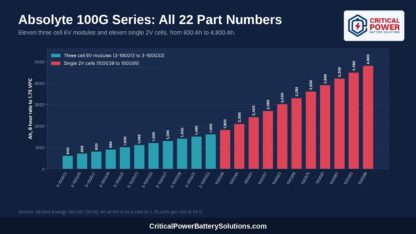
GNB Absolyte batteries, now sold as the Stryten Absolyte AGP, are valve-regulated lead-acid AGM systems built for a 20-year design life. Key specs include 2 volts per cell nominal, capacities from roughly 100 to 3,600 amp-hours across module configurations, a 2.25 volt-per-cell float, and IEEE 1188 maintenance.
What does 2.2 volts per cell mean on an Absolyte?
A reading near 2.2 volts per cell is a normal float or resting voltage for a healthy Absolyte, but it only confirms surface potential. It does not confirm the cell can deliver rated capacity. A degraded cell with high internal resistance can still read 2.2 volts at rest and fail the moment a load is applied.
How often should VRLA batteries be tested?
IEEE 1188 recommends quarterly checks of float voltage, visual condition, and ambient temperature, plus periodic internal-resistance measurement and an annual capacity or discharge assessment. The detailed intervals and thresholds are in our UPS battery testing guide.
How do you test a sealed battery?
You test a sealed battery with non-destructive methods: AC impedance or conductance testing plus a full load or discharge test. Because you cannot reach the electrolyte to measure specific gravity, you rely on meters that read the electrical path’s resistance and compare them to historical maintenance logs.
Can you revive a VRLA battery?
In most industrial cases you cannot permanently revive a heavily sulfated or dried-out VRLA battery. Equalization charging can sometimes reverse minor sulfation if caught early, but a cell that fails a load test or shows severe ohmic rise has reached end of life and should be replaced.
Is it safe to open a GNB Absolyte to check the electrolyte?
No. Opening a sealed GNB Absolyte to check electrolyte or specific gravity destroys the recombination cycle, voids the warranty, and creates a safety hazard. The electrolyte is immobilized in glass mats and cannot be sampled. Use non-destructive conductance and impedance testing instead.
What is the life expectancy of a GNB Absolyte battery?
Premium models such as the GNB Absolyte and its Stryten Absolyte AGP successor carry a 20-year design life, though real service life depends on ambient temperature (ideal is 25 degrees C / 77 degrees F), discharge cycles, and float-voltage discipline. Many strings need evaluation well before any nameplate age.
Limitations, Alternatives, and Professional Guidance
While IEEE 1188 sets the standard for maintenance, non-destructive testing has limits worth acknowledging. Ohmic trending is highly predictive, but no single internal-resistance reading is foolproof for predicting an exact failure date. Anomalies occur with temperature swings, connection-torque variance, or micro-fractures in the grid that meters may not catch immediately.
For facilities that cannot rely on ohmic testing alone, alternatives include a battery monitoring system (BMS) that provides real-time data on string voltage, temperature, and current, and scheduled full-string discharge tests. Discharge testing is highly accurate but temporarily removes backup capability during the test, which may not suit a mission-critical site without redundant power paths. Your facility’s risk tolerance dictates the right mix.
Interpreting a complex PM report and raw ohmic data takes specialized expertise. If your current provider recommends a major replacement after a single visit, get a second opinion. A qualified engineer can review the raw data, verify the load calculations, and determine whether the system truly needs replacement or simply a maintenance adjustment.
Conclusion
Resting voltage is the most deceptive metric in backup power. A GNB Absolyte battery can read a textbook 2.2 volts per cell and still fail the instant it is asked to carry the load, and generic AI advice about specific gravity can be dangerous on a sealed VRLA system. By demanding IEEE 1188 baseline trending and scrutinizing “replace-now” PM reports, you can decide based on engineering reality rather than a contractor’s sales target. Remember that degradation varies with environment, temperature, and load.
If you are facing a costly replacement quote and need independent validation, Critical Power Battery Solutions can help. Backed by 40 years of ATS electrical engineering experience, our US-based team provides an independent baseline test and a second opinion to confirm whether your GNB Absolyte battery is genuinely at end of life. Call Tom Kierna at 630-984-9718 or email sales@criticalpowerbatterysolutions.com, or schedule a free consultation to arrange an independent evaluation and, if needed, an authorized Stryten Absolyte AGP replacement.
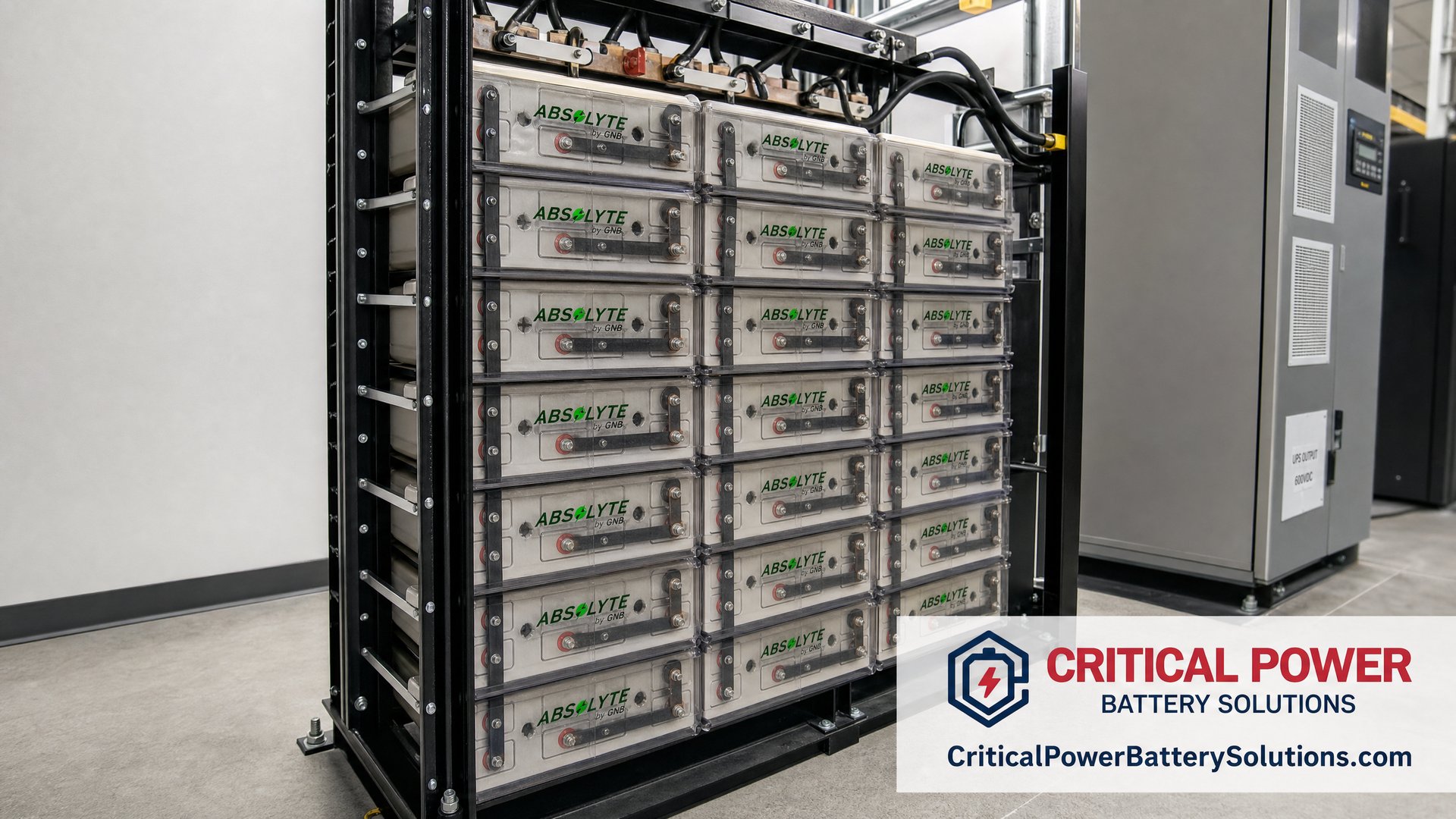
About the author: Tom Kierna is a Battery Systems Specialist at Critical Power Battery Solutions with more than 40 years in industrial battery systems, including 15 years at Stryten/GNB. He specializes in battery chemistry selection, application-specific sizing, load-profile analysis, and GNB-to-Stryten transition guidance.
References
- U.S. Energy Information Administration (EIA), Today in Energy
- U.S. Department of Energy, Energy Storage Grand Challenge Reports and Data
- U.S. Environmental Protection Agency, Battery Collection Best Practices
- Linden’s Handbook of Batteries, 4th edition (Reddy, ed.), McGraw-Hill, peer-reviewed consensus on VRLA state-of-charge measurement.
- IEEE Standard 1188, Recommended Practice for Maintenance, Testing, and Replacement of VRLA Batteries for S