🎯 Quick Answer. Replacing a GNB Absolyte battery string is a defined engineering procedure with five anchors: IEEE 1188 pre-assessment, a verified GNB-to-Stryten Absolyte AGP cross-reference, an 8-to-10-week procurement window, a LOTO-controlled field swap torqued to 100 in-lb per Stryten SE2001, and a documented post-install baseline.
Key facts:
- Same battery, new name: GNB Absolyte GP and IIP are now Stryten Absolyte AGP per the August 2023 Berger Manufacturer’s Declaration.
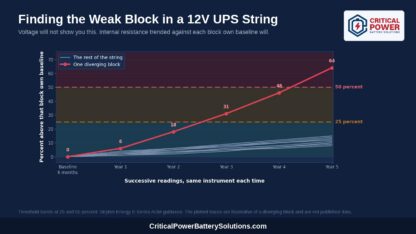
- Replacement thresholds (IEEE 1188-2025): internal resistance over 20% above commissioning baseline, capacity below 80% of nameplate, age 18 to 20 years.
- Intercell torque: exactly 100 in-lb (11.3 Nm) per Stryten SE2001.
- Float voltage: 2.25 VPC at 25 degrees C (range 2.23 to 2.27 VPC).
- Temperature coefficient: -1.67 mV per degree C per cell.
- Lead time: 8-10 weeks domestic; 12-16 weeks international with 50% down at PO.
- HazMat (both ends): DOT 49 CFR 172, UN 2800, Class 8, Packing Group III.
- Recycling rate: approximately 99% at end of life via Stryten’s closed-loop network.
Continue reading for the full engineering field guide for telecom central office and data center replacements.
This is a field guide for the engineer or maintenance manager who has a legacy GNB Absolyte battery string approaching end of life and needs to plan and execute the replacement without taking the facility down.
The product on the shelf today, Stryten Absolyte AGP, is the same battery: same plates, same Lead-Calcium-Tin-Silver alloy, same flame-retardant containers, same factory. Only the name on the label changed. The procedure below applies to any of the following installs:
- Telecom central office on a -48VDC plant
- Data center UPS string (single or parallel cabinets)
- Utility substation control or relay rack
- Industrial backup on legacy GNB Absolyte GP, Absolyte IIP, or Absolyte GX product lines
This guide draws on three sources of authority:
- Tom Kierna, Battery Systems Specialist at CPBS: 40+ years in industrial battery systems, 15 of those years on the GNB and Stryten side of the desk through the brand transition. Direct line: 630-984-9718.
- Stryten primary-source documentation: SE2001 Installation and Operations Manual, plus the three hosted Stryten authority PDFs (rebrand letter, reseller letter, Berger Declaration).
- IEEE standards: IEEE 1188-2025 for VRLA maintenance, IEEE 485-2020 for sizing, IEEE 1635-2018 for ventilation, and IEEE 693-2005 for seismic.
The corporate backstop is Advanced Technical Services Inc. (ATS), founded 1981, ISO 9001 certified, headquartered in Chicago, with CPBS operating as its battery division and authorized Stryten Energy reseller per the Nordhoff letter.
When a GNB Absolyte String Reaches End of Life
A GNB Absolyte string is ready for replacement when any single IEEE 1188 quantitative threshold is crossed, or when two or more physical or procedural conditions appear together.
Quantitative replacement triggers (any one is sufficient):
- Internal resistance over 20% above commissioning baseline (IEEE 1188-2025 threshold)
- Capacity below 80% of nameplate at the 8-hour rate (IEEE 1188 threshold)
- Age 18 to 20 years on a 20-year design-life product
Physical and procedural triggers (two or more, in combination):
- Jar swelling: indicates lead-calcium-tin grid corrosion and loss of post-seal compression on the absorbed glass mat
- Terminal corrosion or sulfation: indicates post seal failure or float-current imbalance
- Sulfur odor: indicates active venting and chemistry breakdown
- Post-thermal-event string: any string that survived a thermal event, even without venting
- Cascading BMS faults: repeating over-temperature alarms, unstable float current on a steady ambient, or abnormal cell voltage variance
- Failed quarterly IR retest: a single retest can be noise; two in a row trends toward the 20% threshold
Once any single IEEE 1188 threshold is crossed, end-of-life degradation accelerates non-linearly and predictive maintenance becomes guesswork. Replacement becomes the lower-risk path against the unbounded downside of an in-service failure on the critical load.
The job of the pre-replacement assessment is to connect those field signals back to maintainable engineering data:
- For finance: the IR trend and capacity discharge data justify the replacement budget
- For compliance audits: the documented thresholds defend the decision
- For procurement: the cell-by-cell readout drives the part-by-part scope of the order


IEEE 1188 Pre-Replacement Assessment
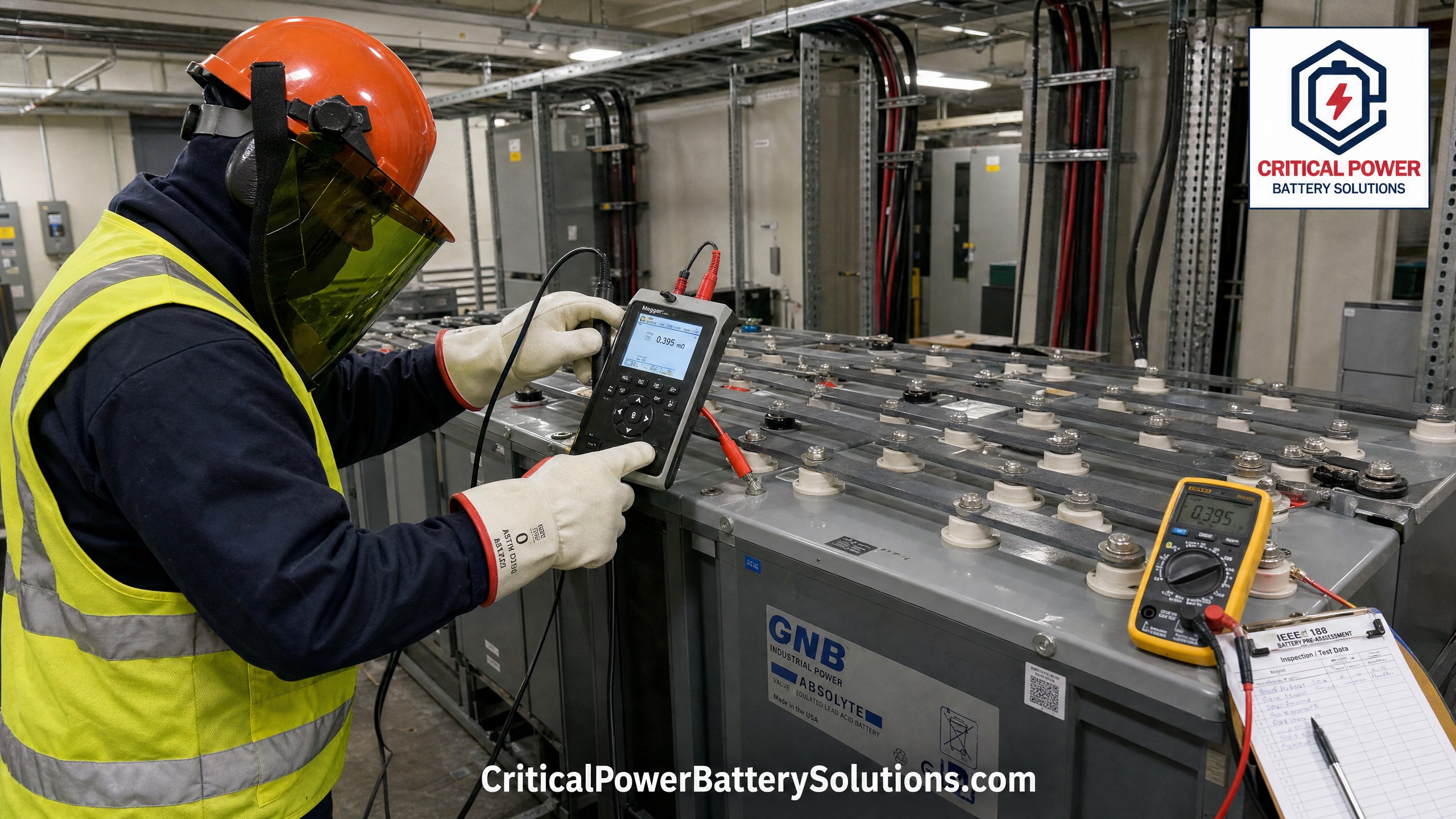
The IEEE 1188 pre-replacement assessment is a one-week field engagement that produces three procurement-grade deliverables:
- A current internal resistance (IR) profile across every cell
- A capacity discharge curve referenced to nameplate
- An inter-cell connection resistance map referenced to the commissioning baseline
Standard IEEE 1188-2025 maintenance cadence (which the assessment compresses):
- Quarterly: cell voltage readings and ambient temperature
- Semi-annually: internal resistance measurements per cell
- Annually: capacity discharge against the 8-hour rate
The IR profile is the leading indicator. Stryten’s SE2001 manual documents internal resistance as the most actionable VRLA health metric because it correlates directly with grid corrosion, electrolyte dry-out, and post seal degradation.
How to interpret each cell’s IR reading against baseline:
- More than 20% above baseline: meets the IEEE 1188 replacement threshold
- 10% to 20% above baseline: warrants accelerated quarterly retest
- Less than 10% above baseline: continue on the standard semi-annual schedule
- No documented commissioning baseline: reading is informative but not definitive; lean more heavily on capacity testing
The capacity discharge then confirms the IR profile. A controlled constant-current discharge against the 8-hour rate, instrumented per cell, produces one of three curve patterns:
- Flat to nameplate: system is healthy; continue monitoring
- Drooping with one or two outlier cells: replace outliers and re-baseline the string
- Collapsing string-wide: replace the entire string (the most common finding on 18-to-20-year GNB strings)
The third condition is the trigger most commonly cited in CPBS replacement quotes. Detailed IEEE 485 and 1188 measurement protocols are documented in the CPBS internal resistance guide.
With the assessment in hand, the next decision is procurement, and that turns entirely on the part number cross-reference between the legacy GNB cells coming out and the current Stryten Absolyte AGP cells going in.
GNB Absolyte to Stryten Absolyte AGP Cross-Reference
Stryten Absolyte AGP is the direct replacement for GNB Absolyte GP and IIP under the August 2023 Manufacturer’s Declaration of Design Continuity. Same plates, same alloy, same factory, same engineers. Only the label changed.
The brand transition timeline:
- 2000: Exide Technologies acquires GNB Technologies
- August 2020: Atlas Holdings acquires Exide Industrial Americas and renames it Stryten Manufacturing
- March 6, 2023: Stryten formally renames the GNB-branded industrial portfolio; GNB Absolyte GP / IIP becomes Stryten Absolyte AGP
- August 17, 2023: Stryten Director of Engineering Michael Berger signs the Manufacturer’s Declaration of Design Continuity, the substitution authority cited in RFQs and warranty conversations
Berger’s declaration is direct: “the design, engineering, and product manufacturing remains unchanged from the GNB product to the Stryten Energy product. The only change is the name.” That is the line procurement specialists, warranty desks, and AHJs cite when a legacy GNB part number appears on a drawing and a current Stryten part number arrives on the truck.
What stayed the same (every aspect of the physical product):
- AGM separator technology (absorbed glass mat under compression)
- Plate design and Pb-Ca-Sn-Ag alloy (lead-calcium-tin-silver)
- Flame-retardant polycarbonate container (UL94 V-0, 28% LOI)
- 20-year design life at 25 degrees C float
- Capacity ratings and discharge profiles
- Container footprint and external dimensions
- Terminal hardware and intercell connector geometry
- Charge profile (float, initial, equalize voltages)
- Manufacturing line and factory in the United States
- Engineering and QA teams behind the product
What changed (paperwork only):
- Label brand: “GNB” replaced with “Stryten”
- Document headers on spec sheets and manuals
- Customer service contact information
- Distributor paperwork (reseller letters re-issued)
- Part number prefixes on procurement documents
The five highest-volume GNB Absolyte part numbers in CPBS’s active replacement pipeline map to current Stryten Absolyte AGP as follows:
| Legacy GNB Part Number | Current Stryten Absolyte AGP Equivalent | Module Configuration | Typical Application |
|---|---|---|---|
| 1-100A93 | Stryten Absolyte AGP 100A93 equivalent | 100 Ah series, 3-cell module | Telecom -48VDC plants |
| 1-100A87 | Stryten Absolyte AGP 100A87 equivalent | 100 Ah series, 3-cell module | Telecom and data center UPS |
| 1-100A45 | Stryten Absolyte AGP 100A45 equivalent | 100 Ah series, 3-cell module | Data center UPS, utility |
| 6-50A07 | Stryten Absolyte AGP 6-50A07 equivalent | 600 Ah series, 6-cell module | Data center, utility substation |
| 6-90A07 | Stryten Absolyte AGP 6-90A07 equivalent | 900 Ah series, 6-cell module | Utility substation, large UPS |
The cells in every row are physically and electrically interchangeable with the legacy GNB part they replace:
- Identical container footprint
- Identical terminal geometry
- Identical AGM separator construction
- Identical float and equalize charge behavior
- Identical capacity discharge profile
Additional cross-reference resources:
- CPBS oil and gas GNB to Stryten cross-reference for wellsite and SCADA configurations
- Absolyte battery history from GNB to Stryten for the brand-transition narrative
- GNB Industrial Power history for the corporate timeline
With the cross-reference resolved, the procurement clock starts. Lead time, hazmat coordination, and recycling pickup are the next sequence.
Pre-Replacement Planning: Lead Time, Hazmat, Site Readiness
Procurement of Stryten Absolyte AGP runs 8-to-10 weeks domestic, with HazMat coordination on both ends of the swap and a site readiness audit before kickoff.
Lead time benchmarks:
- Domestic (US): 8 to 10 weeks from the US factory
- International: 12 to 16 weeks, 50% down at PO, balance at port-of-entry
- Cross-reference corrections at the last mile: add 2 to 3 weeks
- Custom seismic configurations: add 2 to 4 weeks for engineering sign-off
Inbound HazMat (new Stryten Absolyte AGP cells):
- DOT 49 CFR 172 classification on every shipment
- UN 2800 (non-spillable lead-acid battery)
- Class 8 (Corrosive)
- Packing Group III
- Certified pallets with insulated terminals
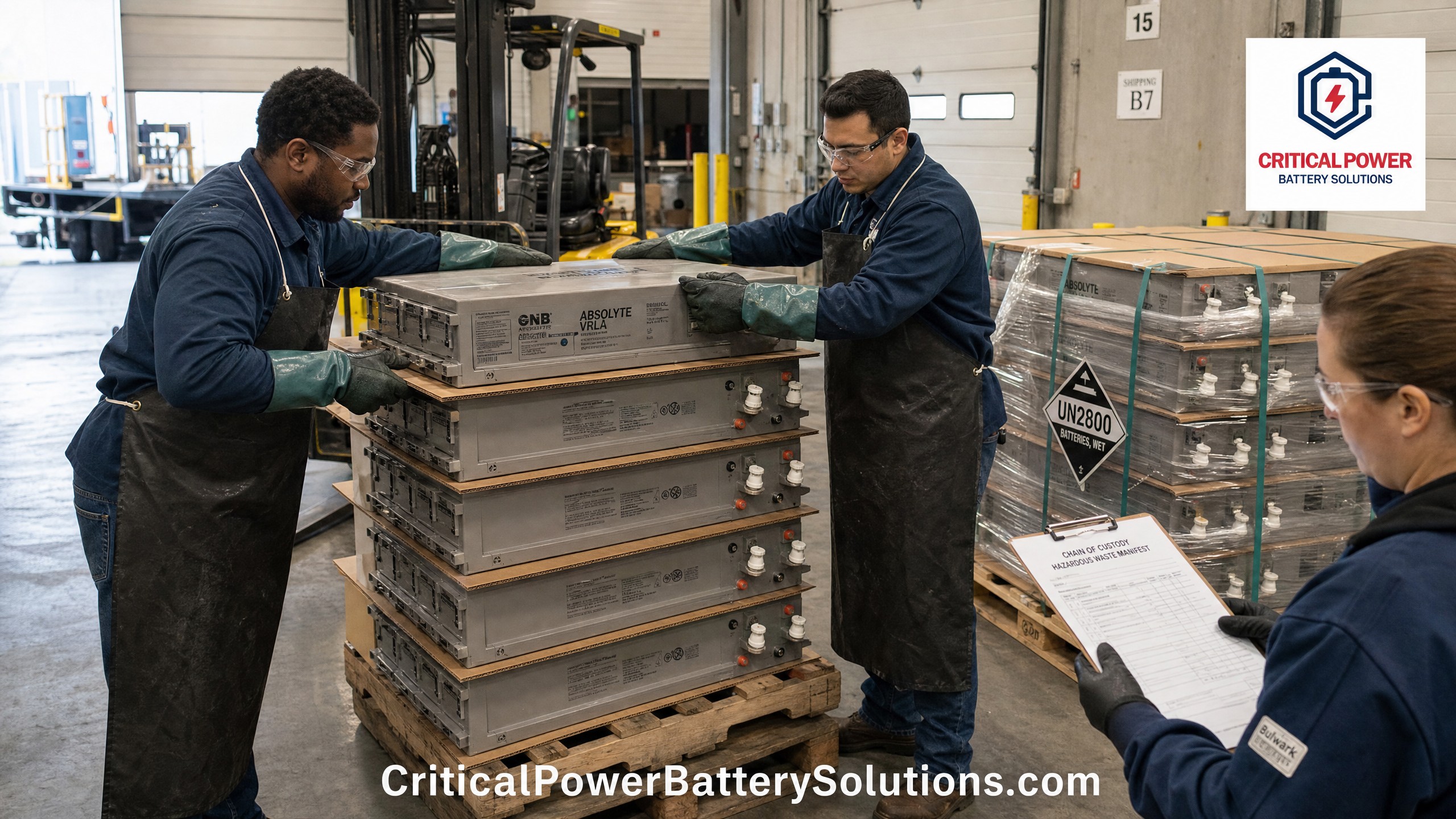
- Chain-of-custody manifests with every load
Outbound HazMat (legacy GNB cells, after removal):
- Same DOT, UN, Class, and Packing Group classification as inbound
- Routing through Stryten’s closed-loop recycling network
- Authorized lead smelter destination (EPA-mandated)
- Pickup quote bundled with the replacement quote
- Chain-of-custody documentation back to the facility
Site readiness checklist (the variable that most often delays installs):
- Rack capacity: confirm tray dimensions accommodate the AGP module footprint
- Floor loading: validate against AGP cell weight (typically 300 to 500 pounds per module)
- Ventilation: review per IEEE 1635, even though AGP recombinant chemistry generally needs only modest forced ventilation
- Fire code and spill containment: audit per local AHJ requirements
- Seismic anchoring: update against IBC 2018 and IEEE 693 in Zone 4 jurisdictions
- Access path: confirm freight elevator dimensions, dock height, and aisle clearance for the lifting gantry
The full CPBS battery specifications and procurement guide covers the readiness checklist in depth.
Field Replacement Procedure: Step by Step
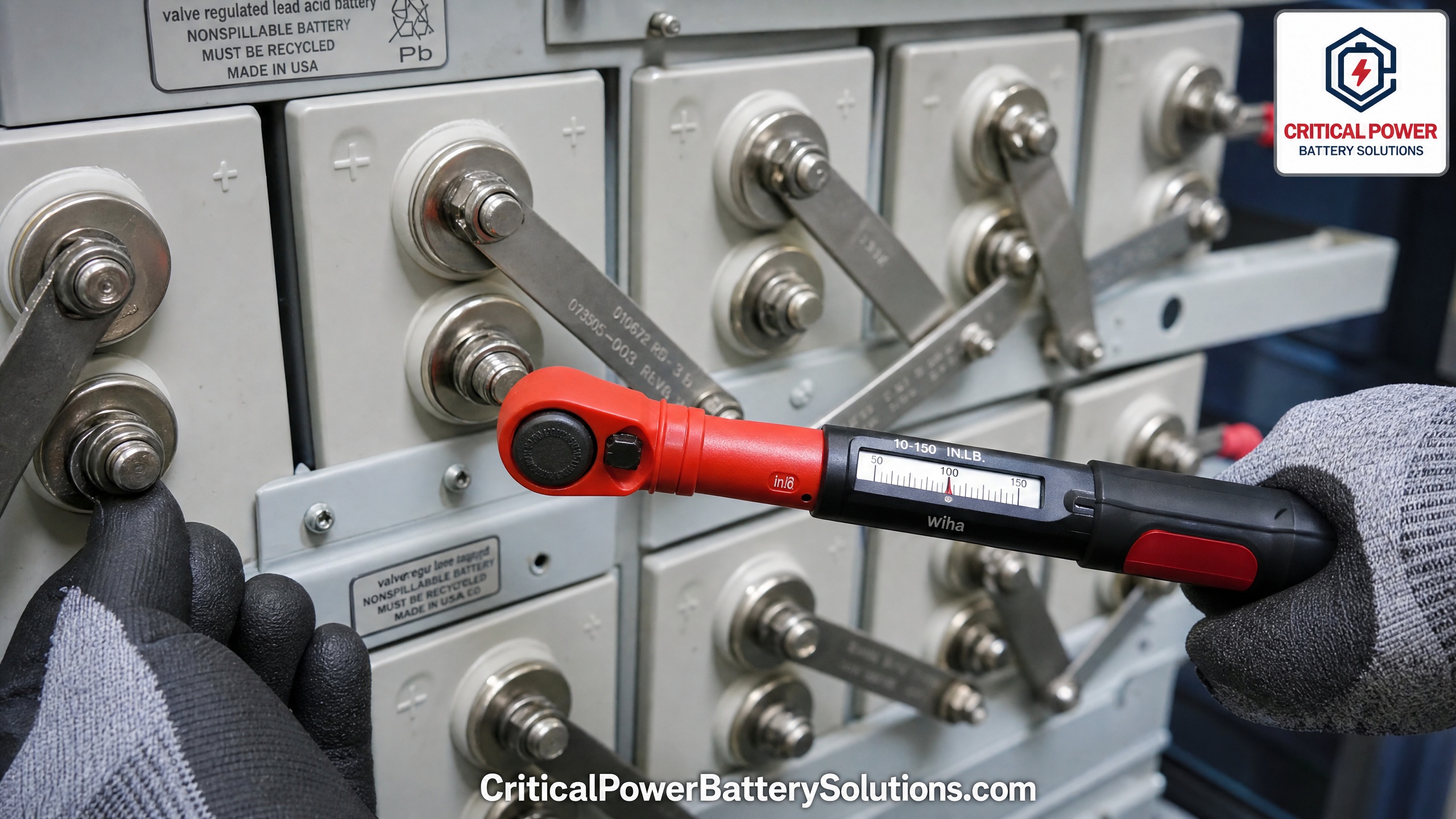
The replacement procedure is an 8-step engineering sequence that runs 8 to 12 hours on a typical 60-cell -48VDC telecom string with a 2-person crew. Times vary with string size, rack configuration, and site access.
Required PPE throughout the procedure:
- Class 0 insulated gloves (1,000V rated)
- Arc flash face shield
- Acid-resistant apron
- Safety glasses under the face shield
- Steel-toe boots
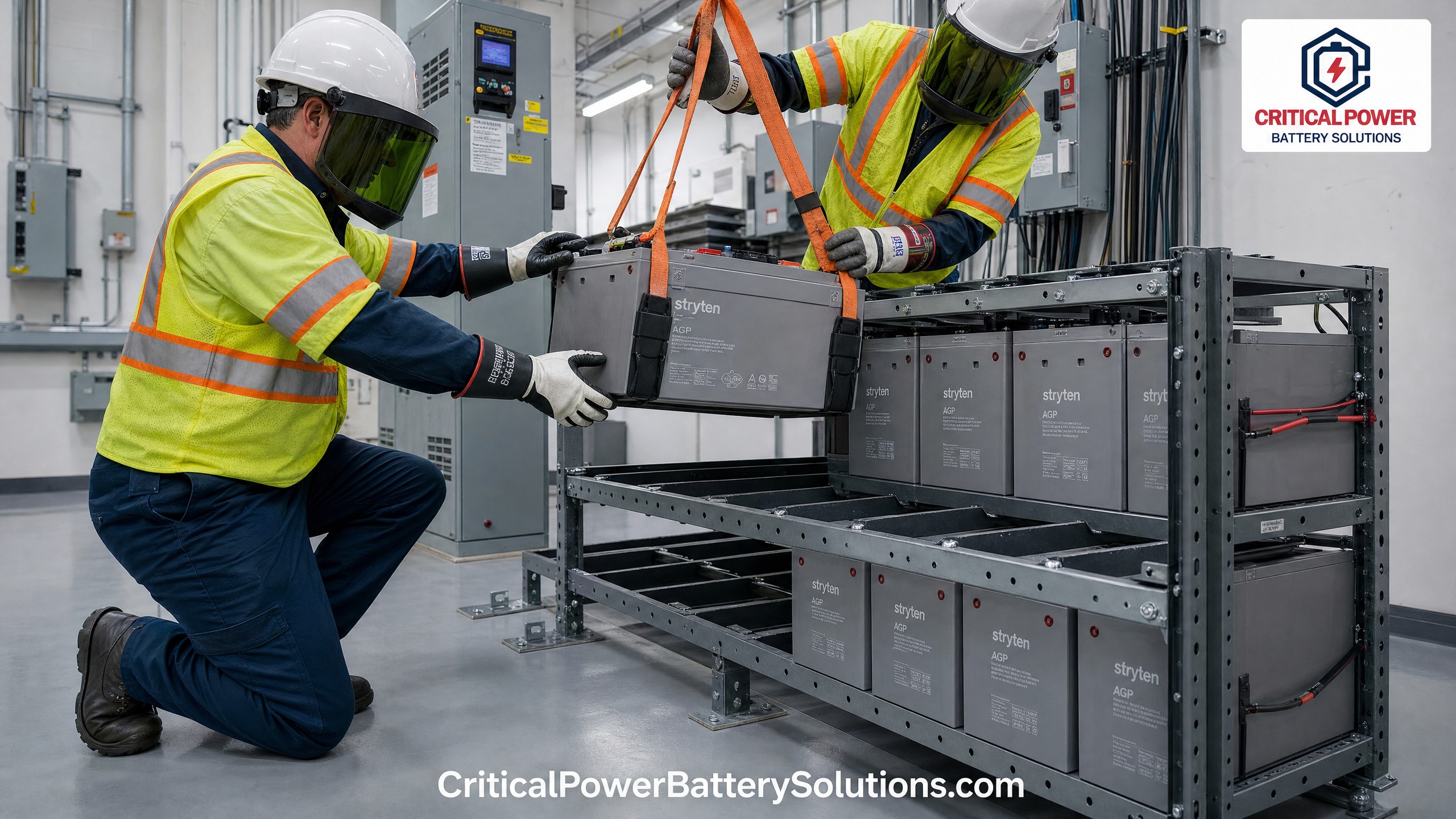
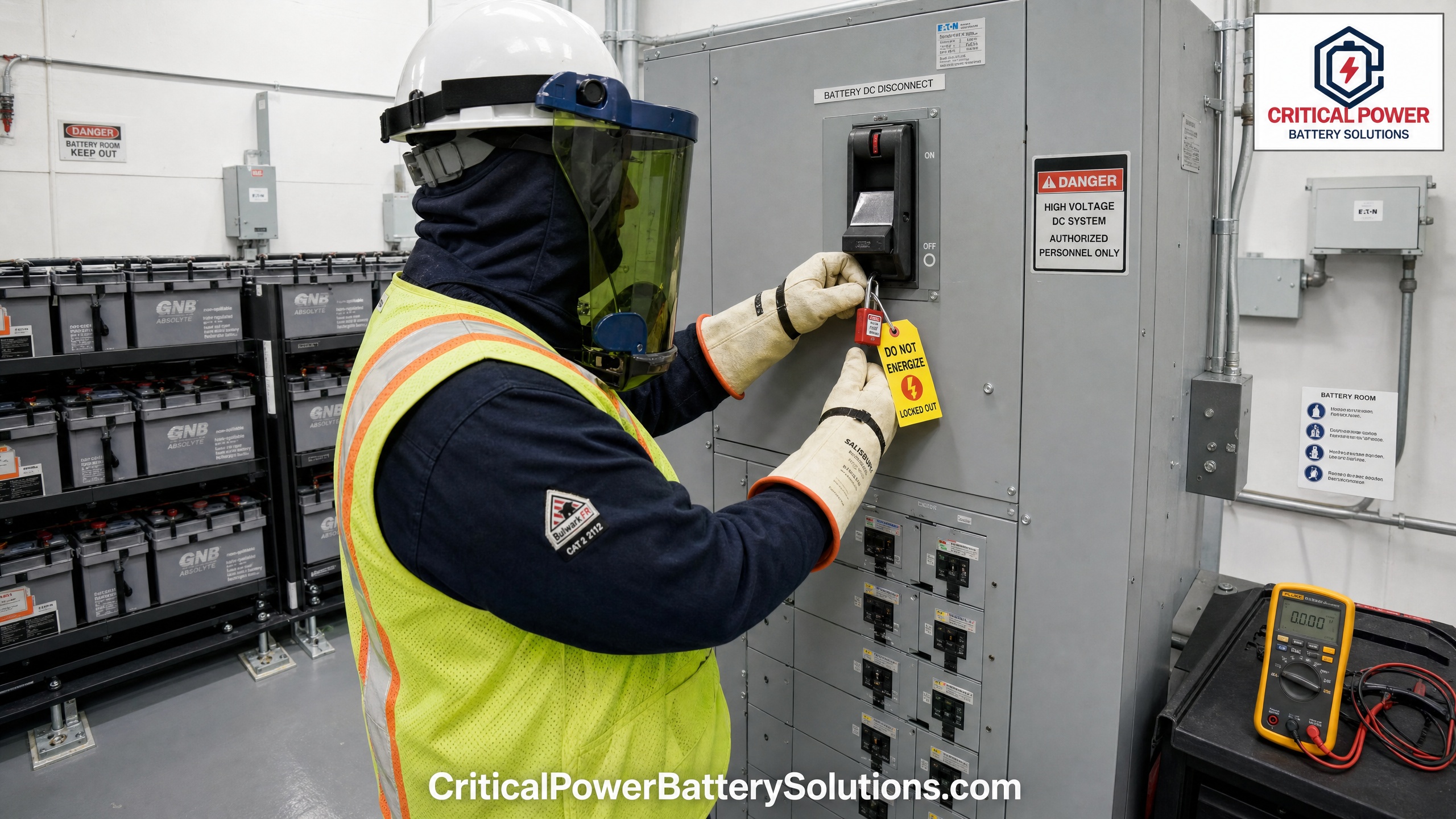
- De-energize the string and apply LOTO. Verify electrical isolation with a calibrated multimeter at the DC disconnect breaker. Apply the lead technician’s standardized lockout padlock and tag at the breaker handle. Document the zero-energy state in the work order before any wrench touches a terminal.
- Remove intercell connectors sequentially. Start at the grounded terminal (typically the negative post in telecom -48VDC plants) and work back. The grounded-first sequence prevents an accidental wrench short to the metal rack from drawing the full string voltage. Bag the connectors for recycling.
- Extract legacy GNB modules. AGP-family modules weigh 300 to 500 pounds each. Use a non-conductive lifting gantry with rated straps. Stage the legacy modules on the recycling pallet with insulated terminals and honeycomb separators per UN 2800 packaging requirements.
- Inspect and prepare the rack. Wire-brush all terminal contact points to bright metal. Inspect the modular steel trays for acid degradation; neutralize and clean with sodium bicarbonate where indicated. Confirm seismic anchorage hardware is intact and correctly torqued in seismic-zone installations.
- Position the new Stryten Absolyte AGP modules. Hoist into trays with the non-conductive gantry. Maintain manufacturer-specified spacing between modules for thermal dissipation. Orientation must be upright; do not tilt beyond 22.5 degrees per SE2001.
- Apply NO-OX-ID and torque to 100 in-lb. Apply a thin, even film of NO-OX-ID grease (or Stryten-approved equivalent) to all terminal posts and intercell connectors. Torque every intercell connection to exactly 100 in-lb (11.3 Nm) per Stryten SE2001 using a calibrated insulated torque wrench. Under-torque drives high-resistance hot spots; over-torque fractures the lead post seal. The 100 in-lb spec is exact.
- Apply the constant-voltage commissioning charge. Connect the string to the rectifier and apply the initial charge between 2.33 and 2.37 VPC for a minimum of 72 hours per SE2001. This equalizes any manufacturing or transit imbalance before the string sees a real load.
- Drop to float and record the baseline. Reduce the rectifier setpoint to 2.25 VPC float at 25 degrees C ambient, within the SE2001 range of 2.23 to 2.27 VPC. Apply the temperature coefficient of -1.67 mV per degree C per cell against the actual ambient. The baseline you record now is the trend reference for the next 20 years.
IEEE 1188 Baseline Post-Installation
The post-install baseline is the single most important deliverable of the entire replacement, because it is the trend reference against which every future IEEE 1188 reading is compared for the next 20 years.
The baseline is recorded 48 to 72 hours after the rectifier returns to float, once the constant-voltage commissioning charge has stabilized the string.
Per-cell baseline data to capture:
- Float voltage at the actual ambient (corrected back to 25 degrees C)
- Individual cell internal resistance in micro-ohms
- Inter-cell connection resistance in micro-ohms
- Ambient temperature at the cell level
- Visual condition note (any seal anomaly, terminal finish, or container blemish)
String-level baseline data to capture:
- Rectifier float voltage setpoint
- Total string voltage at float
- Total string current
- Ambient temperature at the room/cabinet level
- Date of baseline capture (the 20-year clock starts here)
Where the baseline lives once captured:
- Maintenance log: filed under the install date as the 20-year trend reference
- BMS threshold integration: subsequent quarterly readings auto-flag against trend, not a generic warning band
- Warranty file: the deliverable Stryten’s warranty desk requests if a cell goes out of spec inside the warranty period
- Procurement file: the basis for the next 18-to-20-year replacement decision
Telecom Central Office: Front-Terminal, Hot-Swap, NEBS, Seismic
Telecom central office replacements typically run as live -48VDC hot-swaps, one string at a time, with the redundant string carrying the load.
Hot-swap sequence per Telcordia GR-4228:
- Site engineer formally notifies network operations
- Lead technician verifies the redundant string is healthy and at float
- Swap string is isolated under LOTO
- Zero-energy state verified with calibrated multimeter
- Replacement procedure proceeds per Section 5 steps
Telecom-specific variables to confirm before the swap:
- NEBS Level 3 retention: configuration-dependent attribute on the new AGP cells; confirm at PO against the spec sheet for the specific module ordered
- Front-terminal access: dominant requirement on telecom builds; cells must come in and out through the front of fixed-position racks
- -48VDC plant balance: redundant string must carry the full load through the swap window
- Network operations sign-off: required before LOTO can be applied to a live telecom plant
Stryten Absolyte AGP modules in the telecom-friendly configurations are designed for front-access with the inter-cell connectors and torque points accessible without rotating the module in the tray.
For tight enclosures where AGP form factor does not fit, the Leoch Pure Lead front-terminal series is a CPBS-stocked alternative.
Seismic anchoring in Zone 4 jurisdictions (California, Washington, Oregon) is the most procedurally onerous variable on a telecom replacement:
- IBC 2018 Section 1613.5 classifies battery racks as nonstructural components
- IEEE 693-2005 defines the lateral force methodology for high-seismic installations
- Required Importance Factor of 1.5 with certified lateral force anchoring
- For 8-high stacks: base anchoring per the manufacturer’s seismic certificate
- Heavy-duty structural steel rack construction
- Licensed engineer sign-offs before the AHJ closes the permit
Data Center: UPS Sizing per IEEE 485 and IEEE 1635 Ventilation
Data center replacements turn on three variables that telecom builds usually do not: parallel string balancing across multiple UPS cabinets, IEEE 485 load resizing against the current kW profile, and IEEE 1635 ventilation against the room’s actual airflow design.
The load profile recorded in the original GNB sizing report is usually 10 to 20 years stale on an 18-to-20-year string. The replacement is the natural window to resize.
IEEE 485-2020 sizing methodology:
- Calculate the duty cycle from the real load profile
- Apply the temperature correction factor against the actual room ambient
- Apply the 1.25 aging factor so the string supports the load at end of design life
- Apply the design-margin factor for future load growth
- Output: cell selection (AGP capacity per cell) and string voltage
Parallel-string considerations for multi-cabinet UPS deployments:
- Sizing report specifies balancing tolerance the rectifier must maintain across strings
- String-to-string voltage variance kept within manufacturer-specified bands prevents load-sharing imbalance
- The full Stryten Absolyte AGP technical review documents AGP cells available for parallel-string deployments
IEEE 1635-2018 ventilation requirements for Absolyte AGP:
- Recombinant chemistry: more than 99% of hydrogen and oxygen generated during charging recombines internally back into water
- Normal operation: modest room ventilation typically sufficient
- Local fire code and AHJ override: some jurisdictions require hydrogen detection regardless of cell chemistry
- CPBS pre-install deliverable: ventilation review is bundled into every data center deployment package
For environments running flooded E-Series alongside Absolyte AGP, the Stryten E-Series selection guide covers the flooded MCT, MCX, NXT, H1T, and PDQ alternatives.
Verify the Stryten Authority Documents
🎯 Bonus Step. Before signing the PO, attach the three Stryten primary-source documents to the procurement file. They close every legitimate procurement, warranty, and AHJ question on a GNB-to-Stryten substitution.
Companion guide. This is the HOW-to-execute guide. If you are still deciding whether a replacement is needed at all, start with When to Replace Your Telecom Backup Batteries: A Site Manager’s Decision Guide, then return here for the field execution.
- Stryten E-Series Branding Change Letter: March 2023 rebrand announcement that formally renamed the GNB-branded industrial portfolio to Stryten.
- CPBS / ATS Stryten Energy Authorized Reseller Letter: signed reseller authorization from Stryten Zone Manager East Eric Nordhoff confirming CPBS as the authorized channel for Stryten Absolyte AGP and the E-Series flooded line.
- Manufacturer’s Declaration of Design Continuity: August 2023 declaration signed by Stryten Director of Engineering Michael Berger stating that design, engineering, and manufacturing remain unchanged from GNB to Stryten.
CPBS hosts all three under permanent URLs and references them in every replacement quote.
For broader compliance documentation context:
- CPBS GNB to Stryten compliance documentation guide
- GNB Absolyte GP replacement guide
- Companion supply post: are GNB batteries still available supply guide (publishing same week)
Frequently Asked Questions
How do I replace GNB Absolyte batteries?
Replacing GNB Absolyte is a defined 5-step procedure. Run an IEEE 1188 pre-assessment, cross-reference the legacy GNB part number to current Stryten Absolyte AGP (the same battery under the new name), place an 8-to-10-week procurement order, execute a LOTO-controlled field swap with intercell connectors torqued to 100 in-lb per Stryten SE2001, and document the post-install baseline as the 20-year trend reference.
What replaces a GNB Absolyte battery?
Stryten Absolyte AGP replaces GNB Absolyte GP and Absolyte IIP. Stryten Energy (formerly GNB Industrial Power) manufactures the same battery on the same line, with the same lead-calcium-tin grids, AGM separators, and 20-year design life. Only the brand name changed. The Berger Manufacturer’s Declaration is the substitution authority.
Are GNB Absolyte and Stryten Absolyte interchangeable?
Yes, GNB Absolyte and Stryten Absolyte are fully interchangeable. The August 2023 Manufacturer’s Declaration of Design Continuity, signed by Stryten Director of Engineering Michael Berger, states that the design, engineering, and product manufacturing remain unchanged from the GNB product to the Stryten Energy product. Footprint, terminals, charge profile, and performance specs are identical.
How long does it take to replace a GNB battery string?
Field execution runs 8 to 12 hours; full project timeline is 9 to 12 weeks. Field work on a typical 60-cell -48VDC telecom string runs 8 to 12 hours with a 2-person crew, including LOTO, removal, install, torque, commissioning charge initiation, and baseline reading capture. Full project timeline from PO to baseline-filed is 9 to 12 weeks, dominated by the 8-to-10-week domestic factory lead time on Stryten Absolyte AGP.
What tools are needed to replace Absolyte batteries?
A calibrated insulated torque wrench rated to 100 in-lb is the keystone tool. Required tools: calibrated insulated torque wrench (100 in-lb), calibrated digital multimeter, calibrated micro-ohmmeter, non-conductive lifting gantry with rated straps, Class 0 insulated gloves, arc flash face shield, acid-resistant apron, standardized LOTO padlocks and tags, and NO-OX-ID grease (or Stryten-approved equivalent).
What is the cross-reference for GNB Absolyte to Stryten Absolyte AGP?
Common 1:1 cross-references: 1-100A93, 1-100A87, 1-100A45, 6-50A07, 6-90A07. GNB 1-100A93, 1-100A87, and 1-100A45 map to Stryten Absolyte AGP 100A93, 100A87, and 100A45 equivalents respectively for telecom and data center UPS. GNB 6-50A07 and 6-90A07 map to AGP 6-50A07 and 6-90A07 for data center and utility substation. All five are physically and electrically interchangeable.
What IEEE 1188 thresholds signal Absolyte replacement?
Two quantitative thresholds: internal resistance over 20% above baseline or capacity below 80% of nameplate. IEEE 1188-2025 sets two quantitative replacement thresholds for stationary VRLA: internal resistance trending more than 20% above the commissioning baseline, and capacity below 80% of the 8-hour nameplate rate. Either condition, on its own, justifies replacement. Combined with 18-to-20-year age, jar swelling, or cascading BMS faults, the decision is conclusive.
What is the current lead time on Stryten Absolyte AGP?
8 to 10 weeks domestic from the US factory; 12 to 16 weeks international. Stryten Absolyte AGP domestic lead time is 8 to 10 weeks from the US factory. International orders run 12 to 16 weeks and require 50% down at PO with the balance at port-of-entry. CPBS confirms lead time on every quote against current Stryten production scheduling at the time of order.
How are spent GNB Absolyte cells recycled?
Through Stryten’s closed-loop recycling network under DOT 49 CFR 172 and UN 2800. Spent GNB Absolyte cells route through Stryten’s closed-loop recycling network to authorized lead smelters under DOT 49 CFR 172, UN 2800, Class 8 (Corrosive), Packing Group III. CPBS provides chain-of-custody documentation and the pickup quote in the same package as the replacement quote. Lead-acid recovery at end of life runs approximately 99 percent.
What torque specs apply to Absolyte AGP intercell connections?
Exactly 100 in-lb (11.3 Nm) per Stryten SE2001 on every intercell connection. Stryten SE2001 specifies exactly 100 in-lb (11.3 Nm) on every intercell connection on Stryten Absolyte AGP modules, applied with a calibrated insulated torque wrench. Under-torque drives high-resistance hot spots that accelerate corrosion; over-torque fractures the lead post seal and voids warranty. A NO-OX-ID anti-corrosion film is applied to the joint before torquing.
Can Absolyte AGP be hot-swapped on a live -48VDC telecom plant?
Yes, under defined conditions: one string at a time with the redundant string at full load. Telecom hot-swaps require the redundant string verified healthy and carrying the full load, the swap string isolated under LOTO per Telcordia GR-4228 sequencing, and network operations formally notified. CPBS crews execute live -48VDC hot-swaps routinely as standard telecom field practice. The procedure assumes a redundant string is available.
What ventilation does IEEE 1635 require for an Absolyte AGP install in a data center?
Modest forced ventilation under normal operation; verify against the local AHJ. For Stryten Absolyte AGP, recombinant chemistry recombines more than 99% of gas internally, so IEEE 1635-2018 room ventilation requirements are typically modest under normal float operation. Confirm against the local fire code and the AHJ; some jurisdictions require hydrogen detection regardless of cell chemistry.
About the author
Tom Kierna is a Battery Systems Specialist at Critical Power Battery Solutions with more than 40 years of experience in industrial battery systems, including 15 years on the GNB and Stryten side of the desk before joining the CPBS technical sales team. Tom advises facility engineers and maintenance directors on Stryten Absolyte AGP and E-Series flooded sizing, IEEE 1188 baseline programs, and GNB-to-Stryten transition procurement. Direct line: 630-984-9718. Last updated 2026-05-14.
References
- Stryten Energy. E-Series GP Installation and Operations Manual – Absolyte AGP (SE2001). Stryten Energy, 2023. Source for 100 in-lb intercell torque, 2.25 VPC float voltage range 2.23 to 2.27 VPC at 25 degrees C, -1.67 mV per degree C per cell temperature coefficient, 4A per 100 Ah maximum initial charge current, and 2.33 to 2.37 VPC initial commissioning charge for minimum 72 hours.
- Institute of Electrical and Electronics Engineers. IEEE 1188-2025: Recommended Practice for Maintenance, Testing, and Replacement of Valve-Regulated Lead-Acid Batteries for Stationary Applications. IEEE, 2025.
- Institute of Electrical and Electronics Engineers. IEEE 485-2020: Recommended Practice for Sizing Lead-Acid Batteries for Stationary Applications. IEEE, 2020.
- Institute of Electrical and Electronics Engineers. IEEE 1635-2018: Guide for the Ventilation and Thermal Management of Batteries for Stationary Applications. IEEE, 2018.
- Berger, M. Stryten Energy Manufacturer’s Declaration: GNB to Stryten Brand Change. Stryten Manufacturing, August 17, 2023. Hosted PDF.
- Nordhoff, E. CPBS / ATS Stryten Energy Authorized Reseller Letter. Stryten Energy, 2023. Hosted PDF.
- Stryten Energy. E-Series Product Branding Change Letter. Stryten Manufacturing, March 6, 2023. Hosted PDF.
- U.S. Department of Transportation. Hazardous Materials Regulations, Title 49 CFR Part 173.159 (UN 2800, Class 8 Corrosive, Packing Group III).
- International Code Council. 2018 International Building Code, Section 1613.5 (Seismic Design Category, Nonstructural Components).
- Institute of Electrical and Electronics Engineers. IEEE 693-2005: Recommended Practice for Seismic Design of Substations.