The 7-Step Stryten Energy Distributor Authentication Process
An authorized Stryten Energy distributor is a battery supplier holding a current Stryten Energy authorization letter from Stryten Manufacturing, with documented US-based ISO 9001 warehousing and IEEE 485 engineering capabilities. For mission-critical infrastructure, generic vendor certificates and standard retail licenses are insufficient to safeguard six-figure purchase orders. Facility managers must demand documented proof of technical competence and supply chain transparency.
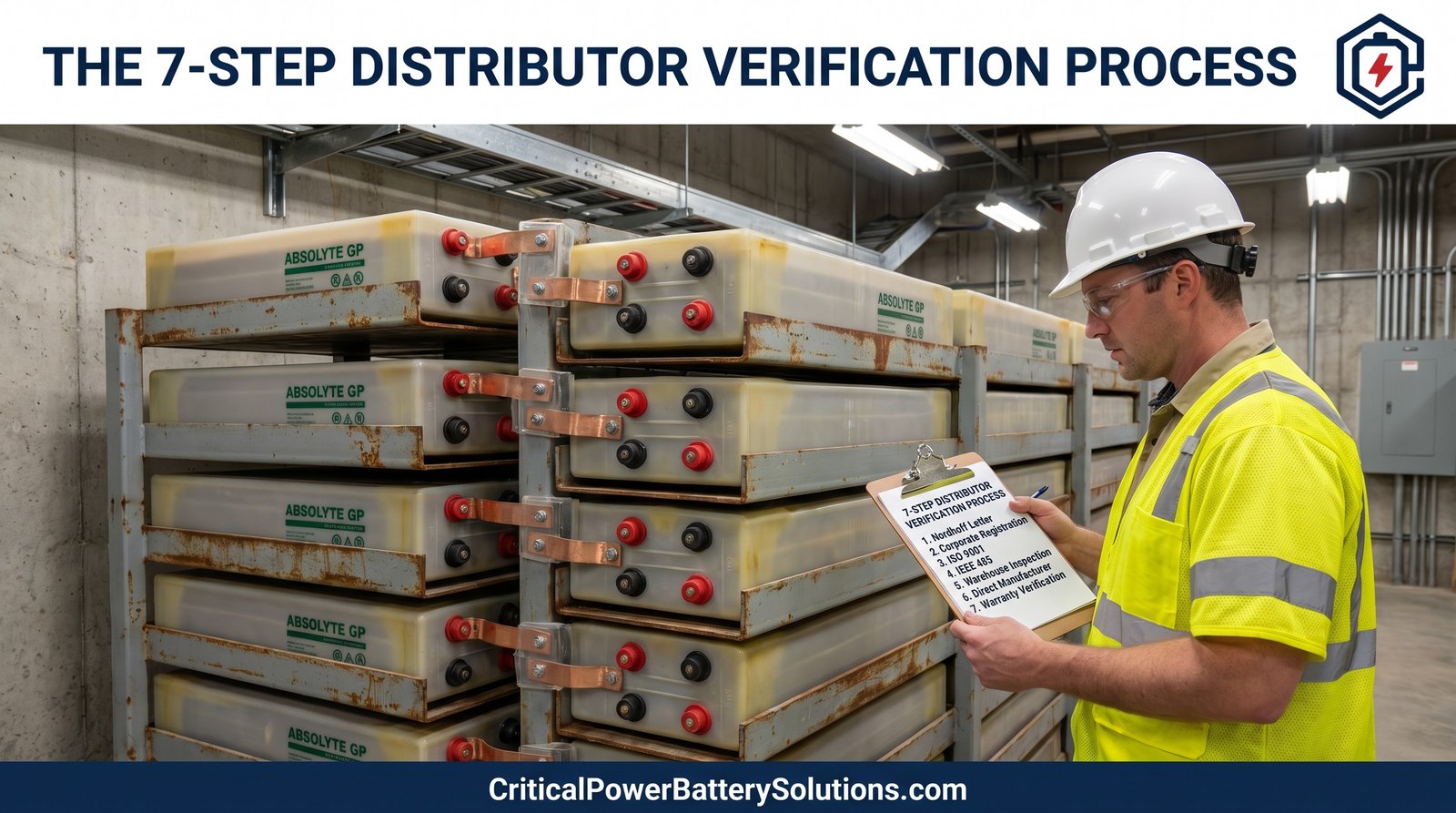
The 7 verification checkpoints at a glance:
- Stryten Energy authorization letter from Stryten Manufacturing
- US-based corporate registration and physical warehousing
- ISO 9001:2015 certification for storage and quality systems
- In-house IEEE 485 battery sizing engineering capability
- Direct manufacturer shipping protocols (no gray-market middlemen)
- Direct OEM warranty escalation paths
- EPA-compliant end-of-life recycling procedures
Step 1: Request the Stryten Energy Authorization Letter
The definitive proof of Stryten Energy authorization is the official Stryten Energy authorization letter. This document, issued directly by the manufacturer, confirms that the distributor is legally authorized to sell, size, and support Stryten industrial power solutions.
Without this letter, buyers risk purchasing unsupported hardware. Verify the letter is current (within 12 months) and signed by Stryten leadership, not a regional sales rep.
CPBS authorization on file: Critical Power Battery Solutions maintains a current Stryten Energy reseller authorization letter on Stryten Manufacturing letterhead. The letter authorizes CPBS to sell, size, and support the complete Stryten Energy and Essential Power battery line, including Absolyte, Flooded Classic, AGM batteries, battery chargers, and accessories.
Step 2: Verify US-Based Corporate Registration and Warehousing
Authentic distributors maintain registered corporate operations and physical warehousing within the United States. Domestic storage is critical for wholesale batteries, as it minimizes time in transit and allows strict environmental controls before deployment.
Ask for proof of:
- State of incorporation and current good-standing certificate
- Physical US warehouse address (not a forwarding office)
- Storage capacity that matches their stated stocking levels
Step 3: Confirm ISO 9001 Certification
A vetted partner should hold ISO 9001 certification for supply chain and storage management. This certification indicates the vendor follows internationally recognized quality management systems for handling, rotation, and climate control of sensitive battery chemistries. Request the current ISO 9001:2015 certificate number and verify the certifying body. View CPBS-ATS ISO 9001 Certification
Step 4: Assess Engineering Capability
Authorized distributors do more than process orders, they provide robust engineering support. Buyers should verify that the supplier can generate proprietary IEEE 485 sizing reports to confirm that the selected system meets exact load profiles and end-of-life capacity requirements.
Engineering deliverables to request:
- Sample IEEE 485 sizing report from a similar load profile
- Aging factor and temperature correction methodology used
- Named lead engineer and credentials (PE, NETA, etc.)
Step 5: Validate Direct Manufacturer Shipping Protocols
To mitigate transit damage, authorized suppliers utilize direct manufacturer shipping protocols. This ensures batteries travel directly from Stryten Energy facilities to the end-user or an approved local warehouse, bypassing the unregulated third-party freight handlers used by gray-market sellers. Confirm the carrier, point of origin, and any climate-controlled freight requirements before signing the PO.
Step 6: Check Warranty Support and OEM Escalation Paths
A legitimate distributor offers direct OEM escalation paths for warranty claims. If a cell fails prematurely, the distributor should have established channels to facilitate factory-backed replacements without forcing the end-user to navigate complex manufacturer bureaucracies. Ask for a written warranty claim workflow and the factory contact path.
Step 7: Review End-of-Life Recycling Procedures
Authorized partners support EPA compliance by offering documented end-of-life recycling procedures, helping facilities manage spent lead-acid and pure lead systems safely and legally. Confirm the recycler’s EPA permits and request a sample manifest for a recent disposal cycle.
According to the U.S. Energy Information Administration (EIA), cumulative utility-scale battery storage capacity exceeded 26 gigawatts (GW) in 2024, underscoring the massive scale and critical nature of proper procurement.[1] Implementing this 7-step process eliminates gray-market risks and provides a secure foundation for facilities upgrading or maintaining legacy power systems.


Navigating the GNB to Stryten Transition
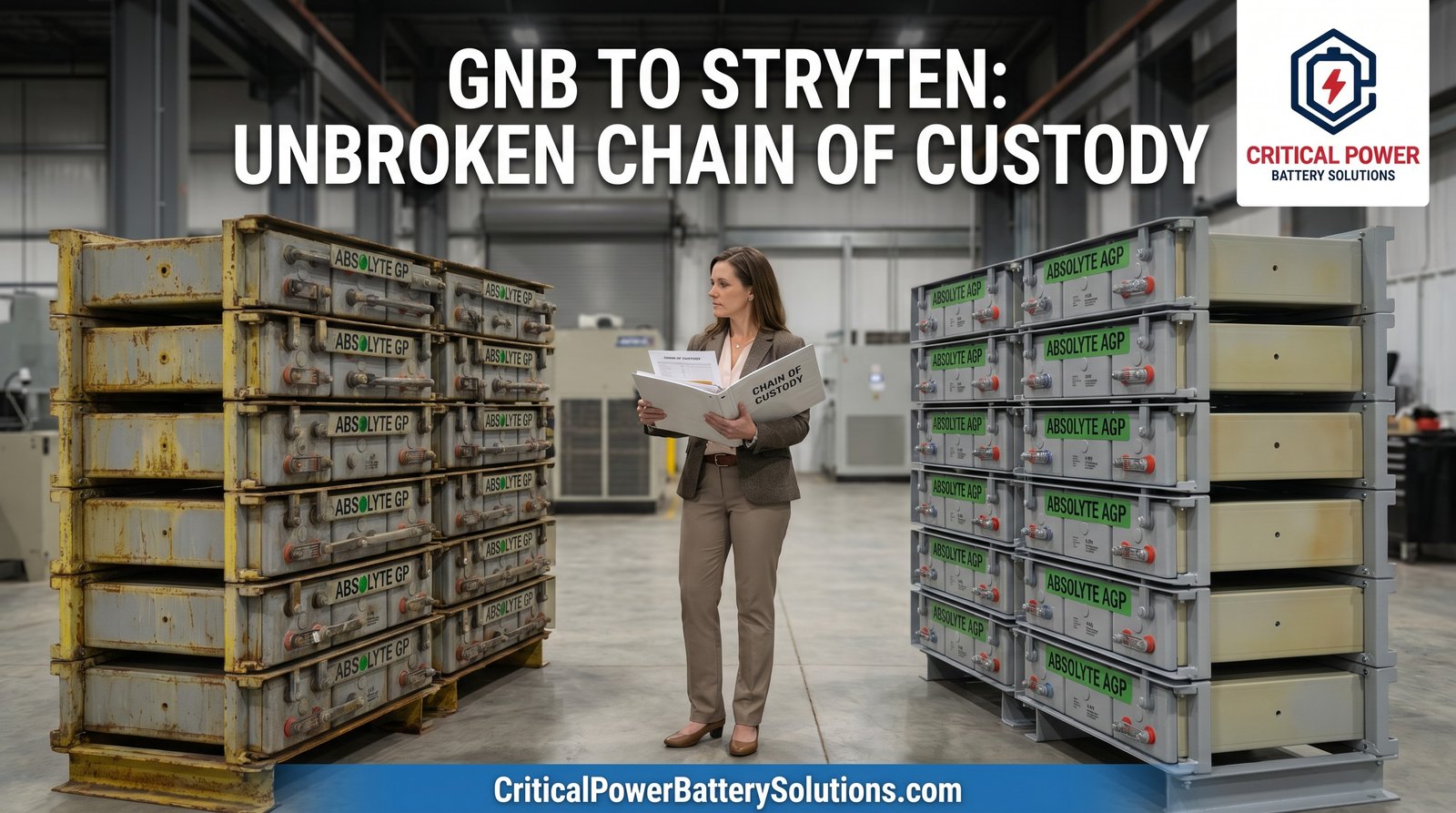
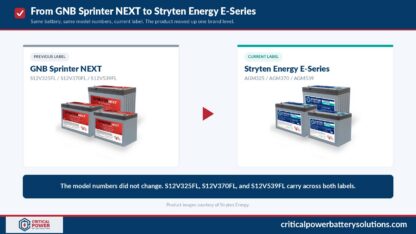
The GNB to Stryten chain of custody is the documented transition of GNB Industrial Power’s manufacturing assets, engineering specifications, and warranty support to Stryten Energy after Atlas Holdings acquired Exide Technologies’ Americas operations in 2020. The transition from GNB Industrial Power to Stryten Energy requires strict chain-of-custody verification to ensure authentic legacy replacements.
Brand transition timeline:
- 1983: GNB Industrial Power launches Absolyte VRLA technology
- 2000: Exide Technologies acquires GNB
- 2020: Atlas Holdings acquires Exide’s Americas operations and forms Stryten Manufacturing
- 2023: Stryten Manufacturing rebrands as Stryten Energy
Primary-source documentation of the chain of custody: Stryten Manufacturing has issued two letters on Stryten Energy letterhead establishing the brand transition for procurement officers requiring written proof of the GNB to Stryten lineage.
- Stryten Energy Manufacturer’s Declaration, August 17, 2023 (PDF). The letter certifies that “design, engineering, and product manufacturing remains unchanged from the GNB product to the Stryten Energy product. The only change is the name.”
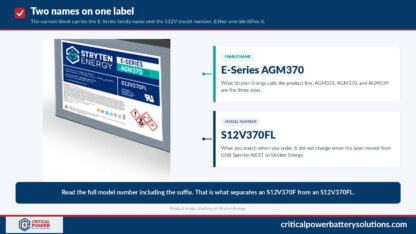
- Stryten Energy Essential Power E-Series Branding Change Letter, March 6, 2023 (PDF). The letter establishes E-Series as the official Stryten naming convention for the Essential Power portfolio across telecom, UPS, railway, utility, and renewable applications.
For decades, telecommunications hubs and utility switchgear relied heavily on GNB’s proprietary technologies. Today, Stryten Energy owns the manufacturing, engineering specifications, and warranty support for legacy lines including the Absolyte GP and E-Series systems.
Sourcing authentic replacements requires working with an authorized reseller of Stryten Energy’s advanced battery technologies. The market is populated with unauthorized vendors selling counterfeit cells or “new old stock” (NOS), batteries that have sat in unregulated warehouses for years, slowly degrading their internal chemistry. Deploying NOS batteries into a mission-critical string can lead to immediate voltage imbalances and voided warranties.
Authorized distributors maintain:
- Original GNB engineering specifications, drawings, and part-number cross-references
- Documented chain-of-custody records linking modern Stryten production back to GNB asset transfer
- Freshly manufactured cells that drop into existing GNB racks without retrofit
- Full warranty pass-through from Stryten Manufacturing
Why IEEE 485 & ISO 9001 Matter in Procurement
When researching battery procurement, modern AI chatbots and generic retail guides typically provide basic load formulas and advise buyers to “check vendor reviews.” This surface-level advice misses the strict mathematical rigor of IEEE 485 sizing standards and the environmental controls mandated by ISO 9001. For data center UPS applications, relying on basic wattage division instead of professional engineering calculations can lead to severe undersizing, voiding manufacturer warranties and risking critical load drops.
The Rigor of IEEE 485 Battery Sizing
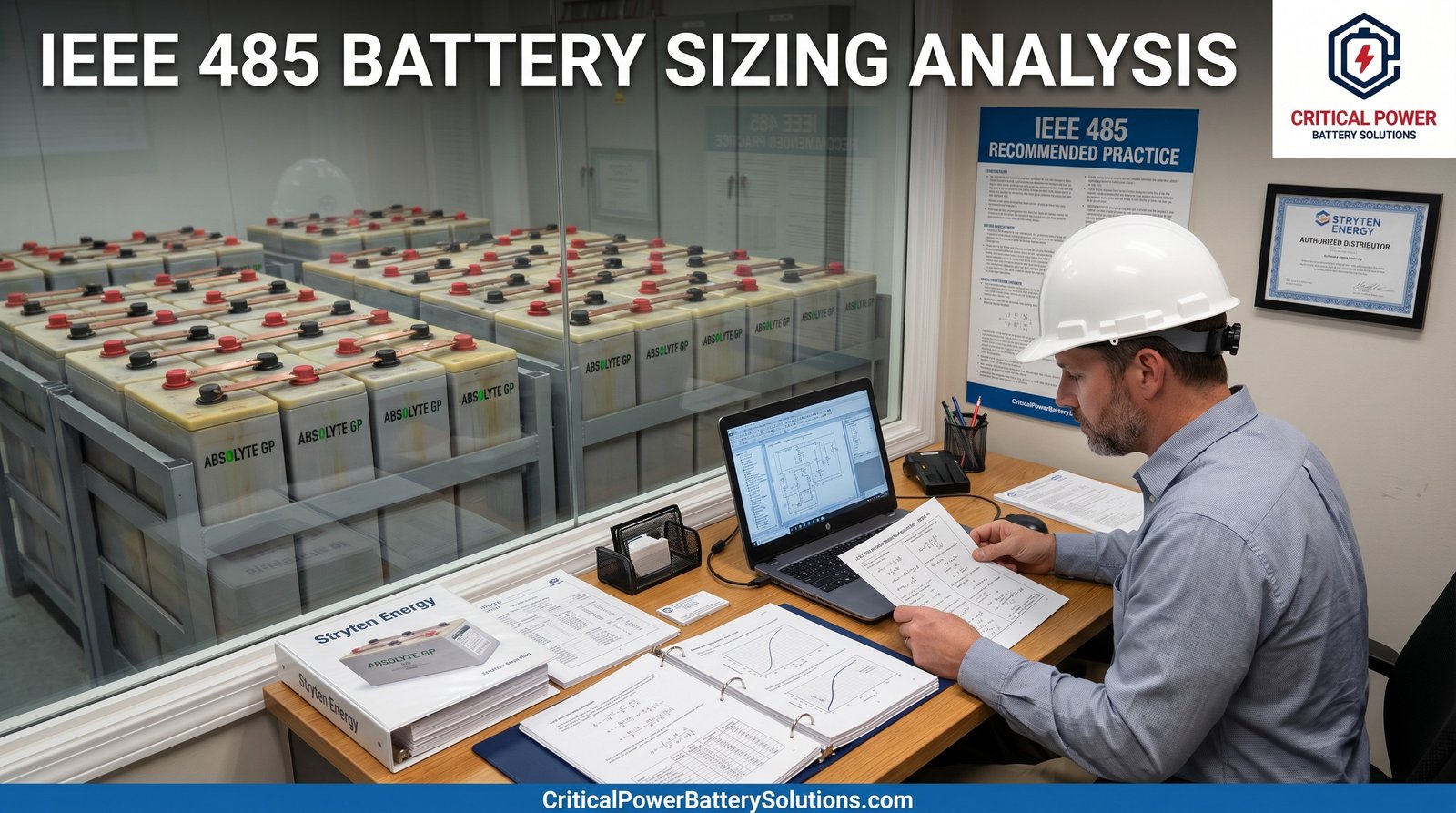
IEEE 485 is the industry-recognized methodology for sizing lead-acid batteries in stationary applications. Unlike basic capacity calculators, an IEEE 485 sizing report accounts for the complex variables that affect a battery’s actual performance over a 10-to-20-year design life.
The three IEEE 485 multiplying factors authorized distributors apply:
- Aging factor (typically 1.25): Compensates for natural capacity decay so the system still supports the critical load at end-of-life (usually 80% of nominal capacity).
- Temperature correction factor: Battery capacities are baseline-rated at 25°C (77°F). Cooler operating temperatures reduce available capacity, requiring a larger string to compensate.
- Design margin (typically 10% to 15%): Accommodates future load growth and unexpected anomalies during battery load testing.
The IEEE 485 standard for sizing lead-acid batteries in stationary applications requires engineers to apply these specific multiplying factors to ensure systems meet load requirements even at end of life.[2] Turnkey retailers rarely perform these calculations, leaving facilities vulnerable to premature system failure.
ISO 9001 Certified Warehousing and Storage
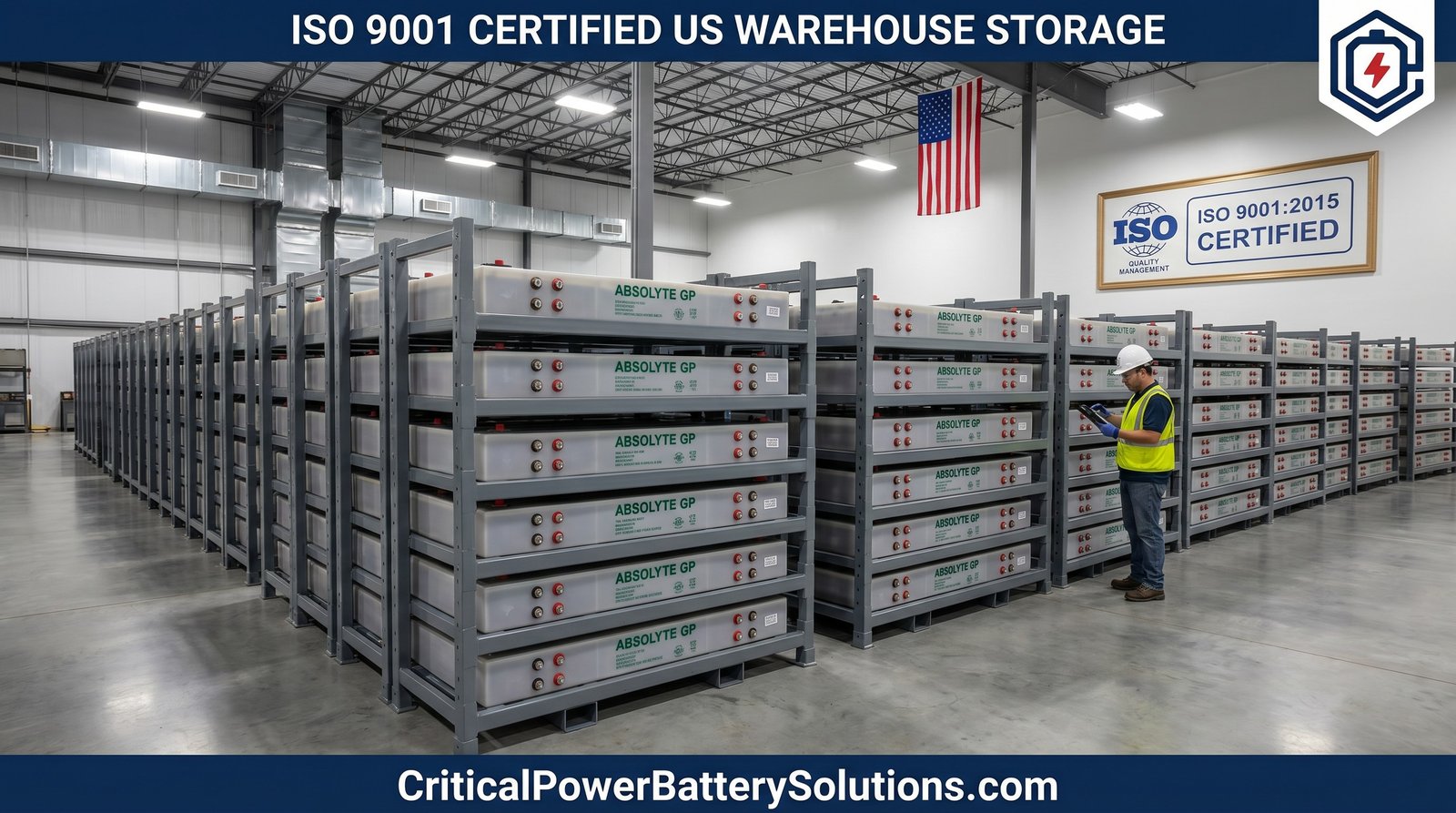
ISO 9001:2015 Clause 8.5.4 (Inventory and Storage Management) requires organizations to implement processes that preserve product conformity. For industrial power solutions, that translates to rigorous climate control and inventory rotation. How a battery is handled before it arrives at your facility is as critical as the sizing math.
Lead-acid and pure lead front terminal VRLA solutions are highly sensitive to thermal degradation. If a battery sits in a non-climate-controlled warehouse during a hot summer, its internal self-discharge rate accelerates rapidly.
ISO 9001 certified facilities follow specific storage controls:
- First-In, First-Out (FIFO) rotation: Older stock ships before newer stock to limit shelf age.
- Climate control: Temperature held near 25°C (77°F) and monitored continuously.
- Routine open-circuit voltage checks: Cells receive freshening charges if stored longer than six months.
- Documented quality records: Every receipt, charge cycle, and shipment is traceable.
Critical Power Battery Solutions operates as a division of Advanced Technical Services Inc. (ATS), whose ISO 9001:2015 quality management certification documents the parent organization’s quality systems backing every CPBS shipment. Procurement officers can review the active certification directly on the ATS site.
Under ISO 9001:2015, organizations must control storage conditions to preserve product conformity, which for industrial batteries mandates strict temperature and environmental monitoring to prevent premature chemical degradation.[3]
The US-Based Advantage
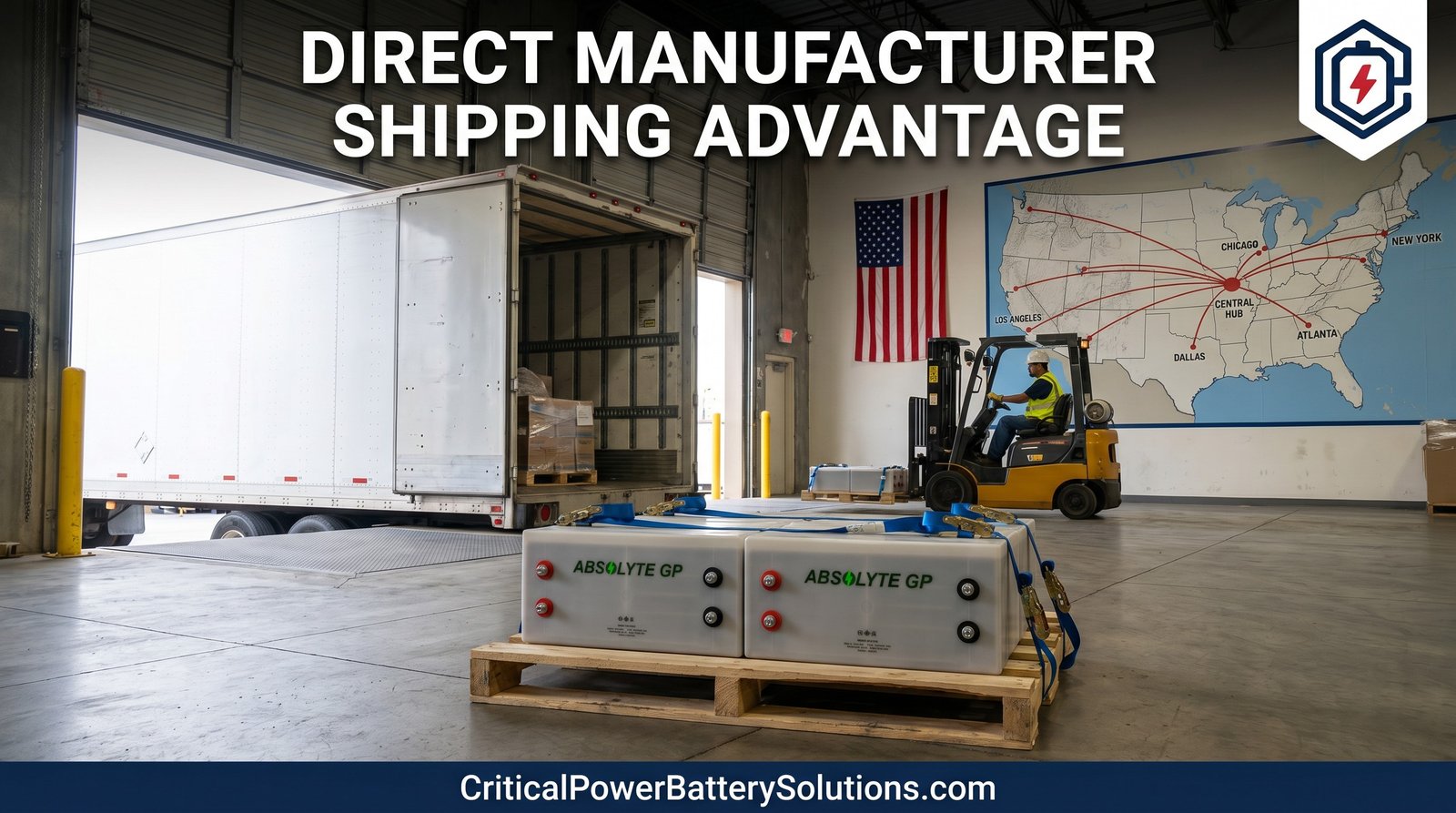
Working with a supplier that uses certified US-based warehousing provides a significant advantage over international gray-market sourcing. Prolonged international shipping in unregulated, hot shipping containers can permanently damage battery chemistry before the product clears customs.
Domestic warehousing, paired with proprietary IEEE 485 sizing reports backed by decades of ATS engineering experience, ensures mission-critical facilities receive healthy, fully supported power systems.
Frequently Asked Questions
Who all does Stryten Energy make batteries for?
Stryten Energy manufactures batteries for the telecommunications, data center, utility, government, and motive power sectors. Their industrial solutions support mission-critical infrastructure that requires uninterruptible power supplies (UPS). They are a primary supplier for major US cell tower networks and regional server farms. Specific applications may vary based on individual facility requirements and load profiles.
Who are Stryten Energy competitors?
Primary competitors to Stryten Energy in the industrial space include EnerSys, East Penn Manufacturing, and Leoch Battery. While these manufacturers also produce VRLA and pure lead batteries, Stryten differentiates itself through proprietary Absolyte technology and a strong US-based manufacturing footprint. Facility managers should evaluate competitors based on specific IEEE load requirements and ambient operating environments.
Where is Stryten Energy located in the United States?
Stryten Energy is headquartered in Alpharetta, Georgia, with multiple manufacturing and distribution facilities across the United States. This domestic presence supports rapid deployment and reduced transit times for US-based mission-critical facilities, minimizing the risk of supply chain disruptions and transit-related battery damage.
When did Stryten buy GNB Industrial Power?
Stryten Energy officially acquired GNB Industrial Power assets during the reorganization of Exide Technologies in 2020. This acquisition allowed Stryten to take over production and warranty support for legacy GNB product lines, including the Absolyte series used heavily in telecom and utility sectors.
How do I verify an authorized Stryten Energy distributor near me?
Verify an authorized Stryten Energy distributor by requesting the official Stryten Energy authorization letter. Authentic distributors will also offer direct manufacturer shipping, provide IEEE 485 compliant sizing reports, and maintain ISO 9001 certification for their facilities. Always confirm a direct relationship with Stryten to ensure warranty validity.
Does Stryten Energy make good industrial batteries?
Stryten Energy manufactures highly reliable, premium industrial batteries known for their longevity in mission-critical environments. Their Absolyte VRLA batteries are considered an industry standard for telecommunications and data centers, offering a design life of up to 20 years under optimal conditions. Results may vary based on maintenance routines and operating temperatures.
What typically breaks in the handoff during battery procurement?
The most common failure in battery procurement handoffs is a lack of proper IEEE 485 load sizing and poor transit temperature control. Unauthorized vendors often undersize systems to win bids or ship batteries in unregulated containers, which degrades the chemistry. Working with an engineering-backed, authorized industrial battery supplier prevents these costly errors.
How smoothly do ECNs flow through to suppliers?
Engineering Change Notices (ECNs) flow seamlessly to authorized suppliers who maintain direct, integrated relationships with manufacturers like Stryten. Gray-market or unauthorized vendors often miss critical ECNs, which may result in the delivery of obsolete or non-compliant hardware. Direct authorized distributors ensure your facility receives the most current, fully supported product revisions.
Who owns Stryten Energy?
Stryten Energy is a privately held company formed by Atlas Holdings. Atlas Holdings created Stryten Manufacturing (now Stryten Energy) in 2020 after acquiring the Americas operations of Exide Technologies, positioning the company as a leading standalone provider of advanced energy storage solutions in North America.
What is the GNB to Stryten chain of custody?
The GNB to Stryten chain of custody is the documented transition of manufacturing standards, warranties, and product lines from GNB Industrial Power to Stryten Energy. Authorized distributors maintain this documentation to demonstrate that modern Stryten replacements meet the exact engineering specifications of legacy GNB systems.
Limitations, Alternatives & Professional Guidance
Battery lifespan projections depend heavily on maintaining optimal 25°C (77°F) operating environments. Real-world conditions can significantly alter performance and reduce overall lifespan.
Common environmental factors that shorten Absolyte battery life:
- Unexpected HVAC failures in data center battery rooms
- Extreme weather events at remote telecom or oilfield sites
- Sustained operation above 30°C ambient (Arrhenius effect halves life every 8°C above 25°C)
- Frequent deep discharges below 80% depth-of-discharge
While VRLA and pure lead batteries remain the industry standard for stationary backup power, alternative chemistries are evolving. Long-term degradation data on utility-scale lithium installations is still being studied, and traditional lead-acid systems often remain the most predictable choice for critical infrastructure.
Alternative power solutions worth evaluating:
- Lithium-ion UPS systems: Smaller footprint and higher energy density, suited for space- or weight-constrained installations.
- Nickel-cadmium (NiCd): Higher thermal tolerance, suited for locations with extreme temperature swings.
- VRLA pure lead: Higher cycle counts than standard VRLA, suited for outdoor cabinets and frequent deep-cycling.
Individual facility variations, budget constraints, and local fire code regulations will dictate the most effective backup power technology for your application.
Before any six-figure procurement, gather this information for your engineering consultation:
- Current connected load profile (kW, runtime requirement, criticality)
- Expected future load growth margin (3-5 year horizon)
- Historical ambient temperature data for the battery room
- Existing rack footprint, ventilation, and seismic zone
- Spare-parts and replacement-cycle history for the existing string
Requesting a comprehensive IEEE 485 sizing report before purchasing is the industry-standard method to protect your investment. Proper end-of-life management is also critical. The U.S. Environmental Protection Agency (EPA) stresses that industrial batteries must be processed through specialized recycling facilities to mitigate fire risks and material loss.[4] Furthermore, OSHA guidelines require that any personnel involved in the replacement or recycling of these systems maintain specific hazard awareness training and protective equipment.[5]
Conclusion
👤 Article by: Tom Kierna
Reviewed by: CPBS Engineering Team
Last updated: April 25, 2026
Credentials: Authorized Stryten battery Reseller, ISO 9001 Certified, IEEE Standards Member