Battery Capacity Calculation for Telecom Loads: Selecting 50G, 90G, or 100G Cells
👤 Article by: Tom Kierna
Reviewed by: CPBS Engineering Team
Last updated: March 22, 2026
Credentials: Authorized Stryten battery Reseller, ISO 9001 Certified, IEEE Standards Member


Transparency: This article explores battery capacity calculation based on IEEE 485 standards, IBC codes, and scientific research. Some links may connect to our authorized Stryten Energy and Leoch products/services. All information is verified and reviewed by our ISO 9001 certified engineering team. Our goal is accurate, helpful information for mission-critical infrastructure.
The Fundamentals of IEEE 485 Battery Capacity Calculation
Accurate battery capacity calculation dictates that engineers evaluate load profiles, discharge duration, and end-of-discharge voltage using IEEE 485 methodology. Unlike a generic battery sizing calculator, this standard is designed to verify that a 48V telecom battery system will reliably support critical loads under worst-case scenarios.
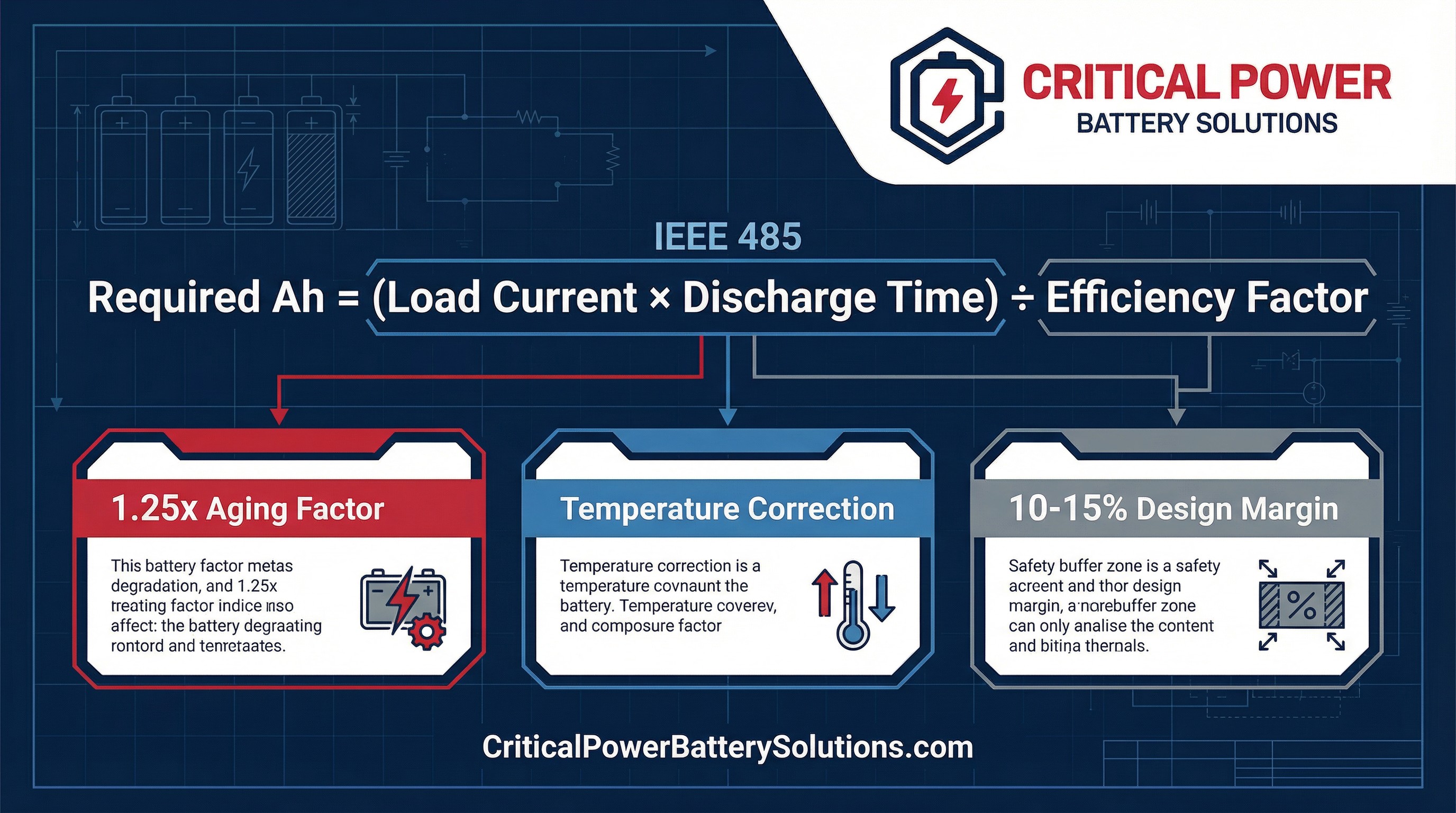
The fundamental battery sizing calculation formula (Load Current × Discharge Time ÷ Efficiency Factor) provides the baseline, but it must incorporate Peukert’s law for varying discharge rates. In the peer-reviewed IEEE 485-1997 standard for sizing lead-acid batteries, engineers established precise temperature correction factors and Peukert’s law applications for stationary backup power. Standards are developed by consensus of industry experts. Furthermore, IEEE 485 mandates a 1.25 aging factor, ensuring the battery still meets 100% of the load at the end of its 20-year design life.
While the 40 to 80 rule suggests maintaining a VRLA battery charge level between 40% and 80% may help optimize cycle life in specific cyclic applications, standby telecom systems typically float at 100% readiness. Finally, incorporating a 10-15% design margin is standard practice to accommodate future load growth.
Applying these IEEE 485 standard fundamentals ensures the baseline calculation is sound, as often shown in standard formula breakdowns. However, translating this raw amp-hour requirement into specific industrial hardware requires understanding OEM nomenclature, which leads us to the Absolyte AGP selection process.
Absolyte AGP Selection Matrix: 50G vs. 90G vs. 100G
Selecting the correct telecom battery backup systems requires mapping your calculated amp-hour (Ah) load to the appropriate plate size and cell configuration. A common industry misconception is that cell nomenclature dictates total capacity, but the G-series designation actually refers to the physical plate type, not the Ah rating.
For small remote sites, utility edge devices, and standard telecom cabinets, 50G cells (140–950 Ah) are highly effective. Their compact footprint fits standard rack configurations effortlessly. The 90G cells serve as the mid-tier solution for regional hubs requiring balanced capacity and a moderate footprint. Conversely, 100G cells (790–4,800 Ah) are engineered for massive central offices and data centers. These high-capacity modules are designed for horizontal modular stacking.
When performing battery bank sizing, engineers must decide whether to specify multiple strings of 50G cells for redundancy or a single massive string of 100G cells to maximize space efficiency. In federal environmental management guidelines, the EPA outlines end-of-life recycling protocols and validates the 20-year design life expectations for industrial VRLA stationary batteries. Standards are federally developed.
Table 1: Absolyte AGP Cell Selection Matrix
| Cell Series | Ah Range | Ideal Application | Footprint/Stacking |
|---|---|---|---|
| 50G | 140–950 Ah | Remote Shelters / Edge | Standard Rack |
| 90G | Moderate | Regional Hubs | Standard/Reinforced |
| 100G | 790–4,800 Ah | Central Offices / Data Centers | Horizontal Modular Stacking |
Note: Review Absolyte battery specs for precise dimensions and weight limits.
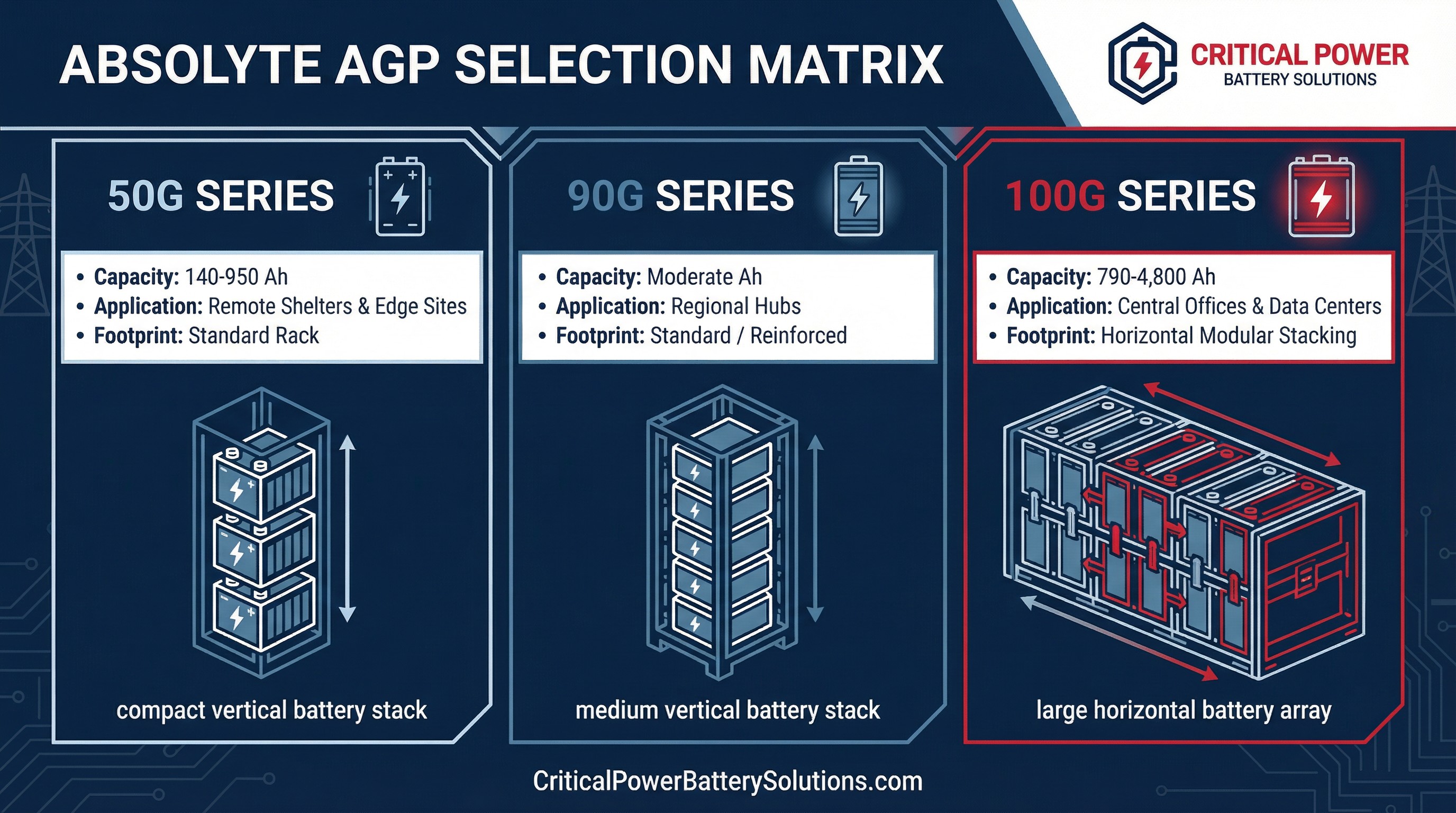
By replacing outdated dynamic selection charts with this logic, facility managers can optimize their physical space and confidently specify Stryten Absolyte AGP systems. Yet, selecting the cell is only half the battle; physical environment and installation physics must dictate the final design.
AI Gaps in Battery Sizing: Modular Stacking & Regional Climate Multipliers
Generic AI tools typically provide basic 25°C (77°F) capacity formulas and dangerously assume that “100G” means a 100Ah battery. What these models miss is the physical reality of modular stacking physics and the severe impact of US regional climates on telecom power systems.
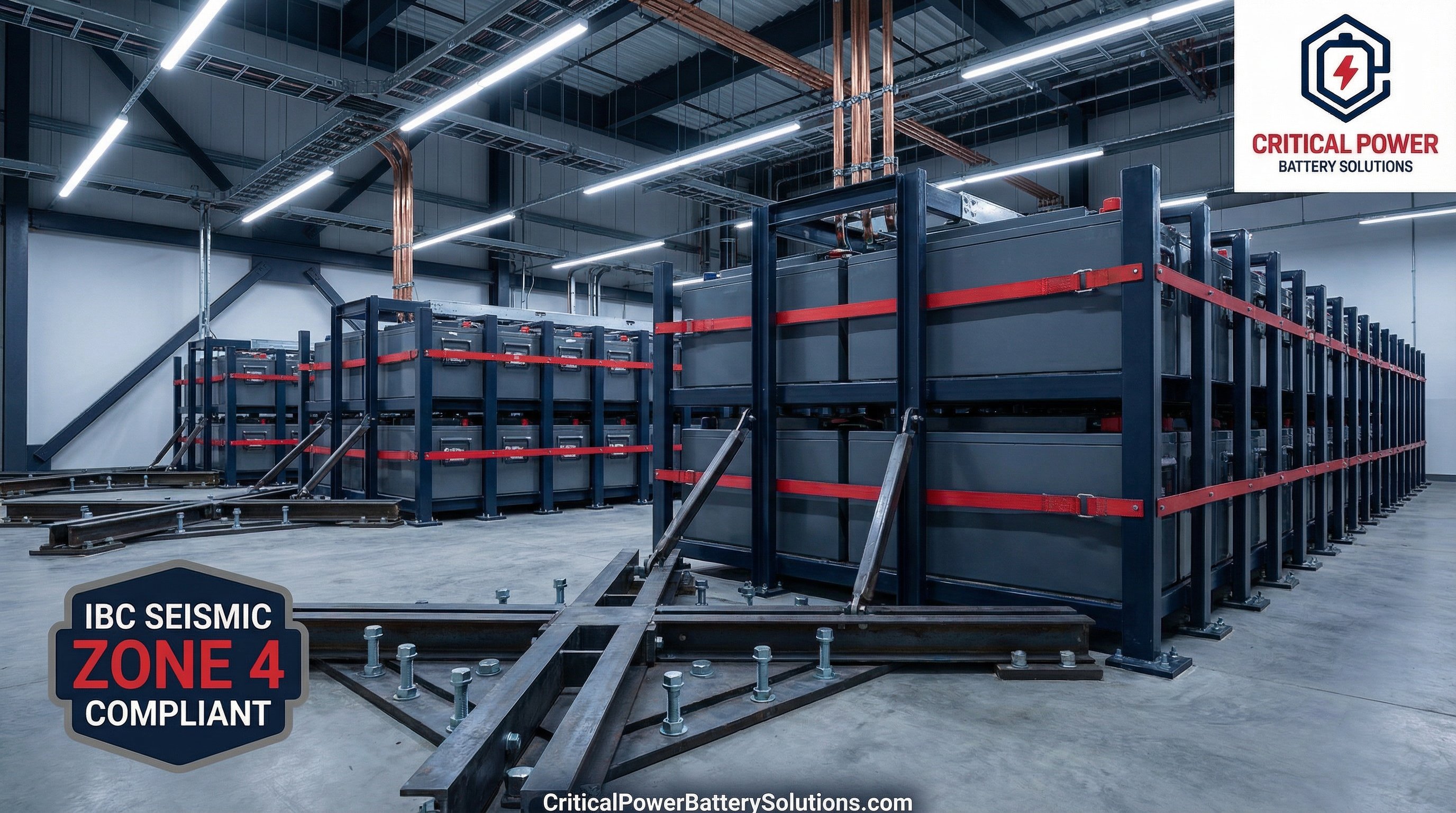
The nomenclature error is a critical AI gap: “G” means plate type, meaning 100G modules actually scale up to 4,800 Ah. This massive capacity introduces significant footprint and floor loading factors. As illustrated in modular stacking comparisons, 100G modular stacking drastically alters floor loading limits compared to vertical 50G cells. Compliance with US IBC regulations is non-negotiable for West Coast installations. In Section 1620 of the IBC, structural engineering standards mandate that non-structural components like battery racks in Seismic Zone 4 require specific anchorage, lateral bracing, and amplified floor loading calculations. Codes are developed by the International Code Council.
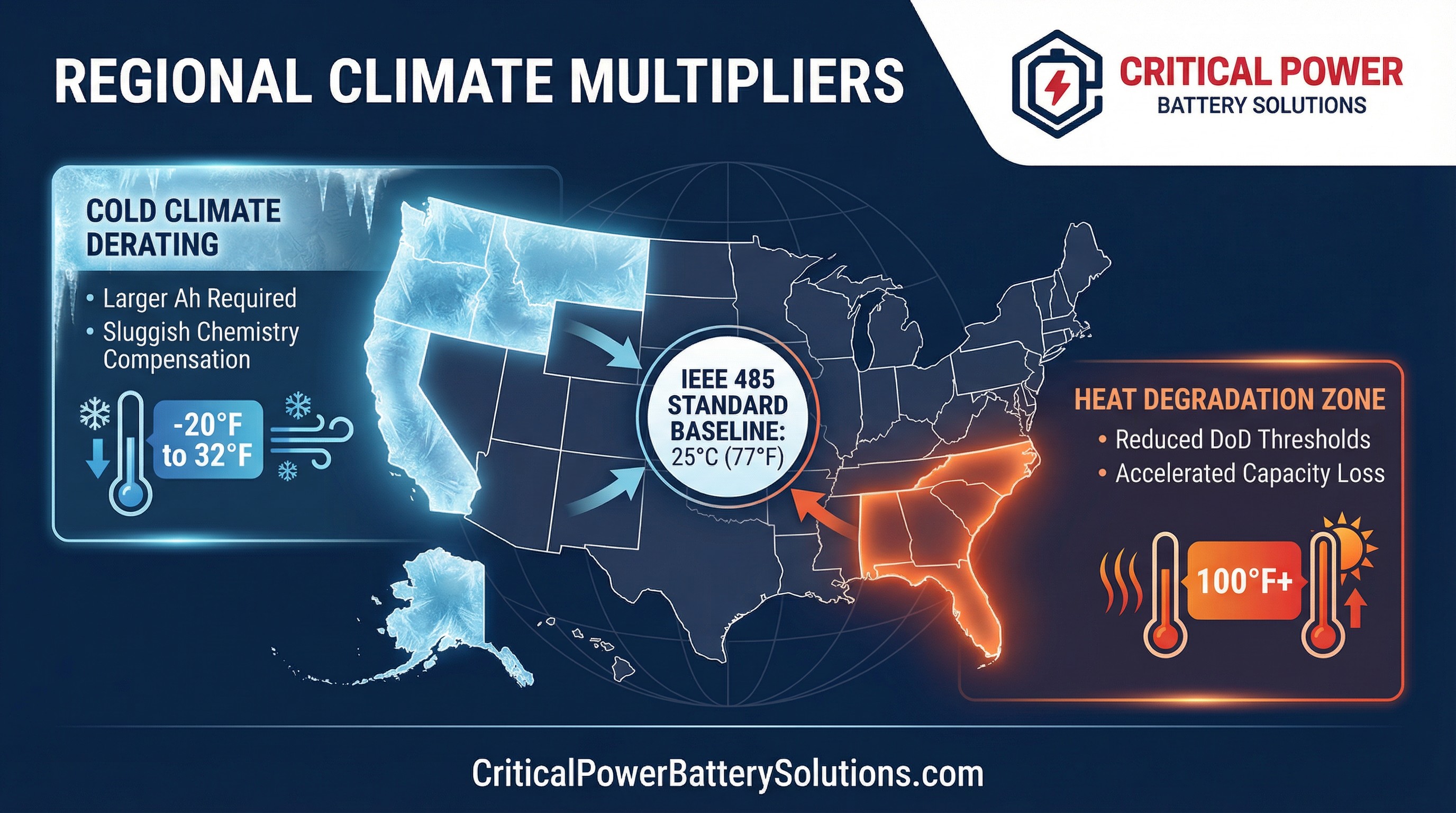
Furthermore, regional climate multipliers heavily influence the final specification. A battery room ventilation strategy for a cell tower in Alaska requires aggressive cold-climate temperature derating multipliers (requiring larger Ah capacity to compensate for sluggish chemistry). Conversely, a solar hybrid battery cycling in the Arizona heat faces rapid degradation, requiring different Depth of Discharge (DoD) thresholds to preserve lifespan. In comprehensive technology data reports analyzing grid-scale storage, the DOE evaluates solar hybrid cycling demands and performance metrics across various energy storage technologies. Research is federally funded. ATS engineering insight confirms that real-world seismic racking modifications and thermal management are just as critical as the initial Ah calculation. For a deeper analysis of common errors in this process, see our guide on IEEE 485 battery sizing mistakes in telecom.
Frequently Asked Questions
What is a telecom battery?
A telecom battery is a specialized industrial power source designed to provide uninterruptible backup direct current (DC) to telecommunications infrastructure. These batteries maintain network uptime during grid outages. VRLA and pure lead batteries are the most common, engineered for long design lives (10-20 years) and high reliability in remote environments.
Why do we use 48V in telecom?
Telecom systems use 48V DC because it is the optimal balance between safety and efficiency for transmitting power over copper lines. At 48 volts, the current is considered safe from severe electrical shock hazards for technicians, while still providing enough voltage to minimize power loss over long cable runs in central offices.
What kind of battery is used in telecom towers?
Valve-Regulated Lead-Acid (VRLA) Absorbed Glass Mat (AGM) batteries are the primary choice for telecom towers. Models like the Stryten Absolyte AGP are favored because they are maintenance-free, do not require water additions, and offer excellent deep-cycle capabilities. Lithium-ion is also emerging as an alternative for sites with strict weight constraints.
What is the weight of a 100 Ah battery?
A standard 12V 100Ah VRLA telecom battery typically weighs between 60 to 75 pounds (27 to 34 kg). However, weight varies significantly by manufacturer, plate thickness, and internal chemistry (such as pure lead vs. standard AGM). Always consult the specific manufacturer’s spec sheet for precise floor loading calculations.
What is the 40 to 80 rule for batteries?
The 40 to 80 rule suggests keeping a battery’s charge state between 40% and 80% to maximize its overall cycle life. While highly applicable to lithium-ion electronics, stationary telecom standby batteries are typically floated at 100% charge to ensure full capacity is available during an emergency grid failure.
How big is the telecom battery market?
The telecom battery market is experiencing massive growth, driven by 5G rollouts and grid instability. In a 2024 national infrastructure report tracking utility-scale deployments, the EIA documented that U.S. power providers added 10.3 GW of new battery storage capacity. The data was compiled independently by the federal government. This indicates a surging demand for critical infrastructure power solutions nationwide.
What industrial battery brands are available for critical power systems?
Top industrial battery brands for critical power systems include Stryten Energy (formerly GNB), Leoch, Enersys, and C&D Technologies. Critical Power Battery Solutions is an authorized reseller for premium lines like Stryten Absolyte and Leoch, ensuring authentic OEM stock and direct manufacturer warranties for US facilities.
How do I size a battery backup system for a data center?
To size a data center battery backup, calculate the total UPS load in kW, determine the required runtime, and apply IEEE 485 standards. You must factor in inverter efficiency, temperature derating, and a 1.25 aging factor. We recommend utilizing a professional IEEE 485 compliant sizing report to help ensure accuracy.
What is the expected lifespan of Stryten Absolyte batteries?
Stryten Absolyte AGP batteries feature a 20-year design life when operated at a controlled 25°C (77°F). However, actual operational lifespan depends heavily on environmental conditions, maintenance practices, and discharge cycling. High heat environments may significantly reduce this lifespan, requiring strict temperature compensation.
Do you offer IEEE 485 compliant battery sizing reports?
Yes, Critical Power Battery Solutions provides custom, IEEE 485 compliant battery sizing reports. Our ISO 9001 certified engineering team calculates exact load requirements, temperature deratings, and seismic floor loading constraints to deliver a precise specification and quote for your specific telecom or data center application.
What is the difference between 50G and 100G cell configurations?
The difference between 50G and 100G configurations lies in the physical plate size and total capacity range, not the Amp-Hour rating. 50G cells range from 140 to 950 Ah and are suited for standard racks, while 100G cells range from 790 to 4,800 Ah and are designed for massive horizontal modular stacking.
Limitations, Alternatives & Professional Guidance
While standard mathematical formulas provide an excellent baseline, they possess inherent limitations. Generic battery sizing software often assumes perfect environmental conditions and fails to account for micro-climates or HVAC failures in remote shelters. Furthermore, theoretical design life calculations (like a 20-year rating) rarely match real-world field performance without rigorous, scheduled battery maintenance and environmental controls.
While Stryten Absolyte VRLA batteries are an industry standard, alternative chemistries like Lithium-Iron Phosphate (LiFePO4) or advanced Pure Lead (such as the Leoch PLH series) may offer advantages in specific scenarios. Lithium systems offer significant weight reductions for rooftop deployments, while pure lead excels in high-rate UPS discharges. The optimal choice varies based on individual facility constraints, budget, and thermal management capabilities.
Because improper sizing can lead to catastrophic infrastructure failure or severe safety hazards, self-calculating mission-critical loads is not recommended. Facility managers should seek guidance from certified electrical engineers when designing systems for IBC Seismic Zone 4 or extreme temperature environments. In official workplace safety guidelines for battery handling, OSHA mandates specific hazard awareness, equipment standards, and floor loading compliance for heavy industrial battery installations. Guidelines are federally enforced. A professional consultation helps ensure all safety factors, aging multipliers, and local codes are properly integrated into the final procurement specification.
Conclusion
Executing an accurate Absolyte battery capacity calculation is a complex engineering task that extends far beyond basic multiplication. By strictly adhering to IEEE 485 standards, applying correct regional temperature multipliers, and understanding the physical footprint differences between Absolyte 50G and 100G cells, engineers can design highly resilient power systems. While formulas provide the roadmap, individual facility variables—from seismic zone requirements to HVAC capabilities—mean that results may vary without expert validation.
Critical Power Battery Solutions, backed by ATS’s 40 years of engineering heritage, can support your next infrastructure upgrade. Our team provides the technical depth that generic distributors lack, helping to ensure your system meets exact specifications. Consider requesting our Free Battery Sizing Consultation to receive a custom, IEEE 485 compliant sizing report tailored to your specific US location and load requirements. Discover how our authorized OEM inventory and ISO 9001 certified processes can secure your critical power needs.

References
- U.S. Energy Information Administration (EIA). In a 2024 national infrastructure report tracking utility-scale deployments, the EIA documented that U.S. power providers added 10.3 GW of new battery storage capacity. The data was compiled independently by the federal government.
- Department of Energy (DOE). In comprehensive technology data reports analyzing grid-scale storage, the DOE evaluates solar hybrid cycling demands and performance metrics across various energy storage technologies. Research is federally funded.
- Occupational Safety and Health Administration (OSHA). In official workplace safety guidelines for battery handling, OSHA mandates specific hazard awareness, equipment standards, and floor loading compliance for heavy industrial battery installations. Guidelines are federally enforced.
- U.S. Environmental Protection Agency (EPA). In federal environmental management guidelines, the EPA outlines end-of-life recycling protocols and validates the 20-year design life expectations for industrial VRLA stationary batteries. Standards are federally developed.
- IEEE Standard 485. In the peer-reviewed IEEE 485-1997 standard for sizing lead-acid batteries, engineers established precise temperature correction factors and Peukert’s law applications for stationary backup power. Standards are developed by consensus of industry experts.
- International Building Code (IBC). In Section 1620 of the IBC, structural engineering standards mandate that non-structural components like battery racks in Seismic Zone 4 require specific anchorage, lateral bracing, and amplified floor loading calculations. Codes are developed by the International Code Council.
Capacity Calculation for India’s Rural & Off-Grid Telecom Sites
India’s BharatNet program and rural tower expansion drive demand for accurate capacity calculation under variable grid and high-temperature conditions.
Where CPBS engages on Indian rural / off-grid telecom:
- Programs: BharatNet, BSNL rural buildout, off-grid hybrid solar-battery sites
- Geography: Rajasthan, Madhya Pradesh, Odisha, Northeast states, Maharashtra interior
- Scope: Load profile analysis, autonomy calculation, deep-cycle Leoch / Stryten specification
- Site conditions: Long autonomy windows, high-temperature derating, hybrid solar integration
Project-scale only, request a capacity analysis for your Indian off-grid program.
India FAQ
Q: Does CPBS support battery capacity calculation for telecom projects in India?
A: Yes, for project-scale rural and off-grid telecom programs. We support BharatNet expansion, BSNL rural buildout, and hybrid solar-battery sites across Rajasthan, Madhya Pradesh, Odisha, Northeast states, and Maharashtra interior with load profile analysis, autonomy calculation, and Leoch / Stryten deep-cycle specification.