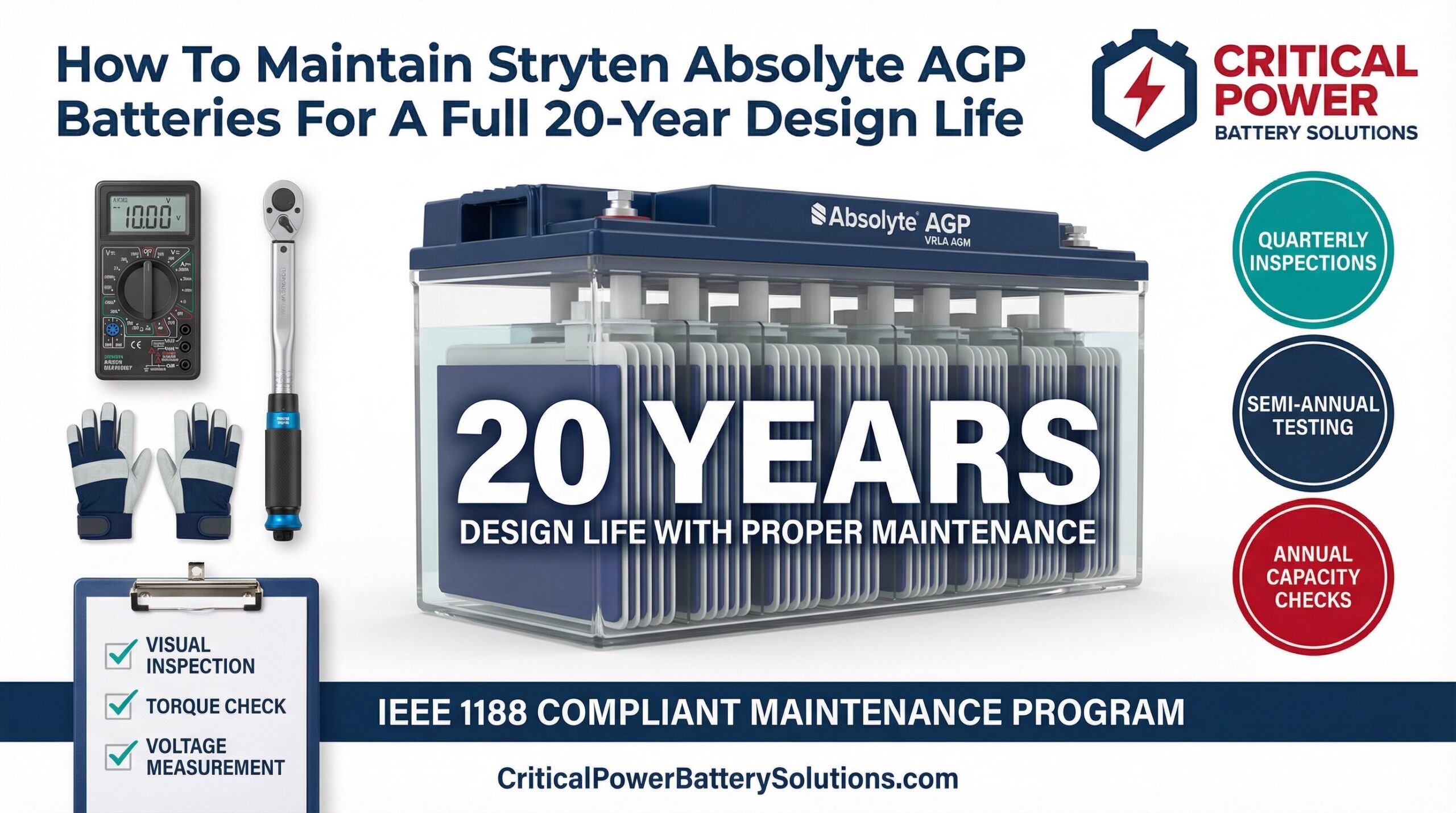
How To Maintain Stryten Absolyte AGP Batteries
If you rely on Stryten Absolyte AGP for critical UPS, telecom, or substation backup, proper maintenance is the difference between realizing the full 20‑year design life and facing early, costly replacements. With a 20-year design life in float service at 77°F, Absolyte AGP will reward a disciplined maintenance program with exceptional reliability and predictable runtime.
Key Takeaways
| Common Question | Expert Answer |
|---|---|
| How do I maintain Stryten Absolyte AGP for maximum life? | Follow a quarterly, semi-annual, and annual inspection and testing schedule, keep float voltage within manufacturer limits, and maintain proper ventilation and temperature. See the Stryten E-Series Absolyte AGP product details for design and operating specs. |
| How is maintaining VRLA different from maintaining flooded batteries? | VRLA like Absolyte AGP is maintenance-free in terms of watering, but still requires visual inspections, torque checks, and testing, unlike flooded systems such as Stryten E-Series MCX flooded batteries that need electrolyte monitoring. |
| What if my data center needs different VRLA formats? | Use the same maintenance principles across VRLA families, including space-efficient options like Stryten E-Series PDQ and telecom-optimized Stryten E-Series H1T. |
| Where can I learn how to test UPS batteries correctly? | Our technical guides and IEEE-based procedures at the CPBS battery resources library walk you through how to test UPS batteries with voltage, conductance, and capacity checks. |
| How do I plan future replacement or system upgrades? | Use documented test data, cycle history, and runtime needs to plan, then review options across Stryten E-Series families on our industrial UPS battery catalog for compatible upgrades. |
| Who can help me with GNB-to-Stryten conversions? | We specialize in GNB / Exide legacy replacements and can advise on how to replace GNB batteries with modern Stryten equivalents, leveraging our GNB industrial power history expertise. |
👤 Article by: Tom Kierna
Reviewed by: CPBS Engineering Team
Last updated: 24 January 2026
Credentials: Authorized Stryten Absolyte AGP battery Reseller, ISO 9001 Certified, IEEE Standards Member


1. Understanding Stryten Absolyte AGP And Why Maintenance Still Matters
Absolyte AGP is a premium VRLA AGM 2 V cell platform built for mission-critical installations where unplanned downtime is unacceptable. It offers a 20-year design life, 1,200 cycles to 80% depth of discharge, and capacity options from 104 Ah to 4,800 Ah per cell.
Although Absolyte AGP is a maintenance-free VRLA design in the sense that you never add water, it is not “set and forget”. You still need structured inspections, electrical testing, and correct charger settings to protect the investment and ensure the battery responds correctly during an outage.
For facility managers and engineers, the maintenance program is also central to asset planning. Proper monitoring tells you how to extend battery lifespan, when to commission battery systems, and how to plan battery replacement before risk increases.
In our experience supporting data centers, telecom networks, and utilities, Absolyte AGP performs best when treated as a critical asset with documented inspections that follow IEEE 1188 (VRLA maintenance and testing) and manufacturer instructions.
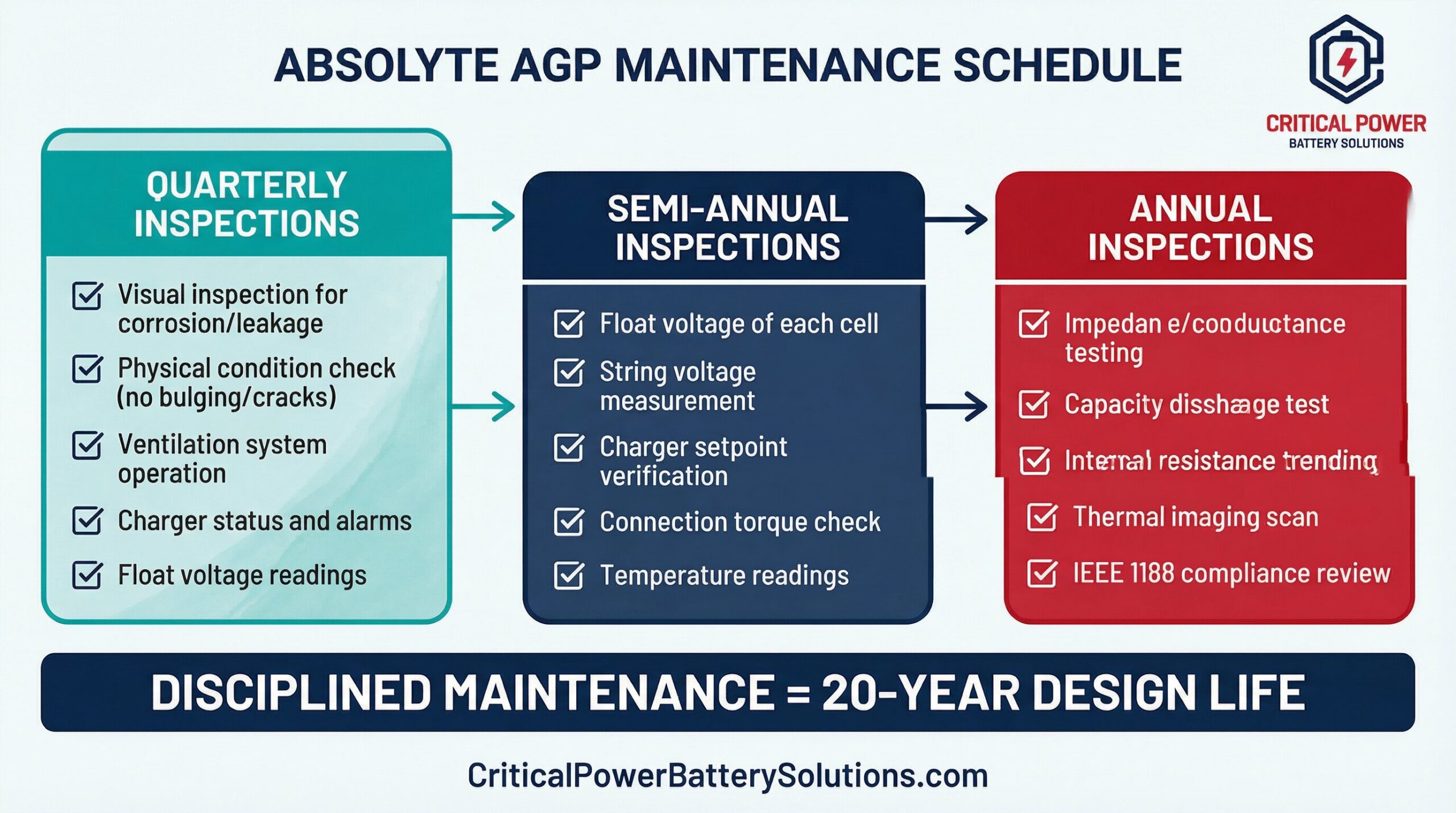
Absolyte AGP Maintenance Schedule Quarterly, semi-annual, and annual maintenance tasks for 20-year design life
2. Safety, PPE, And Preparation Before You Work On Absolyte AGP
Before you think about how to maintain VRLA batteries, you must address safety. Absolyte AGP installations operate at high DC voltages, sometimes several hundred volts per string, which requires strict electrical safety practices.
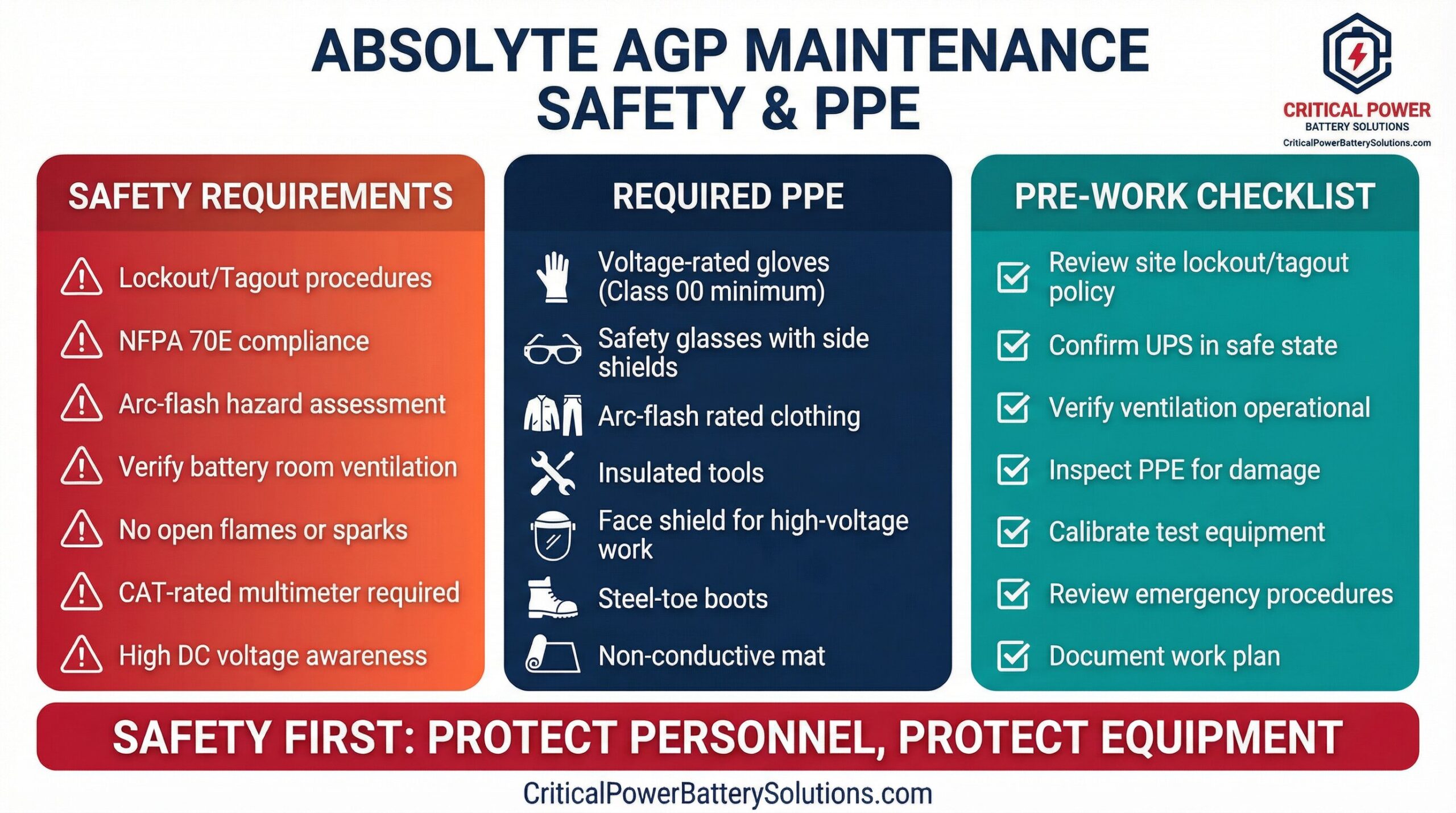
Safety first: Required PPE and procedures for VRLA battery maintenance
Always follow your site’s lockout/tagout procedures and NFPA 70E guidelines. At a minimum, ensure technicians have insulated tools, voltage-rated gloves, eye protection, and arc-flash PPE appropriate to the incident energy level of the room.
- Verify battery room ventilation is operational before starting work.
- Confirm that monitoring systems and UPS controls are in a safe state for testing.
- Use a calibrated, CAT-rated multimeter when taking measurements.
If your team is used to how to maintain flooded batteries, remember that VRLA does not vent continuously in normal service but can still release hydrogen under abnormal charge conditions. Good ventilation and no open flames remain essential.
3. Installation, Commissioning, And Baseline Data For Long-Term Maintenance
Good maintenance starts with proper installation and commissioning. If you are planning how to install Stryten batteries, or specifically how to install Absolyte AGP, you should treat the first day as the foundation for the entire lifecycle.
Step-by-step commissioning priorities
1. Verify correct string design and polarity.
2. Set float voltage on the charger strictly within Stryten’s published range.
3. Perform an initial equalize charge as specified in the operating manual.
4. Record baseline float voltages, temperatures, and intercell connection resistance.
For Absolyte AGP, float voltage guidance of 2.25 VPC ± 0.02 VPC on a non temperature correcting charger is critical. Incorrect settings will accelerate dry-out or reduce available capacity. Previous Absolyte battery models, including Absolyte GP, Absolyte IIP, and Absolyte GX, may require different maintenance plan and commissioning requirements.
We recommend you treat commissioning as part of how to commission battery systems in general. Capture string identification, model numbers, date codes, torque values, float voltage setpoints, and ambient temperature in a permanent maintenance log.
This baseline will later help you decide how to troubleshoot battery issues and how to test UPS batteries efficiently, because you will know what “normal” looked like at day one.
Discover the five essential maintenance steps to keep your Stryten Absolyte AGP at peak performance. This infographic guides you through each step.
4. Routine Inspection Schedule: Quarterly, Semi-Annual, And Annual Tasks
A disciplined inspection cadence is central to how to maintain Stryten batteries in predictable, high-availability environments. We recommend aligning with Stryten’s guidance and IEEE 1188 style intervals.
Quarterly inspections
Quarterly tasks are primarily visual and operational. Walk the installation and check:
- General cleanliness and absence of corrosion or leakage.
- Physical condition of jars and covers, no bulging or cracks.
- Proper operation of ventilation and cooling equipment.
- Charger status, alarms, and float voltage readings.
Semi-annual inspections
Every six months, add basic electrical measurements. Check and record:
- Float voltage of each cell or block.
- String voltage and charger setpoint.
- Connection torque, brought back to specification if needed.
Annual inspections
Annually, perform deeper testing such as impedance or conductance trending. This is part of how to test UPS batteries proactively, not just reactively after an outage.
5. Electrical Measurements: Voltages, Torque, And How To Test UPS Batteries
Even with a “maintenance-free” VRLA design, electrical measurements are essential. If you want to know how to extend battery lifespan, early detection of imbalance is the most effective tool you have.
Voltage checks
Record individual cell or block voltages during float. Look for deviations greater than manufacturer guidance, typically around ±0.03 VPC for VRLA. Persistent low or high cells may indicate developing problems.
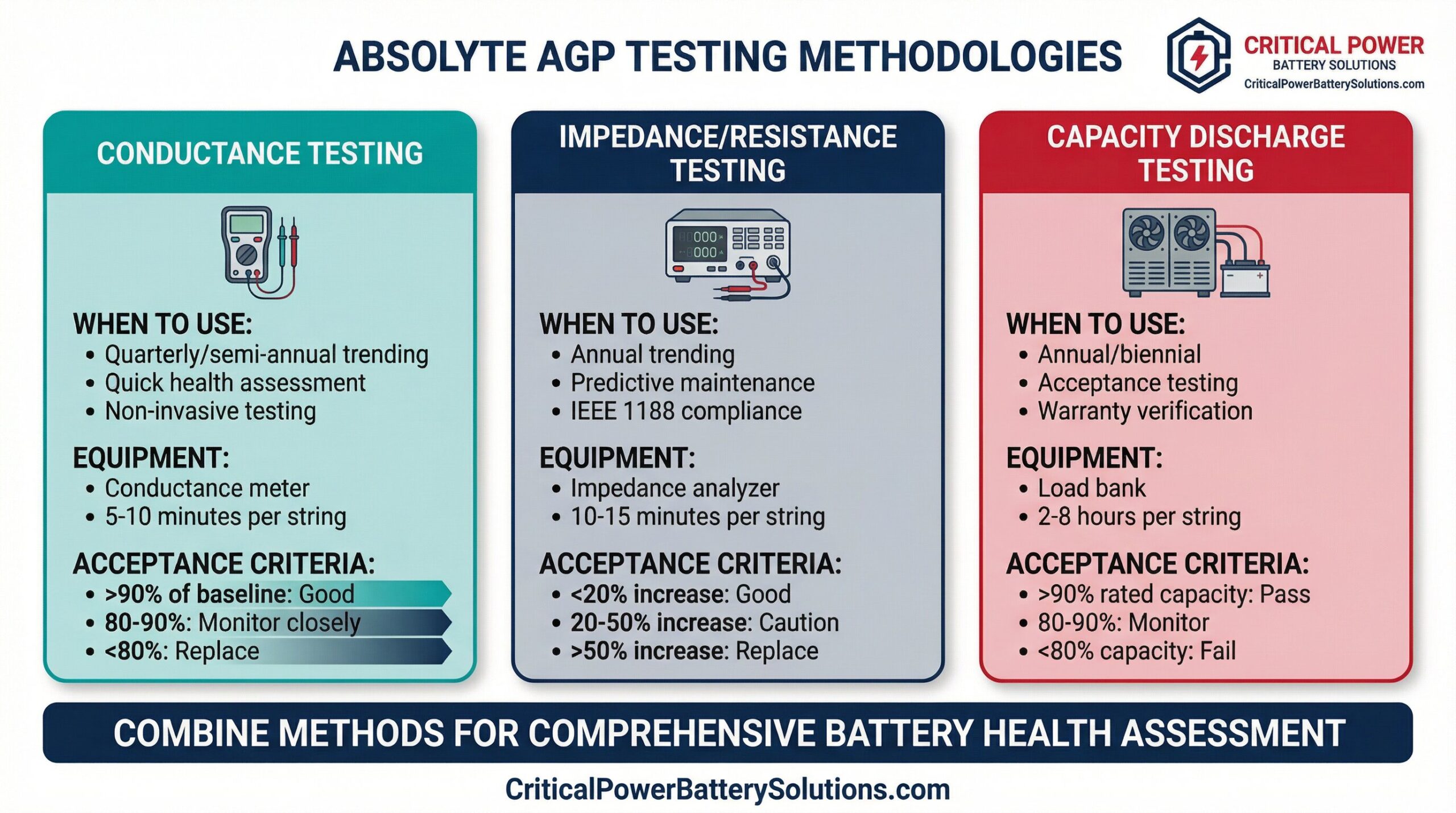
Compare conductance, impedance, and capacity testing methods for comprehensive battery health assessment for Absolyte AGP batteries.
Torque verification
Stryten recommends checking terminal and intercell connection torque at least annually. A typical value for Absolyte AGP is 100 inch-lbs, but always confirm in the current manual. Loose connections increase resistance and heat, which shortens life.
Impedance or conductance trending
Use IEEE 1188 style test methods. Compare each reading to the baseline from commissioning and look for significant deviation over time. This data will guide how to plan battery replacement at the string or cell level.
6. Temperature, Ventilation, And Environmental Controls
Temperature is one of the most important variables in how to maintain Stryten Absolyte AGP batteries. The 20-year design life assumes a 77°F (25°C) environment, and elevated temperatures shorten life.
Keep the battery room within the manufacturer’s recommended range, ideally close to 77°F, and avoid hot spots across strings. For large installations, we suggest placing temperature sensors on representative cells, not relying solely on ambient probes.
Ventilation also matters. Even sealed VRLA cells can emit gas under abnormal charge conditions, so your room design should meet Stryten’s guidance, such as providing at least about 1 square inch of free air space per 5 amp-hours of capacity and avoiding sealed cabinets without airflow.
7. Equalize Charging And Recovery After Discharges Or Faults
Equalize charging is an advanced maintenance tool to restore balance across cells after deep discharges, extended outages, or storage. It is an important part of how to maintain VRLA batteries, but it must be done within limits.
Follow Stryten’s guidance on equalize voltage and duration, for example, 2.30 to 2.35 VPC for specific time windows, adjusted for temperature. Always monitor temperature during equalize and verify that ventilation is adequate.
After any significant discharge event, record the depth of discharge and duration. This helps you understand how to calculate battery runtime under real-world conditions and whether your system is routinely approaching the 80% DoD region that uses more of the 1,200-cycle capability.
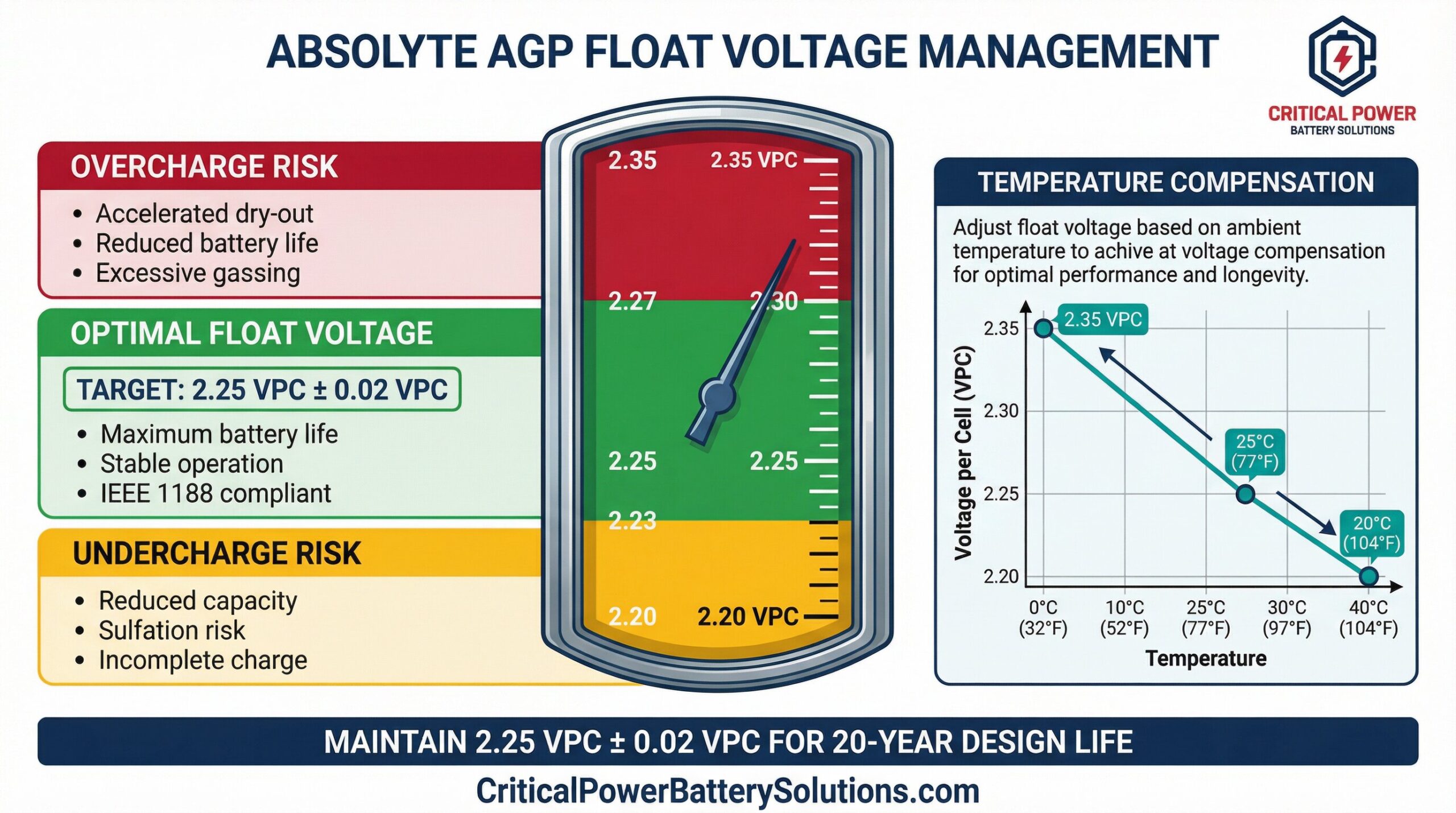
Maintain 2.25 VPC ± 0.02 VPC for optimal Absolyte AGP battery life and performance
8. Planning Replacement, Runtime, And System Sizing Around Absolyte GP, Absolyte IIP, and Absolyte AGP
Effective maintenance goes hand-in-hand with lifecycle planning. When you understand how to size battery systems correctly and how to calculate battery runtime, you can set realistic expectations and design around true load profiles.
Absolyte AGP’s 2 V cells from 104 Ah to 4,800 Ah give you flexible options to match your load and backup time. Our engineers use IEEE 485 methodologies to translate your kW load and desired minutes of runtime into properly sized strings.
As you trend impedance, voltage, and event history, you can decide how to plan battery replacement before capacity loss jeopardizes SLAs. This is especially important for data center and telecom operators who must document how to select data center batteries and how to choose industrial batteries that meet uptime targets.
9. Common Maintenance Mistakes With Absolyte AGP batteries And How To Avoid Them
We regularly see a few recurring issues when facilities maintain VRLA strings, including Absolyte AGP. Avoiding these mistakes will significantly improve reliability.
- Incorrect float voltage: Even a small persistent deviation can reduce life.
- Ignoring temperature: Running hot shortens life, running too cold reduces capacity.
- Infrequent inspections: Annual-only checks are usually not sufficient for critical loads.
- No baseline data: Without commissioning measurements, trends are hard to interpret.
- Untorqued connections: Loose links invite resistance, heat, and possible failure.
For teams used to flooded systems such as MCX or MCT, another trap is assuming VRLA needs no attention at all. Absolyte AGP may not need watering, but it still needs expert stewardship.
10. How Absolyte AGP Fits Into A Broader Stryten Energy Maintenance Strategy
Many sites run mixed technologies. You might use Absolyte AGP for large 2 V cell banks, PDQ or H1T for high-rate rack-mount UPS, and MCX or MCT flooded cells for substations. The good news is that the core discipline of maintenance applies across all.
For example, if you know how to maintain flooded batteries in a substation using MCX or MCT, you already understand the importance of torque checks, ventilation, and temperature control. VRLA simply changes the specific tasks, not the overall rigor.
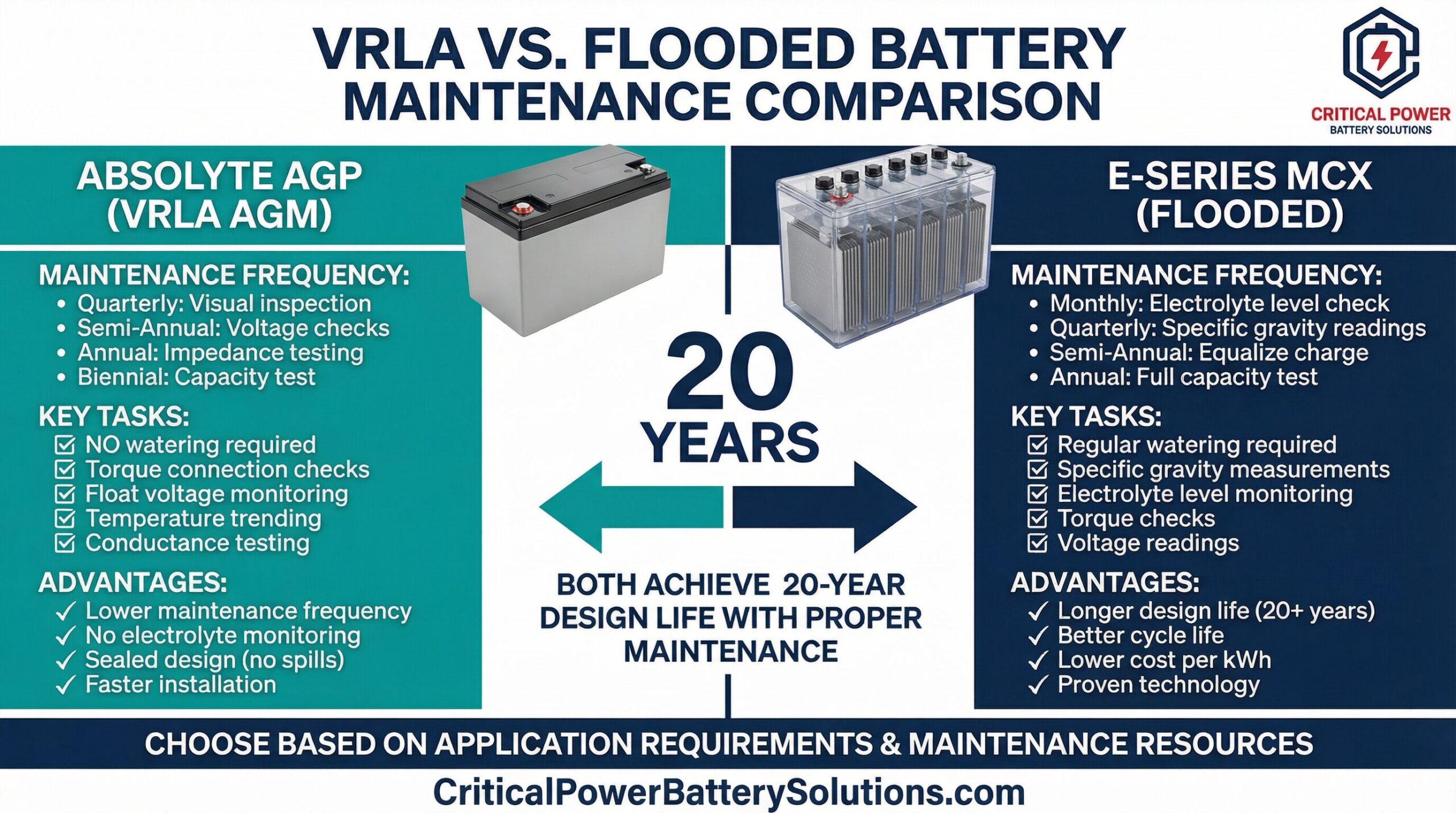
Compare maintenance requirements: Absolyte AGP VRLA vs. E-Series MCX flooded batteries
At a strategic level, maintenance also informs how to choose industrial batteries for future projects. Long-life platforms like Absolyte AGP, NXT, and other E-Series products can reduce the total cost of ownership when sized and maintained correctly.
11. When To Consult A Professional For Absolyte AGP Battery Maintenance
Some tasks are best handled by professionals, especially in high-voltage or highly regulated environments. Based on over 40 years of experience, we recommend outside support for:
- Initial system design and how to size battery systems for complex loads.
- First-time installation or major system expansions where code and seismic requirements apply.
- Capacity testing, load testing, or any procedure that could interrupt critical loads.
- Complex troubleshooting where multiple events or alarms are involved.
You should also consider expert help when you transition from legacy GNB systems to newer Stryten platforms. Knowing how to replace GNB batteries with direct Stryten equivalents, while honoring existing racks and cabling, avoids surprises.
12. Practical Next Steps To Improve Your Absolyte AGP Maintenance Program
To turn these concepts into action, we suggest taking structured next steps. Start by reviewing your current maintenance procedures against Stryten’s published guidance and IEEE 1188 style best practices.
Then, update your documentation to ensure consistent quarterly, semi-annual, and annual tasks. Include specific instructions on float voltage targets, torque values, acceptable voltage deviation, and response steps when measurements fall outside limits.
Finally, integrate maintenance with strategic planning. Use your data to adjust how to maintain Stryten batteries across all sites, refine how to select data center batteries and telecom backup systems, and budget for replacements based on measured condition rather than guesswork.
Conclusion
Maintaining Stryten Absolyte AGP effectively is about discipline, not complexity. With proper float voltage, environmental control, documented inspections, and periodic testing, your AGP strings can deliver the long, reliable service life they were designed for.
As an authorized Stryten Energy reseller backed by ISO 9001 certified processes through Advanced Technical Services Inc., we help customers worldwide implement maintenance programs that protect uptime and budget. Whether you run a data center, telecom network, or utility substation, a structured approach to Absolyte AGP care will pay dividends throughout the life of the system.
Next steps you can take today:
- Review our detailed Absolyte AGP design and maintenance guidance on the Absolyte AGP technical overview page.
- Explore complementary Stryten VRLA and flooded options in our full Stryten and Leoch product catalog to align maintenance strategies across platforms.
- Learn more about our history, engineering background, and customer focus on the CPBS About Us page.
- Schedule remote support for sizing, testing procedures, or maintenance planning through our technical team at the Contact CPBS page.