Critical Power Battery Solutions

Stryten E-Series MCX Review: Specs & GNB Replacement

January 16, 2026Battery Selection Guides, Battery Technology, Industrial batteries.Comments Off on Stryten E-Series MCX Review: Specs & GNB Replacement

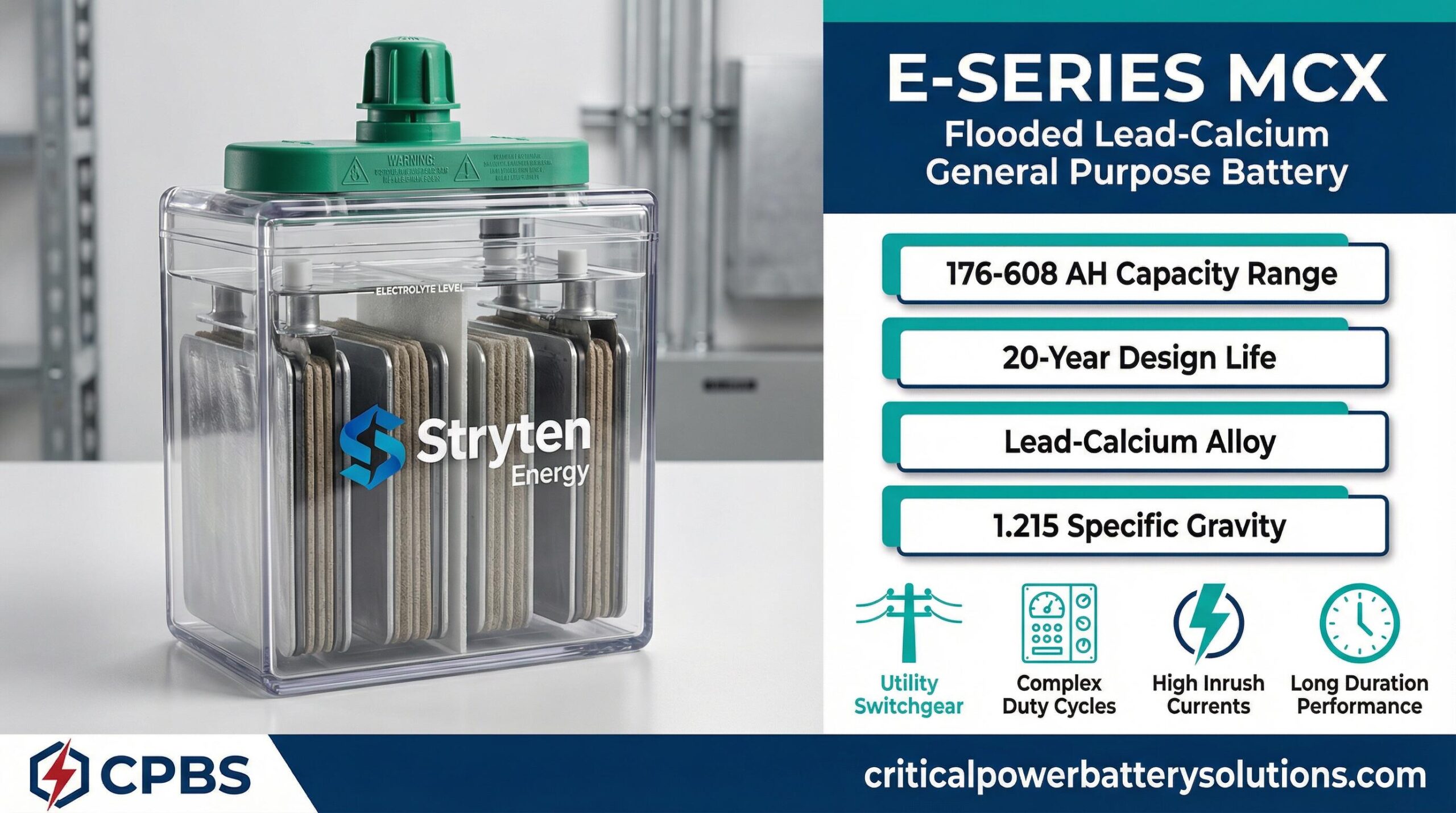
Stryten E-Series MCX Flooded Lead-Calcium Battery: 176-608 AH capacity range, 20-year design life, transparent SAN jar with visible plates, green Pre-Vent flame arrester cap, optimized for utility switchgear and complex duty cycles with high inrush current capability

Stryten E-Series MCX Technical Review & Engineering Guide

🎯 Quick Answer

The Stryten E-Series MCX is the direct, official replacement for legacy GNB Industrial Power and Exide Technologies MCX flooded lead-calcium batteries. Key specifications include:

Design Life: 20 years (Flat Plate Flooded)
Capacity: 175-608 AH range

  • Compliance: Fully compatible with existing GNB racks; meets IEEE 450 maintenance standards.

As a Stryten Energy Authorized Reseller, Critical Power Battery Solutions provides fresh date codes and IEEE 485 compliant sizing reports to ensure warranty validity.

In mission-critical US infrastructure, from telecom central offices to utility substations, verifying battery specifications is more than a procurement checkbox; it is a matter of operational reliability. According to U.S. Energy Information Administration data, utility-scale battery storage capacity exceeded 26 GW in 2024, highlighting the critical need for reliable stationary power infrastructure[5]. The Stryten E-Series MCX stands as the definitive solution for stationary power applications requiring long-duration discharge. This Stryten E-Series MCX Review analyzes the technical capabilities, sizing protocols, and maintenance requirements necessary for facility managers to ensure grid reliability.

You may know this battery as the “GNB MCX.” Confusion regarding the brand lineage is common, but the engineering remains consistent. Critical Power Battery Solutions (ATS) serves as the bridge between legacy installations and modern supply chains. With 40+ years of engineering heritage, we offer valid factory warranties and fresh stock, ensuring that facility managers avoid the risks associated with grey market resellers offering expired “New Old Stock.”


👤 Article by: Tom Kierna
Reviewed by: CPBS Engineering Team
Last updated: 16 January 2026
Credentials: Authorized Stryten MCX Reseller, ISO 9001 Certified, IEEE Standards Member


ℹ️ Transparency: This article analyzes the Stryten E-Series MCX based on IEEE standards and manufacturer specifications. As an Authorized Reseller for Stryten Energy, we provide verified technical data. All sizing advice references IEEE 485-2020 protocols.


Technical Specifications Deep Dive

The E-Series MCX is a flooded lead-calcium flat plate battery designed specifically for long-duration discharge applications. In this section of our Stryten E-Series MCX Review, we break down the core engineering data that facility managers require for specification compliance.

MCX Core Specifications

Feature Specification Engineering Benefit
Plate Technology Flooded Flat Plate Lead-Calcium Optimized for long-duration discharges (telecom/switchgear)
Design Life 20 Years Matches standard plant life expectancy
Capacity Range 175 – 608 AH Scalable for various load profiles
Specific Gravity 1.215 (Nominal) Lower SG reduces grid corrosion vs. high-gravity models
Jar Material Transparent SAN Allows visual inspection (IEEE 450 compliance)
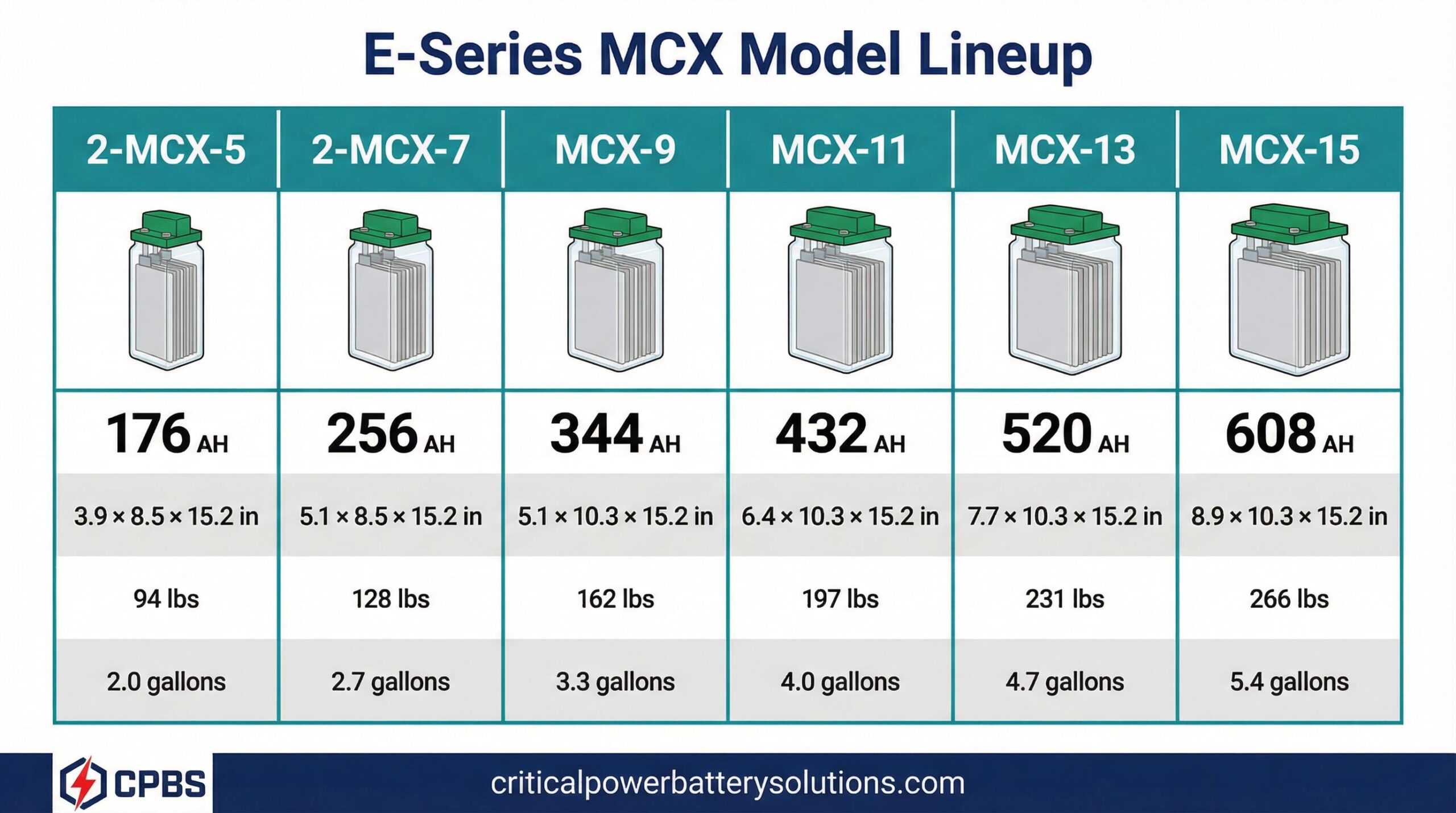
E-Series MCX Model Lineup Comparison: Six models from 2-MCX-5 (176 AH, 44 lbs, 0.80 gal electrolyte) to MCX-15 (608 AH, 134 lbs, 2.80 gal electrolyte) with dimensions, weights, and capacities for utility switchgear applications

Complete E-Series MCX model lineup: 176-608 AH capacity range across six configurations

SAN vs. ABS Jar Comparison

A critical distinction in the Stryten E-Series MCX specs is the use of SAN (Styrene-Acrylonitrile) for the battery jar. While many VRLA batteries use ABS (Acrylonitrile-Butadiene-Styrene) for its impact resistance, the MCX utilizes SAN for its optical properties.

According to material guidelines from Machine Design and EPRI, SAN provides transparency for internal inspection, while ABS offers impact resistance for covers[1]. This transparency is not merely aesthetic; it is a functional requirement for compliance with IEEE 450 maintenance standards, allowing technicians to visually verify electrolyte levels and plate conditions without disassembling the cell.

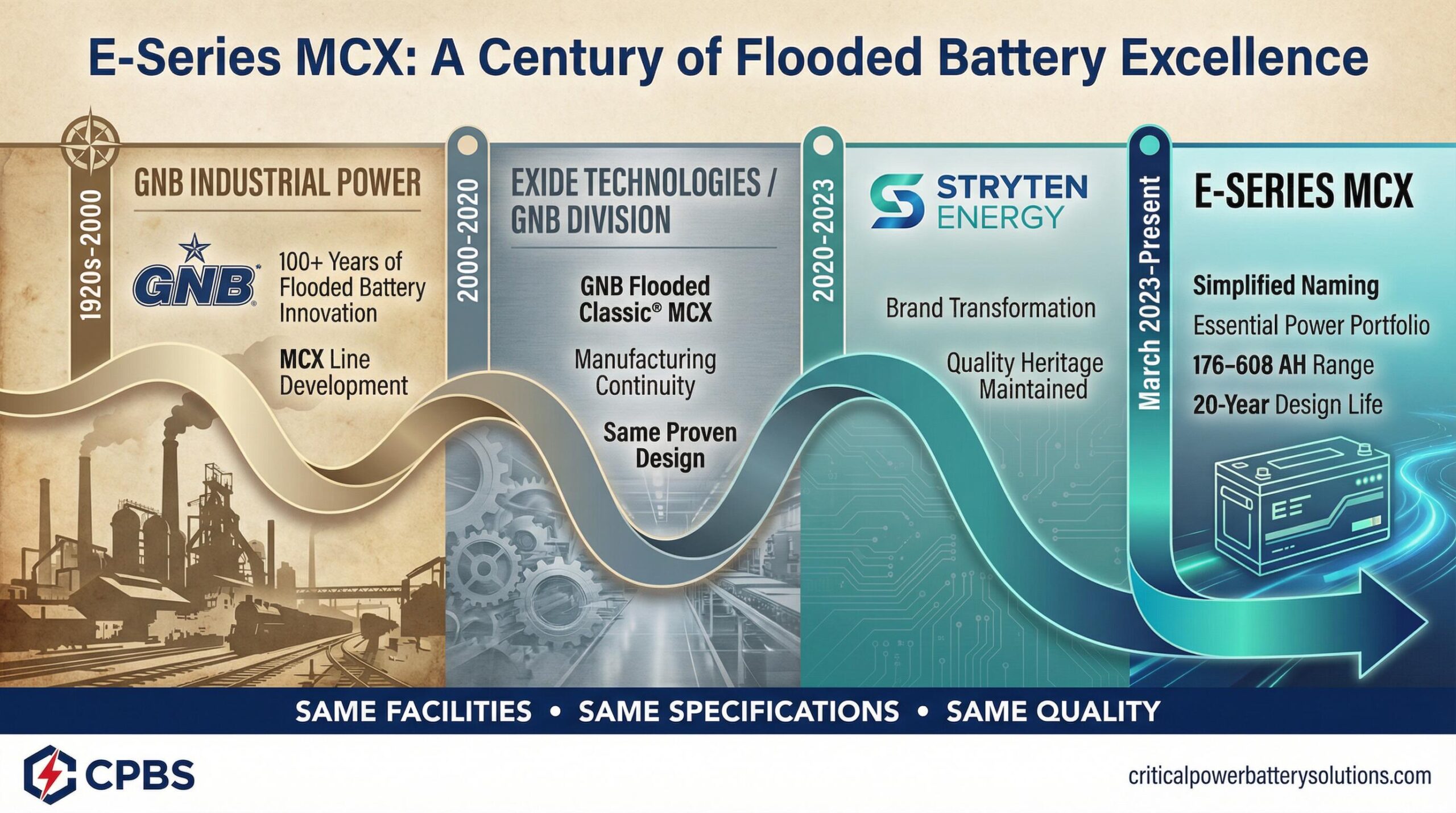
 E-Series MCX Heritage Timeline: 100+ years of flooded battery excellence from GNB Industrial Power (1920s-2000) through Exide Technologies/GNB Division (2000-2020) to Stryten Energy (2020-2023) and E-Series MCX launch (March 2023-Present) - Same facilities, same specifications, same quality

E-Series MCX: A century of flooded battery excellence with continuous manufacturing heritage


The Legacy Explained: GNB to Stryten

Navigating the branding history of industrial batteries can be complex. The MCX product line has a clear lineage that is important for verifying compatibility and warranty status.

The Timeline

Past: GNB Industrial Power was the original innovator of the MCX line.
Transition: GNB was acquired by Exide Technologies.
Present: Exide’s Americas division was acquired and rebranded as Stryten Energy.

The key engineering takeaway is that while the badge on the front has changed, the manufacturing tooling and facility often remain the same. The GNB MCX replacement is the Stryten E-Series MCX; the form factor is identical, ensuring it fits existing racks without modification.

The “Authorized” Warning

There is a significant commercial implication to this transition that automated procurement systems often miss. Buying batteries branded as “GNB” or “Exide” today often means purchasing “New Old Stock” with expired shelf lives. These units may carry no manufacturer support. Only official Stryten E-Series MCX replacements carry a valid factory warranty today. As an Exide MCX replacement, the Stryten unit ensures you are receiving fresh chemistry capable of meeting its 20-year design life.


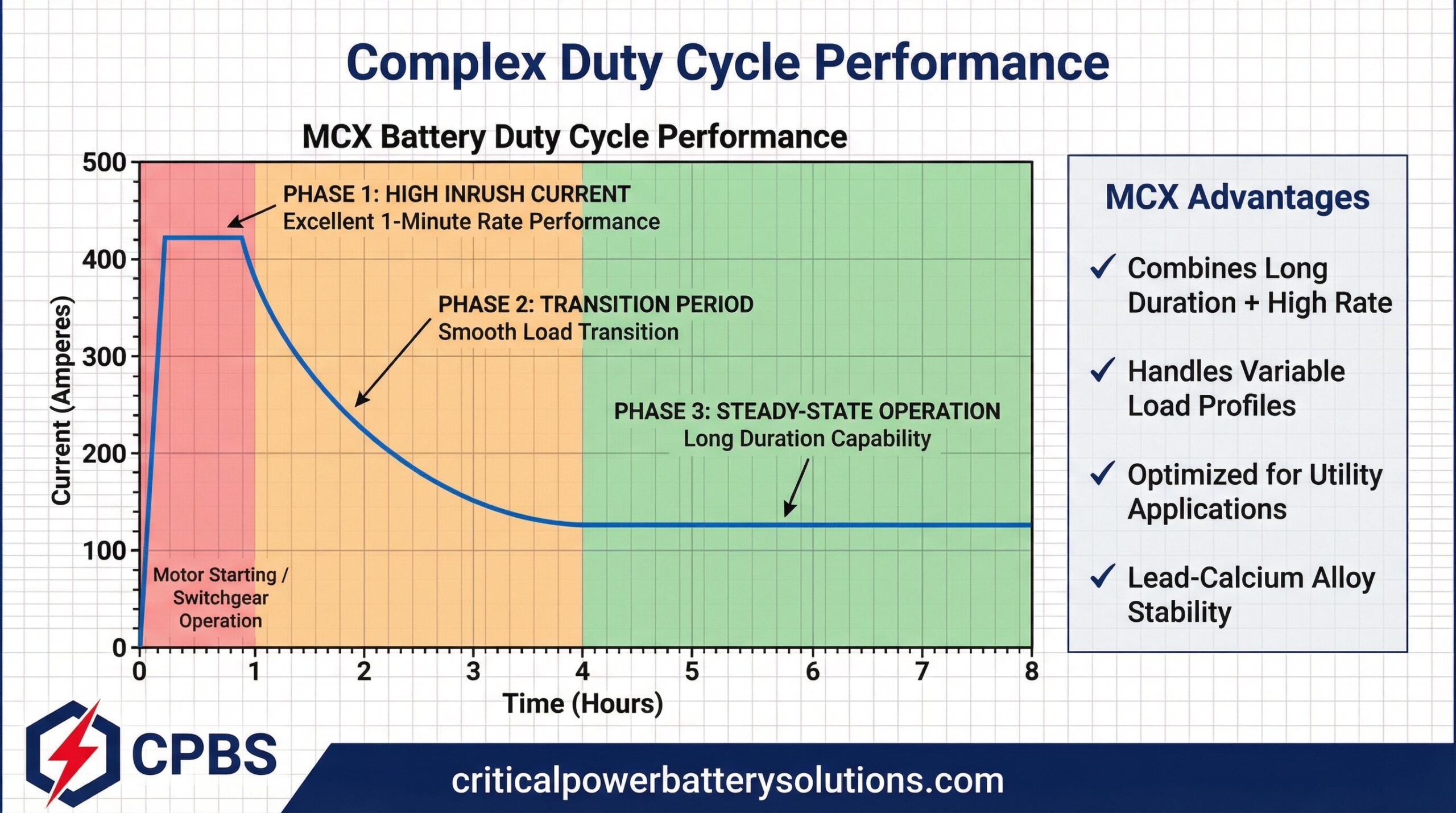
MCX Complex Duty Cycle Performance: Three-phase discharge profile showing Phase 1 high inrush current (400+ amperes for motor starting), Phase 2 transition period with smooth load decline, and Phase 3 steady-state operation (100-150A) demonstrating excellent 1-minute rate and long duration capability

Complex duty cycle performance: MCX combines high inrush current handling with long duration capability


AI Gap: Real-World Sizing & IEEE 485

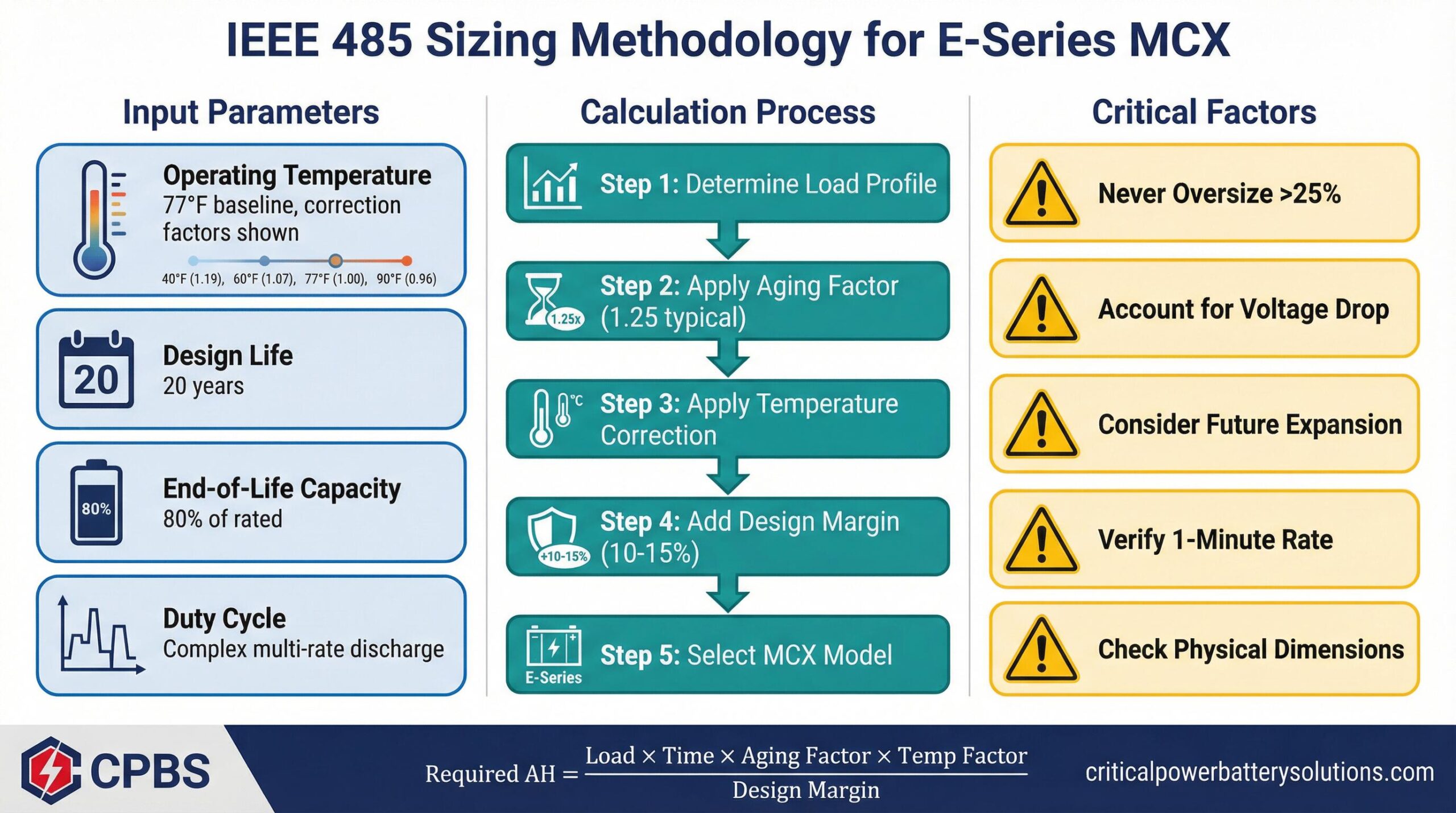
Many online battery backup sizing calculators use a simplified formula: Load divided by Amps. For critical infrastructure, this approach is dangerous and can lead to catastrophic under-sizing during an outage. Professional sizing must adhere to IEEE 485 battery sizing protocols.


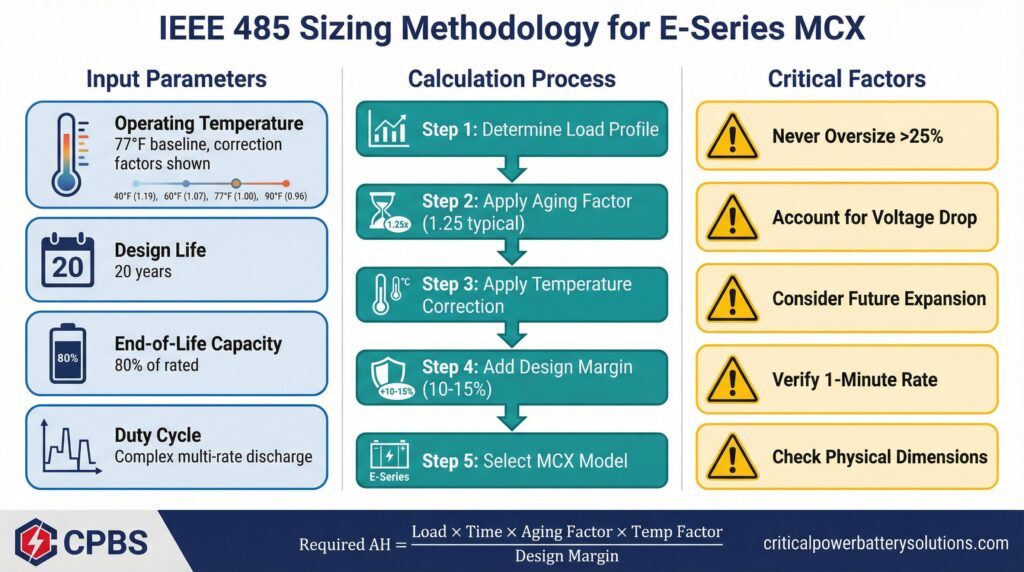
IEEE 485 Battery Sizing Methodology for E-Series MCX: Five-step calculation process including operating temperature correction, design life (20 years), end-of-life capacity (80%), aging factor (1.25), temperature correction, and design margin (10-15%) with critical factors and sizing formula

IEEE 485 sizing methodology: Professional battery sizing accounts for aging, temperature, and design margins

The IEEE 485 Difference

1. Aging Factor

Batteries degrade over time. A battery is rated to deliver 100% of its capacity when new, but it is considered to have reached its end of life when it can only deliver 80% of its rated capacity. IEEE 485-2020 mandates accounting for aging factors (typically 1.25) to ensure the battery meets load requirements at the end of its life, not just the beginning[2]. If you size for Year 1, your system may fail in Year 10.

2. Temperature Correction

US substations are often unconditioned environments. Lead-acid capacity drops as temperature falls. If a substation in Minnesota hits 50°F (10°C), the battery capacity drops significantly below its 77°F (25°C) rating. IEEE 485 requires a temperature correction factor to oversize the battery for the coldest expected operating temperature.

3. Design Margin

Engineers typically add a 10-15% design margin to accommodate future load growth.

The ATS Advantage

We do not simply ship batteries based on a part number. We run the full IEEE 485 calculation for your specific load profile, factoring in duty cycles, momentary loads (like switchgear actuation), and environmental constraints.

Request a custom IEEE 485 Sizing Report to ensure your backup system is compliant and reliable.


Maintenance Standards (IEEE 450)

Proper maintenance is the variable that determines whether a battery reaches its 20-year design life or fails in year seven. For the Stryten E-Series MCX, flooded battery maintenance must follow IEEE 450-2010 protocols.

Inspection Protocols

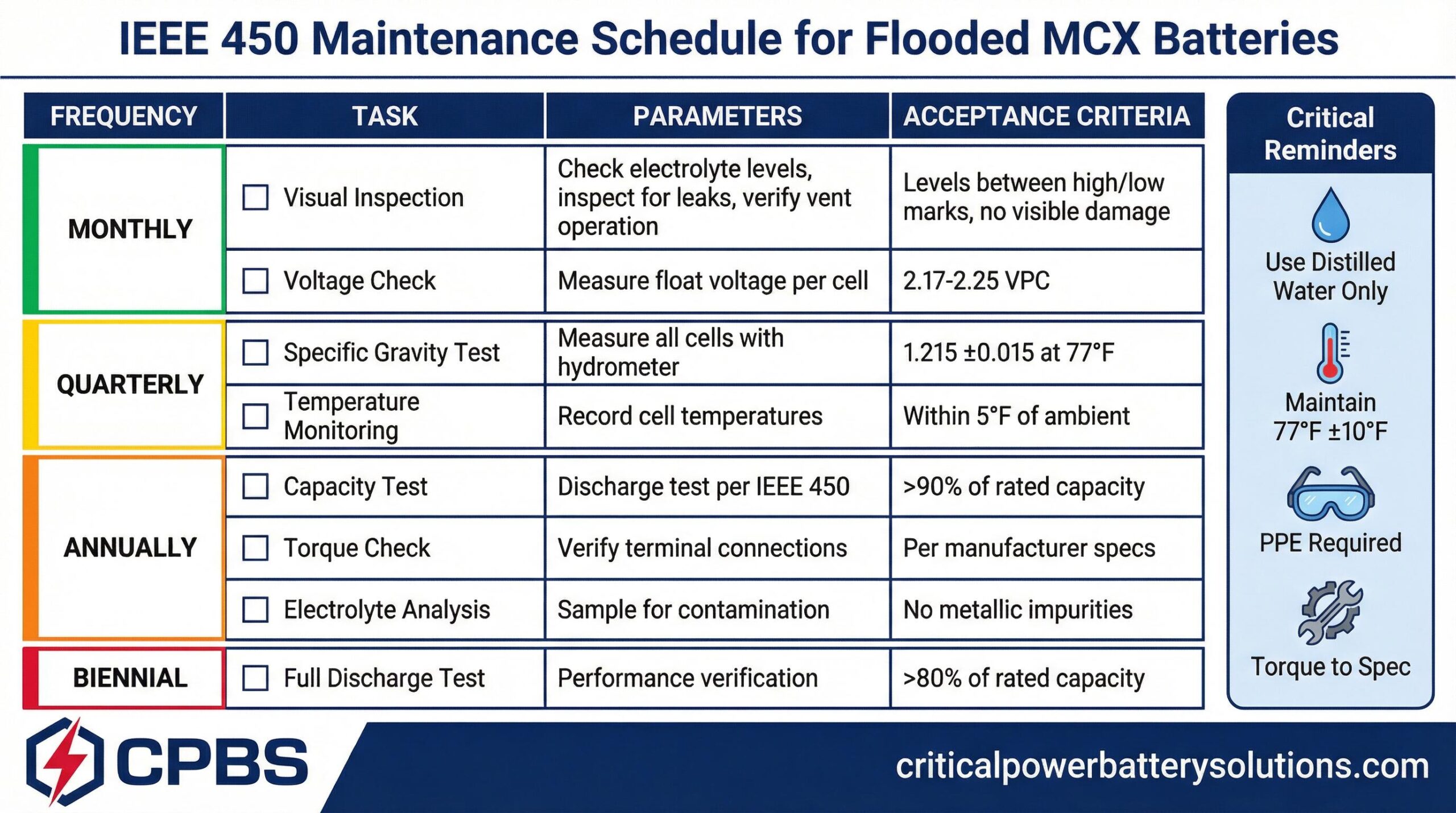
IEEE 450, the “Recommended Practice for Maintenance, Testing, and Replacement,” outlines specific schedules to prevent failure[3]:

Monthly: Conduct a visual check of pilot cells. The transparent SAN jars allow technicians to verify electrolyte levels and sediment accumulation without invasive procedures.
Quarterly: Measure and record the float voltage and battery specific gravity of pilot cells.
Yearly: Perform detailed inter-cell connection resistance checks to identify loose connections that could cause resistance heating or fires.

Specific Gravity Nuance

A critical detail for the MCX is its nominal specific gravity of 1.215. Many technicians accustomed to UPS batteries expect a reading of 1.250 or 1.300. Attempting to charge an MCX until it reaches 1.250 will result in severe overcharging, boiling of the electrolyte, and voiding of the warranty. Always reference the Stryten Energy MCX technical manual which confirms the 1.215 nominal specification[4].
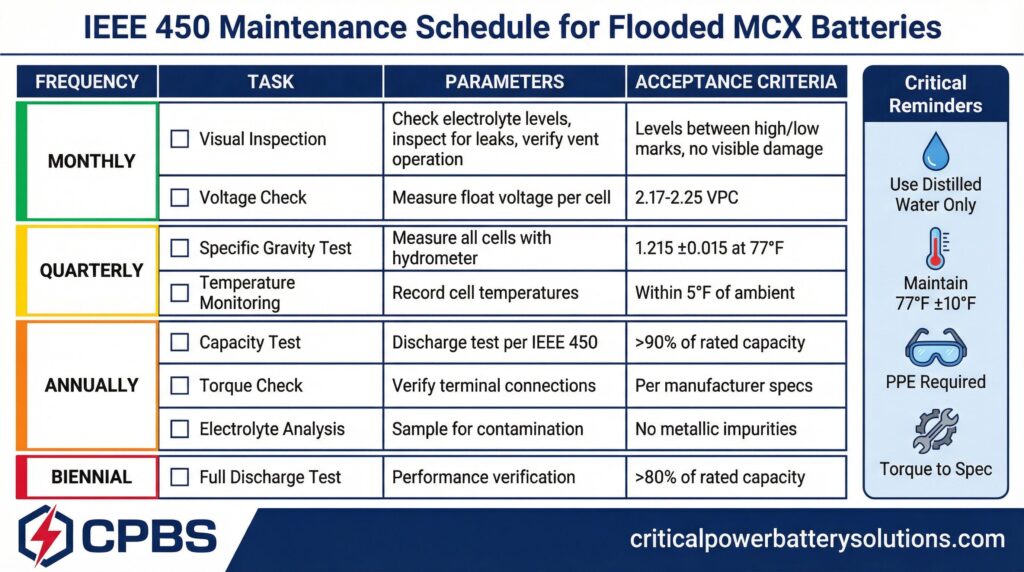
IEEE 450 Maintenance Schedule for Flooded MCX Batteries: Monthly visual inspection and voltage check (2.17-2.25 VPC), quarterly specific gravity test (1.215 ±0.015 at 77°F) and temperature monitoring, annual capacity test and torque check, biennial full discharge test - Critical reminders for distilled water, temperature control, PPE, and torque specifications

IEEE 450 maintenance schedule: Comprehensive inspection protocols for 20-year battery life


Frequently Asked Questions

Who makes GNB batteries now?

Stryten Energy now manufactures the batteries formerly branded as GNB Industrial Power and Exide Technologies in the North American market. The E-Series MCX is the direct manufacturing successor to the GNB MCX, utilizing the same tooling and design specifications.

What is the maintenance required on flooded batteries?

According to IEEE 450 maintenance standards, required actions include monthly visual inspections of electrolyte levels, quarterly specific gravity checks (nominal 1.215 for MCX), and annual connection torque verification. Regular watering is also required to replace volume lost through electrolysis during normal float operation.

What is the expected lifespan of Stryten MCX batteries?

The Stryten E-Series MCX has a 20-year design life in float service at 77°F (25°C). However, real-world service life is heavily dependent on maintaining proper ambient temperature and strictly adhering to IEEE 450 maintenance schedules.

Is Stryten the same as Exide?

Stryten Energy was formed from the acquisition of Exide Technologies’ Americas business. While they are separate corporate entities today, Stryten retains the manufacturing heritage, patents, and production facilities of the former Exide/GNB industrial division.


Limitations & Alternatives

While the MCX is a robust solution, it is not universally applicable. Understanding its limitations is key to proper application engineering.

Vented vs. VRLA

The MCX is a vented (flooded) battery. It continuously releases small amounts of hydrogen gas and requires a dedicated battery room with spill containment systems and active ventilation. For office environments, data centers without separate battery rooms, or sites where watering maintenance is difficult, a VRLA (Valve Regulated Lead Acid) battery like the Stryten Absolyte may be a more appropriate choice.

Temperature Sensitivity

Flooded lead-calcium batteries degrade at an accelerated rate when operated above 77°F (25°C). For every 15°F (8°C) increase in continuous operating temperature, battery life is cut roughly in half. If your facility lacks reliable cooling, you must oversize the bank per IEEE 485 temperature factors or consider chemistries less sensitive to heat.


Conclusion

The Stryten E-Series MCX remains the gold standard for long-life, high-reliability US infrastructure, offering a proven 20-year design life and transparent construction for easy inspection. As we have detailed in this Stryten E-Series MCX Review, it serves as the direct replacement for legacy GNB and Exide models, provided that facility managers respect the change in branding and avoid grey market stock.

Reliability, however, extends beyond the hardware. Proper application requires rigorous IEEE 485 sizing to account for aging and temperature, alongside strict adherence to IEEE 450 maintenance protocols.

Don’t guess on capacity. Ensure your backup power meets compliance standards. Contact Critical Power Battery Solutions today for a quote and a certified IEEE 485 Sizing Report from our engineering team.


References

  1. Machine Design / EPRI. (n.d.). Plastics for Battery Jars: SAN vs. ABS. Retrieved from https://www.machinedesign.com
  2. IEEE Standards Association. (2020). IEEE 485-2020 – IEEE Recommended Practice for Sizing Lead-Acid Batteries for Stationary Applications. Retrieved from https://standards.ieee.org
  3. IEEE Standards Association. (2010). IEEE 450-2010 – IEEE Recommended Practice for Maintenance, Testing, and Replacement of Vented Lead-Acid Batteries for Stationary Applications. Retrieved from https://standards.ieee.org
  4. Stryten Energy. (2023). E-Series MCX Technical Manual. Retrieved from https://www.stryten.com
  5. U.S. Energy Information Administration. (2024). Battery Storage in the United States: An Update on Market Trends. Retrieved from https://www.eia.gov

Comments are closed.

Critical Power Battery News

ISO 9001 Certified – Through Our Parent Company , ATS

Our operations are supported by ISO 9001-certified processes through Advanced Technical Services Inc.
(ATS), providing you with confidence in every order and continuous commitment to improvement.

Expert Battery Sizing When Precision Matters

Don't risk undersizing or overspending on your critical power system. Our battery sizing experts bring over four decades of experience to ensure your installation meets exact specifications for optimal performance and longevity.

Why Schedule a Battery Sizing Consultation:

Precision engineering icon for advanced battery systems and technical expertise
Precision Engineering

Get exact calculations based on your specific load requirements and runtime needs

Application-specific icon for customized battery solutions and expert sizing
Application-Specific Expertise

Benefit from specialized knowledge in telecom, data center, utility, and renewable energy applications

Cost optimization icon for battery replacement services and value engineering
Cost Optimization

Avoid unnecessary expenses from oversizing or costly downtime from undersizing

Compliance assurance icon for battery standards and regulatory requirements
Compliance Assurance

Ensure your battery system meets all relevant industry standards and regulations

Future-proofing icon for UPS battery solutions and technology advancement
Future-Proofing

Plan for growth with scalable solutions that accommodate your evolving power needs

Our battery sizing experts will analyze your critical load requirements, environmental conditions, and backup duration needs to recommend the perfect solution for your application.

DELIVERABLE – IEEE 485 Battery Sizing report as well as a detailed pricing quote.

Free Battery Sizing Consultation