Best UPS Battery Solutions for Data Centers 2026: What Actually Works in the Real World
Power-related issues still account for over half of all outages, and UPS failures contribute to 42% of those events. In our experience, most of that risk traces back to aging, misapplied, or poorly maintained battery systems rather than the UPS electronics themselves. As we head into 2026, data center battery decisions are less about “lead vs. lithium” in the abstract and more about matching chemistries, form factors, and runtime strategies to very specific site constraints and uptime targets.
Key Takeaways
| Question | Answer |
|---|---|
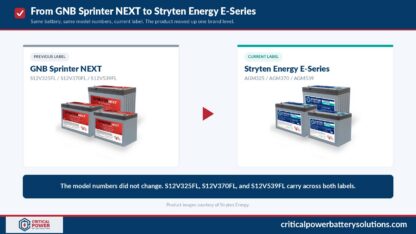
| What are the most practical UPS battery choices for data centers in 2026? | For many facilities, high-performance VRLA (pure-lead and AGM) remains the workhorse due to cost, safety familiarity, and broad UPS compatibility. On our data center battery replacement systems page we typically recommend Leoch PLH/XP/HPX and Stryten E-Series systems for 5–20-year design life projects. |
| How should I size UPS runtimes for modern data centers? | Our experience shows most data centers are settling in the 5–15 minute range, using modular strings that support N+1 or 2N architectures rather than extreme single-string runtimes. |
| Which brands are reliable for mission‑critical UPS battery banks? | We see consistent performance with Leoch pure-lead front-terminal and AGM blocks plus Stryten valve-regulated systems. Both integrate cleanly with common enterprise UPS platforms and are available across our broader critical battery product catalog. |
| How do UPS battery decisions differ by industry (telecom, healthcare, finance)? | Telecom and edge sites typically favor front-terminal pure-lead; hospitals and clinical systems prioritize safety and maintenance access; financial trading floors demand tight runtime guarantees and frequent testing—examples are outlined across our telecom, healthcare, and financial services industry pages. |
| Who can help engineer and support a full UPS battery refresh? | We design, supply, and support battery systems end-to-end, typically collaborating with integration partners such for switchgear, load bank testing, and commissioning. |
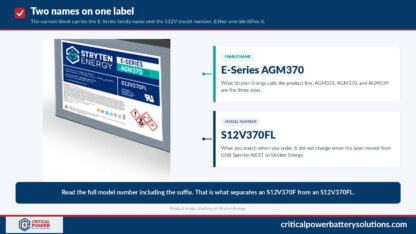
| Where can I get brand-specific technical guidance? | Our engineering team works directly with OEMs like Stryten; you can review the Stryten E-Series Absolyte AGP product details on our AGP product page and broader Stryten portfolio on our Stryten Energy brand overview. |
| How do I engage with your team for a 2026 refresh project? | We typically start with a remote review of one‑line diagrams and battery test data, then move to site assessment and proposal—our process is outlined on our About Us page, and you can reach us via the Contact form. |


👤 Written by: Tom Kierna
Reviewed by: Tom Kierna – CPBS
Last updated: 09 January 2026
2026 Data Center UPS Battery Trends: What’s Changing and What Isn’t
Across hundreds of data center projects, we see a clear pattern: cost and sustainability now drive most technology conversations, but runtime expectations and safety still anchor final decisions. 58% of operators report that cost is the primary driver of energy storage changes, yet we rarely see successful projects driven by cost alone. Reliability, maintenance practices, and integration fit usually determine whether a deployment actually achieves its 10–20-year lifecycle targets.
For 2026 planning, we recommend thinking in terms of three decision layers: chemistry (VRLA vs. lithium vs. hybrid), architecture (modular vs. monolithic, N+1 vs. 2N), and operations (testing, monitoring, and replacement strategy). The “best” battery solution is the combination of those three that reliably meets your SLA at the lowest verifiable total cost of ownership, not the newest technology in the catalog.
Why VRLA and Pure Lead Still Dominate Data Center UPS in 2026
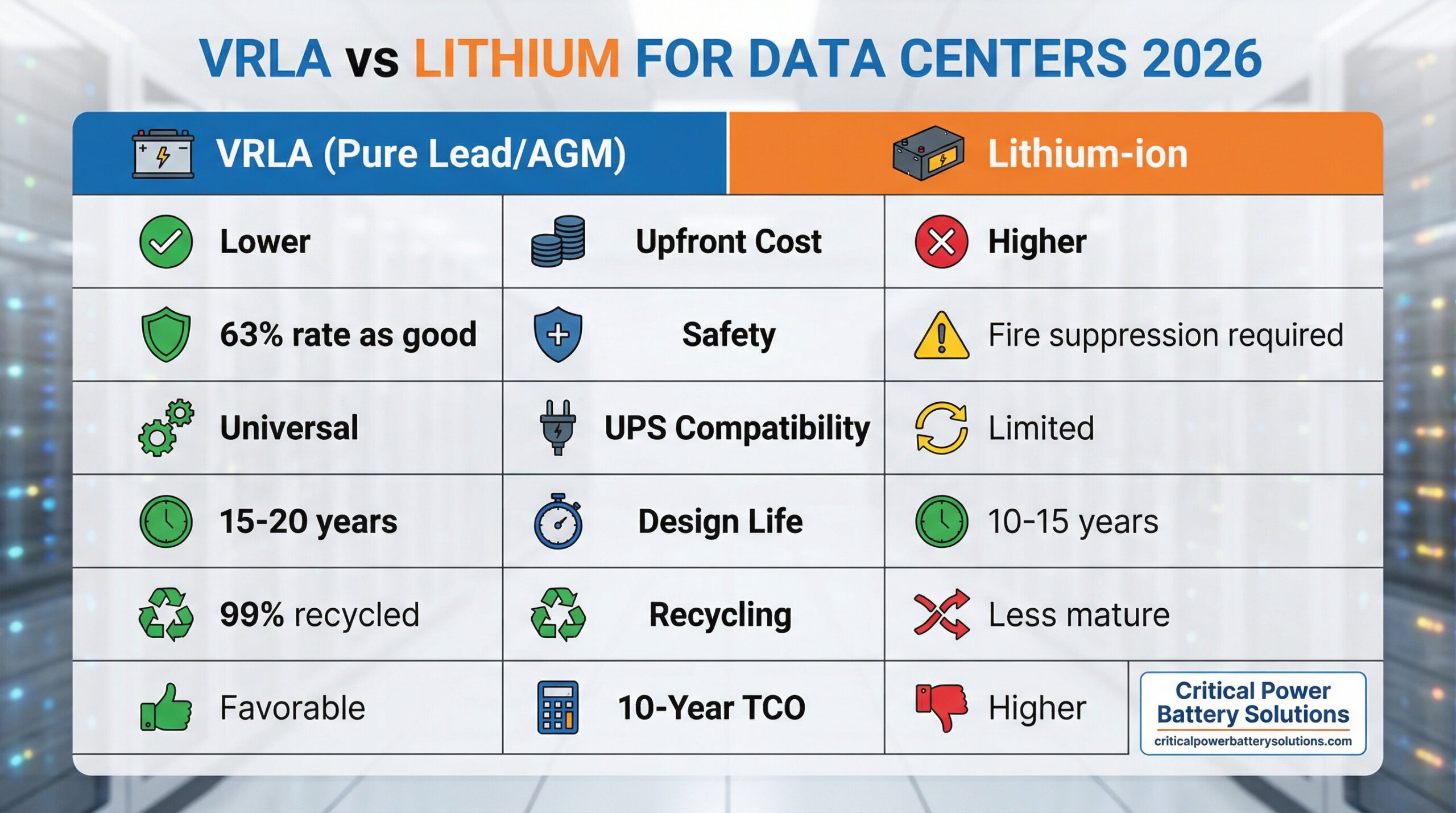
Despite the momentum behind lithium chemistries, our field data shows that high-performance VRLA—especially pure-lead front-terminal and large AGM blocks—remains the default in many Tier II and Tier III facilities. The reasons are straightforward: 63% of operators still rate VRLA as good for safety, and nearly all enterprise UPS platforms are configured around VRLA charge profiles and monitoring assumptions.
For operators with mature maintenance programs and well-understood thermal environments, VRLA offers predictable performance and favorable up-front economics. Where we see VRLA deployments struggle is in high-temperature rooms without adequate airflow, or where periodic load testing and internal resistance measurements are skipped for multiple years.
Front-Terminal Pure-Lead for High-Density Racks: Leoch PLH Series
Leoch PLH Front-Terminal Batteries for Data Center Racks
For high-density racks and tight UPS rooms, front-terminal pure-lead has become a practical compromise between space, serviceability, and lifecycle. The Leoch PLH series (e.g., PLH100FT(A), PLH170FT(A), PLH210FT(A)) is designed specifically for telecom and data-center environments that need high-rate discharge, good deep-discharge recovery, and simplified maintenance in standard 19″/23″ battery racks.
In our experience, the PLH family works well where operators target roughly 10–12 years of design life under controlled temperatures. The front-terminal layout speeds up testing and replacement, which matters when you manage thousands of blocks across multiple rooms or sites.
Typical PLH Use Case: Row-based UPS supporting 5–10 minute runtime at full IT load, with front-access strings installed in seismic-rated racks to simplify IR testing and block replacement.

Large AGM VRLA Blocks for Centralized UPS Rooms: Leoch XP & HPX
Leoch XP12 and HPX12 for High-Capacity Strings
Where floor space is available and operators prefer centralized UPS rooms, large AGM blocks like the Leoch XP12-300 and XP12-350, and high-capacity units like the HPX12-540, are often the most straightforward path. These 12V blocks in the 100–540Ah range support high kW loads with fewer parallel strings, which simplifies balancing and monitoring.
The Leoch XP12-300, for example, is a 300Ah VRLA AGM battery intended for large-scale UPS and data-center layouts. We see it used frequently in 10–15 minute runtime designs supporting 3‑phase UPS systems that protect entire rooms or small facilities, with careful attention to ventilation and ambient temperature control.
| Model | Nominal Voltage | Capacity Class | Typical Use |
|---|---|---|---|
| Leoch XP12-100 | 12V | ~100Ah | Smaller UPS racks, edge rooms |
| Leoch XP12-300 | 12V | 300Ah | Centralized UPS, 10–15 min runtime |
| Leoch XP12-350 | 12V | 350Ah | Extended runtime or higher kW loads |
| Leoch HPX12-540 | 12V | 540Ah | High-capacity, longer runtime designs |
Non-Flammable Valve-Regulated Systems: Stryten E‑Series for Data Centers
 Stryten E-Series Absolyte AGP and MCX
Where safety, code compliance, and long design life are top priorities, we often specify Stryten’s E‑Series valve-regulated systems. The Absolyte AGP line in particular is attractive for operators who want non-flammable, sealed cells, long service life, and proven performance in mission-critical rooms.
 These systems are well-suited to facilities targeting 15–20-year design life, provided temperature control and maintenance discipline are in place. They integrate into modular racks and can be engineered into both centralized and distributed UPS topologies, giving design teams flexibility in how they stage capacity growth.
For operators moving away from flooded systems but still wary of lithium fire protection implications, Stryten E‑Series provides a non-flammable, sealed alternative with long service life potential.
Designing Runtime: How Much Battery Do Data Centers Really Need in 2026?
We rarely see a technical need for 30–60 minute UPS runtimes in modern facilities. Instead, most sites land between 5 and 15 minutes of full-load autonomy, relying on fast-start generators or secondary feeds for extended events. 37% of respondents now expect runtimes to decrease in the future, reflecting a move toward modular redundancy and rapid recovery rather than oversized single strings.
In our designs, we start with a clear definition of events the UPS battery must cover: momentary disturbances, short utility outages, or longer grid failures. From there, we model multiple runtime scenarios against cost, space, and heat load, then down-select based on TCO and operational complexity rather than theoretical “maximum” runtime.
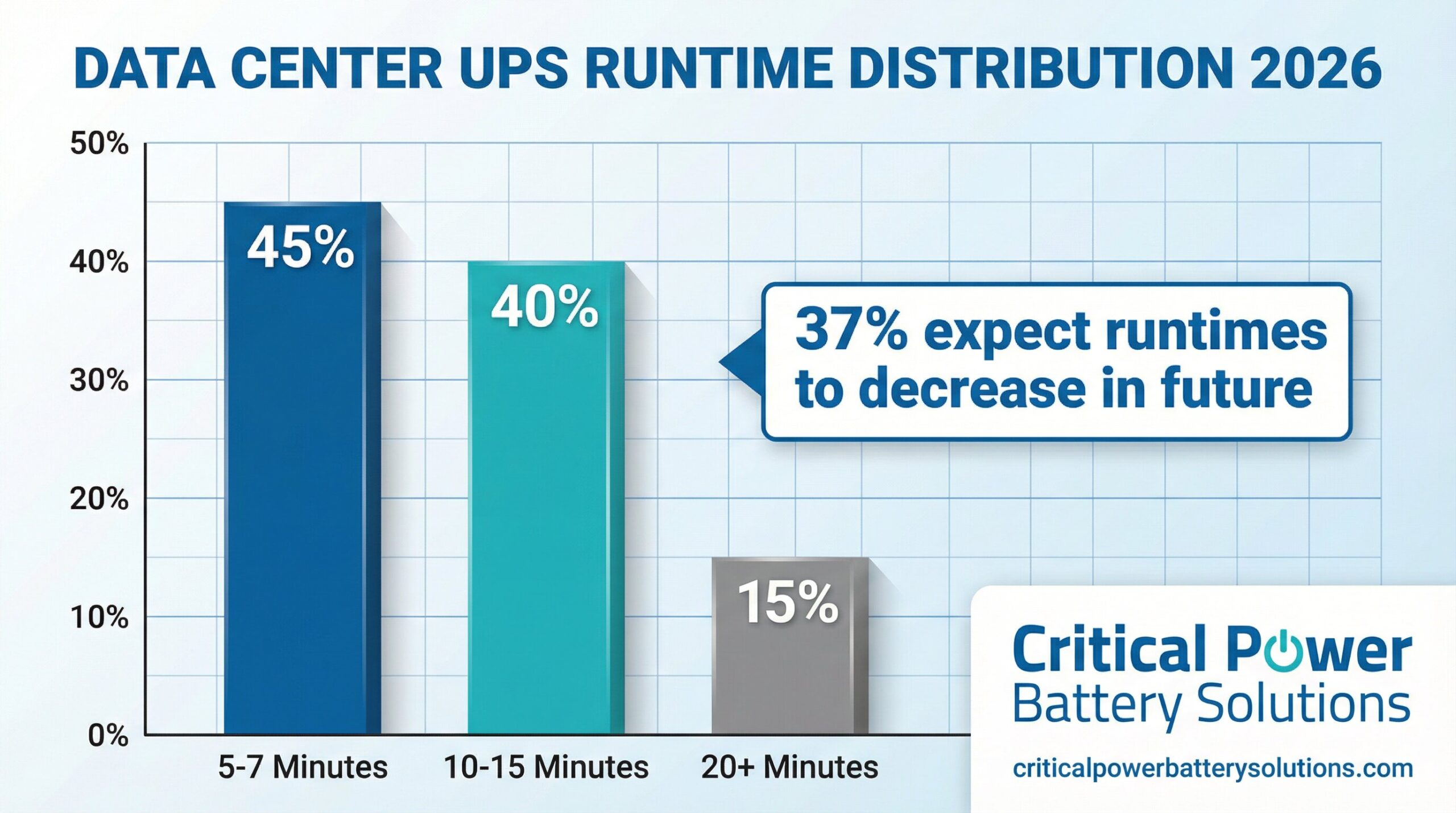
- 5–7 minutes: Common in facilities with highly reliable generators and frequent testing.
- 10–15 minutes: Typical choice where generator or transfer risk is higher, or for critical trading floors and healthcare loads.
- 20+ minutes: Usually driven by site-specific constraints (e.g., no generator) and requires careful thermal and space planning.
Cost, Sustainability, and TCO: Balancing the 2026 Decision Matrix
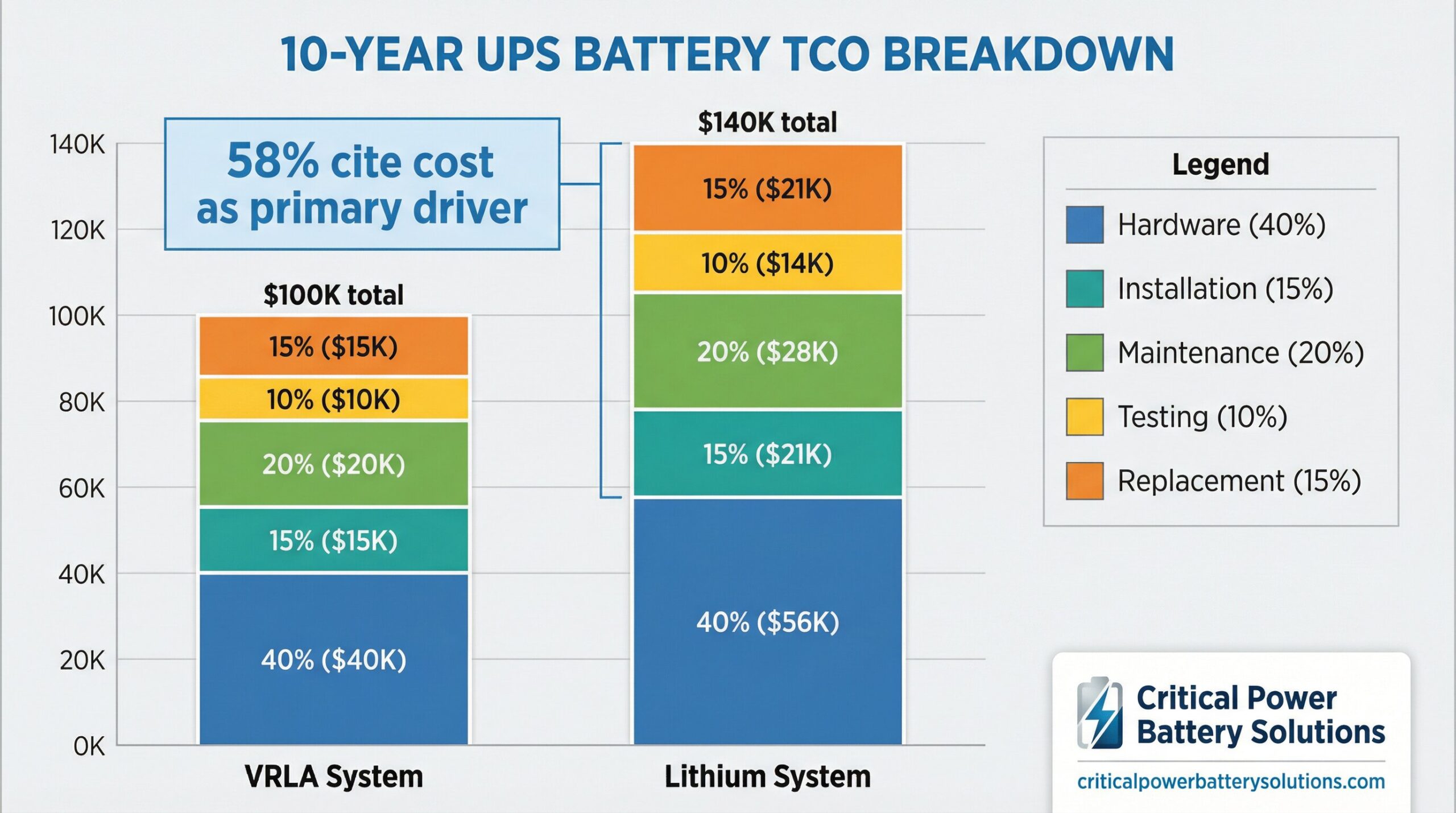
Cost remains the primary driver of battery technology changes for 58% of data center stakeholders, but sustainability has moved from a “nice to have” to a hard requirement—87% now call it a priority. Our experience mirrors this: RFPs increasingly require evidence of recyclability, lower embodied carbon, and responsible end-of-life programs alongside unit pricing and warranty terms.
From a TCO standpoint, we usually see three meaningful levers: extending usable life through better thermal control and testing, selecting batteries with proven multi-year float performance in similar environments, and planning refresh cycles that avoid emergency replacements. High-quality VRLA and valve-regulated systems with robust recycling programs still compare favorably against many lithium offers when you model full lifecycle cost, especially in markets with mature lead recycling infrastructure.

Integration, Monitoring, and Maintenance: Keeping 99.99% Uptime Realistic
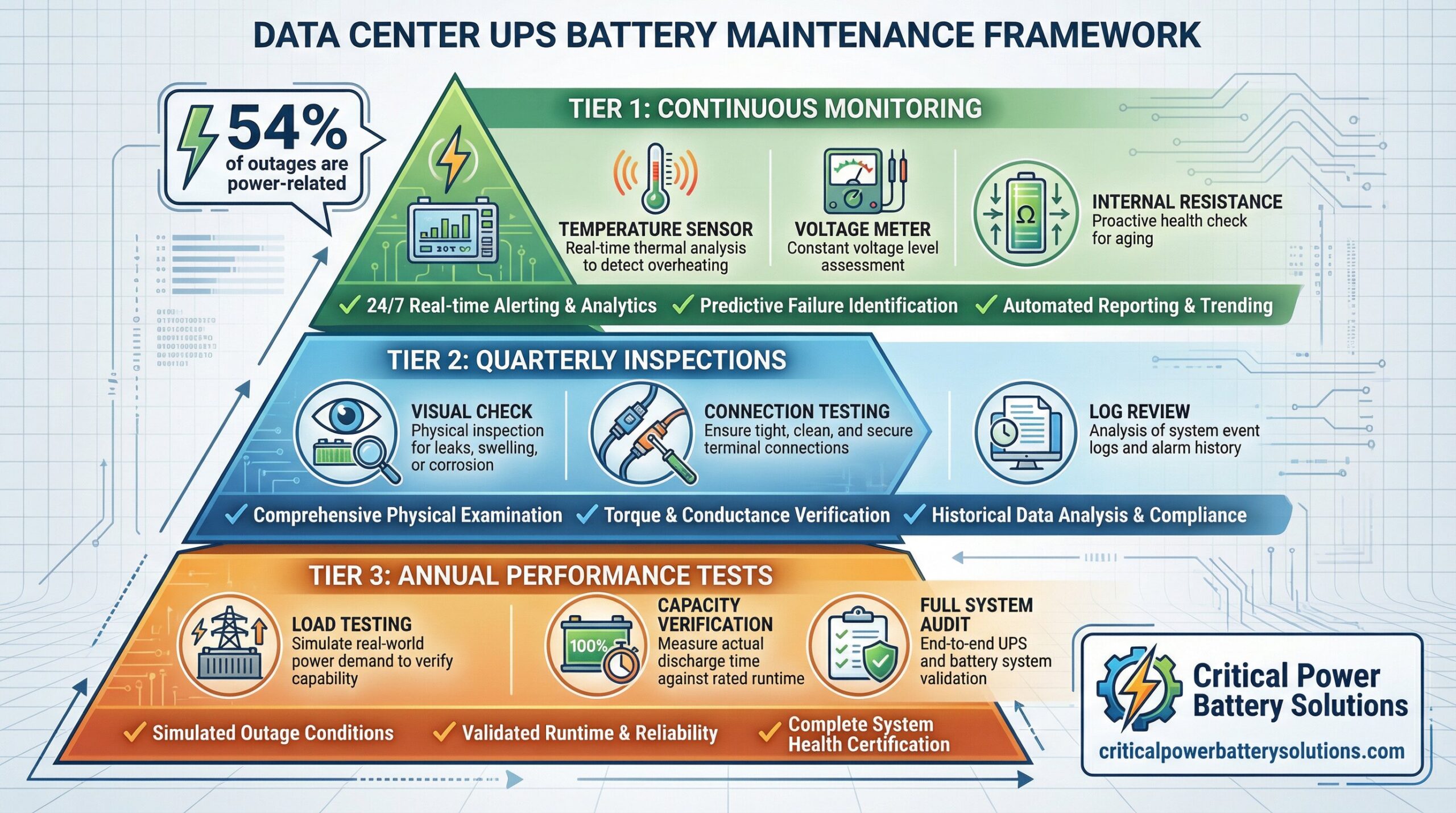
The best battery choice on paper will still fail if integration and maintenance are treated as afterthoughts. 54% of outages are power-related, and UPS batteries are often the weak link when monitoring is limited to periodic voltage checks. We recommend integrating block- or string-level monitoring where budget allows, combined with at least annual load testing and IR measurements.
For 2026 projects, we typically structure maintenance around three tiers: continuous monitoring (temperature, voltage, and where possible internal resistance), quarterly inspections, and annual performance tests under controlled load. This approach provides enough data to plan orderly replacements before risk profiles reach uncomfortable levels.
- Design phase: Confirm UPS compatibility, charging profiles, and monitoring interfaces.
- Commissioning: Document string configuration, perform acceptance testing, and baseline IR readings.
- Operations: Maintain a replacement roadmap based on measured degradation, not just nameplate life.
Example 2026 UPS Battery Architectures Using Stryten and Leoch
To make the decision process more concrete, we often share archetypal designs that have worked across multiple projects. For a medium-sized colocation hall, we may deploy centralized Stryten E‑Series Absolyte AGP strings for the primary UPS, combined with Leoch PLH front-terminal strings for distributed row-based backup of especially sensitive loads.
In another common pattern, enterprise sites with legacy VRLA rooms shift to Leoch XP12‑300 or XP12‑350 blocks for their next refresh, increasing capacity per string while maintaining compatibility with existing UPS frames. In both approaches, the emphasis is on modularity—adding or reconfiguring strings as the load profile changes over time rather than locking in a rigid architecture.
We strongly recommend documenting a “Phase 2” for any 2026 battery deployment—how easily can you add strings, migrate to a different chemistry, or segment loads if the IT footprint shifts?
How to Evaluate Vendors and Partners for a 2026 Battery Refresh
Vendor choice matters as much as product choice. We advise data center teams to prioritize partners who can provide engineering support, not just boxed batteries: runtime modeling, rack layout, conductor sizing, fault current analysis, and clear installation procedures. Our own practice includes warranty administration, worldwide logistics, and recycling coordination because those steps often make or break the project schedule.
When you evaluate proposals, look beyond per‑block pricing. Confirm experience with your exact UPS models, ask for site references with similar runtime and Tier requirements, and require clear documentation for maintenance plans and end-of-life handling. That level of due diligence tends to correlate strongly with successful, low-drama battery changeouts.
Conclusion
For data center directors and critical infrastructure engineers, the “best UPS battery solutions for 2026” are the ones that align clearly with your runtime philosophy, thermal reality, and long-term maintenance strategy. High-performance VRLA systems from Leoch and Stryten remain highly effective in most environments when engineered and maintained correctly, and they provide predictable behavior with existing UPS fleets.
As you plan your next refresh cycle, we recommend treating batteries as an engineered system rather than a consumable line item: define runtime requirements precisely, evaluate chemistries and architectures against TCO and sustainability goals, and choose partners who can support the full lifecycle. Done that way, your UPS batteries stop being an outage statistic and become a quiet, reliable part of your 99.99% uptime story.
AI-Era Data Center Battery Sourcing for India
India’s AI infrastructure buildout, GPU-dense colocation, AI training facilities, and high-density UPS retrofits, is creating outsized battery room demand.
Where CPBS engages on Indian AI / DC programs:
- Workload focus: AI training facilities, GPU-dense colocation, hyperscale UPS retrofits
- Geography: Bangalore, Hyderabad, Noida, Greater Mumbai, Chennai
- Operators: Sify, ESDS, NxtGen, Web Werks, plus AI-buildout operators
- Scope: Stryten Absolyte AGP for high-current discharge, Leoch HXP for compact footprint
Project-scale only, request engineering consultation for your AI data center program.
India FAQ
Q: Does CPBS support AI data center battery projects in India?
A: Yes, for project-scale AI infrastructure deployments. We provide Stryten Absolyte AGP and Leoch HXP specification, sizing, and sourcing for GPU-dense colocation and hyperscale AI facilities in Bangalore, Hyderabad, Noida, Greater Mumbai, and Chennai. Engagement is engineering consultation and project sourcing, not retail.