Leoch Battery Authorized Distributor: A Technical Guide to HXP & PLH Series for Critical Power
Executive Summary: Sizing and Selecting the Right Leoch Battery
As an authorized Leoch battery distributor in the USA, Critical Power Battery Solutions (CPBS) provides this technical guide to help you select between Leoch’s flagship product lines: the Leoch XP & HXP battery series for high-rate UPS applications and the Leoch PLH battery series for long-life telecom deployments. Both utilize Thin Plate Pure Lead (TPPL) technology, a significant advancement over standard VRLA designs.
For Data Center Directors, Network Infrastructure Managers, and Procurement specialists, selecting the correct battery is not just a line item, it’s the foundation of operational continuity. In a world demanding 99.999% uptime, where seconds of downtime can translate into millions in losses, the choice between these TPPL UPS battery options is critical. This guide provides the technical details needed to make an informed decision.
- Who This is For: Engineers and managers responsible for critical power infrastructure in data centers, telecom networks, and utilities.
- What You’ll Learn: The specific differences between Leoch’s high-rate UPS (XP & HXP) and telecom pure lead front terminal battery (PLH) series, including performance characteristics, application fit, and compliance details.
- Why CPBS: As an Authorized Leoch Distributor and a division of ATS, we provide more than just products. We offer 30+ years of critical power expertise, application engineering, and an ISO 9001-certified process to ensure you get the right solution, every time. Due to high demand and potential supply chain constraints, we recommend planning your procurement cycle in advance to avoid extended lead times.


The Market Mandate: Why Your Leoch Battery Choice Matters More Than Ever
The demand for reliable power is accelerating. The global data center battery market is projected to grow from $3.6 billion in 2025 to $6.1 billion by 2035. This growth is driven by the relentless expansion of hyperscale data centers and cloud services. Simultaneously, the telecom industry is under an FCC mandate to ensure 24-hour backup power to maintain 911 service availability during outages.
But here’s what the market projections don’t tell you: UPS battery failure remains the #1 cause of data center downtime. According to industry research, batteries account for 27% of all UPS system failures over equipment life. When those failures happen, the costs are staggering—over half of significant outages now cost more than $100,000, with many exceeding $1 million.
These trends create immense pressure on infrastructure. Your battery system is the last line of defense against outages, making your selection and sizing process a critical business function, not just a procurement exercise.
Tom’s Take: Lessons from the Field
“In my 30+ years in the DC power industry, including my time as a director at Stryten and GNB, I’ve seen firsthand how catastrophic battery failure can be. A common mistake is focusing solely on the initial cost per battery instead of the total cost of ownership and, more importantly, the cost of failure. For a data center, a single outage can cost millions. For a telecom provider, it can mean violating federal mandates. We’re not just selling batteries; we’re engineering reliability.”
Technology Deep-Dive: The Thin Plate Pure Lead (TPPL) Advantage
Both the Leoch HXP and PLH series utilize Thin Plate Pure Lead (TPPL) technology, a significant advancement over standard VRLA/AGM batteries. Understanding why this matters requires looking beyond marketing claims to the actual electrochemistry.
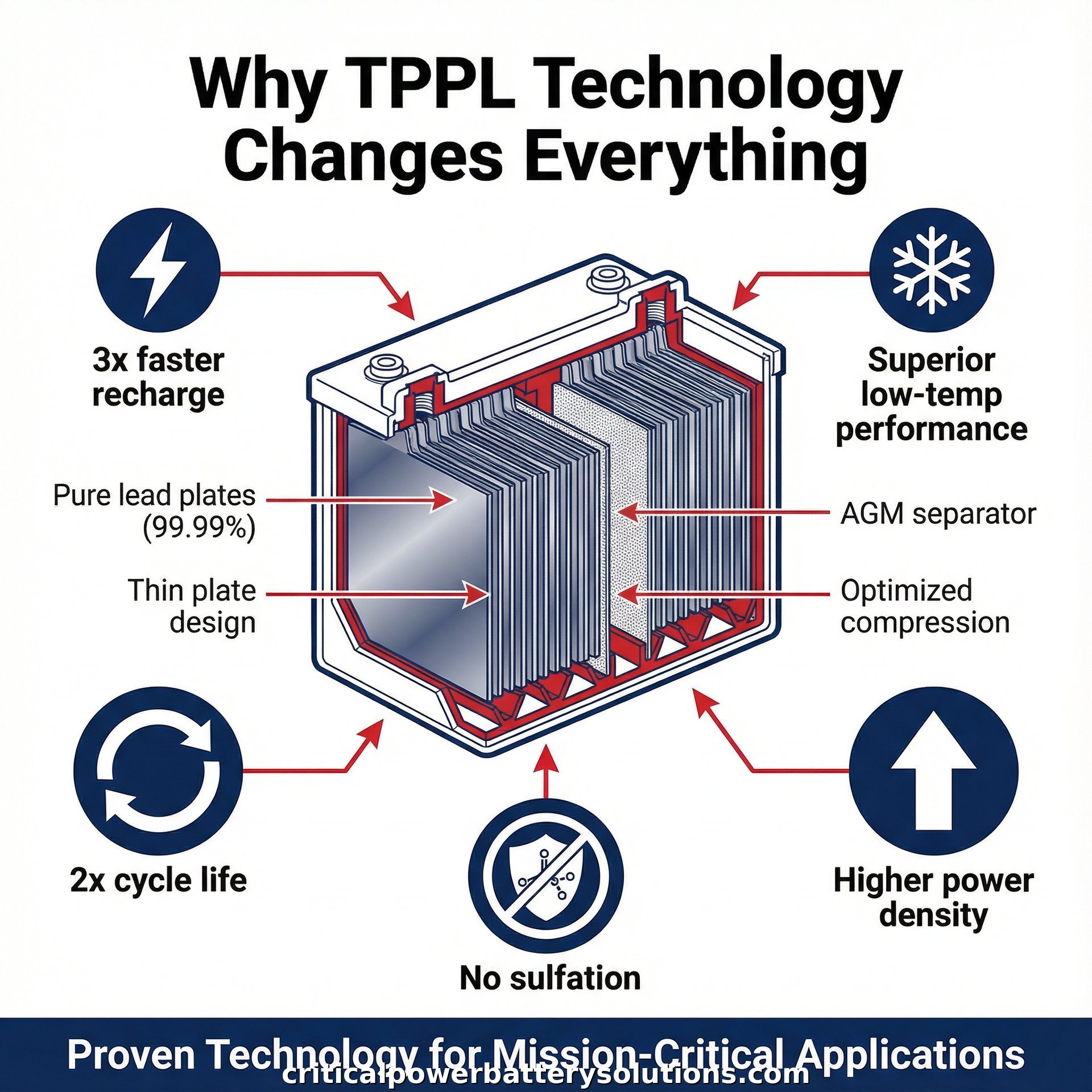
Why Pure Lead Changes Everything
Traditional AGM batteries use lead-calcium or lead-antimony alloys for their plates. TPPL batteries use 99.99% pure lead, and that difference in purity fundamentally changes how the battery performs and ages.
- Higher Energy Density: TPPL plates are up to 20% thinner than conventional designs, allowing for approximately 3x more plates within the same physical footprint. This increases the active surface area dramatically, delivering more power from a smaller battery. In practical terms, this means you can achieve equivalent runtime with fewer batteries, freeing valuable floor space in facilities where every square foot matters.
- Faster Recharge: The increased surface area and lower internal resistance allow TPPL batteries to accept a charge up to 4x faster than conventional AGM. While standard batteries might need 8–12 hours to reach full charge, TPPL can achieve 80% state of charge in approximately one hour with appropriately sized chargers. For facilities experiencing multiple grid events, this rapid recovery is critical—your batteries are ready for the next outage, not still recovering from the last one.
- Longer Life: The pure lead construction resists corrosion and sulfation far better than alloyed alternatives. Grid corrosion is the primary failure mechanism in conventional batteries, and pure lead grids corrode much more slowly in the sulfuric acid environment. This translates to a significantly longer design life (15–20 years) compared to standard AGM batteries (3–5 years). Over a 20-year facility lifecycle, that’s the difference between one battery replacement and four.
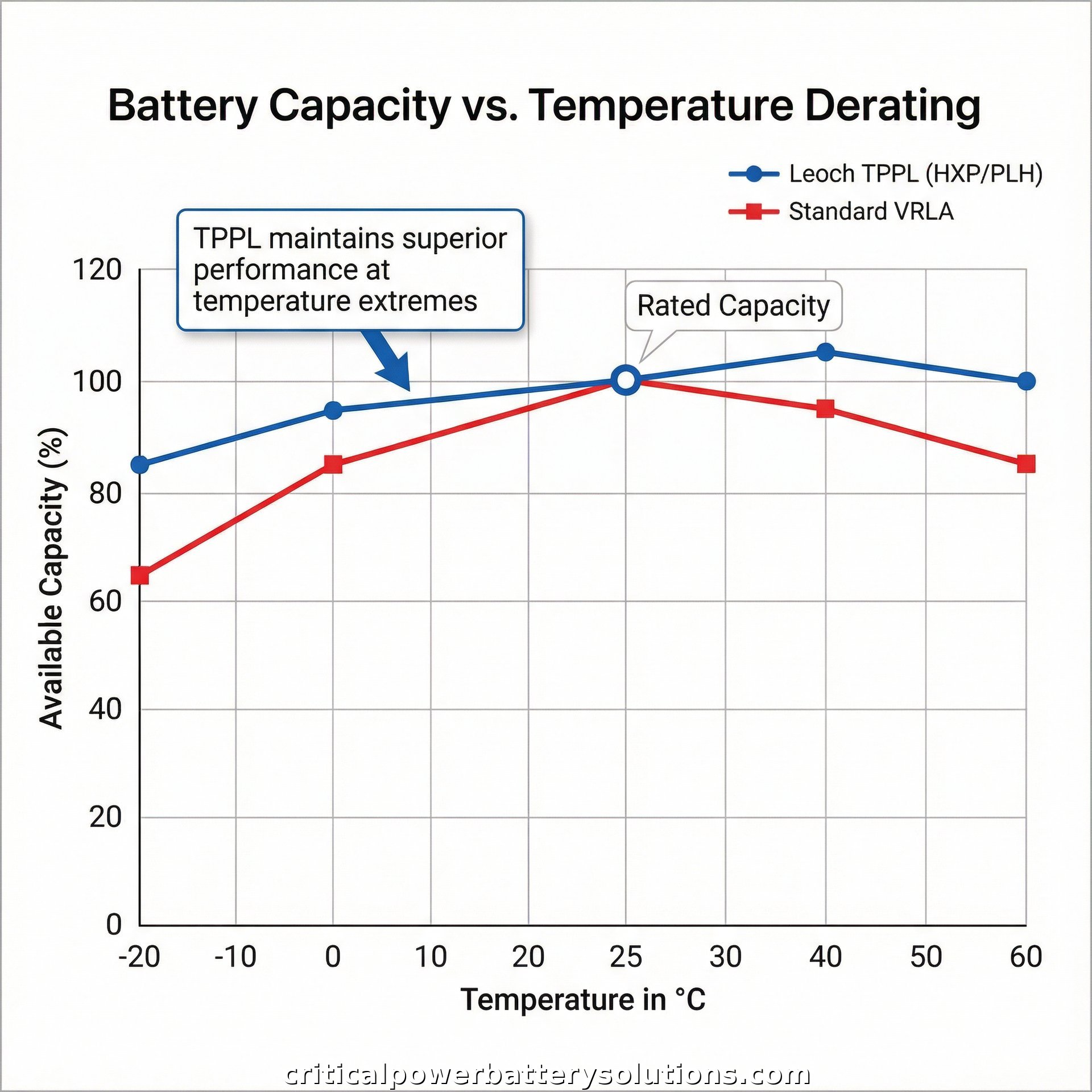
- Wider Temperature Range: TPPL chemistry is more stable in extreme temperatures, making it ideal for challenging environments like remote telecom shelters. The PLH series operates from -40°F to 149°F (-40°C to 65°C), a range that covers everything from an Arizona desert cell tower to an Alaska pipeline station.
Simplified TCO Comparison: Advanced Lead-Acid vs. Lithium-Ion
While Lithium-Ion has a higher initial cost, its longer cycle life can make TCO competitive for certain applications. However, for many standby UPS and telecom applications, advanced lead-acid batteries like Leoch’s TPPL series offer a compelling TCO advantage, especially when factoring in the established and efficient recycling infrastructure for lead.
A 20-year analysis for a 1MWh UPS system showed that advanced lead-acid batteries could provide a lifetime TCO savings of over $264,000 compared to lithium-ion, largely driven by the value of recycled lead at end-of-life.
There’s another factor that doesn’t show up in TCO spreadsheets: fire safety compliance. NFPA 855 limits lithium-ion installations to 600 kWh per fire area and requires 2-hour rated fire barriers. Lead-acid batteries face no such capacity limits—a significant advantage for high-density deployments where fire suppression upgrades could add $50,000–200,000 to project costs.
And then there’s the sustainability story: lead-acid batteries have a 99% recycling rate, the highest of any consumer product in the US. Typical new lead batteries contain 80% recycled content. That’s a mature, proven circular economy that lithium-ion is still decades away from matching.
Tom’s Take: The Temperature Trap
“Here’s something I wish more facility managers understood: every 8–10°C increase above 25°C cuts your battery life roughly in half. I’ve walked into battery rooms where the HVAC was ‘temporarily’ turned off to save energy costs, and found batteries that should have lasted 10 years failing in three. A 5-year rated battery running consistently at 35°C might last only 18 months. When I’m specifying a system, ambient temperature isn’t a footnote—it’s one of the first questions I ask. If you can’t maintain 77°F (25°C) in your battery room, we need to account for that in the sizing, or you’re going to be replacing batteries far sooner than planned.”
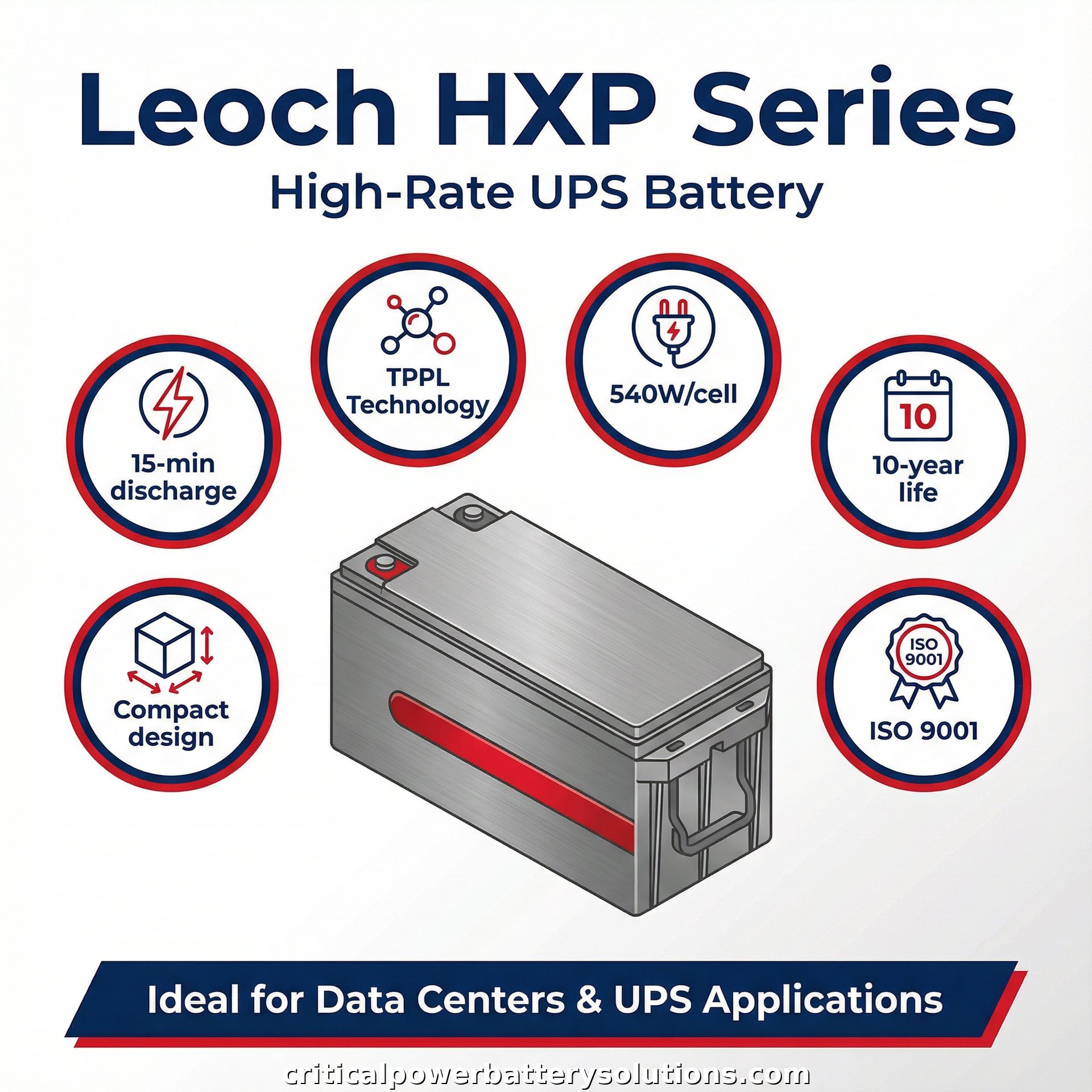
Leoch HXP Battery Series: High-Rate Performance for UPS & Data Centers
The Leoch HXP battery is engineered for short-duration, high-power discharge, making it the ideal TPPL UPS battery choice for data centers and other mission-critical facilities.
- Primary Application: Data Center UPS, Enterprise IT, Healthcare Imaging
- Key Feature: Optimized for maximum power delivery in 5 to 15-minute runtimes
- Design Life: Up to 15 years
When the HXP Series Makes Sense
The Leoch HXP battery is purpose-built for the data center mission profile: deliver massive amounts of power for a short period while generators start and stabilize. Think of it as a sprinter rather than a marathon runner. The engineering prioritizes watts-per-cell at the 15-minute rate—the metric that matters when you need to bridge from utility power to generator.
The fire-resistant PC-ABS container (UL94 V-0 rated) addresses a common concern for facilities managers: what happens if something goes wrong? This material is self-extinguishing, which is exactly what you want in a battery room adjacent to your production floor.
Leoch PLH Battery Series: Long-Life Telecom Pure Lead Front Terminal Battery
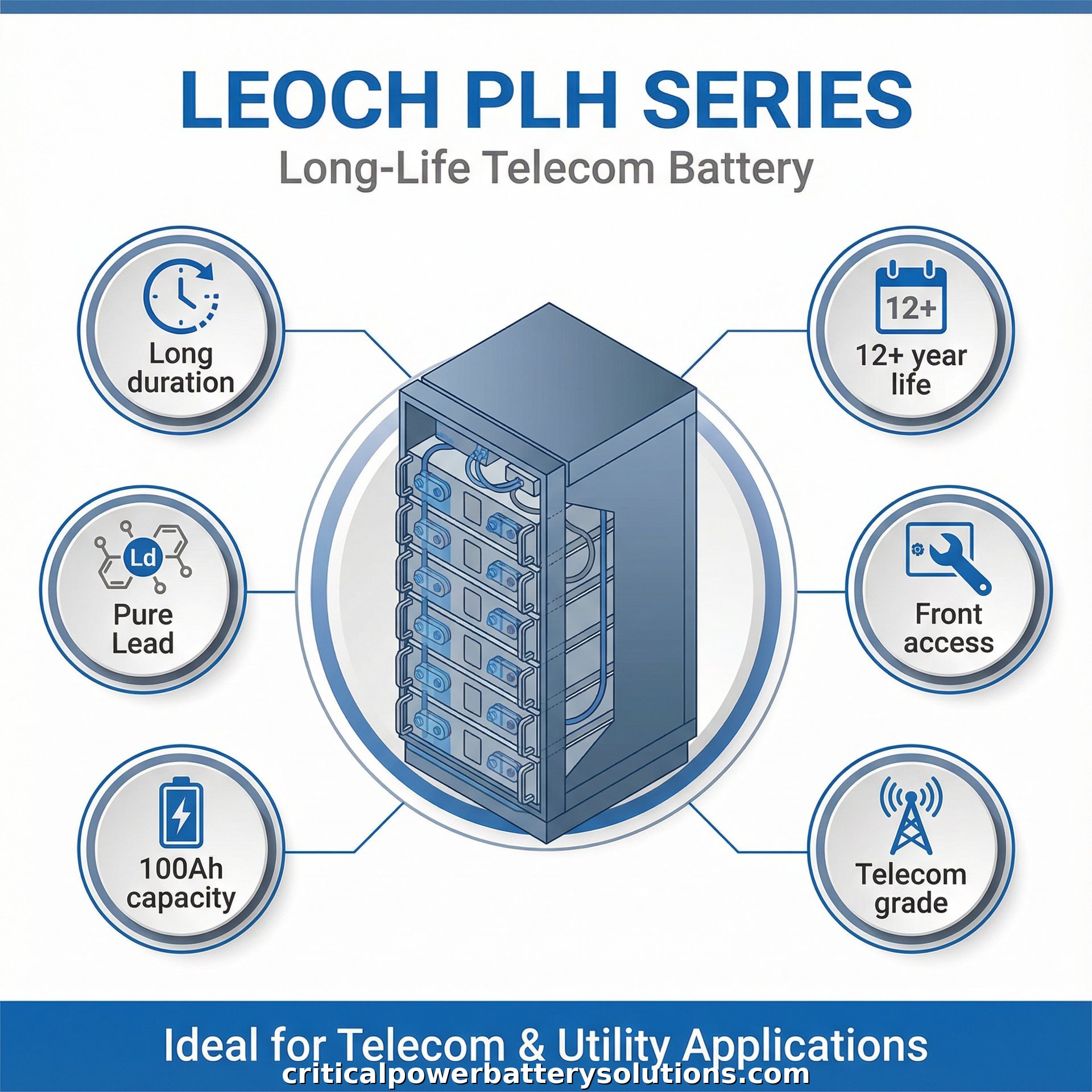
The Leoch PLH battery series is designed for long-life standby applications, with a focus on reliability and serviceability in demanding telecom and utility environments. As a telecom pure lead front terminal battery, the PLH series addresses the unique challenges of remote site deployment.
- Primary Application: Telecom BTS, Central Offices, Utility Switchgear
- Key Feature: Front-terminal design for easy installation and maintenance in dense racks
- Design Life: Up to 20 years
When the PLH Series Makes Sense
The Leoch PLH series addresses a different challenge: how do you keep power flowing to remote sites that might only see a technician once or twice a year? The 20-year design life means fewer truck rolls to remote locations. The front-terminal design means that when a tech does show up, they can perform torque checks and voltage readings without dismantling the entire rack—a job that takes 15 minutes instead of an hour.
The NEBS compliance (GR-4228 and Verizon TPR-9802) isn’t just a checkbox for procurement—it’s verification that these batteries have been tested to the rigorous standards that telecom central offices require. That includes seismic testing, thermal shock, and the kind of environmental extremes that would destroy lesser batteries.
Tom’s Take: Matching the Battery to the Mission
“A telecom site in a remote desert location has vastly different needs than a climate-controlled data center. For the telecom site, the PLH series’ wide temperature range and 20-year design life are non-negotiable. The front-terminal design is also a huge win for technicians servicing crowded cabinets. For the data center, it’s all about predictable, high-power discharge to ride through a utility flicker or transfer to a generator. That’s where the HXP series shines. Using the wrong battery is a recipe for premature failure.”
Leoch HXP vs PLH: How to Choose the Right Battery for Your Application
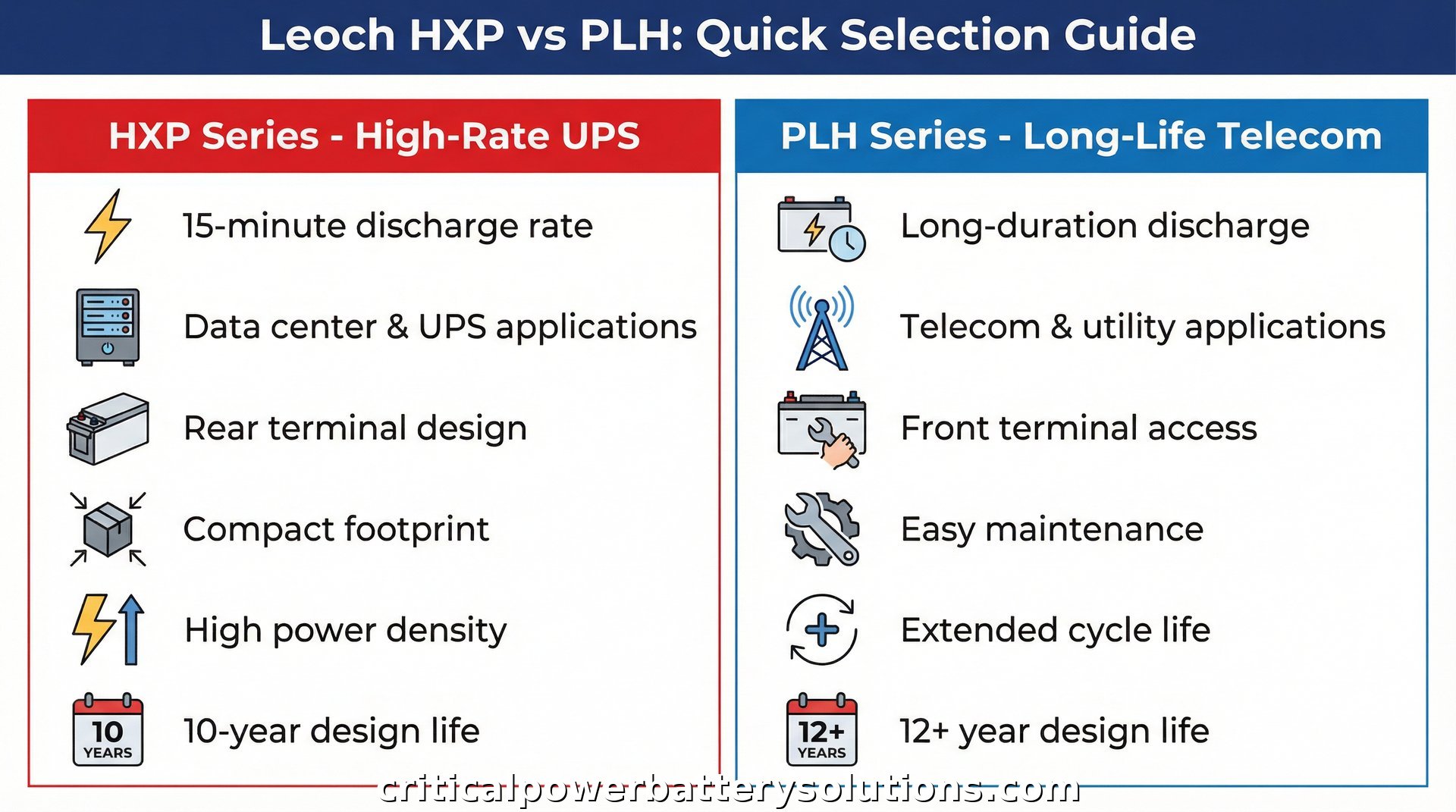
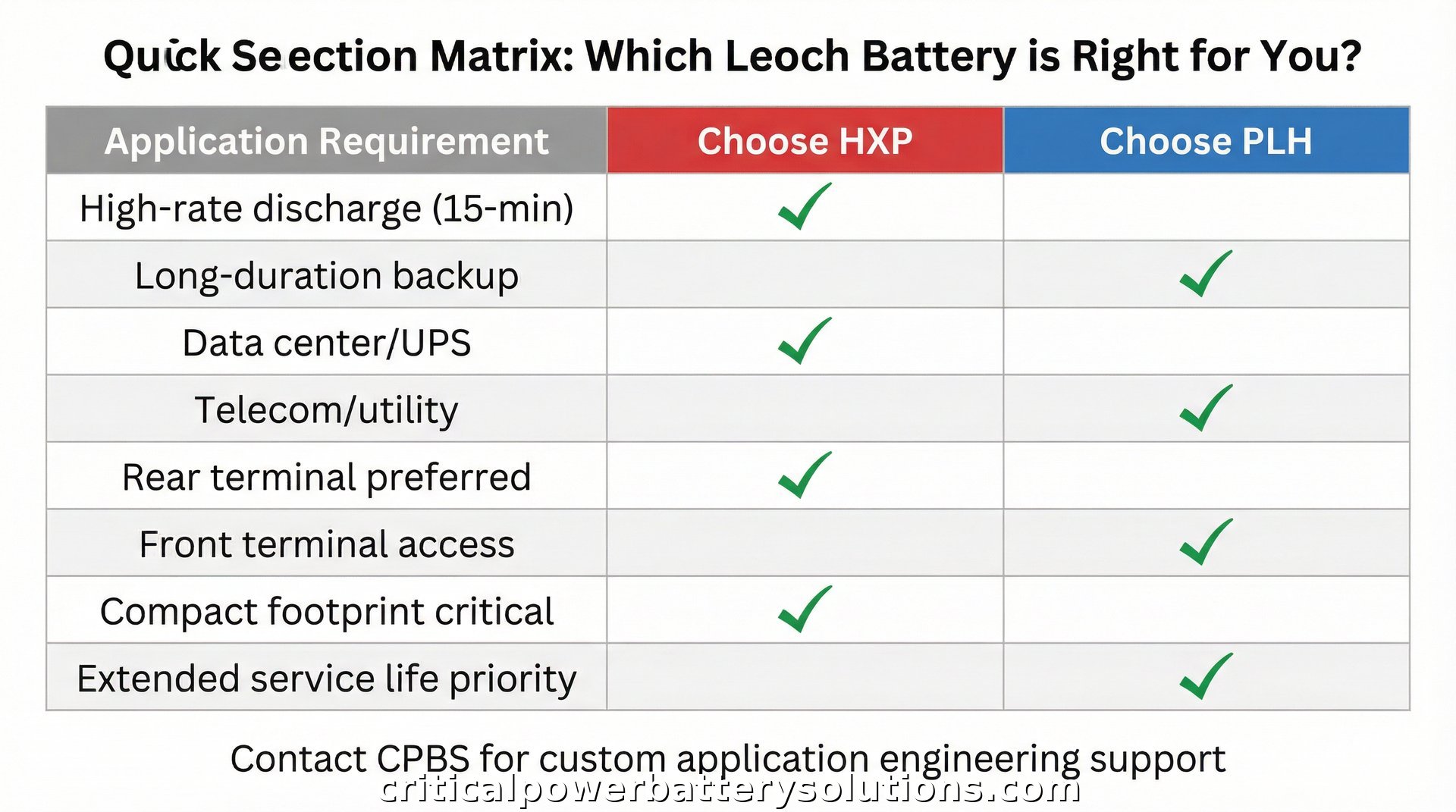
Selecting between the Leoch HXP and PLH series comes down to understanding your application’s primary demands. Here’s a decision framework based on real-world requirements:
Choose Leoch HXP When:
- Your primary need is high-rate discharge for short durations (5–15 minutes)
- You’re powering UPS systems in climate-controlled environments
- Maximum watts-per-cell matters more than extended standby life
- Your facility has regular maintenance access and controlled temperatures
- You need to bridge to generator during utility outages
Typical HXP Applications: Data center UPS, hospital imaging systems, financial trading floors, broadcast facilities, industrial process control
Choose Leoch PLH When:
- Your primary need is long-term reliability with minimal maintenance
- You’re deploying in remote or harsh environments with temperature extremes
- Front-terminal access is required for dense rack configurations
- You need NEBS compliance for telecom central office deployment
- 20-year design life reduces lifecycle costs and truck rolls
Typical PLH Applications: Telecom base stations, central offices, utility substations, remote pipeline monitoring, railroad signaling systems
System-Level Thinking: Beyond the Battery Spec Sheet
Selecting the right battery model is only the beginning. The real engineering happens at the system level, and this is where I’ve seen well-intentioned projects go sideways.
Temperature Derating: The Math That Matters
IEEE 485 provides correction factors for temperature, and ignoring them is one of the most expensive mistakes you can make. If your battery room runs at 60°F instead of 77°F, you need 11% more battery capacity to deliver the same runtime. Ignore this, and you’ll discover the shortfall at the worst possible moment.
String Sizing: When More Isn’t Better
There’s a temptation to solve capacity problems by adding parallel strings. But IEEE guidelines recommend limiting parallel strings to a maximum of four for charge balance considerations. Why? Because strings don’t share load equally—minor differences in internal resistance cause unequal current distribution. One string works harder, ages faster, and eventually becomes the weak link that brings down the system.
A single string of larger-capacity batteries is typically more cost-effective and reliable than multiple parallel strings of smaller batteries. Each additional parallel string also requires independent fusing and battery circuit breakers for isolation during maintenance or fault conditions, adding complexity and potential failure points.
Charge Profile Compatibility: The Silent Killer
Your existing rectifier or UPS charger was designed for a specific battery chemistry. Before specifying any battery replacement, we verify charge profile compatibility. Excessive ripple causes internal heating and accelerated degradation. I’ve seen batteries fail in 18 months because the charger was producing ripple current that would have been acceptable for flooded cells but slowly cooked the AGM.
The 5-Minute Runtime Trap
Many data centers select runtimes of 5 minutes or less, thinking this is sufficient to bridge to generator. Here’s the problem: if your generator fails to start on the first attempt (which happens more often than anyone wants to admit), five minutes isn’t enough time to diagnose and correct the problem, let alone bring a backup generator online.
Your battery runtime should exceed generator startup time plus a reasonable safety margin for troubleshooting. Most facilities should be targeting 10–15 minutes minimum, and those without redundant generators should consider longer.
Why CPBS is Your Ideal Leoch Battery Distributor
Choosing the right battery is critical. Choosing the right distributor is equally important. Here’s what sets Critical Power Battery Solutions apart:
What “Authorized Leoch Distributor” Really Means
As an authorized Leoch battery distributor, CPBS provides direct factory support, warranty backing, and access to the full product line. You’re not buying from a reseller who stocks a few models—you’re working with a partner who can source any Leoch battery configuration and provide factory-level technical support.
The ATS Heritage: 30+ Years of Critical Power Expertise
CPBS is a division of ATS (Advanced Technical Services), a company with over 30 years of experience in critical power infrastructure. This isn’t a side business—it’s our core competency. Our team includes former engineers from Stryten, GNB, and other major battery manufacturers who understand the technology at a fundamental level.
Application Engineering, Not Just Order-Taking
When you contact CPBS, you’re not talking to a sales rep reading from a spec sheet. You’re working with application engineers who will ask about your load profile, ambient temperature, runtime requirements, and existing infrastructure before recommending a solution. We’ve sized battery systems for everything from small telecom shelters to multi-megawatt data centers, and we bring that experience to every project.
Sizing & Selection Methodology: The CPBS Process
Our ISO 9001-certified process ensures nothing falls through the cracks:
- Load Analysis: We start with your actual load profile, not nameplate ratings
- Environmental Assessment: Temperature, altitude, and seismic requirements
- Runtime Calculation: IEEE 485 methodology with appropriate safety factors
- Charger Compatibility: Verification of float voltage, temperature compensation, and ripple limits
- Lifecycle Cost Analysis: TCO comparison including replacement cycles and disposal
- Documentation: Complete submittal package for your approval and records
Take the Next Step
Whether you’re specifying a new installation or replacing an aging battery system, Critical Power Battery Solutions is ready to help you navigate the selection process. As an authorized Leoch battery distributor with decades of critical power experience, we bring technical expertise that goes far beyond product sales.
Contact CPBS today to discuss your Leoch HXP or PLH battery requirements.
Visit us at criticalpowerbatterysolutions.com or call our application engineering team to start your project.